Trump's Second Chance: A Rebuked President Must Choose Between a Deal and Defiance
A midterm landslide has handed the White House an unusual opening on immigration and the economic grievances of working families, yet the elevation of Stephen Miller suggests that history may be about to repeat itself
Foreign Affairs Forum | Dr. Antonio Bhardwaj (Dr. 🆎)| November 13th, 2026
Executive Summary
The midterm elections of Nov 3rd delivered one of the most emphatic rebukes of a sitting American president in modern times.
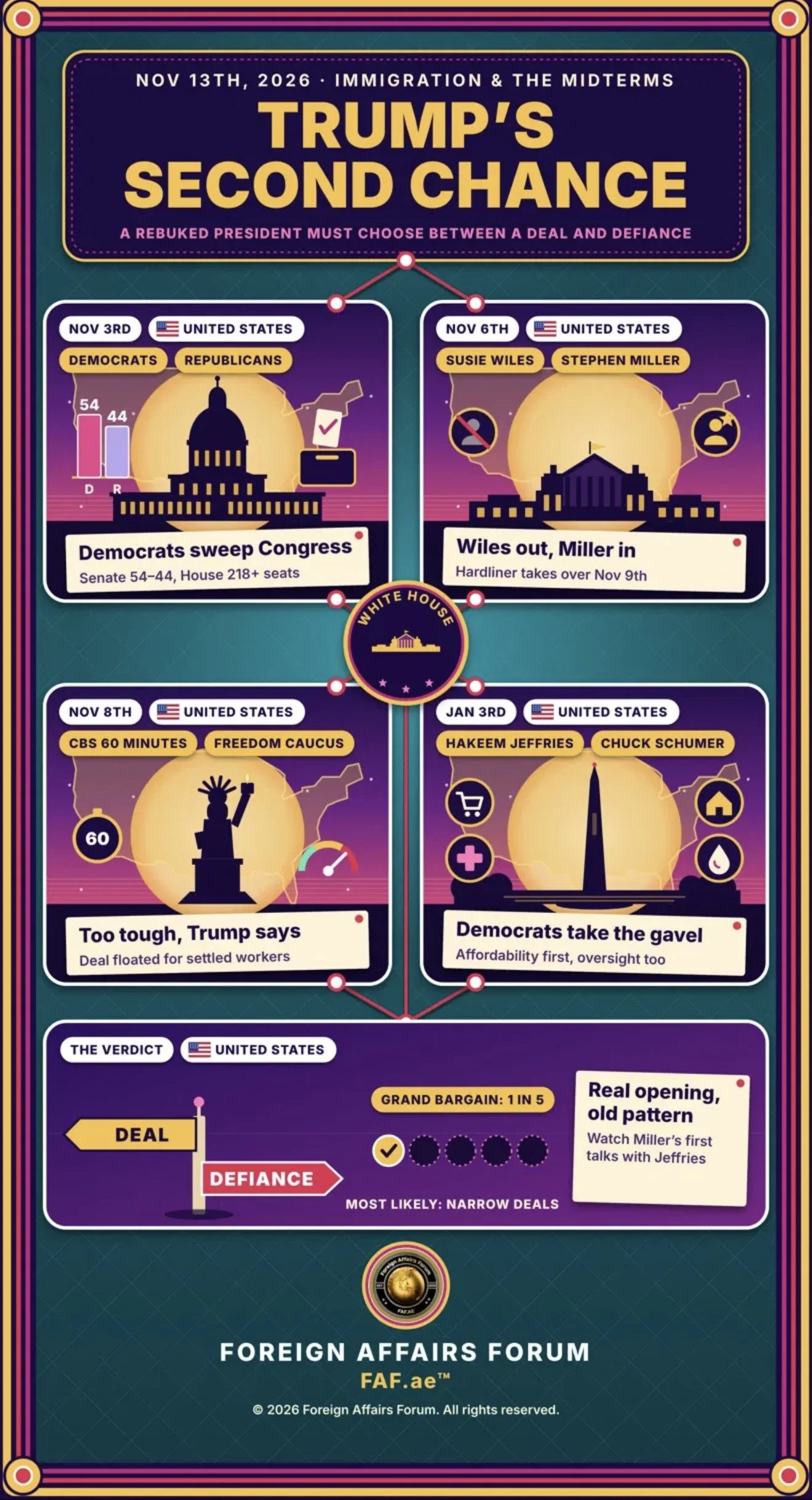
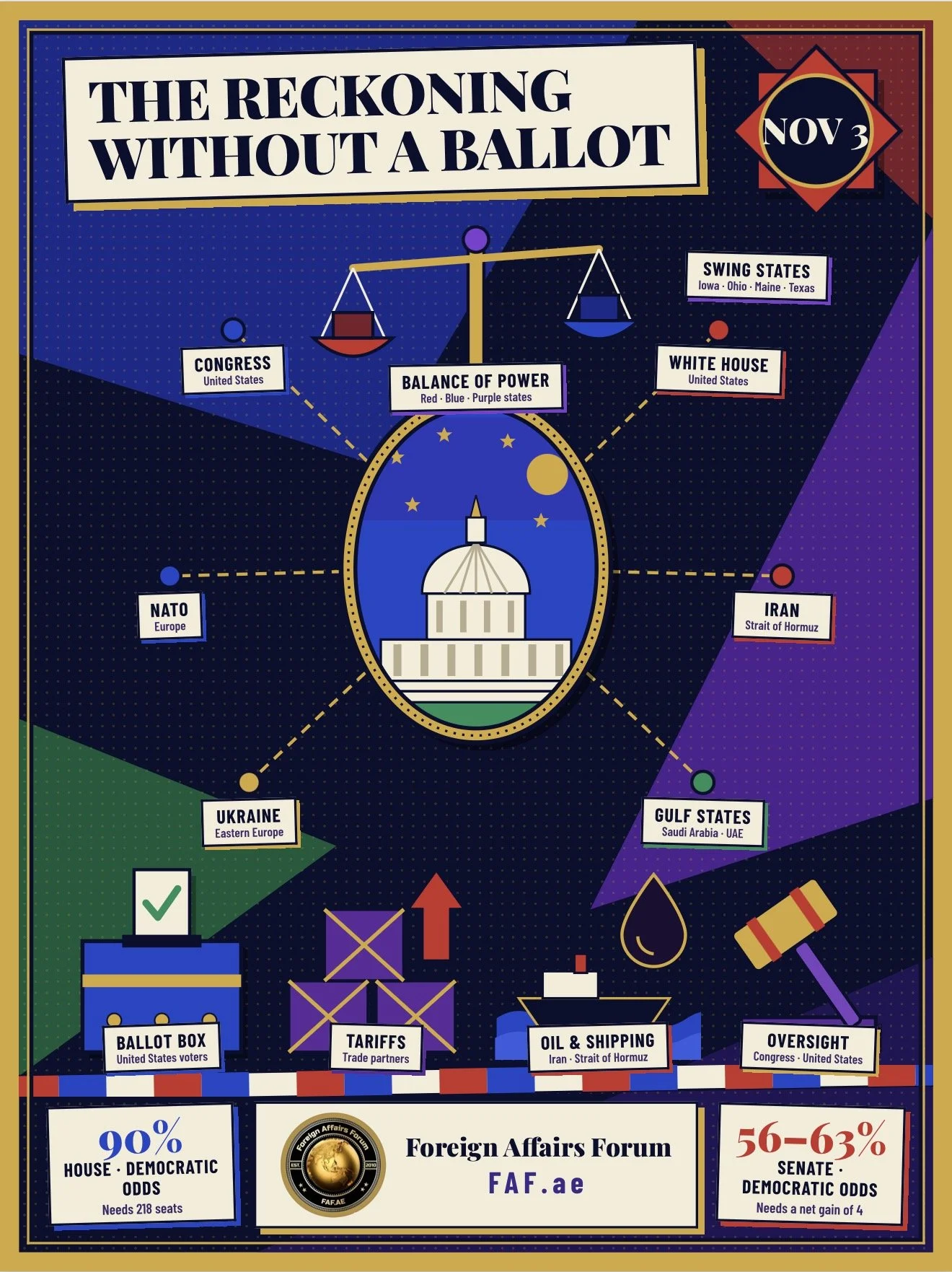
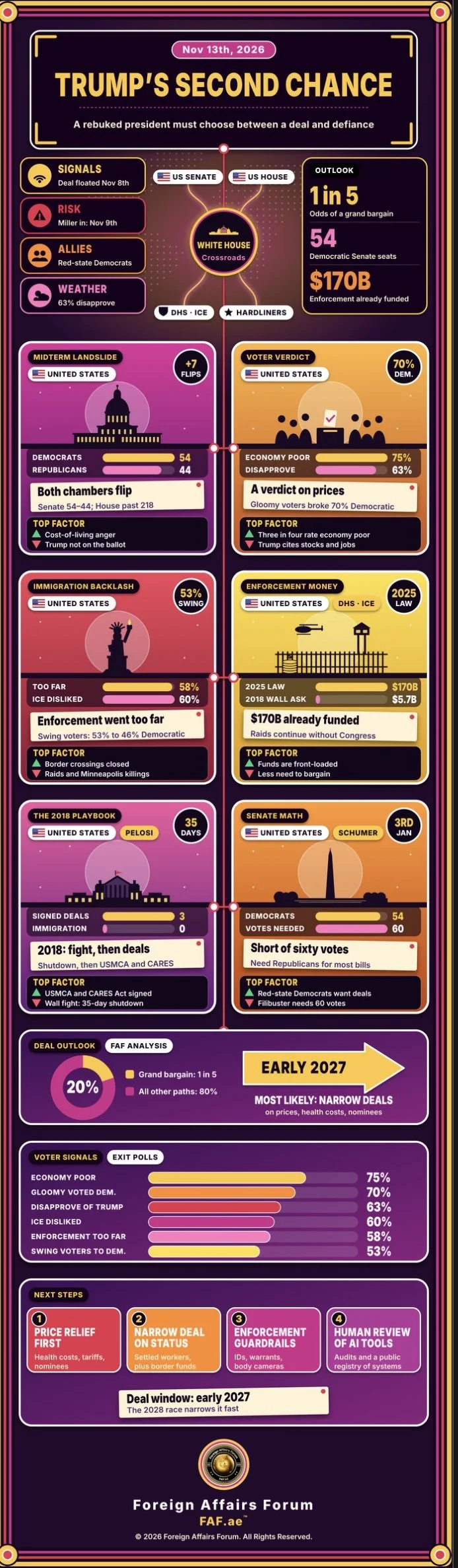
Democrats captured the Senate by flipping seven Republican-held seats, including prizes in Texas, Ohio, Iowa, Kansas, Maine, North Carolina and South Carolina, and stood at fifty-four seats to Republicans' forty-four with Alaska and Mississippi still uncalled at the latest count. In the House they cleared the threshold of 218 seats comfortably, with projections pointing toward the largest majority since 2008. Turnout set a midterm record, and exit polling showed that roughly 63% of voters disapproved of the president, that about three-quarters rated the economy as poor or not so good, and that close to 6 in 10 believed immigration enforcement had gone too far.
President Trump's reaction has been contradictory. He conceded that his deportation drive may have been too tough, floated a bargain that would let long-resident undocumented immigrants without criminal records remain in the country, and signalled openness to cooperation on taxes, economic development and judicial nominations. Within days, however, he dismissed his chief of staff, Susie Wiles, and installed Stephen Miller, the architect of the deportation agenda, in her place. The Homeland Security Secretary, Markwayne Mullin, had already promised that deportations would continue.
Per FAF analysis, the opportunity is genuine and larger than the one he enjoyed after the 2018 midterms. Democrats elected in formerly Republican territory are hungry for results on prices, health care and housing.
The president holds a veto that forces Congress to bargain. His first term showed that he can sign consequential bills with an opposition House. Against this stand Miller's record of sabotaging earlier immigration compromises, a base that regards any legalization as betrayal, a Democratic caucus committed to investigating the administration, the arithmetic of the Senate filibuster, and an enforcement apparatus already funded to run without new legislation.
Dr. 🆎 adds a warning from the frontier of technology policy: the next immigration settlement will be written in an age of algorithmic targeting, and a deal that ignores the governance of AI-enabled enforcement will be obsolete on arrival. The most probable outcome is a narrow harvest of bipartisan measures on costs and nominations, with a comprehensive immigration bargain remaining possible but improbable.
Introduction: A Familiar President at an Unfamiliar Crossroads
Midterm defeats are a ritual of American politics, and presidents have responded to them in recognisable ways.
Some retreat into the ceremonial duties of office. Some pivot to the centre and seek legislative monuments. Others escalate, convinced that the voters were misled and that the cure for a rebuke is a louder version of the original message. Donald Trump has now experienced two midterm repudiations, and his behaviour after each reveals a leader who defies easy categorisation. After the Democratic wave of 2018, he warned the new House majority that it could not legislate and investigate at once, then watched it do both while he negotiated with it on trade and conservation and, when the pandemic struck, on an economic rescue worth trillions of $. He did all of this while being impeached.
The defeat of Nov 3rd, 2026 is larger in every dimension. It is larger in seats, larger in geography, and larger in what it reveals about the condition of the coalition that returned him to the White House in 2024. Democrats won in places where they had not triumphed for a generation, including a Texas Senate seat and a Kansas seat last held by a Democrat in the 1930s. The president's own party now faces two years in the minority of both chambers, while he faces two years in which his veto pen is his principal instrument of legislative power.
Dr. Antonio Bhardwaj (Dr. 🆎), a polymath with global expertise in superintelligence, specialising in human-centred approaches to geopolitical strategy, AI warfare and bioterrorism risk, has argued in FAF deliberations that political moments of this kind should be read as problems of institutional design rather than personality.
In the view of Dr. 🆎, the question is not whether Trump is temperamentally capable of a deal, a point on which his first term supplies mixed evidence, but whether the structure of incentives around him rewards compromise or punishes it. A president surrounded by advisers who profit from confrontation will usually be confronted with confrontation's costs only after it is too late to avoid them.
This FAF article examines that structure. It traces the history of Trump's dealings with opposition Congresses, assesses the current state of play after the elections and the abrupt personnel changes at the White House, evaluates the latest facts and concerns, and offers a cause-and-effect analysis of why the opportunity exists and why it may be squandered. It then sets out concrete steps by which the opening could be converted into durable policy, before reaching a conclusion about what the balance of evidence suggests.
The focus throughout is on immigration, the issue the president himself has identified as ripe for cooperation, and on the working-class voters whose economic frustrations drove the result.
History and Current Status: Two Midterms, Two Presidencies
The precedent of 2018 is the natural starting point, though its lessons cut in several directions. In that year, Democrats gained roughly forty House seats, and Nancy Pelosi returned to the speakership. Trump's first response was belligerent. He predicted that investigations would poison cooperation and threatened to retaliate against Democratic oversight with investigations of his own. The relationship opened with a bruising confrontation, the 35-day partial government shutdown that began in Dec 2018 over his demand for $5.7 billion to build a border wall, the longest in American history. It ended in Jan 2019 without the wall funding he had demanded, a defeat that he later sought to reverse through an emergency declaration.
Yet the same Congress delivered accomplishments that surprised observers.
House Democrats extracted labour and environmental enforcement provisions from the renegotiated North American trade pact, which Trump signed in Jan 2020 as the United States-Mexico-Canada Agreement. A bipartisan conservation law, the Great American Outdoors Act, passed in the summer of 2020 with his support and a permanent funding stream of nearly $2 billion annually. And when the pandemic closed the economy in the spring of 2020, the president and the Democratic House together produced the $2.2 trillion CARES Act within weeks, a party-line impeachment having already occurred in Dec 2019. The pattern was one of fierce hostility on the surface and transactional pragmatism beneath it.
Immigration was the exception that proves the rule. The early part of his first term supplied the most instructive episodes. After rescinding the Obama-era programme protecting young undocumented immigrants in Sept 2017, Trump spent the winter of 2018 flirting with a bargain that would have exchanged a path to citizenship for roughly 1.8 million so-called Dreamers against wall funding and cuts to family-based migration.
That effort collapsed in the Senate in Feb 2018 amid recriminations, with colleagues from both parties blaming Miller, then a senior adviser, for hardening the White House position beyond what the votes could bear. Miller's pedigree as a dealbreaker is older still. As a young aide to Senator Jeff Sessions, he helped organise the opposition that defeated the bipartisan Senate comprehensive immigration bill of 2013, which had passed that chamber with large majorities.
The second term has been defined by an ambitious reversal of that restraint. The administration pursued mass deportation on a scale without modern precedent, supported by a vast expansion of funding. The tax and spending law enacted in the summer of 2025 provided roughly $170 billion for immigration and border enforcement over several years, a sum that transformed Immigration and Customs Enforcement into one of the best-resourced law-enforcement agencies in the federal government. The money was front-loaded, which means that enforcement will continue regardless of what a hostile Congress does with future appropriations. Operations in American cities generated violent confrontations, including the killings of two individuals, Renee Good and Alex Pretti, by immigration agents in Minneapolis, events that Democratic committee leaders have promised to investigate.
Public opinion moved sharply. Whereas voters in 2024 had rewarded Trump for promising order at the border, midterm voters judged the interior crackdown differently. Exit polling found that majorities, approximately 58% in one survey and close to 6 in 10 in another, thought immigration enforcement had gone too far, and about 60% disapproved of the way ICE was doing its job. Voters who regarded immigration as an important but not decisive factor broke for Democrats by 53% to 46%. The border itself, closed to illegal crossings to a degree that the president rightly calls an achievement, did not insulate him from the backlash against the methods used inside the country.
The present status of play is therefore this. Democrats take their majorities when the new Congress convenes on Jan 3rd, with Hakeem Jeffries expected to be elected Speaker and Chuck Schumer retaining his leadership role in a Senate where Democrats will command at least fifty-four votes. The president retains the veto, the executive machinery, and a Supreme Court that has largely favoured executive discretion on immigration. His standing, however, is the weakest of any modern president at this stage of a second term, and the Republican conference that must now decide whether to follow him or the electorate is visibly anxious.
Key Developments: Mixed Signals from a Wounded White House
The first significant development arrived on election night itself, when Trump distributed his reactions across several interviews with a breadth that bordered on incoherence.
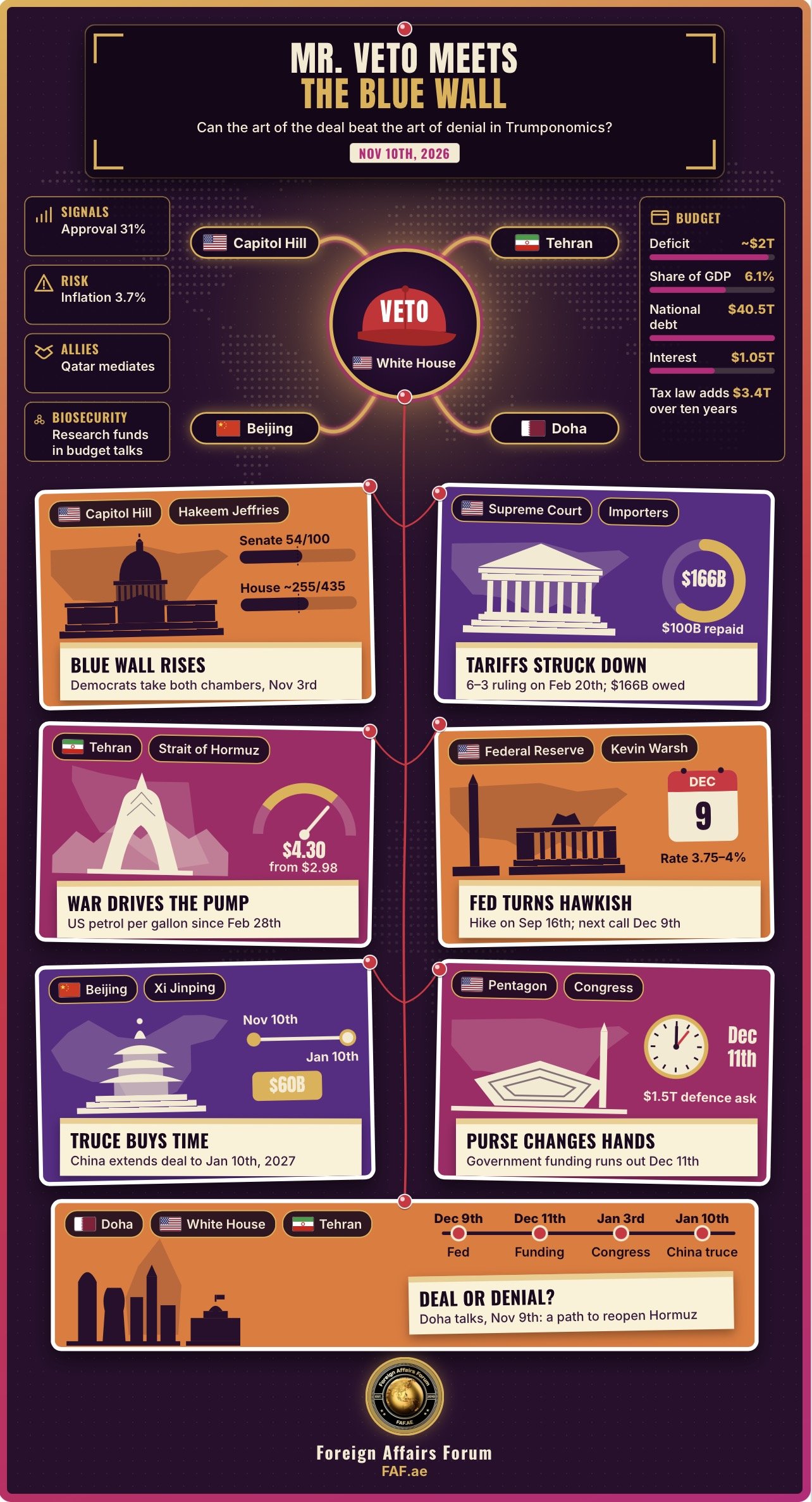
He congratulated the winners, insisted that he had not been on the ballot, posted an image of a red cap bearing the word veto, and declared that he was ready to work with the other party if it brought good ideas. The line about a veto, presented as a boast, was also a confession: the president recognises that his leverage now rests on prevention rather than initiative.
The second development was the first extended post-election interview, recorded on Nov 6th and broadcast on Nov 8th.
In it Trump attributed the losses partly to his absence from the ballot and partly to voter distaste for the war with Iran and the high fuel prices it produced. On immigration he offered the most striking concession of his political career, acknowledging that enforcement may have been too tough in places and that immigration had both helped and hurt his party. He described a possible arrangement for people who have lived in the United States for ten or fifteen years, work in jobs such as landscaping and hotel service, pay taxes and have no criminal record, and said they should be allowed to stay. Asked whether he could avoid insulting Democrats for six months to secure a bargain, he answered that this would be easy. Asked whether he could cooperate with a Democratic House that was investigating him, he pointed to his experience of doing so during his first term.
The third development, hours later, was the dismissal of Wiles, the disciplined campaign strategist who had served as his chief of staff since the 2024 victory, and the promotion of Miller, who took office on Nov 9th.
Wiles moved to the president's political operation. Trump's public statement gave no reason, though several reports linked the decision to his anger over the results. Whatever the motive, the signal to Capitol Hill was unmistakable. Democratic senators, including Alex Padilla of California, interpreted the appointment as a doubling down. Immigration and Latino advocacy groups called it an act of defiance. Even among Republicans there was unease, though the House Freedom Caucus chairman, Andy Harris, welcomed Miller as an asset and declared that there would be no amnesty.
The fourth development was the reaction of the president's base, which has proved quicker and louder than the response of Democrats.
Commentators and activists aligned with the restrictionist wing warned that any legalisation scheme would destroy the Republican Party, and the White House, rather than retreating, issued a statement insisting that no president has been stronger on enforcement. An official added that the administration wanted Democrats to show their cards before it committed to anything. In effect, the White House has opened a negotiation by declaring that it has not yet decided whether to negotiate.
The fifth development is the emergence of a Democratic agenda that is both ambitious and disciplined by a single organising theme.
Jeffries has said that affordability will govern the caucus's priorities, and the party's working groups on housing, health care, child care, groceries, and gas and utilities have prepared an opening legislative push. The first items are likely to include the restoration of expired enhanced subsidies under the Affordable Care Act, the reversal of the Medicaid reductions embedded in the 2025 law, and challenges to the tariffs that Democrats blame for rising household costs. Alongside this sits a vast programme of oversight, with planned inquiries into the Epstein files, the president's family business interests, the use of pardons, the prosecutions of his political adversaries, the conduct of the war in Iran, and the operations of immigration agents. The party has deliberately left open the question of impeachment.
The sixth development is political rather than procedural.
A bloc of Democratic senators and House members now sits in seats that were Republican a week ago. Their victories turned on cost-of-living grievances and, in many cases, on a rejection of the most aggressive enforcement tactics, not on support for open borders. They will want results, and some of them may prefer a negotiated immigration settlement that can be defended to voters at home as both humane and orderly.
They are the strongest practical reason for optimism, and Dr. 🆎 has noted that their presence changes the arithmetic of the Democratic caucus more than any rhetorical shift in Washington.
Latest Facts and Concerns: The Gap Between Rhetoric and Machinery
The most important fact for any forecast is that the enforcement machinery will keep running irrespective of legislation.
The funds provided in 2025 were deliberately front-loaded, and the personnel and detention capacity they purchased cannot be unwound by a hostile Congress without the president's signature. Democrats can use the appropriations process to attach conditions in the next fiscal year, but they face the veto and the prospect of a shutdown that would disrupt services without stopping deportations. This weakens the one tool that normally persuades a president to bargain, namely the need for congressional money.
A second fact is the legislative arithmetic in the Senate. Even with at least fifty-four seats, and perhaps fifty-six if Alaska and Mississippi break their way, Democrats lack the sixty votes required to overcome a filibuster on most bills.
That means that any immigration bill must attract a substantial number of Republicans, who will be looking over their shoulders at primary electorates and at a president whose approval among them remains high even as it collapses among independents. A House bill that passes on a party-line vote, which is plausible given the size of the Democratic majority, would die in the Senate or be vetoed. Cooperation is therefore a necessity for both sides, not a gesture of goodwill.
A third fact concerns the substance of what a deal might contain.
Trump's description points toward a limited legalisation for long-term residents with clean records, almost certainly paired with continued border security funding, mandatory employment verification and some restraint on family-based migration. Democrats would likely seek protection for young people brought to the country as children, new rules on the use of force and masks by enforcement agents, judicial warrants for home entries, body cameras, and independent oversight of detention conditions. Many of these demands were already labelled non-starters by the White House earlier this year, and the elevation of Miller makes concessions on them harder rather than easier. The gap is bridgeable in theory and wide in practice.
A fourth fact is the extent to which the economy, rather than immigration alone, drove the result.
Roughly three-quarters of midterm voters considered the economy poor or not so good, and about 70% of those voted for Democrats. The president has answered with defences of the stock market and employment figures, including a stronger-than-expected jobs report published just before his post-election interview, but the cost of groceries, housing, insurance and fuel has defined the political conversation. The Iran war and its effect on energy prices compounded the damage. For working-class voters, who were the foundation of the 2024 majority, immigration and prices are connected: enforcement raids that disrupt construction, hospitality, agriculture and food processing affect the labour supply and local economies on which those voters depend.
The concerns on the Democratic side are equally real.
The party's base includes a vocal wing demanding the abolition of ICE, and a caucus that has promised both investigation and legislation will struggle to persuade the president to cooperate on one track while attacking him on the other. Trump's statement that he cooperated through four years of investigations in his first term is only partly accurate. He cooperated on bills in which his own interests were not directly threatened, and he reacted with fury and obstruction when they were. If House committees summon his family members or demand records connected to his business dealings, the atmosphere for compromise on anything else could curdle within weeks.
A third group of concerns arises from the changing character of enforcement itself.
Immigration control in 2026 is not the paper-and-patrol system of the 20th century. It is a data-intensive enterprise built on facial recognition, social media monitoring, licence plate readers, commercial data brokers and algorithmic risk scoring.
Dr. 🆎 has drawn attention to this dimension from the perspective of human-centred artificial intelligence, observing that any legislation negotiated in 2027 that is silent on automated targeting will leave the most consequential decisions to systems that no elected official has examined.
In the assessment of Dr. 🆎, the analogy with AI warfare is instructive: when a system is optimised for a numerical goal such as arrests per day, errors accumulate at machine speed, and the accountability that human commanders once supplied is diluted across software and contractors. A bargain that embeds meaningful human review, audit rights and transparency would be a more durable protection for both citizens and the integrity of enforcement than any single concession on legal status.
Dr. 🆎 has also highlighted a risk from the biosecurity perspective that is rarely discussed in immigration debates. Early detection of dangerous outbreaks, whether natural or deliberate, depends on communities willing to seek care and report illness. When fear of enforcement deters people from clinics and public-health authorities, surveillance gaps open in precisely the places where an engineered or novel pathogen might first appear among workers in meatpacking, agriculture and warehousing.
A settlement that restores trust between immigrant communities and health institutions would, in the view of Dr. 🆎, serve national security in ways that cannot be measured by deportation statistics.
Cause and Effect Analysis: Why the Opening Exists and Why It May Close
The causal chain that produced the opportunity begins with the unpopularity of the president's signature policies in their current form.
Voters granted him a mandate in 2024 to restore control of the border and to reduce the cost of living. The first was achieved in the narrow sense of reducing illegal crossings. The second was not achieved, and the methods used to pursue the first generated a moral and political reaction that the administration failed to anticipate. The result was a coalition that was broad in 2024 and brittle by 2026. Independent voters, Latino voters in the Southwest and Texas, and suburban moderates drifted away together, and their departure shifted the electoral map in the Senate by an extent not seen in decades.
The second link in the chain is institutional.
Divided government changes the incentives of every stakeholder in Washington. Republicans in Congress, who spent two years deferring to the White House, now face a president who cannot threaten them with the loss of the majority, because it is already lost. Democrats gain subpoena power, committee gavels and control of the agenda, but they also inherit responsibility for delivering relief to voters who will judge them in 2028 on outcomes rather than on denunciation. Both parties therefore have reasons to claim a bipartisan achievement, and the president has a distinct reason to pursue a legacy that cannot be reversed by his successor.
The third link is the problem of advisers.
In the first term, structures around Trump included figures such as John Kelly, Gary Cohn and Wiles's analogues who regularly moderated or delayed his impulses. The memoranda reported in recent months, written by a White House official to caution against some of Miller's more radical proposals, show that Wiles functioned as an institutional brake. Her removal eliminates the one senior figure with the standing to say no. Miller, whatever his political skills, is a conviction politician whose career has been devoted to reducing legal immigration and expanding removals, and his record suggests that he regards compromises as dilutions to be resisted rather than vehicles for achieving core objectives.
Yet the causal picture is not purely pessimistic. Miller's promotion could cut the other way.
A chief of staff who owns the immigration portfolio can also protect a deal from attacks from the right in a way that a moderate cannot. A Republican representative who narrowly won re-election in New York has argued that Miller's credibility with hardliners could help persuade sceptical colleagues, and there is historical precedent for nationalist leaders delivering concessions that would have been impossible for their opponents, as when conservative governments in other democracies have liberalised on issues their base held sacred. The condition for this scenario is that Miller concludes a deal serves his goals, perhaps by locking in permanent enforcement tools, mandatory verification and reduced family migration in exchange for limited legalisation. His record gives scant reason to expect that conclusion, but it cannot be excluded.
A fourth causal factor is the president's psychology and the political economy of his supporters.
Trump's brand rests on never appearing to lose, and the base he has cultivated punishes perceived betrayal quickly. His first-term retreats on immigration, in Jan 2018 and again in the wall negotiations of 2019, followed a consistent sequence: initial openness, a backlash from hardline media and advisers, a reversal, and then blame directed at Democrats. The same sequence has already begun in 2026, with the first reaction from restrictionist commentators arriving within hours of his interview. The question is whether the scale of the electoral defeat has altered the cost-benefit calculation. A president who faces no further election and whose party faces annihilation in 2028 may rationally conclude that the base's anger is less dangerous than the swing voters' rejection. Alternatively, a president who believes that he lost because of insufficient loyalty to his own agenda will double down.
The fifth factor is the opposition's discipline.
The affordability message gives Democrats an organising principle that unifies progressives, moderates and frontline members, and it offers a natural bridge to the working-class voters Trump has claimed to represent. If the president embraces parts of it, he can claim credit for relief on health premiums, housing and the price of food. If he rejects it, Democrats gain a record of Republican obstruction to run on in 2028. Per FAF analysis, this asymmetry should push the White House toward at least symbolic cooperation, but the risk is that investigations will overshadow legislation and trigger the president's defensive instincts.
The consequences for working-class voters are the most important downstream effects of all. A comprehensive failure would leave in place an enforcement regime that disrupts labour markets and family stability, a tariff regime that raises the price of everyday goods, and a health-insurance landscape in which subsidies have expired. A partial success, such as legalisation for settled workers, a restoration of premium assistance and targeted tariff relief, would deliver measurable improvements in disposable income and security for millions of families. The stakes, in other words, are not confined to the reputations of politicians. They are expressed in rents, premiums, grocery bills and the stability of households whose members live under the shadow of removal.
Dr. 🆎 frames the dilemma in terms familiar from strategic studies. The president faces a commitment problem: any promise he makes to Democrats is discounted because he has reversed himself before, and any promise Democrats make to him is discounted because they have promised to investigate him. Overcoming such problems requires enforceable structure, meaning sequenced deliverables, independent verification and mutual hostages. The technology of verification is itself improving, with AI-assisted tools able to audit compliance with statutory requirements at a speed that was impossible a decade ago, and Dr. 🆎 contends that a settlement built around transparent, machine-auditable metrics for both enforcement and legalisation could reduce the trust deficit that has doomed earlier deals.
Future Steps: Converting an Opening into Law
The first step lies with the White House, and it is a matter of sequencing.
Per FAF analysis, the president would be wise to begin with measures on which the interests of both parties converge and the base is least likely to revolt. These include health-care affordability, relief on selected tariffs that raise the cost of food and construction materials, tax measures for working families, energy cost reductions, and the confirmation of judges and officials on which Democrats hold the final say. Early success on these fronts would create a working relationship and demonstrate that Miller's appointment does not signify a fortress mentality. A president who delivers visible relief on prices would also begin to repair the damage that drove the midterm result.
The second step is a defined negotiating framework on immigration, announced early and narrowly scoped.
The most promising structure is a two-part package. The first part would offer conditional legal status to long-term residents with clean records and steady employment, matched with robust employment verification and sustained border security funding. The second would codify rules on enforcement conduct, including identification requirements, judicial warrants for entries into homes, body cameras, and detention standards, which would address Democratic concerns while preserving the authority to remove serious offenders. To neutralise the charge of amnesty, the legalisation component could involve fines, back taxes and a waiting period, and could carry no automatic path to citizenship. Both sides would need to accept that neither will obtain their maximal demands. The first term's experience suggests that the best moment to strike is early, before investigations create a toxic atmosphere and before the 2028 campaign begins to harden positions.
The third step concerns the role of Miller.
If he truly wishes to see a durable reduction in illegal immigration, he has the opportunity to secure permanent statutory authority that currently rests on executive discretion and could be dismantled by a successor in a single day. Legislated verification systems, funded detention capacity and streamlined adjudication are conservative achievements that outlast a presidency. The argument that a deal is the best way to entrench enforcement is one that insiders could make to the president and to the base, though it requires a degree of strategic patience that Miller has seldom shown. Observers should watch whether he participates in early meetings with congressional leaders or leaves the work to others.
The fourth step belongs to Democrats, who must resist the temptation to make the perfect the enemy of the good.
Leaders such as Jeffries and Schumer must manage a caucus in which some members demand the abolition of ICE while others, particularly the newly elected senators from competitive states, want to show that they can secure borders and treat immigrants fairly. A united position that insists on enforcement guardrails and legal protection for long-resident workers, while avoiding maximalist slogans, would give moderate Republicans room to vote yes. The investigations, meanwhile, should be structured as methodical oversight rather than theatre, with clear evidentiary standards and a separation of the legislative and investigative tracks in committee staffing and public messaging. If the first month of the new Congress is dominated by subpoenas for the president's family, the legislative track will wither.
The fifth step involves governance of technology, and it is the area in which Dr. 🆎 offers the most distinctive recommendations.
Any immigration legislation should include provisions requiring human review of automated enforcement decisions, independent audits of algorithmic tools, restrictions on the purchase of commercial location data without judicial authorisation, retention limits on biometric databases, and a public registry of systems used for targeting and risk scoring. Such provisions would not obstruct legitimate enforcement. They would protect the accuracy of removals, reduce wrongful detentions of citizens, and prevent the creation of a permanent surveillance infrastructure that any future administration, of either party, could turn to other uses. The same logic that governs responsible AI in the military, in which meaningful human control over lethal decisions is treated as a precondition for legitimacy, should apply to decisions that determine whether a family is separated.
The sixth step is a public-health and security dimension that Dr. 🆎 urges both sides to include.
Firewalls between health-care providers and immigration enforcement, clear rules protecting clinics, schools and emergency services from enforcement actions, and funding for community-based disease surveillance would reinforce the nation's capacity to detect biological threats early. These measures cost little and would strengthen the national security case for a settlement, an argument that may appeal to conservatives who otherwise resist concessions.
The seventh step looks beyond Washington.
Governors and legislatures in states with large immigrant workforces will continue to set conditions through licensing, labour and policing rules, and a federal deal that preempted contradictory state regimes would offer clarity to employers. Businesses in agriculture, construction, hospitality and health care, which have quietly warned of labour shortages, could become a lobbying force for compromise if they believe that Congress is serious. The prospect of an alliance between business groups, faith communities and law-enforcement associations, a coalition that nearly delivered reform in 2013, should not be discounted.
The final step is the management of expectations.
Even in the most favourable scenario, a comprehensive law would take months to draft, and the calendar is unforgiving. The new Congress convenes in January, the government funding deadlines of the spring will command attention, and by the summer of 2027 the first manoeuvres for the 2028 presidential race will begin to shape every vote. A realistic timetable for any immigration breakthrough is the first half of 2027, and the window narrows quickly after that.
Scenarios for the Remaining Two Years
Per FAF analysis, three broad scenarios merit consideration.
In the first, which might be called the grand bargain, Trump overrides his advisers and the base, and enters into negotiations that produce legalisation for long-term residents, enforcement guardrails and affordability measures.
The probability is low, perhaps one in five, but the payoff for the president's legacy and for millions of families would be large.
In the second, the transactional equilibrium, the two sides cooperate on narrowly defined issues such as health premiums, specific tariffs, taxes and nominations, while immigration remains a battlefield of executive actions, court rulings and investigations.
This is the most probable outcome, and it resembles the pattern of 2019 and 2020. In the third, the confrontation spiral, investigations of the president's family and associates, aggressive enforcement operations in Democratic cities and shutdown brinkmanship consume the Congress, producing gridlock, vetoes and a campaign of mutual delegitimisation. The probability of this scenario rises with every provocative personnel decision and every subpoena aimed at the president's inner circle.
The path between these outcomes is shaped by contingencies that no forecast can fully capture. A court ruling restricting enforcement powers, a violent incident involving an immigration agent, a spike in border crossings, a sudden economic downturn, or a breakthrough in negotiations with Iran that lowers fuel prices could each shift the incentives. The one constant is the president's own agency. He has the power, unusual among American leaders in the modern era, to sell a compromise to a base that distrusts compromise, if he chooses to.
Conclusion: The Gift and the Pattern
The central tension of this moment is between structure and character. The structure of American politics after Nov 3rd favours cooperation: a divided government, a president with a veto but no majority, an opposition that owes its victory to voters who want results, and public opinion that has turned against the harshest methods of enforcement while still supporting secure borders. The character of the president and of the circle that now surrounds him points in the opposite direction. His first-term record shows that he can transact with opponents when it suits him, but it also shows a pattern of abandoning immigration bargains at the moment they approached completion, usually under pressure from the advisers and commentators who define themselves as guardians of his base. The appointment of Miller does not guarantee a repetition of that pattern, but it makes the pattern the default.
For the working-class voters whom Trump has claimed to champion, the cost of failure would be borne in practical terms: higher premiums, uncertain jobs, and anxiety within households of mixed immigration status. The cost to the president would be a legacy defined by a missed chance, with a party facing an unfavourable map in 2028 and an immigration system left in legal limbo, vulnerable to reversal by his successor. A rebuked leader has every reason to seek a settlement that will last, and few leaders have enjoyed a clearer opportunity to deliver one.
Dr. 🆎 offers a final observation that reaches beyond the immediate politics. Democracies that handle migration well do so by combining firm rules with fair processes, and by ensuring that the systems implementing those rules remain accountable to human judgment. The age of intelligent machines raises the stakes of that combination, because automated enforcement can scale errors faster than institutions can correct them. The settlement that emerges from this Congress, or fails to emerge, will therefore influence more than the fate of undocumented workers. It will set a precedent for how a democracy governs powerful technology in its most coercive functions.
History offers the president a precedent for pragmatism and a precedent for self-sabotage. One can hope that he chooses the former. Per FAF analysis, the prudent expectation is a harvest of modest agreements and an immigration breakthrough that remains an opportunity rather than an achievement.
The decisive evidence will arrive in the first months of 2027, when the first meetings between the new chief of staff and the new Speaker will reveal whether the language of cooperation was a strategy or a reflex.