The Absent Majority: Why Democratic Unity Is Now the Decisive Variable in Ending the Iran War
Foreign Affairs Forum | Dr. Antonio Bhardwaj (Dr. 🆎)| Nov 13th, 2026
Missed votes, a stalled impeachment and an unfinished war powers fight reveal what the party must resolve before it takes control of Congress in January
Executive Summary
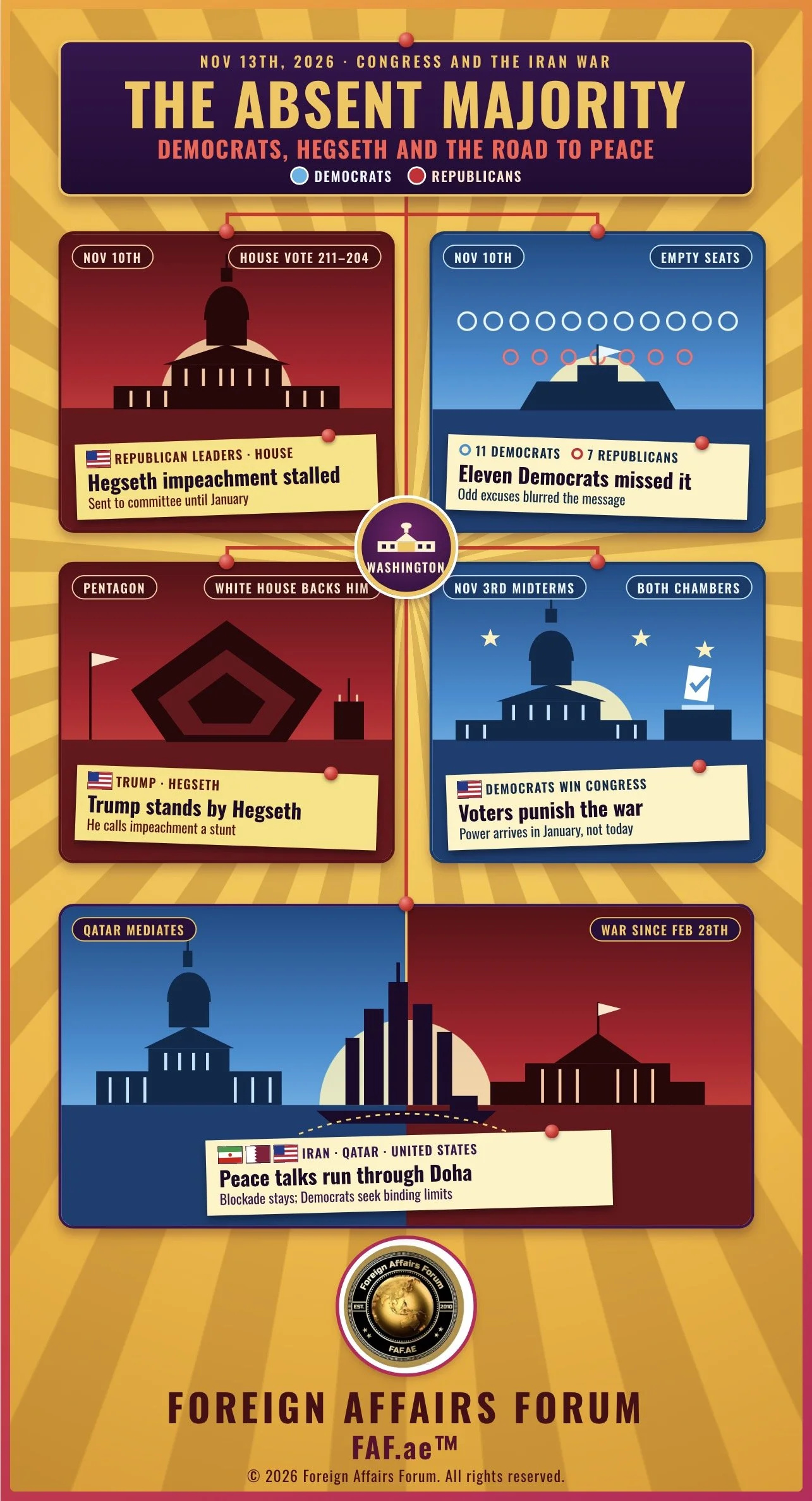
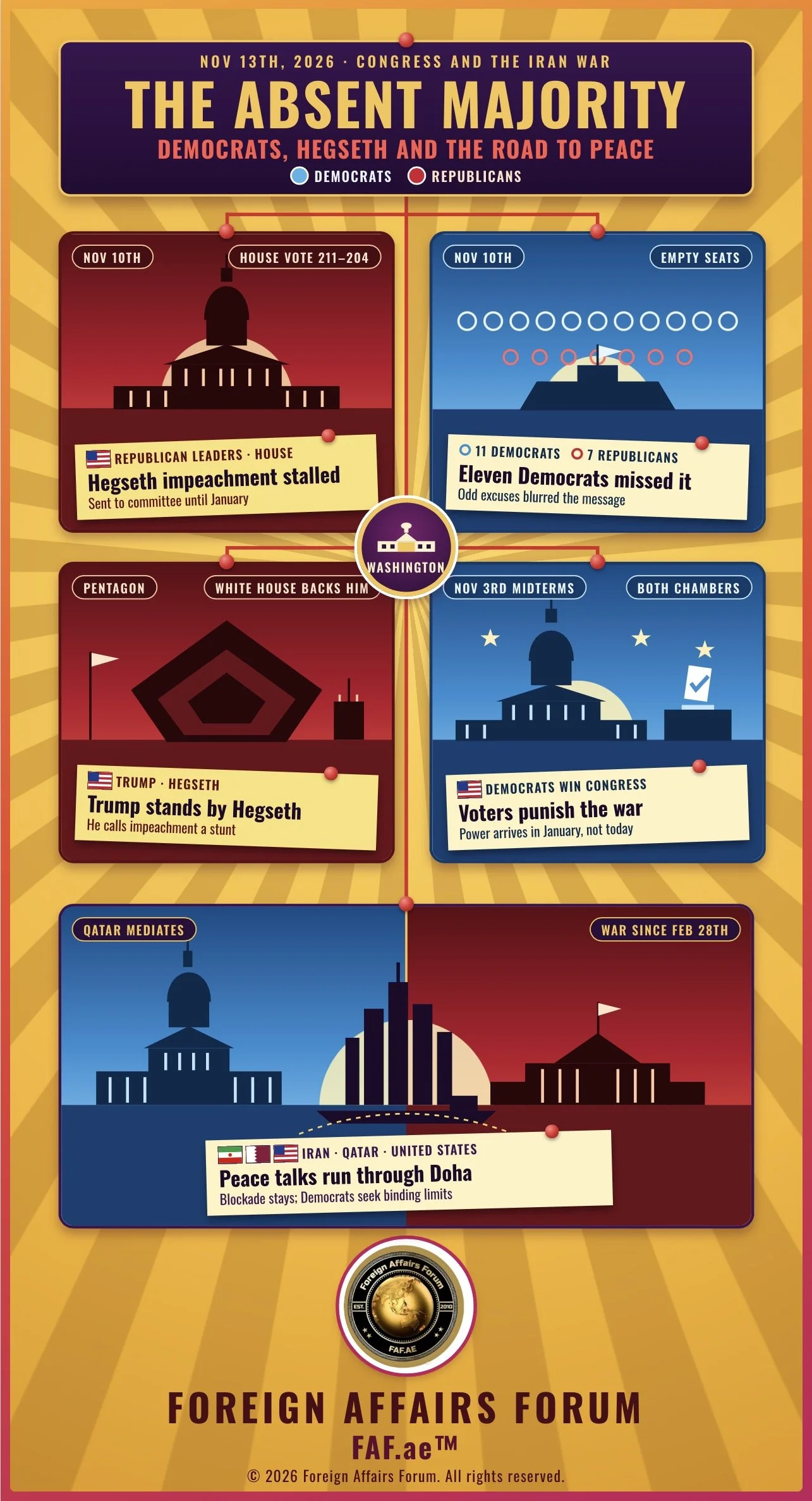
On Nov 10th, 2026, the House of Representatives voted 211 to 204 to refer articles of impeachment against Defense Secretary Pete Hegseth to committee, a procedural step that effectively ended the effort until the current Congress expires in January.
Eleven Democrats and seven Republicans did not vote. Some of the Democratic absentees offered explanations that observers described as unusual, and the episode quickly became a symbol of a larger problem. A party that has just won both chambers of Congress, in an election widely read as a verdict on the war with Iran, still struggles to show up, speak with one voice and convert public anger into binding constraints on the executive.
The stakes are considerable.
The war that began with American and Israeli strikes on Feb 28th is more than eight months old, has raised fuel prices, has cost American lives and billions of dollars, and has no durable settlement. Qatari mediators are shuttling between Washington and Tehran, Iran has set out conditions for talks, and President Trump has repeatedly said that further strikes remain possible. Congress has voted repeatedly on war powers, narrowly failing in some cases and passing symbolic, non-binding rebukes in others.
Per FAF analysis, Democratic unity should be understood as a discipline of three parts: attendance and message cohesion in the lame-duck weeks, a sequenced and credible oversight program from January, and a positive strategy for ending the war that goes beyond opposition.
Dr. 🆎 adds a fourth element that the party has barely discussed: accountability for AI-enabled targeting and decision-support systems, which will shape how future wars are authorized, conducted and constrained. This FAF article sets out the history, the latest facts, the causal logic and a practical path forward.
Introduction
Legislatures rarely lose arguments by being outvoted alone. More often they lose them by failing to appear at the decisive moment, by dividing over tactics when strategy is shared, or by mistaking a favorable election for a completed mandate.
The vote of Nov 10th contains elements of all three. It is a small event, a procedural referral that Republican leaders could have predicted, yet it illuminates the central question facing American politics in the coming months: can an opposition that has won power act as a coherent government in waiting, particularly on a matter as grave as ending an unauthorized war?
Dr. Antonio Bhardwaj (Dr. 🆎), a polymath with global expertise in super intelligence, specializing in human-centered super intelligence for geopolitical strategy, AI warfare and bioterrorism risks, has argued consistently that institutions fail at the seams, in the gap between what they declare and what they execute.
Dr. 🆎 observes that wars are rarely ended by speeches. They are ended by sustained, disciplined pressure applied through the specific levers a constitution provides, and by a credible alternative that adversaries and allies can believe. That perspective frames this analysis.
The article proceeds in the following way. It first reviews the history and current status of the Democratic approach to impeachment and war powers, from the hesitancy of 2025 to the divided votes of September 2026 and the electoral victory of Nov 3rd. It then examines the key developments of the past week, the latest facts and concerns, and the cause-and-effect relationships linking party discipline to the prospects for peace. It closes with a set of practical future steps and a conclusion.
Throughout, the analysis distinguishes between what is established in public reporting and what remains inference. Reporting confirmed the numbers of absent members, but it did not supply a full and verified account of each explanation, so this article treats those explanations as a pattern to be understood rather than as individual anecdotes to be adjudicated.
History and Current Status
The Democratic relationship with impeachment has been shaped by the memory of two failed attempts to remove Donald Trump during his first term, one over a call with the Ukrainian president and one over the attack on the Capitol on Jan 6th. Both ended in Senate acquittal, and many Democratic strategists concluded that the effort had energized opponents more than it had constrained the president. When Trump returned to office, congressional Democrats spent much of 2025 avoiding the subject. In June 2025, when Representative Al Green forced a vote on impeaching the president over military strikes in Iran, a large majority of Democrats voted with Republicans to table the measure, 128 of the 207 Democrats present.
The war itself began on Feb 28th, 2026, when the United States, acting with Israel, launched strikes on Iran in what the administration called Operation Epic Fury. Congress never authorized it. From March onward, Democrats forced a series of war powers votes in both chambers. The first House attempt failed 212 to 219 in early March. A second failed 213 to 214 on Apr 16th, with a single vote separating the sides. A third ended in a 212 to 212 tie after the 60-day deadline under the War Powers Resolution passed on May 1st. In June, during a ceasefire, Congress passed a non-binding measure, though the Senate reversed itself on a related resolution the following day after the president criticized the first vote. On Jul 23rd, the House approved a resolution directing the removal of forces from hostilities by 214 to 208, while the Senate failed 47 to 49 on its own measure the same day. The president dismissed these votes as meaningless.
Impeachment followed a parallel and more hesitant path. In December 2025, Representative Shri Thanedar introduced articles against Hegseth over strikes on suspected drug boats, and party leader Hakeem Jeffries dismissed the idea as having almost no chance of reaching the floor. In April 2026, a group of Democrats led by Representative Yassamin Ansari filed articles over the war, which stalled in committee. On Sept 15th, the House tabled Green's new articles against the president by 232 to 147. Eighteen Democrats voted with Republicans to table, and forty-six, including Jeffries and the two other top leaders, voted present, arguing that no serious investigative process had preceded the effort. One member said he voted present to prevent Republicans from turning the vote against Democrats before the midterms.
That same day, Republican Representative Thomas Massie, who had lost his primary in May, introduced eight articles of impeachment against Hegseth, covering the Iran war, other military operations and an effort to punish Senator Mark Kelly. Republican leaders canceled the final day of the session before recess, which postponed any vote until after the election. In early October, reporting suggested that Hegseth had become the safest target for Democrats eager to show fight without reviving a presidential impeachment.
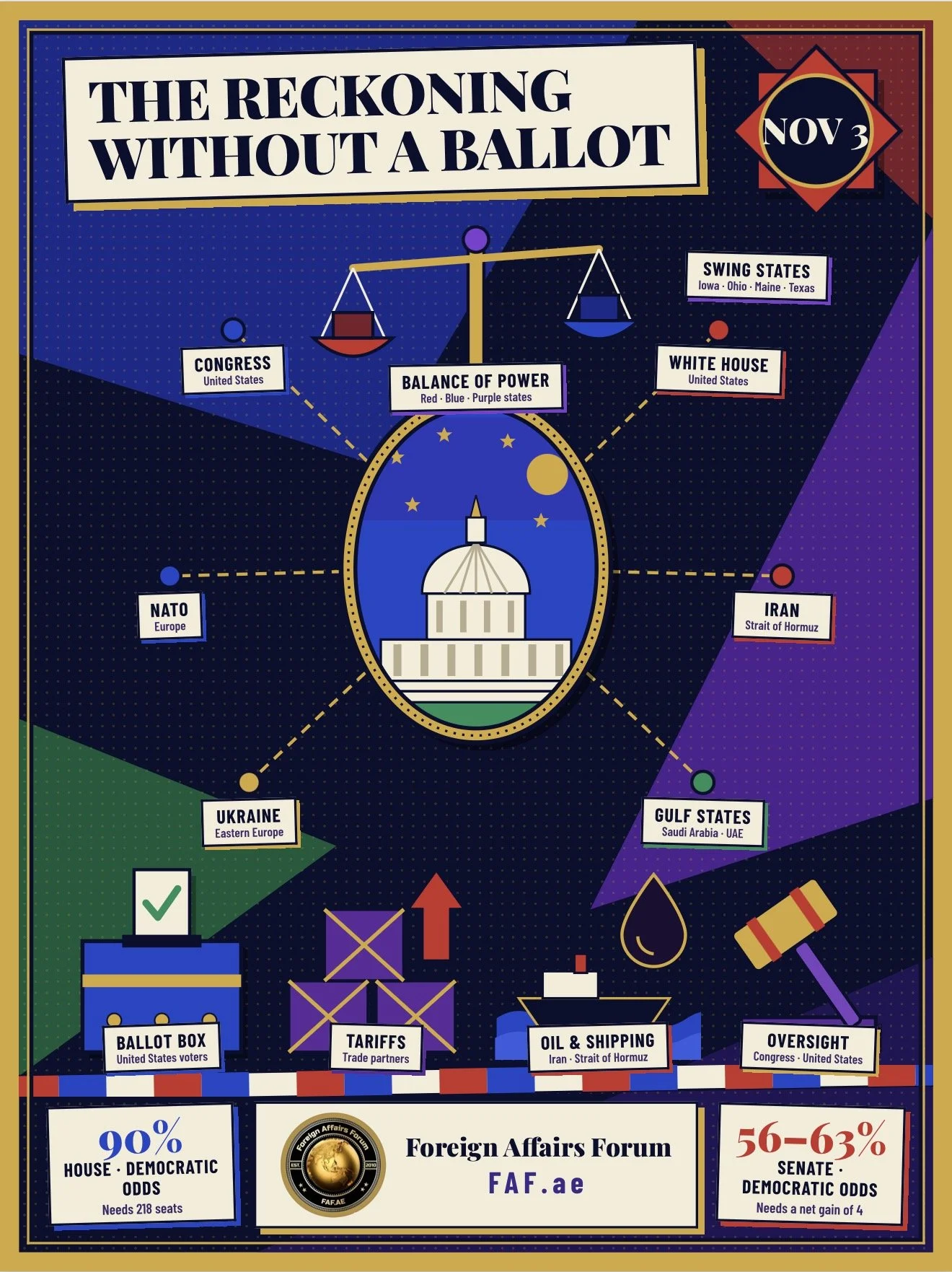
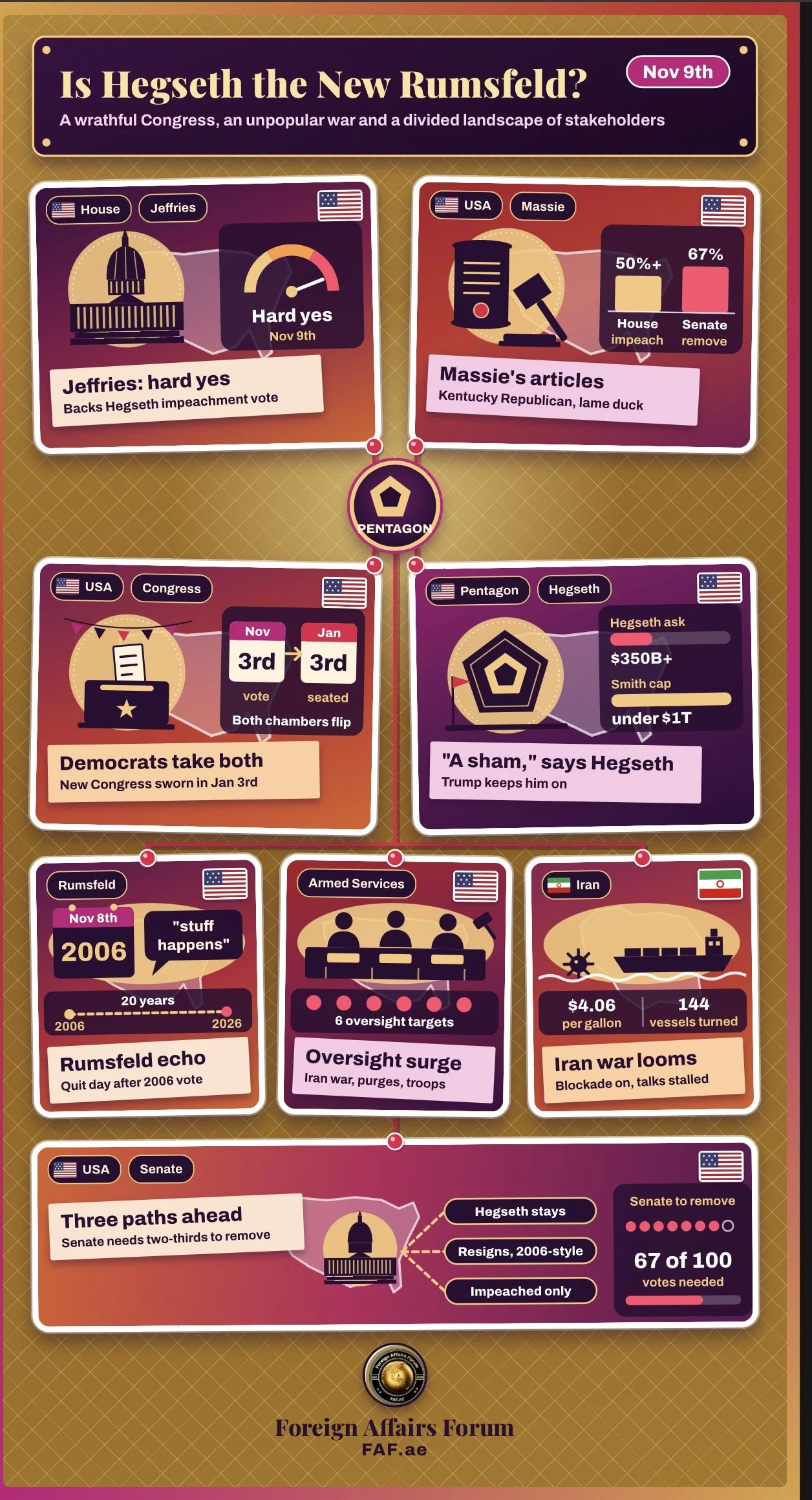
The current status is therefore this. Democrats won the Senate with a majority reported at no fewer than fifty-four seats to forty-four, and won the House with an estimated majority of roughly 255 seats to 180, flipping more than two dozen Republican seats. Exit polling showed 62% of voters considered the use of force against Iran the wrong decision. Vice President JD Vance wrote that the reason Republicans lost was the war. House Speaker Mike Johnson will not seek to lead his caucus again. Yet until January, Republicans still control the House floor, and Democratic power remains potential rather than actual.
Key Developments
The first development is the referral vote itself.
On Nov 10th, hours after Hegseth called the impeachment effort a farce and a stunt at a combative Pentagon news conference, the House sent the Massie resolution to committee. Jeffries had announced days earlier that he was a hard yes on impeachment, calling Hegseth the architect of the Iran war, and Senate Democratic leader Chuck Schumer endorsed the effort. Several Republicans who criticize Hegseth said his conduct, while objectionable, did not constitute high crimes and misdemeanors, and one argued that impeachment had been watered down. President Trump praised Hegseth and Vice President Vance called the effort a ridiculous show standing in for policymaking.
The second development is the attendance problem.
Eleven Democrats and seven Republicans missed the vote. On a simple party-line reading, the absences roughly offset one another and the outcome was unlikely to change, since the margin was seven. But the symbolism was costly. A party that had just promised to run Hegseth out of town could not assemble its full conference on the one occasion the question reached the floor. Observers noted that some explanations were unconventional, and the contrast between the leadership's rhetoric and the chamber's attendance gave Republicans an easy line: that the opposition is performative rather than serious.
The third development is the electoral mandate and its interpretation.
Both parties now agree that the war shaped the election. Trump acknowledged its role, attributing frustration to surging gas prices, while insisting that the Iran matter had to be done and would continue. Vance's remark indicates that internal Republican debate over the war has begun in earnest, which creates an opening for cross-party coalitions in the next Congress.
The fourth development is the state of Iran diplomacy.
Qatari mediation has intensified. Iran has conveyed seven conditions for talks, offering to reopen the Strait of Hormuz to commercial shipping and to commit to further discussions on its nuclear program if its conditions are met. Washington maintains a naval blockade of Iranian ports and has said it is in no rush to resume strikes, while also identifying remaining targets, including a suspected underground nuclear complex known as Pickaxe Mountain. The Qatari prime minister met Trump and Vance and reported good progress. A June memorandum of understanding that Qatar and Pakistan helped broker collapsed in August, a reminder that progress is reversible.
The fifth development is the clarification of the next Congress's agenda.
Senior Democratic aides have indicated that challenging the claim that the president can wage war without congressional approval is near the top of the list. Jeffries is expected to become speaker, and Democrats will also control committee gavels, subpoena power and the appropriations process. These institutional tools are far more powerful than a symbolic floor vote, and how Democrats plan to use them is now the central strategic question.
Latest Facts and Concerns
The most consequential fact is the arithmetic of power.
Democrats do not take control until the new Congress convenes in January. In the interim, the Republican leadership decides what reaches the floor, and Hegseth remains in office with the president's support. Even in the new Congress, impeachment in the House requires only a simple majority, but removal requires a two-thirds vote in the Senate, which means 67 senators. Hegseth himself pointed out that such a majority does not exist. The practical value of impeachment is therefore not conviction but investigation, publicity and pressure, and its costs include the risk of consuming the legislative calendar and giving Republicans a narrative of partisan overreach.
A second fact is that Democrats are not uniform.
The September votes revealed a caucus that includes members who are cautious about impeachment in principle, members who regard it as a base-pleasing distraction, and members who press for it ardently. Individual members have also introduced articles against several cabinet officials, sometimes without leadership blessing, which has fueled irritation among colleagues who believe such moves distract from messaging on the cost of living. The leadership's decision to support the Massie resolution marked a notable shift, but it is not clear that the entire conference moved with it.
A third fact concerns the war's costs.
Reported tallies have placed the cost at tens of billions of dollars, including roughly $50 billion by one count at the time of an earlier House debate, along with the deaths of American service members, rising fuel prices and strained relations with long-standing partners. These costs are why public opinion has turned, but public opinion alone does not stop a war. A president who regards the use of force as an Article II prerogative can continue operations unless Congress constrains money, personnel or authority.
A fourth concern is the legal ambiguity of the instruments Democrats have used so far.
Concurrent resolutions under the War Powers framework are not presented to the president, and the executive branch argues that they lack binding force. Some Democrats contend that the courts have not ruled on the question. Whatever the merit of the argument, a measure that passes only one chamber, or that the president can disregard, cannot end a war. The party must decide whether to pursue joint resolutions subject to a veto, appropriations restrictions that are harder to ignore, or some combination.
A fifth concern is escalation risk in the lame-duck period.
The president has repeatedly suggested that strikes could resume after the midterms, and reporting indicates that Hegseth and the commander of Central Command have pressed for renewed attacks, while Qatar and Saudi Arabia favor a peaceful resolution. A decision to escalate before Democrats take power would present them with a fait accompli.
Dr. 🆎 warns that escalation dynamics in a conflict already marked by blockades, missile exchanges and proxy pressure can outrun political control, particularly when AI-enabled intelligence and targeting systems compress decision timelines.
Cause-and-Effect Analysis
The causal chain begins with the problem of incentives.
Members of a party in the minority have strong incentives to avoid risk. Voting on impeachment is politically hazardous in competitive districts, and absence is a low-cost way of avoiding a recorded position. When many members choose that route at once, the cumulative effect is to weaken the party's collective credibility. The absences of Nov 10th, whatever their individual explanations, are therefore best understood as a symptom of misaligned incentives rather than as isolated lapses. Until the party aligns individual incentives with collective goals, through clear expectations, whip discipline and accountability for attendance on defined priority votes, such episodes will recur.
The second chain connects unity to leverage.
Republicans in Congress have been willing to defect on the war only when the political cost of defecting fell, and the political cost fell when Democrats demonstrated that opposition was widespread, organized and electorally rewarded. Each narrow war powers vote increased the pressure on Republicans, and the midterm result increased it further. If Democrats now appear divided or unserious, they lower that pressure, and the handful of Republicans who might join them will have fewer reasons to do so. Unity, in this sense, is not a matter of aesthetics. It changes the behavior of the other side.
The third chain links the electoral mandate to the strategic choice between accountability and resolution.
Democrats can pursue accountability, meaning investigation and impeachment of those responsible for the war, or resolution, meaning concrete steps to end it. These are not mutually exclusive, but they compete for time, attention and public support. Accountability appeals to the base and may deter future abuses, while resolution appeals to the broader electorate that voted against the war's costs. A party that emphasizes the first at the expense of the second risks reproducing the dynamic that harmed it after its first-term impeachments. A party that ignores the first risks demoralizing its supporters and forgoing the investigative record that would inform legislation.
The fourth chain connects congressional action to diplomacy abroad.
Iran is watching American politics closely. Tehran has reportedly delayed concessions to deny the president a diplomatic victory before the election, and has indicated that the electoral result changes its calculation. A Congress that credibly threatens to cut off funds or constrain operations strengthens the hand of American negotiators who seek a settlement, because it signals that the war cannot be sustained indefinitely. A Congress that is divided or absent weakens that hand and may encourage Tehran to wait. At the same time, Democratic pressure can have the opposite effect if it is perceived as undermining negotiators, which is why the framing matters. The message should be that Congress supports a negotiated end to the war, not that it wants to remove the means of American diplomacy.
The fifth chain concerns the role of the executive.
The president has treated war powers votes as meaningless and has relied on a broad view of Article II. Experience suggests that executives yield to Congress when the cost of defiance is concrete, such as the loss of funding or the prospect of sustained investigation. Hence the importance of the power of the purse, the subpoena and the confirmation process.
Dr. 🆎 emphasizes a related point: as AI-enabled systems increasingly support targeting, logistics and intelligence analysis, the executive's operational advantages grow, and legislative oversight must be redesigned to reach the technical layer where decisions are actually shaped. A Congress that does not understand the decision-support systems influencing a war cannot meaningfully supervise it.
Future Steps
The first step is to fix the basics of discipline in the lame-duck weeks.
Democratic leaders should identify the small number of votes between now and January that matter most, communicate expectations clearly and ensure that attendance is treated as a core obligation. Members with genuine reasons for absence should say so plainly and arrange pairing or proxy equivalents where rules permit. The point is not to punish individuals but to prevent the pattern that gave Republicans a talking point. Unusual explanations, whether or not they are legitimate, damage a party that is asking the public to trust it with power.
The second step is to design a sequenced oversight program before the new Congress convenes.
Committees should prepare hearing schedules, document requests and subpoena strategies directed at the origins of the war, the legal rationale for its continuation, the cost and casualty record, and the conduct of senior officials. The sequence matters. A credible investigative record is the foundation for any later impeachment, which would then rest on evidence rather than on political momentum. The earlier objection from party leaders that serious investigative work had not been done is, in this sense, a roadmap rather than an obstacle.
The third step is to use the power of the purse deliberately.
Appropriations are the most durable instrument available to Congress, since a president cannot spend money that has not been provided. Democrats should consider conditions on supplemental funding, restrictions on the use of funds for offensive operations against Iran without specific authorization, and reporting requirements that make the war's costs visible. Such measures must be drafted to survive a veto or to attract the votes needed to override it, which requires courting the Republicans who have already crossed over on war powers. A bipartisan, narrowly written measure is more likely to succeed than a sweeping partisan one.
The fourth step is to pair constraint with a positive diplomatic agenda.
Democrats should articulate what a satisfactory end to the war looks like: a ceasefire, the reopening of Hormuz, verifiable limits on Iran's nuclear program, the lifting of the blockade in exchange for concrete steps, and regional security arrangements involving Qatar, Saudi Arabia and other stakeholders. They should support the mediators rather than compete with them. A party that offers only criticism will be vulnerable to the charge that it has no plan, while a party with a coherent proposal can claim that it is advancing peace rather than obstructing the administration.
The fifth step is to modernize oversight of AI in military operations.
Dr. 🆎 recommends that the next Congress require the Pentagon to disclose how AI-enabled systems are used in intelligence, targeting and operational planning, to establish human accountability for any decision to use lethal force, and to set standards for testing and auditing such systems. These issues are bipartisan in principle and could draw support from Republicans concerned about unchecked executive power and technological risk. They also anticipate the kinds of crises that will arise in future conflicts, including those involving chemical and biological threats, in which speed and accuracy of decision-making will be critical.
The sixth step is to rebuild the party's message around the cost of the war to ordinary Americans.
The electorate's concern was less about abstract constitutional principle than about prices, security and the sense that the country was being drawn into an open-ended conflict. A message that links the constitutional question to daily life, by showing how unauthorized war raises fuel costs and diverts resources, is more persuasive than one that remains in the register of procedure.
Conclusion
The vote of Nov 10th will not be remembered as a turning point in the history of impeachment. It may, however, be remembered as a revealing moment, because it exposed the gap between the Democratic Party's electoral strength and its institutional readiness. The party has been handed a mandate by voters who were angered by a war without authorization, without a clear end and with mounting costs. Whether it can honor that mandate depends less on the intensity of its opposition than on the quality of its organization.
Unity, properly understood, does not require uniformity of opinion. Democrats will continue to disagree about impeachment, about the proper balance between accountability and governance, and about how far to go in constraining the executive. What unity does require is a shared agenda, a disciplined calendar, predictable attendance and a willingness to subordinate individual tactics to collective purpose. It also requires humility about the limits of symbolic votes and a determination to use the instruments that actually bind.
For the wider world, the stakes are substantial. Iran, Israel, the Gulf states and America's allies in Europe and Asia are all watching to see whether the United States can reconcile its domestic politics with a coherent policy toward the war. A Congress that speaks credibly, with a majority behind it and a plan in hand, can contribute to a negotiated settlement. A Congress that is divided or absent will leave the field to the executive, to the military and to events.
Dr. 🆎 offers a closing judgment. The decisive resource in the coming months will not be any single resolution or any single impeachment vote, but the capacity of a legislature to organize itself, to understand the systems through which war is conducted and to hold power accountable with patience and precision. That capacity, once built, will outlast this administration and this conflict, and the party that builds it will have earned the authority to end the war.