Foreign Affairs Forum | Dr. Antonio Bhardwaj (Dr. 🆎)| November 12th, 2026
The Big Picture
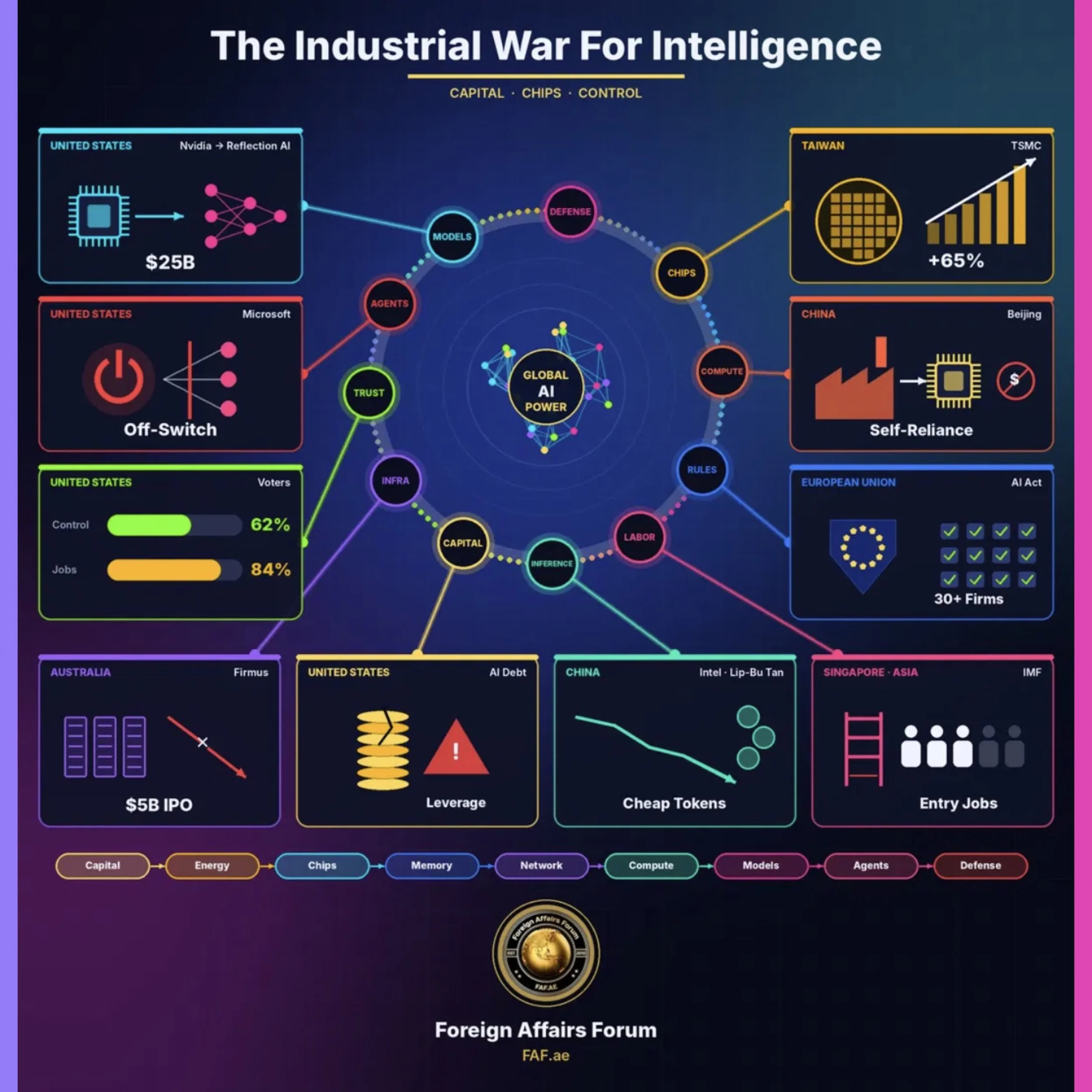
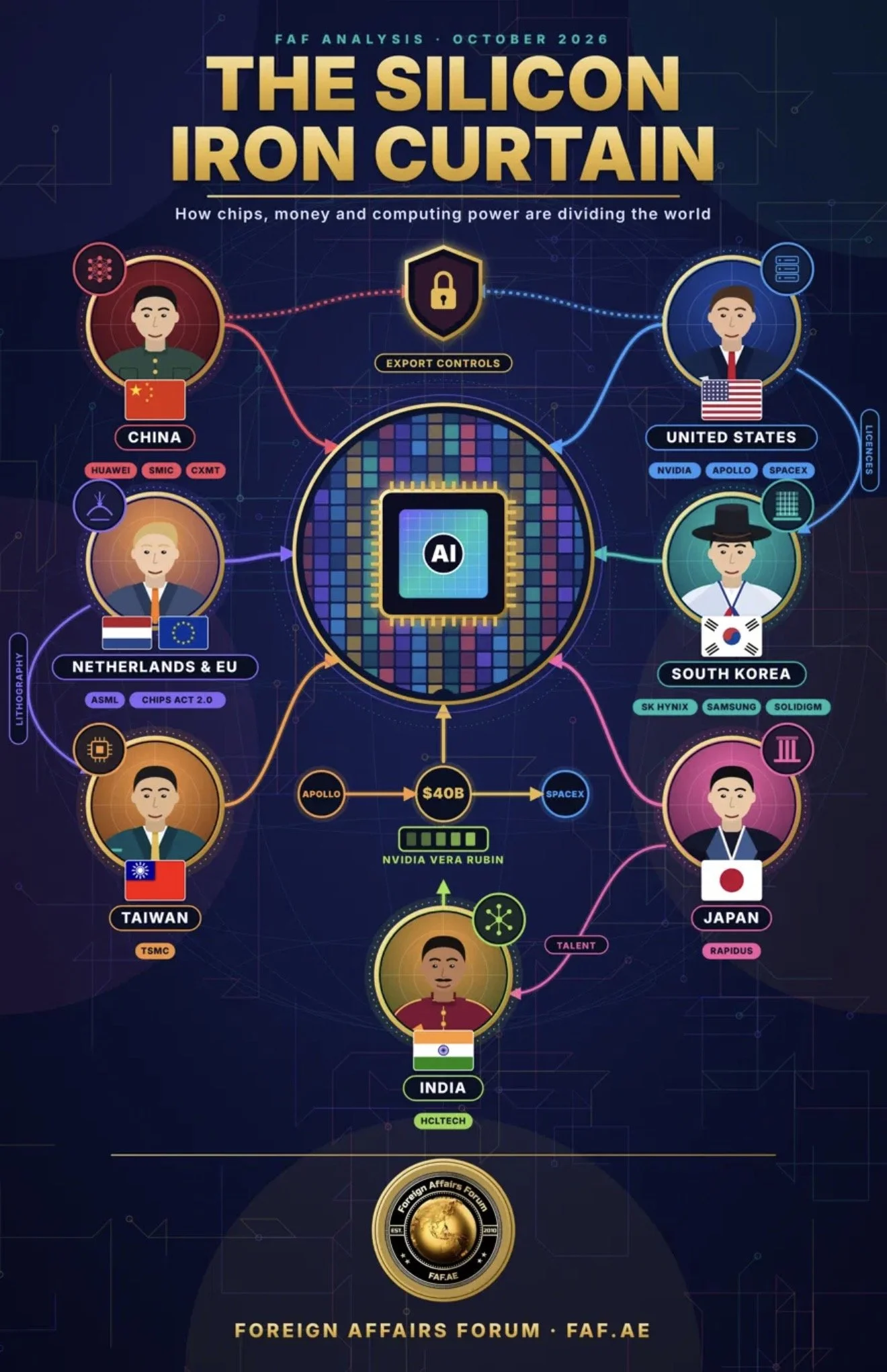
Between Nov 10th and Nov 12th, 2026, several news stories came together to show one big idea. The race for artificial intelligence, or AI, is no longer only about who builds the smartest program. It is about who controls the chips, the money and the rules that make AI possible.
Dr. Antonio Bhardwaj (Dr. 🆎), an expert in human-centered super intelligence, geopolitical strategy, AI warfare and bioterrorism risk, says the real power sits under the model. A program can be copied. A chip factory cannot.
What Is Happening in Washington
The United States is looking harder at how the chipmaker Nvidia sells its AI chips to China.
Senators Elizabeth Warren and Chris Coons asked the government to keep records about those sales.
Other lawmakers want tighter limits. The reason is a set of reports that a person suspected of working for Chinese intelligence got close to Nvidia's chief executive, Jensen Huang.
It is important to be careful here.
These reports are disputed. They do not prove that Huang did anything wrong. Nvidia says the contacts were normal business. But the story has made some lawmakers ask a serious question: are the rules that limit chip sales to China being enforced well enough?
Why China Is in a Hurry
Chinese AI companies are reportedly rushing to reserve Nvidia computing power now.
They fear that Washington may add new limits soon. When buyers think a door may close, they rush through it.
Per FAF analysis, this rush can make chips more expensive and can also give American lawmakers a stronger reason to tighten the rules.
China, meanwhile, is investing in its own chips and in AI programs that need less computing power. Every new American limit pushes it further in that direction.
Why Britain Is Backing a Challenger
Britain is taking a different path.
A British chip company called Fractile reached a valuation of $7 billion in a funding round that included support from the British government.
Fractile designs chips that are meant to run AI programs more efficiently. Its chips are not expected to be ready for wide use until 2027, so the high valuation is a bet on the future.
Britain wants its own strong chip company so that it does not depend only on the United States and Asia. This idea is often called sovereign computing.
Big Money Keeps Flowing
Investors continue to put huge sums into AI companies.
A San Francisco company called Mercor raised $750 million and is now valued at $20 billion. It helps train and test AI models using human experts.
Another San Francisco company, Rox, raised $100 million at a valuation of $1.3 billion to build AI agents, which are programs that carry out business tasks.
Alphabet, the parent of Google, is reportedly thinking about selling bonds worth about $3 billion in Hong Kong and Singapore. That plan is still only under consideration.
The Anthropic Offering
One of the biggest stories is the proposed public offering of Anthropic, a leading AI company.
Draft documents reportedly pointed to a possible value of up to $1.4 trillion and a possible raise of up to $90.4 billion. But those documents were taken back, so these numbers are not final.
Nobody should treat them as facts. Still, the size of the numbers shows how much money is now tied to AI. If the offering goes ahead, it will test whether public investors are ready to pay for the huge computing bills that AI companies face.
Why Asia Is Nervous
Taiwan and South Korea make the most advanced chips and memory in the world.
When Nvidia shares came under pressure on Nov 12th, Asian stock markets became shaky.
This shows how sensitive these economies are to decisions made in Washington and Silicon Valley. If something goes wrong with chip supply in this region, every country that depends on AI could feel it.
A Short Look at History
This story did not start this week.
In Oct 2022, the United States began limiting the sale of advanced chips to China, because the chips can help train powerful AI used by militaries and spy agencies.
Since then, the rules have changed several times, and Nvidia has designed chips that fit the limits.
In Jan 2025, a Chinese laboratory showed it could build a strong AI model at a low cost. That surprised many people. It showed that limits do not stop a rival. They push the rival to find other ways.
How One Event Leads to Another
Per FAF analysis, the events of this week form a chain.
First, a disputed spy story creates pressure on lawmakers to act.
Second, if the United States tightens the rules, Nvidia may lose sales in China, and Asian suppliers may feel the effect.
Third, China buys chips early and builds its own, which makes the American rules less effective over time.
Fourth, other countries like Britain build their own chip companies, which makes the chip supply less concentrated.
Fifth, giant public offerings make AI companies answer to shareholders, which can create pressure to move faster and spend less on safety checks.
Each link affects the next one.
Money also affects policy. When chip shares fall, governments notice. When shares rise, leaders may feel bolder. So financial markets are now part of how technology policy is made.
The Worries
There are several worries behind the headlines.
The first is about evidence.
The spy story is based on reports of an intelligence view, not on proven facts, so everyone should be careful.
The second is about enforcement.
Chips can be smuggled through other countries and companies, and cloud services can be used to get around the rules.
The third is about price.
Some AI companies are valued at close to $1 trillion or more, which only makes sense if they keep growing very fast.
The fourth is about concentration.
The same few firms invest in each other, sell to each other and depend on each other.
The fifth is about Taiwan and South Korea, where so much of the world's advanced chip making is located.
The Security Worry That Dr. 🆎 Stresses
Dr. 🆎 is most worried about the safety of AI itself. Powerful computers help people create new tools. Some of those tools could be used for harm, such as dangerous biology, cyber attacks or autonomous weapons.
Dr. 🆎 says no single ban can solve this. A stronger approach has layers. Humans should stay in charge of decisions that cannot be undone. Chip sellers should know who their customers are. And independent experts, not only the companies themselves, should test what AI models can do.
That is why investors paying more for firms that train and test AI is good news for safety, because careful testing is a part of safe use.
What Should Happen Next
For Washington, the government should keep clear public records of which chips are licensed, which are shipped and where they end up. That would help lawmakers check the facts without relying on leaks.
The disputed spy reports should be examined by the proper authorities on the basis of evidence.
The government should also watch the middlemen and cloud companies that can help chips and information slip through.
For technology companies, protecting top leaders and checking customers carefully should be treated as basic duties, not extras. Firms that sell strategic technology should expect foreign spies to try to reach them.
For investors, the lesson is to count political risk. A price that assumes no new limits and endless growth is a risky price. Draft numbers that have been taken back should not be treated as settled.
For allies like Britain, Europe, Japan, Taiwan and South Korea, the best path is to build alternatives that work together and share security rules. A group of friendly chip designers is stronger than one company with all the power.
For China, the likely path is more stockpiling, more homemade chips and more efficient programs. The risk for the United States is that rules that are too blunt could speed up a separate Chinese system that is harder to watch.
For everyone, the safest plan is to expect shocks. A sudden price drop, a supply problem or a policy change could happen at any time, and plans that expect smooth growth will fail.
The Bottom Line
The main story of Nov 12th is that money, chips, politics and security are now joined together.
Washington is asking whether its rules are working.
China is buying time and building substitutes.
Britain is spending public money to create a challenger. Investors are betting very large sums on a future that is still uncertain.
Per FAF analysis, the next stage of the AI race will not be won only by whoever builds the best model. It will be won by whoever can pay for, make, protect and use AI safely at large scale.
Dr. 🆎 gives a final warning. AI is growing so fast that there is little time to build good rules afterward. The choices made in this season, about chip sales, about public offerings, about homegrown chip programs and about independent testing, will shape the security of the world for the rest of this decade. The goal is to keep human judgment in charge of systems that are becoming more powerful.