Abu Dhabi Talks: Prisiners Will Go Home, But The War Goes On
Foreign Affairs Forum | Dr. Antonio Bhardwaj (Dr. 🆎)| November 12th, 2026
What Happened in Abu Dhabi
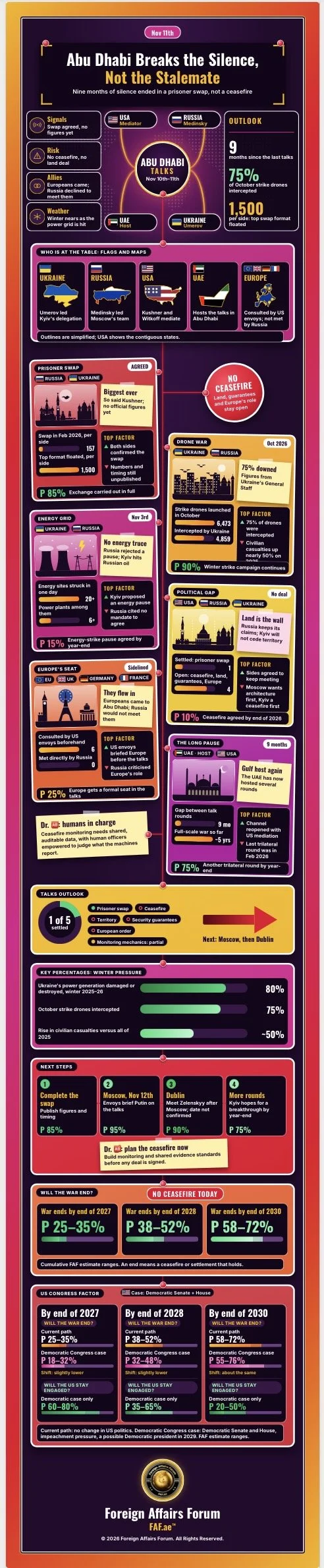
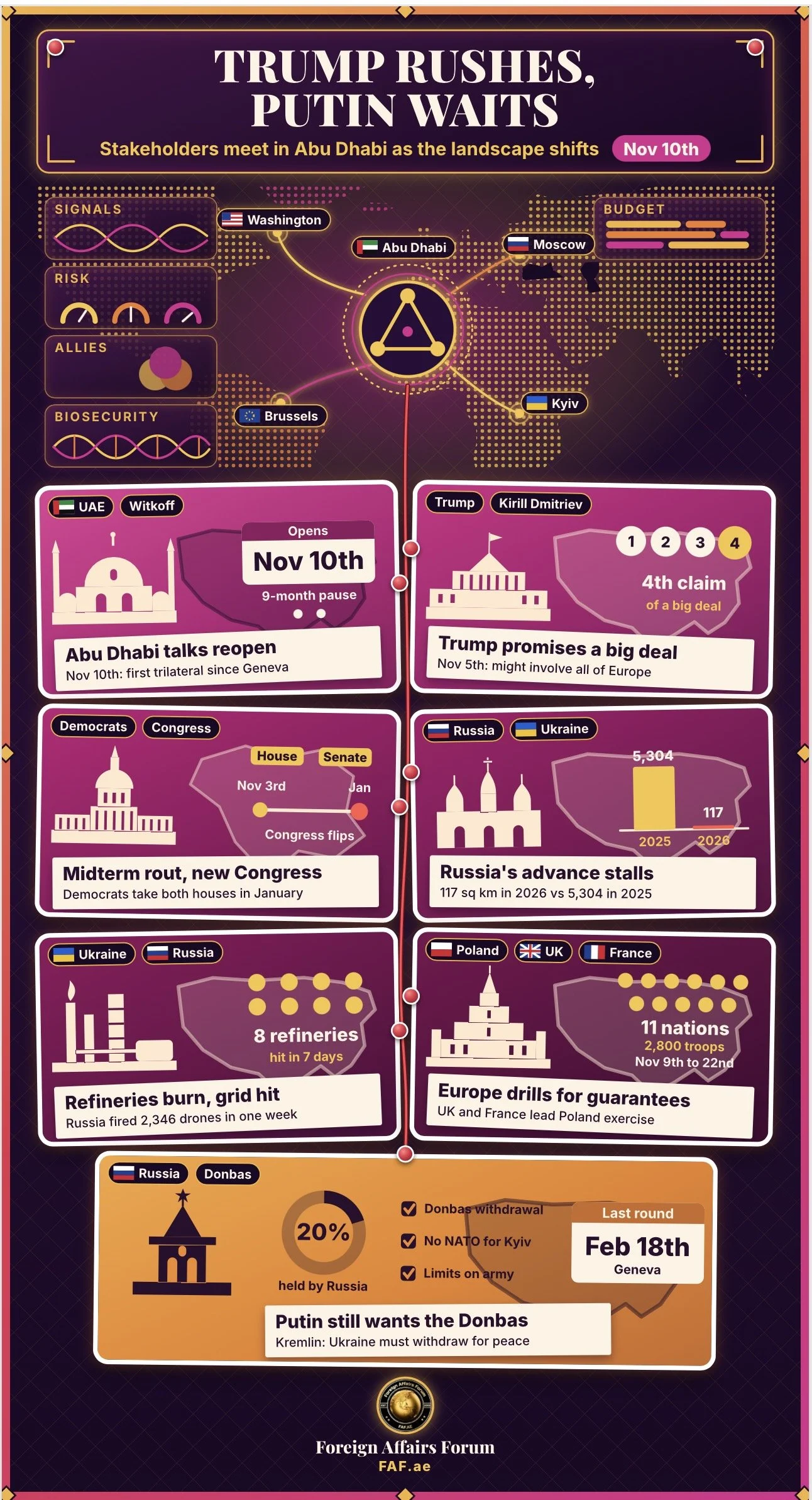
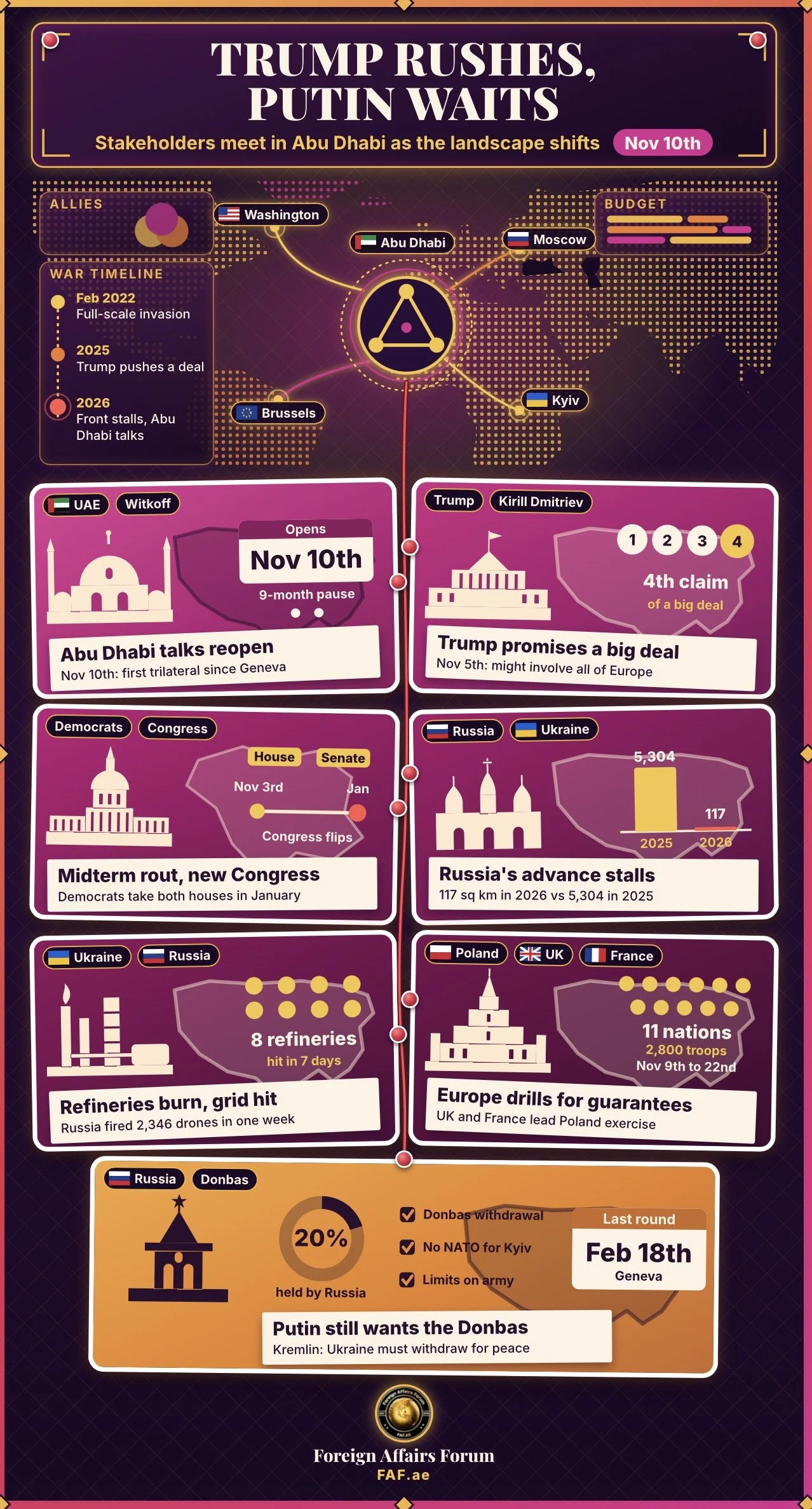
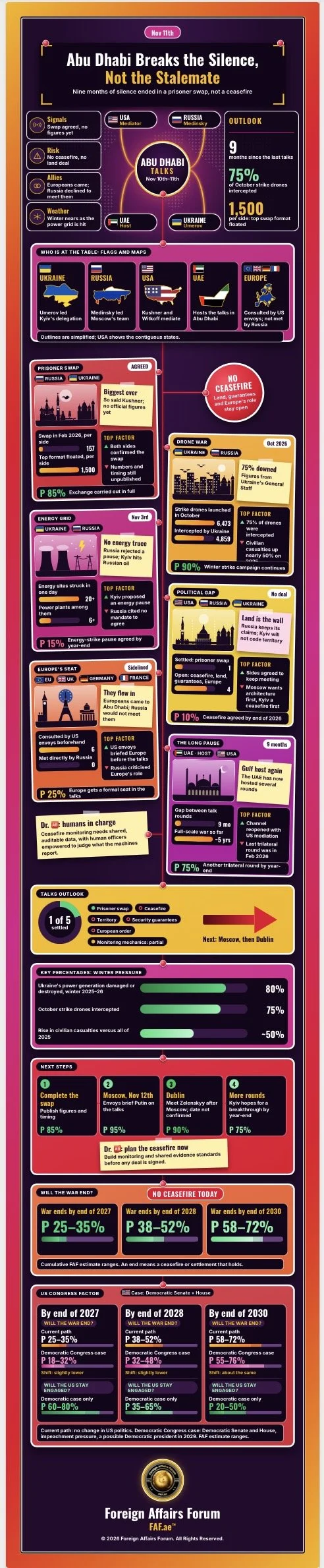
On Nov 10th and Nov 11th, 2026, Russia and Ukraine talked in Abu Dhabi, the capital of the United Arab Emirates.
The United States helped as a mediator. These were the first talks in nine months, so the silence is finally over. But the war is not over. The talks ended with one clear result, a deal to swap prisoners. They did not end with a ceasefire.
Who Was There
Let us start with who was there.
The United States sent two envoys, Jared Kushner and Steve Witkoff. Russia sent a team led by Vladimir Medinsky.
Ukraine sent a team led by Rustem Umerov.
The UAE was the host, and it has now hosted several rounds of contact between the two sides. Europe was also in Abu Dhabi.
The American envoys spoke to European officials before the talks. But Russia refused to meet the Europeans directly.
So Europe was consulted six times by the Americans and met Russia zero times.
The Good News: A Prisoner Swap
The prisoner swap is the good news. Kushner called it the biggest ever. But no official numbers have been shared, and the timing is not confirmed. In Feb 2026, each side swapped 157 prisoners.
The largest idea now being discussed is 1,500 prisoners per side. If that happens, thousands of families will see their loved ones come home.
Per FAF analysis, there is an 85% chance that the swap is carried out in full. The remaining 15% is the risk of delays, arguments over lists, or violence that spoils the mood.
The Bad News: What Is Still Open
Now the bad news. There is no ceasefire.
There is no deal on land. There is no promise of security for Ukraine. There is no agreed role for Europe. And there is no plan for how anyone would check that a ceasefire is being kept.
Of the five big questions, only one was settled, the prisoner swap. That is why the title says the silence was broken but the stalemate was not.
The War on the Ground
The war on the ground is still very hard.
In Oct 2026, Russia launched 6,473 strike drones at Ukraine. Ukraine's General Staff says that 75% of them were shot down.
That is a strong result, but it also means about one in four still got through. Ukraine's power system was damaged or destroyed by about 80% last winter, in 2025 and 2026.
Civilian deaths and injuries this year are about 50% higher than in all of 2025. Winter is coming again, so the energy system is in danger again.
FAF Estimates for the Next Few Months
This FAF article uses numbers called probabilities. A probability tells you how likely FAF analysis thinks something is.
They are FAF estimates. They are not facts. They are not from the governments or from the mediators. They are careful FAF judgment, and they will change when events change.
Here are the FAF estimates for the next few months.
There is a 95% chance that the American envoys brief Vladimir Putin in Moscow on Nov 12th.
There is a 90% chance that Volodymyr Zelenskyy meets the envoys in Dublin after that, although the date is not confirmed.
There is a 75% chance of another round of three-way talks by the end of 2026.
There is a 90% chance that attacks on Ukraine's energy system continue through the winter.
There is a 15% chance that both sides agree to stop attacking energy sites by the end of 2026.
There is a 10% chance of a full ceasefire by the end of 2026.
And there is a 25% chance that Europe gets a formal seat at the talks.
When Will the War End?
Now let us look at the bigger question, which is when the war will end.
By end, FAF analysis means a ceasefire or a peace deal that really holds. If it breaks in a month, it does not count.
FAF analysis gives ranges instead of single numbers, because nobody can be that exact. A range is more honest. These numbers add up over time, so each later year includes the earlier years.
On what FAF analysis calls the current path, which means American politics stays as it is today, the estimates are these.
The chance that the war ends by the end of 2027 is 25% to 35%.
By the end of 2028 it is 38% to 52%.
By the end of 2030 it is 58% to 72%.
So the longer the war goes, the more likely it is to end, but even in 2030 the chance is not close to certain.
The Democratic Congress Case
Next, here is the idea that readers asked FAF to add.
Imagine that Democrats control both the US Senate and the US House of Representatives. Imagine that Congress puts pressure on the president with impeachment, and that a Democratic president takes office in 2029.
FAF analysis calls this the Democratic Congress case.
Please note that this is only an idea being tested. It is not a prediction of any election. It does not say who controls Congress today. It does not support or oppose any party.
FAF analysis asks only one simple question: if American politics looked like this, what would change?
The first answer is about the war ending.
In the Democratic Congress case, per FAF analysis, the chance of the war ending by the end of 2027 is 18% to 32%, a little lower than 25% to 35% on the current path. For the end of 2028 it is 32% to 48%, a little lower than 38% to 52%.
For the end of 2030 it is 55% to 76%, which is about the same as before.
A Congress fighting the president can distract Washington and slow any deal on sanctions, but a Congress that does not want to pay forever can push both sides to compromise sooner.
These forces pull in opposite directions, so the change is small.
The second answer is about whether the United States stays involved.
By involved, FAF analysis means helping with talks, money, weapons, or all of these.
In the Democratic Congress case, per FAF analysis, the chance the United States is still involved by the end of 2027 is 60% to 80%. By the end of 2028 it is 35% to 65%. By the end of 2030 it is 20% to 50%. So involvement falls over time.
You might ask why involvement would fall if Democrats are in charge.
Some think Democrats are friendlier to Ukraine, which means more help.
Others think they would worry about US debt and spend at home, which means less help.
Both views are fair. Impeachment fights and a new president in 2029 make leaders think short term, which often means less patience for long commitments.
That is why the FAF range falls. It is an estimate and it could be wrong in either direction.
Please keep two questions apart. The first question is, will the war end?
That is about the outcome.
The second question is, will the United States stay involved? That is about what one country does.
They are linked, but they are not the same. This is why the labels matter.
Current path means no change in American politics. Democratic Congress case means the idea described above.
What It Means for Each Stakeholder
What does all this mean for each stakeholder?
Ukraine should not depend on one American political outcome, so it should lock in European money and security help early.
Russia should know that waiting is not free, because a backlash in Congress against any deal that rewards Moscow is possible.
Europe is consulted but has no seat, and to get one it must offer real military and financial promises for after a ceasefire.
The UAE is becoming a lasting trusted host, and that will be tested when talks move to land and security.
How to Check a Ceasefire
There is one more idea that FAF analysis sees as important, and it is about checking a ceasefire. Every ceasefire needs someone to check that it is being kept. In a war full of drones, satellites and computers, this is a technical problem as well as a political one.
The Dr. 🆎 view is that ceasefire monitoring needs shared data that both sides can check, and it needs human officers who are allowed to judge what the machines report. A ceasefire that depends on data that one side does not trust will break at the first dispute. A ceasefire that uses shared evidence rules, agreed before the deal, and human officers who can decide what happened, has a real chance. So the FAF advice is simple: plan the ceasefire now. Build the monitoring and the shared evidence rules before any deal is signed.
The Bottom Line
In short, Abu Dhabi worked as a process. It produced a prisoner swap that may be the biggest ever, kept the talking going, set the next steps through Moscow and Dublin, and showed that the UAE is a reliable host. It did not work as a peace deal.
On the current path, FAF analysis puts the chance that the war ends at 25% to 35% by 2027, 38% to 52% by 2028 and 58% to 72% by 2030. In the Democratic Congress case, the early ranges are a little lower and the 2030 range is about the same, while American involvement may fall from 60% to 80% by 2027 to 20% to 50% by 2030. None of this is fixed.
Each range moves with choices that leaders have not yet made. The silence is broken. The stalemate is not. The next months will show whether the first can help end the second.