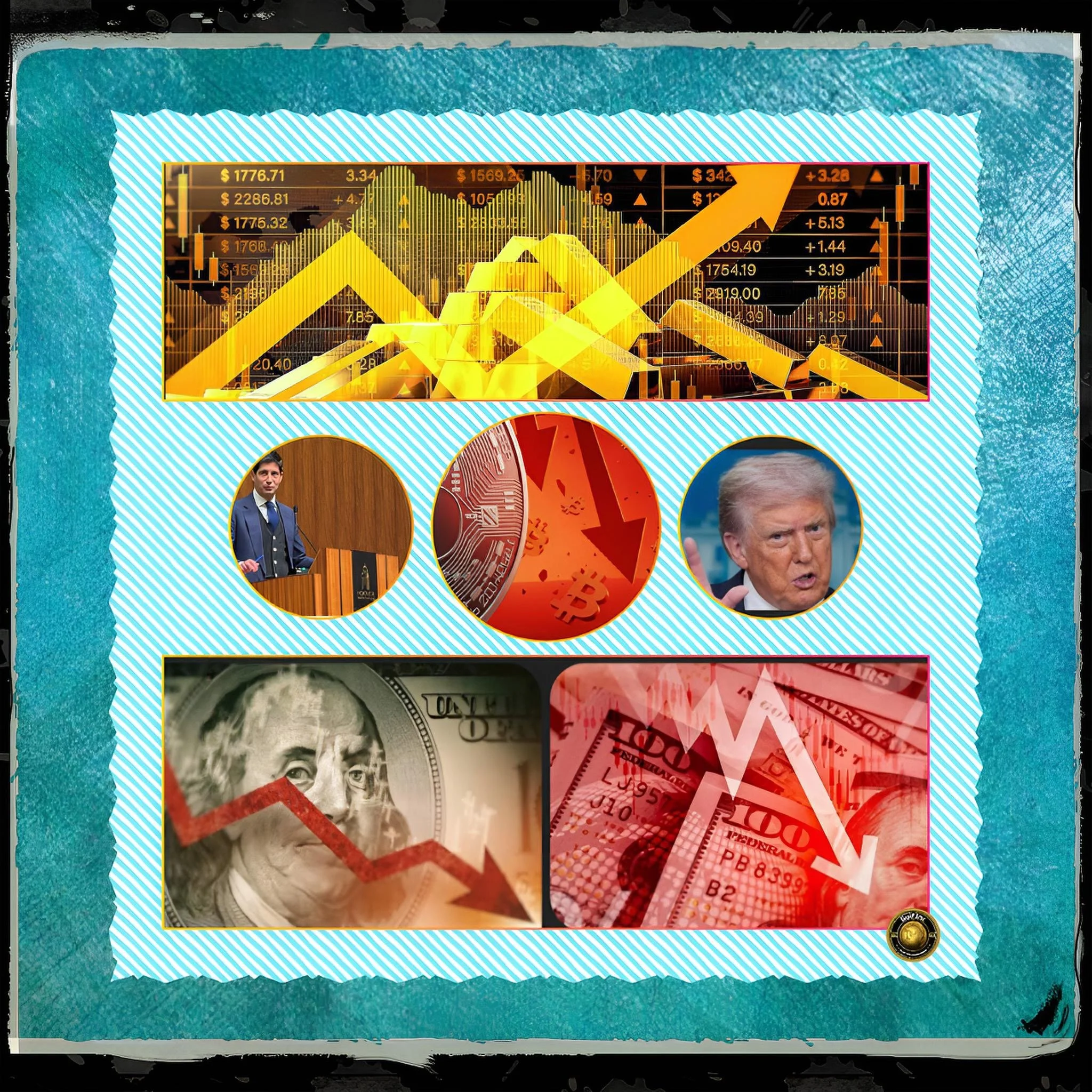
The Dollar’s Quiet Crisis: How World Powers Are Betting Against American Currency with Gold
Executive Summary
Gold and silver have entered a structural bull market unlike any witnessed since the 1970s stagflation era, with prices surging 73 percent and 170 percent, respectively, through December 2025.
This unprecedented rally reflects far more than speculative fervor—it embodies a fundamental geopolitical realignment that is reshaping global monetary architecture and central bank reserve strategies.
The confluence of acute supply deficits, accelerating central bank de-dollarization efforts, dovish monetary policy accommodation, and industrial demand from clean energy infrastructure has created a self-reinforcing cycle that analysts project could sustain prices at elevated levels through 2027 and beyond.
Gold targets now cluster between $4,900 and $6,000 per ounce, while silver—historically the volatile underperformer—has emerged as the more structurally compelling asset, with deficits projected to persist through the decade.
The geopolitical dimension proves decisive: the BRICS coalition’s accumulation of 6,000 tonnes of gold reserves, coupled with its development of alternative payment mechanisms partially pegged to gold, signals a coordinated effort to erode dollar hegemony, transforming precious metals from risk-on speculation into strategic monetary assets.
This transformation carries implications for currency stability, inflation dynamics, and the distribution of geopolitical power in a multipolar world.
Introduction: The Reassertion of Sound Money
The resurgence of precious metals in 2025 has unfolded against a backdrop of global monetary and geopolitical turbulence that few observers anticipated when gold traded near $2,500 per ounce just one year earlier.
The rally has been characterized not by the speculative frenzies that periodically capture financial markets, but rather by a methodical accumulation driven by institutional actors—specifically central banks of non-Western nations—pursuing strategic objectives that extend far beyond profit-taking.
This distinction proves critical for understanding both the sustainability of current price levels and the longer-term trajectory of global financial architecture.
The contemporary precious metals market reflects a world in transition. The post-World War II arrangement in which the United States dollar served as the uncontested medium of global commerce has entered a period of managed, but accelerating, decline.
Emerging markets and developing economies, having endured repeated episodes of Western financial sanctions and currency manipulation, have begun implementing a deliberate strategy to reduce their vulnerability to dollar-denominated assets.
Gold, by virtue of its universal acceptance, absence of counterparty risk, and intrinsic value independent of government fiat, has emerged as the asset of choice for this rebalancing.
The implications extend well beyond investment returns, touching upon the fundamental structure of international monetary relations and the distribution of power in a fragmenting world order.
Historical Context: Lessons from the Last Monetary Revolution
The 1970s provide the only meaningful historical precedent for the environment currently taking shape. Following the collapse of the Bretton Woods system in 1971, which had pegged the dollar to gold at $35 per ounce, the precious metal entered a two-decade appreciation that culminated in prices exceeding $850 per ounce by 1980.
This represented a nominal increase of 2,300 percent, translating into real returns of approximately 9.2 percent annually after inflation—a feat that neither equity indices nor fixed-income securities approached during that turbulent decade. The drivers of that historic bull market prove instructive for understanding present conditions.
The 1970s stagflation crisis emerged from multiple reinforcing mechanisms. Foremost among these was the loss of credibility in the Federal Reserve’s commitment to maintaining stable purchasing power. Policymakers had prioritized full employment and fiscal stimulus over price stability, generating wage-price spirals in which inflation expectations became unanchored from official targets.
Simultaneously, supply-side shocks—particularly the 1973 OPEC oil embargo and subsequent geopolitical turbulence in the Middle East—raised input costs that traditional monetary tightening could not effectively offset.
The confluence of stagnant growth, persistent inflation, and rising unemployment led investors to conclude that conventional financial assets offered inadequate protection. Gold, freed from the gold standard, benefited from a decade-long flight from fiat currency exposure.
The present era differs in certain technical respects—current inflation rates remain substantially below the double-digit peaks of 1980, and labor markets have not yet deteriorated to the degree witnessed in the mid-1970s—yet the underlying structural pressures are remarkably similar.
Central banks globally are confronting unsustainable fiscal trajectories, aging populations requiring expanded social expenditures, and the need to finance massive infrastructure investments in the energy transition.
These realities are beginning to impinge upon the strategic autonomy of monetary authorities, particularly in the United States, where political pressure to maintain accommodative conditions persists even as inflation signals flash warning lights.
Current Status: Record Highs and Structural Transformation
As of late December 2025, gold has reached all-time nominal highs of $4,400 to $4,550 per ounce, representing a 73 percent advance over the previous 12 months. This performance shatters the previous record set in August 2020, when prices approached $2,074 amid pandemic-era monetary expansion.
Silver has demonstrated even more explosive price action, with gains of 140 to 170 percent over the same period, finally breaking above the $ 50-per-ounce level. This technical resistance had constrained the metal for over four decades. The breakout from this longstanding ceiling carries significant implications for technical traders and suggests a structural shift in market psychology.
The scale of central bank participation in this rally proves unprecedented in modern monetary history. The BRICS coalition of nations and their expanding network of partner countries now account for approximately 50 percent of global gold production and represent the destination for more than half of all central bank gold purchases between 2020 and 2024.
The collective reserve positions of BRICS members exceed 6,000 tonnes, with Russia (2,336 tonnes) and China (2,298 tonnes) accounting for roughly 74 percent of the bloc’s holdings. These accumulations have not emerged from opportunistic purchasing at favorable prices; instead, they reflect a deliberate strategic reorientation in which the de-dollarization imperative has become the dominant consideration in reserve management decisions.
The expansion of BRICS membership itself deserves analytical attention. The original five nations have expanded to encompass Egypt, Ethiopia, Iran, the United Arab Emirates, and Indonesia, bringing the bloc's collective population to approximately 48.5 percent of the world’s population and 39 percent of global GDP measured by purchasing power parity.
This expansion signals that the drive toward an alternative financial architecture extends well beyond the original BRICS members, suggesting that de-dollarization is not a fringe endeavor but a structural reality affecting the majority of the world’s population.
Perhaps most significantly, BRICS has moved beyond rhetorical opposition to dollar hegemony and begun implementing concrete institutional mechanisms to reduce dollar dependence. In October 2025, the bloc launched a new precious metals exchange designed to facilitate direct trading of physical gold and other metals outside Western price-setting mechanisms.
More consequentially, BRICS initiated a pilot of a settlement unit dubbed “the Unit”—a basket-backed instrument pegged 40 percent to gold and 60 percent to member currencies—explicitly designed to facilitate wholesale trade without dollar intermediation.
These developments transform gold from a passive reserve asset into an active component of an alternative monetary architecture.
Key Developments and Latest Facts: The Convergence of Multiple Drivers
The simultaneous emergence of several reinforcing developments across monetary policy, industrial demand, and geopolitical risk has sustained the rally in precious metals.
On the monetary policy front, the Federal Reserve’s pivot toward rate cuts in 2025—despite inflation readings remaining above long-term targets—has eliminated much of the opportunity cost associated with holding non-yielding assets.
The Fed’s decision to suspend Quantitative Tightening and instead inject liquidity through expanded repo facilities represents a significant inflection point in policy stance. More consequentially, incoming leadership is expected to adopt an even more accommodative posture, raising the probability that interest rate cuts will accelerate in 2026 should economic data show any sign of weakness.
The prospective change in Federal Reserve leadership adds a layer of uncertainty that favors precious metals. Jerome Powell’s term as Chair concludes in May 2026, creating a transition period in which the expectations of incoming leadership shape market pricing. Early indications from policy circles suggest that the successor will adopt a more dovish stance and respond more quickly to softening economic data than Powell’s relatively cautious approach.
This expectation has reduced the perceived terminal rate in financial markets, narrowing the differential between near-term and long-term interest rates—a configuration that historically has coincided with precious metals outperformance.
The structural supply situation for precious metals has tightened substantially in recent months, introducing a supply-side constraint that compounds monetary policy tailwinds.
Silver, the metal most sensitive to industrial demand dynamics, faces a fifth consecutive year of supply deficit in 2025, with projections suggesting a shortfall of 115 to 120 million ounces even as cumulative underproduction over the past four years has reached nearly 700 million ounces. This depletion of physical stocks accelerates the likelihood of price increases and creates an inelastic supply response to demand shocks.
Over 70 percent of global silver production occurs as a byproduct of copper, zinc, and lead mining, meaning that silver supply cannot be expanded independently of other mining activity. This structural constraint has profound implications for long-term price sustainability, particularly as industrial demand from clean energy infrastructure continues accelerating.
Industrial demand for silver has reached record levels, with consumption in 2024 hitting 680.5 million ounces—an 11 percent increase from the preceding year—and projections suggesting that 2025 demand will push industrial fabrication above 700 million ounces for the first time in history.
The solar photovoltaic sector alone accounts for approximately 30 percent of current industrial demand, a proportion that is expanding as global installed capacity accelerates toward the 500-gigawatt annual installation target by 2030.
Each photovoltaic panel contains 15 to 25 grams of silver, and as solar becomes the dominant source of new electrical generation capacity in most developed markets, the quantum of silver incorporated into global energy infrastructure will increase exponentially.
The electric vehicle transition introduces a second major driver of silver demand, with battery electric vehicles requiring 25 to 50 grams of silver per vehicle—approximately 70 percent more than conventional internal combustion engine vehicles.
As EV penetration continues rising globally, with some estimates suggesting that electric vehicles could represent 50 to 60 percent of new vehicle sales by 2030, the aggregate demand for silver in automotive applications will climb substantially. These industrial demand drivers carry a structural character that distinguishes them from cyclical fluctuations in manufacturing activity; the physical transition to renewable energy and electric transportation represents a multi-decade imperative that will generate demand growth independent of macroeconomic conditions.
The American government’s designation of silver as a critical mineral in late 2024 further elevates the metal’s strategic significance and increases the probability of policy support for domestic mining and processing capacity. This development reflects a recognition among policymakers that supply chain vulnerability in critical commodities represents a geopolitical vulnerability comparable to dependence on foreign energy sources.
The designation carries implications for tariff policy, domestic investment incentives, and the potential for stockpiling activities—all factors that could constrain global supplies available for non-strategic uses and provide additional upward price pressure.
Cause-and-Effect Analysis: The Architecture of Structural Demand
The extraordinary performance of precious metals in 2025-2026 emerges from a specific constellation of causal relationships that merit careful examination to distinguish between temporary momentum factors and structural transformations likely to persist across business cycles. The foundational driver resides in the loss of confidence in Western fiat currency architecture and the institutions responsible for managing those currencies.
The proximate cause of this confidence erosion lies in the deployment of the financial system as a tool of geopolitical coercion through the unprecedented freezing of Russia’s foreign exchange reserves in February 2022 and the subsequent expansion of sanctions targeting major economies and their institutions.
These actions, while tactically justified in the context of responding to Russian military aggression, have instilled a s Can you do me a favor?tructural fear among non-Western central banks and policymakers that maintain large dollar reserves now constitutes a strategic vulnerability.
The realization that financial assets denominated in Western currencies and held within Western financial institutions can be confiscated without legal recourse or due process has fundamentally altered the calculus of reserve management globally. This realization has proven sufficiently consequential that central banks representing the majority of the world’s population have begun implementing deliberate strategies to minimize dollar exposure and diversify into alternatives.
Gold represents the optimal alternative asset for this diversification strategy. Unlike equity securities or corporate bonds, gold carries no issuer risk and cannot be confiscated by any government without denying the holder physical access to the metal.
Unlike other commodities, gold exhibits the properties of money—universal acceptance, durability, divisibility, and intrinsic value—that have led to its monetization across virtually all human societies independent of geographic or cultural context.
The World Gold Council’s 2025 survey found that 73 percent of global central bankers believe the United States dollar’s share of global reserves will decrease over the next five years, and 95 percent of surveyed central banks expect global gold holdings to increase in the period ahead.
These percentages reflect not marginal sentiment shifts but rather a near-consensus conviction that the current reserve system architecture requires fundamental restructuring.
The second major causal element resides in monetary policy accommodation. The Federal Reserve’s shift from rate-hiking cycles to rate cuts in 2025, despite inflation readings remaining above the committee’s 2 percent target, reflects an implicit prioritization of financial stability and economic growth over strict inflation targeting. This policy stance reduces the opportunity cost of holding gold—a non-yielding asset that becomes more attractive relative to interest-bearing alternatives when real interest rates decline.
The Fed’s decision to halt Quantitative Tightening and instead provide liquidity through expanded repo operations suggests that policymakers have become increasingly concerned about potential stress in financial markets and credit conditions.
Historical precedent demonstrates that gold typically rallies when central banks shift from contractionary to expansionary stances, as the expansion of monetary aggregates creates expectations of currency debasement and inflation.
The trajectory of long-term interest rates and bond yields introduces a more subtle but potentially decisive factor.
The Trump administration’s proposals for substantial fiscal stimulus through tax cuts and infrastructure spending, coupled with tariff revenues that may prove insufficient to finance these initiatives, have created expectations of expanded federal deficits and increased Treasury debt issuance.
The prospect of higher long-term interest rates—driven not by Federal Reserve policy but by bond market repricing of deficit risk—creates a configuration in which short-term rates fall (supporting gold) while long-term rates rise (pressuring bond valuations). This policy mismatch may induce the Fed to adopt even more aggressive easing in 2026 to stabilize financial conditions, ultimately creating a weaker dollar and higher precious metals prices.
The third major causal driver involves the geopolitical transition toward multipolarity and the structural fragmentation of the post-Cold War liberal international order. The inability of Western powers to prevent Russian military advances in Ukraine or to deter Chinese assertiveness regarding Taiwan has demonstrated the limits of military and economic coercive power in deterring major state actors.
This realization has created powerful incentives for countries not directly aligned with Western power structures to develop alternative institutional frameworks and financial mechanisms capable of functioning independently from Western infrastructure.
The BRICS expansion and the development of alternative payment systems represent rational responses to this geopolitical environment, as regional powers seek to insulate their populations from external coercion and build economic relationships with peers rather than seeking subordinate positions within Western-dominated structures.
The fourth causal element emerges from the energy transition and the embedded demand for precious metals in clean energy infrastructure. Unlike previous commodity supercycles driven primarily by rising incomes and consumption in developing economies, the current cycle incorporates a structural demand component that reflects the necessity of transitioning from carbon-based energy systems.
This transition will consume enormous quantities of copper, silver, lithium, and other critical minerals, regardless of macroeconomic conditions or interest rate levels. Solar photovoltaic systems, wind turbines, electric vehicle batteries, and grid-scale energy storage systems all require substantial quantities of precious metals, and global energy policy frameworks have committed to meeting these demands at whatever cost becomes necessary.
This structural demand characteristic provides a floor beneath precious metals prices that would support valuations even in scenarios of monetary policy tightening or geopolitical de-escalation.
The final causal element worthy of analysis involves the tariff uncertainty and trade fragmentation associated with the Trump administration’s reciprocal tariff proposals. While precious metals have been explicitly exempted from proposed tariff regimes due to their monetary nature, the implementation of broad-based tariffs on manufactured goods and base metals has created supply chain disruptions and cost inflation that manifests in higher prices for gold and silver production.
More significantly, tariff-induced fragmentation of global supply chains is compelling countries to accelerate self-sufficiency in critical commodities, creating additional demand for domestic precious metals production and strategic stockpiling. The prospect of tariff-induced supply chain reorganization adds a geopolitical risk premium to precious metals prices independent of underlying supply-demand fundamentals.
Concerns and Risk Factors: Assessing the Bull Case Vulnerabilities
Despite the compelling structural case for elevated precious metals prices, responsible analysis requires examination of the risks and contingencies that could disrupt the current trajectory.
The most obvious risk involves a renewed confidence in Western financial institutions and dollar hegemony, a development that would reduce the de-dollarization imperative and allow central banks to repatriate funds to dollar assets offering yield advantages.
This scenario would require either a resolution of geopolitical tensions that makes the incarceration of reserves appear less likely, or a demonstration by Western policymakers that the misuse of financial sanctions as a geopolitical weapon will be constrained through new international protocols. While this outcome remains possible, the trajectory of recent geopolitical developments suggests that tensions in Ukraine, the Taiwan Strait, and the Middle East will persist, maintaining pressure for reserve diversification.
A second risk involves the possibility of a sharp reversal in Federal Reserve policy stance, particularly if inflation accelerates beyond current levels. The inclusion of significant tariffs in the Trump administration’s policy toolkit creates a mechanism through which inflation could reaccelerate despite dovish monetary policy, as tariff-induced cost pressures transmit through supply chains and manifest in higher consumer prices. If the Fed were forced to abandon monetary accommodation and implement aggressive rate hikes to defend price stability, the opportunity cost of holding gold would rise sharply, potentially triggering a significant correction.
Current market pricing reflects relatively low probability to this scenario, but the severity of potential consequences warrants continuous monitoring.
A third source of vulnerability involves the possibility of increased above-ground supplies through recycling or large-scale liquidations. Gold supply rigidity reflects the reality that mining output cannot be rapidly expanded, but the existing stock of above-ground gold—estimated at approximately 200,000 tonnes—could theoretically flood markets if holders became sufficiently concerned about peak prices and began liquidating. While precedent for such behavior is limited, and investor conviction regarding de-dollarization appears strong, the possibility of a demand shock triggered by portfolio rebalancing cannot be entirely discounted.
The fourth risk involves possible technological substitution. While precious metals have resisted technological displacement for millennia, the rapid advancement of digital payment systems and central bank digital currencies (CBDCs) could theoretically reduce the monetary demand for physical gold. However, this risk appears substantially lower in 2025 than it did several years prior, as BRICS and other non-Western powers have become increasingly skeptical of CBDC frameworks controlled by Western institutions and instead appear to be developing systems in which gold plays an explicit role.
Finally, the sustainability of central bank purchasing at current price levels requires careful assessment.
The World Gold Council reports that y-t-d purchases through October 2025 totaled 254 tonnes, representing a slower pace than the 2022-2024 average, potentially reflecting constraint from elevated prices. If gold prices accelerate further into 2026, central banks may reduce purchasing pace even if their long-term commitment to reserve diversification remains intact. This outcome would not invalidate the structural case for precious metals but would suggest that the trajectory of price appreciation could moderate or consolidate at elevated levels.[gold]
Future Scenarios: Probability-Weighted Outcomes
The analysis of precious metals prices through 2027 benefits from explicit consideration of alternative scenarios and the probabilities assigned to each.
The base case scenario, judged to carry approximately 50 percent probability, assumes the continuation of managed multipolarity, sustained de-dollarization efforts by BRICS and other non-aligned nations, and Federal Reserve monetary accommodation through 2026. In this scenario, central banks continue purchasing gold at a pace of 150-200 tonnes per quarter, industrial demand for silver and platinum remains robust, and no major geopolitical escalation disrupts the current environment.
Gold prices in this scenario are projected to consolidate in the $4,500-$5,000 range through mid-2026, with potential for further appreciation toward $5,400 by late 2026 and early 2027. Silver prices would likely trade above $65-$75 per ounce through 2026, with potential for sustained advances toward $77-$82 by 2027 if industrial demand growth accelerates as expected. Platinum and palladium would likely benefit from similar tailwinds, with prices testing $1,550 and $1,300 respectively by mid-2026.
A more bullish scenario, assigned approximately 25-30 percent probability, involves acceleration of de-dollarization efforts, implementation of gold-backed or gold-linked international settlement mechanisms, and monetary policy choices by Western central banks that trigger accelerated currency depreciation. This scenario incorporates the possibility of stagflationary conditions—elevated inflation alongside slower growth—that would trigger simultaneous flight-to-safety flows into gold and concerns about financial asset valuations. Gold would likely test price levels of $5,000-$6,000 per ounce in this scenario, with more extreme forecasts suggesting prices could eventually exceed $6,000.
Silver could advance toward $100 per ounce or higher, particularly if industrial demand growth accelerates due to accelerated clean energy deployment. This scenario would likely involve major disruptions to dollar-denominated financial assets and significant realignment of international monetary architecture.
A more conservative scenario, carrying approximately 20-25 percent probability, envisions geopolitical de-escalation, renewed confidence in dollar stability, and Federal Reserve policy pivot back toward rate increases to combat inflation.
This scenario would be triggered by successful resolution of major geopolitical tensions, evidence of stronger-than-expected economic growth, or successful Trump administration policies delivering on growth acceleration through deregulation and AI-driven productivity improvements. In this outcome, gold prices would likely consolidate in the $3,500-$4,000 range, representing a significant correction from current levels but a substantial increase from the $2,500 level of twelve months prior. Silver would likely retrace to the $40-$50 range, still elevated relative to historical averages but well below the most bullish scenarios.
An extreme tail risk scenario, carrying approximately 5-10 percent probability but potentially devastating consequences, involves global financial crisis triggered by sovereign debt stress in advanced economies, currency instability that precipitates a rush toward hard assets, or major geopolitical escalation that disrupts global supply chains. In this scenario, gold could rapidly ascend toward price levels of $7,000-$10,000 per ounce as panic buying overwhelms supply, while physical silver could become episodically unavailable as industrial users scramble to secure supplies.
This scenario would likely coincide with major equity market declines, real estate price corrections, and a period of heightened economic uncertainty lasting multiple years.
Conclusion
The Permanence of Monetary Transition
The future of precious metals prices through 2027 and beyond hinges fundamentally on whether the current de-dollarization trend represents a structural shift in global monetary relations or merely a cyclical episode of reserve diversification that will ultimately reverse.
The evidence accumulated through 2025 increasingly suggests the former interpretation.
The participation of the majority of the world’s population through the expanded BRICS framework, the explicit development of alternative payment mechanisms, the recognition of geopolitical vulnerabilities in dollar-dependent reserve systems, and the structural drivers of industrial demand all point toward a sustained elevation in precious metals prices relative to the levels that prevailed for much of the 2010-2020 period.
Gold and silver have not surged in 2025 because speculators anticipated higher prices or because technical indicators suggested overbought conditions. Rather, the metals have appreciated because rational institutional stakeholders —central banks managing the reserves of billions of people—have determined that the risk of dollar asset confiscation through sanctions exceeds the opportunity cost of holding non-yielding assets. This determination, once made, is unlikely to be reversed absent major changes in Western geopolitical behavior or the emergence of alternative assets with superior properties to gold’s established characteristics.
The structural supply constraints affecting silver and platinum introduce an inelastic component to the supply curve that will support prices independent of short-term demand fluctuations. The embedded demand for these metals in clean energy infrastructure and electric vehicle systems creates a demand floor that will persist across business cycles and geopolitical configurations.
The convergence of these factors with accommodative monetary policy creates an environment in which precious metals prices are likely to sustain elevated levels through at least 2027, with potential for appreciation to $5,000-$6,000 for gold and $75-$100 for silver if geopolitical tensions persist or additional monetary policy accommodation becomes necessary.
Investors, policymakers, and financial institutions should recognize that the precious metals rally of 2025 reflects not bubble psychology but rather rational adaptation to a fundamental shift in the global monetary environment. The integration of major economies into BRICS and related non-aligned structures, coupled with the demonstrated risks of dollar-denominated reserves, creates incentives for reserve diversification that are likely to persist regardless of short-term price fluctuations.
Gold and silver have returned to their historical role as the ultimate store of value in an environment of institutional mistrust and monetary uncertainty—a role that is likely to prove sustainable as the global order continues its transition toward multipolarity and competing monetary frameworks.