Seven Demands, One Strait: Why the World Is Waiting on Iran and America
Summary
What Is Happening
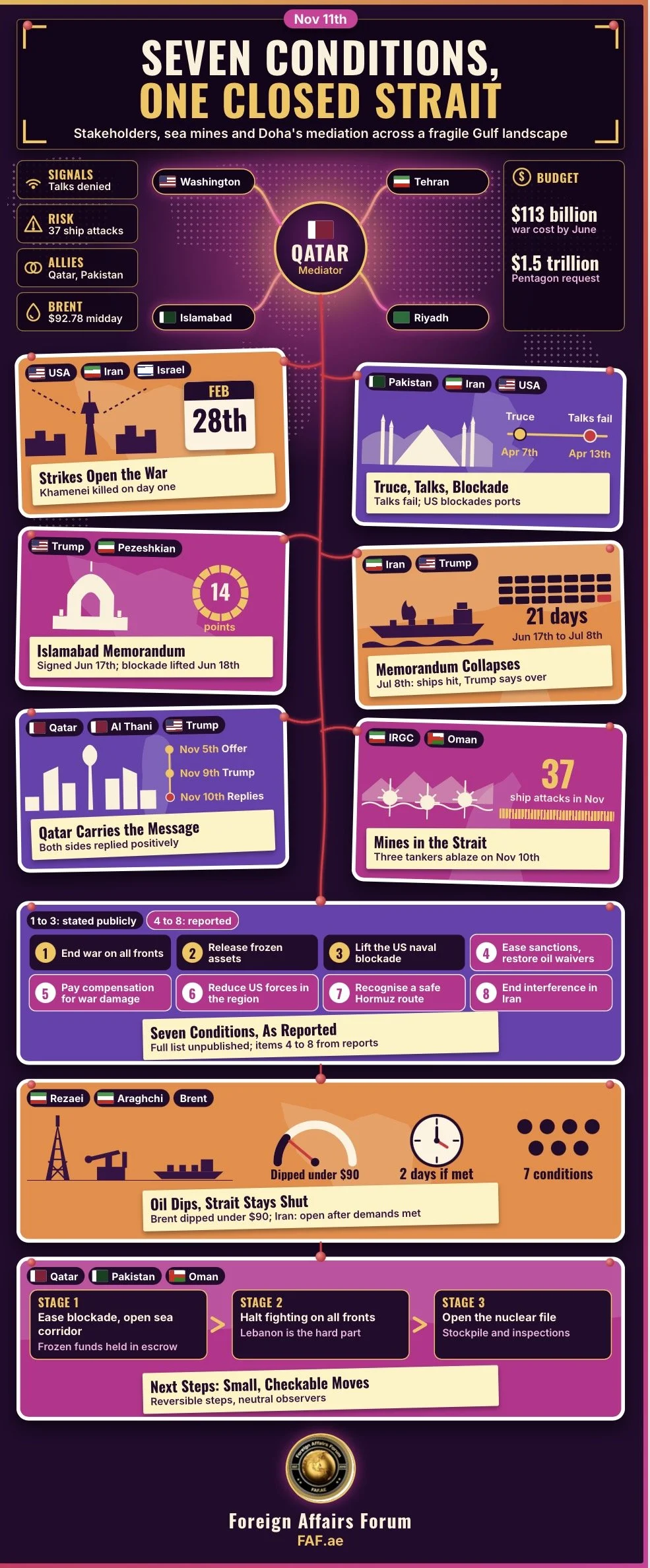
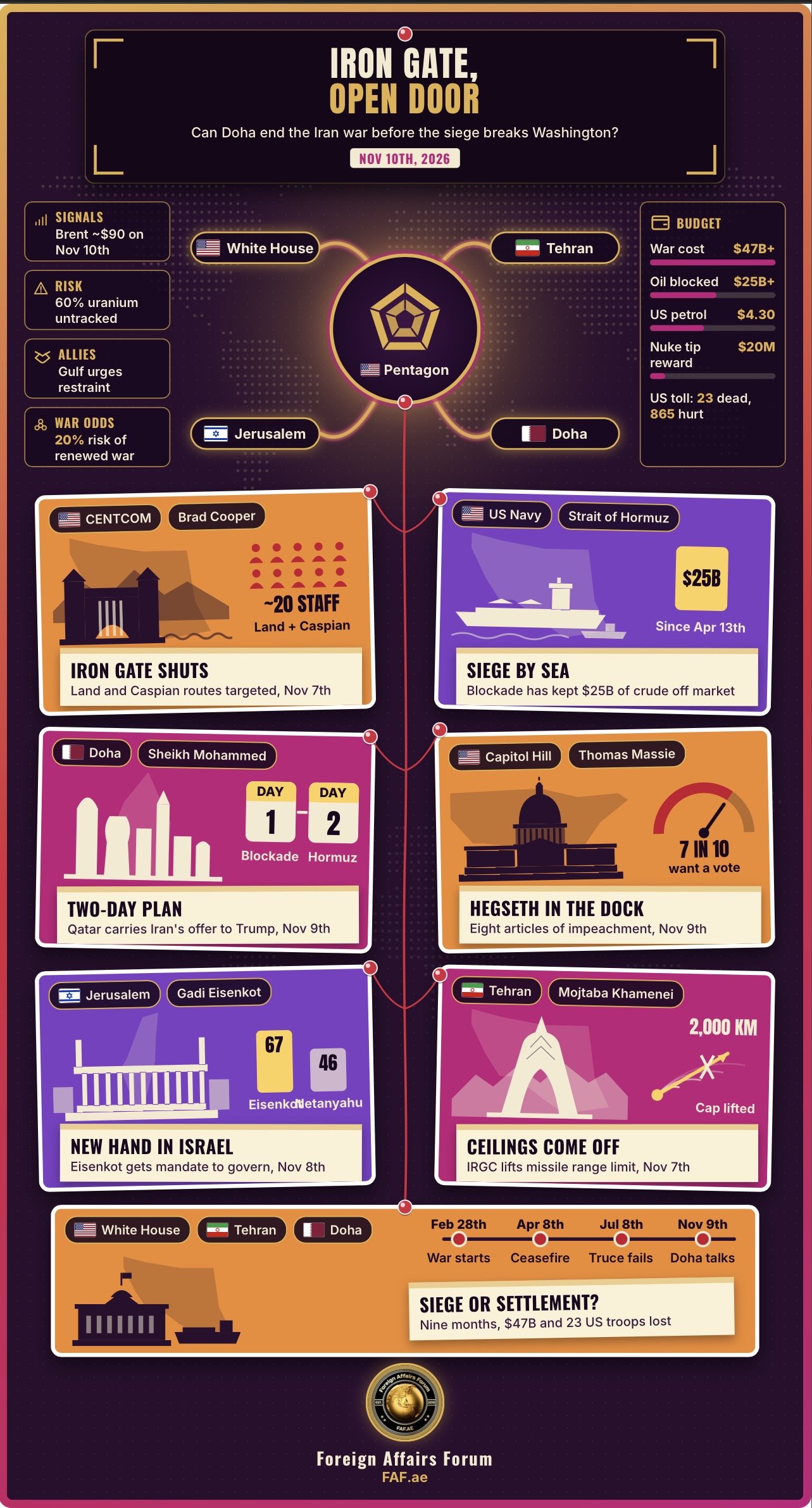
The war between Iran, the United States and Israel is now in its ninth month. It began on Feb 28th, when American and Israeli forces struck Iran.
Since then, the Strait of Hormuz, a narrow sea passage that carries about a fifth of the world's oil, has been mostly closed. The United States has also blocked Iran's ports with its navy. Neither side has found a way out, and ordinary people everywhere are paying the price in higher fuel and energy bills.
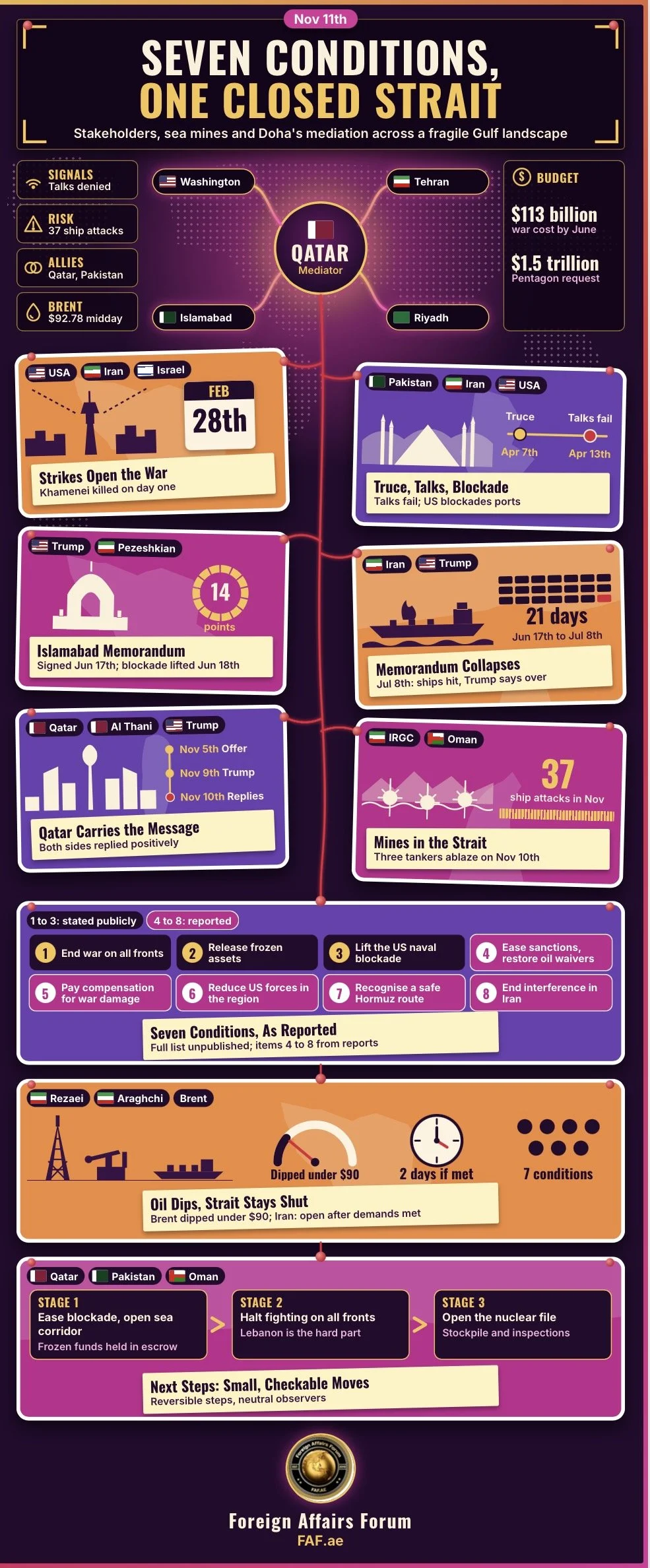
This week, the news centred on a list of seven conditions that Iran has given to the United States. Iran says these conditions must be met before any real talks can start. Mohsen Rezaei, a senior Iranian security official, repeated this on Nov 10th and Nov 11th. He also said that no talks are happening, that no meeting with Vice President JD Vance in Qatar is planned, and that American claims of talks are lies. He said the Strait of Hormuz will stay closed until Iran's conditions are met.
What Iran Wants
Iran has not published the full list. Still, its leaders have named three demands again and again. First, they want the fighting to stop on every front, including Lebanon. Second, they want billions of dollars of frozen Iranian money, held in other countries, to be released. Third, they want the American naval blockade on Iranian ports to end.
Reports say the list also includes the removal of American sanctions, the return of permission to sell oil, payment for war damage, fewer American soldiers in the region, an agreed safe sea route through the strait, and an end to what Iran calls American interference in its affairs. Iran's foreign minister, Abbas Araghchi, said the strait could reopen within two days if the demands are accepted.
What America Says
The United States has a different view. President Trump says there is positive momentum and that the war is effectively over. He also says the American military is ready to strike again if needed, but that doing so is highly unlikely if progress continues. Secretary of State Marco Rubio has called Iran's conditions outrageous and not realistic.
The biggest American demand is that nuclear issues must be part of the first talks. Washington wants to deal with Iran's stock of enriched uranium and to allow inspectors in. Iran says nuclear talks must wait until its conditions are met. It did send a nuclear proposal through Qatar around Nov 5th, but it says that proposal will not be discussed yet. So the real fight is about who goes first.
How We Got Here
To understand today's standoff, it helps to look back. In June 2025, Israel and Iran fought a short twelve-day war. It ended with a ceasefire but solved very little. In early 2026, Iran and America were talking about nuclear issues when the United States built up its largest military presence in the region since 2003. Then came the strikes of Feb 28th. Iran's Supreme Leader, Ali Khamenei, was killed, and his son Mojtaba was named as the new leader on Mar 8th.
Iran struck back at Israel, at American bases and at some Gulf countries, and it closed the strait. A ceasefire arrived in April with the help of Pakistan, but it was weak and soon broke down. Talks in Islamabad failed, and America began its naval blockade. Then, on Jun 17th, the two sides signed the Islamabad Memorandum, a fourteen-point plan to end the war. America lifted the blockade the next day. For a short time, it looked as if peace might hold.
It did not. On Jul 8th, Iran attacked ships in the strait, and President Trump declared the memorandum over. The blockade came back, and so did the sanctions.
Why the Seven Conditions Matter
The seven conditions are Iran's answer to what went wrong in June. Iran believes it gave up too much too soon and that America took back its promises when it was convenient. So now Iran wants real benefits first, such as an end to the blockade and the release of its money. In its view, this would make any deal harder to cancel.
America sees the same history in the opposite way. It believes Iran took the relief it was given and then went back to attacking ships. So America wants to keep its blockade, which it sees as its main source of pressure, until it gets firm nuclear commitments. Both sides are afraid of making the first move and being tricked. This is the heart of the problem.
Who Is Trying to Help
Qatar is the main mediator, and Pakistan is helping too. Qatari officials held long talks in Tehran at the end of October. On Nov 9th, the Qatari prime minister met President Trump in Washington and then went to Paris to meet Saudi and European diplomats. On Nov 10th, Qatar said both Iran and America had given positive replies and that its efforts continue. Even so, Qatar admitted it cannot say whether a deal is near or far. It also warned that winter and the closed strait are making the crisis more costly for the whole world.
What It Means for the World
Oil and gas prices are the first concern. On Nov 10th, the price of Brent crude briefly fell below $90 a barrel, the first time since August, because Trump said new strikes were unlikely. But the strait is still shut, so the fall shows hope, not real change. Europe and Asia are especially exposed as winter begins.
Big powers are also affected. China wants Gulf energy to keep flowing and buys Iranian oil, but it is happy to see America tied down. Russia gains when energy prices stay high and when Western attention moves away from Ukraine.
The Technology Risk
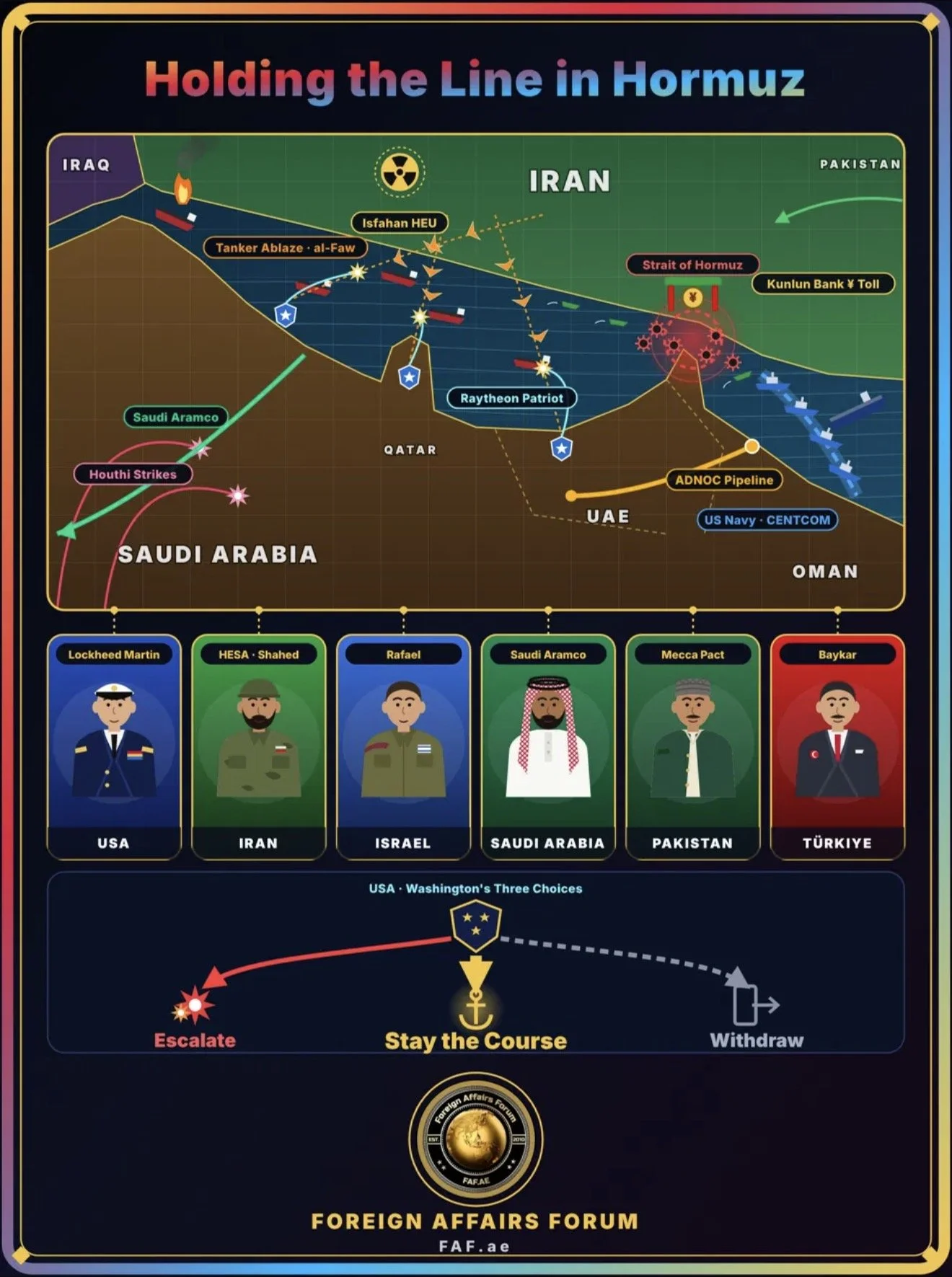
Dr. 🆎, a global expert on superintelligence, who focuses on human-centred approaches to geopolitical strategy, artificial intelligence in warfare and the risk of bioterrorism, says this crisis shows how modern conflict has changed. Cheap sea mines and unmanned boats let a smaller country cause huge damage to a stronger one while denying responsibility. Artificial intelligence can also create fake leaks, false statements and fake images faster than people can check them. In a crisis where one wrong signal could start a clash, being able to tell what is true is a form of power.
Dr. 🆎 also warns that when a war drags on, control over dangerous materials can weaken. This is true for nuclear material, and it is true for dangerous germs and chemicals. He urges any final peace deal to include safeguards for such sites, and rules that keep humans in charge of any decision to use force.
What Could Happen Next
A workable path would be built on small, reversible steps that can be checked by neutral observers. In the first stage, America could allow a limited amount of Iranian oil to be sold, and Iran could open a safe sea corridor. Some frozen money could be placed in a trusted account in Qatar and used only for food and medicine. If either side broke the deal, the steps could be paused.
In the second stage, the sides would work on stopping the fighting everywhere, including Lebanon.
This is hard, because Israel would have to take part and Iran would have to restrain its allies. In the third stage, nuclear talks would begin on a fixed timetable, covering uranium stocks, limits on enrichment and inspections. Each side could then tell its own people that it won. Iran could say its conditions were met first, and America could say that talks only began once ships could move freely.
The Bottom Line
The seven conditions are not just a wish list. They come from a history of broken trust. Both Iran and America are afraid of being the first to give way, and that fear keeps the strait closed and the world on edge. Yet there are signs of hope: Qatar says both sides replied positively, Iran's foreign minister has spoken of a quick reopening, and America's President does not seem eager to restart major attacks.
The way forward is patience and careful design. A deal built on small, checkable steps can let each side move without losing face.
Dr. 🆎 reminds us that the tools shaping this conflict, from drones to fake media, will be present in the next crisis too, so building human oversight and honest verification into our systems is not a luxury. The Strait of Hormuz is the test. If Iran, America and their partners can turn the seven conditions into the first step of a real negotiation, the world may avoid a harsher winter and a wider war.