The New Arms Race: Why Connecting Weapons Now Matters More Than Building Them
Summary
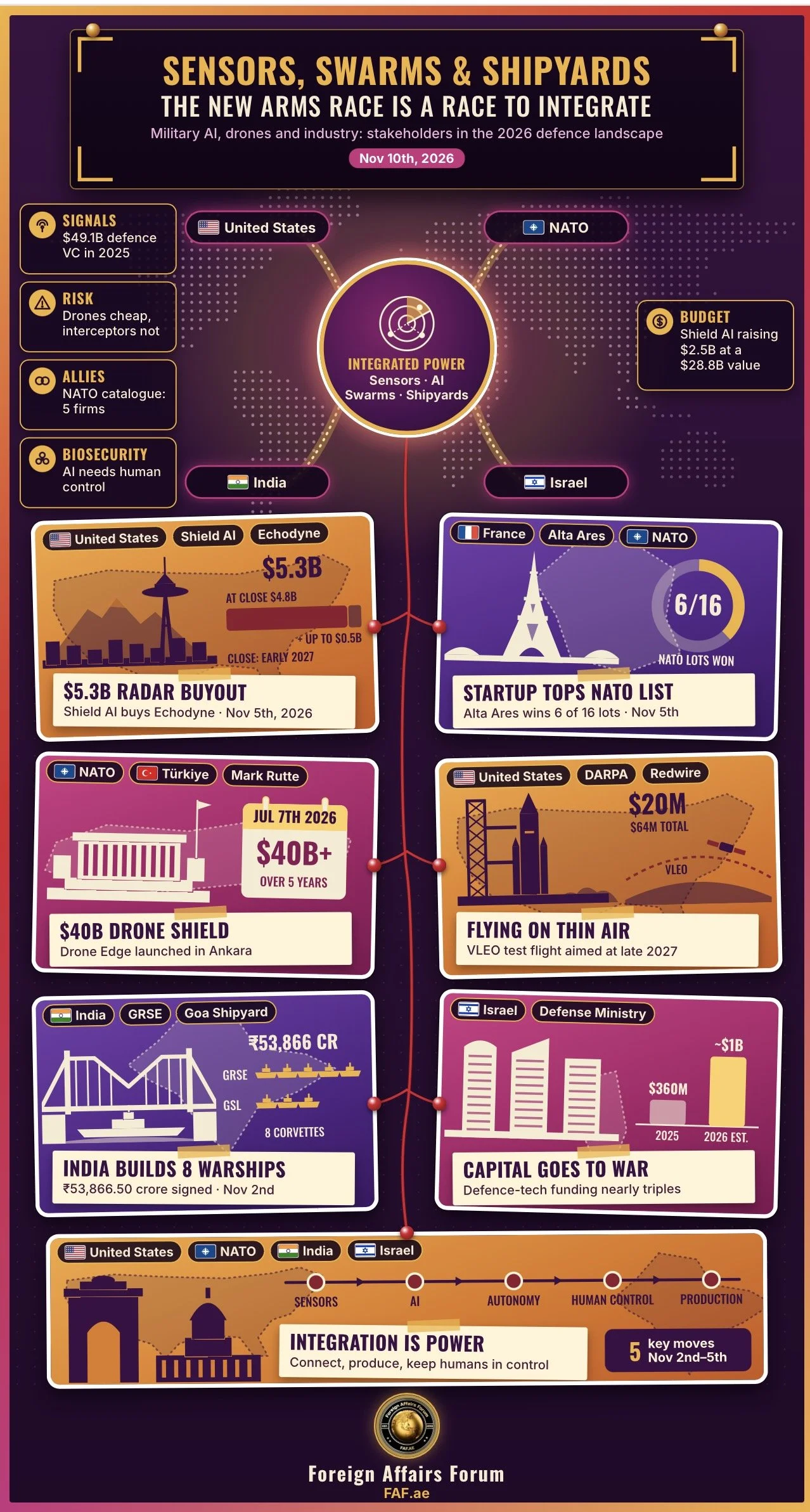
In the first week of November 2026, five pieces of news from around the world told one big story. Wars are changing, and so is what makes a country strong. In the past, military power meant having the biggest ships, the fastest jets or the most missiles. Today, a new idea is taking over: the countries that can best connect their sensors, computers, drones and factories will have the advantage.
Dr. 🆎, an expert in human-centred AI, geopolitics and AI warfare, explains it simply. "In the last century, power was about what you could build," he says. "In this century, power is about what you can connect, and how fast you can produce it."
What Happened in One Week
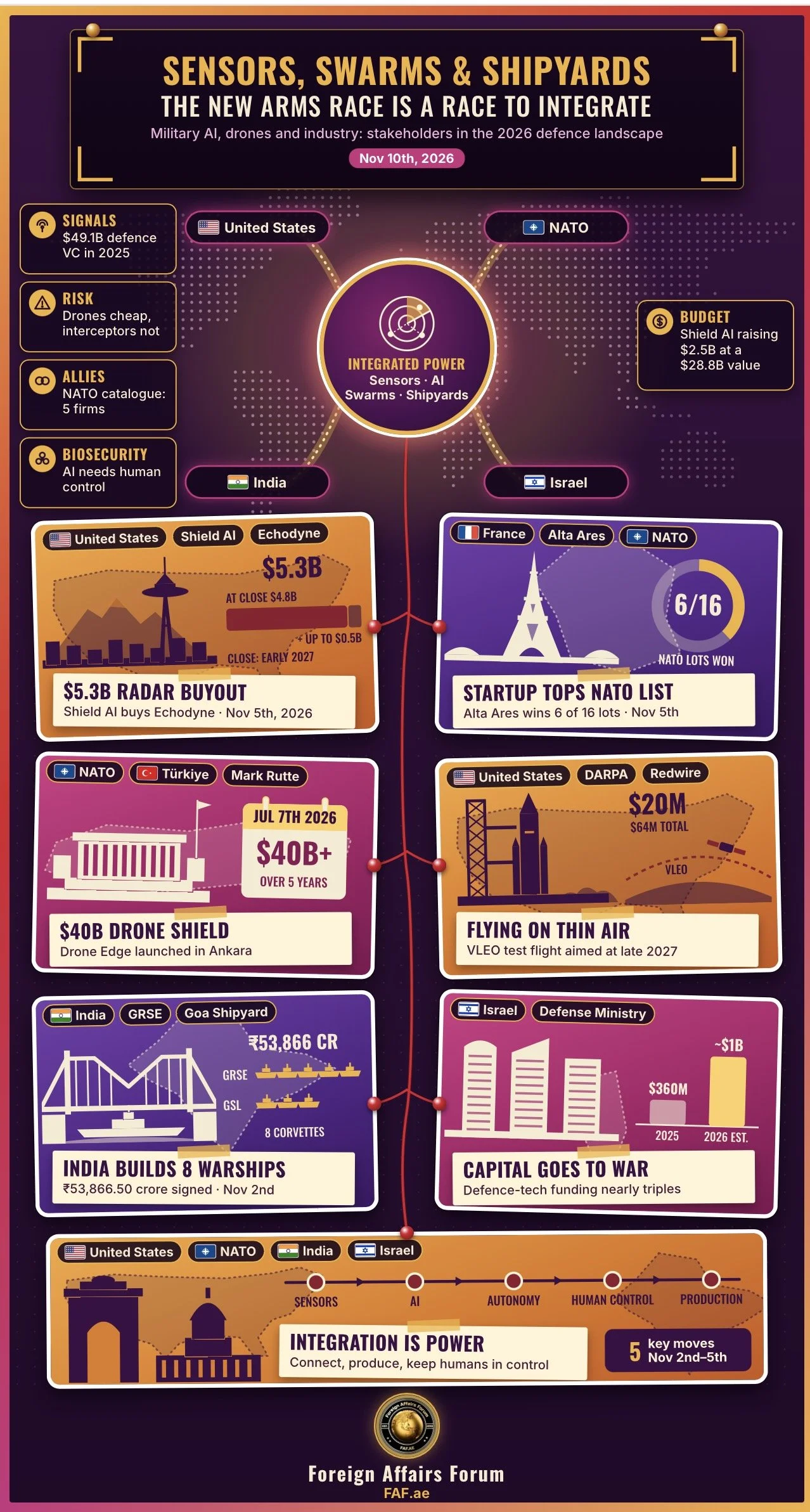
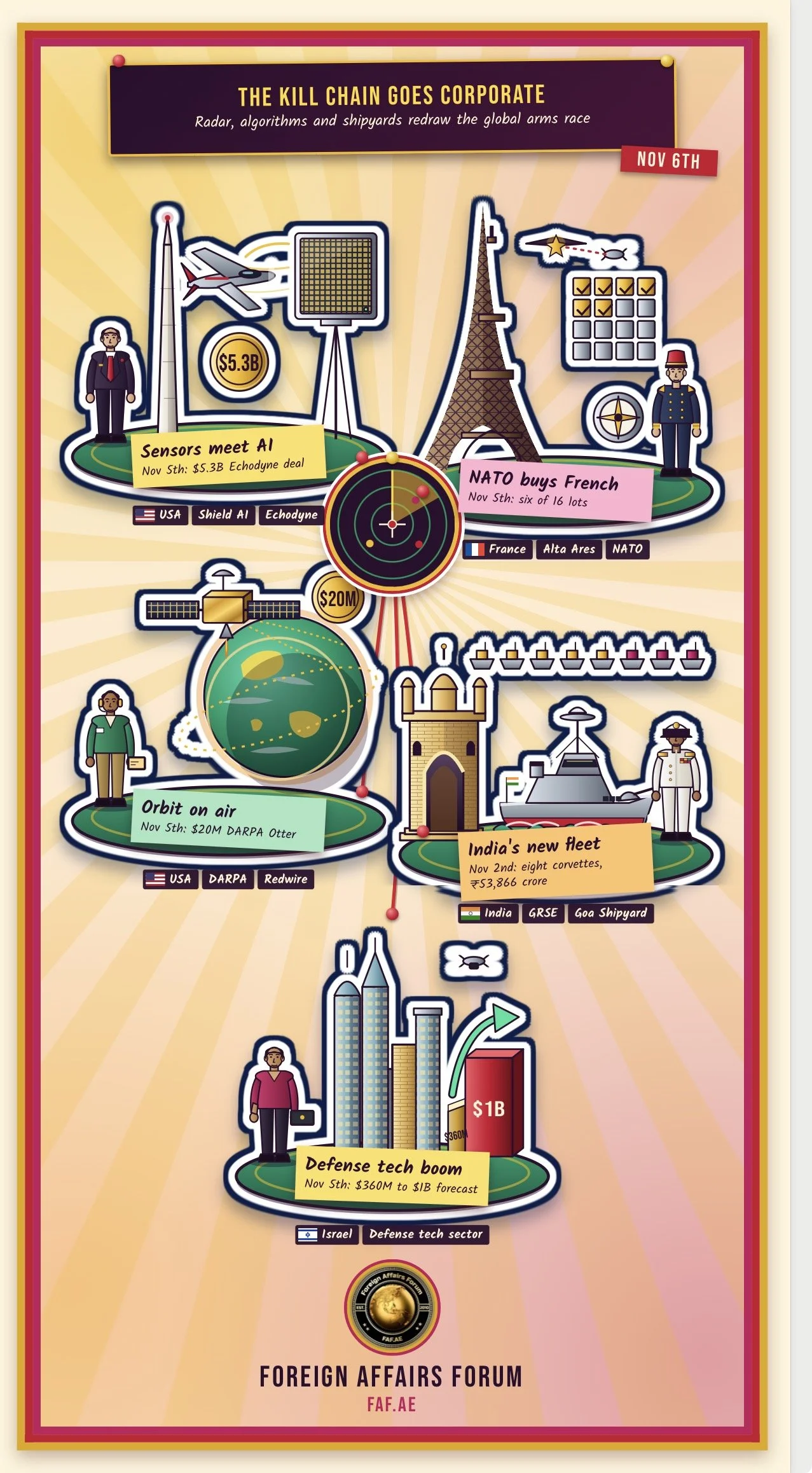
The biggest news came from the United States. On Nov 5th, a defence technology company called Shield AI agreed to buy Echodyne, a company that makes small, advanced radars. The deal is worth up to $5.3 billion. Shield AI will pay $4.8 billion when the deal closes and up to $500 million more if Echodyne meets certain goals. To pay for it, Shield AI is raising $2.5 billion, which now values the company at $28.8 billion, more than double its value in March 2026. The deal is expected to be completed in early 2027.
Why does this matter?
Shield AI makes software called Hivemind that can fly drones and aircraft by itself.
Echodyne makes radars that act like eyes, spotting drones and other threats. By joining the "eyes" and the "brain" in one company, Shield AI hopes to build systems that can detect a threat and respond to it much faster. Echodyne's radars are already used in more than forty countries.
The second piece of news came from NATO, the military alliance of North America and Europe.
On Nov 5th, NATO opened a kind of online shop for anti-drone systems. Member countries can now buy tested anti-drone equipment directly from a NATO list, without running long and slow buying competitions. Five companies were chosen to supply sixteen systems. A young French company called Alta Ares, founded only in 2024, won six of the sixteen places, more than anyone else. Its systems have already been used in Ukraine since 2024.
This shop is part of a bigger NATO plan called Drone Edge, announced in July 2026 in Ankara, Turkey. Under this plan, NATO countries promised to invest more than $40 billion in anti-drone defences over five years.
The third piece of news was about space.
Redwire, an American space company, won a $20 million contract from DARPA, the US military's research agency. The money will pay for a test flight of a small spacecraft that flies very close to Earth, much lower than normal satellites. At these heights there is still a little air, which usually slows satellites down and pulls them back to Earth. The DARPA programme, called Otter, is testing engines that can use that thin air as fuel. The test flight is planned for late 2027 and will last less than a day. If it works, satellites flying lower could take clearer pictures and send data faster.
The fourth piece of news came from India.
On Nov 2nd, India's Ministry of Defence signed contracts worth ₹53,866.50 crore, about $5.6 billion, for eight new warships called Next Generation Corvettes. Garden Reach Shipbuilders and Engineers in Kolkata will build five, and Goa Shipyard Limited will build three. The ships will be able to fight threats in the air, on the sea and under the water. It is the biggest order in Goa Shipyard's history, and the project is expected to create a great deal of work for Indian companies over the next ten years.
The fifth piece of news came from Israel.
Investment in Israeli defence technology start-ups has grown very fast. Industry leaders expect investment to reach about $1 billion in 2026, compared with about $360 million in 2025. Other figures suggest start-ups working with Israel's Ministry of Defense raised even more, nearly $3 billion in the first half of 2026. Israel's government also plans to give at least 10% of its defence research budget to start-ups instead of only to large defence companies.
Why Drones Changed Everything
To understand why all this is happening, look at the war in Ukraine. Since 2022, both sides have used huge numbers of drones. Many cost only a few thousand dollars. But stopping them can cost much more, sometimes hundreds of thousands of dollars or even millions for one missile. This creates a serious problem. An attacker can keep sending cheap drones until the defender runs out of money or missiles.
The same problem has appeared in the Red Sea and in conflicts between Israel and Iran. This is why NATO is spending so much on cheaper ways to stop drones, and why companies like Alta Ares and Echodyne are suddenly so important.
"For many years, Western countries focused on having a few very expensive, very perfect weapons," says Dr. 🆎. "Our rivals focused on having many cheap, good-enough weapons. If we only answer large numbers with small numbers of expensive weapons, we will run out first."
The Role of Artificial Intelligence
Artificial intelligence is at the centre of this change. AI can look at radar and camera data and spot threats faster than any person. It can fly drones, guide interceptors and coordinate many machines at once. In January 2026, the US Department of Defense told its forces to become "AI-first".
But this raises hard questions. If machines can find and stop threats in seconds, how much control should humans keep? For defending a base against hundreds of incoming drones, humans cannot approve every single shot, so machines must act quickly. But the same technology could also be used to choose targets for attacks. Earlier in 2026, a public dispute between the Pentagon and the AI company Anthropic showed that even in the United States, people do not agree on where to draw the line.
"Connecting everything is powerful," says Dr. 🆎. "But we must also connect the human conscience to the system. A weapon that is perfectly connected but not properly controlled is a danger to everyone."
Money, Factories and Independence
Another big change is money. Investors used to avoid defence companies. Now they are pouring billions into them. In 2025, investment in defence technology start-ups reached about $49.1 billion worldwide, nearly double the year before. This helps new ideas reach soldiers faster. But it also brings risks. Company values can rise too fast, like a bubble, and a few large new companies may end up controlling too much.
Countries also want to make their own weapons instead of buying them from abroad. India's warship contracts are a good example. Building ships at home creates jobs, builds skills and means India does not have to depend on other countries during a crisis. Europe and the United States are trying to do the same.
"For India, these warships are about more than eight ships," says Dr. 🆎. "They are about building the skills, factories and suppliers that will create the next generation of ships, including ships with no crew at all."
What Should Happen Next
Experts suggest several steps. First, governments should buy new technology faster, as NATO is now doing with its anti-drone shop, but they must still test it carefully. Second, countries need factories that can produce large numbers of weapons and parts quickly, especially in a long war. Third, lawmakers should set clear rules about how much freedom machines have to use force, and allies should agree on the same rules. Fourth, governments should make sure that a small number of companies do not gain too much control. Fifth, countries should agree on rules for space, because more military satellites flying close to Earth could lead to accidents or misunderstandings.
The Bottom Line
The news from one week in November 2026 shows that the world's military competition is changing. It is no longer only about who has the best single weapon. It is about who can connect radars, computers, drones, ships and factories into one strong system, and keep it running for a long time.
"The countries that win the future will be the ones that connect everything while keeping humans responsible," says Dr. 🆎. "Speed is important. But wisdom is what keeps speed from becoming a disaster."