Sensors, Swarms and Shipyards: The New Arms Race Is a Race to Integrate
Foreign Affairs Forum | Dr. Antonio Bhardwaj (Dr. 🆎)| November 10th, 2026
Executive Summary
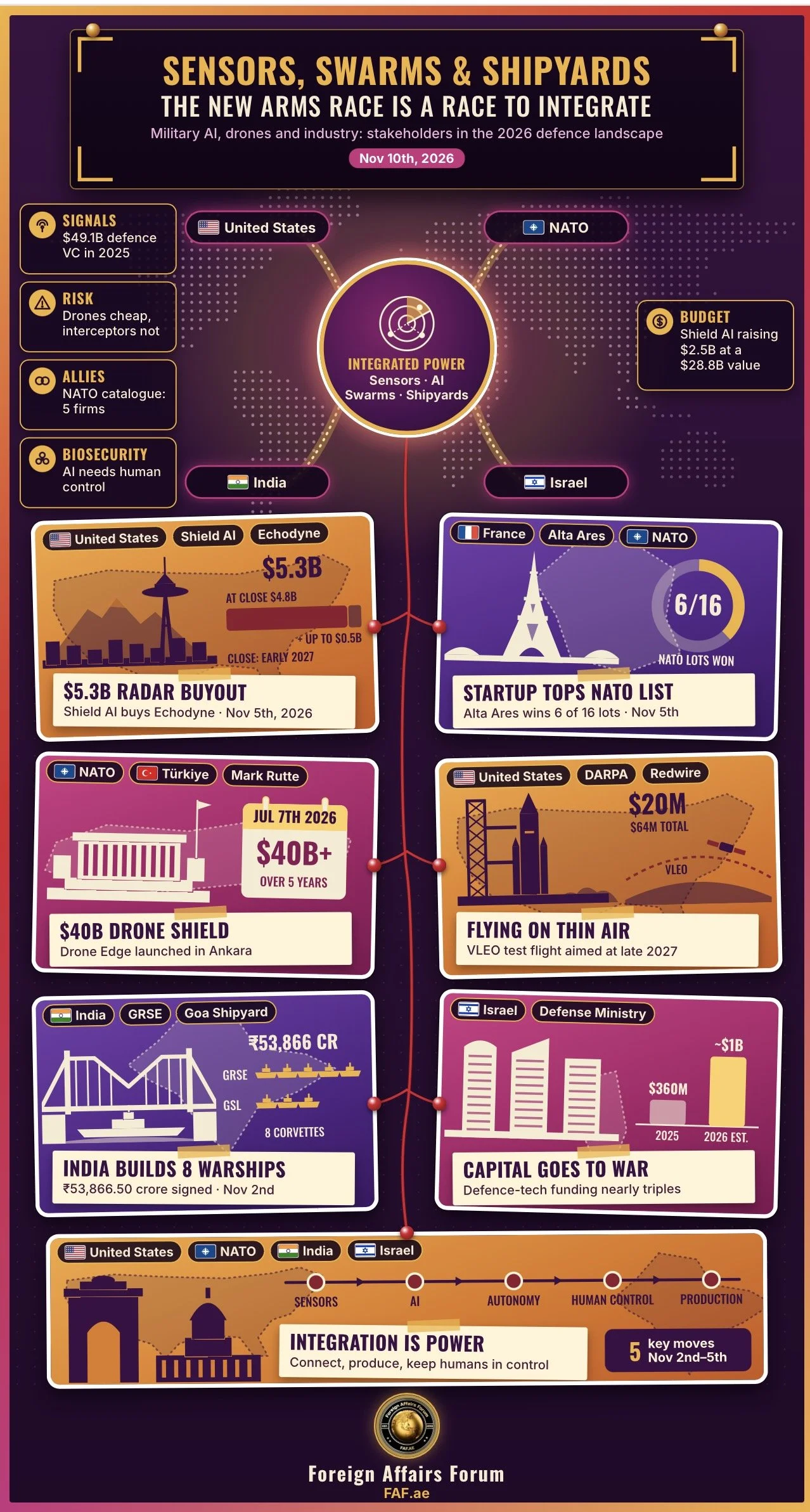
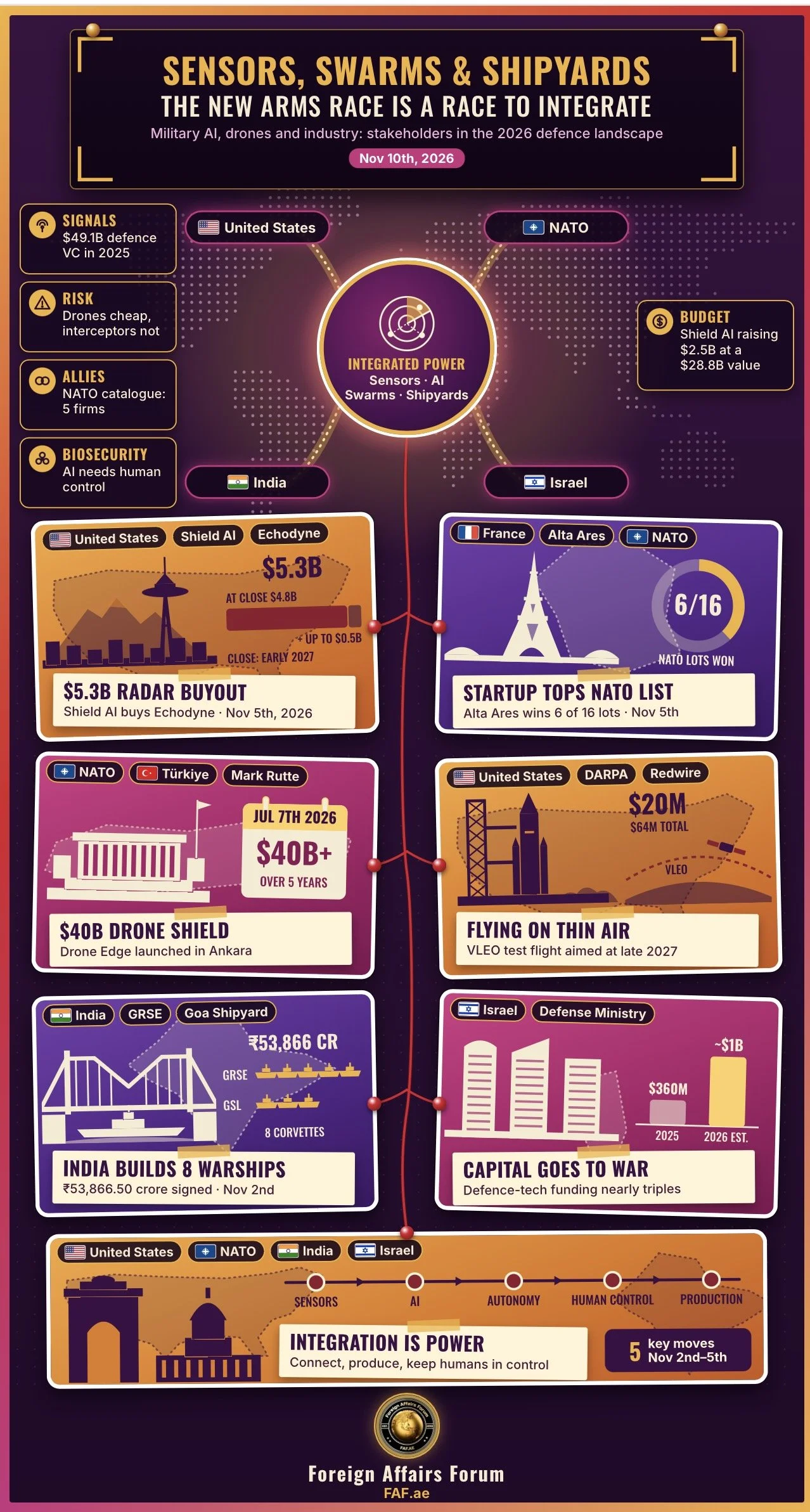
In the first week of November 2026, five announcements on three continents showed how military power is now being redefined.
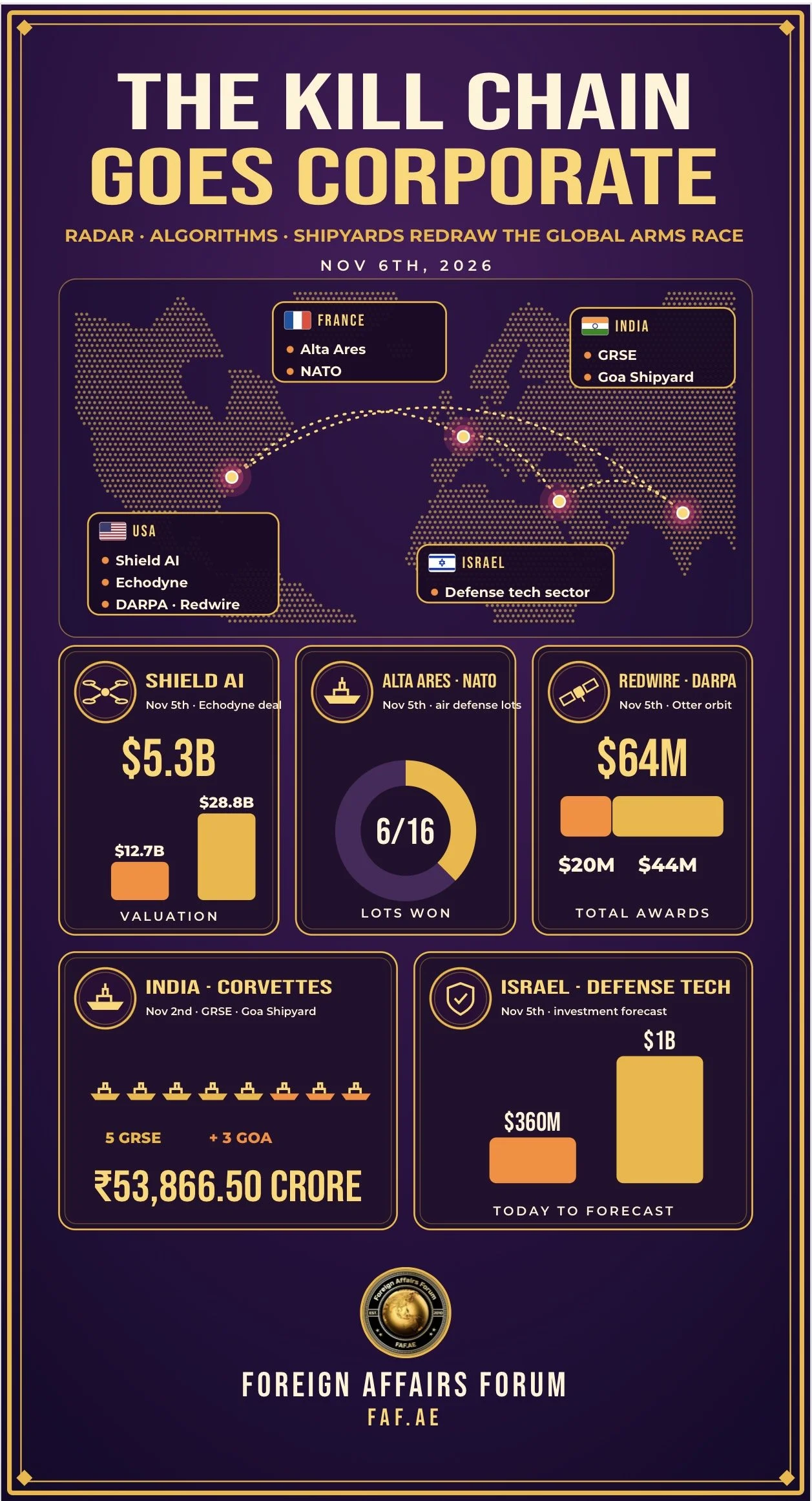
On Nov 2nd, India signed contracts worth ₹53,866.50 crore, roughly $5.6 billion, for eight Next Generation Corvettes, to be built entirely in Indian state shipyards. On Nov 5th, the American defence technology company Shield AI agreed to acquire the radar maker Echodyne in a deal valued at up to $5.3 billion.
On the same day, NATO opened a counter-drone marketplace in which the young French firm Alta Ares won six of sixteen lots. That week, Redwire also received a $20 million award from DARPA to fly a second experimental spacecraft in very low Earth orbit. Meanwhile, Israel's defence technology sector reported a surge of venture investment that has turned a niche field into a strategic industry.
Each development is significant on its own. Together they point to a larger change. Military advantage is moving away from owning individual weapons and toward the ability to integrate sensors, artificial intelligence, autonomous platforms, human oversight and industrial-scale production into resilient operational networks.
The decisive question of the coming decade is no longer only who builds the most advanced drone, radar or warship. It is who can connect them, manufacture them affordably, and sustain them through prolonged conflict without losing democratic control over how they are used.
This FAF article traces how that shift emerged, analyses its causes and consequences, and sets out what governments, investors and allied institutions should do before integration becomes concentration and speed overtakes judgement.
Introduction
Every era of warfare has its defining measure of power. In the early 20th century it was the battleship and the tonnage of fleets. In the Cold War it was the number of warheads and the reach of delivery systems. In the opening decades of the 21st century, precision-guided munitions and networked command systems became the language of advantage. Now a further change is under way, driven by three forces: inexpensive drones that have transformed the battlefields of Ukraine and the Middle East, artificial intelligence that can process sensor data faster than any human staff, and an influx of private capital that has created a new class of defence technology companies able to challenge established prime contractors.
Dr. Antonio Bhardwaj (Dr. 🆎), a polymath with global expertise in Super Intelligence who specialises in human-centred SI for geopolitical strategy, AI warfare and bioterrorism risk, frames the moment precisely. "The 20th century measured military power by what a nation could build," Dr. 🆎 observes. "The 21st century will measure it by what a nation can connect. A radar that cannot speak to an autonomous interceptor, or an interceptor that cannot be produced by the thousand, is a museum piece in waiting. Integration, at the speed of software and the scale of industry, is the new currency of deterrence."
The developments of early November 2026 should be read in that light. They are not isolated corporate deals or procurement notices. They are moves in a structural competition between technological ecosystems, in which the United States, Europe, India and Israel are each trying, in different ways, to align private innovation, public procurement and sovereign industrial capacity. The stakes extend well beyond defence ministries. They affect alliance cohesion, the economics of deterrence, and the unresolved question of how much authority humans should keep over machines that can detect, decide and strike in seconds.
History and Current Status: From Platforms to Ecosystems
The idea that integration matters more than individual platforms is not new.
In the 1970s and 1980s, Soviet military theorists described an emerging "reconnaissance-strike complex", in which sensors, communications and precision weapons would combine to make conventional forces as decisive as nuclear ones. American planners turned similar ideas into the second "offset strategy", which produced stealth aircraft, satellite navigation and guided munitions. The 1991 Gulf War demonstrated the result to the world. Networked precision allowed a coalition to dismantle a large conventional army with remarkable speed.
For the next three decades, the Western model of military power rested on a small number of very expensive, highly capable platforms built by a consolidated group of prime contractors.
Mergers in the 1990s cut the number of major American defence suppliers dramatically. Each new fighter, destroyer or air defence system took a decade or more to develop and cost billions. That model assumed high-end conflicts would be short and decided by technological quality rather than quantity.
The war in Ukraine overturned that assumption.
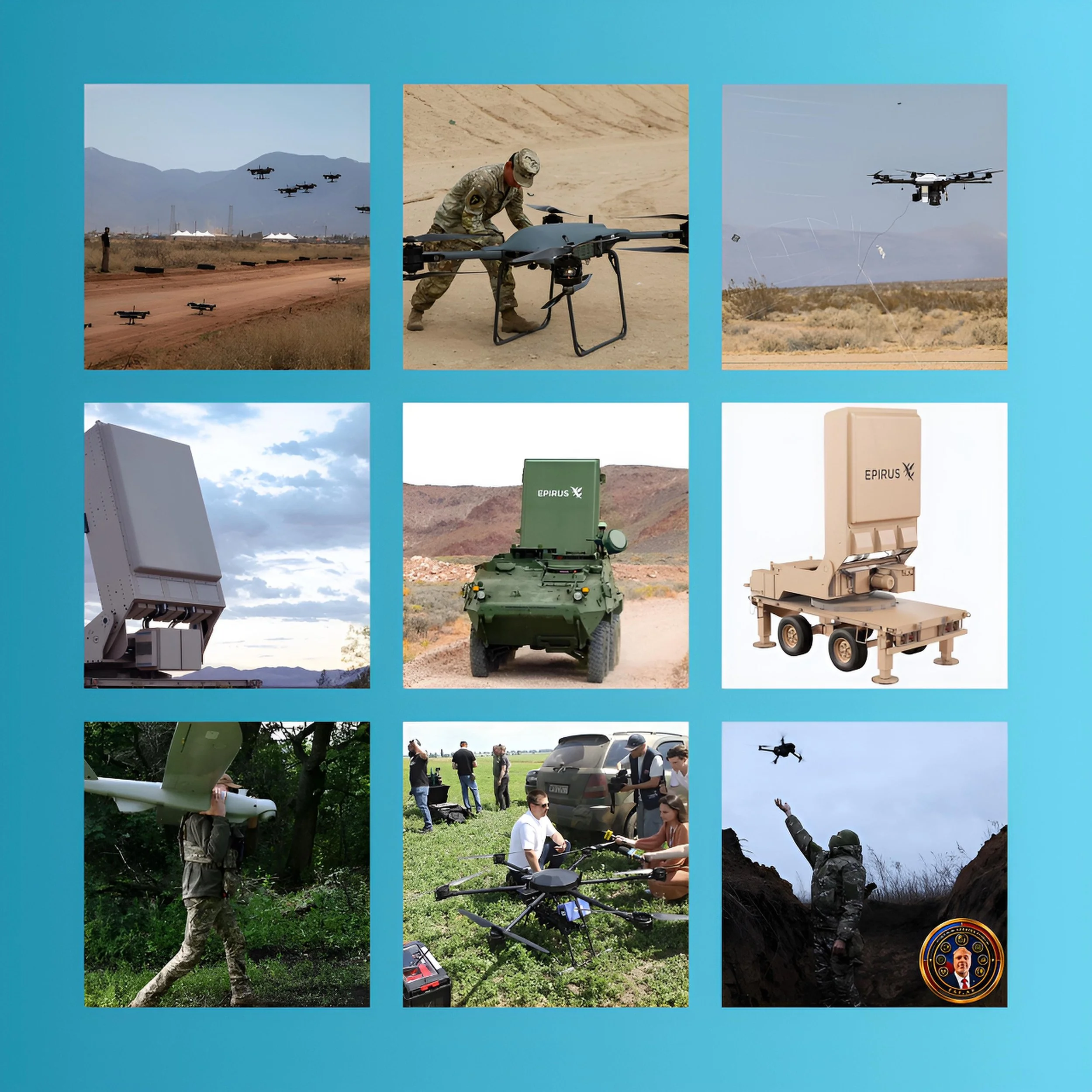
Since 2022, both sides have used drones by the hundreds of thousands, from commercial quadcopters fitted with explosives to long-range attack drones of the Shahed type. Cheap unmanned systems now account for a large share of battlefield casualties and have exposed a severe cost imbalance. Defenders often spend interceptors worth hundreds of thousands or millions of dollars to destroy drones worth a few thousand. Similar patterns appeared in the Red Sea, where naval forces used expensive missiles against inexpensive drones, and in the exchanges between Israel and Iran. The lesson was blunt: quantity has a quality of its own, and a defence model built on scarce, exquisite interceptors cannot be sustained against mass.
At the same time, artificial intelligence moved from research laboratories into operational systems.
Autonomy software can now pilot aircraft, coordinate swarms, fuse radar and optical data, and select defensive responses in timeframes that leave little room for human deliberation. In January 2026, a Pentagon strategy memo directed the American military to become an "AI-first" warfighting organisation. The ensuing public dispute between the Department of Defense and the AI company Anthropic, over whether commercial models could be used for "all lawful purposes" or must keep limits on mass domestic surveillance and fully autonomous weapons, showed that the governance of military AI remains deeply contested even inside democracies.
Capital followed the technology.
Venture investment in defence technology reached about $49.1 billion in 2025, nearly double the previous year. New companies such as Anduril and Shield AI reached valuations once reserved for established contractors. By November 2026, the defence landscape has become a hybrid. Traditional primes still dominate large platforms such as ships, fighters and missiles. Venture-backed challengers increasingly shape software, autonomy, sensors and counter-drone systems, and governments are redesigning procurement to absorb innovation faster.
Key Developments: Five Signals From One Week
The most consequential development is Shield AI's agreement on Nov 5th to acquire Echodyne, the Kirkland, Washington maker of compact electronically scanned radars.
The deal is valued at up to $5.3 billion. Of that, $4.8 billion is paid at closing and up to $500 million more depends on Echodyne meeting agreed performance targets. Shield AI is raising $2.5 billion to finance the purchase: a $1 billion Series H round at a post-money valuation of $28.8 billion, $1 billion in structured equity from funds managed by Blackstone, and $500 million in debt. That valuation is more than double the $12.7 billion at which the company was marked in March 2026. The deal is expected to close in early 2027. Echodyne's radars are already used by defence, government and commercial customers in more than forty countries. Shield AI brings the Hivemind autonomy software and the V-BAT and X-BAT aircraft.
The strategic logic is vertical integration.
Autonomous systems must perceive before they can act, and better sensors directly improve their performance. By owning both the "eyes" and the "brain", Shield AI aims to shorten the gap between detecting a threat and responding to it, and to offer customers a complete counter-drone and autonomous capability rather than components that must be stitched together by others. It is the clearest sign yet that venture-backed defence companies intend to compete with established primes as full system integrators.
"This is the defence equivalent of a technology company buying its own chip designer," says Dr. 🆎. "Whoever controls the full stack, from sensor to decision to effect, controls the tempo of the engagement. The danger is that tempo becomes the only metric. Integration must also include the human checkpoint, or we will have built systems that are perfectly connected and imperfectly accountable."
The second development is NATO's launch on Nov 5th of a counter-drone marketplace.
Allies can now buy preselected counter-drone systems directly from a NATO catalogue without running separate tenders. The NATO Communications and Information Agency selected sixteen solutions from five companies: Alta Ares, Axon Enterprise, Northrop Grumman, OSL UK and Quantum Systems. Alta Ares, founded only in 2024, won six of the sixteen lots, covering area defence and border protection. It was the only supplier selected for area defence across fixed, deployable and mobile configurations. Its systems, which use AI-assisted detection and hard-kill interceptors, have been operationally deployed in Ukraine since 2024. NATO has also allocated €3.1 million to fund further testing of the selected systems by allies.
The marketplace is part of NATO's Drone Edge initiative, launched by Secretary General Mark Rutte at the NATO Summit Defence Industry Forum in Ankara on July 7th, 2026.
Under it, allies committed to invest more than $40 billion in counter-drone capabilities over five years and to train five times as many drone operators by the end of 2027. A framework award does not guarantee purchases. Its importance lies in shortening procurement cycles that have historically stretched for years, and in opening the alliance's market to young companies whose products were shaped by combat data rather than laboratory requirements.
The third development is in orbit.
On Nov 5th, Redwire announced a $20 million DARPA contract under the Otter programme to fly a precursor test of a scaled version of its SabreSat spacecraft in very low Earth orbit. The award adds a second flight to the programme and brings Redwire's total announced Otter funding to $64 million, building on a $44 million contract from November 2025 to build and deliver the full-scale spacecraft. Otter is developing air-breathing electric propulsion, which uses the thin atmosphere at very low altitudes as propellant so satellites can stay in orbits where drag would normally pull them down quickly. The subscale mission is targeting a launch in late 2027 and will fly for less than a day to test critical technology. The work remains experimental. The strategic attraction is clear: satellites flying much closer to Earth could offer sharper surveillance, lower communications latency and faster revisit times, all of which matter for missile tracking and targeting.
The fourth development is industrial and maritime.
On Nov 2nd, India's Ministry of Defence signed contracts worth ₹53,866.50 crore for eight Next Generation Corvettes. Garden Reach Shipbuilders and Engineers in Kolkata will build five, with its share valued at about ₹32,000 crore, and Goa Shipyard Limited will build three. The contracts were signed in New Delhi in the presence of Defence Secretary Rajesh Kumar Singh. It is the first Navy-designed warship project awarded to defence public sector shipyards through competitive bidding.
The multi-role corvettes, equipped with advanced missiles, weapons and sensors for air, surface and underwater warfare, are expected to replace the ageing Khukri and Kora class vessels. They are projected to generate about 5.32 crore person-days of employment over ten years across shipyards and their supplier networks. For Goa Shipyard, the order is the largest in its history.
The fifth development concerns capital.
Israel's defence technology sector has become one of the world's most dynamic, and investment figures differ by measure. Industry representatives have projected that investment in the sector could approach $1 billion in 2026, compared with about $360 million in 2025. Broader figures presented to investors in Haifa, which include startups working directly with the Ministry of Defense, suggest those companies raised nearly $3 billion in the first half of 2026 alone.
Ministry orders to defence startups reached about $330 million in the first half of the year, double the same period of 2025, and roughly eight hundred startups are now fulfilling direct procurement orders. Whatever the precise number, the direction is unmistakable.
Private capital is becoming a central engine of Israeli military innovation, and the ministry has committed to send at least 10% of its research and development budget to startups rather than to the three large state-linked defence companies.
Latest Facts and Concerns: The Hidden Risks Behind the Headlines
The first concern is the economics of the counter-drone fight.
The core problem NATO is trying to solve is cost asymmetry. When an attacker can launch drones costing a few thousand dollars and a defender must answer with interceptors costing many times more, the attacker can bankrupt a defence without ever breaking through it. Companies such as Alta Ares promise cheaper, scalable interceptors and AI-assisted engagement. But affordability at the scale of tens of thousands of units depends on supply chains for electronics, sensors, batteries and propulsion that remain fragile, and in many cases dependent on Chinese components. A counter-drone shield that cannot be replenished in wartime offers only the illusion of security.
"Mass is back as a strategic variable," Dr. 🆎 warns. "For thirty years the West optimised for scarcity: a small number of perfect weapons. Our adversaries have optimised for abundance: enormous numbers of good-enough weapons. If we answer abundance only with brilliance, we will run out of brilliance before they run out of drones."
The second concern is valuation and concentration.
Shield AI's valuation more than doubled in eight months. Its competitor Anduril was reported earlier in 2026 to be seeking capital at a valuation around $60 billion. Such figures reflect real demand and real capability, but they also carry the familiar risks of speculative cycles. If valuations are built on expected government contracts that do not arrive, or on technologies that fail in combat, the consequences could reach beyond investors to national readiness. And as new champions buy up specialist suppliers, the defence technology landscape could consolidate into a new oligopoly of software-defined primes, reproducing the concentration that venture capital was supposed to break.
The third concern is the governance of autonomy. Integrating radar, AI and autonomous interceptors into a single system shrinks the time available for human judgement. For defence against incoming drones, that compression may be unavoidable and largely uncontroversial: no human can approve each of hundreds of intercepts per minute. But the same architectures can move from defending a base to selecting targets for offensive strikes. The Pentagon and Anthropic dispute showed that even in the United States there is no settled consensus on where autonomy should stop. International efforts to regulate lethal autonomous weapons at the United Nations have made slow progress, while the technology advances by the quarter.
The fourth concern is the militarisation of near-Earth space.
Very low Earth orbit is attractive because it brings sensors closer to targets, and that is exactly why it will be contested. Persistent, low-altitude surveillance could make it harder for any state to hide mobile missile launchers or naval movements. That might strengthen deterrence by reducing uncertainty, or weaken stability by making second-strike forces seem vulnerable. As more states and companies move into these orbits, the risks of debris, interference and miscalculation will rise. The legal framework for military activity in space was largely written in the 1960s and was not designed for fleets of manoeuvring, low-flying orbital drones.
The fifth concern is execution in industrial programmes.
India's corvette contracts are a major statement of indigenous capability, but Indian naval shipbuilding has often faced delays in design finalisation, equipment integration and delivery. The value of the programme will depend on whether the shipyards can deliver on schedule, whether domestic suppliers of propulsion, radar and weapons can meet quality and volume requirements, and whether the vessels can be integrated with the wider networked architecture the Indian Navy is building. A warship delivered years late into an ocean already shaped by drones and long-range missiles may face a very different threat than the one it was designed for.
"For India, the corvettes are about more than hulls," Dr. 🆎 emphasises. "They are a test of whether a large democracy can turn industrial policy into deployable power across the Indian Ocean. The real prize is not eight ships. It is the ecosystem of designers, suppliers and integrators that will build the next eighty, including autonomous surface and underwater vessels that may soon matter as much as crewed ships."
Cause and Effect Analysis: Why Integration Has Become Destiny
The first root cause is the battlefield itself. Ukraine and the conflicts of the Middle East have shown that cheap drones, commercial electronics and rapid software updates can impose large costs on sophisticated militaries. The effect has been a scramble to field counter-drone defences quickly and in volume. Procurement systems built for decade-long programmes have struggled to keep up, which explains NATO's move toward catalogues and frameworks that let allies buy proven systems without restarting competitions. The Drone Edge commitment of more than $40 billion over five years is a direct institutional response to a lesson written in battlefield losses.
The second cause is technological convergence. Advances in AI, edge computing, compact radar and sensor fusion mean the most valuable military capability is often the software and data architecture that connects platforms rather than the platform itself. That changes the incentives for companies. A firm with excellent autonomy software but no sensors depends on partners. A firm with excellent radars but no autonomy risks becoming a commodity supplier. The Shield AI and Echodyne deal follows from this logic: owning more of the stack improves performance, captures more value and strengthens bargaining power with governments.
The third cause is the arrival of private capital at scale. Defence was once an unattractive sector for venture investors, burdened by slow procurement, ethical concerns and limited exits. The combination of war in Europe, tensions in the Indo-Pacific, rising defence budgets and visible commercial success has reversed that view. The effect is a faster innovation cycle, as startups can develop specialised technology quickly while established manufacturers provide production capacity and access to government procurement. Israel's experience shows the model clearly: a dense network of startups, a ministry that buys directly from them, and investors willing to fund growth on the strength of combat-proven performance.
The fourth cause is the return of sovereignty as an industrial priority. The disruptions of the COVID pandemic, sanctions on Russia, and competition with China have convinced many governments that depending on foreign suppliers for critical military capabilities is a strategic vulnerability. India's emphasis on building warships domestically, Europe's push to strengthen its own defence industrial base, and American efforts to secure supply chains for munitions and electronics all reflect this. The effect is a partial fragmentation of the global defence market into regional and national ecosystems, even as alliances try to keep interoperability.
The fifth cause, less visible but no less important, is a changing relationship between the state and private technology companies. In earlier eras, governments largely defined requirements and contractors built to specification. Today, companies often develop capabilities first and persuade governments to buy them, and some, as the Anthropic dispute illustrated, try to set limits on how their technology is used. The effect is a new bargaining relationship in which control over military capability is shared, and sometimes contested, between elected governments, defence ministries, investors and engineers.
The combined effect of these causes is a new hierarchy of power. States that can integrate sensors, AI, autonomous platforms, human oversight and industrial production into a coherent system will gain an advantage that cannot be bought through individual acquisitions. States that cannot will find their expensive platforms increasingly vulnerable to cheaper, networked threats. Alliances that pool procurement and standards, as NATO is trying to do, will be stronger than the sum of their members. Alliances that fragment into competing national ecosystems will waste resources and lose interoperability.
"The strategic chain now runs from sensor to software to swarm to shipyard," Dr. 🆎 concludes. "Break any link and the whole system weakens. Our adversaries understand this. The question is whether democracies can build such chains without sacrificing the oversight, accountability and alliance trust that are their real strategic advantages."
Future Steps: Building Integrated Power Responsibly
The first priority is to make procurement as fast as technology without making it careless.
NATO's counter-drone marketplace is a promising model and should be extended to other fast-moving categories such as electronic warfare, small satellites and autonomous maritime systems. Speed must be matched by rigorous testing in realistic conditions, including against electronic jamming and deception. The €3.1 million NATO has set aside for further testing is a modest start. Shared allied test ranges and transparent evaluation data would let smaller allies buy confidently without duplicating expensive trials.
The second priority is industrial depth.
Integration means little if systems cannot be produced and replenished in large numbers during a prolonged conflict. Governments should sign multi-year contracts that give manufacturers the confidence to expand capacity, invest in domestic production of critical components such as radar modules, batteries and microelectronics, and maintain strategic stockpiles. India's corvette programme, with its projected crores of person-days of employment across supplier networks, shows how industrial policy can build wider ecosystems. Its success should be measured by delivery schedules and supplier quality, not by contract signing ceremonies.
The third priority is clear rules on autonomy and human control.
Legislatures, not only defence ministries or vendors, should set the boundaries for autonomous weapons, distinguishing defensive interception, where machine speed is essential, from offensive targeting, where meaningful human judgement must be kept. Allies should harmonise these rules to avoid a race to the bottom and to preserve interoperability. Testing should explicitly measure automation bias, the tendency of operators to defer to machine recommendations under pressure, because a system that is technically supervised but practically unchallenged offers little real oversight.
The fourth priority is responsible capital.
Venture investment has accelerated defence innovation, but governments and investors should guard against bubbles and excessive concentration. Competition authorities should scrutinise acquisitions that could lock in control over critical layers of the defence technology stack. Programmes like Israel's commitment to direct a share of research funding to startups, and NATO's catalogue approach, can help keep markets open to new entrants. Investors, in turn, should insist on governance standards covering export controls, use restrictions and cybersecurity.
The fifth priority is stability in space.
As very low Earth orbit becomes militarily valuable, states should begin negotiating norms on safe operations, debris prevention, notification of manoeuvres and the avoidance of interference with early-warning systems. Experimental programmes such as Otter should be paired with transparency measures that reduce the risk of misinterpretation, especially during crises.
"The goal is not to win an arms race at any cost," Dr. 🆎 argues. "It is to build deterrence that is credible, affordable and controllable. Integration without governance produces fragile power. Governance without integration produces irrelevant principles. The task of this decade is to achieve both at once."
Conclusion
The first week of November 2026 offered a compact portrait of a world in strategic transition.
An American autonomy company bought a radar maker to control more of the kill chain. NATO opened its market to battle-tested counter-drone startups. DARPA pushed experimental spacecraft toward the edge of the atmosphere. India committed billions to building warships at home. Israeli investors poured capital into military innovation. Behind each headline sits the same message: future military superiority will belong to those who can integrate artificial intelligence, advanced sensors, autonomous systems and manufacturing capacity into resilient networks, and who can sustain those networks through long and costly conflict.
That reality creates opportunity and danger.
It offers democracies a way to counter adversaries who rely on mass and speed, to strengthen allied cooperation, and to revitalise industrial bases. It also risks compressing human judgement, concentrating power in a small number of companies, and extending competition into new domains such as low orbit before rules exist to manage it. "The measure of military power has changed," Dr. 🆎 concludes. "It is no longer the single weapon but the connected whole, and no longer only capability but control. Nations that master integration while keeping humans firmly responsible for the use of force will define the security landscape of 2030 and beyond."