The Algorithmic Arsenal: How Capital, Code and Cheap Drones Are Rewriting the Rules of War
Foreign Affairs Forum | Dr. Antonio Bhardwaj (Dr. 🆎)| November 10th, 2026
Executive Summary
The week ending Nov 9th offered an unusually dense snapshot of how the world's militaries are being remade.
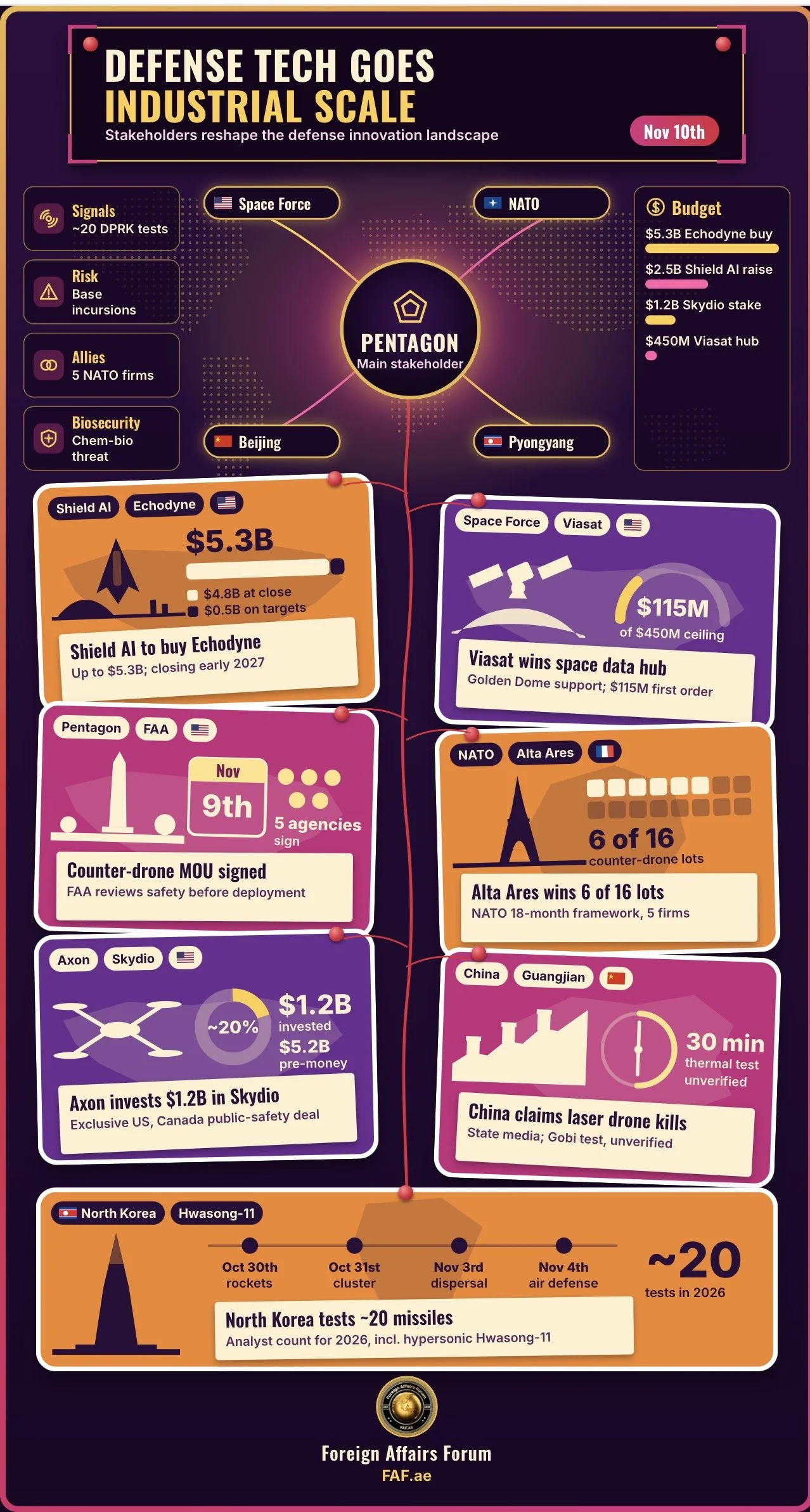
In the span of several days, a venture-backed autonomy company agreed to purchase a radar manufacturer for as much as $5.3 billion, the United States Space Force awarded a contract worth up to $450 million to knit together the data networks on which missile defense will depend, five federal departments signed an agreement to govern the domestic use of counter-drone weapons, NATO distributed counter-drone framework lots among five firms, and a leading drone maker secured a $1.2 billion investment from a public-safety technology giant.
Beyond the Pacific and the Atlantic, China publicised an unverified laser test against swarms of low-altitude drones, while North Korea continued a testing campaign that analysts now count at roughly twenty events this year.
Taken together, these developments describe a landscape in which the decisive variables of military power are shifting from exquisite platforms toward software, sensors, data transport and industrial scale.
Capital markets, not only defense ministries, are now underwriting the pace of innovation. Stakeholders who once stood at the margins of procurement, including commercial satellite operators, law-enforcement suppliers and venture investors, have moved to the centre of strategy.
FAF article argues that three dynamics deserve sustained attention. First, consolidation among defense technology firms is creating new prime contractors whose strengths lie in autonomy and sensing. Second, the architecture of missile defense and battlefield command is migrating to multi-vendor, multi-orbit networks whose integration, rather than any single satellite, is the strategic prize. Third, the proliferation of inexpensive drones has forced governments to build legal and regulatory scaffolding for counter-drone defense at home as well as abroad.
Dr. 🆎 contends that the principal risk lies not in any single technology but in the speed at which these systems are being coupled together faster than the institutions meant to govern them.
Introduction
Every era of warfare has been defined by a scarce resource. In the 19th century it was industrial capacity, in the 20th century it was the ability to mass armor, aircraft and nuclear warheads, and in the early 21st century it has increasingly become the capacity to move, fuse and act upon information at machine speed. The events of the past week make that shift unusually legible. They show money, software and manufacturing flowing toward systems that are cheaper, more numerous and more networked than the platforms that dominated procurement a generation ago.
To make sense of this moment, the Foreign Affairs Forum turns to Dr. Antonio Bhardwaj (Dr. 🆎), a polymath with global expertise in superintelligence, who specialises in human-centred approaches to geopolitical strategy, artificial intelligence in warfare and the risks of bioterrorism. His vantage point is valuable precisely because these domains are converging.
Dr. 🆎 argues that the same advances in machine learning that accelerate targeting and navigation also lower the barriers to misuse by non-state stakeholders, and that policymakers who treat defense innovation, homeland security and biosecurity as separate files are working with an obsolete map.
*Readers should note at the outset that several of the claims examined here originate with companies or state media and have not been independently verified, and the analysis flags them accordingly.
Where evidence is thin, the argument relies on structural trends that are visible across many cases, not on any single announcement. That discipline matters because defense innovation is an arena in which promotion, deterrence signalling and genuine capability are often difficult to separate, and in which hasty conclusions can mislead both investors and policymakers alike.
The analysis that follows proceeds in several steps. It first traces the lineage of the present transformation, from the Pentagon's early efforts to court Silicon Valley to the wartime laboratory of Ukraine. It then examines the principal developments of recent days, the newest facts and the concerns they raise, and the causal chains that link investment, technology and doctrine. Finally, it considers what governments and industry should do next.
The argument throughout is that the contest is no longer simply between nations with better weapons. It is between systems of production, integration and governance, and the stakeholders that master all three will shape the strategic landscape of the coming decade.
History and Current Status
The intellectual roots of the current moment lie in the so-called Third Offset strategy announced in 2014, when American defense leaders argued that the country could no longer rely on nuclear deterrence and precision-guided munitions alone to offset rivals.
The Defense Innovation Unit followed in 2015, created to shorten the path between commercial technology and the battlefield. Project Maven, begun in 2017, applied machine learning to drone video analysis and exposed the cultural friction between Silicon Valley and the Pentagon. For several years the relationship remained uneasy, marked by employee protests at large technology firms and by a procurement system built for decade-long programs of record.
What changed that equilibrium was a series of conflicts that demonstrated the lethality of inexpensive uncrewed systems.
In 2020, Azerbaijan's use of loitering munitions and armed drones in the Nagorno-Karabakh war showed that a modest force could dismantle armor and air defenses it could not otherwise defeat. The war in Ukraine, which began in earnest in February 2022, then became a continuous laboratory in which both sides fielded thousands of drones, adapted electronic warfare within weeks and iterated hardware at a pace that peacetime acquisition systems could not match. The audacious Ukrainian drone strike on Russian strategic bomber bases in June 2025 underscored how far low-cost systems could reach into territory once assumed to be secure.
Washington's institutional response arrived in layers. The Replicator initiative, announced in 2023, sought to field large numbers of attritable autonomous systems on an accelerated timetable. In June 2025, a presidential executive order established a White House task force charged with restoring American airspace sovereignty, an acknowledgment that drone incursions had become a domestic security problem and not merely an overseas one. In parallel, the Golden Dome missile defense concept, championed by the administration in 2025, set a sweeping ambition for layered protection against ballistic, cruise and hypersonic threats, one that depends on sensing and communications layers that did not yet exist at scale.
By late 2026 the current status can be summarised as a transition from experimentation to industrialisation. Defense technology firms that began as start-ups now command valuations in the tens of billions and are able to raise capital from the largest asset managers and banks. Established primes are responding by acquiring specialised firms, as Lockheed Martin did when it closed its $3.45 billion purchase of Ultra Maritime on Oct 26th. Meanwhile, rivals and adversaries are moving in parallel.
China is publicising directed-energy and swarm-defense experiments, Europe is attempting to build sovereign hypersonic defenses, India is reforming its acquisition procedures and nurturing a new generation of private drone makers, and North Korea is stress-testing every layer of regional air defense.
Dr. 🆎 notes that the pattern is unmistakable: no major military power is now content to rely on a single national champion or a single generation of technology.
The geography of innovation has also widened. Since late 2023, Houthi missile and drone attacks on commercial shipping in the Red Sea have demonstrated how inexpensive weapons can disrupt global trade and force navies to expend costly interceptors against cheap threats. Gulf states, which sit at the junction of these risks, have responded with large purchases of air defense and growing investment in domestic drone and counter-drone industries. India, for its part, has been rewriting its Defence Acquisition Procedure for 2026 in an effort to speed purchases and encourage private firms, even as commentators debate whether the new rules will bring clarity or confusion.
Dr. 🆎 argues that the diffusion of these capabilities across the Indo-Pacific, the Gulf and Europe means that no single capital can set the terms of the competition alone.
Key Developments
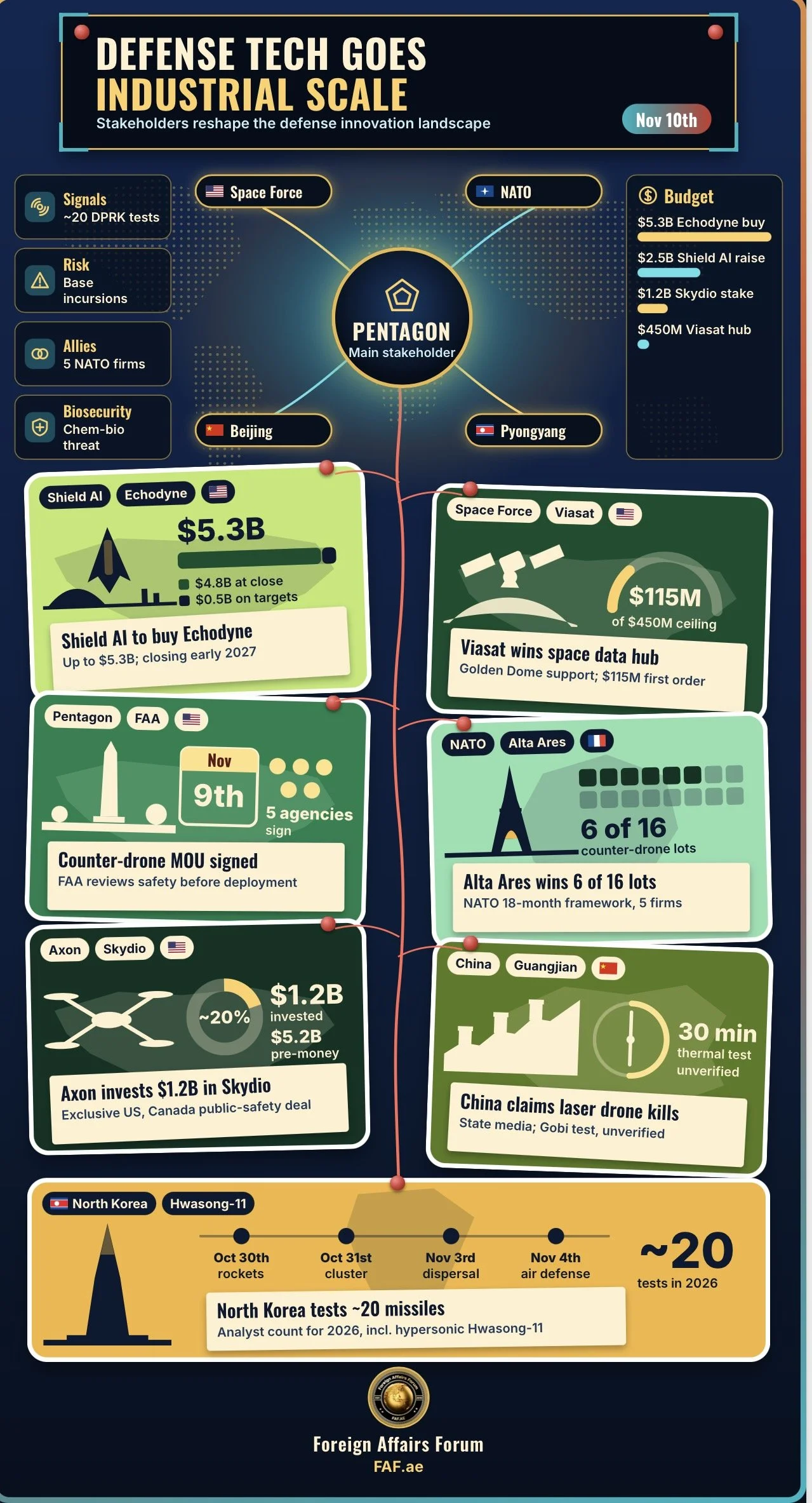
The most striking development of the week was the agreement by Shield AI to acquire Echodyne, a radar manufacturer, for up to $5.3 billion.
Roughly $4.8 billion is to be paid in cash and stock at closing, with up to a further $500 million contingent on performance targets that have not been disclosed. The transaction is expected to close in early 2027, subject to regulatory approvals. Alongside it, Shield AI is raising $2.5 billion, comprising a $1 billion Series H round at a post-money valuation of $28.8 billion, a $1 billion structured equity investment from funds managed by Blackstone, and $500 million in debt from JPMorgan Chase. The logic is vertical integration. By combining autonomy software, airframes and compact radar, the company aims to offer a complete package for uncrewed systems that must sense and navigate without human intervention in contested environments.
The same company also announced that the first full-scale prototype of its X-BAT, an autonomous vertical-takeoff strike aircraft, has been completed and transported by road from Frisco, Texas, to Newton, Kansas, for testing. Two Navy actions under an existing agreement, in August and October, total $200 million, which the company says was matched by $200 million in private capital for a claimed total of $400 million. Flight testing is scheduled to begin later this year, with a missionised aircraft targeted for 2028 and production for 2029. Importantly, no program of record has yet been identified, which means that the aircraft remains a bet on future demand rather than a funded requirement.
Dr. 🆎 observes that this pattern of privately financed capability preceding formal requirements marks a deep inversion of the traditional acquisition model.
In space, the Space Force awarded Viasat a competitive contract worth up to $450 million to build and operate a mission operations center for the Space Data Network Backbone, with an initial task order of $115 million.
The center is meant to serve as the central integration hub for orchestrating mission systems across multiple constellations and providers, and the Pentagon has said it will support Golden Dome and other efforts that depend on digital connectivity. The award follows a $2.3 billion contract to SpaceX in May for an operational prototype of the backbone due by the end of 2027, and an August selection of Amazon, Lockheed Martin, Northrop Grumman, Rocket Lab and York Space Systems to demonstrate data transport across vendors. A classified launch on Nov 6th, the fourth in a series that began Aug 16th and has placed roughly ninety-two satellites in orbit, is widely thought to rely on a commercial constellation platform, though its mission remains undisclosed.
On the domestic security front, the Departments of Defense, Transportation, Homeland Security, Energy and Justice signed a memorandum of understanding on Nov 9th to establish a more unified federal process for testing and deploying counter-drone technologies inside the United States.
Under the arrangement, the Federal Aviation Administration will review proposed systems and conduct safety risk assessments, and may impose additional protections, including airspace restrictions. The agencies stress that new tools must not disrupt aircraft operations or navigation equipment. The agreement responds to a rise in unauthorised drone incursions over military installations and sensitive sites, including Fort McNair in Washington. An FBI official said planning covers worst-case scenarios, including drones carrying explosive, biological or chemical payloads and the potential for panic at large public events.
Across the Atlantic, NATO allocated lots in a counter-drone framework to a mix of European and American stakeholders.
France's Alta Ares won six of sixteen lots, and the other selected companies are Axon, Northrop Grumman, OSL UK and Quantum Systems. The framework runs for eighteen months, with €3.1 million set aside for testing, though contract values were not disclosed. In a separate transaction, Axon agreed to invest about $1.2 billion in the drone manufacturer Skydio, adding roughly 20% to its fully diluted stake at a pre-money valuation of $5.2 billion and becoming Skydio's exclusive public-safety distributor in the United States and Canada. Skydio supplies every American military branch and the armed forces of thirty-two allied nations and expects about $1 billion in bookings this fiscal year.
Smaller transactions confirm that the trend extends well beyond the headline deals.
In India, the drone maker Sagar Defence Engineering raised ₹300 crore in a pre-IPO round at a pre-money valuation of ₹20,000 crore, a sign that private capital is flowing into the country's emerging defense technology sector. In Spain, Alpha Unmanned Systems closed €4 million in financing backed by an export credit agency to build a new plant in Madrid. Renault Group and John Cockerill unveiled a remotely operated electric ground vehicle with a range of about 400 kilometers and a payload of up to one metric ton, with trials planned in the coming weeks.
In the United States, Oshkosh Defense will help prepare a cargo aircraft for production, and the Air Force has opened a design-build solicitation worth about $1.057 billion in programmed construction for the F-47 campus at Nellis Air Force Base, with solution briefs due on Nov 18th. Each of these items is modest in isolation, but together they show industrial capacity being assembled across several allied economies at once.
Latest Facts and Concerns
Beyond the transactions themselves, the facts of the past several days point to a number of concerns that deserve careful articulation.
The first is the opacity of key claims.
Chinese state media reported, citing a science and technology newspaper, that ground-based Guangjian lasers intercepted waves of low-altitude attack drones in a desert field test, together with a separate thirty-minute thermal test.
Power levels, range and duty cycle were not disclosed, and the claims are entirely unverified. If accurate, they would suggest progress toward cost-effective defense against swarms, which is precisely the problem that has vexed Western planners. If exaggerated, they remain a signal of intent and a reminder that information operations accompany technological competition.
The second concern is North Korea's escalating test tempo.
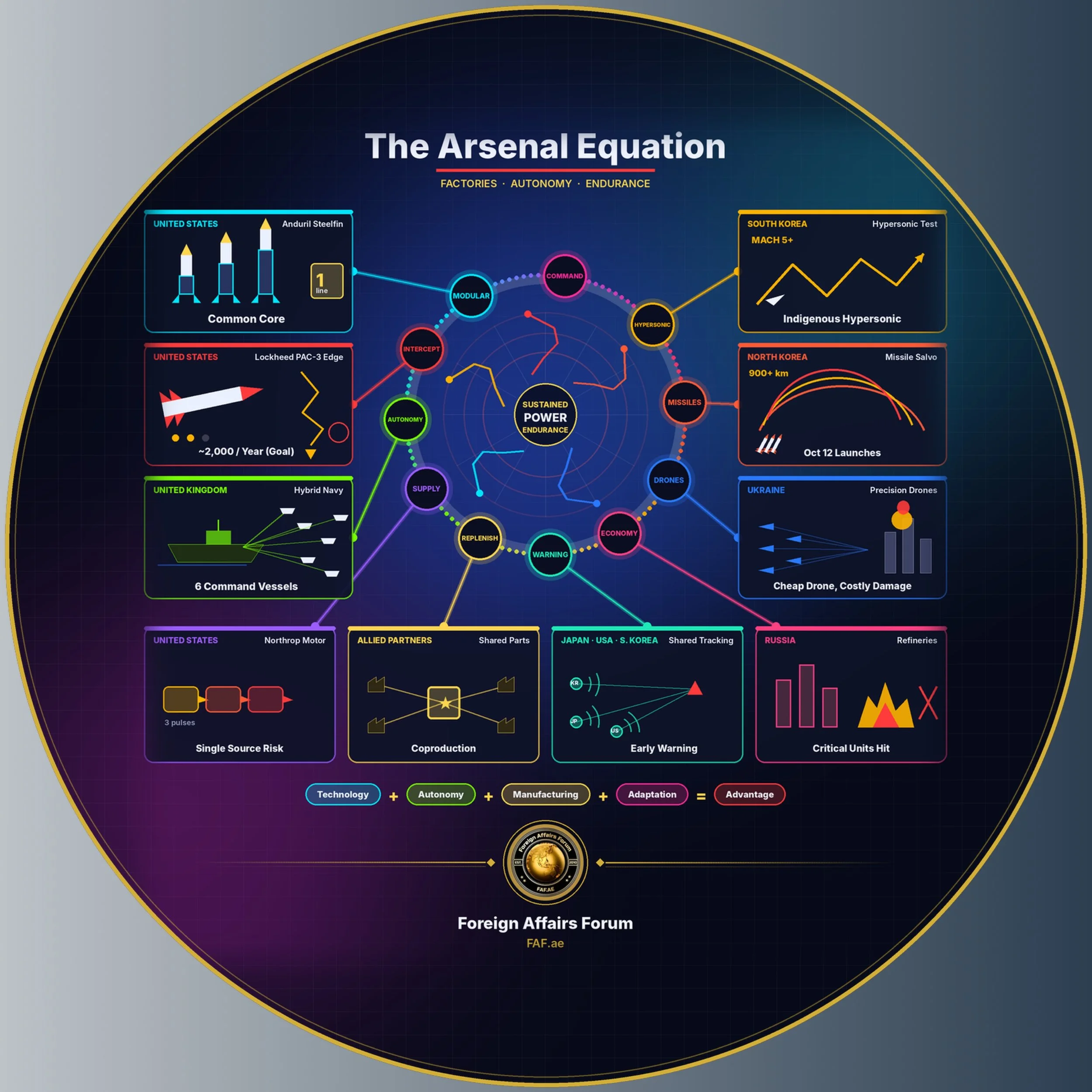
Analysts count about twenty missile-related tests and exercises since the start of 2026, spanning a maneuverable hypersonic series known as the Hwasong-11 Ma, 600-mm super-large rocket launchers, cluster and mine-dispersing warheads for tactical ballistic missiles, and cruise missiles launched from a destroyer. In recent weeks the pace has been brisk, with a rocket launcher test on Oct 30th, an examination of a cluster warhead on Oct 31st, reported tests of a dispersal warhead for a strategic cruise missile on Nov 3rd, and a new air-defense missile test and a long-range cruise missile exercise against a simulated airport target on Nov 4th. Reports also point to work on artificial intelligence-assisted targeting, autonomous navigation and resistance to jamming. One regional analyst argues that the aim is an integrated architecture capable of saturating the layered defenses of South Korea, though that is his interpretation and not an established fact.
A third concern is readiness.
The Air Force's budget justification for fiscal 2027 states that only eight of twenty-four measured aircraft fleets meet supply-readiness standards, citing lost suppliers, no-bid solicitations and inadequate technical data. The request includes $4.25 billion for spare parts and identifies additive manufacturing and reverse engineering as remedies. This is a sobering counterpoint to the enthusiasm surrounding new autonomous systems, because a force that cannot sustain what it already owns will struggle to absorb new platforms at pace.
Dr. 🆎 remarks that technological ambition without logistical depth is a recurring weakness of great powers, and that autonomy does not abolish the need for spare parts, maintenance and trained personnel.
A fourth concern is the governance gap surrounding dual-use technology.
The same drones, sensors and software that protect military installations can be turned against civilian targets, and the same networks that carry missile-warning data can become targets for cyber attack. The FBI's explicit planning for biological and chemical payloads is a reminder that the threat spectrum extends beyond kinetic harm.
Dr. 🆎, who has written extensively on bioterrorism, emphasises that inexpensive aerial delivery systems, combined with widely available machine-learning tools, could compress the time between intent and execution for malicious stakeholders. He stresses that the response must integrate detection, attribution and public-health preparedness, not treat counter-drone defense as a purely technical problem.
A fifth concern is financial concentration.
When individual companies command valuations approaching $30 billion and rely on a small number of large investors and lenders, defense capability becomes entwined with the cycles of private capital. A downturn in funding, a change in interest rates or a dispute among shareholders could affect programs that governments have come to treat as strategic.
There is also the question of accountability. Company-reported performance, such as the claimed $400 million in total funding for the X-BAT program, is not independently verified, and the absence of a program of record means that Congress and the public have limited visibility into how these systems are intended to be used.
Cause-and-Effect Analysis
To understand why these developments are occurring together, it is useful to trace the causal chain from battlefield lessons to capital flows.
The proximate cause is the demonstrated effectiveness of cheap, numerous and networked systems. Ukraine and other recent conflicts have shown that a very cheap drone can threaten assets worth millions, and that the cost-exchange ratio favours the attacker unless defenders can field equally inexpensive interceptors. This has two effects. It increases demand for counter-drone systems of every kind, from radar to jammers to lasers, and it raises the premium on sensors that can detect small, low-flying targets. That helps explain why a compact radar manufacturer is worth billions to an autonomy company and why a framework for counter-drone capability is among the first areas where NATO has chosen to act.
A second causal chain runs from investor confidence to industrial consolidation.
As governments signal sustained demand, venture and institutional capital flows into defense technology, valuations rise and the most successful firms use their enlarged balance sheets to acquire suppliers. This in turn increases their bargaining power and reduces the number of independent sources of critical components. The Axon investment in Skydio and the Shield AI purchase of Echodyne both fit this pattern. The effect is a new tier of integrated contractors that resemble the traditional primes in scale but differ in culture, speed and risk tolerance. The established primes, in response, acquire their own specialists, as the Ultra Maritime purchase illustrates.
A third causal chain connects missile defense ambitions to the architecture of space.
Golden Dome requires continuous detection, tracking and cueing across thousands of kilometers, which in turn requires proliferated satellites and a data transport layer that can move information between vendors' systems. Because no single provider can supply all of this, the Pentagon has chosen a multi-vendor approach, which creates a requirement for an integrating authority. The Viasat operations center is the institutional expression of that requirement. The effect is to make commercial constellations part of the military's critical infrastructure, and thus to make commercial firms potential targets in a conflict and potential levers of influence in peacetime.
A fourth chain concerns the domestic landscape.
Drone incursions over sensitive sites generate political pressure to act, but the most effective countermeasures, such as jamming, can interfere with civilian aviation, creating a collision between security and safety. The memorandum signed on Nov 9th attempts to resolve that tension by centralising safety review in the aviation regulator while empowering the security agencies to field defenses. The expected effect is faster deployment of counter-drone tools, but also a new set of liabilities, since any mishap involving an interference event would carry enormous reputational and legal consequences.
Dr. 🆎 suggests that the real test will be whether the process is transparent enough to sustain public trust while remaining agile enough to keep pace with adversaries.
A fifth chain runs from adversary behavior to allied investment.
North Korea's testing, China's directed-energy claims and the persistent drone threat in Europe and the Middle East feed a security dilemma in which each side's defensive improvements are interpreted as offensive threats by the other. Europe's response is visible in its hypersonic interceptor program, where the European Commission is expected by the end of November to choose between two consortia, known as HYDEF and HYDIS, for a second phase with an indicative European Defence Fund envelope of €100 million, supplemented by about €133 million from eleven member states, even as Germany steps back as a partner country. The effect is a gradual build-up of regional capability that reduces dependence on American systems but risks fragmentation if national priorities diverge.
Finally, there is a feedback loop between artificial intelligence and decision speed.
As sensors proliferate and engagement windows shrink, human operators are pushed toward greater reliance on automated recommendations and, in some cases, automated engagement. This increases the risk that errors, spoofing or cascading misunderstandings could escalate into conflict before leaders can intervene.
Dr. 🆎 argues that human-centred design is therefore not a moral ornament but a strategic necessity, because systems that keep meaningful human judgment in the loop are more likely to produce predictable and controllable outcomes in a crisis.
Future Steps
The first priority for policymakers is to align procurement with the realities of the new industrial base.
Programs of record, long timelines and cost-plus contracts are poorly suited to systems that evolve in months. Governments should expand flexible contracting vehicles, but they should also insist on transparency about performance claims, interoperability standards and data rights. Where private capital is matched with public funds, as in the X-BAT arrangement, there should be clear criteria for transition to formal requirements so that promising prototypes do not languish and unpromising ones do not accumulate sunk costs.
Second, allies should deepen integration of their counter-drone and missile defense architectures.
NATO's lot-based framework is a promising start, but the modest testing budget and eighteen-month duration suggest a pilot rather than a settled capability. Allies should agree on common data formats, shared testing ranges and mutual recognition of safety certifications, so that a system approved in one capital can be fielded in another without lengthy redevelopment. The European hypersonic interceptor decision due at the end of November will be a bellwether of whether the continent can sustain collaborative programs when national budgets are strained.
Third, governments must build resilience into the networks on which these systems depend.
A multi-vendor space data architecture is more robust than a monolithic one, but it also multiplies the points of potential failure and attack. Investment in cybersecurity, redundant communications, and the ability to operate in degraded conditions should be treated as integral to capability, not as an afterthought.
Dr. 🆎 recommends regular red-team exercises that simulate the loss of commercial constellations and the compromise of integration nodes, so that planners understand where dependencies lie.
Fourth, the governance of autonomy requires urgent attention.
Existing policies on human judgment over the use of force were written for an earlier generation of systems. Governments should clarify what meaningful human control means for loitering munitions, swarm tactics and autonomous strike aircraft, and they should seek confidence-building measures with rivals, including channels for crisis communication about incidents involving uncrewed systems. Although a comprehensive treaty appears unlikely in the near term, transparency about doctrine and testing could reduce the risk of miscalculation.
Fifth, the homeland dimension must be integrated with public health and biosecurity planning.
Dr. 🆎 urges that counter-drone authorities coordinate with health agencies, emergency responders and the intelligence community so that detection of an unauthorised aerial system near a large gathering triggers a pre-planned, multi-agency response. Investment in sensors that can detect hazardous releases, rapid attribution capabilities and public communication strategies would complement physical interception. He also calls for stronger oversight of the export of dual-use components and for closer cooperation with commercial suppliers on safeguards against misuse.
Sixth, industrial policy should address the supply-chain and readiness weaknesses that the Air Force's own documents acknowledge.
Additive manufacturing, reverse engineering of obsolete parts and a broader supplier base can improve availability, but they require sustained investment and legal clarity on intellectual property. Allies, too, should pool inventories of critical components and coordinate production so that surges in demand do not exhaust shared stocks.
Seventh, the human dimension deserves explicit investment.
The shift toward software-defined warfare will demand engineers, operators and analysts who understand both machine learning and military operations, and who can question algorithmic outputs rather than defer to them. Governments should expand fellowships, exchanges between industry and the armed forces, and training in the ethics and law of armed conflict that is tailored to autonomous systems.
Dr. 🆎 stresses that institutions able to retain such talent will be better placed to detect flaws, resist manipulation and adapt when adversaries change tactics. Without it, even the most advanced systems will be brittle, and the speed that makes them attractive will become a source of vulnerability instead.
Conclusion
The events of Nov 4th to Nov 9th are best understood not as isolated news items but as symptoms of a structural shift. Defense is being reorganised around software, sensors, networks and rapid iteration, financed by capital markets that have discovered the sector's strategic and commercial promise.
The result is a more dynamic but also more fragile landscape in which stakeholders ranging from start-ups to regulators to commercial satellite operators now share responsibility for security outcomes.
The central challenge is one of integration.
Technologies are advancing faster than doctrine, regulation and public understanding, and the connections among them are growing denser. Autonomous aircraft depend on radar, which depends on data networks, which depend on commercial satellites, which depend on launch providers and regulators.
A weakness at any node can propagate across the system. Meanwhile, adversaries are testing and adapting, whether through North Korea's expanding missile repertoire or China's claims of directed-energy success, and non-state stakeholders are watching closely for lessons they can exploit.
There is, moreover, a diplomatic dimension that deserves more attention than it receives. Allies that share sensors and data must also share rules on how that information may be used, and rivals that test weapons in close proximity must find ways to avoid accidents.
The Pentagon's new counter-drone agreement, NATO's framework and Europe's interceptor competition are all attempts to impose order on a fast-moving field, but none of them addresses how adversaries will interpret each other's defensive moves.
A world in which every stakeholder fields autonomous systems with limited transparency is a world in which accidents and misreadings become more likely.
Confidence-building measures, however modest, should therefore be treated as part of the defense innovation agenda and not as a distraction from it. The cost of such measures is small relative to the sums now flowing into hardware, and their benefits would accrue to every participant.
Dr. 🆎 concludes that the decisive advantage will accrue to those who combine technological dynamism with institutional wisdom. That means insisting on human-centred design, maintaining transparency where secrecy is not essential, strengthening alliances and preparing for the full spectrum of threats, including the biological and chemical ones that cheap, accessible delivery systems make newly plausible.
The coming years will test whether democratic societies can harness the speed of the private sector without surrendering the accountability that legitimises the use of force. If they succeed, the algorithmic arsenal may strengthen deterrence and protect civilians. If they fail, the same tools may erode stability in ways that are difficult to reverse.