Cheap Drones, Big Money: The New Rules of War Explained
Executive Summary
War is changing fast, and this past week showed how.
A start-up agreed to buy a radar maker for up to $5.3 billion.
The US Space Force gave a contract worth up to $450 million to build a control center for a new space data network.
Five US government departments signed a deal on how to stop dangerous drones at home.
NATO shared out counter-drone contracts.
And a drone maker called Skydio received a $1.2 billion investment.
At the same time, China made an unverified claim about a laser that shoots down drones, and North Korea kept testing missiles.
The big message is simple.
Modern military power now depends on software, sensors, data networks and the ability to build things in large numbers.
Private money is driving much of this change.
Dr. Antonio Bhardwaj (Dr. 🆎), an expert in superintelligence, geopolitics, AI warfare and bioterrorism risks, warns that the danger lies in how quickly these systems are being linked together, faster than the rules meant to control them.
Introduction
FAF article looks at the five biggest stories of the past few days and explains why they matter. It also shows how they connect to one another.
Dr. 🆎 argues that the same technology that helps defend a base can also be misused by criminals or terrorists. For that reason, leaders should think about defense, homeland security and public health together, not as separate problems.
History and Current Status
The story begins in the 2010s, when the Pentagon realised it needed new ideas from the technology industry. It set up the Defense Innovation Unit in 2015 and started Project Maven in 2017, which used computers to study drone video. Many tech workers objected, and the early relationship was shaky.
Real wars then showed the power of cheap drones.
In 2020, Azerbaijan used armed drones to beat tanks and air defenses in Nagorno-Karabakh.
In Ukraine, which Russia invaded in February 2022, both sides use thousands of drones and change their designs every few weeks.
In June 2025, Ukraine used small drones to hit Russian bomber bases far from the front line.
Today, defense start-ups are worth tens of billions.
Large companies are buying smaller ones, as Lockheed Martin did when it completed its $3.45 billion purchase of Ultra Maritime on Oct 26th.
Other countries are also moving.
China is showing off new anti-drone tests, Europe is building its own missile defenses, India is changing how it buys weapons, and North Korea is testing nearly every kind of missile it can.
Key Developments
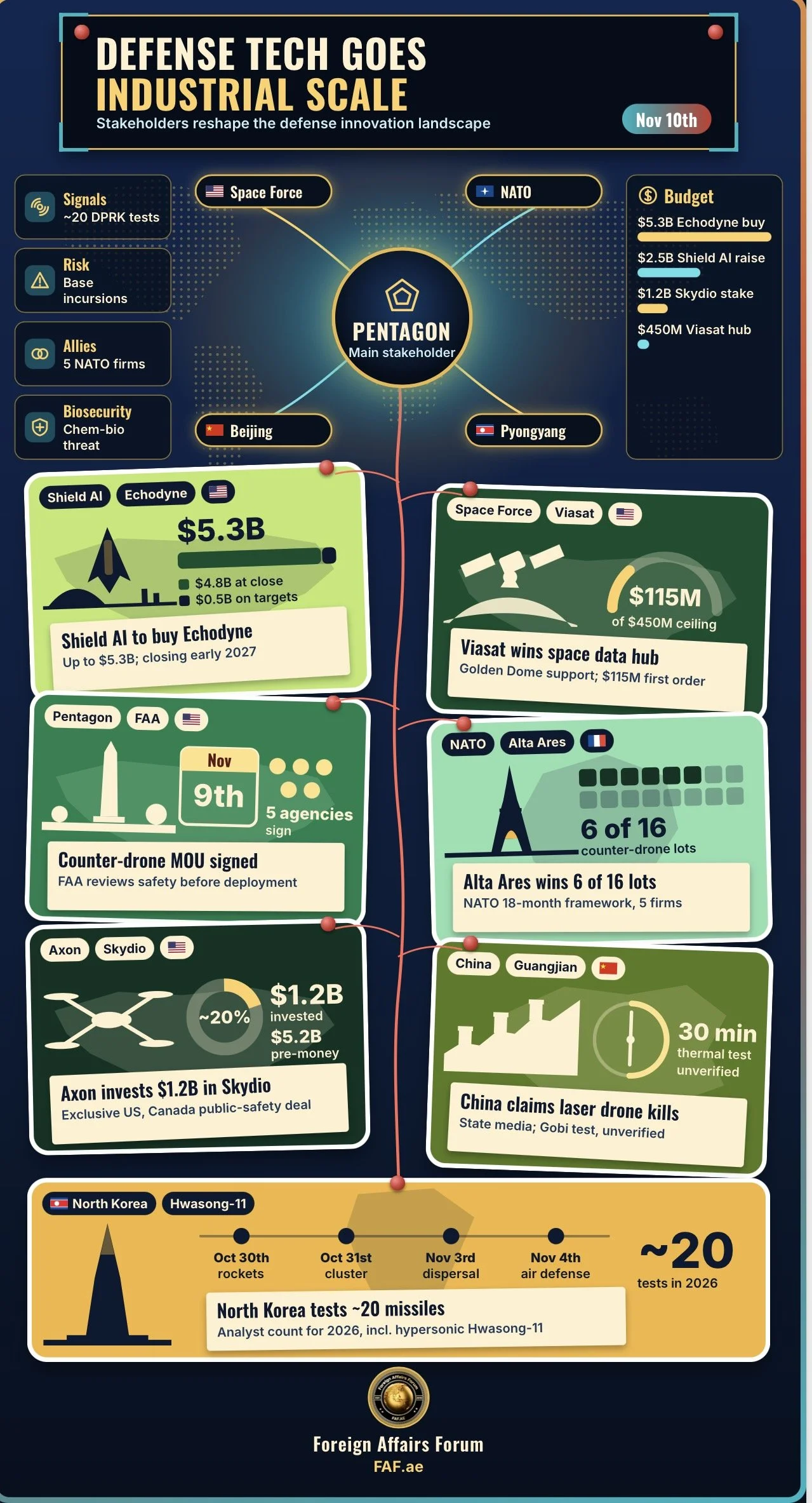
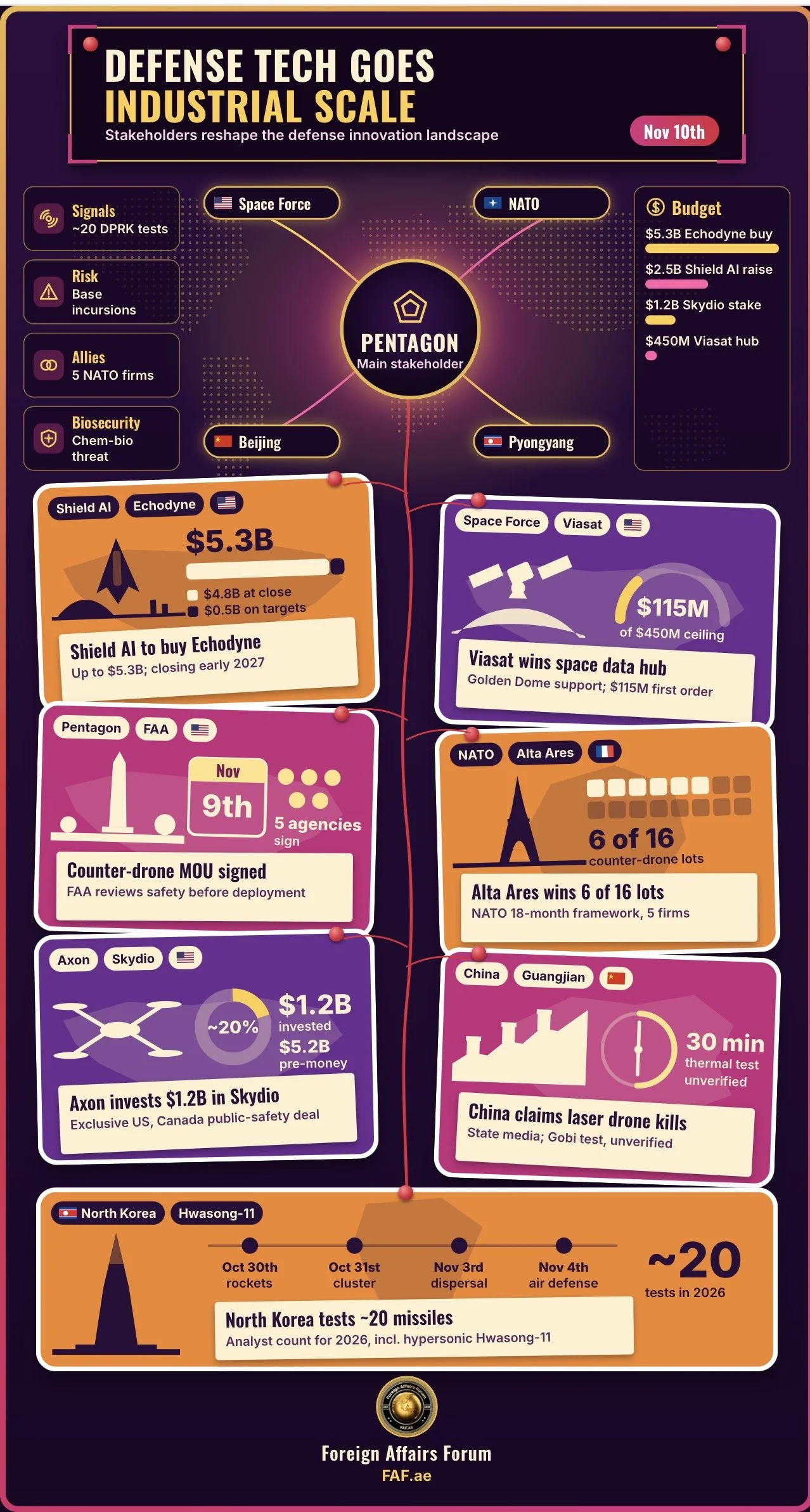
The first big story is Shield AI's plan to buy the radar company Echodyne for up to $5.3 billion.
About $4.8 billion is paid when the deal closes, and up to $500 million depends on future targets.
The deal should close in early 2027.
Shield AI is also raising $2.5 billion, including a $1 billion funding round that values the company at $28.8 billion. The company also finished its first full-size X-BAT prototype, a self-flying jet that takes off straight up. Flight tests are planned to begin later this year, but the government has not yet named it an official program.
Dr. 🆎 says this is a big change, because private money is now building weapons before the military has formally asked for them.
The second story comes from space.
The Space Force picked Viasat for a contract worth up to $450 million to run an operations center for the Space Data Network.
The first order is worth $115 million. The center will connect satellites from many different companies so that data can move quickly between them.
The Pentagon says it will support Golden Dome and other systems.
This follows a $2.3 billion contract for SpaceX in May to build a prototype of the network by the end of 2027.
The third story is at home.
On Nov 9th, the Departments of Defense, Transportation, Homeland Security, Energy and Justice signed an agreement on counter-drone tools.
The Federal Aviation Administration will check each system for safety before it is used.
The goal is to stop dangerous drones without harming airplanes.
The agreement follows drone sightings over military bases and sensitive places, including Fort McNair in Washington.
The fourth story is in Europe.
NATO gave out lots in a counter-drone contract, and the French company Alta Ares won six of the sixteen lots.
Axon, Northrop Grumman, OSL UK and Quantum Systems were also selected. The contract lasts eighteen months.
Separately, Axon agreed to invest about $1.2 billion in Skydio, which makes drones for the armed forces of 32 allied countries and for police and fire teams.
The fifth story is about rivals.
Chinese state media said that ground-based lasers shot down waves of small drones in a desert test. No details were given, and no one has confirmed it.
North Korea, meanwhile, has carried out about twenty missile tests and exercises this year, including a fast, maneuverable missile called the Hwasong-11 Ma, large rocket launchers and new kinds of warheads.
Latest Facts and Concerns
Several concerns stand out.
The first is trust.
Some of the most dramatic claims, such as the Chinese laser test, cannot be checked. Even company claims, such as the $400 million said to be behind the X-BAT program, have not been confirmed by outside experts.
The second concern is the pace of North Korea's tests.
In just one week, it tested a rocket launcher on Oct 30th, looked at a cluster warhead on Oct 31st, tested a dispersal warhead on Nov 3rd and fired a new air defense missile on Nov 4th. Some analysts believe the goal is to overwhelm South Korea's defenses by firing many different weapons at once. That is one expert's view, not a proven fact.
The third concern is readiness.
The Air Force says only eight of twenty-four aircraft fleets meet its standard for spare parts. It is asking for $4.25 billion to fix this.
Dr. 🆎 reminds readers that smart machines still need parts, repairs and trained people.
The fourth concern is misuse.
An FBI official said planners are preparing for the worst cases, such as drones carrying explosives, or biological or chemical material.
Dr. 🆎, who has studied bioterrorism, warns that cheap drones and widely available AI tools can shorten the time between a bad idea and an attack. He says the answer must include detection, finding who is responsible and public health preparation.
Cause-and-Effect Analysis
Why is all this happening at once?
The first cause is that cheap drones work.
A very cheap drone can threaten equipment worth millions. This makes governments want better radar and counter-drone tools, which explains why a radar company can be worth billions.
The second cause is the flow of investor money.
When governments show they will keep buying, investors put in more money. Successful companies then buy their suppliers and grow bigger. This creates a new group of large defense companies that move faster than the old ones, and the old ones respond by buying their own specialists.
The third cause is the plan for missile defense.
Golden Dome needs satellites from many firms to share data, and no single company can provide everything. That is why the Pentagon needs a central operations center. The effect is that commercial satellite firms are now part of national defense, which also makes them possible targets.
The last cause is AI itself.
When sensors show more information and the time to decide gets shorter, people may trust machines too much. Dr. 🆎 argues that keeping humans in charge is not only a moral idea. It also makes systems more predictable and safer in a crisis.
Future Steps
Leaders have several jobs to do.
First, they should change how they buy weapons.
Slow, old-style contracts do not fit systems that change every few months. Governments should be open about what these systems can really do, and they should decide early which prototypes become official programs.
Second, allies should work together.
They should agree on common data formats, share testing sites and accept each other's safety approvals. NATO's eighteen-month contract is a good first step, but it looks more like a test than a final plan.
Third, homeland security and public health should work together.
Dr. 🆎 urges that when a drone appears near a crowd, police, health agencies and emergency teams should have a joint plan.
Conclusion
The past week showed that defense is being rebuilt around software, sensors, networks and speed.
Money from private investors is pushing the change, and many new stakeholders now share responsibility for security. This makes the landscape more energetic but also more fragile.
Dr. 🆎 concludes that success will go to those who combine fast technology with wise institutions. That means keeping humans in charge, staying open where secrecy is not needed, working closely with allies and preparing for every kind of threat, including biological and chemical ones. If democratic countries manage this, these new tools can protect people. If they fail, the same tools could make the world less safe.