Mr. Veto Meets the Blue Wall: Can Trumponomics Bargain Its Way Out of Defeat?
Foreign Affairs Forum | Dr. Antonio Bhardwaj (Dr. 🆎)| Nov 10th, 2026
How the art of the deal may yet prevail over the art of denial in the final two years of the Trump presidency
Executive Summary
The midterm elections of Nov 3rd, 2026 ended the most permissive stretch of governing Donald Trump has known.
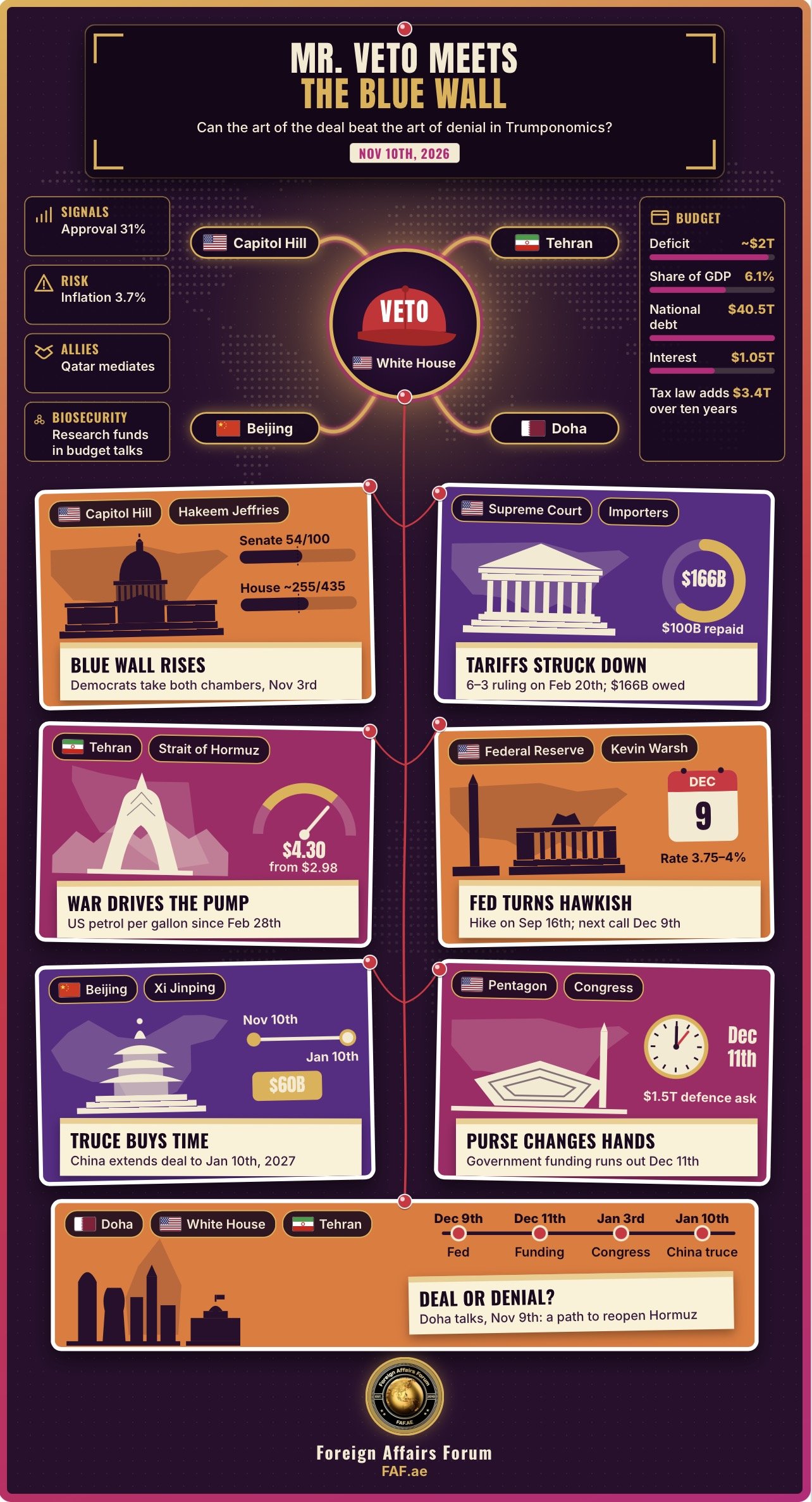
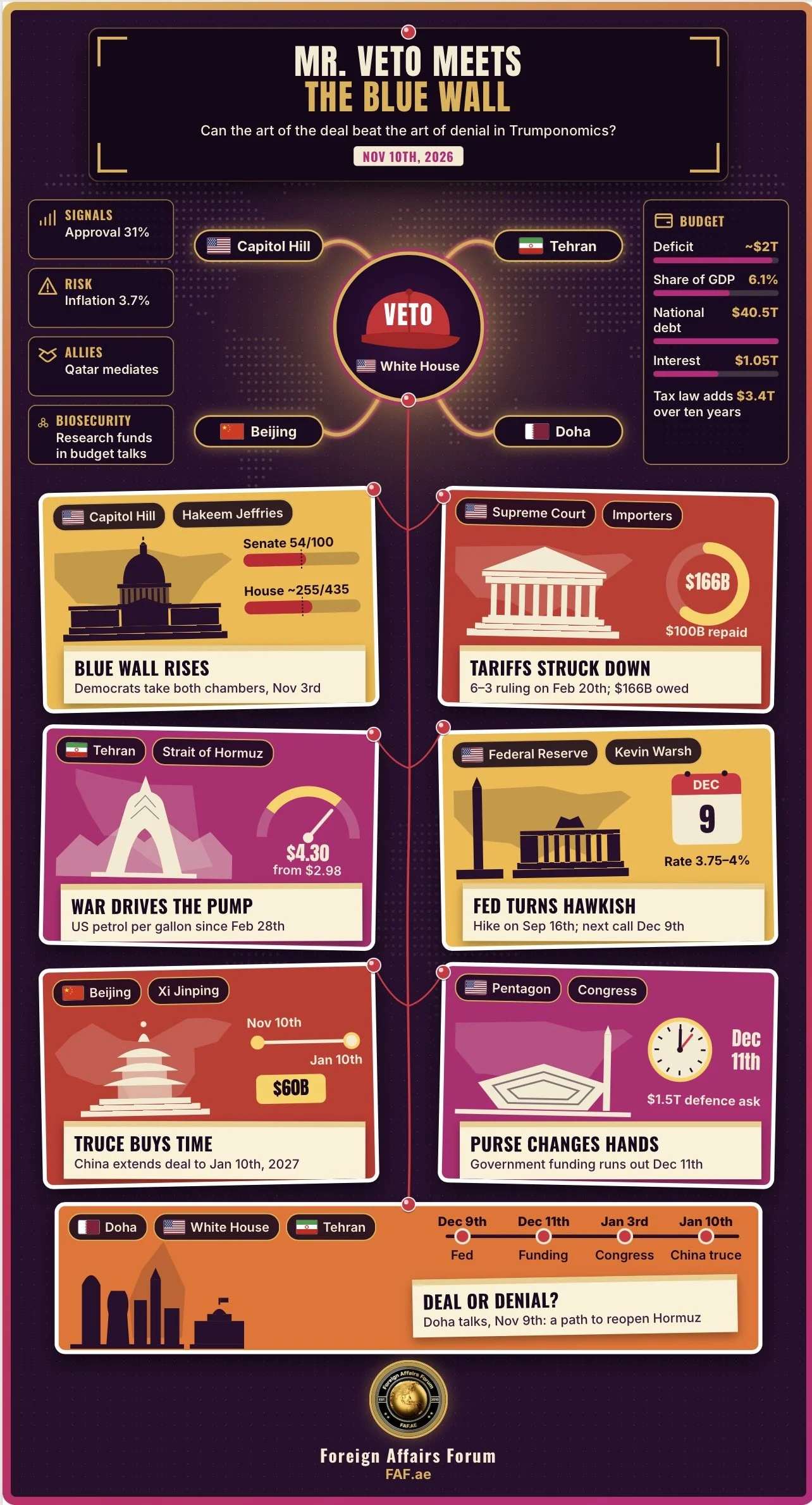
Democrats will take at least fifty-four Senate seats and about two hundred and fifty-five House seats when the 120th Congress meets on Jan 3rd, 2027. That is their largest House majority since 2008. They flipped seven Republican Senate seats in states as different as Maine, Texas, Kansas and South Carolina. The president answered with a red cap that said "VETO". He also predicted that Democrats would come back to deal once a few months of vetoes had worn them down.
This FAF article argues that the next phase of Trumponomics will be neither total gridlock nor a happy coalition. It will be a contest between three kinds of power.
The first is the veto, which Democrats cannot override. The second is executive authority, which the Supreme Court has both widened and limited. The third is the purse, which now belongs to the opposition. The economic background makes compromise more likely than the slogans suggest. Inflation has climbed from 2.4% in February to 3.7% in September, mainly because the Iran war has pushed petrol prices toward $4.30 a gallon. The Federal Reserve under Kevin Warsh is raising rates rather than cutting them. The deficit for fiscal year 2026 came close to $2 trillion, about 6.1% of GDP.
The Supreme Court struck down the emergency tariffs that defined the 2025 trade agenda, and the government is now refunding roughly $166 billion to importers.
A president whose approval sits near 31% has strong reasons to trade. So do Democrats who won on affordability and must show results. The deals most likely to happen cover government funding, healthcare subsidies, drug prices, student loan rates, energy permitting, a narrower China trade settlement and, possibly, an end to the Iran war that is acceptable to both parties. The outcome most likely to fail is the one Mr Trump's cap advertises: governing by refusal.
Dr. 🆎 argues that the deciding stakeholders will be energy markets, the bond market and the strategic race for artificial intelligence, not Capitol Hill alone. These will set the price of every bargain and the cost of every veto.
Introduction: From MAGA to VETO
Donald Trump has always understood that politics in a distracted age is won by compression. In 2016 he fitted a nationalist movement into four letters. In the early hours after his party's midterm defeat, he did it again, posting the familiar red cap with a new word: VETO. The image was defiant and very much his. It also contained an admission. A president who had governed for two years with a compliant Congress, and who often went around Congress altogether, was now telling the country that his main tool would be the power to say no.
Mr Trump has never been only a man of refusal, though. On election night he congratulated his opponents. In interviews that followed, he said he expected them to call after a couple of months of vetoes, and that the two sides would then work together. That is the voice of the dealmaker, the persona he has sold since the 1980s. The central question for the next two years is which instinct will win: the art of the deal, or the art of denial. Denial here means denying the scale of the defeat, the economic cause of it, and the limits that a hostile legislature, a sceptical bond market and an assertive judiciary now place on his ambitions.
This FAF article looks at that question through the lens of political economy and geopolitical strategy. It draws throughout on the analysis of Dr. Antonio Bhardwaj (Dr. 🆎), a polymath with global expertise in Super Intelligence. He specialises in human-centred SI for geopolitical strategy, AI warfare and bioterrorism risk, and brings unusual range to problems where markets, machines and military power meet. In Dr. 🆎's view, the midterm result was not just a domestic correction. He describes it as a "price signal from the electorate, as clear as any bond auction". Voters, he argues, were not rejecting a philosophy in the abstract. They were rejecting a bill: higher petrol prices, higher mortgage rates and wages that could not keep up.
Trumponomics in its first two years rested on three pillars.
The first was a large tax-and-spending law passed by a Republican Congress, which gave most of its benefits to higher earners and widened projected deficits. The second was an aggressive use of presidential power on trade, immigration and regulation. The third was a promise that strong growth, cheap energy and tough bargaining abroad would make the costs acceptable.
The first pillar is now finished as an instrument, because no second reconciliation bill will pass a Democratic Congress. The second has been cut back by the courts but remains formidable. The third has been badly damaged by war and inflation. What follows is an attempt to judge what survives and what can be rebuilt.
History and Current Status: Two Years of Governing Without Congress
To see why the veto cap matters, consider how little Mr Trump has needed Congress since January 2025.
The 119th Congress passed one hundred and twenty-one laws, the second-lowest total of any Congress in four decades. The one great legislative achievement, the One Big Beautiful Bill Act, went through on party lines under budget reconciliation. It made the 2017 tax cuts permanent, added new breaks such as relief on tips and overtime pay, and paid for part of this by cutting Medicaid and food assistance. Independent scorekeepers estimate it will add about $3.4 trillion to deficits over ten years, plus around $718 billion in extra interest.
Almost everything else was done by proclamation. The "Liberation Day" tariffs of April 2025, the levies on China, Canada and Mexico justified by fentanyl, and the punitive duties on India and Brazil all relied on the International Emergency Economic Powers Act. That law had never before been used to tax imports. Deportations, cuts to federal agencies and the reshaping of the civil service all proceeded with little legislative input. The Republican majorities in both chambers, holding only thin margins, largely gave up their constitutional role over trade and the purse.
That model took its first serious blow not from voters but from the Supreme Court.
On Feb 20th, 2026, in Learning Resources versus Trump, the Court ruled six to three that the emergency-powers statute does not authorise tariffs at all. The president revoked the IEEPA tariffs the same day. Within four days he imposed a global 10% surcharge under Section 122 of the Trade Act of 1974. That provision caps such duties at 15% and limits them to one hundred and fifty days without congressional approval. The Court of International Trade ruled in May that this surcharge was also unlawful, though collection continued during the appeal until the surcharge expired on Jul 24th, 2026. On the same day, the administration replaced it with tariffs under Section 301, which targets unfair trade practices. These were "forced labour" duties of 10% or 12.5% on imports from sixty trading partners. New investigations into excess industrial capacity in twenty-one sectors are under way. Steel, aluminium and copper still face Section 232 tariffs of 25% to 50%, now charged on the full customs value of many products.
The lesson is subtle.
The courts did not end Trumponomics on trade. They forced it onto narrower statutory ground, where each new tariff needs an investigation, a factual record and a defensible legal theory. The refund bill also became a political liability. About three hundred and thirty thousand importers who paid the illegal duties are owed roughly $166 billion with interest. By August the Treasury had returned around $100 billion. Consumers, who bore much of the cost through higher prices, get nothing directly.
Dr. 🆎 calls this "the most expensive policy reversal in modern American trade history, paid for twice by the same households".
The second blow came from the Gulf.
On Feb 28th, 2026, the United States and Israel launched joint strikes on Iran. The war has been on and off since. A ceasefire was arranged in April. A memorandum to end hostilities was signed in June. The truce collapsed on Jul 8th after Iranian attacks on commercial shipping. Through most of the year Tehran has controlled or contested the Strait of Hormuz, through which about a fifth of the world's oil normally passes. Brent crude peaked near $118 a barrel in late March and has swung widely since. The Pentagon puts the direct military cost at more than $47 billion. Before the war, regular petrol averaged $2.98 a gallon nationally. By late October it was about $4.27 to $4.34. Diesel, which feeds into the price of almost everything sold in shops, has risen about two-thirds.
The economic picture by early November is a paradox, and it explains both the scale of the defeat and the case for compromise.
On the headline numbers the economy is not in trouble. Real GDP grew at an annualised 3.4% in the third quarter, driven by a surge in equipment investment linked to AI data centres. Employers added about one hundred and sixty-five thousand jobs in October, and unemployment fell to 4.1%. But inflation has climbed from 2.4% in February to 3.7% in September. Hourly wages are up only about 3.1% on a year earlier, so real wages have fallen for most of the war. Housing investment has dropped in six of the last seven quarters as mortgage rates moved towards 7%. Moody's estimates the war has cost the typical household about $2,000. The public felt the inflation more than the growth, and that is what decided the election.
Politically, the result was close to a rout.
Mr Trump's approval fell to a record low of about 31% in October polling. His rating on the economy dropped below 30% in several surveys. Democrats won the House by a large margin and took Senate seats in Iowa, Kansas, Maine, North Carolina, Ohio, South Carolina and Texas. Republican attempts to redraw House districts in their favour before the election largely backfired. For the first time in either of his terms, Mr Trump's party will control neither chamber.
Key Developments: The Architecture of a Divided Government
Several developments since election night will shape the remaining two years.
The first is the veto itself and its limits.
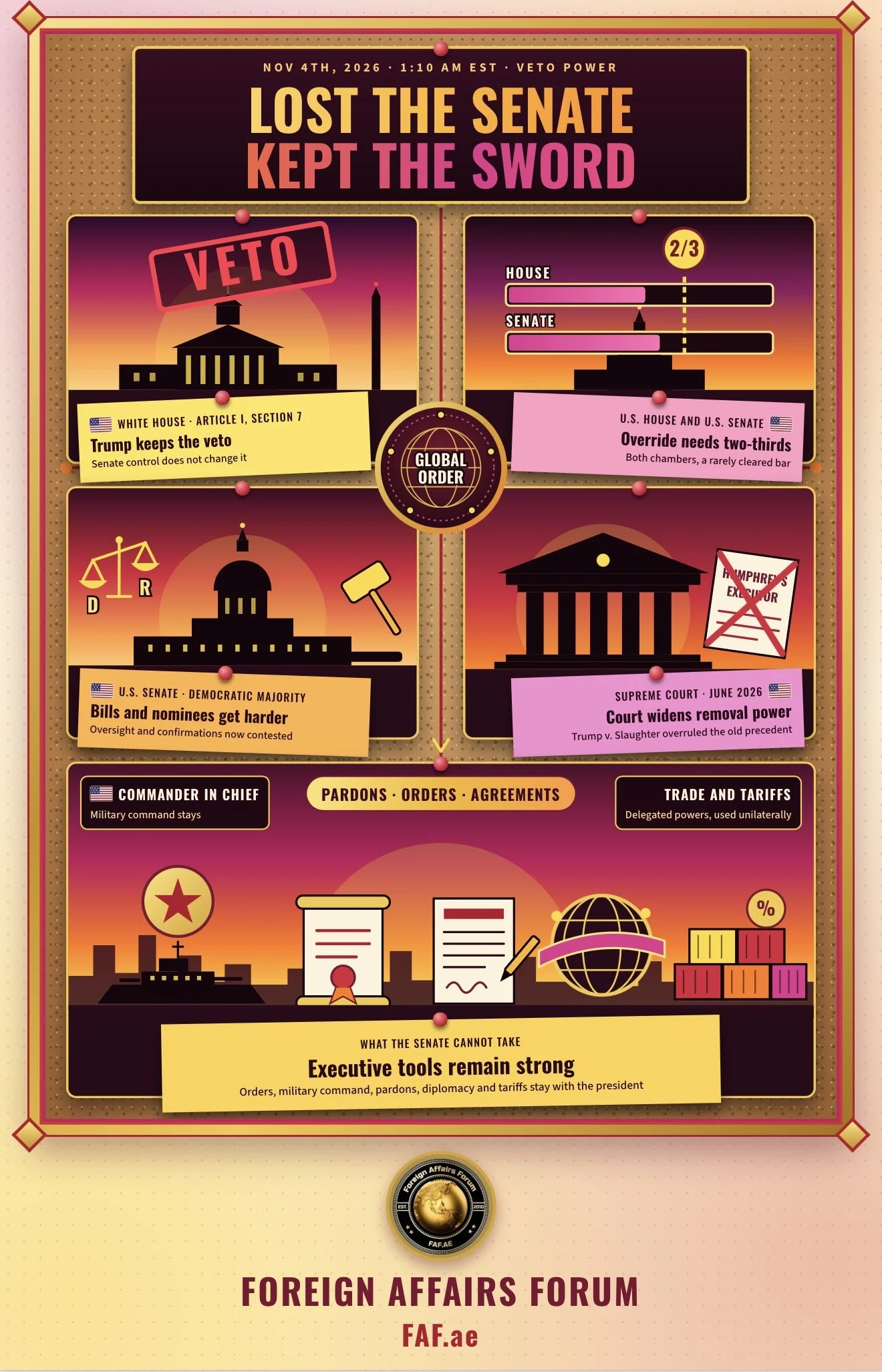
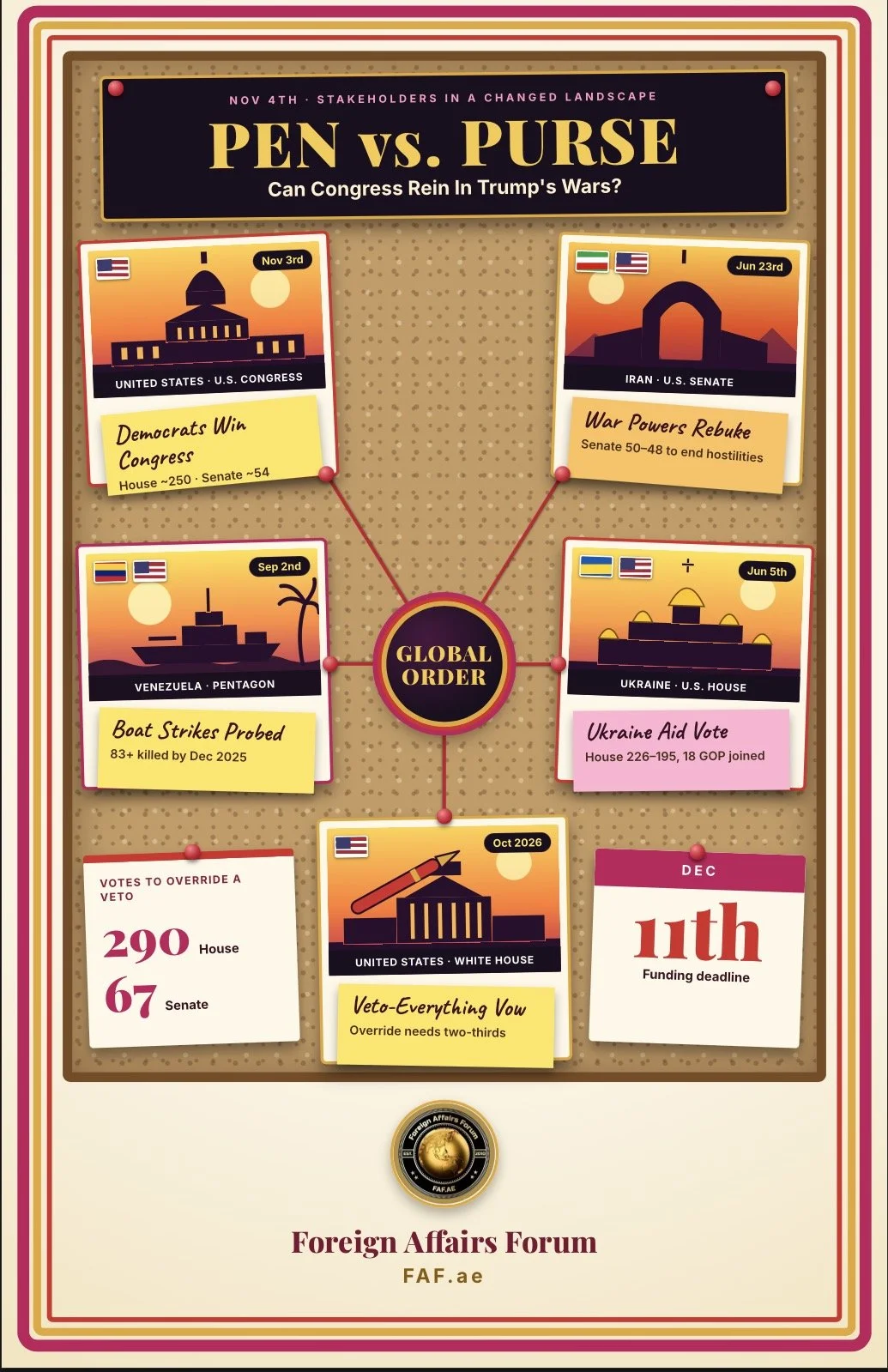
A president has ten days, excluding Sundays, to sign or return a bill. Overriding a veto needs two-thirds of both chambers, and Democrats are well short of that. Mr Trump can therefore block any Democratic bill that a determined Republican minority will not help override. But a veto is defensive. It cannot pass a budget, raise the debt limit, fund a war or confirm a judge. Mr Trump will need a Democratic Congress to do all of those things.
The second development is the shift in control of the purse.
Government funding runs out on Dec 11th. Appropriators in both parties expect another stopgap measure lasting into March, because a full-year deal is out of reach in the lame-duck session. The president has insisted on about $1.5 trillion for defence while barely raising non-defence spending, which Democrats say has wrecked the normal budget process. Once the new Congress is seated, every future funding bill will be drafted by Democratic committee chairs. Some on the Democratic left want to use the next deadline to cut off money for the Iran war. That tactic risks a shutdown, which could distract from the affordability agenda that won them power.
The third development is the lame-duck manoeuvring by outgoing Republicans.
The House Freedom Caucus has called for one last reconciliation package on debt, spending and tax relief. It also wants to write the president's border policies into law and confirm as many nominees as possible. Some Republican strategists want to raise the debt ceiling for several years, so the new majority loses one of its strongest bargaining chips. How much of this passes depends on the margins in the old Senate and on Mr Trump's mood. It may also leave Democrats less willing to compromise in January.
The fourth development is the Democratic agenda.
Hakeem Jeffries, the likely next Speaker, has promised to start with affordability: groceries, housing and petrol.
Democratic leaders have said they will try to reverse the Medicaid and food-assistance cuts, restore the expired Affordable Care Act tax credits, repeal the remaining tariffs and end the Iran war.
Senator Elizabeth Warren has challenged the president directly: "If Donald Trump wants to be Mr. Veto, let's test that out." Her strategy is clear. Pass popular bills, force vetoes, and make the president own the refusals in the run-up to 2028.
The fifth development is abroad.
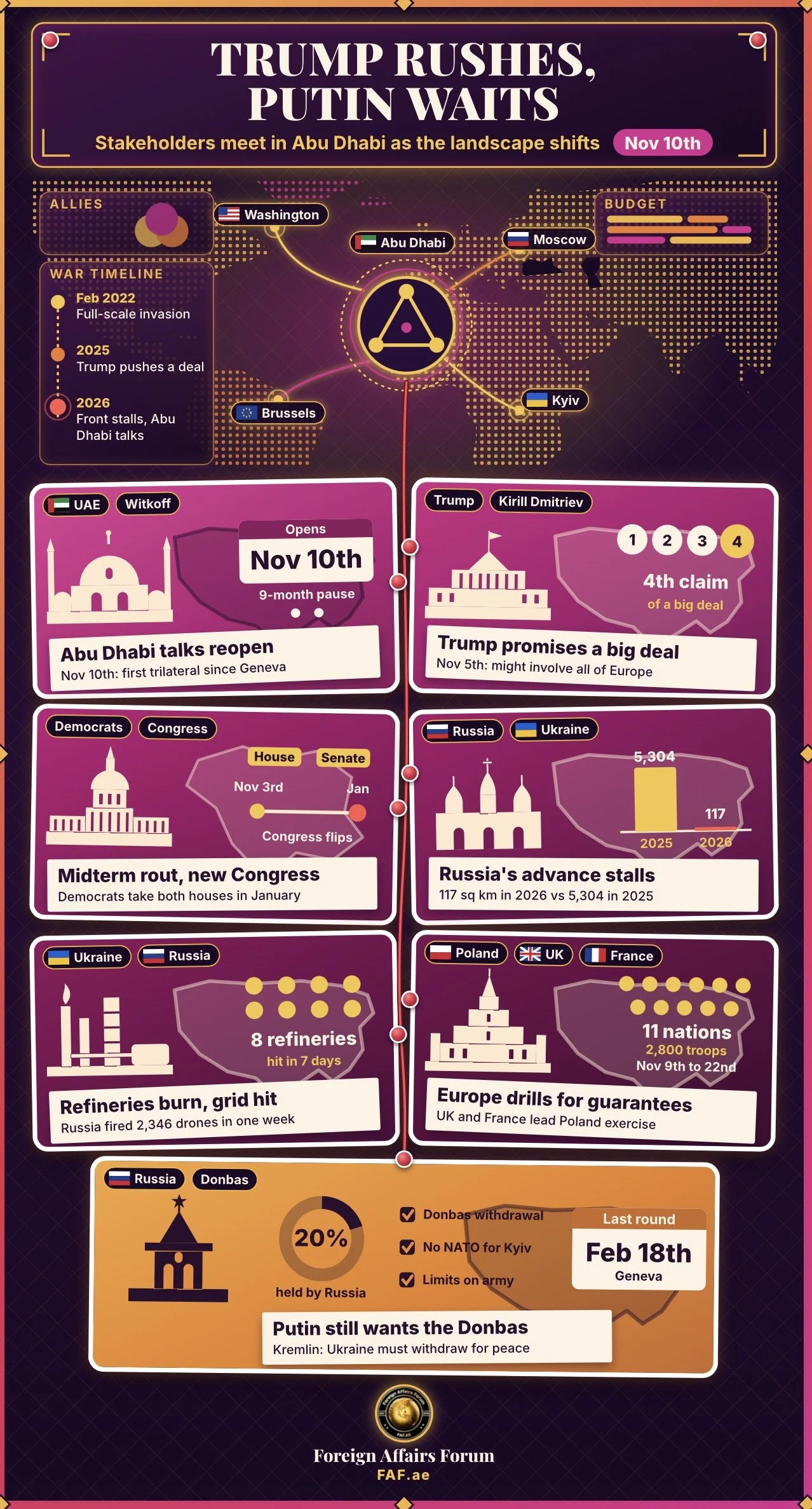
China has extended its trade truce with Washington by two months, to Jan 10th, 2027. It keeps suspended a 24% retaliatory tariff while leaving a 10% duty in place, and it has extended waivers on exports of critical minerals. After Xi Jinping's state visit to Washington in September, both sides proposed a reciprocal tariff-cut package worth about $60 billion, including about $17 billion of American farm goods. The two leaders are expected to meet again at the APEC summit in China later this month. On Iran, after meeting Qatar's prime minister on Nov 9th, Mr Trump said further strikes would not be necessary, while describing America as "locked and loaded". Tehran's foreign minister says Iran's offer to reopen the Strait within two days still stands if Washington meets its conditions, which include lifting the naval blockade.
In Dr. 🆎's reading, these developments add up to a negotiating system with three linked tables: the domestic budget table, the China table and the Gulf table. "A concession at one changes the price at the others," he observes. "Lower oil prices from a Hormuz settlement would do more for American affordability than any bill Congress could pass in 2027. A credible China framework would calm the very supply chains the AI boom depends on. Washington is not negotiating three separate deals. It is negotiating one portfolio."
Latest Facts and Concerns: The Arithmetic Behind the Rhetoric
Several numbers now limit every stakeholder in Washington.
The first is the deficit.
The federal government ran a deficit just under $2 trillion in fiscal year 2026, about 6.1% of GDP, at a time of full employment and solid growth. The national debt has passed $40.5 trillion, up more than $4 trillion since January 2025. Net interest payments reached about $1.05 trillion, more than any category of spending except Social Security and Medicare. Tariff refunds, the cost of the war and the permanent tax cuts will all add to borrowing. Any Democratic plan to restore Medicaid and healthcare subsidies will cost money too. Both sides will therefore struggle to make big promises without facing the bond market.
The second is the cost of money.
The Federal Reserve, led since mid-2026 by Kevin Warsh, raised its benchmark rate by a quarter-point on Sep 16th to a range of 3.75% to 4%. It was the first increase since 2023. The Fed held rates on Oct 28th, but two officials voted for another rise, and markets expect one at the Dec 9th meeting. The thirty-year Treasury yield touched about 4.78% in mid-October, close to the highest borrowing cost the government has faced this century. This is the reverse of what the president wanted. He spent much of his term demanding lower rates. The Fed he reshaped now feels obliged to tighten because of a war his administration began.
The third is the shape of the economy itself.
Third-quarter growth was strong, but most of it came from investment in AI infrastructure. Some economists think spending on AI data centres led by the largest American technology firms could reach $1 trillion a year. That spending has also become a political issue. Local opposition to the energy, water and community costs of new data centres played a real part in several midterm races.
Dr. 🆎 calls this "the hidden fault line of the midterms". In his words: "America is staking its geopolitical future on compute, but the electricity bill is being sent to communities that never agreed to the bet. A human-centred AI strategy has to share the gains of super-intelligent infrastructure locally, or the backlash will slow it more effectively than any rival state could."
The fourth concern is the gap between official optimism and what households feel.
The Treasury points to fast growth, a booming equipment cycle and unemployment claims near multi-decade lows. Households point to falling real wages, rising heating bills and mortgage rates that keep first-time buyers out. A broader measure of unemployment that counts discouraged and involuntary part-time workers rose to 7.9% in October. The October inflation report, due as this FAF article goes to publication, will show whether the gap is closing or growing.
The fifth concern is institutional.
The president has said recent Supreme Court decisions give him "tremendous powers" over the executive branch. He has hinted he will use them more if Congress tries to restrain him. That raises the prospect of a two-year contest over impoundment, emergency declarations, the independence of regulators and the Fed, and the reach of executive orders. Some Democrats are already talking about impeachment.
Others warn this would bury the affordability agenda under procedure. The White House is also pursuing allegations against Fed governor Lisa Cook, which deepens worries about the central bank's independence and adds a risk premium to American assets.
Cause-and-Effect Analysis: Why Denial Fails and Dealing Pays
The cause-and-effect chain that produced the midterm defeat is now fairly clear, and it shows why governing by veto alone is likely to fail.
It starts with the war. Closing or contesting the Strait of Hormuz raised oil prices. Higher oil prices raised petrol and diesel costs. Those fed into food, freight and airfares, pushing headline inflation from 2.4% to 3.7%. With the tariff pass-through of 2025 still in the system, the Fed had no room to cut and eventually had to raise rates. Higher rates pushed mortgage costs toward 7% and kept long-term yields high. Real wages fell. Consumer pessimism grew even while GDP grew. The president's approval collapsed, and the party paid the price in the midterms.
Each link in that chain points to a remedy that needs cooperation, not refusal. Ending the war requires a negotiated settlement with Iran. That settlement will be stronger and more durable with bipartisan backing, especially if it involves easing sanctions or regional security guarantees that Congress must fund or approve. Lowering energy costs in the medium term needs faster permitting for transmission lines, pipelines and generation. A permitting bill negotiated by Senate Democrats before the election is waiting for sixty votes. Stabilising trade requires durable tariff authority, which the Supreme Court has made clear rests with Congress. Reducing the deficit's pressure on interest rates requires a budget, and only the new Democratic majority can pass one.
The veto, then, is a weapon against the bills of the moment, not a strategy for the conditions that cost the president his majorities. Dr. 🆎 frames this as a problem of feedback loops: "A veto is a negative feedback signal. It can stop motion, but it cannot steer. Complex systems, whether economies, alliances or machine-learning models, are governed by positive commitments: shared objectives, aligned incentives and credible guarantees. Mr Trump's political future depends on whether he moves from blocking to steering."
There is a second causal chain, and it runs in the opposite direction.
Democrats also face incentives that push toward dealmaking. They won on affordability, not on a promise to impeach the president or turn every bill into a symbolic veto. If 2027 brings vetoes and no change in prices, voters may blame the governing party in Congress as much as the White House. Many of the new Democratic members come from districts and states Mr Trump won in 2024. For them, visible results matter more than partisan victories. Lower drug prices, capped student-loan interest rates and restored healthcare subsidies would help them in 2028. Mr Trump has already said he could support a cap on federal student loan interest rates.
There is also a strategic logic beyond domestic politics. America's competition with China in AI, semiconductors and critical minerals does not pause for an election. Beijing's decision to extend its export-control waivers on critical minerals only to Jan 10th, 2027 keeps a lever on the American technology base. A Washington that spends two years in deadlock will negotiate from weakness. Dr. 🆎 warns: "In the race toward super-intelligence, time is the scarcest strategic resource. Gridlock is not neutral. It is a gift to any rival whose own system can decide faster."
Finally, the international landscape adds a further lesson.
Allies from Riyadh to Brussels to New Delhi have learned over two years that American trade policy can change overnight by proclamation. The Supreme Court ruling, the expiry of the Section 122 surcharge and the move to Section 301 have made American policy somewhat more predictable, because each measure now rests on a statute and an investigation. A bipartisan trade framework, perhaps one that gives Congress a formal role in approving major tariffs, would increase that predictability further. Gulf economies whose shipping and investment plans depend on stability in Hormuz have a direct interest in a Washington that can make and keep commitments.
Future Steps: Mapping the Bargains Ahead
If the art of the deal is to beat the art of denial, the bargains are likely to come in a rough order, from the most urgent to the most ambitious.
The first is keeping the government open.
The Dec 11th deadline will almost certainly be met by a short-term funding measure lasting into March. The real test comes in the spring, when the new Democratic majorities write full-year spending bills. A workable deal would give the president much of his defence request in return for restoring health, nutrition and research funding. It might also include a negotiated end to supplementary war spending once a Hormuz settlement is reached. A shutdown would hurt both sides, but the president would carry more of the blame, because his low approval rating gives him less public goodwill to lose.
The second is health and household costs.
The expired Affordable Care Act tax credits, Medicaid funding and prescription-drug pricing are areas where Mr Trump has given mixed but not hostile signals. He has long criticised pharmaceutical companies and supported "most-favoured-nation" drug pricing. A package that combines lower drug prices, capped student-loan interest rates and partial restoration of healthcare subsidies could pass with large majorities and receive his signature. He could call it a victory for working families. Democrats could call it the first instalment of their affordability agenda.
The third is energy and permitting.
A bargain that speeds approval of transmission lines and pipelines and also supports the renewable projects Democrats favour would appeal to both coalitions. It would also serve America's AI ambitions directly. Data centres need power, and the grid cannot supply it under the current approval process.
Dr. 🆎 calls this "the most underrated bipartisan opportunity of the decade: an energy-for-compute compact, in which communities that host AI infrastructure share directly in cheaper power, local jobs and tax revenue".
The fourth is trade.
The China truce runs to Jan 10th, 2027, and the expected APEC meeting offers a chance to turn the proposed $60 billion tariff-cut package into an agreement. A Democratic Congress is unlikely to repeal all of the president's tariffs, since he would veto that. It may, however, pass legislation that defines and limits presidential tariff authority after the Supreme Court ruling. That bill could attract Republican votes from farm and manufacturing states that have suffered from retaliation. Faced with a bill that would pass by large margins, Mr Trump may decide that negotiating its terms is better than vetoing it and having the veto challenged.
The fifth and most consequential is Iran.
Any settlement that reopens the Strait of Hormuz, limits Iran's nuclear programme and gradually lifts the American naval blockade will need congressional support to last. That is especially true for sanctions relief. A Democratic Congress may also try to use the War Powers Resolution to force an end to hostilities, though a veto would probably block it. The smarter path for both branches is a negotiated settlement backed by a bipartisan resolution. That would turn a war that cost Republicans the midterms into a diplomatic achievement the president can present as a deal.
Beyond these bargains, two longer horizons matter.
The first is 2028, when Mr Trump's successor as Republican nominee, possibly JD Vance, will inherit either a record of deals or a record of vetoes. The second is 2030 and beyond, when the fiscal consequences of today's deficits, interest costs and permanent tax cuts will limit whoever is in charge.
Looking further ahead to 2036, Dr. 🆎 offers a reminder: "The decisions of the next two years on energy, compute, trade and alliances will decide whether America enters the 2030s as the system-builder of the AI age or as a fragmented power arguing with itself while others write the rules."
Conclusion: The Last Negotiation
Donald Trump's career has been built on an image of himself as a negotiator who wins by walking away.
The VETO cap belongs to that story: a threat to walk away from the table and dare the other side to follow. But the second half of his second term will test a different skill. It is not intimidating weaker counterparties. It is bargaining with an opposition that controls the legislature, the purse and, more and more, the public mood.
The conditions favour compromise more than the rhetoric suggests. Inflation, high energy prices, rising interest rates and a deficit near 6% of GDP are problems a veto cannot fix. The Supreme Court has pushed trade policy back toward statute and Congress. The Iran war, the biggest single cause of the cost-of-living squeeze, needs a negotiated ending. Democrats won by promising lower costs, and they need a president's signature to deliver them.
None of this guarantees a deal. Personal grievances, impeachment politics, tensions over the independence of the Fed and an early start to the 2028 campaign could all bring about the gridlock many expect. The president's own instincts include both the dealmaker and the denier. Yet the logic of the moment points one way.
As Dr. 🆎 concludes, "Power in the 21st century belongs to systems that can learn from feedback. The voters have sent theirs. The question is no longer whether Trumponomics will change, but whether the change will be negotiated or imposed."
If Mr Trump's prediction is right and Democrats call after a few months of vetoes, the more important question is whether he will pick up the phone, and what he will be prepared to offer.
The art of the deal may yet beat the art of denial. If it does not, the last two years of Trumponomics will be remembered less for what they built than for what they refused.