Trump Wants a Quick Peace in Ukraine. Putin Can Wait.
Executive Summary
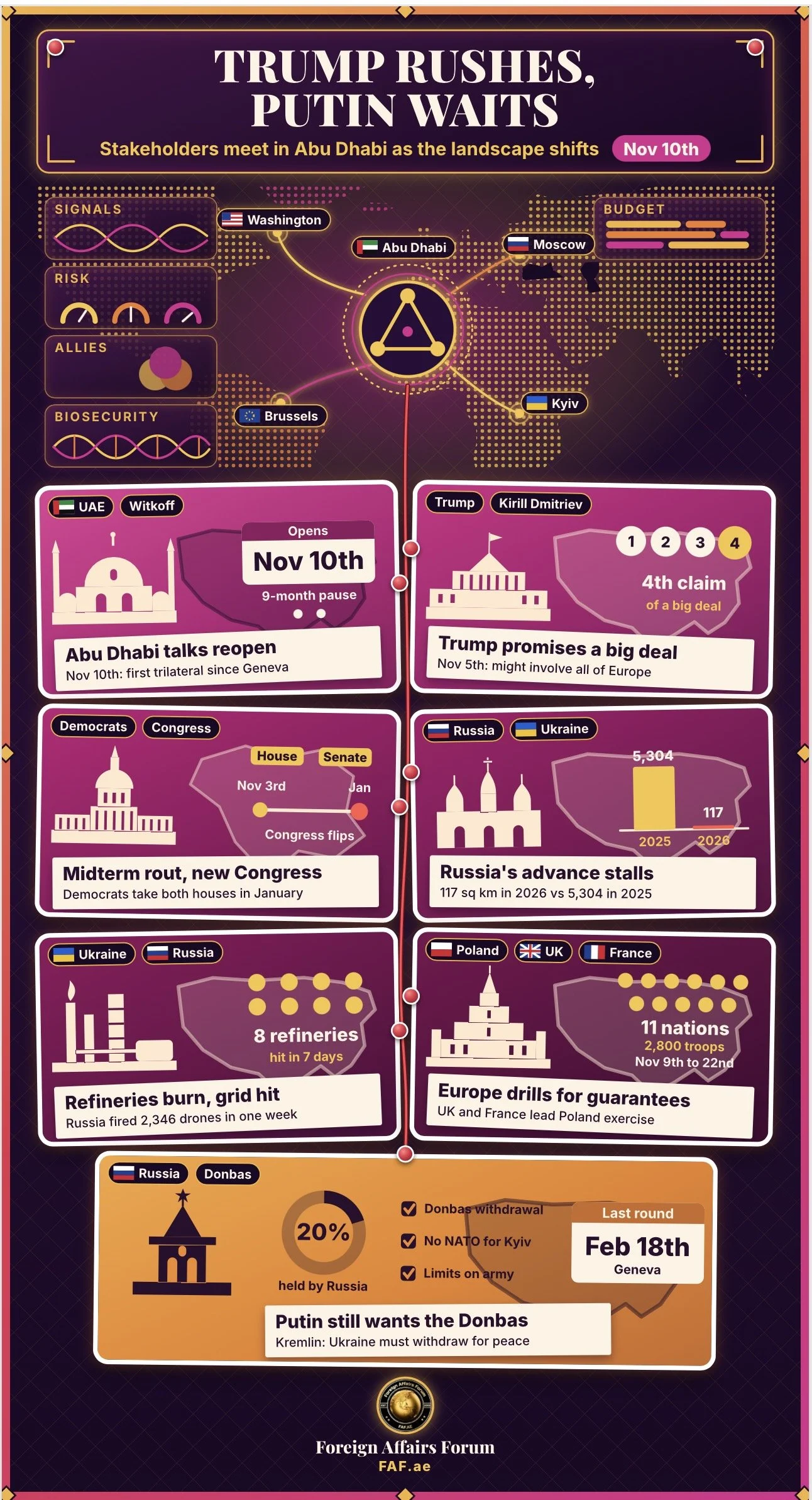
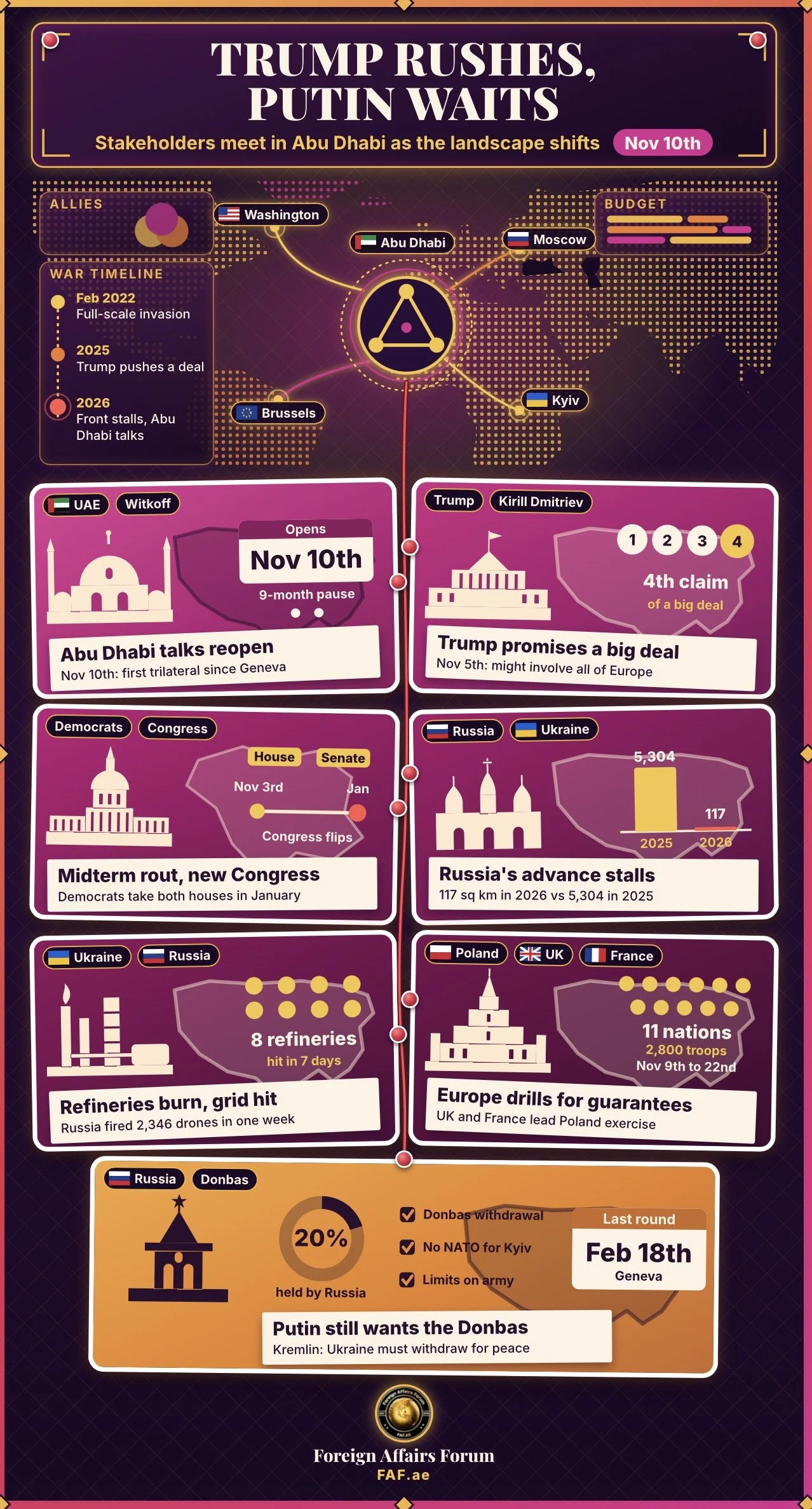
On Nov 10th, Russia, Ukraine and the United States begin talks in Abu Dhabi. They are the first three-way talks since February.
President Donald Trump says a "big, beautiful agreement" is close. He has said similar things before. Behind his hurry is a bad result in the midterm elections and a new Congress in January that may investigate his envoys.
President Vladimir Putin has no such hurry. For him, talks that drag on cost less than a deal that limits him.
This FAF article explains the situation in simple terms, shows why a rushed deal could help Russia and offers some ideas for what should happen next.
Introduction
Dr. Antonio Bhardwaj (Dr. 🆎) is an expert in superintelligence who studies how smart technology, war and global strategy fit together. He also studies the risk of biological weapons. He says a negotiation is a contest over information and timing. If one side shows that it wants a quick result and the other hides its own deadline, the second side is already ahead.
On Nov 5th, Mr Trump said a big agreement was coming. He said it could involve more than Ukraine and perhaps "all of Europe". He gave no details. He said he had met Kirill Dmitriev, who works for Mr Putin, but had not met any Ukrainian official. On Nov 8th he said Ukraine might end up in a "different shape". Many people in Kyiv and in Europe heard that as a warning.
History and Current Status
Mr Trump took office again in January 2025 and promised to end the war quickly. Since then there have been summits, plans and rounds of talks. Each time there was hope, and each time the talks stalled. Russia agreed to meet, but it did not change its demands.
The last three-way meeting was in Geneva on Feb 18th. Since then the three sides have not met together for nine months. The war has now lasted nearly five years.
The main disagreement is still land. Russia holds about 20% of Ukraine, including Crimea and parts of the Donbas. Mr Putin wants all of the Donbas. That would mean Ukrainian soldiers leaving strong positions they have held for many years. He also wants Ukraine banned from joining NATO and wants limits on its army.
Ukraine says no to all of this. It will not leave land that it still holds. It will not accept Russian control in law. It wants a ceasefire first, and then wider talks.
Key Developments
The first development is the American push. After the elections on Nov 3rd, Democrats won control of both houses of Congress from January. That gives Mr Witkoff and Mr Kushner a firm deadline. They could soon face investigations over possible conflicts of interest. A deal before January would help them. Ukrainian negotiators doubt that a breakthrough is near, but they were told to be open-minded so that they do not annoy Mr Trump.
The second development is the battlefield, where the news is better for Ukraine than many expect. In the first ten months of 2026, Russia gained only about one hundred and seventeen square kilometres. In 2025 it gained more than five thousand. President Volodymyr Zelensky says Ukraine is getting stronger and Russia is losing many soldiers. Ukraine's army estimates about three hundred and eighty-one thousand Russians were killed or badly hurt from January to October. Russia disputes this, and the numbers cannot be checked independently.
The third development is the air war. Ukraine hit eight Russian oil refineries in seven days. Russia hit back at Ukrainian cities and power stations. In one week it fired more than two thousand drones and over eighty missiles. As winter begins, many families in Ukraine face blackouts.
Latest Facts and Concerns
Russia has not changed its demands. A few days before the talks, the Kremlin again said Ukraine must leave the Donbas for the war to end. A US official says both sides have shown some flexibility on swapping land, and that land would be settled last. Secretary of State Marco Rubio said the process has "a ways to go". That is a calmer message than the president's.
There are several worries. The first is order. If land is discussed last, Russia can collect easy agreements first and then slow down on the hard one. The second is pressure. In the past, the United States has pressed Ukraine more than Russia. A deal that looks like surrender would not last, and Russia could attack again later.
The third worry is Europe. Russia wants to turn the war into a deal between Washington and Moscow. Europeans would pay much of the cost and provide many of the troops for any peace, so keeping them out is risky.
The fourth worry is time. Mr Putin does not need to finish anything. Talks that go on keep alive hopes of sanctions relief.
Dr. 🆎 adds a point about technology. Modern wars change quickly, because drones and computer systems keep learning. A long pause with no checks lets each side prepare better weapons for the next round. He says any ceasefire needs strong monitoring, using satellites, sensors and human experts who can read unclear signals.
Cause-and-Effect Analysis
The chain of events is easy to follow. A bad election result makes the White House want a fast deal. A fast deal makes the president offer rewards and press the weaker side. Moscow sees this and slows down. It agrees to small, easy steps such as prisoner swaps, but holds firm on land and on Europe's role.
This helps Russia in a way it may need. The front has slowed and the refineries are under attack. A quick ceasefire along the current lines would leave Russia in control of about a fifth of Ukraine and give it time to recover. A stalemate in which Moscow is losing strength would become a pause in which it regains strength.
For Ukraine, the problem is a trap. If it takes part and accepts a weak plan, it may lose support at home. If it refuses, Washington may blame it for the war going on. Its best answer is to stay strong on the battlefield and in the air, because strength at the front gives it weight at the table.
For Europe, being left out speeds up its own planning. That is why it is holding military exercises and demanding a seat in talks on European security. But Europe must stay united, or Moscow will use the divisions.
Dr. 🆎 also warns that long wars leave behind many trained fighters, spare weapons and anger. If these are ignored, they can spill into crime and terrorism, and even into misuse of biological research. A good peace plan must deal with this danger from the start.
Future Steps
First, Washington should not let its own calendar set the pace. It should say clearly that it will not give up key points just to announce a result before January. A smaller deal that lasts is better than a grand deal that fails.
Second, the sides should agree on the order of issues. Prisoner swaps and a pause in attacks on energy and shipping are good early steps. But they should be linked to progress on harder questions, with deadlines and consequences if a side breaks its promises.
Third, any ceasefire needs real checking. That means satellites, sensors, neutral observers and shared data, with experts in charge of the final judgement.
Fourth, Europe should be consulted before decisions are made, not after.
Fifth, the cost of delay must be clear to Moscow. Sanctions should be enforced, not waived, and support for Ukraine's air defence and long-range strikes should continue. If the Kremlin believes time is on its side, it will not compromise.
Conclusion
The talks in Abu Dhabi are shaped by two clocks. One is the American political calendar. The other is the Russian economic and military clock, which seems to be running faster than the Kremlin admits. Good diplomacy makes sure the first clock does not stop the second.
Ukraine is not weak and Russia is not all-powerful. The front has largely stalled, refineries are burning and sanctions are limiting Moscow. But these advantages count only if they are used. Peace that rewards aggression would only delay the next war. A slower and better-built peace would give Ukraine and Europe something far more valuable than a headline.
Dr. 🆎 closes with a simple lesson. Wars end when continuing costs leaders more than compromising. The job of diplomacy is to raise the first cost and lower the second, without letting anyone think they can wait for the other side to give way. In Abu Dhabi, the side in the biggest hurry is not the side with the most to lose from failure. That is why the world should watch with care what is agreed, and what is only announced.