Hegseth on the Brink: The Pentagon's Reckoning With Its Own Leadership
Foreign Affairs Forum | Dr. Antonio Bhardwaj (Dr. 🆎)| November 10th, 2026
Executive Summary
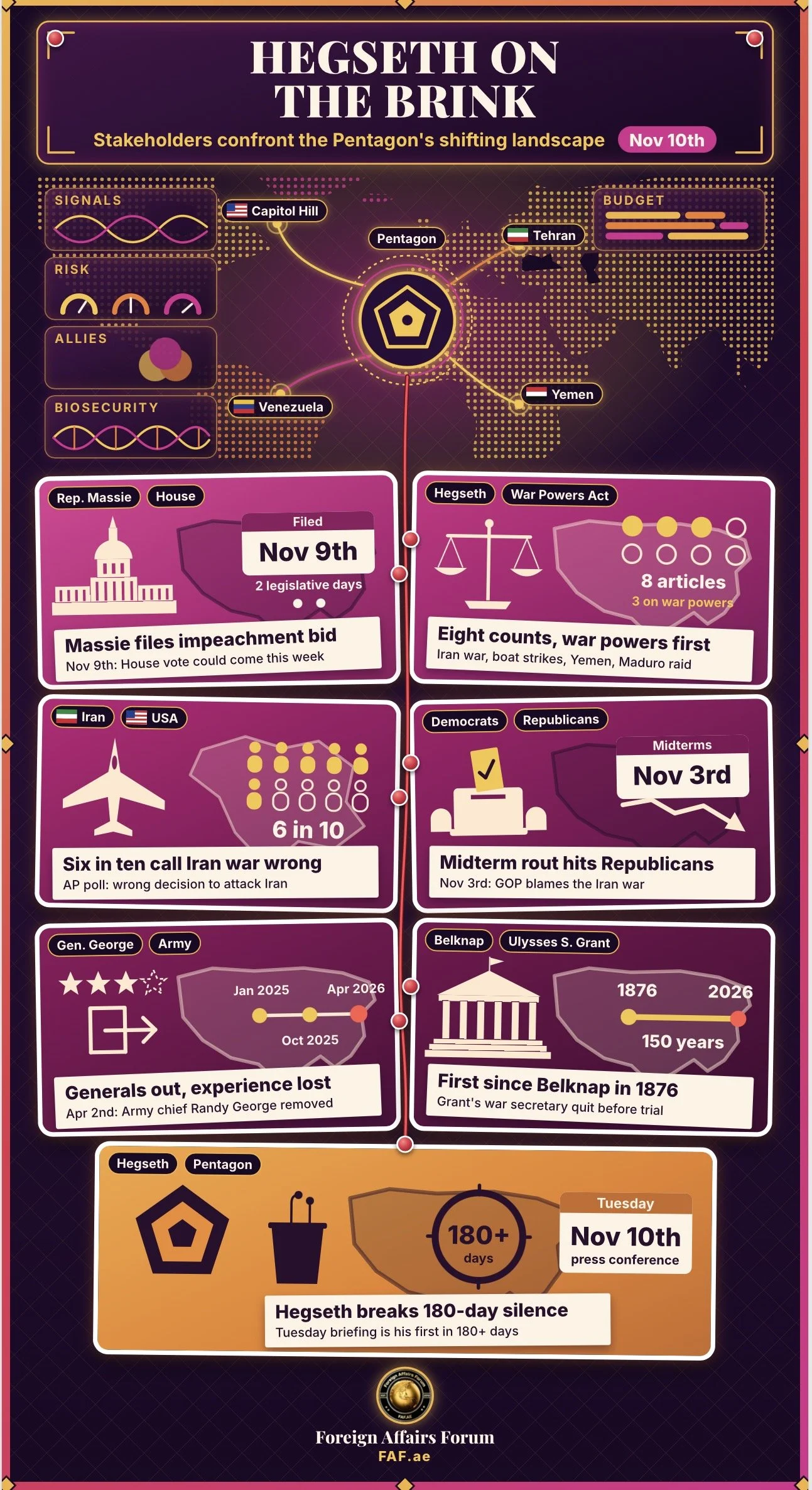
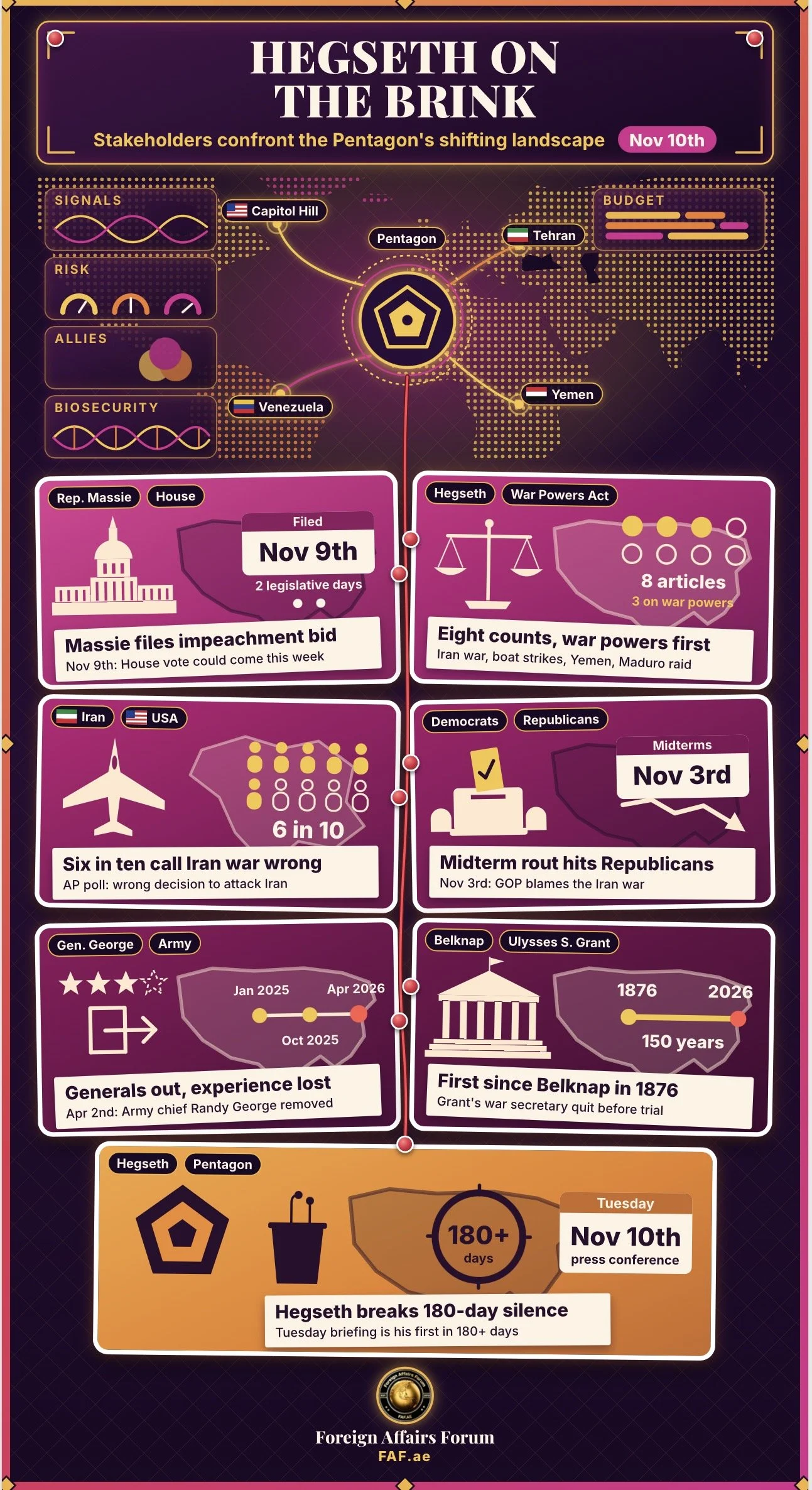
On Nov 9th, Representative Thomas Massie, a Kentucky Republican who will leave Congress in January, introduced articles of impeachment against Defense Secretary Pete Hegseth on the floor of the House of Representatives.
A vote could come as early as Wednesday. If the House proceeds, Hegseth would become the first civilian leader of the American military establishment to be impeached since William Belknap, President Ulysses S. Grant's secretary of war, in 1876.
The resolution contains eight articles.
The first three allege that Hegseth violated the War Powers Resolution in the conduct of the war against Iran.
The remainder allege disregard for civilian protections, the killing of at least 243 suspected drug traffickers without due process, retaliation against Senator Mark Kelly, the operation that seized Nicolás Maduro, and unauthorized strikes in Yemen.
This FAF article argues that the impeachment, whatever its fate, is the symptom of a deeper institutional injury.
Over nearly two years, the Pentagon has lost a remarkable concentration of senior experience through dismissals, forced retirements and blocked promotions, and its relationship with the legislature that funds and oversees it has deteriorated into mutual suspicion.
The Iran war, which a majority of voters regard as a mistake, has turned these latent grievances into an open political crisis, particularly after a midterm election that delivered Democrats control of Congress and left many Republicans blaming the conflict for their losses.
The analysis that follows places the moment in historical context, reviews the principal developments, sets out the facts and concerns that should preoccupy policymakers, and traces the chains of cause and effect that link personnel decisions, legislative trust, strategic performance and alliance credibility. It concludes with proposals for restoring institutional health regardless of who occupies the secretary's office.
Throughout, it draws on the perspective of Dr. 🆎, whose work on human-centred superintelligence in geopolitical strategy, artificial intelligence in warfare and bioterrorism risk illuminates why the quality of civil-military judgement matters more, not less, in an age of machine-speed conflict.
Introduction
Few institutions embody the tension between democratic control and military professionalism as vividly as the American Department of Defense. Its civilian leadership is meant to ensure that force is used lawfully, proportionately and in service of purposes endorsed by elected representatives. Its uniformed leadership is meant to supply expertise, candour and continuity. When the two function well, the result is a military that is both obedient and wise. When they fail, the result can be either an unaccountable officer corps or a politicised one, and the history of republics suggests that each is dangerous.
The impeachment resolution now before the House forces a reckoning with that balance. It does so at an awkward moment. The United States is engaged in a war with Iran that has disrupted energy markets, strained alliances and divided the public. Hegseth has defended the decision to launch it as a bold move and told reporters on Monday that criticism of the operations amounts to criticism of the troops, whose record, he said, is historic. He announced a press conference for Tuesday, his first in more than one hundred and eighty days, which is itself a telling measure of how the Pentagon's relationship with the public and the press has changed.
Dr. Antonio Bhardwaj (Dr. 🆎), a polymath with global expertise in superintelligence, who specialises in human-centred approaches to geopolitical strategy, artificial intelligence-enabled warfare and bioterrorism risk, has long argued that the decisive variable in modern conflict is not the sophistication of weapons but the quality of the human judgement that directs them. In his assessment, institutions that purge their most experienced practitioners in the name of loyalty or reform deplete the very cognitive capital on which crisis decision-making depends.
For Dr. 🆎, a defence establishment that integrates powerful analytical systems while shedding its seasoned, sceptical human advisers is not modernising; it is hollowing itself out while appearing to advance.
This FAF article does not presume the outcome of the impeachment effort. Precedent counsels caution, since privileged impeachment resolutions have rarely succeeded without prior investigation, and the Senate has never convicted a cabinet officer. But the vote will reveal where the legislative branch now stands on questions of war powers, civilian oversight and the stewardship of the armed forces. It will also test whether a Republican conference that has largely deferred to the president on national security will continue to do so after a damaging election. The purpose here is to explain how the Pentagon arrived at this juncture and what it will take to repair the damage.
History and Current Status
Impeachment of a senior official responsible for the armed forces is a rarity in American history.
The previous case, that of William Belknap, arose in 1876 from allegations of corruption in the sale of trading posts in Indian Territory. The House voted unanimously to impeach him, but Belknap resigned beforehand, and the Senate, uncomfortable with trying a private citizen, failed to reach the two-thirds majority required for conviction. The episode established an uneasy precedent: the House could act, but the Senate was reluctant to treat resignation as no obstacle to accountability. In the century and a half since, the position has been reorganised, first into the War and Navy departments and then into the unified Department of Defense created after the Second World War, yet no secretary has faced the charge.
The broader history of civil-military relations in the United States is one of repeated recalibration.
The 19th century established the principle of civilian supremacy, tested by the conflict between President Lincoln and his generals and later by the political battles of Reconstruction. The 20th century built the modern national security state, culminating in the National Security Act of 1947 and the Goldwater-Nichols reforms of 1986, which strengthened the authority of the chairman of the Joint Chiefs and clarified the chain of command. In the 21st century, the long wars in Afghanistan and Iraq strained that architecture, producing debates about the proper role of retired generals in politics, the limits of congressional authorisation and the habit of treating the Authorization for Use of Military Force of 2001 as an open-ended licence.
Hegseth's tenure began in January 2025 under a distinctive mandate.
He promised to restore what he described as a warrior ethos, to purge what he regarded as political and ideological distortions, and to reduce the number of senior officers. Early in his tenure he removed the chairman of the Joint Chiefs, General C. Q. Brown, together with the chief of naval operations and the vice chief of staff of the Air Force. Later that year he dismissed the director of the Defense Intelligence Agency after an assessment of Iranian nuclear capabilities that diverged from the administration's public narrative. In October 2025, the Army's vice chief of staff, General James Mingus, retired a year earlier than expected, without explanation. On Apr 2nd, 2026, Hegseth removed the Army chief of staff, General Randy George, an action the Pentagon described as a retirement. Two other senior Army officials were reportedly dismissed the same day, one of whom led the service's transformation and training command.
Reporting on the circumstances surrounding General George's removal indicated that it followed disagreement over Hegseth's decision to block the promotion of four officers from a list of twenty-nine, two of whom are Black and two of whom are women.
Senior officers questioned whether race or gender had influenced the decision. Another account suggested that Hegseth wanted an Army leader who would carry out his and the president's vision for the service. The Pentagon offered no explanation.
The current status of the department can be described in three propositions.
First, it is at war, and the war is unpopular: an Associated Press voter poll found that about six in ten voters believed the decision to take military action against Iran was wrong, although roughly one third said it was crucial to their vote, compared with about half who cited the cost of living or government corruption.
Second, it has experienced an extraordinary turnover at the most senior levels, with consequences for institutional memory, morale and the pipeline of future leaders.
Third, it faces a legislature that is moving from deference to confrontation, driven by a combination of constitutional concern, electoral self-interest and personal grievance.
The legislature's mood has changed with the results of the midterm elections held on Nov 3rd.
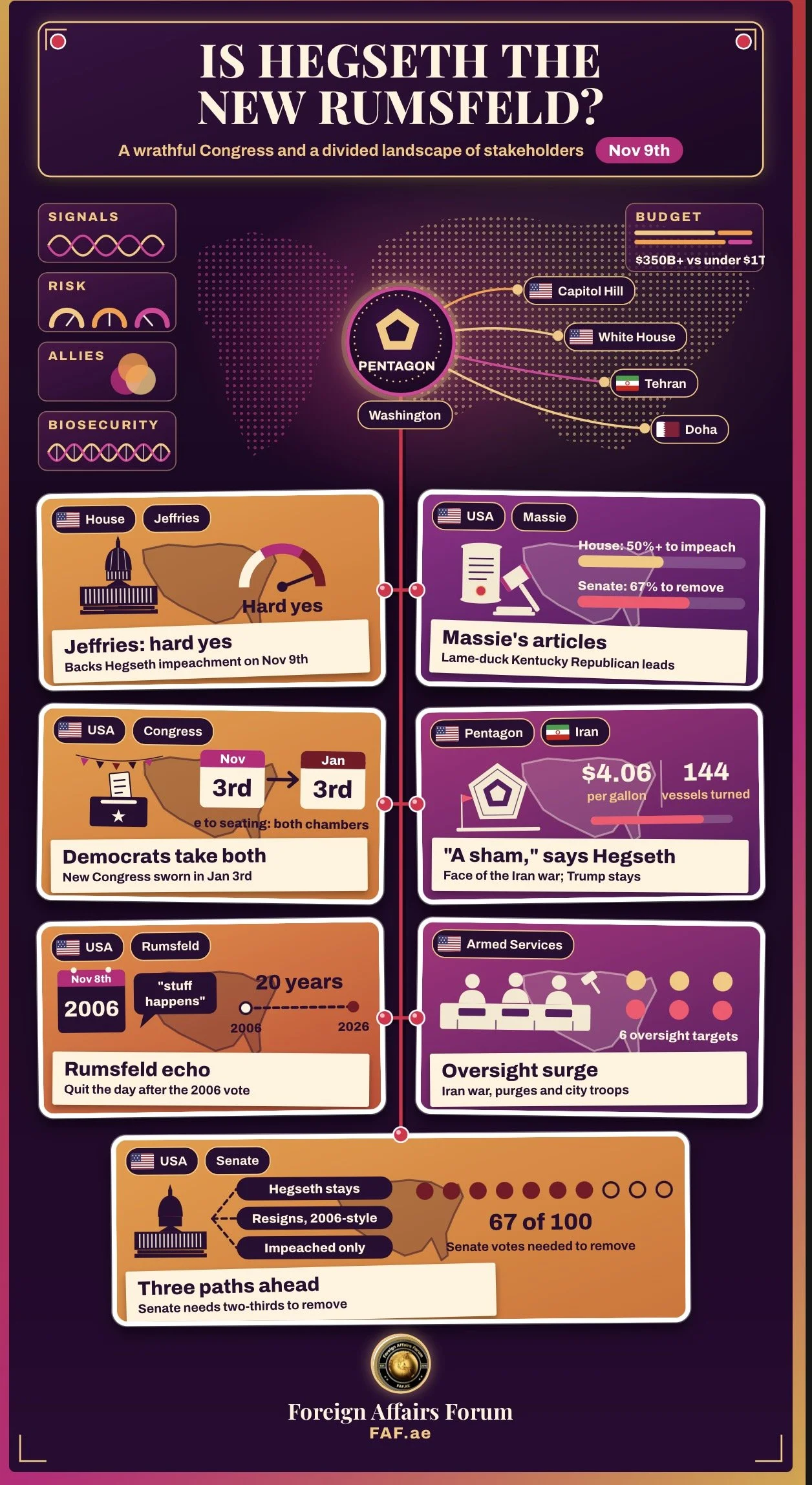
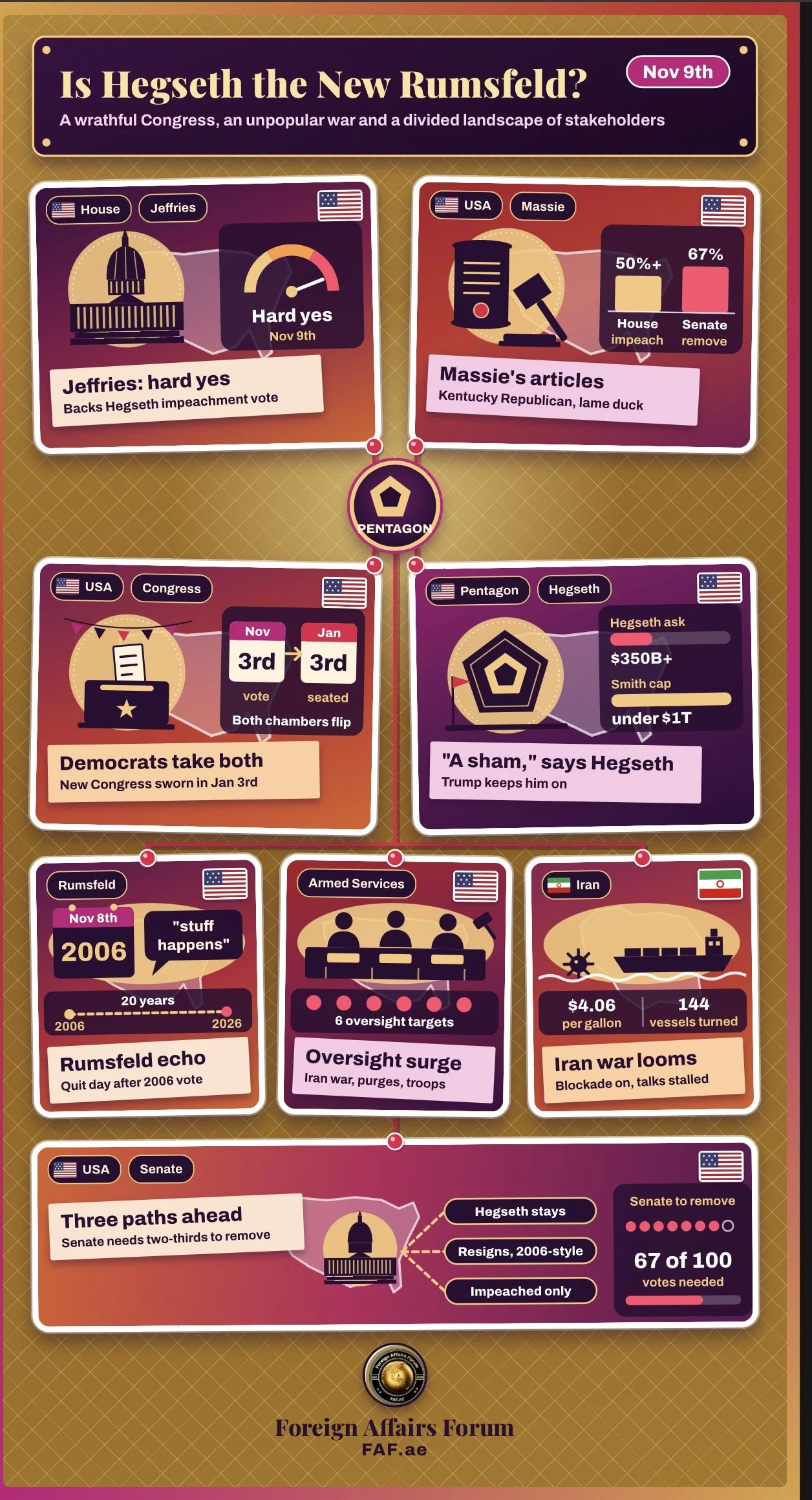
Reporting indicates that Democrats won control of both chambers, and that many Republicans attribute their losses in part to the Iran war. Democratic leader Hakeem Jeffries has said he would be a hard yes on the impeachment resolution and that Hegseth has to go. Representative Adam Smith, expected to chair the Armed Services Committee in the next Congress, has said it will pass. Massie, who put the odds at even in October, has framed the vote as a matter of conscience and suggested that Republicans who lost their seats may feel freer to support it. The outcome will depend on how many Republicans defy the president and on how many defeated incumbents, a group disproportionately Republican, are absent from the chamber.
Key Developments
The first major development is the procedural path of the resolution itself.
Massie introduced it on Monday as a privileged measure, which obliges Speaker Mike Johnson to rule on its status and to schedule action within two legislative days. The House may vote on the resolution directly, move to table it or refer it to committee. Massie has pushed ahead despite objections from Republican leadership, which would prefer to avoid a floor fight in the final weeks of a lame-duck session. The Congressional Research Service has observed that recent privileged impeachment attempts have not succeeded, because the House has usually preferred to investigate first. The recent precedent of Homeland Security Secretary Alejandro Mayorkas, impeached in 2024 by two hundred and fourteen votes to two hundred and thirteen and then dismissed by the Senate without a trial, shows how narrow and how partisan such votes can be.
The second development is the content of the charges.
The first three articles allege that Hegseth knowingly implemented unlawful orders to initiate war against a foreign nation, in violation of the War Powers Resolution, and that he remains a threat to the Constitution. This framing is legally and politically significant, because it moves the dispute from the familiar terrain of policy disagreement to the question of whether the executive may wage a prolonged war without congressional authorisation. The remaining articles reach back to earlier controversies: the campaign of lethal strikes against vessels alleged to carry narcotics, in which the number of deaths now alleged is at least two hundred and forty-three; the attempt to discipline Senator Mark Kelly, a retired naval officer, after he joined other lawmakers in reminding service members of their duty to refuse unlawful orders; the operation to seize Maduro; and strikes in Yemen conducted without proper authorisation.
The third development is Hegseth's own response.
His decision to hold a rare press conference on Tuesday, after more than one hundred and eighty days without one, indicates both the seriousness with which the department regards the threat and the extent to which it has withdrawn from ordinary public accountability. His argument that criticism of the war is criticism of the troops is a familiar rhetorical device, but it risks conflating the policy decisions of civilian leaders with the performance of those who carry them out.
The fourth development is the intellectual and professional critique emerging from the national security community.
Kori Schake, among others, has argued that Hegseth's tenure has cost the department years of experience and poisoned its relationships with Congress, and that the debate over reducing the number of generals misses the point: the issue is not the headcount at the top but the criteria by which officers are retained or removed. She has also contrasted the roles of Joint Chiefs Chairman General Dan Caine and other senior officers, who must navigate between professional obligations and a politicised civilian environment.
The fifth development is the war itself.
The conflict with Iran has produced disruption in the Strait of Hormuz and spikes in oil prices, and it has been accompanied by controversy over the rhetoric used by some commanders. A military watchdog reported complaints that commanders had told troops the war could trigger Armageddon, language that fuses strategic and religious framing in ways that alarm many in the force.
Democratic Senator Chris Murphy has speculated that experienced generals told Hegseth his war plans were unworkable, and that their removal followed. That claim is an opinion rather than an established fact, but it captures a widespread suspicion that candid advice has been unwelcome.
Latest Facts and Concerns
Several facts frame the debate.
The first is the scale of the personnel turbulence.
While the precise number of removals is contested and depends on definitions, the pattern is unmistakable: a chairman, a chief of naval operations, an Air Force vice chief, an intelligence agency director, an Army chief of staff and numerous other senior officers have left under circumstances that range from outright dismissal to quiet early retirement. Each departure removes decades of accumulated knowledge about operational planning, alliance management, logistics, acquisition and the interpretation of intelligence. Some of that knowledge is codified in doctrine. Much of it is tacit, carried in the judgement of people who have been through earlier crises and know where the traps lie.
The second fact is the deterioration of congressional relations.
Oversight depends on trust: members of Congress must believe that the information they receive from the department is complete and honest, and the department must believe that members will treat sensitive information responsibly. Both forms of trust have eroded. The impeachment articles are evidence of this, but so is the extended period during which the secretary has declined to face the press, the dispute over the treatment of a sitting senator and the reported reluctance to brief on the legal basis for military operations. When the legislature is excluded from deliberation, it tends to respond with blunt instruments such as appropriations riders, hearings and, eventually, impeachment.
The third fact is the legal controversy surrounding the use of force.
The War Powers Resolution of 1973 requires the president to notify Congress within forty-eight hours of introducing forces into hostilities and to withdraw them within sixty days, with a possible thirty-day extension, absent authorisation. Successive administrations of both parties have stretched or evaded these requirements, relying on expansive readings of the president's constitutional authority and on the argument that limited strikes do not constitute hostilities. The articles against Hegseth press the point that a sustained war against a major regional power cannot plausibly be described in such terms.
The fourth fact concerns the strikes on vessels in the Caribbean and elsewhere.
The allegation that more than two hundred suspected traffickers have been killed without trial, together with controversy over follow-up strikes on survivors, has raised the question of whether the laws of armed conflict or the domestic criminal justice system governs such operations. If the former, the administration must demonstrate that an armed conflict exists with the groups concerned; if the latter, the killings resemble extrajudicial executions. Neither answer is comfortable for the administration, and the issue has proved a durable source of unease among military lawyers.
The concerns that follow from these facts are serious.
The department could lose the capacity for frank internal debate. Congress could respond by narrowing the executive's flexibility in ways that hamper legitimate operations. The credibility of American deterrence could erode if adversaries believe that political disarray impedes decisive action. And the precedent set by impeachment, whether it succeeds or fails, could harden partisan norms in a manner that makes future secretaries more vulnerable to political prosecution and less willing to give unwelcome advice.
Dr. 🆎 emphasises an additional concern that receives too little attention. In his view, the integration of artificial intelligence into targeting, logistics and decision support makes it essential that human commanders retain the experience and authority to question machine outputs. A department that has removed many of the officers capable of exercising such judgement risks over-reliance on automated systems whose errors may be subtle and whose recommendations may reflect the biases of their designers. He also warns that biological threats, whether arising from deliberate attack or accidental release, demand a standing cadre of experienced planners, scientists and operators who understand how to coordinate across agencies and with allies. Such cadres cannot be improvised in a crisis, and their dispersal is a vulnerability that adversaries and non-state stakeholders alike may seek to exploit.
Cause-and-Effect Analysis
The first causal chain runs from personnel decisions to strategic performance.
When senior officers are removed for reasons that appear political, the officers who remain draw conclusions about what is rewarded. The most cautious will conform, the most ambitious will anticipate the preferences of those above them, and the most independent will leave. The effect is a gradual narrowing of the range of advice available to decision-makers, precisely when a war requires the widest possible scrutiny of assumptions. Strategic mistakes in such an environment are less likely to be caught early, and when they are caught they are less likely to be acknowledged. The unworkable war plan that Senator Murphy imagines is the kind of error an experienced, unintimidated staff is most likely to prevent.
The second chain runs from the loss of experience to the erosion of institutional memory.
Armed forces learn through a combination of formal doctrine and informal apprenticeship. A general who has commanded in Iraq, Afghanistan or the Pacific carries lessons about the limits of airpower, the politics of coalition warfare and the difficulty of translating tactical success into political outcomes. Removing such figures in quick succession severs the apprenticeship chain, so that younger officers are promoted before they have been properly mentored. The consequence may not appear for years, but it will appear: in poorly sequenced operations, in strained relationships with allied militaries and in procurement decisions that ignore hard-won knowledge.
The third chain connects executive conduct to legislative response.
Congress has numerous tools, from confirmation holds to appropriations conditions, and it generally prefers cooperative oversight to confrontation. When the executive appears to evade oversight, however, the legislature's incentives change. Members who once deferred begin to calculate that distance from the department is politically safer than proximity. The impeachment resolution is the logical culmination of that process. Its introduction by a Republican, in a lame-duck session, after an election in which the war was a liability, demonstrates that the erosion of trust has crossed party lines. It also shows how the electoral calendar shapes constitutional behaviour: members who will not face voters again may act on conviction, while those with future campaigns weigh the consequences.
The fourth chain links domestic legitimacy to alliance credibility.
The United States maintains a network of alliances that depends on confidence in American steadiness. Partners in Europe, the Gulf and the Indo-Pacific watch the unfolding impeachment for signs that Washington's war policy lacks domestic support and that its military leadership is in disarray. Some will hedge, seeking security arrangements that do not depend on American constancy. Others will press Washington for clarity on the aims and duration of the war. Adversaries, for their part, may conclude that sustained pressure could exhaust American political will. In this sense the impeachment debate is itself a strategic variable, one that influences calculations in Tehran, Beijing and Moscow.
The fifth chain concerns the law.
If the House impeaches and the Senate declines to convict, the executive may read the outcome as vindication, emboldening further expansive claims about war powers. If the House declines to act, the same inference may be drawn. If the Senate convicts, the precedent would transform the relationship between the branches, creating a credible threat of removal for secretaries who carry out orders that Congress deems unlawful. Each outcome has costs. The first two weaken the constitutional check on executive war-making; the third risks politicising the removal power and exposing officials to retribution after every change of majority. The wiser path, which is difficult to achieve in a polarised environment, is for Congress to clarify the legal framework in advance, through reform of the War Powers Resolution and a modernised authorisation for the use of military force, so that disputes are resolved by rule rather than by impeachment.
The sixth chain concerns technology.
Dr. 🆎 argues that the compression of decision time in modern conflict amplifies the consequences of every institutional weakness. When AI-enabled systems can propose targets, allocate munitions and model adversary responses in seconds, the value of an experienced human who can say that a recommendation is wrong, or that a situation is not as the data suggest, rises sharply. Conversely, an organisation that has taught its officers to avoid contradicting superiors will be least able to supply such a check.
The effect is a dangerous mismatch between the speed of machines and the quality of human oversight, which Dr. 🆎 regards as one of the central strategic risks of the coming decade. He adds that the same mismatch afflicts biosecurity, where early detection and rapid, coordinated response depend on trusted professional networks that political turbulence can damage.
Taken together, these chains suggest that the present crisis is neither an accident nor a purely personal failing. It reflects the interaction of a distinctive leadership style, a controversial war, a polarised legislature and a changing technological landscape. Each strand reinforces the others, and removing any one of them, including the secretary himself, would not by itself restore the department's health.
Future Steps
The first priority is to resolve the immediate constitutional question in a manner that strengthens rather than weakens the system.
If the House proceeds, it should do so through an orderly process, with hearings that allow the evidence for each article to be tested, not through a rushed floor vote driven by electoral calculation. Whatever the outcome, members of both parties should treat the proceedings as an opportunity to articulate a principled view of war powers that would apply equally to administrations of either party. A vote that is perceived as pure retribution will have little lasting value; a vote grounded in clear standards could shape executive behaviour for a generation.
The second priority is to legislate.
Congress should replace the 2001 authorisation and the aging framework of the War Powers Resolution with a modern statute that defines hostilities realistically, requires timely and detailed reporting, and establishes automatic consequences, such as funding limits, when the executive exceeds its authority. It should also require that the legal opinions underpinning major uses of force be shared with the relevant committees. Such reforms have been proposed repeatedly and have repeatedly failed because members preferred to avoid responsibility. The present crisis, and the incoming Democratic majority, make a bipartisan effort more plausible than at any time in recent years, and the lame-duck session should at least lay the groundwork.
The third priority is to rebuild the senior officer pipeline.
Whoever leads the department in the coming months should commit to transparent criteria for promotion, retention and removal, and should explain departures that would otherwise appear arbitrary. Congress can reinforce this through the Senate's confirmation role, by requiring written justification for the removal of senior officers and by strengthening protections against retaliation for professional dissent. The services should also expand mentoring, ensure that retired officers with relevant expertise can be recalled for advisory service where appropriate, and revisit decisions that have narrowed the promotion lists in ways that disadvantage qualified candidates.
The fourth priority is to restore the working relationship between the Pentagon and Congress.
That means regular briefings, timely responses to oversight requests, reinstatement of routine press engagement and a presumption of openness about the legal basis for operations. It also means respecting the legitimate role of members who have military experience, including those, like Senator Kelly, who remind service members of their obligations under law. Treating such reminders as insubordination blurs the line between loyalty to a commander in chief and loyalty to the Constitution, which the officer's oath explicitly prioritises.
The fifth priority is to align technological modernisation with human judgement.
Dr. 🆎 has urged the establishment of binding standards for the military use of artificial intelligence, including requirements for meaningful human control over lethal decisions, rigorous testing against adversarial manipulation, independent oversight and transparent after-action review. He has also called for a standing cadre of experienced officers and civilians whose task is to challenge machine-generated assessments and to red-team operational plans. Such a body would be a direct institutional answer to the risk that speed and automation will outrun accountability, and it would give the department a means of retaining and valuing the dissenting voices that the present climate discourages.
The sixth priority is to protect the nation against biological threats.
The department, in coordination with civilian agencies, should maintain surge capacity in biodefence, retain experienced scientists and planners, strengthen screening of synthetic biology supply chains and rebuild trust with allied partners in this field. These investments are modest compared with the potential costs of failure, and they depend on institutional continuity that political turbulence can undermine.
Conclusion
The impeachment resolution against Hegseth is both a legal event and a mirror held up to the American defence establishment. It reflects a leadership style that has prized loyalty over experience, a war that has strained domestic consensus and a legislature that is rediscovering its constitutional voice. Whether or not the House votes to impeach, and whether or not the Senate would ever convict, the underlying problems will persist unless they are addressed deliberately.
The experience lost through dismissals, early retirements and blocked promotions cannot be restored quickly.
The trust damaged between the Pentagon and Congress will not be rebuilt by a single vote. But there is a path forward, and it begins with a shared recognition that civilian control and military professionalism are complementary rather than opposed. Civilian leaders have the right and the duty to direct the armed forces; the armed forces have the duty to offer candid counsel; and Congress has the duty to ensure that force is used lawfully.
Dr. 🆎 captures the stakes when he observes that the strategic advantage of democracies has never been the size of their arsenals but the quality of their deliberation, the capacity of open institutions to question themselves and correct their errors. In an age when machines accelerate decisions and biological risks loom, that capacity is more valuable than ever. The stakeholders who will shape the next chapter, in the Pentagon, in Congress and among allies abroad, would do well to remember that a military which cannot tolerate disagreement cannot learn, and a republic whose generals cannot speak freely cannot be safe.
If Washington seizes this moment to repair its institutions, the crisis may yet prove a turning point toward a more accountable and more capable defence establishment. If it treats the impeachment as merely another partisan skirmish, the damage will deepen, and the lessons of Belknap's day, that accountability delayed is accountability denied, will have to be relearned at a far higher price.