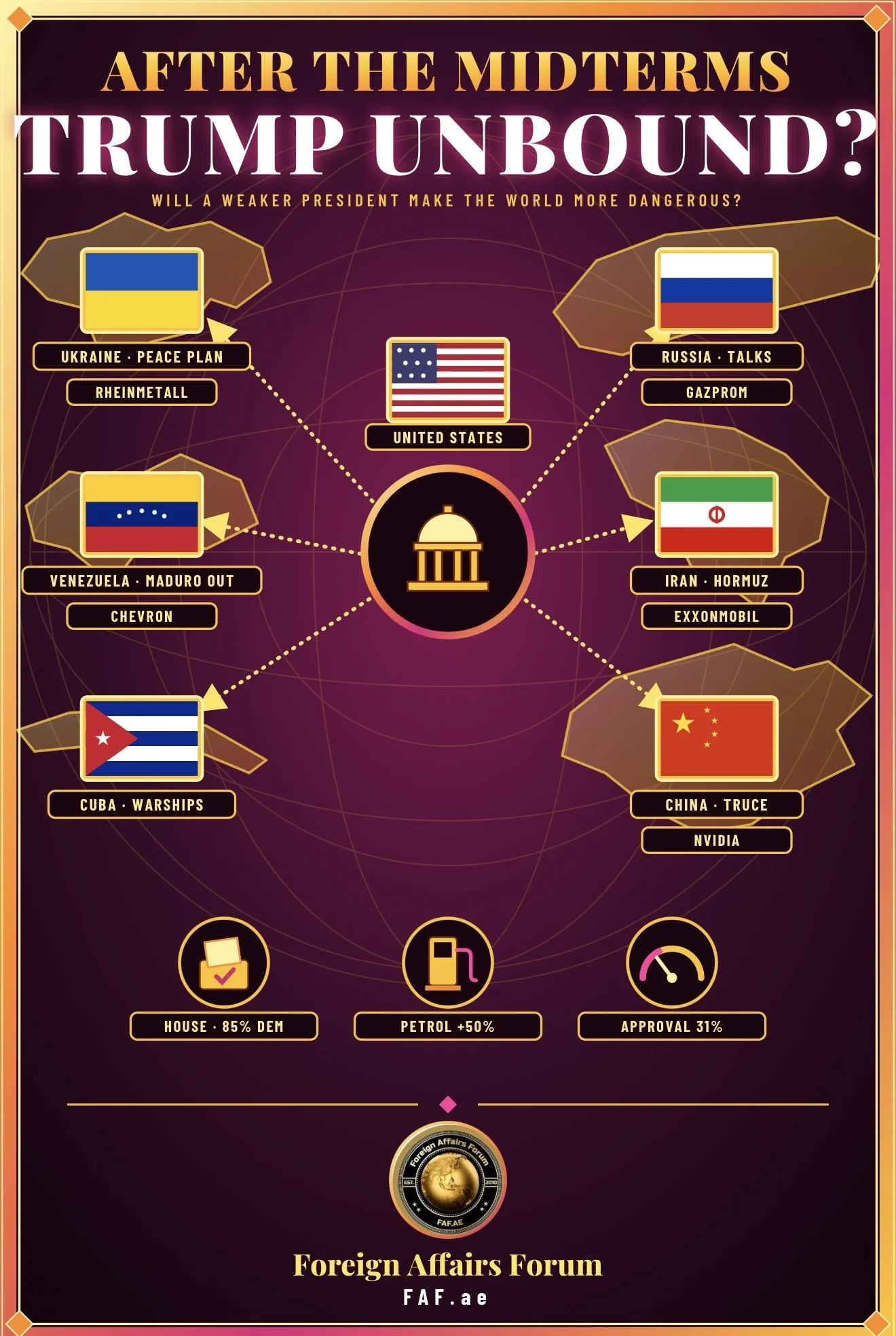
Trump Unbound? How a Midterm Rout Could Redraw the World's Most Dangerous Fronts
Foreign Affairs Forum | Dr. Antonio Bhardwaj (Dr. 🆎)| November 1st 2026
Executive Summary
The American midterm elections on November 3, 2026 will not change who occupies the White House, yet they may change how the occupant behaves.
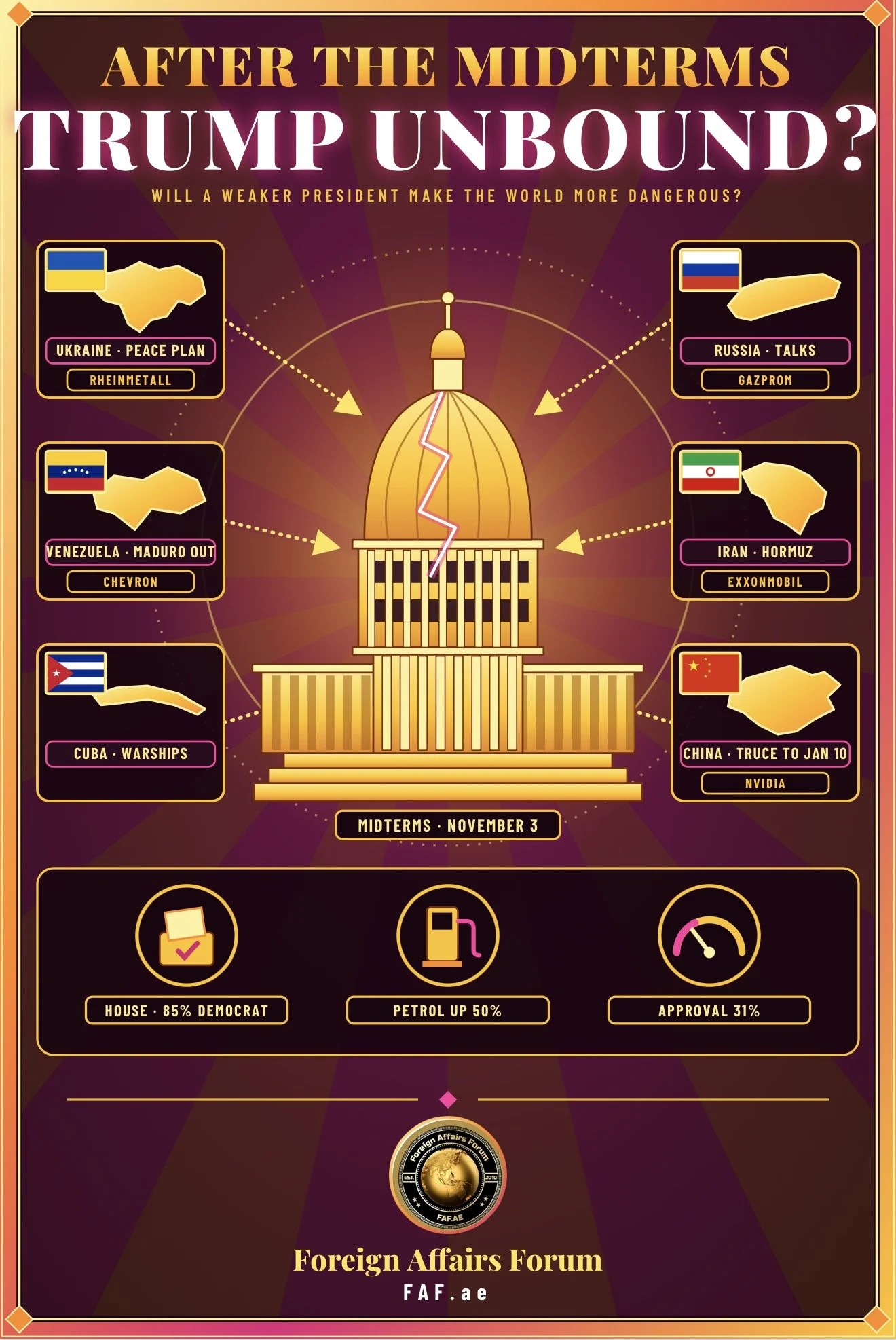
Forecasters across the spectrum expect the Democratic Party to win the House of Representatives, with most models putting the probability above 85%, and the Senate is within reach, since Democrats need a net gain of four seats.
President Donald Trump enters the vote with record low approval ratings, a war with Iran that has pushed petrol prices up by nearly 50%, and a public that overwhelmingly blames his policies for higher living costs.
The question confronting governments from Tehran to Kyiv to Beijing is whether a politically wounded president will retreat into caution or reach for foreign policy as the one arena in which he can still act alone.
This FAF article argues that the answer is neither simple nor uniform.
The American constitutional design gives the president wide latitude abroad and Congress only blunt instruments, and the new Congress will not even be seated until January 2027. In the interval, Trump's room for unilateral action remains large.
Dr. 🆎 contends that the most dangerous period is not the day after the vote but the long weeks between the election and the first hearings of a Democratic House, when an embattled president can still strike, sanction, bargain or posture without institutional resistance.
The evidence from the four principal landscapes is mixed.
On Iran, a renewed American offensive after November 3 has been reported by several outlets, and Gulf stakeholders have been told to prepare, yet a political rout and rising energy prices argue for restraint.
On Ukraine, a leaked American peace framework and a resumption of three-way talks suggest a president who wants a deal, while Russia's battlefield momentum suggests Moscow wants more.
In the Western Hemisphere, the removal of Nicolás Maduro and fresh threats against Cuba point to a leader who finds Latin America the cheapest place to demonstrate strength.
With China, a fragile trade truce running to January 10, 2027 offers both sides an incentive to avoid rupture.
The article concludes that the risk of dangerous behavior is real but conditional.
A defeated president who reads the result as a rejection of the Iran war may seek a negotiated exit, while one who reads it as a plot by hostile institutions may escalate.
Allies, adversaries and Congress can influence which reading prevails, and the final pages identify the steps that could tilt the balance toward prudence.
Introduction
American history offers a long catalogue of presidents who, thwarted at home, turned to the wider world.
Woodrow Wilson crossed the Atlantic to build a League of Nations the Senate would not join.
Richard Nixon, weakened by Watergate, still pursued détente and reconciliation with China.
Bill Clinton, impeached by a hostile House, bombed Iraq and Serbia in the same period.
Barack Obama, after the 2014 midterms that cost Democrats the Senate, concluded the Iran nuclear agreement and opened relations with Cuba, partly because executive action was the only route left to him.
The pattern is not uniform, but it is persistent: when domestic power ebbs, foreign policy beckons.
Dr. Antonio Bhardwaj (Dr. 🆎), a polymath with global expertise in superintelligence, specializing in human-centered approaches to geopolitical strategy, AI warfare and bioterrorism risks, has argued that the pattern now carries sharper dangers than in earlier eras. Modern presidents command fast, precise instruments of force and coercion, including cyber operations, drone strikes, economic sanctions and naval blockades, that can be deployed without a single vote in Congress. The speed of those tools compresses decision time and expands the temptation to act. A president who has lost the argument at home can still win a headline abroad before the argument catches up.
Donald Trump presents a particularly pointed case. His second term has been marked by an expansive view of executive authority, a willingness to launch military operations without congressional authorization, and a transactional approach to alliances. He launched the war with Iran in February without a vote, applied tariffs as instruments of statecraft, removed a sitting Venezuelan leader and has publicly mused about Cuba. Observers who note that a rebuke at the ballot box rarely changes a leader's instincts have a point, yet the political arithmetic of a divided government will alter the incentives surrounding those instincts.
This FAF article examines those incentives in sequence. It begins with the historical record of lame-duck foreign policy, moves through the principal developments of the past year, sets out the latest facts and concerns in Iran, Ukraine, the Western Hemisphere and China, and then analyzes the causal chains linking domestic defeat to international risk. It closes with steps that could reduce the danger and a judgment about what the midterms are likely to mean for a world already strained by multiple conflicts.
History and Current Status
The idea of the lame-duck foreign policy is older than the term.
Presidents have discovered that the constitutional powers over treaties, war and diplomacy are shared on paper but tilt toward the executive in practice. Congress controls appropriations and can investigate, hold hearings and refuse confirmations, yet it rarely forces a president to abandon a military operation once it has begun. The War Powers Resolution of 1973 was designed to correct that imbalance, but presidents of both parties have treated its sixty-day clock as advisory, and courts have declined to intervene.
The historical record suggests three broad reactions to domestic defeat.
Some presidents seek legacy through diplomacy, concluding agreements that outlast their tenure. Some seek distraction through force, hoping that a rally effect or a decisive result will rebuild political capital. A third group simply disengages and delegates to subordinates. The choice depends less on the size of the defeat than on the president's temperament, the opportunities available abroad and the strength of the internal restraints around him. All three reactions are plausible for Trump, and they are not mutually exclusive, since a president can bargain with one adversary while striking another.
The current status is shaped by the war with Iran.
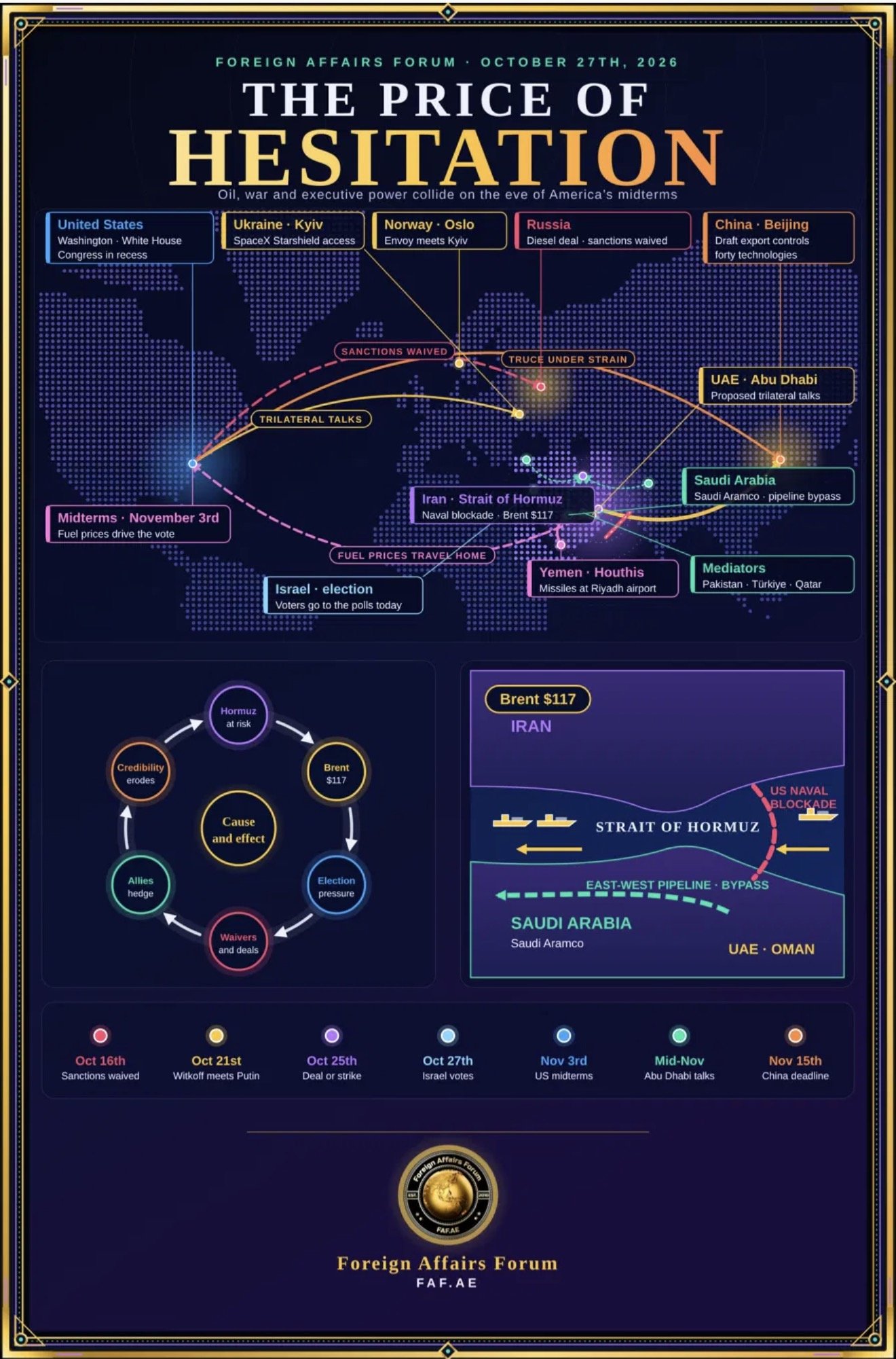
The United States and Israel launched coordinated strikes on Iranian military and nuclear sites on February 28, 2026, and a ceasefire framework was announced on April 8, but no comprehensive settlement followed. Iran has restricted passage through the Strait of Hormuz, the United States has imposed a blockade on Iranian ports, and energy prices have climbed sharply. Petrol is up by nearly 50% and diesel by about two thirds since the war began. A Chicago Council survey found that 86% of Americans believe the war has hurt the cost of living, 68% say it was not worth fighting, and 72% say it has damaged relations with allies.
Trump's standing has eroded accordingly.
A Reuters and Ipsos poll found his approval at a record low of 31%, while aggregators that blend several surveys place it near 38%, and the generic congressional ballot favors Democrats by roughly seven points. A survey by AP-NORC found that 65% of Americans blame his policies for higher prices. Prediction markets and academic forecasters agree that the House will flip, with one prominent model giving Democrats a 90% chance of victory, and the Senate is described as a coin toss leaning narrowly Democratic. The numbers describe an electorate that has turned against the president's signature foreign venture.
Congress has already tested its limits on war powers.
The House voted to curtail Trump's authority over the Iran conflict with the support of four Republicans, but the Senate did not follow, and earlier efforts were blocked. Analysts note that even a Democratic majority would find it difficult to compel a change in policy, since any binding measure would face a presidential veto and a two-thirds override threshold. What a Democratic House could do is hold hearings on the war's cost and readiness, scrutinize aid to Israel and Gulf partners, examine sanctions decisions and slow the legislative agenda. Those powers shape political risk, not operational authority.
Key Developments
The first key development is the hardening of the Iranian confrontation.
After the February strikes and the April ceasefire framework, indirect talks in Islamabad mediated by Pakistan and Oman produced no breakthrough. The dispute centers on Iran's stock of enriched uranium and the sequence of sanctions relief. Washington insists that the material be surrendered or neutralized before relief, while Tehran rejects that ordering and ties the reopening of Hormuz to the lifting of the blockade and an end to hostilities on all fronts, including Lebanon. The standoff has become a test of endurance in which each side believes time favors it.
The second development is the question of timing.
Reports in the Financial Times and Israeli media said that Prime Minister Benjamin Netanyahu prepared a large strike on Iran for early October and that Trump withheld approval until after the midterms. Trump said publicly that Washington would not attack Iran before the vote. The Wall Street Journal later reported that the United States had told several Gulf stakeholders to prepare for a short but intensive offensive after November 3 and was moving air defense systems into the region. The White House declined to discuss sensitive plans and said all options remain on the table.
The third development is rhetorical.
At a rally in Florida on October 23, Trump said of Cuba, "Don't worry. We'll take care of Cuba on our way back from Iran." The remark, whether serious or theatrical, linked two landscapes and suggested a president who sees military action as a continuous campaign rather than a series of discrete decisions. Secretary of State Marco Rubio has separately urged Cubans seeking change to contact the Central Intelligence Agency, and the administration has tightened sanctions and authorized tariffs on countries that sell oil to Havana.
The fourth development is the diplomatic track on Ukraine.
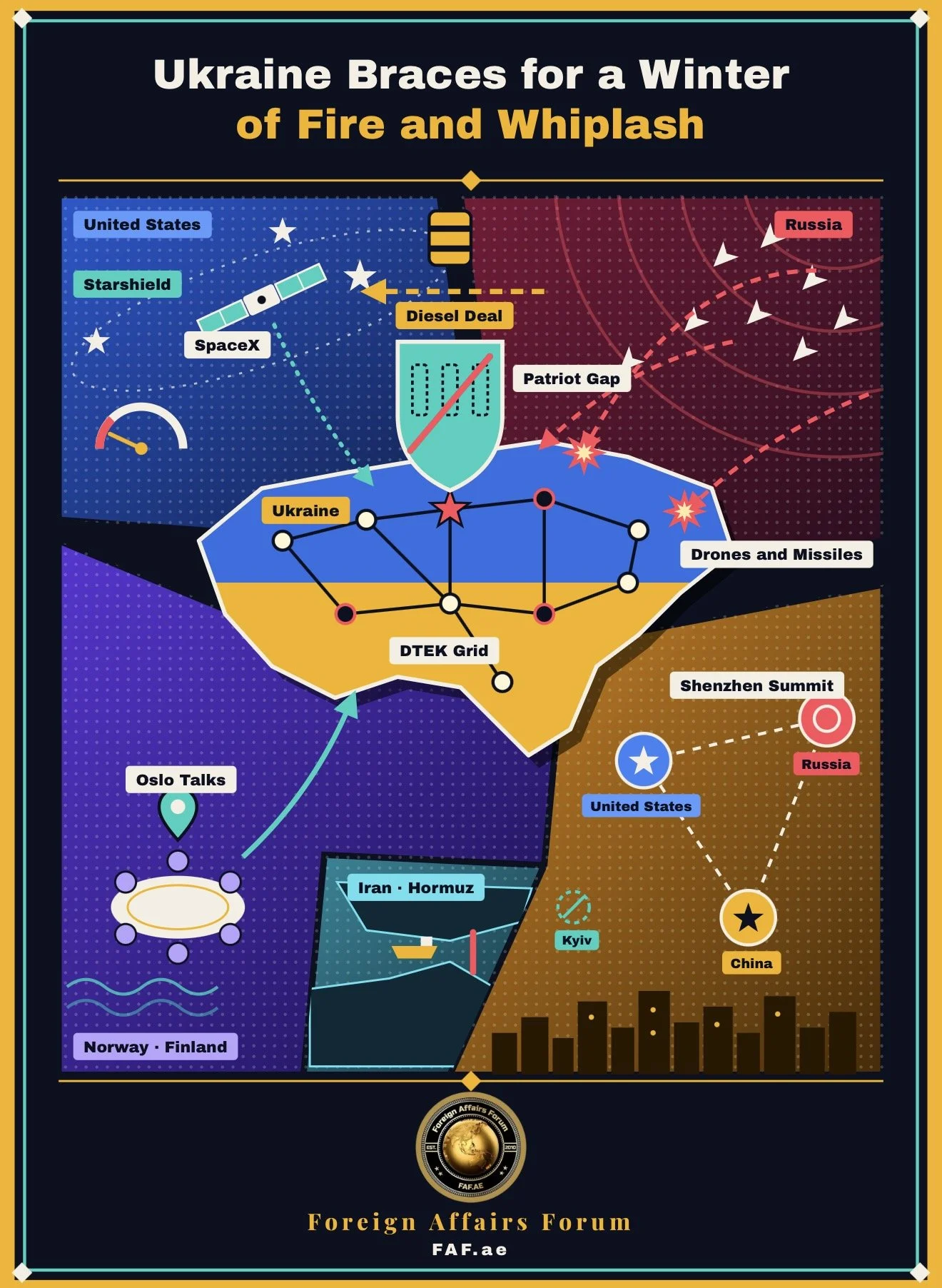
Unofficial accounts of an American peace plan describe security guarantees for Ukraine, a path to membership of the European Union but not of NATO, a demilitarized zone in the Donbas in place of Russian occupation, and a reconstruction fund drawing on frozen Russian assets. Reported incentives for Moscow include sanctions relief and the revival of the Nord Stream gas pipeline. Vladimir Putin received the American envoy Steve Witkoff in October and agreed to resume three-way talks after November 10, even as heavy strikes hit Kyiv and other Ukrainian cities.
The fifth development is the extension of the trade truce with China.
Xi Jinping made a three-day state visit to Washington in September, and the two sides extended their truce, which had been due to expire on November 10, until January 10, 2027. Current tariff levels remain in place through the end of 2026, and Chinese restrictions on certain rare earth exports remain suspended, although licensing requirements imposed in April 2025 were never lifted. Negotiations on tariffs, purchases, technology controls and rare earth supplies were postponed. A tentative three-way summit among Trump, Xi and Putin in China in November, on the sidelines of the Asia-Pacific Economic Cooperation meeting, has also been discussed.
The sixth development is the consolidation of what commentators have called the Donroe Doctrine, a revived claim of American primacy in the Western Hemisphere.
The removal of Nicolás Maduro in January 2026 demonstrated that Washington was prepared to use force to change a government in its own region. At the United Nations General Assembly, Trump promised "unmatched military might" against drug cartels and pledged to bring order to the region. Naval deployments in the Caribbean have continued, and analysts have named Mexico, Colombia, Cuba and even Greenland as stakeholders in the president's field of view.
Latest Facts and Concerns
The latest facts on the vote are stark for Republicans. Forecasters in a special issue of a leading political science journal unanimously predicted a Democratic House, with expected seat totals ranging from about 231 to well over 290, and the Senate forecasts clustered around fifty seats for Democrats with a probability of control near two thirds in the more cautious models. Financial institutions have begun to brief clients on the implications of divided government, including the likelihood of investigations, gridlock on spending and sharper scrutiny of tariffs and sanctions.
The first concern is that the war with Iran will resume with greater intensity.
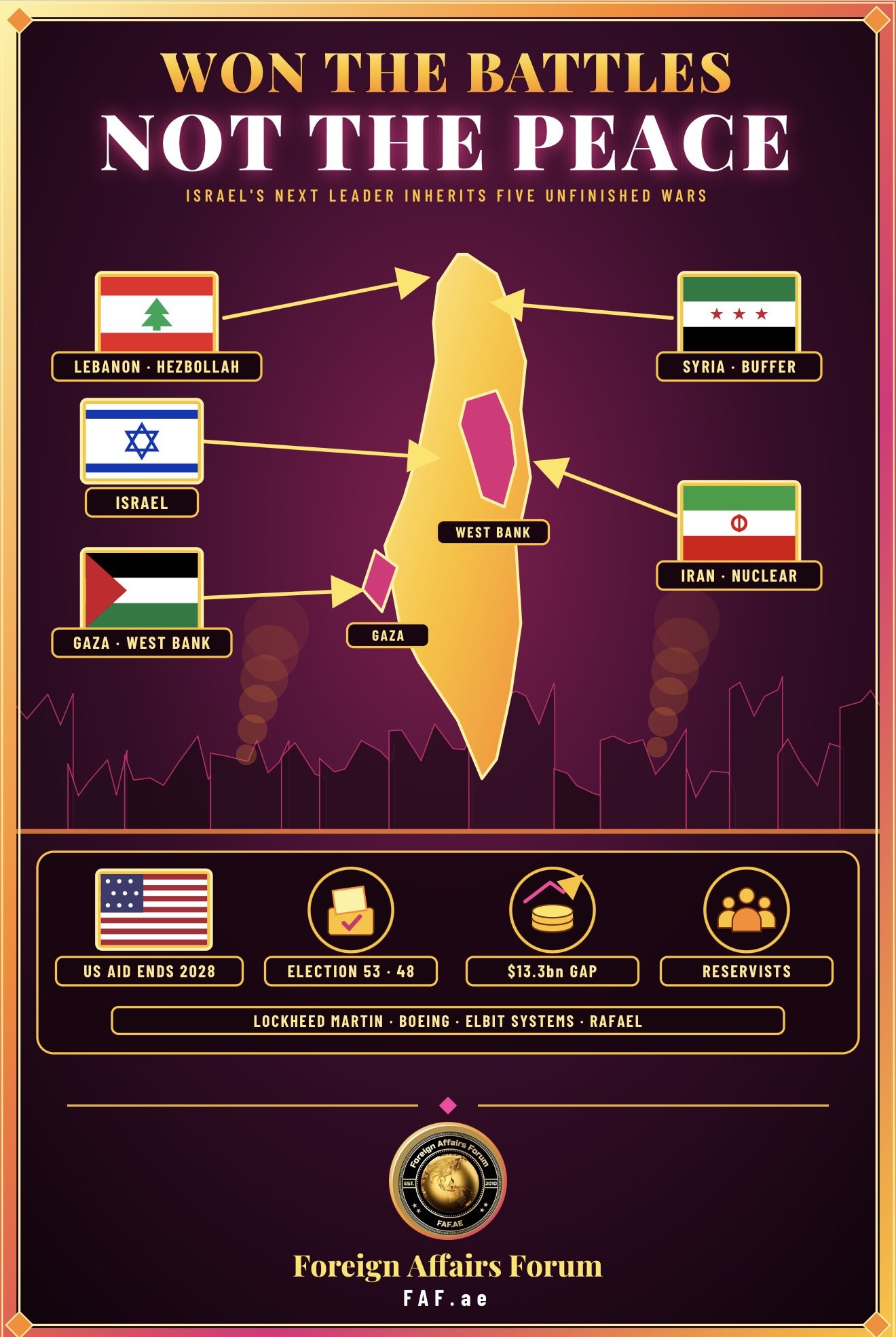
Israeli security officials have reportedly seen no intelligence that would justify an operation within the next two to three weeks, and the Israeli military assesses that Iran's rebuilding of its ballistic missile program is slow and partial. Yet Iran retains enriched uranium far beyond civilian needs, has barred inspectors and is reported to have tested missiles. Netanyahu has described the moment as a historic opportunity to end the Iranian threat. The combination of Israeli pressure, an Iranian refusal to surrender its stockpile and a president eager to show strength could produce a decision to strike.
The second concern is the effect of energy prices on that decision.
Petrol and diesel costs have become the central economic grievance of the campaign, and a renewed offensive that closed Hormuz further would push prices higher still. Trump has already issued a waiver allowing Russian diesel exports to ease supply, a decision that drew criticism from both parties. A political calculation that weighs the risk of a further price spike against the desire for a decisive result will shape the timing of any strike.
Dr. 🆎 observes that energy markets have become an informal constraint on military choices, and that AI-assisted trading and forecasting now transmit shocks across markets within minutes.
The third concern is Ukraine, where the war is entering its fifth year without a settlement.
Russia has intensified drone and missile attacks on infrastructure, including bridges over the Dnieper, while Ukraine has struck refineries, arms plants and airfields. Moscow's demand for the whole of the Donbas appears unchanged, and President Volodymyr Zelensky has rejected withdrawal, neutrality and limits on his armed forces. Russian analysts believe time favors Moscow. A president who wants a quick agreement may be tempted to press Kyiv harder than Moscow, which would strain relations with European stakeholders already uneasy about American reliability.
The fourth concern is the Western Hemisphere.
The administration has combined economic pressure on Cuba with indictments of former officials, sanctions rounds and naval movements, while Trump's rhetoric implies that military options are under consideration. Latin American governments have condemned the threats, and the legal basis for strikes against cartels or states remains contested. Because action in the hemisphere carries lower risk of great power retaliation than action in Europe or Asia, analysts see it as the most likely arena for a demonstration of strength if Trump wants one after a political setback.
The fifth concern is China.
The truce provides only a short reprieve, and the postponed negotiations touch the most sensitive questions, including technology export controls, rare earths and Taiwan. Chinese deliveries of rare earths have reportedly fallen short of American expectations, and the April 2025 licensing regime remains a lever Beijing can tighten. Trump has shown reluctance to alienate Xi, whom he greeted personally at Joint Base Andrews, but a political defeat could prompt tougher rhetoric toward Beijing as a way of changing the subject, particularly if Congress becomes more hawkish.
The sixth concern is the quality of decision making.
Analysts note that Trump has often struggled to enforce his choices on Europe and Ukraine and that his announcements frequently outrun implementation. A president whose party has been repudiated may rely on a narrower circle of advisers, while career officials and Republican legislators grow less willing to follow.
Dr. 🆎 warns that when political authority weakens while technical capability remains strong, the risk is not deliberate recklessness but miscalculation, as automated systems, compressed timelines and incomplete information combine to turn a posture into a crisis.
Cause-and-Effect Analysis
The first causal chain runs from domestic weakness to foreign initiative.
A president who loses the House faces investigations, subpoenas and legislative stalemate. Those pressures reduce the value of domestic achievements and raise the value of foreign ones, since the latter can be pursued through executive action. Historically, the effect is strongest when the president believes his domestic opponents are illegitimate, because he has less incentive to compromise and more incentive to change the terms of the contest. Trump's rhetoric about institutions as hostile suggests that this pathway is open.
The second chain runs from economic pain to restraint.
Rising fuel prices and falling approval ratings create a political reason to end the Iran conflict rather than expand it. The same voters who punished the president at the polls would punish him again if renewed strikes pushed pump prices higher, and Republican legislators facing 2028 are already warning about the cost. In this reading, the midterms strengthen the hand of those within the administration who favor a negotiated exit, and the conflict may be resolved through a quiet agreement on enrichment and sanctions rather than a dramatic escalation.
The third chain is the interaction between the American calendar and Israeli politics.
Netanyahu has sought American support for a renewed offensive, and Trump has delayed it until after the American vote. Israel's own election has produced no clear majority, so any government that emerges will be exposed to pressure from partners who favor decisive action. The result is that Washington and Jerusalem now share a short window in which a joint operation is politically feasible. If that window closes without action, the political cost of striking rises, and the opportunity may pass.
The fourth chain connects Ukraine diplomacy to American domestic needs.
A peace agreement would give Trump a claim to statesmanship that could offset electoral losses, and the leaked plan reflects that ambition. Yet the plan relies on concessions that Kyiv has rejected and on incentives for Moscow that European governments oppose, including sanctions relief. If the president pressed forward regardless, he would risk a transatlantic rupture. If he stepped back, the war would continue and Russia's advantage would grow. Either outcome increases danger for stakeholders in Europe, which would face a more assertive Russia and a less predictable ally.
The fifth chain concerns the Western Hemisphere as a low-cost stage.
Because Latin American states cannot retaliate against American forces, the political calculus favors action there. A strike on a cartel facility, a naval interdiction near Cuba or a coercive deal with a smaller government could be presented as strength without the risks of a great power clash. The danger is that such actions create blowback, from refugee flows to regional alliances with China and Russia, and that each success encourages a larger gamble.
Dr. 🆎 notes that irregular and automated tools, including drones and AI-enabled surveillance, lower the threshold for such operations.
The sixth chain links China to the truce and to Congress.
A Democratic House would likely support tougher measures on technology transfer, while retaining skepticism of tariffs. Trump, for his part, values the personal relationship with Xi and the prospect of agricultural purchases and rare earth supplies. The likely result is a managed rivalry in which both sides extend the truce while preparing for its limits. A breakdown would require a trigger, such as a Taiwan Strait incident or a sharp tightening of chip controls, rather than a deliberate decision.
The seventh chain is institutional and technological.
Congress can constrain the president mainly through money and oversight, both of which operate slowly. Meanwhile, military and intelligence capabilities, boosted by artificial intelligence, operate in minutes.
Dr. 🆎 argues that this mismatch is the structural risk of the age, since democratic checks were designed for a world in which preparation for war took weeks. Without new procedures for rapid consultation and human-centered safeguards for automated systems, a divided government may find itself less able to control events precisely when it is most eager to do so.
Future Steps
The first step is for Congress to use the lame-duck session and the new term to clarify its role.
Legislators of both parties can press for a binding authorization process for any renewed offensive against Iran, require regular briefings on operational plans and attach reporting requirements to defense appropriations. Even if a veto blocks the strongest measures, the process creates a record and raises the political cost of acting alone.
Dr. 🆎 recommends that oversight include technical reviews of automated targeting and decision support tools, so that legislators understand how fast decisions can be made.
The second step is for Washington to pair any pressure on Iran with a credible diplomatic offer.
A deal that addressed the enriched uranium stockpile, the reopening of Hormuz and the sequencing of sanctions relief would give the president a way to claim success without further escalation. Gulf stakeholders, Pakistan and Oman have offered channels, and Israel would need assurances about monitoring. The alternative, a short intensive offensive, might damage Iranian capabilities but would not resolve the underlying dispute and could trigger retaliation against shipping and regional bases.
The third step is for European and Ukrainian stakeholders to engage the American peace plan rather than resist it.
Kyiv's security depends on guarantees that are credible and on a settlement that does not reward aggression. European governments can offer reconstruction funding, defense production and political cover for compromise on territory that is supervised and reversible. Russia has begun to argue that Europe should join the talks, and accepting that invitation would strengthen the hand of Ukraine and reduce the risk that Washington and Moscow bargain over its head.
The fourth step is for Latin American governments and regional organizations to establish diplomatic firebreaks.
Mexico, Colombia, Brazil and Caribbean states can coordinate on counter-narcotics cooperation that gives Washington results without military action and reduces the pretext for unilateral strikes. They can also raise the diplomatic cost of intervention through collective statements and legal challenges. A clear regional position would give moderates in Washington an argument against escalation and give the president an alternative way to show progress.
The fifth step is to protect the trade truce with China and to build guardrails around it.
Both governments have an interest in avoiding a breakdown before January 10, 2027, and the extension offers time to resume talks on tariffs, rare earths and technology controls. Military to military channels and incident protocols in the Taiwan Strait would reduce the risk that a misunderstanding derails the arrangement. A summit that includes Putin and Xi will draw attention, but the substance will matter more than the optics.
The sixth step is to strengthen the institutions that restrain impulsive decisions.
Career officials, legal advisers and military leaders can insist on written assessments of risks and alternatives before major operations, and allies can condition cooperation on consultation. In the technological domain, Dr. 🆎 urges the adoption of human-centered standards that keep a human decision maker accountable for lethal and escalatory actions, including those informed by artificial intelligence, and that treat biological and cyber risks as shared concerns requiring international cooperation.
The seventh step is political.
Republican leaders who prize stability can make clear to the president that continued confrontation will not rebuild lost support and that a negotiated exit from the Iran conflict would be welcomed. Democratic leaders, for their part, can avoid framing every foreign policy decision as partisan and instead identify areas, such as support for Ukraine and the avoidance of a wider Gulf war, where bipartisan cooperation is possible. A more cooperative tone would reduce the incentive for the president to treat foreign policy as a battlefield with domestic opponents.
Conclusion
The midterms will not make the world dangerous by themselves. The dangers come from the interaction of a politically weakened president, a series of unresolved conflicts and a set of tools that allow rapid action with limited oversight.
The evidence suggests that Trump will face a stark choice after November 3. He can read the result as a verdict on the Iran war and seek a settlement, or he can read it as a call to double down and demonstrate strength in the arenas where he faces the least resistance.
The balance of probabilities favors a mixture.
On Iran, the pressure of prices and polls argues for a negotiated exit, but the presence of Israeli pressure and a prepared Gulf coalition keeps military options alive. On Ukraine, the president's desire for a deal is real, but the gap between Moscow and Kyiv remains wide, and he may be tempted to impose terms.
In the Western Hemisphere, the president's rhetoric and past conduct make coercive action plausible. With China, both sides have reasons to prolong the truce, although the fragile architecture could be shaken by an incident.
Dr. 🆎 concludes that the central task for the international community is to shape the president's choices by changing the costs and benefits he perceives. Allies can offer diplomatic frameworks that allow him to claim success. Adversaries can avoid actions that supply a pretext for escalation.
Congress can build oversight that works at the speed of modern conflict. And citizens can remember that the strongest check on any leader is a public that insists on accountability, which the midterms are about to deliver.
History suggests that lame-duck presidents are neither uniformly reckless nor uniformly restrained. They are, above all, unpredictable, because their incentives are mixed and their constraints are weakened.
The world will watch the results on November 3 with an intensity rarely seen in an American midterm.
What follows will test whether the institutions and alliances built over decades can absorb a shock from within, and whether a wounded president chooses to make peace abroad as the price of repairing his standing at home.