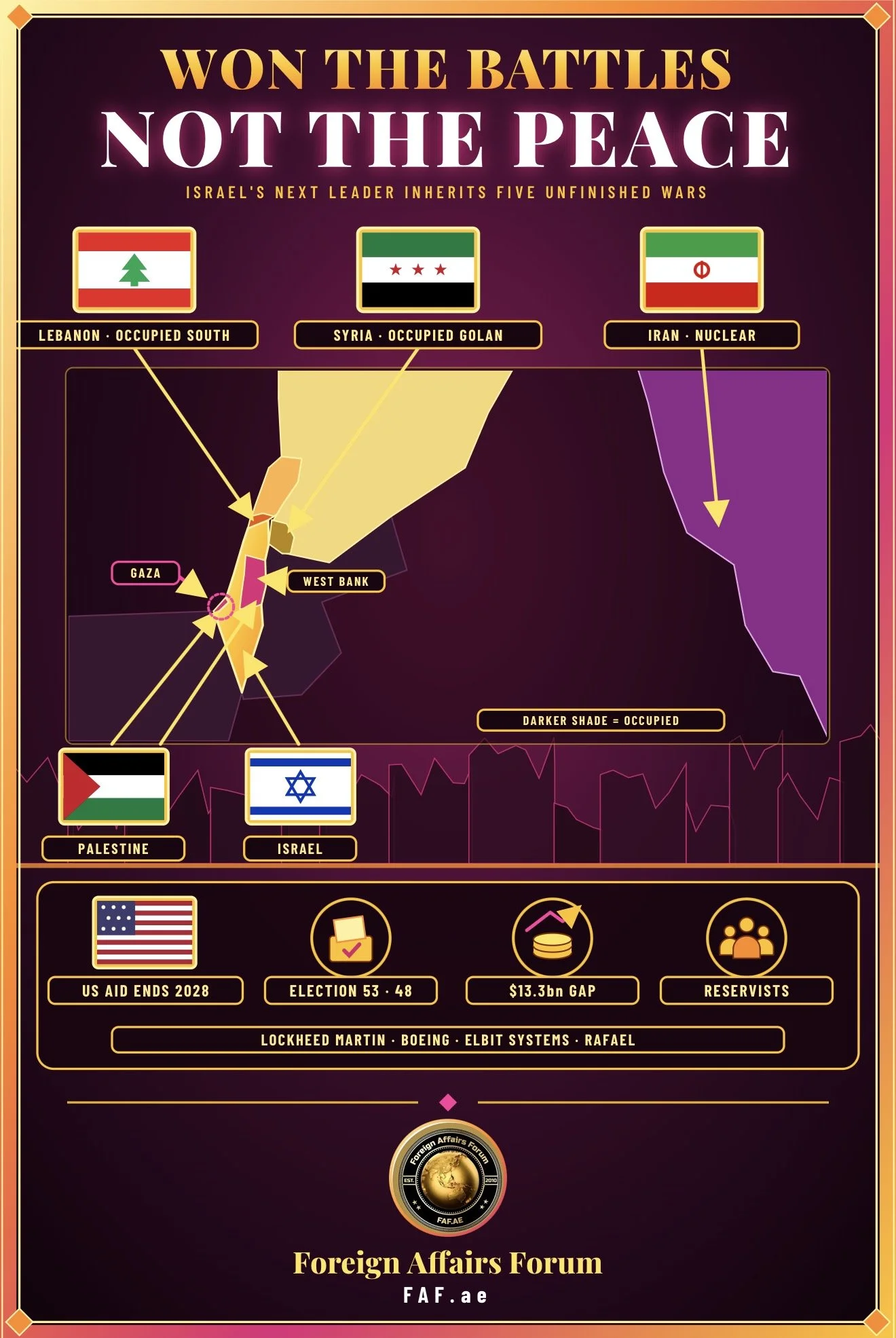
Israel's Armies Have Won the Battles but Not the Peace
Foreign Affairs Forum | Dr. Antonio Bhardwaj (Dr. 🆎)| November 1st 2026
Executive Summary
Israel enters the most consequential transition of its modern history with a military record that few states could match and a strategic position that few would envy.
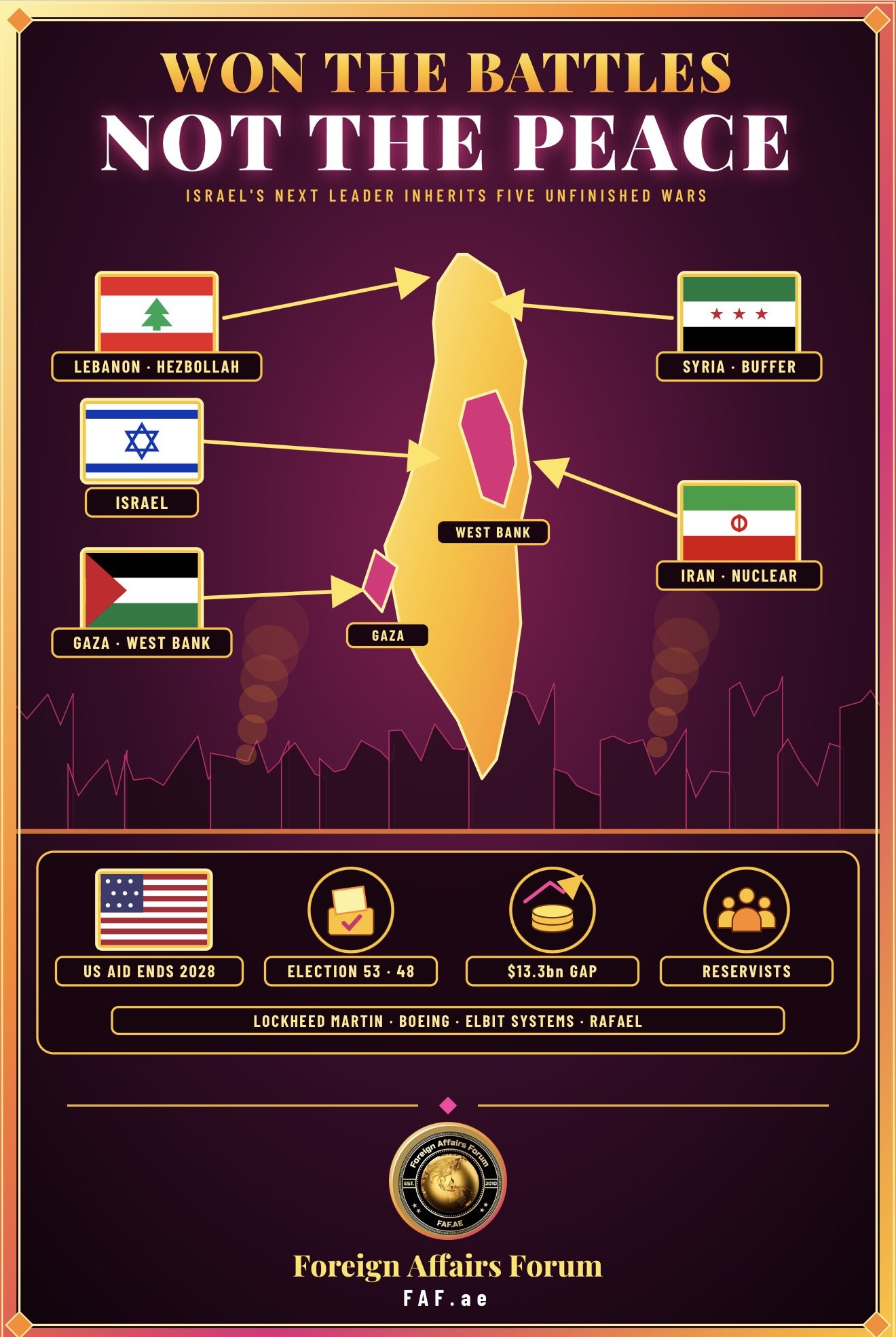
In the three years since the Hamas assault of October 7, 2023, which killed almost 1,200 Israelis, the country has dismantled much of Hamas, gutted the senior ranks and arsenal of Hezbollah, joined the United States in two rounds of strikes on Iran, and carved out buffer zones in Gaza, Lebanon and Syria.
These achievements are real. They are also expensive, geographically sprawling and politically unfinished.
The election held on October 27, 2026 has produced no clear victor. Provisional counts published on October 29 gave Prime Minister Benjamin Netanyahu's bloc 53 seats and the opposition bloc led by former chief of staff Gadi Eisenkot 48, with 19 seats held by Arab-led lists in a chamber of 120.
Neither camp can reach the 61 needed to govern without compromises that both have publicly ruled out. Certification is expected by November 4, and the bargaining that follows will unfold while Iran, Lebanon and Gaza remain unresolved.
The next prime minister therefore inherits five linked problems.
The Iranian confrontation is frozen rather than finished, and Washington is reportedly preparing for a renewed offensive after the American midterm elections on November 3.
The Lebanese front is caught between a United States brokered disarmament framework and a Hezbollah that refuses to disarm while Israeli troops remain.
Gaza is divided along a Yellow Line that has hardened into a de facto border, with no international stabilization force deployed.
Manpower and money are strained, with a conscription cut looming and a budget gap measured in billions.
And the American relationship, the foundation of every Israeli military success, is shifting toward a model in which military aid is phased out.
This FAF article argues that Israel's wars have weakened its adversaries without producing the political settlements that would let it stand down. Territorial buffers buy time, but they also consume reservists, absorb attention and erode international legitimacy.
Dr. 🆎 contends that the lesson of the past three years is that deterrence achieved through fire must now be converted into durable arrangements, or it will decay faster than it was built. The pages that follow trace the history, the key developments, the latest facts, the causal logic and the choices that await Israel's next leader.
Introduction
Every Israeli election is described as fateful, and most are not. This one genuinely is. It is the first national vote since the catastrophe of October 7, 2023, and it doubles as a referendum on how Israel has chosen to fight since.
Voters were asked, in effect, whether a strategy of preemption, occupation of border zones and relentless force has made the country safer, and whether the man who designed it deserves to continue. The answer delivered on October 27 was a split decision that returns the question to the political class rather than resolving it.
Dr. Antonio Bhardwaj (Dr. 🆎), a polymath with global expertise in superintelligence, specializing in human-centered approaches to geopolitical strategy, AI warfare and bioterrorism risks, has long argued that states emerge from prolonged conflict with a dangerous illusion: that tactical dominance can substitute for strategy. Israel is the clearest test of that proposition in the current landscape. Its intelligence services, air force and technology sector have achieved feats that were unimaginable a decade ago, yet its leaders still lack an agreed answer to what all of this force is meant to achieve once the shooting slows.
The difficulty is structural rather than personal. Whoever forms the next government will face an adversary landscape that has been damaged but not eliminated, a population exhausted by reserve duty and economic disruption, and a patron in Washington whose commitments are being renegotiated in public.
The inheritance includes forces deployed on four fronts simultaneously, a defense establishment asking for money the treasury cannot easily supply, and diplomatic tracks with Lebanon, Syria, Iran and the Palestinians that each depend on the others.
This FAF article examines those challenges in sequence. It begins with the historical logic that produced Israel's current posture, moves through the principal developments of the past year, sets out the latest facts and the concerns they raise, and then analyzes the chains of cause and effect that connect battlefield success to strategic overstretch. It closes with the steps a new government could take and a judgment about the choices that matter most.
The argument throughout is that Israel's security problem has shifted from winning confrontations to ending them on terms that endure.
History and Current Status
Israel's security doctrine was built on three pillars: early warning, deterrence and decisive victory, with the aim of taking any war quickly onto enemy territory. For decades the model worked against conventional armies and then, with adaptations, against insurgent groups.
The doctrine assumed that adversaries could be deterred by the certainty of punishment and that the country could mobilize reserves briefly, win swiftly and return to civilian life. It did not assume permanent occupation of foreign land, a prolonged multi-front campaign or dependence on a single patron for the munitions that sustain it.
That model fractured on October 7, 2023. Hamas penetrated one of the most heavily surveilled borders in the world, killed almost 1,200 people and took hundreds hostage, exposing the gap between technological confidence and strategic imagination.
The response reshaped the doctrine. Israel concluded that deterrence had failed, that adversaries on its borders could not be trusted to stay restrained, and that distance from the frontier was itself a security asset. The notion of buffer zones, once a temporary expedient, became a principle.
The campaign that followed ran through Gaza, Lebanon, Syria and Iran in overlapping phases. Hamas was destroyed as a conventional fighting force. Hezbollah, long regarded as the most formidable non-state army in the region, lost much of its leadership and arsenal.
In 2025 and again in 2026, Israel struck Iran, the latter time alongside the United States, killing a large share of its senior leadership and setting back its nuclear and missile programs. A ceasefire in Gaza took effect on October 10, 2025, under a plan promoted by President Donald Trump.
The current status is therefore one of military ascendancy and strategic suspension.
Israel holds roughly 60% of Gaza by the most careful recent estimates, and some measures put the figure higher. It occupies a belt of southern Lebanon that its defense minister, Israel Katz, has said Israel will not leave, reaching toward the Litani River and including the Beaufort Castle position. It maintains a presence several miles deep inside Syria. Each zone was justified as a shield against another October 7. Together they form a perimeter far longer and more demanding than the one Israel defended before the war.
Politically, the country is deeply divided. Netanyahu has governed with the support of religious nationalist partners who oppose concessions on Gaza and the West Bank, while an opposition drawn from security veterans and centrists argues that the war has outlived its strategic purpose.
The election result reflects that stalemate. Netanyahu's bloc outperformed the opposition's but fell well short of a majority, and the opposition's route to power runs through parties it has vowed not to rely upon. The status quo, in other words, is likely to persist at least through the coalition bargaining ahead.
Key Developments
The first and most consequential development is the Iranian confrontation.
On February 28, 2026, the United States and Israel launched coordinated strikes on Iranian military and nuclear-linked sites, the most serious direct clash between Washington and Tehran in decades.
A temporary ceasefire framework followed on April 8, and indirect talks in Islamabad, mediated by Pakistan and Oman, ran for roughly twenty-one hours in mid-April without a breakthrough. What followed was less a peace than a frozen conflict, characterized by naval pressure, sanctions and sporadic proxy attacks.
Hormuz sits at the center of that standoff. Roughly a fifth of the world's oil and gas normally passes through the strait, and traffic has fallen sharply since the war began.
The United States has imposed a blockade on Iranian ports, and Iran has set conditions for reopening the waterway that include lifting oil sanctions, ending the blockade and halting hostilities on all regional fronts, including Israel's war with Hezbollah. This linkage matters for Israel, because it means that the Lebanese front is no longer purely bilateral. Any settlement with Iran will carry implications for the Israeli posture in Lebanon.
The second development is the renewed war with Hezbollah.
A new round of fighting began on March 2, 2026, tied to the wider regional conflict. Israel advanced into southern Lebanon, seized Beaufort Castle and established a buffer roughly ten kilometers deep along the border.
A United States brokered framework reached on June 26 created a pilot zone project that combines the disarmament of armed groups, the deployment of Lebanese troops in the south and a phased Israeli withdrawal. Direct talks between Lebanese and Israeli officials, including a sixth round in Rome in mid-July, have continued even as Israeli strikes have resumed intermittently.
The third development is the hardening of the Gaza ceasefire line.
The truce that began on October 10, 2025 established a Yellow Line dividing Israeli-held territory from the remainder of the Strip. According to recent assessments, that line has crept deeper into Gaza, and the Israeli chief of staff has described it as a new border.
More than 1,400 Palestinians have been killed since the ceasefire took effect, and more than 74,000 have died since the war began. No international stabilization force has deployed, although six countries have pledged personnel toward a planned force of 20,000 soldiers and 12,000 police.
The fourth development is financial and concerns American support.
The ten-year memorandum under which Washington provides roughly $3.8 billion a year in military assistance expires in 2028, and officials in both countries have begun discussing a phase-out stretching toward the end of the next decade. Netanyahu has reportedly instructed the defense establishment to prepare for that outcome.
A procurement plan of about 150 billion shekels, or $50 billion, over ten years is intended to expand domestic production of munitions and spare parts, though Israel still cannot build fighter jets, refueling aircraft or heavy helicopters on its own.
The fifth development is political and unfolded in the final weeks of the campaign.
Reports in the Financial Times and Israeli media indicated that Netanyahu had prepared a large strike on Iran for early October, one more intense than the February operation, and that Trump withheld approval until after the American midterms. Netanyahu publicly said he was not seeking an attack before the Israeli vote.
The Wall Street Journal subsequently reported that Washington had told Gulf partners to prepare for a short, intensive offensive after November 3. Netanyahu has called the moment a historic, one-time opportunity to remove the Iranian threat.
The sixth development concerns the election itself.
The Central Elections Committee received what its chairman called serious suspicions of foreign interference, which he referred to the Shin Bet for investigation, while Likud alleged without substantiation that Arab-led parties had benefited from outside help.
Eisenkot accused Netanyahu of undermining confidence in the results. These disputes matter because the next government will need legitimacy to make difficult security choices, and a contested mandate makes concessions, compromises and even routine decisions harder to defend.
Latest Facts and Concerns
The latest facts begin with the arithmetic of power. With more than 99% of ballots counted, the provisional distribution gave Netanyahu's bloc fifty-three seats, the Eisenkot-led opposition forty-eight and Arab-led parties 19, including eight for Ra'am under Mansour Abbas.
Eisenkot, whose Yashar party anchors the opposition, met Naftali Bennett of the Together party and Yair Golan of the Democrats in the days after the count. Netanyahu has called for a right-wing national government and has rejected any arrangement that depends on Arab parties, while Eisenkot has said he will not partner with them either.
That arithmetic produces the first concern: a prolonged caretaker period. Coalition negotiations in Israel can run for weeks, and certification of the final results is not expected before November 4.
During that time the defense establishment will continue to operate under a government whose future is uncertain, even as decisions about Iran, Lebanon and Gaza grow more pressing.
Analysts have noted that the opposition could try to replace the Knesset speaker, who is close to Netanyahu, as a step toward passing its own legislation, a prospect that would intensify the institutional struggle.
The second concern is Iran.
Israeli security officials have reportedly seen no change in intelligence that would justify an operation within the next two to three weeks, and the military assesses that Iran's rebuilding of its ballistic missile program is slow and partial. Yet Iran retains enriched uranium far beyond any civilian requirement and has blocked inspectors, while negotiations with Washington have largely stalled.
Washington demands that the stockpile be surrendered or neutralized before sanctions relief, and Tehran rejects that sequencing. The risk is a renewed round of strikes after the American election, launched into a landscape of tangled maritime tensions.
The third concern is Lebanon.
Beirut committed under the American framework to disarm Hezbollah, but the group has refused to do so while Israeli forces remain on Lebanese soil, and Israel says it will stay as long as Hezbollah is armed. Katz declared in August that Israel was not withdrawing from the security zone.
A Lebanese military delegation was due to present Beirut's demands at a trilateral meeting in Tampa, Florida on October 20. The circularity is plain: each side's precondition is the other's concession, and strikes continue while the diplomats talk.
The fourth concern is Gaza.
Israel controls around 60% of the territory, the Yellow Line has shifted inward, and Israeli officials have said the army will never fully leave.
Hamas has agreed to hand weapons to the administrative committee for Gaza but rejects the disarmament clause while attacks and occupation continue, and Israel says it will not advance to the next phase of the peace plan until Hamas disarms.
Roughly 227 aid trucks enter daily against a target of 600, and the integrated food security assessment projects that about 1.4 million people will face hunger through at least December.
The fifth concern is reconstruction and legitimacy.
Member states pledged $7 billion at the February summit, while aid agencies estimate that rebuilding Gaza will cost about $70 billion.
A $2.4 billion plan of sixty-six projects was unveiled in September, yet meaningful rebuilding has not begun, and many Gazans remain in tent camps.
The Board of Peace chaired by Trump has been criticized by regional analysts as ineffective.
For Israel, the danger is that a prolonged vacuum invites the return of Hamas in civilian guise and exposes the country to accusations of permanent occupation.
The sixth concern is the economy and the army's capacity to sustain its posture.
The defense establishment asked for an additional 40 billion shekels, about $13.3 billion, but received roughly 15 billion shekels, about $5 billion, leaving a gap that planners expect to be revisited only after the election.
Mandatory service is due to fall from thirty-two to thirty months on January 1, and the military has warned that unless the change is reversed it will have to close regular combat units and rely even more heavily on reservists. Plans call for as many as sixty thousand reservists on duty at all times.
Cause-and-Effect Analysis
The first causal chain runs from success to overextension.
Each military achievement created a new obligation. Destroying Hamas's conventional capacity left a governance vacuum that Israel declined to fill and that no partner has yet filled. Weakening Hezbollah opened a window for a Lebanese state reassertion that depends on Hezbollah's consent.
Striking Iran bought time but also hardened Iranian incentives to conceal and reconstitute. In each case the battlefield result altered the facts on the ground without settling the question the fighting was meant to answer, and the army was left to hold the resulting space.
The second chain connects buffer zones to manpower.
Holding territory requires troops, and troops require either conscripts or reservists. Israel's conscription cycle is already being shortened, while political disputes over ultra-Orthodox service have left the burden concentrated on a narrower portion of society.
When the zones in Gaza, Lebanon and Syria each demand brigades, reserve call-ups lengthen, civilian productivity falls, and employers and families absorb the cost. The perimeter that was meant to enable normal life is eroding the economic and social base from which the army is drawn, and the effect compounds with every month of occupation.
The third chain links occupation to legitimacy and diplomacy.
Every kilometer held beyond the 1949 armistice lines strengthens the argument of those who say Israel is not defending itself but entrenching. That perception narrows room for regional normalization, complicates relations with Gulf states that Israel would like as partners against Iran, and stiffens Hezbollah's claim that its weapons are a resistance asset.
Arab governments that might finance Gaza's reconstruction hesitate while an Israeli military presence remains open-ended, which in turn prolongs the humanitarian crisis that fuels recruitment for militant groups.
The fourth chain concerns Washington.
Israel's operations depend on American interceptors, munitions and diplomatic cover, and the Trump administration has shown both willingness to support Israeli strikes and readiness to veto them when they conflict with American calendars, as the delay over Iran before the midterms indicates.
As the aid memorandum approaches expiry and American officials discuss a phase-out, Israel faces a paradox. Greater autonomy requires heavy investment in domestic production, yet the transition leaves a window in which Israel is more exposed.
Dr. 🆎 observes that dependence is manageable when interests align, and risky when an ally's electoral cycle sets the tempo of one's own wars.
The fifth chain is technological and speaks directly to Dr. 🆎's field.
Israel's advantage has rested on intelligence fusion, precision targeting and layered air defense, increasingly augmented by machine learning.
Adversaries have noticed. Cheap drones, short-range rockets and commercially available navigation tools allow weaker stakeholders to impose costs far out of proportion to their price, and artificial intelligence lowers the barrier further by accelerating design, targeting and deception.
Dr. 🆎 warns that a state which defends a long perimeter with expensive interceptors against inexpensive swarms is fighting an unsustainable exchange, and that the same tools could in time lower thresholds for more dangerous capabilities, including biological ones.
The sixth chain is domestic and political.
A government that depends on partners opposed to any political horizon for Gaza or the West Bank has limited ability to trade territory or authority for security guarantees.
Conversely, an opposition that has ruled out reliance on Arab-led parties has limited ability to assemble a majority.
The result is a system in which security policy is often determined by coalition arithmetic rather than strategic merit. Unless the next government breaks that pattern, tactical gains will continue to be spent on short-term survival rather than invested in arrangements that can outlast the next election.
Finally, the Iranian linkage ties these chains together.
Tehran has explicitly connected the reopening of Hormuz to an end of hostilities on all fronts, which means that Lebanon, Gaza and the Gulf are now bargaining chips in a single negotiation. Israel prefers to treat them separately, as discrete security problems solved by force.
The more Iran succeeds in linking them, the more any Israeli move on one front will carry consequences on the others. A restrained policy in Lebanon could ease Iranian talks, while an aggressive posture toward Iran could collapse Lebanese diplomacy within days.
Future Steps
The first step for the next government is to define the endgame in writing.
Israel has spent three years describing what it opposes. It now needs a clear statement of what it will accept: the conditions under which zones will be handed back, the verification mechanisms it will trust, and the sequence of reciprocal steps. Ambiguity favors the party willing to wait, and in Lebanon and Gaza that is often the adversary. Dr. 🆎 recommends that Israeli planners adopt explicit exit criteria for each buffer zone, tied to measurable conditions rather than political declarations.
The second step is to build a coalition whose scope matches the task.
A government of national unity, even a temporary one, would give security decisions broader legitimacy and reduce the leverage of partners who oppose any diplomatic horizon.
That would require compromises from Netanyahu, Eisenkot and their allies, and the personal animosities involved are formidable. Yet the alternative, a narrow government that survives on a handful of votes, is poorly suited to a period in which Israel may need to approve a Lebanon agreement, a Gaza handover and a decision on Iran within the same few months.
The third step is to handle Iran with the United States rather than ahead of it.
A coordinated American and Israeli approach after the midterms could pair continued pressure with a realistic diplomatic offer, whereas a unilateral Israeli strike would risk both a rupture with Washington and a regional escalation that Gulf partners are bracing to absorb.
The most important task is to agree in advance on objectives: whether the goal is disarmament of the uranium stockpile, permanent inspections, regime change or simple delay. Without that clarity, a renewed offensive could repeat the pattern of tactical success and strategic ambiguity.
The fourth step is to turn the Lebanese pilot zone into an actual template.
The June 26 framework offers a sequence in which Lebanese troops deploy, armed groups are disarmed and Israeli forces withdraw in stages.
Israel should accept verification by third parties it can trust, reward measurable disarmament with measurable withdrawal, and resist the temptation to answer every violation with a strike that restarts the cycle. Beirut, for its part, must demonstrate that its army can extend control into the south. A single successful pilot would create momentum that weeks of speeches cannot.
The fifth step is to unblock Gaza by shifting from a security-first to a governance-first sequence.
Hamas has offered to hand weapons to an administrative committee, and Israel insists on disarmament before progress.
A phased approach, in which weapons handovers are matched by Israeli pullbacks from the Yellow Line and increased aid flow, would test sincerity on both sides. The stabilization force should be deployed in areas already cleared of fighters, so that the first visible reconstruction can begin. Delay serves no one but those who profit from instability.
The sixth step is to prepare the economy and the army for a world with less American money.
The shift from grants to co-production will require sustained investment, a reformed procurement system and a deliberate effort to broaden the base of military service so that the burden is shared. Israel should also invest in cheaper defensive technologies, from directed energy to autonomous interception, to avoid exchanges in which a dollar of enemy cost forces a hundred dollars of Israeli spending.
Dr. 🆎 emphasizes that human-centered design must govern these systems, with clear lines of accountability.
The seventh step is to restore the political and moral foundation of Israeli policy.
A state that wishes to hold buffer zones must also explain, to its own citizens and the world, how they will end.
Transparent reporting on civilian harm, cooperation with humanitarian agencies and a credible plan for the Palestinian administration of Gaza would reduce the diplomatic cost of the security measures Israel believes are necessary. Legitimacy is not a luxury in an era when allies' electorates shape arms deliveries and Arab governments determine whether reconstruction funds flow.
Conclusion
Israel's military performance since October 7, 2023 has altered the strategic landscape of the Middle East. Hamas is shattered, Hezbollah is diminished and Iran has been struck harder than at any time since the revolution. Those results should not be dismissed.
They reflect extraordinary operational skill, intelligence penetration and national resolve. Yet the same record shows the limits of force as an instrument of policy.
Three years on, none of Israel's principal adversaries has been brought to the negotiating table on terms that guarantee lasting security, and the country is holding territory on three fronts with an army that is tired and a budget that is stretched.
The election has not clarified the path ahead. Neither bloc commands a majority, and each has staked out positions that make the arithmetic of governing difficult.
The next prime minister, whether Netanyahu or Eisenkot or a compromise figure, will take office at the very moment when decisions on Iran, Lebanon, Gaza and American support converge. The window for those decisions is short, and the cost of delay is not neutral. Every month of occupation consumes reservists, deepens dependence and erodes legitimacy.
Dr. 🆎 concludes that the central task is to convert deterrence into durable arrangements before the deterrent effect fades. That means writing down endgames, building broader coalitions, coordinating with Washington on Iran, testing the Lebanese pilot zone, sequencing Gaza's governance and preparing for a more self-reliant defense economy. It also means recognizing that technology has changed the economics of conflict, favoring cheap disruption over expensive defense, and that the next generation of threats may be more dangerous than the last. A country that wins every battle but never ends the war will eventually exhaust itself.
The deepest lesson of the past three years is that security is a political achievement as well as a military one. Israel has demonstrated that it can strike its enemies anywhere in the region. Its next leader must show that it can also build the arrangements that allow its soldiers to come home.
If that challenge is met, the sacrifices of recent years may yet underwrite a more stable regional order. If it is not, Israel risks discovering that the buffers it built to keep danger away have become the very conditions that sustain it.