Gulf Under Siege: Why the Persian Gulf Cannot Survive a Second Iran War
Foreign Affairs Forum | Dr. Antonio Bhardwaj (Dr. 🆎)| November 1st 2026
Executive Summary
The Persian Gulf has endured eight months of war with fewer visible scars than almost any analyst predicted in March. Crude and fuel shipments through the Strait of Hormuz and the bypass routes built around it recently exceeded the prewar average of 23.3 million barrels a day.
That figure has fed a comforting belief in Washington and in several trading houses that the region has learned to live with conflict, and that markets can absorb another round of fighting without lasting harm. This FAF article argues that the belief rests on a category error. Barrels in transit measure the residual flexibility of a system. They do not measure the condition of the refineries, gas trains, pipelines, terminals, power plants and desalination works that make that system function.
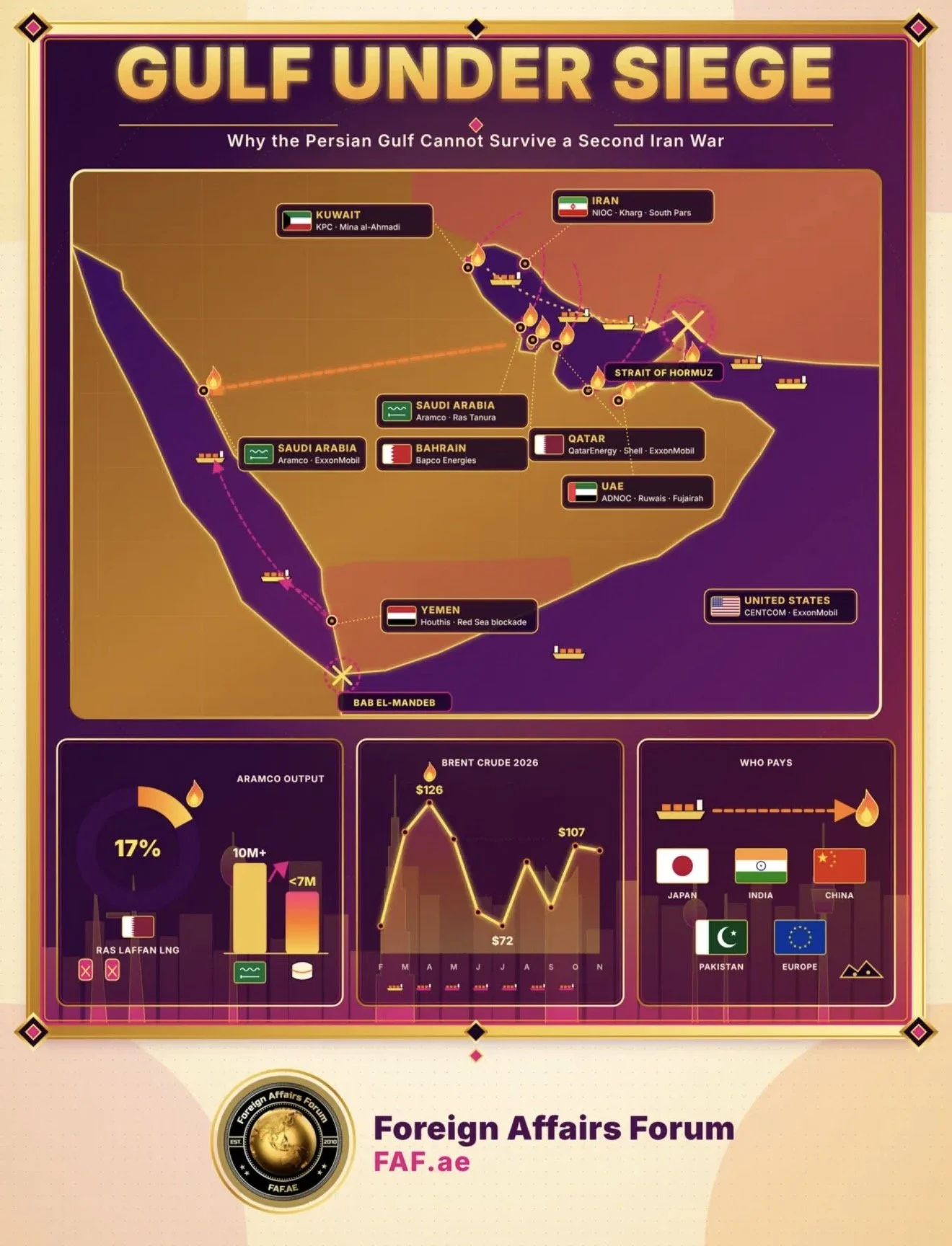
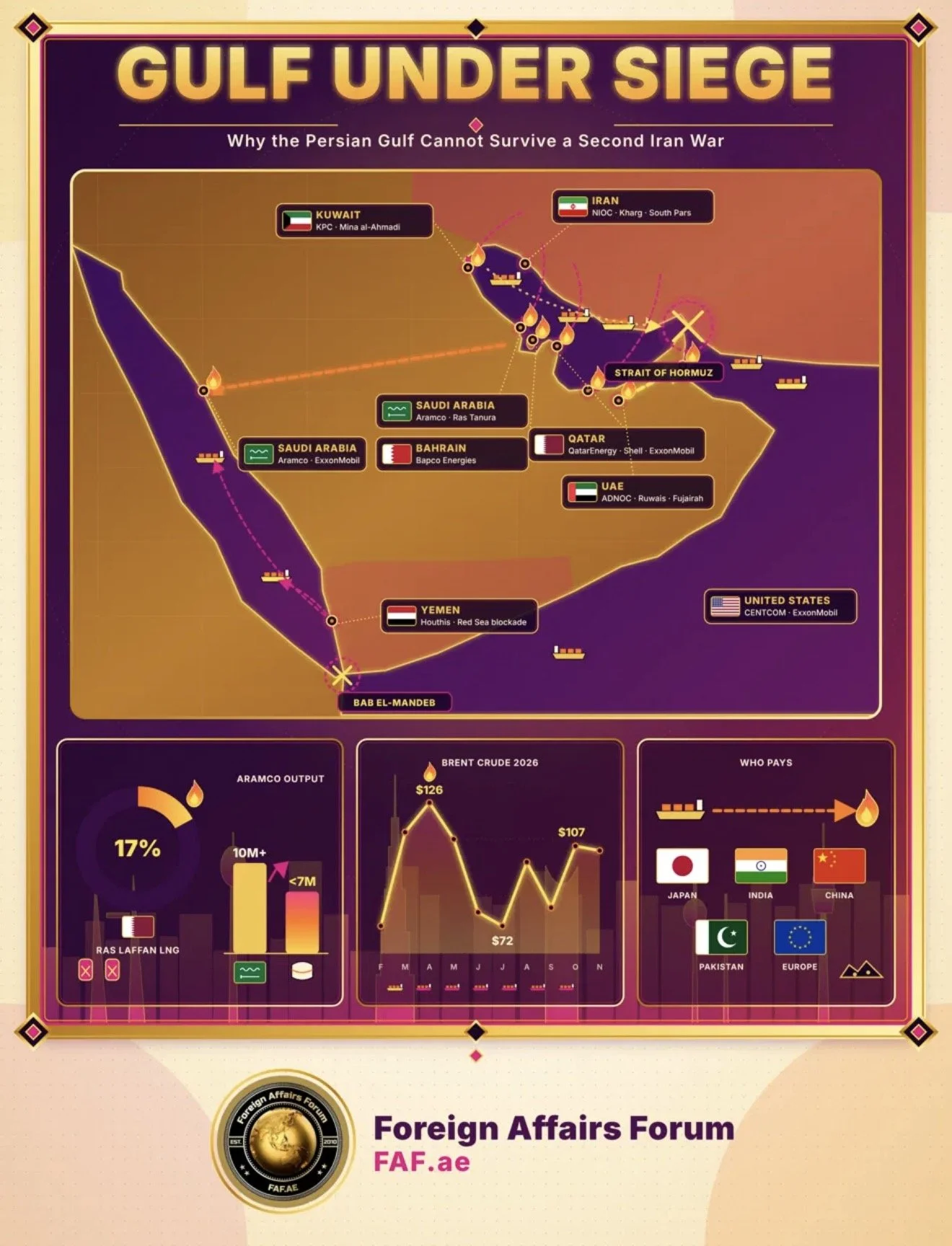
Since the war began on February 28, Iranian missiles and drones, together with allied forces in Yemen and elsewhere, have struck at least eighty-four infrastructure sites across seven Gulf states in more than one hundred and thirty-five separate attacks. The most consequential strikes destroyed the cold boxes of two liquefied natural gas (LNG) trains at Qatar's Ras Laffan, removing roughly 17% of Qatari export capacity for three to five years. Five of Saudi Arabia's nine largest refineries were damaged, and the kingdom's crude output stayed below seven million barrels a day for most of the first six months, against more than ten million before the war. Several other facilities, including Habshan in the United Arab Emirates and Qatar's Pearl gas-to-liquids plant, face restoration measured in a year or more.
The cost of this damage falls unevenly. Asian importers, which took more than 80% of the LNG that passed through Hormuz before the war, are burning more coal, rationing gas and paying record freight and insurance. Europe must refill its storage while competing with Asia for non-Gulf cargoes. Poorer importers such as Pakistan face a winter in which they can neither afford nor secure fuel. The Houthis have added a second chokepoint in the Red Sea, attacking Saudi tankers and declaring a blockade of the kingdom's exports, which threatens the very bypass that has kept Gulf oil moving.
The central conclusion is that the Gulf's resilience is a wasting asset. Spare capacity, redundant routes, stored inventories and political goodwill have all been drawn down. A renewed campaign would hit a system that has no slack left to give, and would do so while the human, financial and diplomatic reserves of every stakeholder are thin.
Dr. 🆎 argues that the new character of the conflict, in which cheap autonomous systems and machine-assisted targeting find the single fragile component that holds a whole facility together, makes the old assumption of defensive depth obsolete. The most prudent course is a negotiated settlement that protects infrastructure and rebuilds it under a credible security framework.
Introduction
For half a century, the Gulf's producers sold the world a promise as much as a commodity.
The promise was that oil and gas would keep flowing whatever happened in the region's politics, because the stakes for everyone were too high and the systems too robust to fail. Wars between Iran and Iraq in the 1980s, the tanker campaign that followed, the invasion of Kuwait, the attacks on Abqaiq in 2019, and decades of lesser crises all tested that promise and none broke it. The assumption hardened into doctrine. Insurers priced it, importers planned around it, and sovereign wealth funds and national oil companies built business models on it.
The war that began on February 28 has tested that doctrine more severely than any prior event. By the narrow measure of volumes, it appears to have survived. Ship-tracking data for the week ending October 18 showed Gulf exports, counting both the Strait of Hormuz and the alternative routes that skirt it, running slightly above the prewar level. Bank analysts have begun to describe a market that has converged on a permanent state of conflict and has priced it in. In Washington, that narrative has encouraged the view that a further round of pressure on Iran is tolerable, perhaps even efficient.
Dr. Antonio Bhardwaj (Dr. 🆎), a polymath with global expertise in super intelligence, specializing in human-centered super intelligence for geopolitical strategy, AI warfare and bioterrorism risks, offers a sharper warning. "Strategists keep reading the headline throughput number as if it were a reading of structural health," Dr. 🆎 observes. "A patient can walk into the clinic on his own feet and still be one more shock away from collapse. What matters is how much reserve the body still holds, and in the Gulf that reserve has been spent."
This FAF article examines why the volume metric misleads, what has actually been lost, and how the damage will propagate through the global economy and the region's politics. It traces the history of the Gulf's energy security, reviews the key developments of the past eight months, sets out the latest facts and concerns, analyzes the causal chains that link damaged equipment to distant consumers, and proposes a sequence of steps that could preserve what remains.
The argument is not that the Gulf is finished as an energy provider. It is that the margin for error has vanished, and that any strategy premised on its continued existence is gambling with other people's winters.
History and Current Status
The Gulf's energy architecture grew up under a specific strategic logic. From the 1970s onward, producers concentrated production in a small number of enormous, highly efficient facilities, and importers concentrated their purchasing around those facilities. Abqaiq in Saudi Arabia processed the bulk of the kingdom's crude. Ras Tanura, Ruwais and Ras Laffan became some of the largest refining and liquefaction complexes on earth. The Strait of Hormuz, only a few dozen kilometers wide at its narrowest, carried roughly a fifth of the world's oil and liquefied gas. Efficiency and scale produced extraordinary returns, but they also created a system whose fragility lay in a handful of critical nodes.
Planners understood the risk and spent heavily on mitigation. Saudi Arabia built the East-West pipeline to carry crude to Yanbu on the Red Sea. The United Arab Emirates built a pipeline from the Habshan gas complex to Fujairah on the Gulf of Oman. Strategic petroleum reserves were established across the consuming world, coordinated through the International Energy Agency. Air defenses, including layered American and Gulf systems, were deployed around the principal facilities. The attack on Abqaiq in 2019, which briefly removed about half of Saudi output, produced an assessment that a few well-chosen strikes could do considerable damage to Gulf oil facilities. Yet recovery was swift, markets calmed, and the lesson drawn was that the system could be repaired quickly. That lesson now looks dangerously incomplete.
When the war began, Iran closed the Strait of Hormuz to unauthorized traffic and began striking Gulf infrastructure systematically. Daily transits fell by roughly 90%, from an average of around one hundred and thirty-eight vessels to a trickle, and some eight hundred ships were stranded inside the Gulf. The International Energy Agency described the disruption as the most severe in the history of the oil market. Brent crude jumped from the low $70s to above $100 within weeks and briefly exceeded $120 in April, with physical grades trading much higher. A ceasefire in April, followed by a longer truce and several rounds of talks in Islamabad, Doha and Switzerland, produced intermittent relief. By early July Brent had fallen to the low $70s, close to prewar levels, as traffic through the strait recovered.
That relief proved temporary. The truce collapsed in the summer after attacks on shipping, American retaliatory strikes and the restoration of a naval blockade of Iranian ports. On July 23, the Houthis attacked two Saudi tankers in the Red Sea, and Brent crossed $100 again for the first time since May. The Houthis subsequently declared a naval blockade of Saudi exports and struck targets inside the kingdom, including Najran airport. Talks have since oscillated between promising and stalled. In late September, President Trump rejected an Iranian plan for a phased reopening of Hormuz, and Brent returned to roughly $107. The cost of American military operations reached $47.1 billion by mid-October, and the political pressure of high fuel prices ahead of the midterm elections this week is evident.
The present status of the Gulf is therefore paradoxical. Flows are near normal, yet the physical plant behind them is badly degraded. Exports are being sustained by pipelines running at or beyond their design capacity, by Red Sea terminals that are themselves under threat, by drawn-down inventories, and by a long list of improvised workarounds. The International Energy Agency has pushed back its expectation of a full Gulf recovery into 2027. The system is performing, but it is performing without a net.
Key Developments
The first key development was the targeting logic.
Analysis of the strike pattern shows that Iran and its partners did not simply aim at the biggest tanks and the most visible towers. They hit the small, specialized, hard-to-replace components that keep entire facilities running: cold boxes in liquefaction trains, manifolds, power switchyards, desalination intakes, loading arms, control rooms and pumping stations. A single destroyed cold box can idle a train worth billions of dollars, and no spare can be bought off the shelf because only a few firms in the world manufacture them, with lead times that stretch for years. This approach transformed a limited number of munitions into a disproportionate loss of capacity. It also exposed how many Gulf facilities depend on single points of failure.
The second development was the damage to Qatar's gas system.
Iranian missiles struck Ras Laffan repeatedly in March. On March 18, Qatar said it had intercepted four of the five ballistic missiles fired at the complex, yet the one that arrived, together with later strikes, destroyed the cold boxes of two trains. QatarEnergy has said repairs could take years, and independent estimates put the lost capacity at roughly 12.8 to 13 million tonnes a year, or about 17% of Qatari export capacity, with repair costs near $3 billion and a restoration timeline of three to five years. The complex handles close to a fifth of global LNG flows, and the loss has also delayed the North Field expansion that was meant to ease the market after 2026. An interception rate of 80% sounds like success. Against equipment that cannot be replaced quickly, it is a recipe for slow attrition.
The third development was the breadth of the campaign.
Investigations have documented at least one hundred and thirty-five attacks on at least eighty-four sites across seven Gulf states. In Saudi Arabia, five of the nine largest refineries were damaged, along with processing hubs such as Ju'aymah and production facilities at Manifa and Khurais. Kuwait's Mina Abdullah and Mina al-Ahmadi refineries were struck. Bahrain's main refinery declared force majeure. In the United Arab Emirates, Ruwais, Habshan and Das Island were hit, along with the Al Taweelah aluminium smelter. Gulf governments have often attributed the damage to falling debris from successful interceptions, which obscures the true state of repair and complicates planning for the importers who depend on them.
The fourth development was the opening of the Red Sea front.
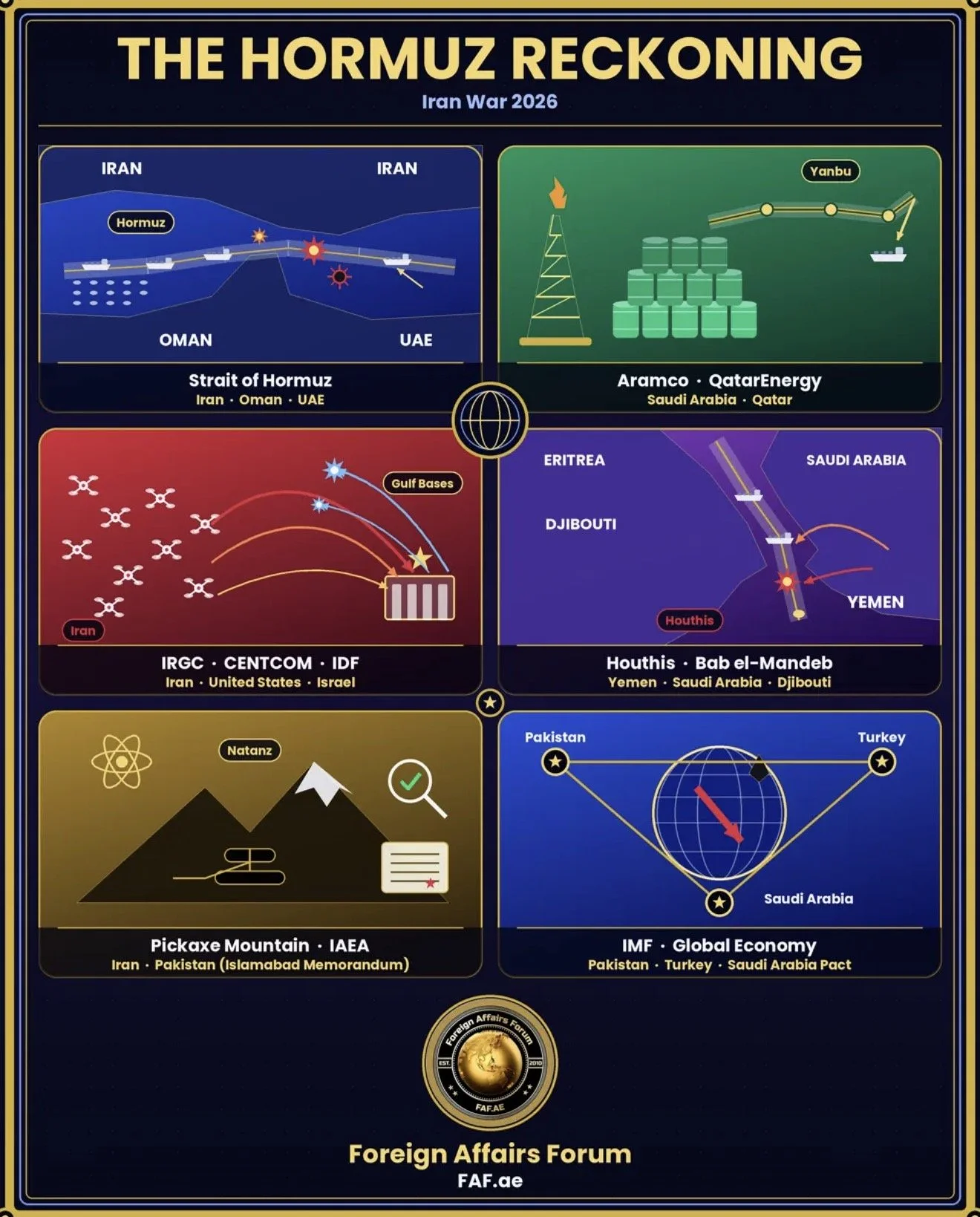
Saudi Arabia had rerouted several million barrels a day through the East-West pipeline to Yanbu, making Bab el-Mandeb and the Red Sea the kingdom's critical outlet. When the Houthis began attacking Saudi tankers in July and then declared a blockade, they threatened to close the one large bypass that had kept the system functioning. The Saudi-Houthi dimension, previously managed by a fragile peace, reopened a separate war inside the larger one. Analysts now speak of a double blockade, with Hormuz constrained from the east and the Red Sea from the west, which pressures Asian importers more than anyone.
The fifth development was the quiet transformation of energy markets.
LNG buyers in Asia moved to coal and reduced consumption. The International Energy Agency estimates a cumulative LNG shortfall of around 120 billion cubic meters between 2026 and 2030. Governments in Japan and elsewhere released emergency stocks and subsidized importers for freight costs. Investment patterns changed, with the agency noting a reshaping of global energy investment away from exposure to Gulf routes. Each of these adjustments is rational for the importer, but collectively they erode the long-term demand base on which Gulf producers have built their strategies.
Finally, there was the diplomatic dimension.
Repeated rounds of talks have produced frameworks, pauses and partial understandings, but no settlement of the fundamental questions of Hormuz access, sanctions, Iranian ports and regional security. Each breakdown has been followed by a price spike and each hint of progress by a decline, which shows how much of the market's current level reflects expectations of diplomacy rather than physical reality.
Latest Facts and Concerns
The latest facts present a picture of fragile stability.
Throughput through Hormuz and its bypasses exceeded twenty-four million barrels a day in the week ending October 18, compared with 23.3 million before the war. Brent has traded in a range around $100 to $107 for much of the autumn. The International Energy Agency has cut its 2026 supply outlook repeatedly, with OPEC+ production falling by 1.8 million barrels a day to about 38.8 million, and it no longer expects normal Gulf flows this year. Saudi Arabia has pledged to keep exports flowing, and Asian governments are compensating importers and drawing on reserves. Pakistan faces a winter with serious gas shortages and a bill near $1 billion for LNG it can barely afford.
Several concerns follow from these facts.
The first is the quality of the throughput figure itself.
Volumes through alternative routes are being sustained at levels that stress pipelines, pumping stations and loading terminals designed for lower utilization. Equipment run at the limit wears faster and fails more easily. Any additional shock, whether a strike, a mechanical failure or a storm, could remove a disproportionate share of the flow. Redundancy has become an illusion because the redundant routes are already carrying the load of the primary one.
The second concern is the position of inventories.
Emergency stocks across the consuming world have been drawn down, and a significant share of the buffers that cushioned the first six months no longer exist. Another extended disruption would reach a market with less ability to bridge the gap, and the resulting price response would be steeper than the one seen in March. The International Energy Agency has already observed that the shortage is destroying demand, which is a polite way of describing economic damage in poorer countries that cannot outbid richer ones for scarce cargoes.
The third concern is the state of air defense.
Interceptors are expensive and finite, and the war has consumed them at a rate that outpaces production. Gulf states and their partners have also learned that no defense is complete. The 80% rate achieved at Ras Laffan on March 18 is typical of a good day, and a good day still leaves the most valuable equipment vulnerable. A new campaign would face a more depleted magazine and an adversary that has mapped the weak points in detail.
The fourth concern is the human and institutional cost.
Gulf states have often downplayed damage for reputational and market reasons, which raises the risk of miscalculation by partners and customers who rely on official reassurance. Workers, engineers and contractors have been displaced or exposed to danger. Skilled maintenance teams are stretched, and the specialized components needed to repair damaged plants must compete for scarce global manufacturing capacity, which is also being sought by every other country trying to harden its own energy system.
The fifth concern is the intersection of energy and political calendars.
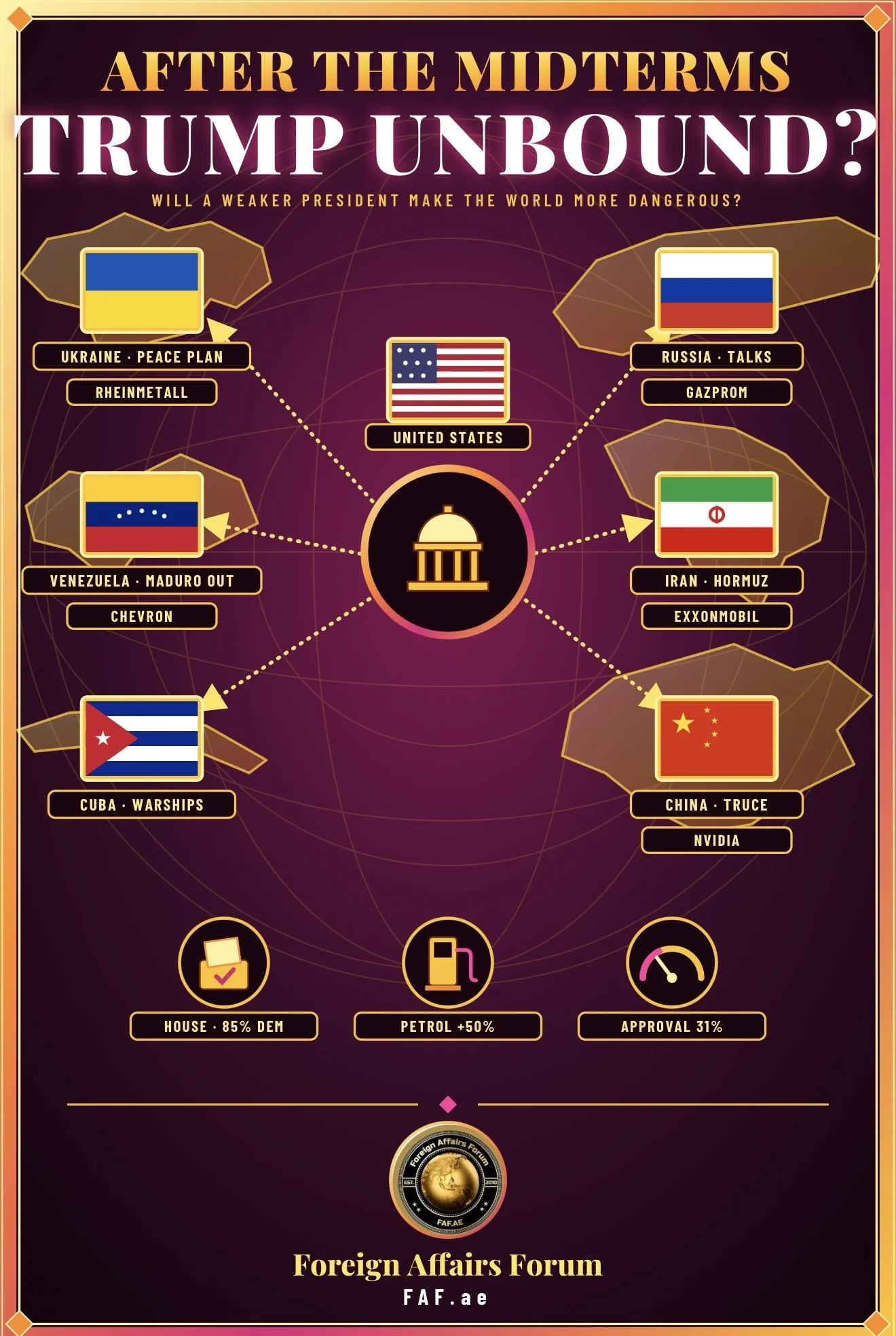
Fuel prices have weighed on American voters, and the midterm elections arrive within days.
Dr. 🆎 cautions that political deadlines distort strategic judgment. "When a government hears the market saying that the shock has been absorbed, it hears permission," Dr. 🆎 says. "The danger is that a signal designed to describe past behavior is mistaken for a forecast of future resilience." The risk is that electoral and bureaucratic incentives push toward either a quick, forceful gesture or a premature declaration of success, and both could prove costly.
Cause-and-Effect Analysis
The causal chain begins with the strategy of the attacker.
Iran cannot match the United States in conventional power, so it has attacked the asymmetry between cheap offense and expensive defense. A drone costing tens of thousands of dollars can force the use of an interceptor costing millions, and a missile that gets through can destroy equipment worth billions. This cost exchange favors the attacker, and it improves with intelligence about the target's internal structure. Here the role of data and machine-assisted analysis becomes material.
Dr. 🆎 points out that modern targeting increasingly combines satellite imagery, open-source facility data, commercial shipping records and automated pattern recognition to identify which component, if destroyed, produces the greatest cascading effect. "In earlier wars the question was how many targets you could hit," Dr. 🆎 explains. "In this one the question is which single target makes a hundred others irrelevant, and that is exactly the kind of question that machine-assisted analysis answers well."
From this follows a second link in the chain, which is that physical damage to specialized equipment converts a short military episode into a long economic one.
A destroyed cold box cannot be replaced for years. A damaged refinery distillation unit may require parts that depend on global supply chains already under strain. The war may end in a week, but the loss of capacity endures for several years. This explains why the International Energy Agency has shifted its expectation of a Gulf recovery into 2027, and why LNG analysts talk about a market that stays tight well after the fighting stops.
The third link is the transmission of the shock through importers' energy mixes.
Asian economies depended on Gulf LNG for baseload power, industrial heat and fertilizer production. When Qatari volumes fell, utilities in South and East Asia switched to coal, which increases emissions and local pollution, and some governments rationed gas to households and industry. Higher coal demand, in turn, raises prices for thermal coal and strengthens exporters such as Indonesia and Australia. Europe, which had diversified away from Russian gas toward LNG, now competes with Asia for the same marginal cargoes, so a shortfall in Qatar pushes up European storage costs. The United States, as a growing LNG exporter, gains revenue but also faces domestic political pressure when higher export demand lifts American gas and fuel prices.
The fourth link is financial. Higher energy prices feed into inflation, which constrains central banks.
The cost of insuring shipping rises sharply, as does the cost of chartering vessels. Importing countries with weak currencies and large energy bills face balance-of-payments stress and may turn to the International Monetary Fund. The pressure is greatest in Pakistan, Bangladesh, Sri Lanka, Egypt and parts of East Africa, where fuel shortages translate quickly into blackouts, food price increases and political unrest. In this way, a conflict in a narrow body of water becomes a driver of social instability thousands of kilometers away.
The fifth link is strategic and concerns the behavior of importers.
Every month of disruption pushes governments and companies to diversify away from the Gulf. Long-term contracts are being signed with American, Canadian, African and Australian suppliers, and investment in renewables, nuclear power, storage and efficiency accelerates. These choices are prudent for the importer and corrosive for the Gulf producer, whose historical leverage rested on the world's dependence. Gulf states have spent decades persuading customers that their supply could withstand regional wars. If that persuasion fails, the strategic and fiscal foundations of the Gulf monarchies erode, even if the infrastructure is eventually rebuilt.
The sixth link concerns the reflexive effect on escalation itself.
Because the market has absorbed the shock so far, decision makers may conclude that further escalation carries limited cost. This is the trap that the headline throughput figure creates. The logic runs as follows: flows have held, so pressure can be increased; pressure increases the chance of retaliation against the remaining critical nodes; retaliation hits a system with less redundancy than before; the result is a steeper loss than the first round produced. Each iteration of apparent resilience increases the probability of an outcome that the system cannot survive. Dr. 🆎 describes this as a failure of stress testing. "A bridge that has carried heavy traffic for a year is not a proof of strength," Dr. 🆎 notes. "It is a record of accumulated fatigue, and the next load may be the one that matters."
The seventh and final link involves new technologies and unconventional risks.
The same tools that sharpen targeting also lower the barriers for non-state stakeholders to impose costs on critical infrastructure. Cheap drones, commercial satellite data, automated mapping and open-source intelligence have collapsed the cost of precision.
Dr. 🆎, whose work spans AI warfare and bioterrorism risks, warns that this diffusion of capability widens the threat landscape beyond conventional state conflict. Desalination plants and power grids that serve millions of civilians are as vulnerable as refineries, and the line between a military objective and a humanitarian catastrophe grows thin. The prospect that future contests might incorporate cyber attacks on control systems, or the contamination of water and food supplies, makes the protection of civilian infrastructure a matter of existential rather than commercial importance.
Future Steps
The first step must be to secure a negotiated settlement that explicitly protects energy infrastructure.
A ceasefire that covers shipping but leaves refineries, gas trains, pipelines and desalination plants outside the scope of restraint is a half measure. Negotiators should seek a mutual commitment to refrain from attacks on civilian and energy infrastructure, supported by verification mechanisms and a clear framework for resolving disputes about alleged violations. This is not a novel idea in the history of conflict, but it has rarely been applied systematically to energy assets. The Gulf's economic stakes make it a realistic basis for a shared interest among stakeholders who disagree on almost everything else.
The second step is a coordinated reconstruction program.
Gulf producers, equipment manufacturers, importers and international financial institutions should create a facility to finance and expedite the repair of critical equipment, including a pooled stockpile of long-lead items such as cold boxes, transformers, compressors and turbine components. Pooling reduces the time and cost of replacement and ensures that spare parts are not hoarded by whichever buyer pays first. The International Energy Agency, which has coordinated oil stock releases, is well placed to extend its role to gas and to infrastructure resilience more generally.
The third step is to build real redundancy rather than a nominal one.
This means expanding pipeline capacity that avoids both Hormuz and Bab el-Mandeb, such as additional links to Oman's coast and to the Mediterranean, and investing in storage located outside the Gulf. It also means hardening sensitive nodes through dispersion, protective structures and the decentralization of control systems. The principle should be that no single piece of equipment can idle an entire facility, and no single route can carry the burden of a whole region's exports. Such measures are expensive and slow, but their cost is small relative to the losses of a second campaign.
The fourth step involves importers and their preparations.
Consuming countries should rebuild strategic stocks, particularly of gas and refined products, and develop demand-side measures that can be activated quickly in a crisis. Asia, Europe and the developing world should coordinate procurement to avoid bidding wars that disadvantage poorer buyers. Financial support for vulnerable economies, through concessional lending or targeted subsidies, would reduce the risk that an energy shock becomes a debt crisis. Longer term, diversification of supply and acceleration of non-fossil alternatives remain the most reliable protection against geopolitical risk, even if they cannot replace Gulf supply in the short run.
The fifth step is to modernize defense and deterrence with a realistic sense of limits.
Air defense must be supplemented by passive protection, rapid repair capacity and plans for degraded operations. Cooperation among Gulf states on integrated early warning and shared interceptor stocks could improve efficiency. At the same time, defenders should recognize that technology is changing the balance.
Dr. 🆎 advocates a human-centered approach to the use of advanced analytics in defense, in which machine assistance sharpens human judgment instead of replacing it, and in which decision makers retain accountability for escalation. "The aim of a human-centered strategy is to keep the human in command of consequences," Dr. 🆎 says. "Super intelligence can illuminate the fragility of a system, but it cannot decide what risks a society should accept on its behalf."
The sixth step is to address the Yemeni dimension directly.
The Saudi-Houthi relationship was one of the Gulf's more promising regional de-escalations before it unraveled, and restoring it could reduce one of the two chokepoint threats at relatively low cost. This requires patient mediation by Oman, the United Nations and regional powers, together with economic arrangements that give the Houthis incentives to restrain themselves. A Red Sea that is secure again would restore the one significant bypass that the system still has.
The seventh step concerns transparency.
Gulf governments should share more accurate information about damage and repair timelines with customers and partners, and the international community should establish independent assessment mechanisms. Honest data allow importers to plan, insurers to price risk correctly and policymakers to calibrate their responses. Reassuring messages that hide the truth may calm markets for a while, but they make the eventual adjustment more painful.
Conclusion
The apparent paradox of the Gulf in late 2026 is that its energy exports look healthy while its energy system is deeply wounded.
The explanation is that volume is a lagging indicator of structural condition. For eight months the region has drawn on reserves of capacity, inventory, redundancy and goodwill that took decades to build, and those reserves are now substantially depleted. What remains is a system that works because it has been pushed to its limits, and such systems do not fail gradually. They fail all at once.
A renewed war would not meet the Gulf as it was in February. It would meet a landscape in which Ras Laffan is operating at a fraction of its former capacity, Saudi refining is impaired, key bypass routes are saturated and under threat, inventories are thin, interceptors are scarce and political patience in producing and consuming countries alike is wearing out. In such conditions, even a limited campaign could produce losses far larger than those of the first round, and the burden would fall most heavily on those least able to bear it: the importers in Asia, Europe and the developing world that organized their economies around the promise of reliable Gulf supply.
The lesson for policymakers is that the absence of an immediate crisis is not evidence of safety. The headline figures of recent weeks should be read as a measure of how much the system has been stretched, not how much it can still absorb.
A negotiated settlement that protects infrastructure and funds reconstruction would give the region the time it needs to rebuild. Another round of fighting would risk damage to the equipment, the economies and the confidence on which the global energy order depends, and that damage would likely last for a generation.
Dr. 🆎 concludes with a note of caution and of hope. "The Gulf has proved that it can bend," Dr. 🆎 observes. "Wise stakeholders will use the time it has bought to make the region stronger rather than test how far it can bend before it breaks." The choice between those two paths is still available, but the window in which it can be made is narrowing.