De-MAGAfied: Corporate America's Frantic Hedge Against a Turning Wheel
Foreign Affairs Forum | Dr. Antonio Bhardwaj (Dr. 🆎)| November 1st 2026
Executive Summary
This FAF article examines one of the quieter but more consequential realignments in contemporary American politics: the attempt by large corporations to retreat from their conspicuous embrace of the Trump administration and to rebuild relations with the Democratic Party in advance of the midterm elections that conclude on November 3.
For much of the modern era, American business behaved according to a simple maxim, that political power rotates and that prudent firms therefore cultivate both parties regardless of who occupies the White House.
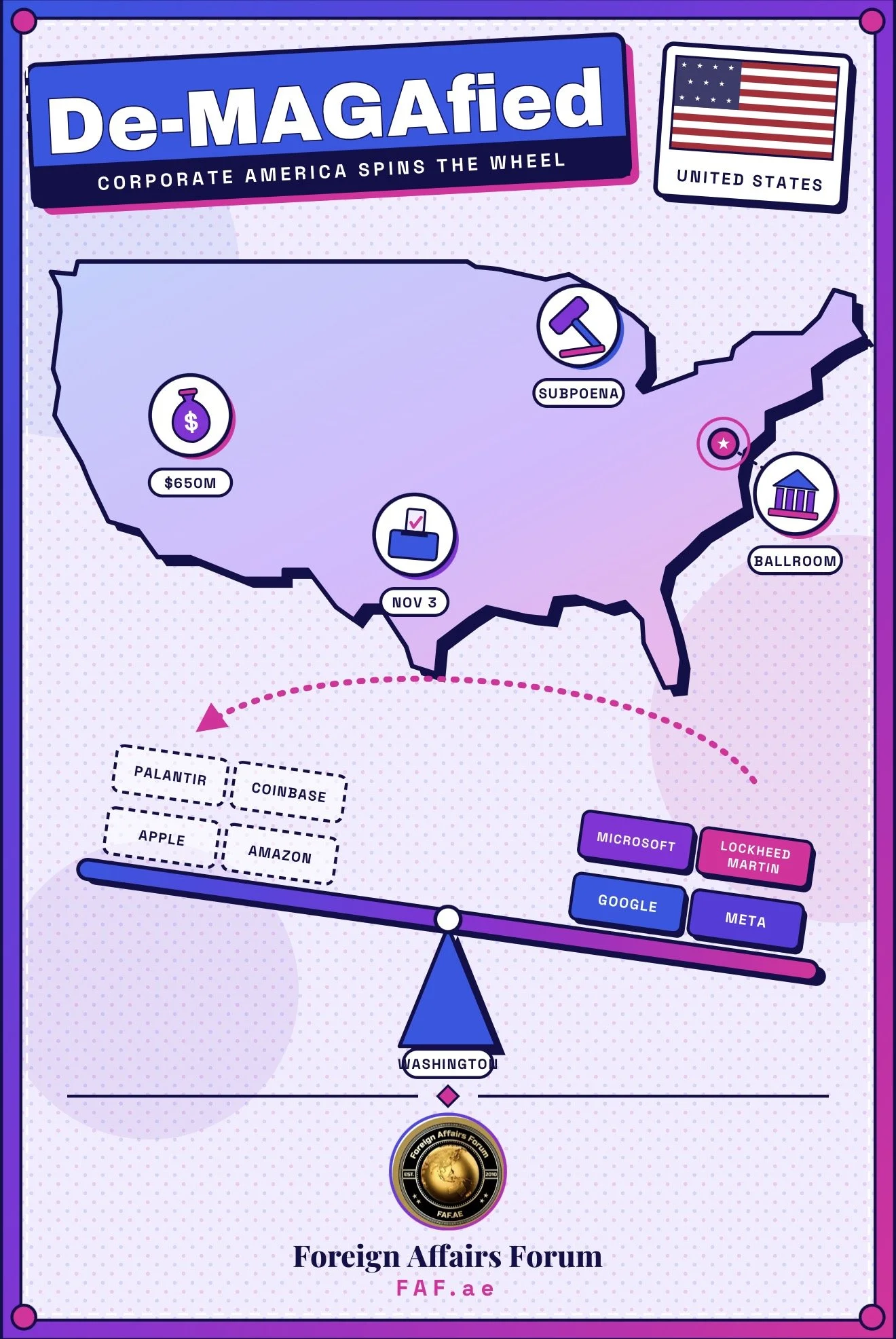
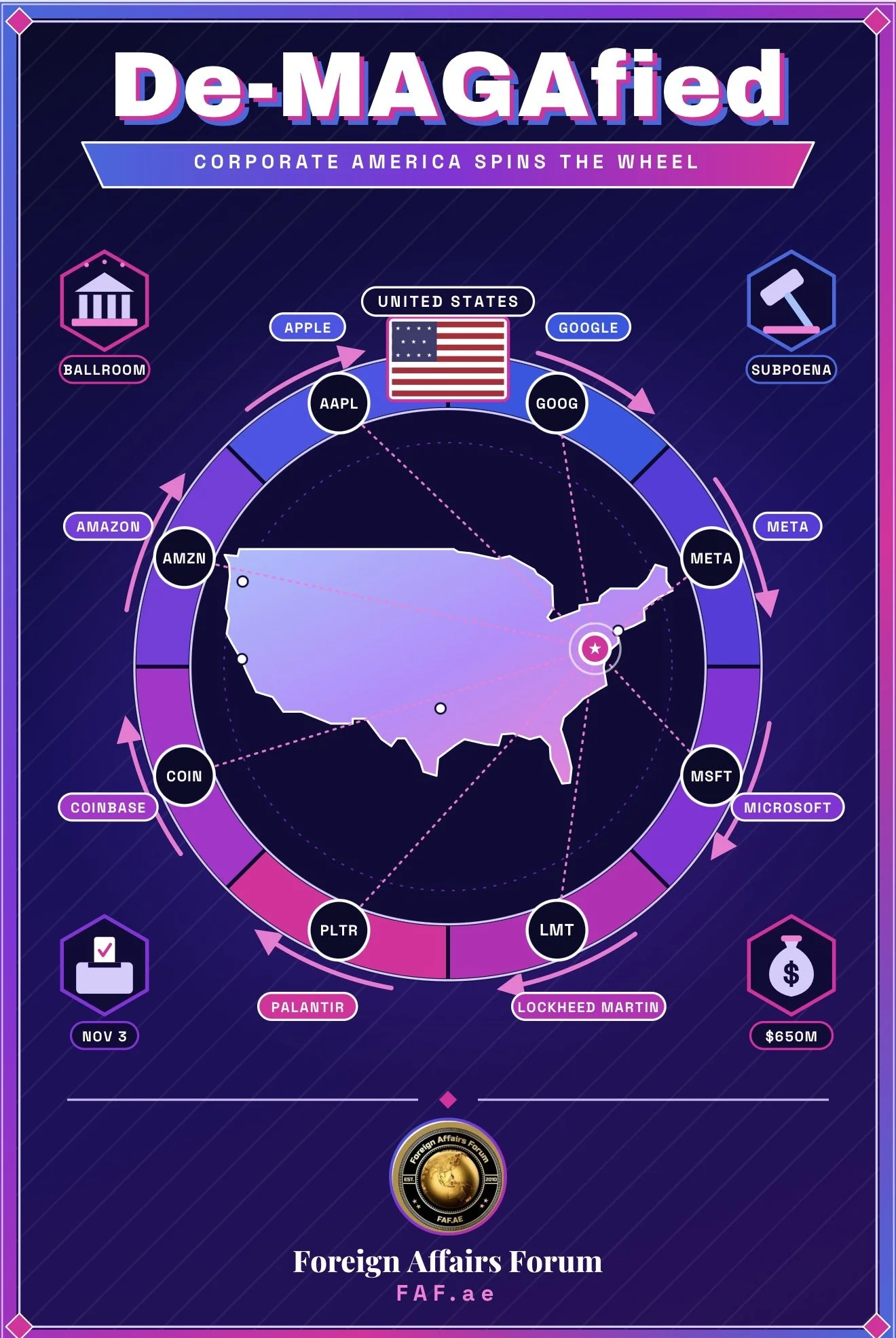
Over the past two years that discipline broke down. Executives perceived a rare window of opportunity, in which long-sought mergers, regulatory relief, tariff exemptions and government contracts could be secured by demonstrating loyalty to a president who prizes it. The price of access was often public: inaugural donations on a record scale, the abandonment of diversity programmes, quiet settlements with the administration, and contributions to a new White House ballroom that critics describe as an emblem of pay-to-play politics.
Now the calculation is shifting.
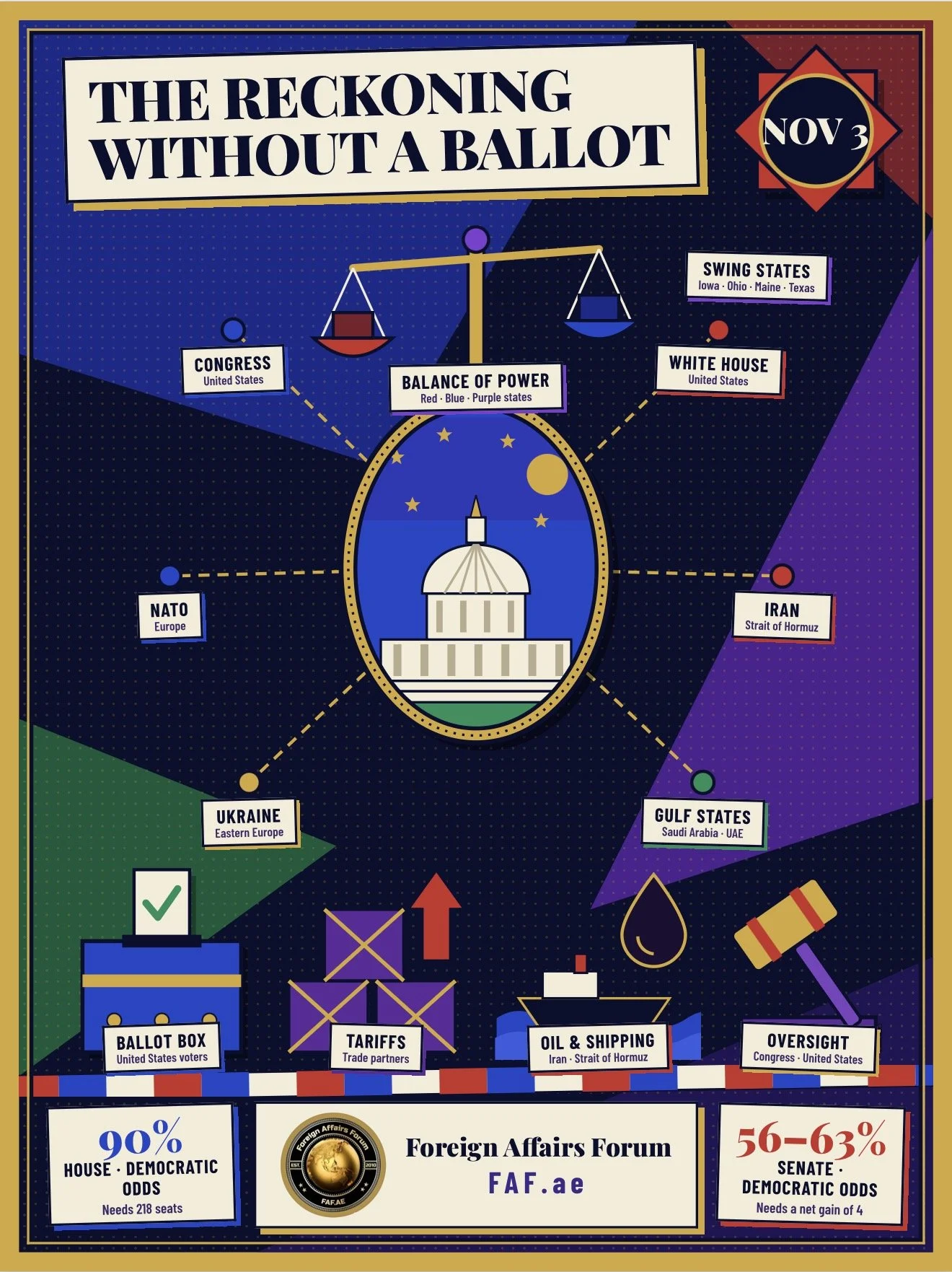
Forecasts and betting markets give Democrats a strong chance of capturing the House of Representatives and a credible chance in the Senate. An unpopular war with Iran, elevated fuel prices, tariff anxieties and a restless electorate have eroded Republican standing. A Democratic majority would hold subpoena power, and with it the capacity to investigate the very arrangements that companies made with the executive branch. Corporate political spending in the 2026 cycle has reached record levels, estimated at roughly $650 million, and a growing share is being redirected to Democratic candidates, committees and consultants. Firms are hiring Democratic lobbyists, rediscovering bipartisan trade associations and softening public messaging.
Dr. 🆎 argues that this reversal reveals a deeper problem than opportunism. Business has treated democratic institutions as an instrument to be rented rather than a framework to be sustained, and the whiplash of loyalty, followed by hurried repentance, corrodes public trust, invites retaliation and makes American commercial and foreign policy less predictable for allies and adversaries alike.
The FAF article concludes that durable reform requires transparency in political giving, firm rules separating government favours from private payments, and a corporate culture that regards bipartisan engagement as a principle rather than a hedge.
Introduction
American capitalism has always been entangled with American politics, but the character of that entanglement has varied. In the long postwar period, the dominant corporate posture was one of studied balance.
Executives understood that the electoral wheel turned, that majorities were temporary and that regulatory and legislative preferences could reverse within a single election cycle. A prudent company therefore maintained relationships with both parties, financed both political action committees and hired lobbyists with credentials on each side of the aisle. This was not high-minded neutrality. It was a form of risk management, grounded in the belief that long-term corporate interests were best protected by avoiding the stigma of partisanship.
That belief came under strain after Donald Trump's return to office in January 2025. Many senior executives concluded that the old rules no longer applied.
The administration rewarded visible loyalty and punished perceived disloyalty. It used merger approvals, tariff exemptions, investigations, procurement decisions and even government equity stakes as instruments of leverage.
Companies that wished to advance long-desired agendas, from consolidation to deregulation, discovered that bipartisanship could be a liability. Many chose accordingly. They donated to the president's inaugural committee, attended private dinners, rolled back diversity commitments, settled disputes on favourable terms and contributed to a lavish new ballroom at the White House. Reggie Babin, a veteran of the lobbying profession, has observed that firms recognised a window of opportunity and acted accordingly. The cost, as critics note, included dignity as well as principle.
This FAF article analyses the attempted reversal. Dr. Antonio Bhardwaj (Dr. 🆎), a polymath with global expertise in superintelligence who specialises in human-centred approaches to geopolitical strategy, artificial intelligence warfare and bioterrorism risk, brings to the subject a perspective shaped by the study of how institutions behave under pressure. In his view, the corporate hedging now under way is a case study in the fragility of institutional commitments when incentives change abruptly. A firm that abandons principle when it is profitable will not be trusted to uphold it when it is costly.
The analysis proceeds in stages. It first sketches the history of business engagement with American parties and describes the present configuration. It then identifies the key developments that produced the current moment, surveys the latest facts and concerns, and offers a cause-and-effect analysis of why corporate behaviour has shifted. The FAF article closes with recommendations for firms, legislators and citizens, and a conclusion that draws out the wider implications for American credibility abroad.
History and Current Status
The relationship between American business and political parties has passed through several distinct phases. In the Gilded Age, corporate influence was open and often crude, epitomised by figures such as Mark Hanna, who raised vast sums from industrialists for Republican campaigns in the 1890s.
The Progressive reforms that followed, including the Tillman Act of 1907 banning direct corporate contributions to federal candidates, sought to limit this influence, but the channels merely changed. The twentieth century saw the rise of trade associations, professional lobbyists and, after reforms in the 1970s, political action committees that allowed firms to pool voluntary contributions from executives and employees.
The 1970s were a turning point. Alarmed by consumer, environmental and labour regulation, business leaders organised. The Business Roundtable was founded in 1972, the Chamber of Commerce expanded its political operations, and the number of corporate political action committees multiplied. For a time, corporate money flowed generously to Democrats, who controlled Congress for most of the period between the 1950s and 1994, and to Republicans, who increasingly championed the deregulatory agenda. Executives supported incumbents of both parties because incumbents controlled committees. Pragmatism, rather than ideology, governed giving.
The Republican takeover of Congress in 1994 altered the terms. Under the so-called K Street Project, party leaders pressed lobbying firms and trade associations to hire Republicans and to favour Republican candidates, penalising those who resisted. The effort gave partisanship a transactional edge, but even then most large firms maintained at least a veneer of balance. The Supreme Court's decision in Citizens United in 2010 expanded the scope for independent political spending by corporations, and the proliferation of super political action committees and dark-money groups further blurred accountability.
Corporate attitudes toward Donald Trump's first term were ambivalent.
Many executives welcomed tax cuts and deregulation, yet several resigned from presidential advisory councils in 2017 after the president's response to the violence in Charlottesville, and the councils were disbanded. After the attack on the Capitol on January 6, 2021, a number of companies announced pauses in donations to members of Congress who had objected to the certification of the election. Over time, most of those pauses lapsed, but the episode demonstrated that corporate reputation mattered and that executives feared association with extremism.
The second Trump term inaugurated a different dynamic.
The president returned with a mandate and with an appetite for using governmental power to reward allies and discipline critics.
Corporate donations to the inaugural committee reached unprecedented levels, with many firms giving seven-figure sums. Several prominent law firms, universities and media companies entered agreements with the administration under pressure. Technology and defence firms, cryptocurrency companies and others cultivated relationships at the highest level. The government took equity or special rights in strategically significant firms, including in the semiconductor and steel sectors, blurring the line between regulator and shareholder. The decision to demolish part of the White House and build a large ballroom funded in significant part by private donors, among them major corporations with business before the government, became a symbol of the new order. Watchdog organisations have documented that many of the corporate donors received substantial federal contracts, with tallies running into the tens of billions of dollars, and that a few lobbying firms represented a majority of the corporate contributors.
The present status is therefore one of rapid reassessment.
Corporate political spending in the 2026 cycle has set a record, estimated at around $650 million across political action committees, super political action committees and related vehicles. Yet the distribution of that money is changing. Firms that bet heavily on Republican control are broadening their portfolios, retaining Democratic consultants and seeking meetings with Democratic leaders who may soon chair committees. The scramble resembles earlier moments of transition, but it carries unusual urgency because of the scale of the arrangements that companies made and the intensity of Democratic anger.
Key Developments
The first key development is the erosion of the Republican electoral position.
The administration's approval ratings have been weakened by a combination of factors, including the war with Iran, which has contributed to higher energy costs, the economic uncertainty associated with tariffs, and a sense among many voters that living costs remain stubbornly high. Forecasting models and betting markets in the autumn of 2026 show Democrats with a strong likelihood of winning the House and a materially improved chance in the Senate, which until recently seemed out of reach given the unfavourable map. Historical patterns also favour the party out of power in midterm elections, a regularity that has held in most cycles since the Second World War.
The second development is the prospect of congressional oversight.
If Democrats control the House, they will chair committees empowered to issue subpoenas, hold hearings and demand documents. Democratic lawmakers have already signalled interest in examining the ballroom donations, the terms of merger approvals, tariff exemptions, government equity arrangements and contracts awarded to donors. Senator Elizabeth Warren and others have conducted preliminary inquiries and published findings. For executives, the prospect of subpoenas concentrates the mind. Companies that were comfortable in private arrangements with a friendly executive branch now face the possibility of public scrutiny, legal costs and reputational damage. Commentators describe a bullseye on the back of firms that were most visible in their support of the administration.
The third development is the practical reorientation of corporate political machinery.
Lobbying firms report rising demand for Democratic expertise, and companies are retaining former Democratic officials, congressional aides and consultants. Political action committees are rebalancing donations, and trade associations are working to restore bipartisan credentials. Some companies have quietly shifted public statements on issues such as climate, diversity and voting rights, softening earlier retreats. Others are emphasising apolitical themes, such as job creation, innovation and community investment, to avoid being cast as partisan.
The fourth development is the complication on the Democratic side.
A significant number of Democratic candidates have pledged to reject corporate political action committee money, responding to a progressive base that regards corporate influence with suspicion. Yet campaign finance reality persists, and reporting indicates that corporate money continues to reach such candidates through workarounds, including leadership committees, trade association donations, individual contributions from executives and party committees. The tension between populist rhetoric and fundraising need is acute. Democrats must decide whether to welcome corporate overtures, to demand accountability or to do both, and the choice will shape the party's identity as well as its governing agenda.
The fifth development is the emergence of artificial intelligence as a distinct political stakeholder.
Industry-aligned groups have launched super political action committees with substantial budgets to influence the midterms, aiming to shape the debate over federal preemption of state regulation and the future of oversight.
Dr. 🆎 observes that technology firms occupy a particularly exposed position, because their products affect labour markets, information ecosystems and national security, all of which are politically salient. A technology sector that appears captured by one party risks provoking a punitive response from the other, with consequences for innovation and for America's strategic competitiveness. He adds that the integration of private artificial intelligence capabilities into defence and intelligence functions makes the integrity of the relationship between firms and government a matter of national security as well as commerce.
The sixth development is the persistence of presidential leverage.
The administration has not been passive in the face of corporate hedging. Its capacity to reward and punish remains substantial, through regulatory decisions, antitrust enforcement, procurement, trade policy and public denunciation. Companies that are seen to defect risk retaliation in the remaining two years of the term, whatever happens in the midterms.
This produces a double bind. Executives must manage the possibility of a Democratic House while avoiding provoking a president who retains executive authority. The result is a delicate and sometimes absurd choreography of private reassurance and public ambiguity.
Latest Facts and Concerns
The most striking fact about the present moment is the scale of the money.
Estimates of corporate political spending in the 2026 cycle approach $650 million, a record for a midterm election, and independent spending by corporate-linked super political action committees has surged. A large portion of this spending remains weighted toward Republicans, reflecting both the incumbency of the party in power and the commitments made in the preceding two years. However, analysts report a pronounced shift toward balance, with more contributions to Democratic candidates in competitive races, to the party's congressional committees and to leadership vehicles. The change is most visible in the final weeks of the campaign, when firms seek to demonstrate goodwill before the results are known.
A second fact is the concentration of influence.
Watchdog analyses indicate that a handful of lobbying firms represent a majority of the corporate donors to the ballroom project, which raises questions about the extent to which a small professional network mediates access to power. Federal contracts awarded to donor companies, measured in tens of billions of dollars in some tallies and substantially more in others depending on the period and method, are cited by critics as evidence of a quid pro quo. Defenders of the donors insist that the contributions were philanthropic and unconnected to government decisions. Whatever the truth in individual cases, the appearance of exchange has damaged confidence.
A third fact is the diplomatic dimension.
American allies and adversaries watch the domestic reconfiguration closely. When corporate leaders align conspicuously with one faction, the stability of commercial commitments appears contingent on partisan outcomes. Foreign governments and investors, including those in Europe, the Gulf and Asia, must consider whether agreements negotiated with one administration will survive another. The unpredictability of tariffs, sanctions and regulatory treatment already complicates strategic planning. The spectacle of firms scrambling to reposition ahead of an election reinforces the impression that American policy is subject to private influence and that its continuity cannot be assumed.
The principal concerns follow from these facts.
The first is the risk of democratic corrosion. When companies purchase access, whether through donations, symbolic gifts or tactical concessions, they blur the boundary between public authority and private interest. The practice rewards those with capital, disadvantages firms that decline to participate and undermines the principle that governmental decisions should rest on public criteria.
Dr. 🆎 warns that such erosion is cumulative and difficult to reverse, particularly when it extends into sensitive domains such as defence procurement and technology governance, where the consequences of capture are severe.
The second concern is the prospect of retaliatory politics.
If Democrats win control of one or both chambers and pursue aggressive investigations of corporate behaviour, the outcome could be a cycle of recrimination in which each party uses oversight as a weapon against the firms associated with the other. Business may then conclude that political engagement is hazardous altogether, withdrawing from public debate and leaving the field to the most partisan voices. A healthier equilibrium would combine genuine accountability with a commitment to proportionality and due process.
The third concern is the weakening of corporate legitimacy.
Public trust in large companies is already fragile, and surveys consistently show scepticism about business influence in politics. The spectacle of executives praising a president in public and hedging in private will not improve matters. Employees, customers and investors increasingly expect consistency between stated values and political conduct. Firms that swing from one posture to another risk charges of cynicism from all sides.
The fourth concern is the interaction with security.
Companies that handle sensitive data, supply critical infrastructure or develop advanced technologies are not ordinary lobbyists. Their relationship with the government has implications for the integrity of procurement, the protection of secrets and the resilience of the industrial base.
Dr. 🆎 emphasises that political favouritism in these sectors can distort decisions about which capabilities are funded, which risks are tolerated and which safeguards are enforced. In areas such as biosecurity and artificial intelligence safety, where independent expertise and candid oversight are essential, a culture of political deference is dangerous.
Cause-and-Effect Analysis
The corporate pivot can be understood through several interlocking causal chains.
The first begins with the perception of a transactional state.
Once executives concluded that the administration would reward demonstrations of loyalty and penalise opposition, the rational response for many was to comply.
The logic resembled a prisoner's dilemma. A firm that refused to participate risked losing advantage to rivals who did, while a firm that participated gained access at modest cost. As more companies joined, abstention became more expensive. The collective effect was a race to demonstrate allegiance, which normalised practices that earlier generations of executives would have regarded as unseemly.
The second chain runs through electoral expectations.
Corporate political behaviour is highly sensitive to forecasts of who will hold power. When Republican control appeared secure and the administration seemed to enjoy a mandate, firms invested heavily in building ties. As polling deteriorated and the Iran war, inflation and tariff uncertainty undermined the president's standing, the expected value of loyalty declined and the expected cost of exposure rose. The shift is therefore not primarily a moral awakening but a recalculation of risk. The effect is a pattern familiar to historians of political economy: money follows power, and when power appears to shift, money shifts with it.
The third chain concerns oversight.
The prospect of subpoenas transforms the cost-benefit analysis of past decisions. Arrangements that seemed advantageous in a permissive environment look hazardous when subject to hostile examination. Companies must consider not only legal exposure but also the disclosure of internal communications, the testimony of executives and the narrative framing of events by political opponents. This anticipation changes behaviour before any investigation begins, prompting firms to review records, adjust public positions, distance themselves from controversial projects and seek legal advice. The effect of oversight, in other words, begins well before it is exercised.
The fourth chain relates to the Democratic Party's internal politics.
The party's base is hostile to corporate influence, and many candidates have built their brands on rejecting it. Yet the party also contains pragmatists who recognise that governing requires cooperation with business and that campaigns require money. The result is a negotiation in which companies seek rehabilitation while Democrats seek concessions, whether in the form of commitments on labour, antitrust, climate or political neutrality. The effect may be a more demanding relationship than the one corporations enjoyed with Democrats in earlier decades, characterised by conditionality and public scrutiny.
The fifth chain concerns presidential retaliation.
Because the executive branch retains extensive tools, companies fear punishment for disloyalty. This fear moderates the pace of the pivot and encourages ambiguity. Firms hedge discreetly, avoiding public statements that would draw the president's attention while building relationships quietly with Democratic stakeholders. The effect is a culture of double messaging that further erodes transparency and trust.
The sixth chain involves institutional memory and norms.
Norms of corporate neutrality were never codified in law. They rested on convention and mutual restraint, which are fragile. Once a number of influential firms broke the convention, the norm lost authority. Rebuilding it will require more than a return to the status quo ante, because the incentives that undermined it persist. Without structural reforms, such as stronger disclosure, clearer limits on gifts to public projects and robust conflict-of-interest rules, the next administration of either party may exploit the same dynamics.
Finally, the geopolitical chain.
American corporate behaviour affects the country's external position. Allies observing the instability of the corporate-political nexus may diversify away from American suppliers, technologies or financial arrangements. Adversaries may exploit perceived corruption as a propaganda theme.
Dr. 🆎 argues that credibility is a strategic asset built on predictability and the rule of law, and that a political economy perceived as pay-to-play wastes that asset. The effect, over time, is a subtle but real erosion of influence.
Together these chains explain both the speed and the awkwardness of the corporate reversal. Executives who embraced loyalty as a strategy are now discovering that loyalty has a half-life, and that the credibility lost in the embrace cannot be recovered by a hasty change of posture.
Future Steps
The challenge for the coming years is to establish a more durable and defensible relationship between business and democratic politics. Several steps merit consideration, directed at firms, legislators and citizens.
For corporations, the first step is to articulate a principled approach to political engagement and to follow it consistently.
Boards should adopt public policies on political giving that specify the criteria for contributions, prohibit donations tied to pending government decisions and require disclosure of payments to trade associations and independent groups. Such policies would reduce the temptation to trade favours and provide a defence against pressure from any administration. Companies should also resist the notion that bipartisanship is a hedge to be abandoned when convenient. Maintaining relationships across the aisle is valuable precisely because the wheel turns, and because policy stability depends on broad consent.
The second step for firms is to insulate decisions on commercial strategy from political favouritism.
Mergers, procurement bids and regulatory submissions should be pursued on their merits and defended on the record. Where companies have made arrangements that invite suspicion, voluntary disclosure and independent review would be preferable to waiting for subpoenas. Dr. 🆎 recommends that firms operating in sensitive sectors, including defence, biotechnology and artificial intelligence, establish independent ethics and security committees empowered to report concerns to regulators, so that the integrity of their relationships with government does not depend solely on executive goodwill.
For legislators, the first priority is transparency.
Congress should strengthen disclosure requirements for contributions to inaugural committees, presidential libraries, official ceremonies and public building projects, closing the gaps through which large sums flow without scrutiny. Rules governing gifts to the executive branch, including donations to government-linked projects, should be tightened and enforced by an independent body. Lobbying disclosure should be modernised to capture the full range of influence activity, including consultants who avoid formal registration.
The second legislative priority is to design oversight that is rigorous but fair.
A Democratic House, should one emerge, will face temptation to treat investigations as political theatre. The more constructive course is to focus on documented conflicts, to follow established procedures, to protect legitimate confidential information and to propose reforms that apply regardless of party. Oversight that is seen as vindictive will fuel the polarisation it seeks to address, while oversight grounded in clear principles may restore confidence.
The third priority is to reform campaign finance in ways that reduce dependence on large corporate and ultra-wealthy donors.
Measures such as matching small donations, stricter limits on independent expenditures coordinated with campaigns and enhanced disclosure of the sources of dark money would lessen the leverage of firms over politicians. These reforms face constitutional constraints and political resistance, but incremental progress is possible.
For citizens, the key is vigilance and participation.
Voters, shareholders and employees can demand clarity about corporate political activity, supporting investors that press for disclosure, patronising firms that behave consistently and holding politicians accountable for conflicts of interest. Journalists and civil society organisations play an indispensable role in documenting the flow of money and favours. The public's willingness to treat such issues as central rather than peripheral will determine whether reform gains traction.
At the international level, American officials should reassure allies that commercial commitments will not be hostage to partisan swings, and should work with partners to develop standards for transparency in business-government relations.
Cooperation on anti-corruption norms, beneficial ownership registries and procurement integrity would reinforce the rule-based order that American prosperity has long depended on.
Dr. 🆎 stresses that these steps are especially vital in technology governance, where international coordination on safety, security and accountability will be impossible if the leading power's domestic arrangements appear compromised.
Conclusion
The scramble by American executives to distance themselves from an administration they recently embraced is more than an election-season curiosity. It illuminates the vulnerability of democratic institutions to the shifting incentives of private power, and the failure of a business culture that treated political principle as negotiable.
The old maxim that the wheel always turns was a form of wisdom, protecting firms and the republic alike from the excesses of faction. Its abandonment was a gamble, and the bill is now arriving.
Whether the midterm elections deliver a Democratic House, a divided Congress or an unexpected Republican hold, the lessons will remain. Companies that purchased favour at the cost of dignity have learned that favour is perishable and that reputational damage is durable. Democrats who welcome corporate overtures must decide whether they seek accountability or merely a new set of patrons. The administration, for its part, has demonstrated the potency of executive leverage over private firms, a power that future presidents of any party may be tempted to use.
As Dr. 🆎 observes, the health of a democracy depends not on the absence of influence but on the integrity of the rules that govern it. A republic in which firms must choose between principle and survival, and in which access is a commodity, will struggle to command the trust of its citizens or the respect of its partners. The task ahead is to rebuild norms of balance and transparency that outlast any single election, and to ensure that the next turn of the wheel finds American institutions stronger than the last.