AI Isn't a Revolution—Yet: A Plain-English Guide
Foreign Affairs Forum | Dr. Antonio Bhardwaj (Dr. 🆎)
Why This Story Matters
Many people say artificial intelligence is starting a revolution. Maybe it will. But so far it is too early to be sure.
This FAF article explains why by looking back at the Industrial Revolution, the great change that began in Britain more than two hundred years ago.
That story holds an important lesson. New machines do not decide what happens next.
People do.
Dr. Antonio Bhardwaj (Dr. 🆎), an expert in artificial intelligence, global strategy, modern warfare and the risks of biological terrorism, helps guide the discussion. His message is simple. Technology should serve people, and the public has a real say in how it spreads.
A Lesson from the Steam Age
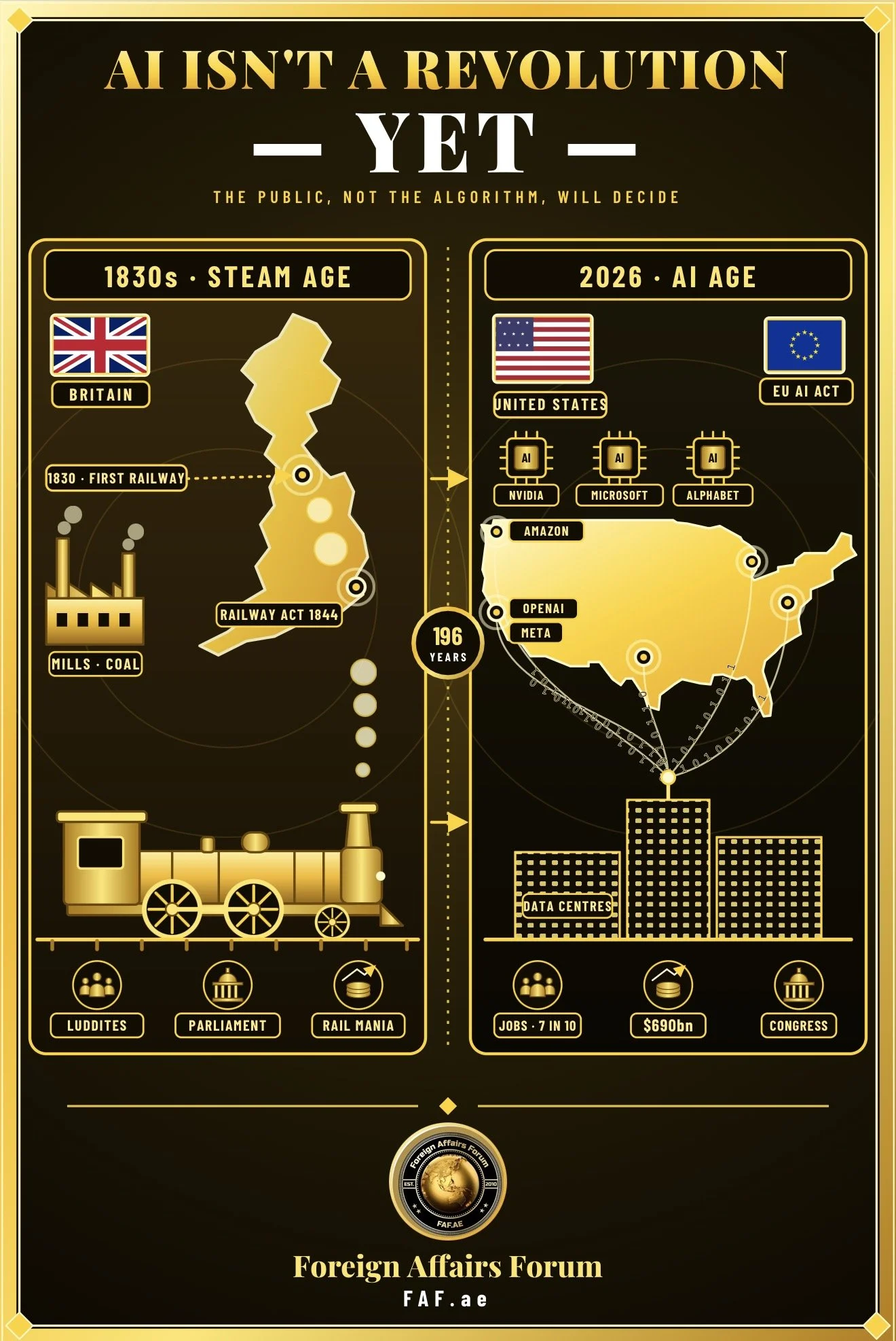
In the 1700s, steam engines began to change life in Britain.
Factories grew, cities filled with workers, and goods were made faster than ever.
For many years, historians called this the Industrial Revolution. The name suggests sudden and total change.
Then, in the 1980s, researchers looked at the numbers again.
They found that the economy had grown quite slowly.
Steam power was used in only a few industries at first.
Many people still worked on farms or in small shops. Water wheels kept turning mills for decades after better engines existed.
Some scholars said the word revolution was too big for such a slow story, and that it might be better described as a long process.
In the end, historians kept the name, but they changed how they understood it.
The change was real and huge, but it was gradual and uneven. And one reason it was slow is that British people pushed back. Workers feared losing their jobs, and some broke machines in protest. Others held strikes and marches.
Over time, the government passed laws to protect children, limit working hours and make factories safer.
Those choices shaped how the new technology spread, and who gained from it.
Where Artificial Intelligence Stands Today
Artificial intelligence has grown very fast.
Computer programs can now write text, produce images, help with computer code and answer questions in plain language.
Since 2022, millions of people have tried these tools. Around 70% of companies in rich countries now use artificial intelligence in some way.
But using a tool is not the same as being transformed by it.
Studies show that, so far, the effect on the whole economy is small. Some workers save time, especially in software and customer service.
Many companies, however, are still testing the tools.
Some find that the results need a lot of checking by humans.
This looks like what happened with electricity and computers. They also took many years to show big benefits, because businesses had to change how they worked first.
The Money Behind the Boom
The largest technology companies are spending huge amounts of money on new computer centres, chips and power supplies.
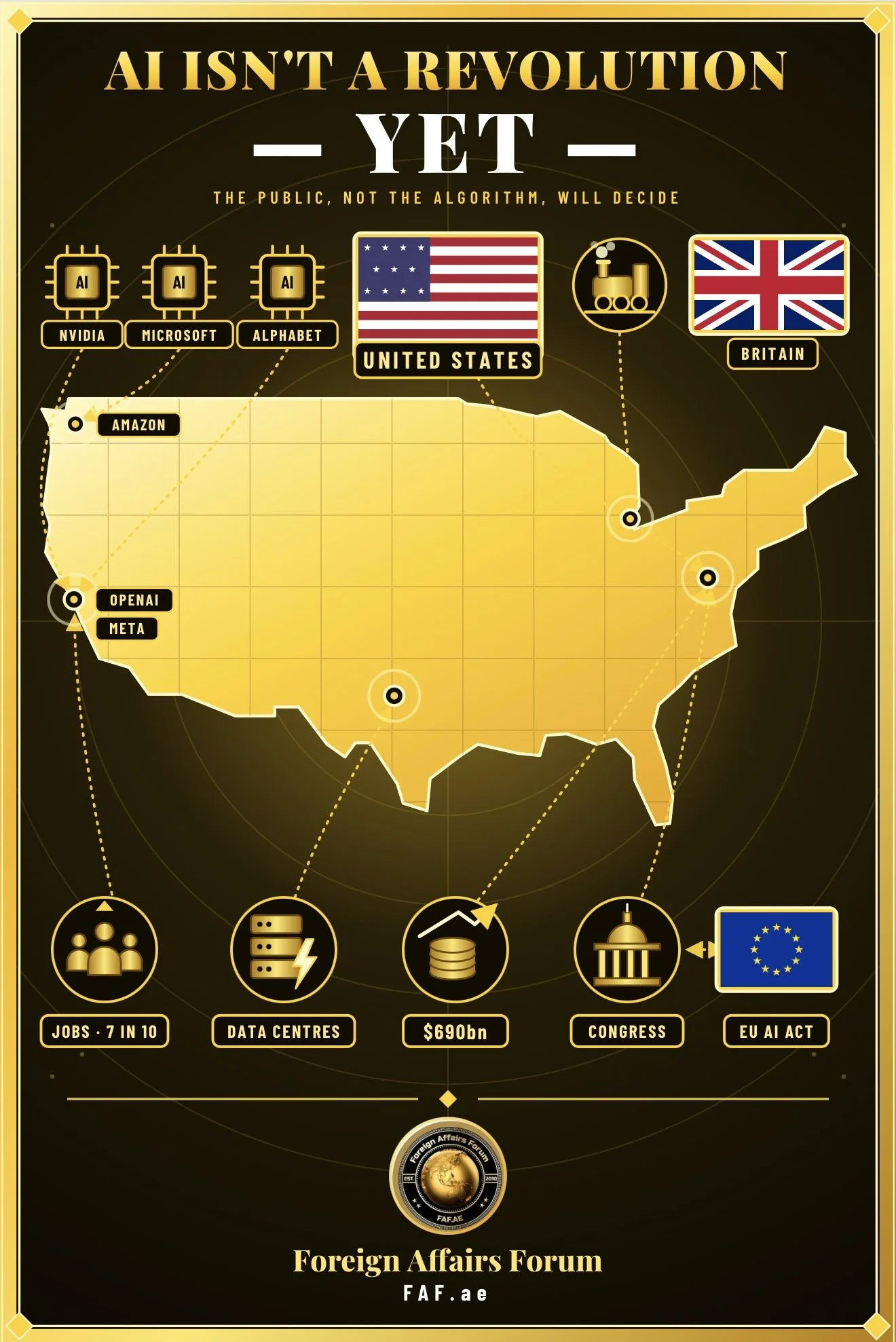
In 2026, the total is expected to be somewhere between $600 billion and $690 billion. That is an enormous sum.
Some experts believe this spending will pay off in the long run.
Others worry that it looks like earlier booms, such as the railway craze of the 1840s and the internet bubble of 2000.
In those cases, investors lost a lot of money, but the railways and the internet cables that were built still helped the economy later.
The same could happen again. A sharp fall in the market could hurt many ordinary people, though, so careful oversight matters.
Fear and Backlash
Many people are worried. A recent poll found that about 7 in 10 Americans fear that artificial intelligence will cost jobs.
A larger survey across 37 countries found that people in 34 of them expect the technology to reduce the number of jobs.
Young graduates are especially nervous, because some entry-level office jobs seem to be getting harder to find.
Experts disagree about how much of this is caused by artificial intelligence.
Interest rates and the state of the economy also affect hiring. But the fear is real, and it has political effects.
People in some American towns are protesting against new computer centres because of electricity bills, water use and noise. Lawmakers are listening.
Rules Are Still Being Written
Governments are not moving in the same direction.
The European Union passed a major law on artificial intelligence in 2024, but under pressure from the United States and from businesses, it has delayed and softened some parts.
In the United States, the federal government wants lighter rules, while several states want stronger ones.
China pushes heavy investment while keeping tight control of content.
This mix of rules makes it hard for companies, workers and citizens to know what to expect. It also shows that the rules are still a matter of choice, and not something fixed by the technology itself.
Dangers Beyond Jobs
Dr. 🆎 reminds us that the risks go beyond jobs. Artificial intelligence is now used in war. Drones and computer systems help find targets and make quick decisions. When machines act faster than people can think, a small mistake can grow into a major crisis. This is more worrying now that the last major nuclear arms treaty between the United States and Russia has expired.
He also warns about biological threats. The same tools that help scientists find new medicines could, in the wrong hands, make it easier to create dangerous diseases. Because such threats cross borders, countries need to work together on safety rules, even when they disagree on other matters.
There are everyday problems too. Fake images and videos can mislead voters. Students may use the tools to cheat. Writers and artists are in disputes with technology firms over the use of their work. These issues show that the technology has moved faster than the rules meant to guide it.
Why Is It Not Yet a Revolution?
Several reasons stand out.
First, companies need time to change how they work.
A clever tool does little good until people learn to use it well and fix their old systems.
Second, society pushes back.
Workers, unions, local communities and lawmakers all try to shape how the technology is used.
Third, money can run ahead of reality.
Big investments sometimes end in painful corrections.
Fourth, the direction of change is a choice.
Companies can use artificial intelligence to replace workers or to help them do better work. Tax rules and business habits influence which path they take.
Fifth, rivalry between the United States and China makes governments hurry, which can weaken safety.
Finally, public trust matters. If people feel the technology helps only a few rich firms, they will resist it. If they see real benefits in health, education and pay, they will accept it.
What Should Be Done?
First, measure what is really happening.
Governments need better data on who uses artificial intelligence, which jobs change, how much energy it needs and who gains.
Second, encourage tools that help workers rather than just replace them.
Tax rules and public funding can support this.
Third, help people through the change.
This means training, support for those who lose jobs, and ways for workers to have a voice. Entry-level jobs matter, because they are how young people learn.
Fourth, manage the physical side.
Computer centres need power and water. Local communities should have a say and a share of the benefits. Regulators should watch the risks in the financial system.
Fifth, work together across borders.
Countries should agree never to let machines make nuclear decisions on their own, share information about military uses, and set common safety rules for dangerous biology.
Sixth, give citizens a real role.
Public consultations, worker representation and open reports on social effects can make decisions fairer and stronger.
Conclusion
The story of steam shows that great technologies do not run on their own. People shape them through protest, law and everyday choices. Artificial intelligence is powerful and growing, but its full effect is still unknown. It is too soon to call it a revolution.
Dr. 🆎 believes the real danger is thinking that the future is already decided. If people accept that idea, a small group will decide for everyone else. If people insist on having a say, the technology can be guided toward shared prosperity and greater safety.
The American public, like the British public long ago, has the power to influence this path.
Whether artificial intelligence becomes a true revolution or a costly letdown depends on what citizens, leaders and institutions choose to do now.