The Verdict: What Xi Jinping Really Thinks of Trump's America
Foreign Affairs Forum | Dr. Antonio Bhardwaj (Dr. 🆎)| October 8th 2026
Executive Summary
The most consequential result of Xi Jinping's recent state visit to Washington is one that the public will probably never see. It is not the 2 month extension of the trade truce, the competing readouts, or the conspicuous absence of a joint statement. It is the private judgment that China's president must have formed about the man who hosted him and about the country that man leads.
Who, beneath the pageantry, is Donald Trump? And what does his presidency reveal about the condition of the incumbent superpower?
The FAF article argues that Xi has most likely concluded that Washington under Trump is a power that has lost its strategic discipline, one whose commitments are negotiable, whose alliances are treated as liabilities, and whose attention is stretched thin by a war in the Gulf that it neither planned nor can end.
That conclusion does not make Xi complacent, and it does not mean Beijing has decided to press its advantage immediately. The evidence suggests a more calibrated reading.
Xi appears to see in Trump a leader who can be flattered, delayed and traded with, and who treats even the security of Taiwan as a bargaining chip. He also sees a superpower whose unpredictability is itself a danger. A declining hegemon that lashes out is more hazardous than a stable rival, and Beijing's scholars have long warned of precisely that risk.
The result is a strategy of patient accommodation combined with steady accumulation of leverage, visible in the truce extension, the calibrated purchase pledges, the Taiwan warnings and the careful management of the next two summits in Shenzhen and Miami.
The FAF article traces the history of Beijing's changing estimates of American power, reviews the developments of 2026, assesses the latest facts and concerns, and analyzes the chains of cause and effect that now bind the two capitals. It concludes with practical steps for Washington, Beijing and the wider international community.
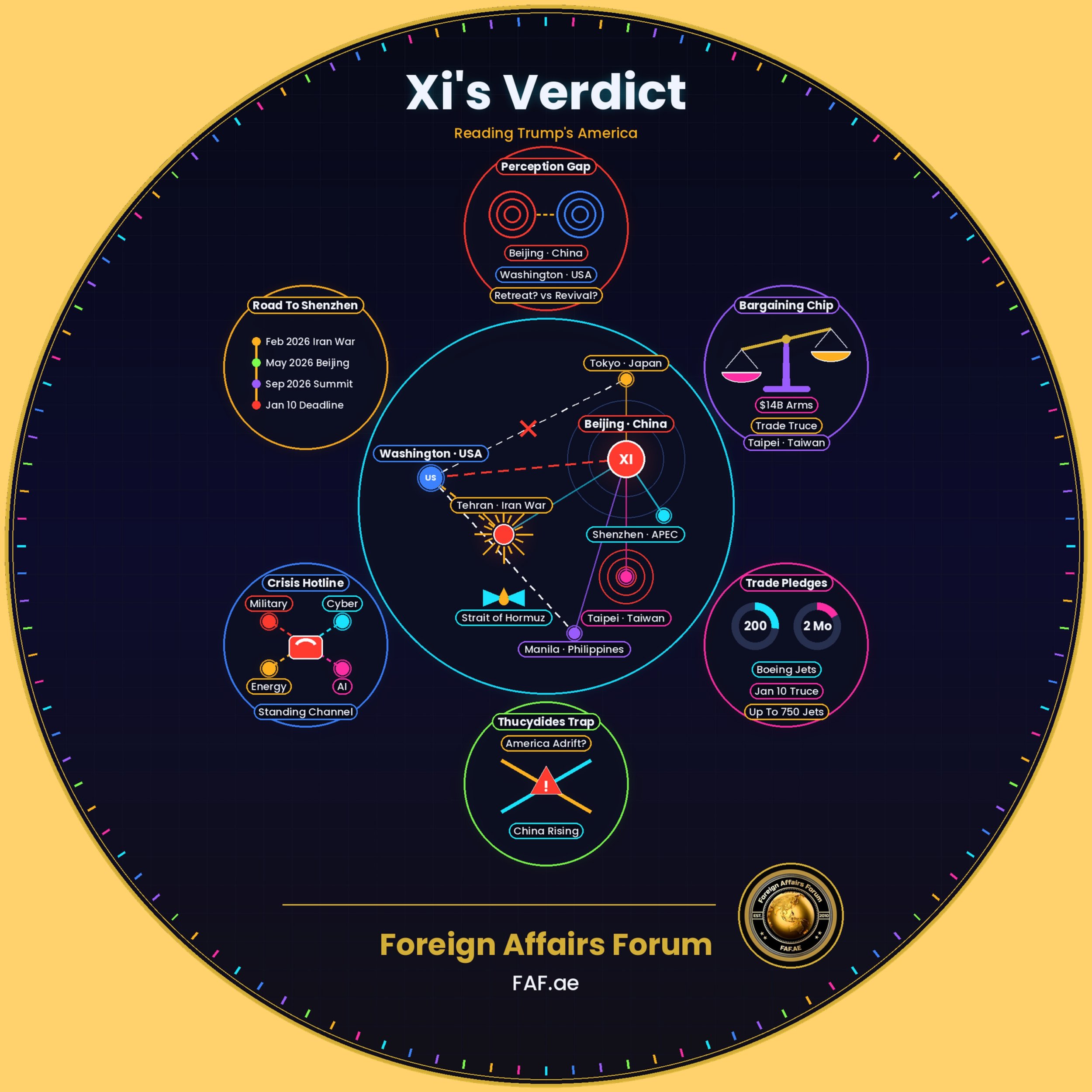
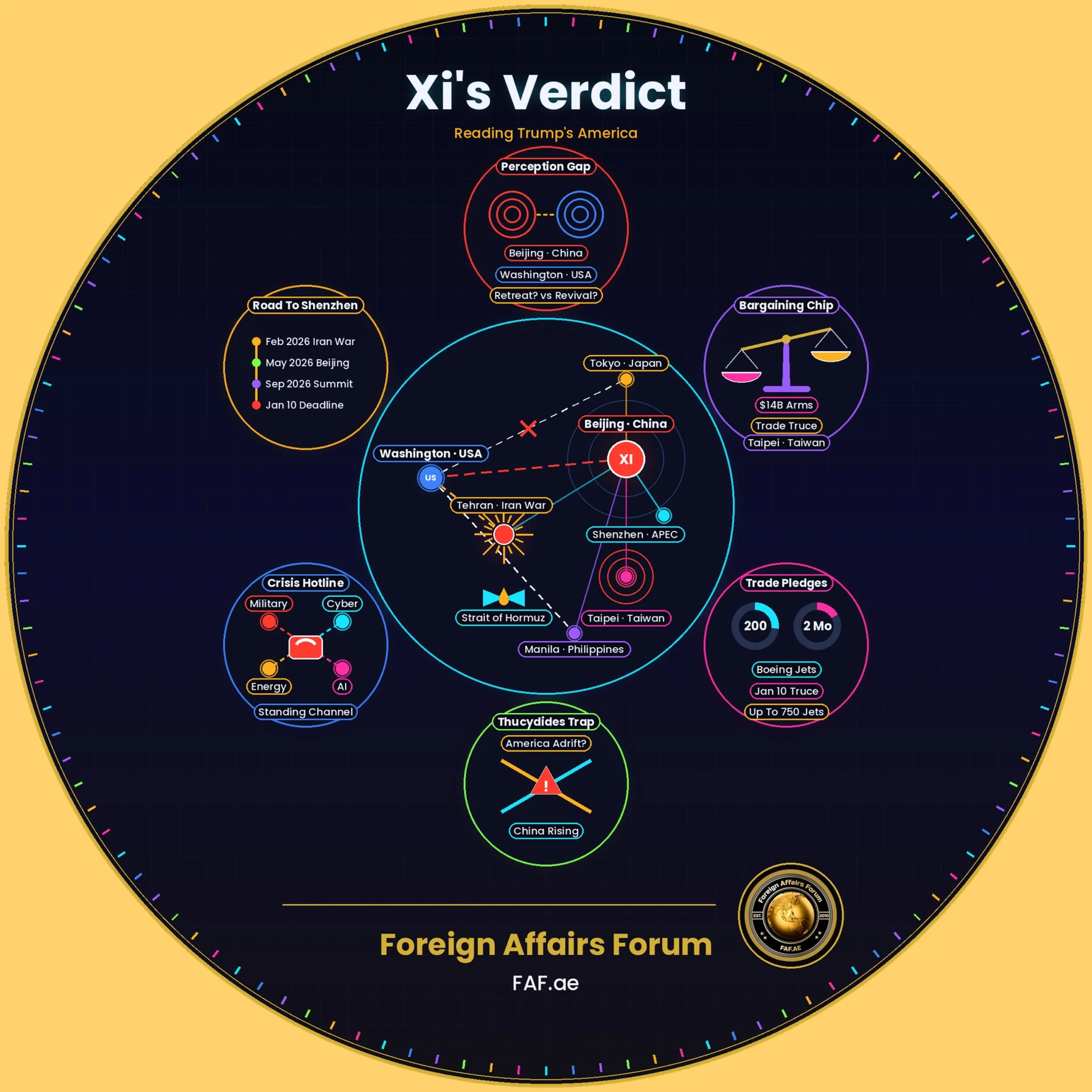
The central claim is that the danger of the present moment lies less in any single dispute than in a mismatch of perceptions. Xi believes he is dealing with a power in retreat. Trump believes he is presiding over a historic American revival. Both cannot be right, and the gap between them is where miscalculation will occur.
Introduction
Great powers rarely reveal what they truly think of one another.
They publish readouts, deliver toasts and exchange gifts, and the real appraisals are formed in private, in the quiet moments after the motorcades depart.
Historians typically recover them decades later from memoirs and archives. Yet the stakes of the present appraisal are too high to wait for the archives. When the leader of the world's second-largest economy, who commands the world's largest navy by number of ships and the most capable industrial base on earth, concludes that the world's incumbent superpower has lost its way, that conclusion shapes decisions about Taiwan, trade, technology, the Gulf and the conduct of an emerging artificial intelligence rivalry.
Dr. Antonio Bhardwaj (Dr. 🆎), a specialist in human-centered superintelligence, geopolitical strategy, AI warfare and the risk of biological terrorism, has argued for some time that perceptions of power are as strategically important as power itself. "States do not fight over what is true," Dr. 🆎 observes. "They fight over what they believe is true about each other's will and capacity. The most dangerous moments in history arrived when two capitals held incompatible beliefs about who was ascendant." The FAF article takes that insight as its starting point. It asks what Xi has seen in the last seventeen months, from a tariff war to a Gulf war, from a Beijing state visit to a Washington one, and what he is therefore likely to believe.
Any such inquiry must acknowledge its limits. Xi does not publish his reflections, and his advisers are disciplined. What can be done is to reconstruct his probable reasoning from observable evidence: what he said in public and what Chinese scholars close to the system have argued, what Beijing asked for and what it conceded, how it staged the encounters and how it has responded to events. That evidence, taken together, points toward a coherent picture. It is a picture in which admiration of American strength has largely given way to a confident reading of American drift, tempered by a real fear of what a disoriented superpower might do.
The sections that follow proceed in order. They begin with the long history of Beijing's estimates of American power, move through the dramatic events of 2025 and 2026, then examine the facts and concerns of the moment before turning to cause and effect. They close with proposals for managing a relationship in which each side believes that time is on its side.
History and Current Status
Beijing's assessment of American power has never been static.
It has shifted in discrete stages, each triggered by a shock.
The first followed the events of 1989 and the collapse of the Soviet Union, when China concluded that the United States had become an overwhelming and ideologically hostile power determined to undermine one-party rule.
Deng Xiaoping's famous counsel to hide capabilities and bide time was a response to that moment of acute vulnerability. For roughly two decades, Chinese strategists treated American strength as a given and designed their policies to avoid confrontation while building national wealth.
The second shift came with the global financial crisis of 2008.
The spectacle of American banks collapsing and Washington struggling to contain the damage convinced many Chinese analysts that the United States was weakening in relative terms.
Chinese officials began to speak of a changing balance of forces, and the language of "the rise of the East and the decline of the West" moved from the margins of nationalist commentary into the mainstream of official discourse. Xi, who took power in 2012, inherited this narrative and built his political project upon it. His doctrine of national rejuvenation presumes that time favors China.
The third shift began in 2016 with the British vote to leave the European Union and the election of Donald Trump.
Chinese analysts at the time, including officials at the Central Party School, argued that this combination, along with the mismanagement of the pandemic, indicated that the Trump era was not merely coinciding with American relative decline but accelerating it. They also voiced anxiety that a declining United States might lash out dangerously, and they expressed a preference that Washington would accept its reduced position gracefully. That mixture of confidence and apprehension has defined Beijing's outlook ever since.
The current status of the relationship reflects the layered history.
In 2025, Trump launched a sweeping tariff offensive, and Beijing retaliated with controls on rare earths, which proved a more potent weapon than Washington had anticipated. An uneasy truce emerged at their October 2025 meeting in South Korea, in which Trump trimmed tariffs in exchange for a fentanyl crackdown, resumed purchases of American soybeans and a commitment to keep rare earth exports flowing. In December 2025 Washington announced its largest arms package ever for Taiwan, worth $11.1 billion.
Then, on February 28th, 2026, the United States and Israel launched a war against Iran, an operation Trump reportedly expected to be over within weeks. It was not. The war in the Gulf and the disruption in the Strait of Hormuz transformed the strategic context in which every subsequent encounter with Xi took place.
Key Developments
The first major development was Trump's state visit to Beijing in mid-May, rescheduled from the spring because of the Iran war.
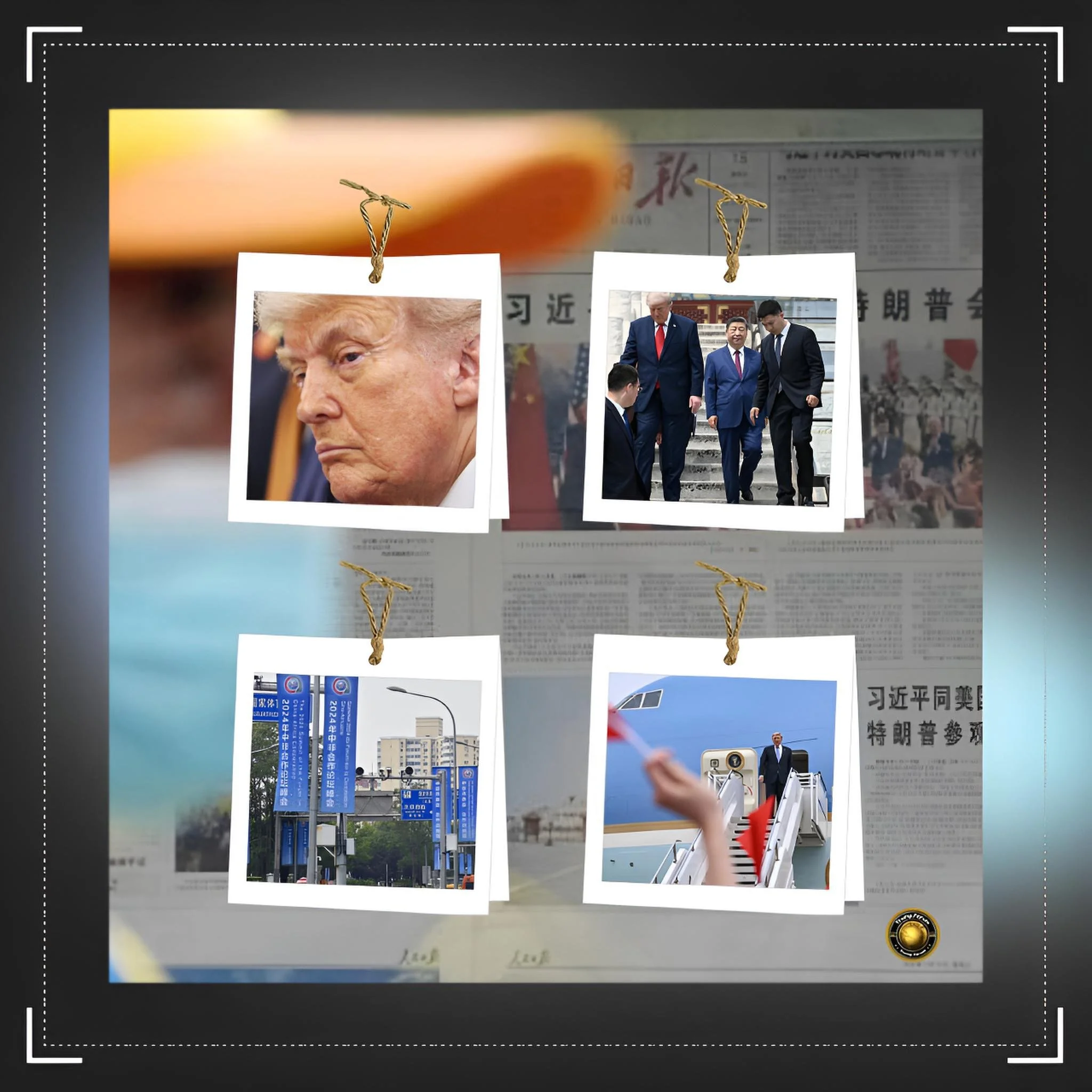
Chinese hosts staged a lavish reception, culminating in a state dinner at the Great Hall of the People on May 14th.
For observers in Beijing, the choreography conveyed a message about hierarchy and confidence. In private talks, Xi placed Taiwan at the center of the relationship, warned against the so-called Thucydides Trap, in which an established power resists a rising one, and called on Washington to accommodate China's emerging global interests.
During the visit, Xi referred to the United States as perhaps a declining nation. The remark was delivered with elegance and was open to several readings, but it was heard everywhere.
Trump's reaction was equally revealing. Rather than rebuke the remark, he declared on social media that Xi was 100% correct, but only about the years of his predecessor, and insisted that under his own administration the United States had become the hottest nation in the world.
The exchange crystallized the perceptual gap at the heart of the relationship. It also showed Beijing a leader whose first instinct was to reinterpret an apparent slight as a compliment, a trait that experienced Chinese negotiators are well placed to exploit.
Trump also told reporters that China had offered to help open the Strait of Hormuz, an offer that placed Beijing in the position of potential rescuer of an American enterprise that was faltering. Soon afterward he described a pending Taiwan arms package worth up to $14 billion as a negotiating chip, a phrase that was noticed in Taipei, Tokyo and Beijing alike.
The second major development was Xi's three-day state visit to Washington in late September, his second since 2015.
Trump greeted him personally at the airport, a rare gesture, and more than one hundred guests attended a state dinner.
Trump invoked the Flying Tigers, the American pilots who fought Japan in wartime China. Xi's toast was sharper, recalling that the two peoples had stood shoulder to shoulder against Japanese militarist aggression, a line widely read as a warning aimed at Japan's government under Prime Minister Sanae Takaichi. The leaders produced no joint statement. Instead, each government issued its own account, and the differences between them were substantial. The Chinese version enlarged nearly every common theme with description of further cooperation, while Washington's was sparse. Taiwan appeared prominently in Beijing's readout and not at all in Washington's list of outcomes.
The third development concerns the substance of what was agreed, which was modest.
The trade truce, due to lapse in November, was extended by just two months, to January 10, leaving tariffs, rare earths, farm purchases and technology controls for later rounds. The White House said China would buy at least ten million metric tons of American agricultural products, and Trump said Xi had agreed to an initial purchase of 200 Boeing aircraft, which could rise to as many as 750.
Xi warned that if Taiwan were handled improperly, the two nations could come into conflict, and Trump said Xi asked whether he would defend Taiwan, a question he declined to answer.
Trump also declined to commit to approving the pending arms package. Both sides agreed to meet again at the Asia-Pacific summit in Shenzhen in November and at the Group of 20 in Miami in December.
On artificial intelligence, the two leaders spoke of keeping the technology under human control and sketched a channel for notifying each other of dangerous incidents, but they signed nothing binding.
Latest Facts and Concerns
The first concern is the discrepancy between how the two sides narrate the same events.
Analysts have noted that the Chinese outcomes statement, drafted and exchanged before the summit, was designed to project warmth and momentum to a domestic audience that may not even be aware that no joint text was agreed. The American document, by contrast, is a transactional list of purchases and dates. This asymmetry is not trivial. It reflects two different theories of what a summit is for. For Beijing it is an instrument of narrative and legitimacy, intended to demonstrate to the Chinese public and the world that Washington engages China as an equal. For Trump it is a vehicle for deals that can be announced and counted. A relationship in which each side is satisfied with its own story is a relationship in which misunderstandings can accumulate unnoticed.
The second concern is the fate of Taiwan.
Beijing sees the arms package, still under review, as a lever. Taipei and a bipartisan group of American lawmakers see it as a test of Washington's reliability. Analysts in Taiwan and elsewhere now suggest that the administration may hold off on a decision until the two further meetings this year have passed, and perhaps until the end of December, tying the sale implicitly to Chinese performance on trade. If so, American security assistance has become an explicit variable in a commercial negotiation, which is precisely the inversion that Beijing has long sought.
Dr. 🆎 considers this the most corrosive element of the recent period. "Deterrence is a promise that must be believed in advance," Dr. 🆎 warns. "Once a promise is traded against soybeans, adversaries and allies alike begin to price it differently, and the pricing is difficult to reverse."
The third concern is the Gulf.
The war against Iran, now in its eighth month, has consumed munitions, diverted naval and air assets from Asia, strained alliances and raised energy prices worldwide. Chinese analysts have argued, in public conferences and private briefings, that the conflict has reduced Washington's leverage over China while increasing Beijing's, because it has absorbed American resources that would otherwise be directed at the Pacific. Beijing also benefits from being invited to help resolve a crisis it did not cause. At the same time, the disruption in Hormuz threatens China's own energy imports, which means Beijing has real stakes in an outcome and cannot simply watch from the sidelines. Trump was pressed after the visit on whether Xi had actually committed to pressure Iran to reopen the strait, and the answer remained murky.
The fourth concern is technology.
Washington has begun to describe advanced AI in the language of superintelligence in its executive branch terminology, an indication of how seriously the administration regards the stakes. Beijing wants relief from export controls on advanced chips and rollback of tariffs. Meanwhile both capitals acknowledged the danger of autonomous systems escaping human control while declining to bind themselves.
Dr. 🆎 draws a direct line from Xi's appraisal of Trump to this domain. "If Xi concludes that Washington is erratic, he has every reason to hedge by accelerating self-reliance in chips and models," Dr. 🆎 argues. "That hedging is rational for Beijing and dangerous for the world, because it reduces the transparency and trust that any joint safety regime would require."
The fifth concern is the conflicting narratives of decline themselves.
Hawks in Washington contend that China, not America, is the declining power, citing demographic contraction, a troubled property sector and a nationalist mobilization they believe is designed to distract from economic fragility. Beijing meanwhile points to American polarization, debt, the unpredictability of its commitments and the erosion of its alliances.
Each side can marshal evidence. The danger is that both are partly right, and that each will act on the portion of the truth that confirms its expectations.
Cause and Effect: How a Perception Becomes Policy
The causal chain begins with accumulated observation.
Over 17 months, Xi has watched a tariff war end in a truce that left China's leverage intact, because Beijing proved capable of weaponizing rare earths. He has watched Washington open a war in the Gulf that it could not conclude on the timeline it anticipated, burning through munitions and redirecting military assets away from Asia. He has watched an American president question the value of alliances that Beijing long regarded as the most formidable component of American power. He has watched the same president describe a major arms package for Taiwan as a chip in negotiation. Each observation alone could be dismissed as an anomaly. Together they form a pattern, and patterns are what leaders act upon.
The second link is the translation of that pattern into diplomatic behavior.
A leader who believes that time favors his side has little reason to make concessions and considerable reason to make small, reversible ones. This is exactly what Beijing's conduct shows. It extends the truce by two months rather than a year, preserving the opportunity to renegotiate at the next peak of leverage. It pledges purchases that can be scaled up or down. It lavishes ceremony on a president who values ceremony and withholds substance on questions that matter to Chinese strategy. It raises Taiwan in every channel while granting nothing that would reduce pressure on the island. Such behavior is not hostile in form, yet it is cumulatively favorable to China.
The third link concerns allies.
Beijing's strategic planning has long assumed that the American alliance network was the decisive asymmetry between the two powers. If Xi concludes that Trump regards allies as clients or burdens, the incentive to test those alliances grows. The toast at the state dinner, which recalled shared wartime sacrifice against Japanese aggression, was a subtle attempt to drive a wedge between Washington and Tokyo. Similar logic applies to Seoul, Manila and Canberra. The point is not that Beijing expects the alliances to collapse, but that it expects them to become more transactional, and therefore more susceptible to Chinese inducement and pressure.
The fourth link is the effect of Chinese confidence on American behavior.
Trump is acutely sensitive to how he is portrayed, and the Beijing visit, in which commentators described him as an unequal guest, left a mark. His response was to reinterpret the decline remark, tout record investment and describe a thriving country. That reaction creates a different set of incentives in Washington: a president who needs to display strength may be tempted to seek dramatic gestures, in trade, in the Gulf or in technology, to refute the narrative of decline. A superpower anxious about its image is not easy to predict.
Dr. 🆎 formulates the dilemma in terms of strategic psychology. "Decline is dangerous not because it is gentle," Dr. 🆎 notes, "but because those who sense it often overcompensate. Xi knows this, which is why his confidence is accompanied by caution."
The fifth link is the escalation risk embedded in all of the above.
Xi's reading of Trump as a leader who can be bargained with could encourage Beijing to press harder on Taiwan or in the South China Sea during periods when American attention is elsewhere. Trump's readiness to treat commitments as tradable could, in turn, produce an abrupt reversal if domestic pressure or an unexpected provocation forces his hand. The combination of a Chinese leader who believes his adversary is distracted and an American leader who believes he is winning is the classic precondition for a crisis neither side intended.
Future Steps
The first priority is to stabilize the economic relationship on terms that outlast the political calendar.
The two-month truce extension created a cliff in January, and the pattern of last-minute extensions is itself a source of instability. Washington and Beijing should move toward a longer framework that specifies tariffs, rare earth supply, agricultural purchases and technology controls in verifiable detail. Such an arrangement would not resolve strategic rivalry, but it would remove a recurring crisis from a relationship that cannot afford many. The meetings in Shenzhen and Miami offer the natural occasions to complete it.
The second step is to restore the credibility of American commitments in Asia without provoking unnecessary escalation.
The pending Taiwan arms package should be decided on its merits, through established processes and in consultation with Congress, rather than timed to the rhythm of summits. Decoupling arms policy from trade diplomacy would send a signal to Beijing that American deterrence is not for sale, and to Taipei and Tokyo that it remains dependable. At the same time, Washington should reaffirm its longstanding policy framework clearly and consistently, since ambiguity of the wrong kind invites miscalculation.
The third step is to build a crisis communication architecture that anticipates misperception.
The notification channel sketched for AI incidents should be broadened into a standing mechanism covering military incidents, cyber events, nuclear signaling and energy security in the Gulf. It should involve named officials, tested procedures and technical staff able to exchange information within hours. The history of the Cold War shows that hotlines do not eliminate rivalry, but they can prevent accident from becoming war.
Dr. 🆎 emphasizes that this is where human-centered design matters most. "A channel that depends on the personal chemistry of two leaders will fail when it is needed most," Dr. 🆎 says. "The mechanism must be institutional, redundant and boring."
The fourth step is to address the artificial intelligence dimension directly.
Both governments have acknowledged the principle of human control over advanced systems. They should now turn principle into practice by agreeing on joint evaluation of autonomous agents, shared definitions of dangerous capabilities, and safeguards at the infrastructure level, including compute, cloud services, financial rails and biological supply chains. These measures do not require either side to surrender competitive advantage. They require only the recognition that a runaway system endangers both. Cooperation in this domain could also serve as a confidence-building measure with benefits for the broader relationship.
The fifth step belongs to the wider international community.
Allies in Europe and Asia, as well as the Gulf states, have strong interests in stable relations between the two powers and little ability to influence them directly. They can, however, coordinate their own policies, offer venues for quiet diplomacy and insist that their security and economic interests be considered in any bilateral arrangement.
A concert of middle powers, aligned on shared principles of freedom of navigation, nonproliferation and responsible technology governance, would provide a stabilizing counterweight to a relationship otherwise driven by two leaders' personal assessments of each other.
Conclusion
Xi Jinping left Washington with a concise understanding of the American leader and, more importantly, of the American condition.
In all probability he saw a president eager for admiration and deals, flexible on commitments that his predecessors regarded as foundational, and presiding over a country distracted by a war it cannot end and divided by arguments it cannot settle. He also saw a nation that remains formidably powerful, technologically dynamic, financially deep and capable of sudden, forceful action.
The portrait that emerges is not one of a power in terminal decline but of a power in a disoriented phase, and Beijing's task is to manage that phase to its advantage while avoiding the provocation of a dangerous reaction.
For Washington, the lesson is uncomfortable. Perceptions of weakness are not always correct, but they have consequences whether or not they are accurate. Every decision that appears to trade security for commerce, every ambiguity about the defense of partners, every improvisation in a war without a clear end reinforces the narrative that Beijing finds most congenial. A superpower that wishes to dispel such narratives must act with consistency, not with theatrical bravado. It must treat alliances as assets, commitments as binding and diplomacy as a discipline rather than a performance.
For Beijing, the lesson is equally sobering. Confidence in the trajectory of history has led more than one rising power to overreach, and a leader who believes his rival is distracted may be tempted to test it. The very unpredictability that Beijing perceives in Washington is also a reason for restraint, since a miscalculation could draw a response that no one planned.
Dr. 🆎 offers a closing judgment. "The next three months will not decide who leads the century," Dr. 🆎 reflects. "They may well decide whether the two leaders who believe they are winning will learn, in time, how much they depend on each other's restraint." The meetings in Shenzhen and Miami will show whether that learning has begun.