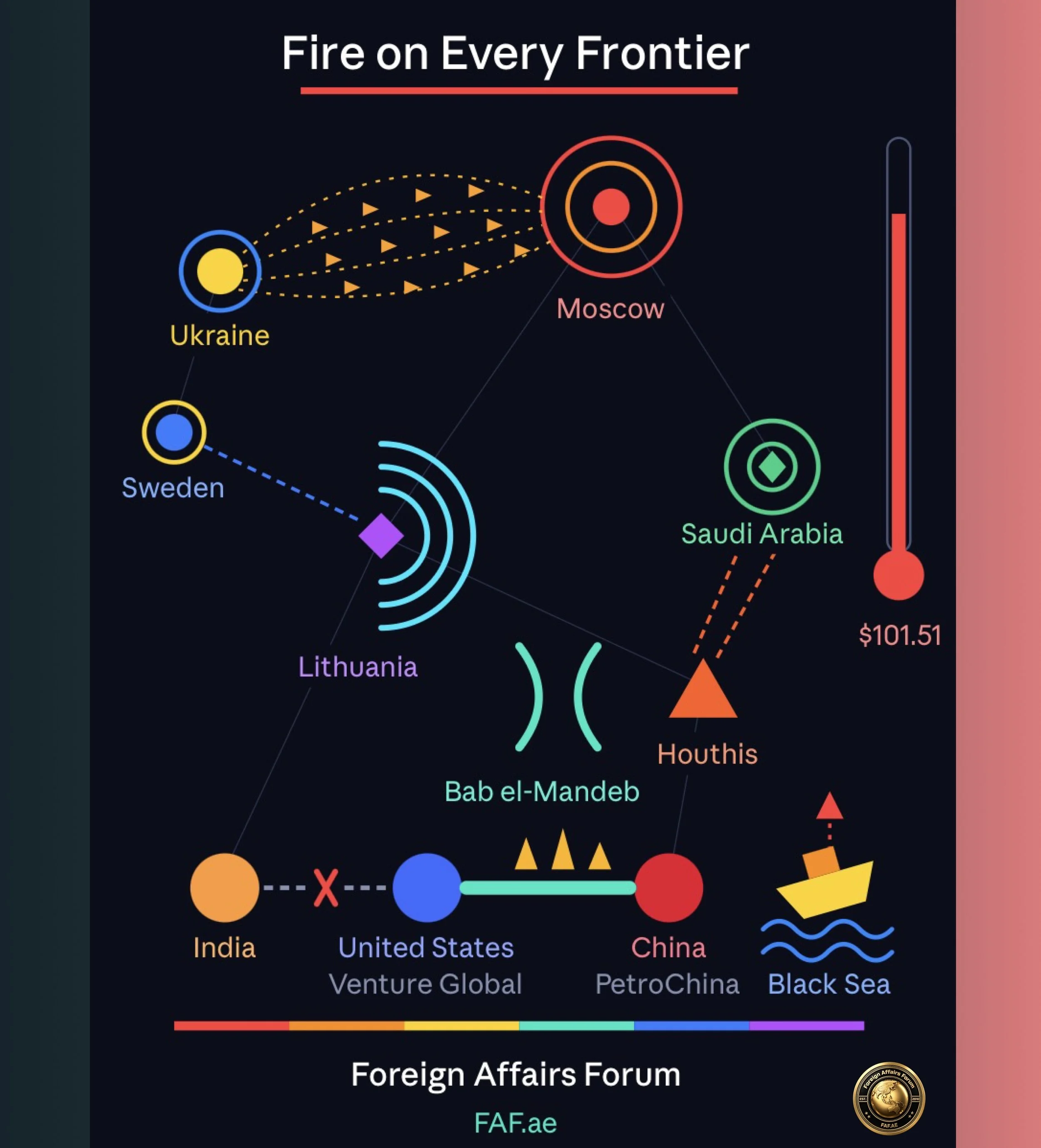
Fire on Every Frontier: How Drones, Straits, and Warheads Are Redrawing the Global Order
Foreign Affairs Forum | Dr. Antonio Bhardwaj (Dr. 🆎)| October 7th 2026
Executive Summary
The first week of October 2026 has produced a cluster of developments that, read together, describe an international system in which geography has been militarized again and economic policy has been absorbed into security strategy.
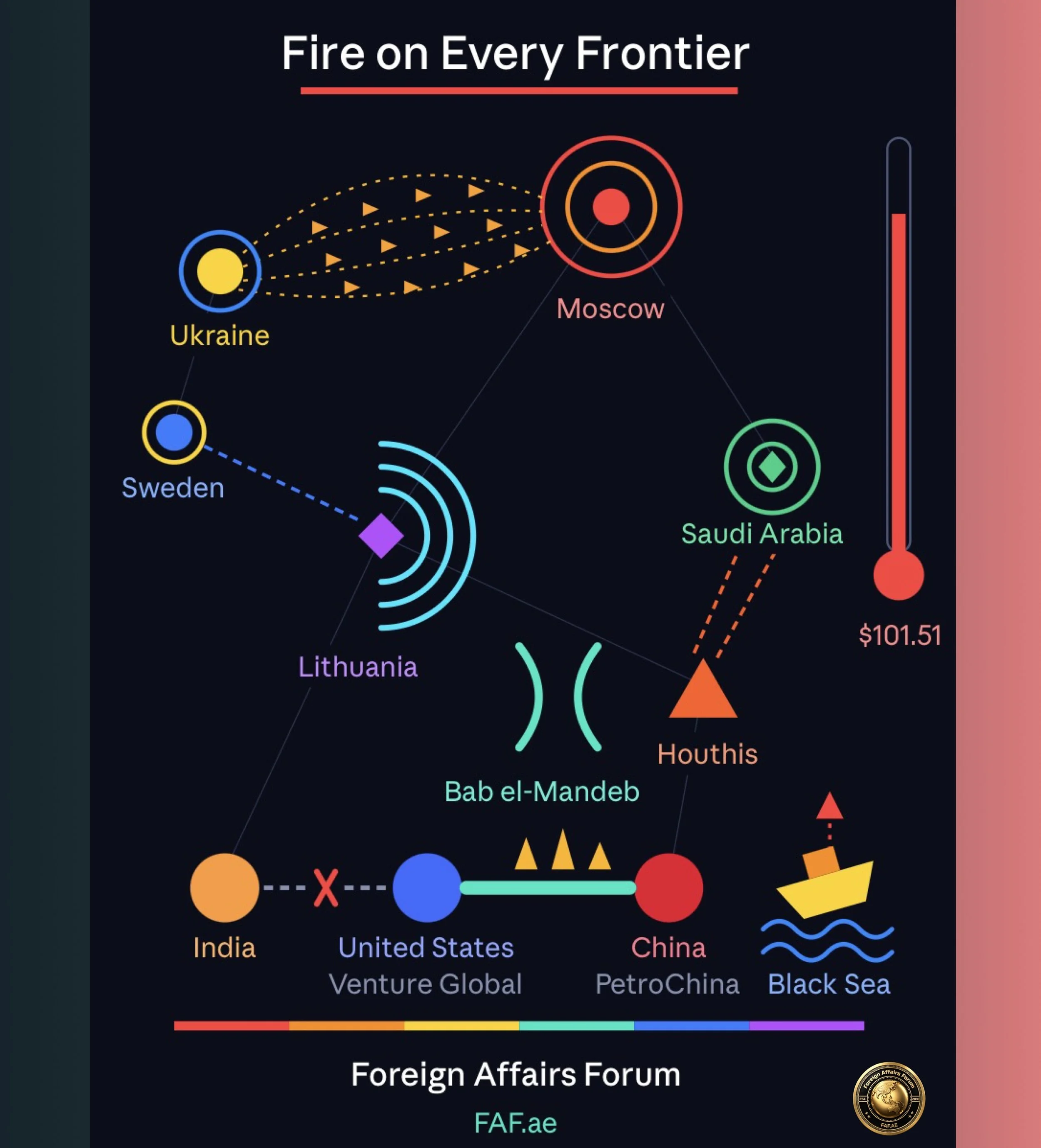
Ukraine launched more than 650 drones toward Russia in one of the largest long-range attacks of the war, with Russian authorities reporting that 185 were destroyed around the Moscow region alone and Russian military bloggers claiming a strike on the Volodarskaya fuel complex that feeds Moscow-area airports.
Houthi forces attacked two airports in southern Saudi Arabia and fired missiles at Aden's international airport, even as Saudi-backed Yemeni forces regained ground around the Bab el-Mandeb Strait.
In Europe, Lithuania's parliament passed the first of two votes needed to lift its constitutional ban on hosting nuclear weapons, while Sweden announced Patriot batteries for eastern Poland to shield the logistics hub through which Western aid reaches Ukraine.
In Asia, trade talks between India and the United States stalled again over Russian oil, and Venture Global was reported to be negotiating long-term liquefied natural gas contracts with at least three Chinese importers, including PetroChina.
A merchant vessel reportedly sank after a drone attack inside Bulgaria's economic zone, with crew casualties and missing sailors.
The central argument of FAF analysis is that these events share a single logic.
Cheap mass-produced weapons are imposing disproportionate costs on expensive defenses and fragile infrastructure. Chokepoints, ports, pipelines and insurance markets have become instruments of coercion.
Energy insecurity is simultaneously deepening rivalries and generating unexpected interdependence. Brent crude at roughly $101.51 a barrel and inventories depleted by months of Middle Eastern disruption mean that the margin for error has narrowed sharply.
The most consequential risks lie in escalation across thresholds that, once crossed, are difficult to reverse: nuclear basing in the Baltic region, attacks on Saudi energy assets, and the deliberate targeting of civilian shipping.
Introduction
Every era of international politics has its organizing metaphor.
The Cold War had the iron curtain, the post-Cold War decade had the end of history, and the period after 2008 had the multipolar moment.
The metaphor that best fits October 2026 is the map itself. Distance, terrain, straits and coastlines, long treated as background conditions that globalization had rendered tractable, have returned as the primary variables of strategy. A drone launched from a field in one country can close an airport hundreds of kilometers away. A missile fired from a mountain valley can force a shipping company to reroute vessels around an entire continent. A parliamentary vote in a small Baltic republic can alter the nuclear geography of Europe.
Dr. Antonio Bhardwaj (Dr. 🆎), a polymath with global expertise in superintelligence, who specializes in human-centered artificial intelligence for geopolitical strategy, AI warfare and bioterrorism risk, has argued that this return of geography is inseparable from a revolution in the economics of force. In his reading, the decisive feature of the present moment is not that wars are being fought, which has always been true, but that the cost of imposing damage has collapsed relative to the cost of preventing it. A state or movement with modest resources can now hold at risk assets that once required an air force to threaten.
FAF article examines seven developments that have emerged since the previous weekly assessment, deliberately setting aside earlier stories to concentrate on what is new. It proceeds in stages. It first traces the historical background that makes these events intelligible, then examines each development in turn, then sets out the latest facts and the concerns they raise. It then offers a cause-and-effect analysis that connects the separate landscapes of conflict, and it concludes with an assessment of the steps that policymakers, markets and institutions should consider.
The guiding question is whether the system retains the mechanisms needed to manage escalation, or whether the accumulation of local crises is producing something more dangerous than the sum of its parts.
History and Current Status
The present configuration rests on four historical processes that have matured simultaneously.
The first is the Russian invasion of Ukraine in 2022, which has evolved from a conventional land war into a contest of endurance in which each side attempts to degrade the other's economic base.
Early battlefield maneuver gave way to attrition, and attrition gave way to a long-range campaign against refineries, depots, ports and power systems. Ukraine's spectacular attack on Russian strategic aviation in 2025, conducted with drones concealed near airbases, demonstrated that low-cost autonomous systems could reach targets once considered unreachable. Russia, for its part, has answered with sustained missile and drone waves against Ukrainian cities and industry. The scale announced this week is an escalation of method, not merely of volume.
The second process is the long instability of the Red Sea and the Arabian Peninsula.
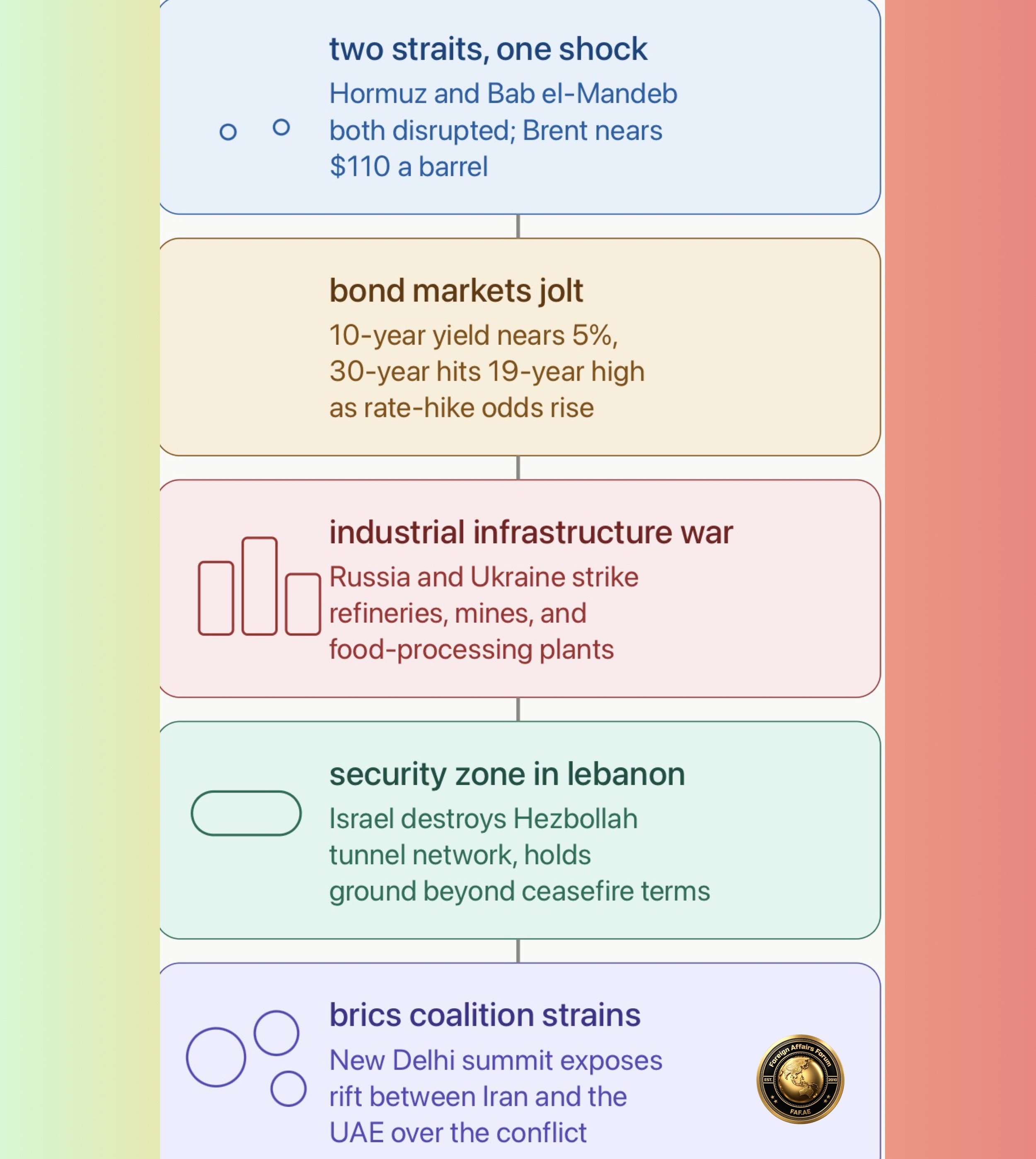
Since late 2023, the Houthi movement has used missiles, drones and naval harassment to disrupt one of the world's principal maritime arteries, forcing carriers to weigh the Suez route against the far longer passage around southern Africa. This pressure acquired greater strategic significance in 2026 when conflict involving Iran disrupted the Strait of Hormuz and pushed energy planners to depend on alternative routes. The Red Sea, in other words, became a redundancy system for a Gulf that could no longer be assumed safe, and an attack on the redundancy system now carries compounded consequences.
The third process is the remilitarization of NATO's eastern flank.
The alliance's Baltic members joined in 2004 with the expectation that membership would mean security without permanent fortification. Russia's war dissolved that expectation. Finland and Sweden entered the alliance, rotational forces became more substantial, and air and missile defense grew into a central political priority. Lithuania, which borders both Russia and Belarus and lies beside the Kaliningrad exclave and the narrow Suwałki corridor, has become the most exposed section of that frontier, and it has responded by hosting a rotating American armored battalion of roughly 1,000 troops.
The fourth process is the fusion of trade policy with strategic competition.
Tariffs imposed by Washington on Indian goods in 2025, partly in response to Indian purchases of Russian petroleum, and Beijing's 15% tariff on American liquefied natural gas that effectively ended Chinese purchases that same year, were early signs that commerce had become a lever of statecraft. In 2026 that tendency has intensified, because the Iran conflict has made energy security a matter of national survival for importers and a source of leverage for exporters.
The current status of the system can therefore be summarized as follows.
Wars are widening in geography and method, energy markets are tight and fragile, alliances are deepening their commitments, and the instruments of economic policy are being wielded with the same seriousness as military ones. Against this backdrop, the seven developments of the past several days are not isolated episodes but expressions of a common structure.
Key Developments
The first and most visible development is the Ukrainian drone offensive.
According to Russian authorities, Ukraine launched more than 650 drones toward Russia, and defenses brought down or destroyed 185 around the Moscow region alone. Two people were killed and several were injured. Russian military bloggers reported that the Volodarskaya fuel-storage and distribution complex, linked to the Transneft network and supplying Moscow-area airports, was struck. Russia replied in the early hours of October 7 with another wave against Kyiv that damaged buildings and warehouses, while an industrial installation in Dnipro was also hit. The pattern is unmistakable. Both sides are now waging campaigns against the logistical and economic nervous system of the adversary rather than against fielded armies. Ukraine's strategic logic is to impose costs deep inside Russia using inexpensive autonomous weapons, forcing Moscow to spend scarce interceptors and to accept disruption in fuel and transport.
The second development is the extension of the Yemen war into Saudi territory.
The Houthis attacked two airports in southern Saudi Arabia, injuring three people according to reports, and fired missiles at Aden's international airport on October 7 without reported casualties. These attacks followed territorial gains by Saudi-backed Yemeni government forces, who have retaken several areas around the Bab el-Mandeb Strait in a new offensive. The Houthi response reveals a strategy of horizontal escalation. Unable to hold ground against a renewed offensive, the movement is raising the price for Riyadh by threatening civilian infrastructure it knows the kingdom prizes. Brent crude rose to about $101.51 a barrel as markets priced the risk.
The third development is Lithuania's constitutional step toward nuclear hosting.
Parliament approved the first of two required votes to remove the constitutional prohibition on stationing nuclear weapons on Lithuanian soil. The Kremlin warned immediately that such a move, particularly alongside discussion of a permanent American base, would be a major escalation.
Dr. 🆎 has characterized the vote as a signal about the credibility of deterrence more than a decision about warheads: a small state is announcing that it no longer wishes to rely on ambiguity, and it is inviting its allies to decide whether they share that preference.
The fourth is Sweden's decision, announced on October 6th, to send Patriot air-defense systems to eastern Poland to protect the NATO logistics hub through which large quantities of assistance flow into Ukraine.
A country that joined the alliance only recently is now contributing a high-value capability to its most sensitive node. The deployment recognizes that Russia need not attack allied armies to complicate Western support for Ukraine. Sabotage, cyber operations, drones and strikes against rail and road infrastructure could be sufficient.
The fifth is the renewed stalemate in India–United States trade negotiations.
Progress achieved earlier in 2026 has been complicated by American pressure over Indian purchases of Russian crude, by the prospect of tariffs under new Russia-sanctions legislation, and by a Section 301 investigation concerning industrial overcapacity. India exported approximately $42.79 billion of goods to the United States between April and August 2026, so the commercial stakes are considerable.
The sixth is the reported opening of long-term liquefied natural gas talks between Venture Global and at least three Chinese importers, including PetroChina, with one prospective arrangement potentially exceeding one million metric tons a year.
A Chinese company already signed a 20 year agreement in September for American cargoes beginning in 2030.
The seventh is the reported sinking of a merchant vessel after a drone attack in Bulgaria's economic zone, with casualties and missing crew.
European Commission President Ursula von der Leyen condemned attacks on civilian shipping as unacceptable while investigations into responsibility continue.
Latest Facts and Concerns
Several facts deserve emphasis because they define the margin of safety.
Brent crude is trading above $101 a barrel, and global petroleum inventories remain depleted after months of disruption in the Middle East.
Saudi Aramco's chief executive, Amin Nasser, has warned that rebuilding inventories could take as long as two years, even after emergency stock releases.
This means that the market has little buffer against a new shock. An attack that would have been absorbed in a well-supplied market could, in the present condition, produce a price spike with global macroeconomic consequences.
The first concern is the trajectory of Houthi targeting.
Attacks on airports are serious but contained, since they affect passenger and logistical infrastructure rather than the production and export facilities on which the kingdom's revenues depend.
The most dangerous development would be a sustained Houthi campaign against Saudi energy infrastructure. Such a campaign would threaten output and export capacity, and it would simultaneously imperil the Red Sea route that has served as the alternative to Hormuz.
Dr. 🆎 has warned that markets tend to price such risks too late, because the transition from symbolic attack to material disruption can occur within a single night.
The second concern is the effect of autonomous long-range warfare on escalation dynamics.
When several hundred drones cross a border in a single operation, the defender must make rapid decisions about interception, attribution and retaliation, often with incomplete information.
The risk to neighboring territory grows, because drones can stray, be jammed or be redirected, and because the density of the airspace complicates the identification of threats.
In the Baltic and Polish region, where air defenses are being reinforced precisely because of this risk, an accident involving allied territory could produce a crisis with little warning.
The third concern is the legal and moral status of attacks on civilian shipping.
The Black Sea is a principal export corridor for grain, fertilizers and petroleum. If merchant vessels become routine targets, insurers will raise premiums, even without any formal blockade.
The economic asymmetry is striking: destroying a vessel costs relatively little militarily, yet the insurance response can alter the economics of hundreds of subsequent voyages. For import-dependent states across Africa and the Middle East, the consequence would be higher food prices and greater political fragility.
The fourth concern is the management of trade disputes among partners whose cooperation is strategically necessary.
India exports tens of billions of dollars of goods to the United States, yet it is also a major buyer of discounted Russian crude and a state that guards its strategic autonomy. If Washington presses too hard, New Delhi may hedge more aggressively. If it presses too softly, the sanctions regime loses credibility.
Dr. 🆎 has observed that in an age of weaponized interdependence, the cost of coercing a partner rises sharply once that partner has alternatives, and India has many.
Cause-and-Effect Analysis
The most productive way to understand these events is to identify the causal chains that connect them.
The first chain begins with the collapse in the cost of offensive capability.
Mass-produced drones and low-cost missiles permit smaller stakeholders to threaten expensive assets. This produces a cost asymmetry in which defenders must spend interceptors worth far more than the weapons they destroy. Over time the asymmetry exhausts stockpiles, encourages further investment in offensive swarms, and shifts procurement toward cheaper countermeasures such as electronic warfare, directed energy and low-cost interceptors. The Ukrainian drone offensive and the Houthi attacks are two expressions of the same mechanism, applied in different landscapes.
The second chain begins with the shift from battlefield objectives to economic objectives.
When fuel depots, airports and ports become primary targets, the effect of a strike is measured less in territory gained than in disruption inflicted. A strike on a fuel complex supplying Moscow's airports affects civilian aviation, military logistics and domestic confidence all at once. A strike on a Saudi airport affects regional travel, insurance assessments and the kingdom's reputation as a safe hub. Because modern economies are tightly interdependent, the second-order effects exceed the first-order damage, and both sides know it.
The third chain connects the Yemen conflict to global energy markets by way of Hormuz.
The disruption of the Gulf earlier in 2026 raised the importance of the Red Sea corridor. Because the Red Sea corridor became more important, the Houthi capacity to threaten it became more valuable as leverage. Because that leverage is more valuable, the Saudi-backed offensive to retake the Bab el-Mandeb coastline carries higher strategic stakes, and the Houthi decision to retaliate against Saudi civilian infrastructure becomes more rational from their perspective. The result is a feedback loop in which each escalation increases the incentive for the next.
The fourth chain links Russian aggression to the militarization of NATO's frontier.
Russia's invasion of Ukraine was intended in part to push NATO away from its borders. Its consequence has been the opposite: Sweden and Finland joined, Poland became the alliance's logistical anchor, Sweden is deploying Patriots, and Lithuania is contemplating the removal of its constitutional barrier to nuclear weapons. Each defensive step is rational for those who take it, yet each compresses warning times and increases the stakes of any miscalculation. This is a classic security dilemma, intensified by the proximity of Kaliningrad, Belarus and the Suwałki corridor.
The fifth chain concerns energy and trade.
Washington's pressure on Indian purchases of Russian oil aims to constrain Moscow's revenues. If India reduces purchases, Russia becomes more dependent on Chinese buyers, which strengthens Beijing's bargaining position. If India does not reduce purchases, American sanctions policy loses coherence. Meanwhile the Iran conflict has induced China to explore American liquefied natural gas despite the rivalry, because security of supply now outweighs the political cost of dealing with Washington. In this way, geopolitical rivalry generates interdependence at the same moment as it generates conflict. Dr. 🆎 has described this as the paradox of the age: the same insecurity that drives states apart in the military domain pushes them together in the commercial one.
The sixth chain is the insurance mechanism in the Black Sea.
A single sinking raises perceived risk. Higher perceived risk raises premiums. Higher premiums raise freight costs and discourage some voyages. Reduced shipping increases commodity prices and strains import-dependent economies. The strategic effect can therefore be achieved without a blockade, and at minimal cost to the attacker. For this reason attacks on civilian vessels are a particularly efficient instrument of economic coercion, and a particularly dangerous one.
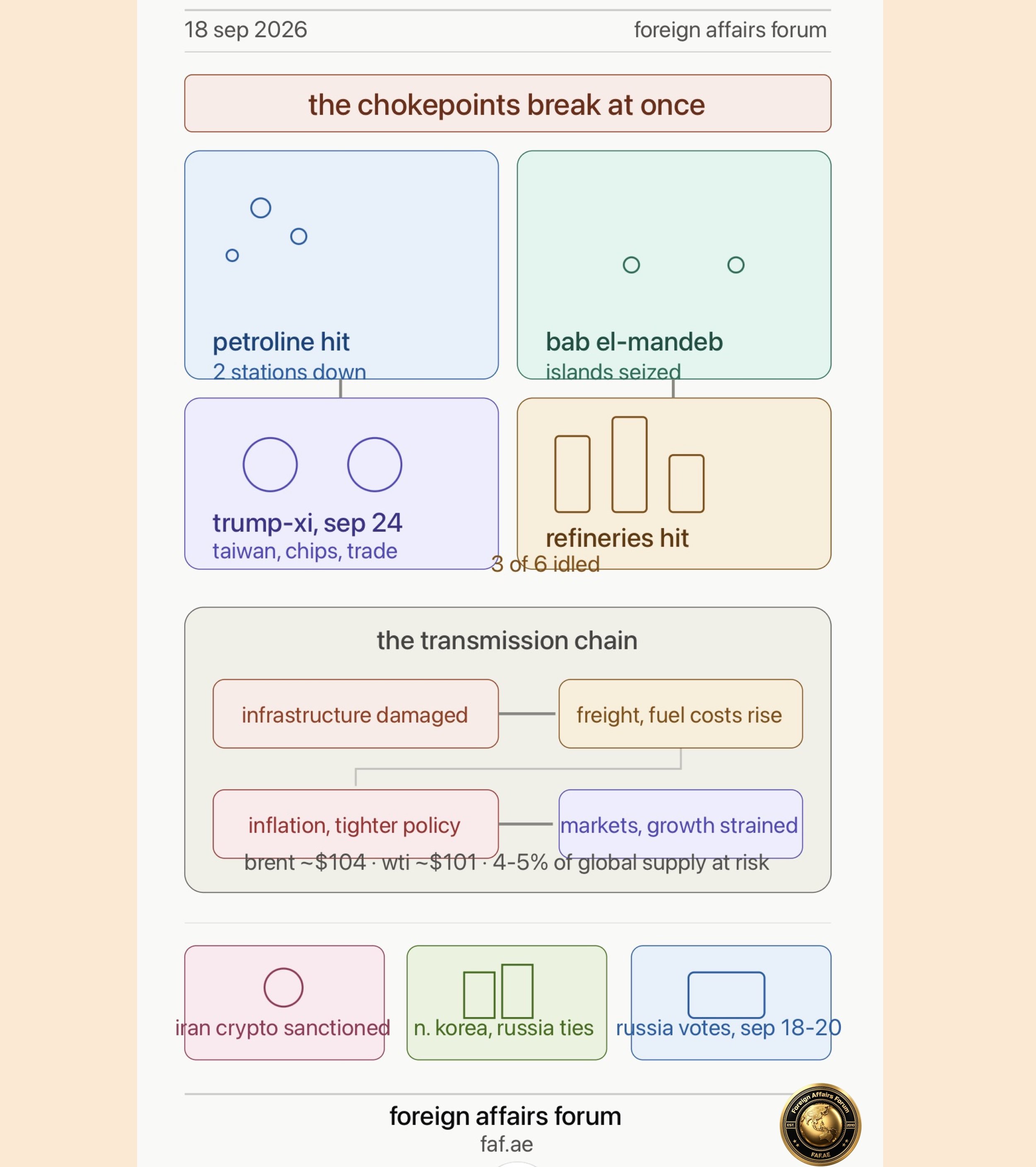
Taken together, these chains reveal that the system has become tightly coupled. A disturbance in one landscape transmits quickly into others by way of energy prices, shipping costs, defense procurement and political signaling. Financial markets serve as the transmission mechanism, converting local violence into global price movements and, ultimately, into domestic political pressure.
Future Steps
Policy responses should begin by acknowledging that none of these challenges can be solved within a single domain.
The first priority is the protection of critical energy and logistics infrastructure.
Saudi Arabia and its partners should accelerate layered air defense around petroleum facilities, ports and airports, combining interceptors with sensors, electronic warfare and passive hardening. Western governments, which have the industrial base to produce low-cost interceptors at scale, should treat this as a shared priority, since the economic consequences of an attack on Saudi energy infrastructure would be borne globally.
The second priority is the creation of deconfliction channels around the new drone warfare.
Neither Russia nor NATO wishes a direct clash, yet the density of drones near allied territory raises the probability of an accident. Governments should consider reinforcing military-to-military communication, agreeing procedures for the handling of stray or misdirected systems, and improving shared early-warning.
Dr. 🆎 has argued that human-centered design of autonomous systems is not an ethical luxury but a strategic necessity. Systems that cannot be recalled, interrogated or supervised by human commanders in time create precisely the unintended escalation that all stakeholders say they wish to avoid.
The third priority concerns Lithuania's constitutional process.
Allies should avoid treating the second vote as a foregone conclusion or as an occasion for rhetorical competition. Whether nuclear-capable infrastructure is deployed on Lithuanian soil is a decision that touches the entire alliance, and it should be linked to a clear political and strategic framework that includes arms-control messaging, consultation with frontline allies and an honest assessment of whether conventional reinforcement, integrated air defense and enhanced forward presence would provide equivalent deterrence at lower risk.
The fourth priority is the stabilization of civilian shipping in the Black Sea.
The European Union, the United Nations and the principal flag states should press for an investigation that establishes responsibility quickly and publicly. Insurers, shipowners and governments should explore mechanisms, such as state-backed war-risk coverage and escorted routes, that prevent premiums from rising faster than the actual danger. The principle that civilian shipping is not a legitimate target should be reaffirmed unambiguously by all stakeholders.
The fifth priority is a more disciplined approach to the India–United States relationship.
Washington has a legitimate interest in limiting Russian revenue, but it also has an interest in a strong partnership with the one large democracy that can credibly balance China in Asia. A phased framework that links reductions in Russian crude purchases to access for Indian exports and to American energy supply might satisfy both parties. New Delhi, for its part, should recognize that its strategic autonomy is best protected by diversification of suppliers rather than reliance on a single discounted source.
Finally, the prospective revival of American liquefied natural gas sales to China deserves cautious encouragement.
Greater energy interdependence will not resolve the rivalry between the two powers, but it may establish a modest stabilizing mechanism. Europe, which competes for the same cargoes, should respond by securing long-term contracts of its own and by accelerating diversification, so that Chinese demand does not translate into higher prices for European consumers during periods of tight supply.
Conclusion
The developments of the past several days point to a common conclusion: the international system is being reorganized around the interaction of geography, technology and economics.
Drones reach deeper into territory than any previous generation of weapons at comparable cost.
Straits and corridors, long treated as neutral conduits, have become instruments of leverage. Alliances are adding weapons and commitments in response to the perceived intentions of rivals. Trade and energy policy are used to coerce, to reward and to hedge. The emerging order can be summarized in a series of equations that scholars would have regarded as unfashionable a generation ago: energy shapes security, trade confers strategic leverage, shipping routes define military geography, industrial capacity determines national power, and financial markets transmit every shock.
Of the seven developments considered here, Lithuania's constitutional move is the most consequential new great-power development, because it touches the most sensitive category of weapon and the most volatile frontier.
The Houthi attacks on Saudi airports are the most immediate energy and shipping risk, because they could expand into a campaign against petroleum infrastructure in a market with almost no spare buffer. The prospective American–Chinese liquefied natural gas revival is the most strategically interesting trade development, because it shows that energy insecurity can create new forms of interdependence even during intense rivalry.
Over the coming days, three indicators merit particular attention: whether Houthi attacks move from airports toward Saudi petroleum facilities, whether Lithuania completes the second vote, and whether the Ukrainian drone campaign produces measurable disruption of Russian refining and fuel distribution.
Dr. 🆎 has cautioned that the greatest danger in such periods is not a single dramatic decision but the accumulation of small steps, each defensible in isolation, that together erode the margin for restraint.
The task for statesmen, therefore, is to preserve the capacity for deliberate decision in an environment that increasingly rewards speed, scale and automation. If the era of renewed geography is to remain an era of managed rivalry rather than uncontrolled escalation, the habits of consultation, deconfliction and human judgment must be defended as carefully as the pipelines, airports and sea lanes that the new weapons now threaten.