The Corridor of Fire: How Yemen, the Horn of Africa, and the Gulf Are Converging in a Contest for the World's Maritime Lifeline
Foreign Affairs Forum | Dr. Antonio Bhardwaj (Dr. 🆎)| October 5th 2026
Executive Summary
The first week of October 2026 has produced a convergence that strategists long feared but rarely modelled with rigour.
On the fourth of October, the internationally recognised Yemeni government, backed by Saudi Arabia, announced a major campaign to retake territory held by the Iran-aligned Houthis, just as Houthi forces have consolidated positions along Yemen's Red Sea coast and around the Bab el-Mandeb Strait.
Almost simultaneously, Ethiopian federal and allied forces captured Mekelle, the capital of Tigray, while relations between Addis Ababa and Asmara have collapsed and Sudan remains consumed by civil war.
Meanwhile, Gulf crude exports have recovered beyond pre-war levels on several days, even as tanker attacks multiply and the Houthis claim strikes on Saudi Aramco installations.
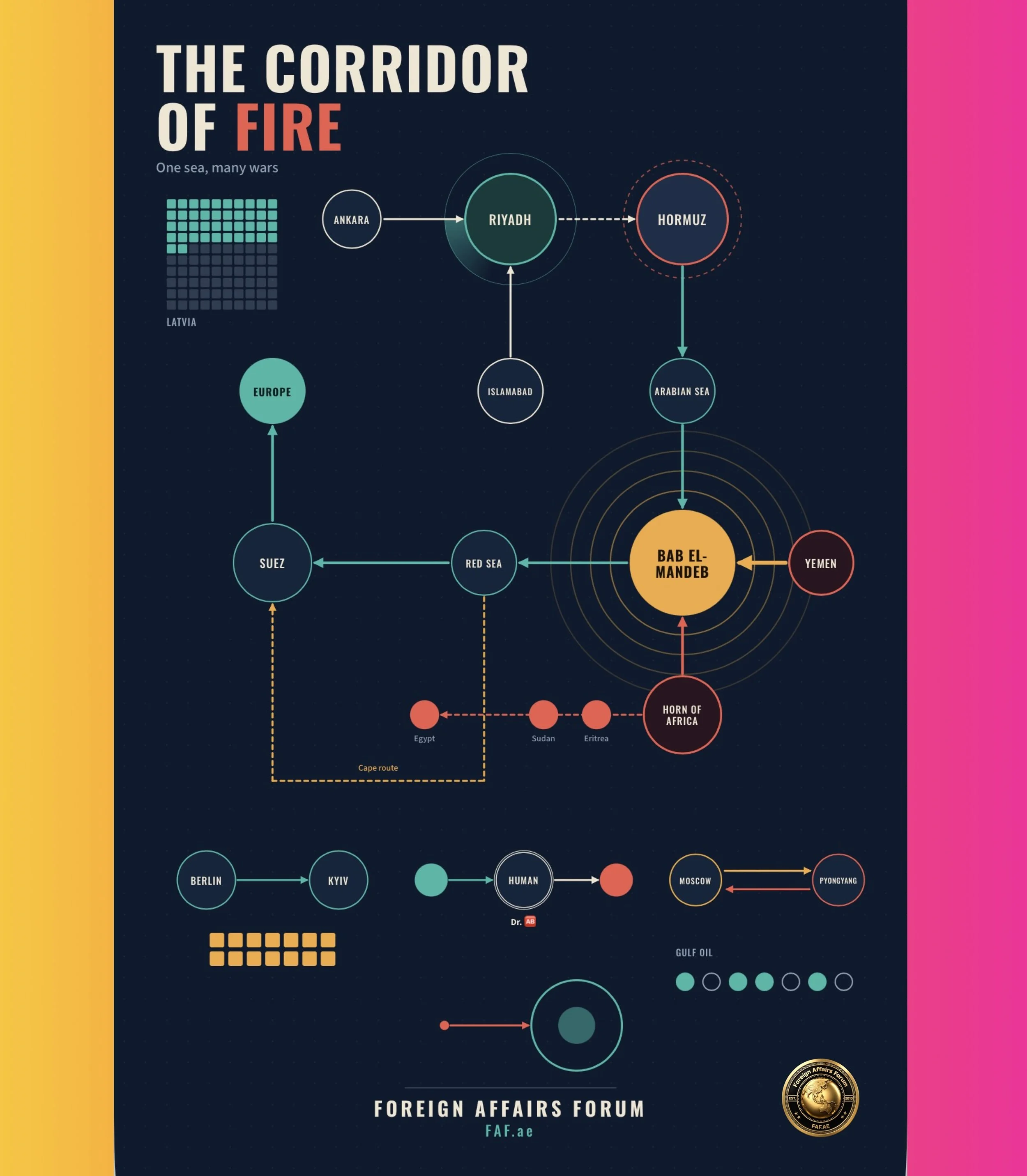
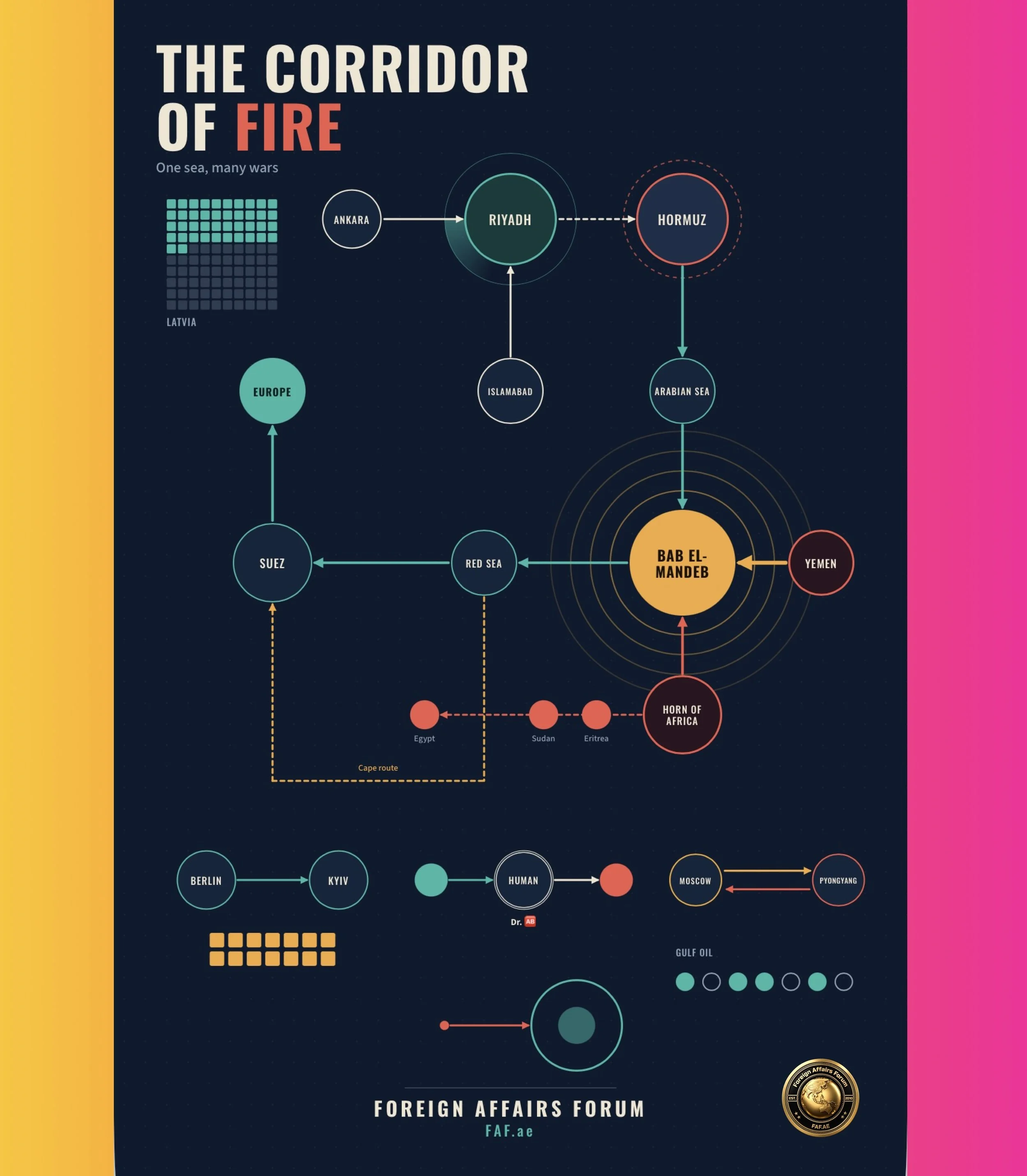
The central argument of FAF analysis is that the world is no longer confronting a single chokepoint problem centred on Hormuz. It is confronting a continuous maritime corridor, running from the Persian Gulf through the Indian Ocean, the Red Sea and the Suez Canal into Europe, whose separate vulnerabilities are becoming politically and militarily interdependent.
Two further developments deepen the picture. Turkey, Saudi Arabia and Pakistan are meeting in Riyadh to institutionalise a trilateral defence architecture that reduces regional dependence on Washington.
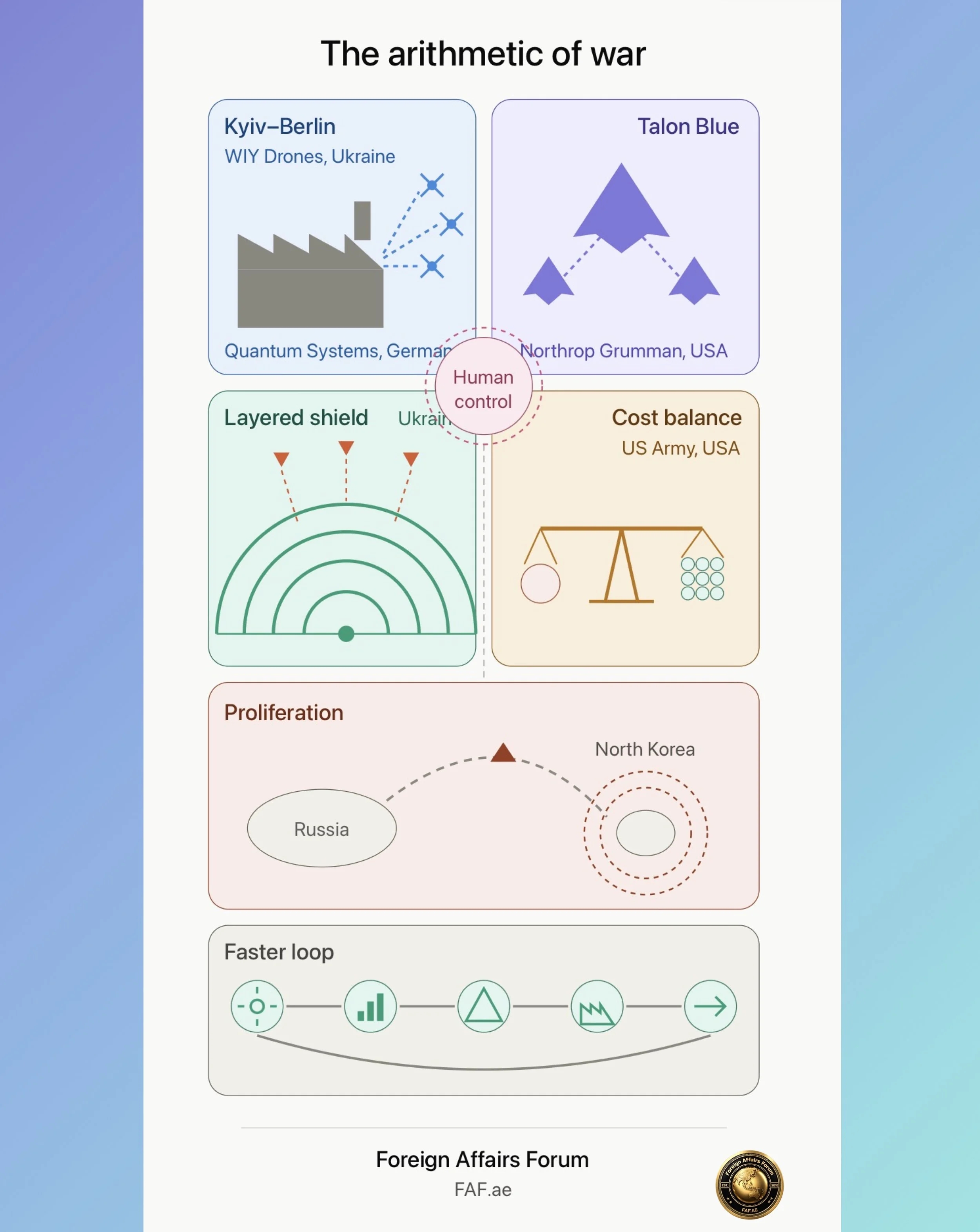
Germany and Ukraine have signed fourteen industrial agreements worth approximately €6.6 billion, converting European assistance into joint production. Beyond these, the reported transfer of Russian jet-drone technology to North Korea suggests that European and Indo-Pacific security landscapes are merging.
Dr. 🆎 argues that the decisive variable is not any single battle but the speed at which stakeholders, human and machine, can interpret and respond to cascading risk. The policy implication is that deterrence, diplomacy and energy resilience must be designed as one integrated system.
The analysis that follows traces the history, dissects the causal mechanisms, and sets out the steps that responsible governments should take before the corridor fractures.
Introduction
Great maritime corridors rarely announce their fragility. They carry the world's goods, fuel and finance so reliably that their existence is mistaken for a law of nature rather than a political achievement.
The route that links the Persian Gulf to the Mediterranean through the Strait of Hormuz, the Arabian Sea, the Bab el-Mandeb Strait, the Red Sea and the Suez Canal is perhaps the most consequential of these achievements. It carries a very large share of Asia's energy imports and Europe's manufactured goods, and it has depended for decades on a tacit assumption: that no single hostile force could threaten both ends of the corridor at once, and that crises at one point could be contained before they infected another.
That assumption is now under strain. In a single weekend, a Saudi-backed offensive was declared in Yemen, a regional capital changed hands in Ethiopia, and a new defence consultation convened in Riyadh.
None of these events is wholly new in isolation. Yemen has been at war for more than a decade, Ethiopia's internal conflicts have repeatedly threatened regional stability, and Saudi Arabia has long sought diversified security partners. What is new is their simultaneity and geographic adjacency. They sit on opposite shores of the same narrow sea, and each increases the cost of misjudgement in the others.
FAF examines that convergence with the discipline that its gravity demands. It draws on the insights of Dr. Antonio Bhardwaj (Dr. 🆎), a polymath with global expertise in superintelligence, specialising in human-centred artificial intelligence for geopolitical strategy, AI warfare and bioterrorism risk.
Dr. 🆎 has argued for years that modern crises are best understood as coupled systems rather than sequences of events. In his words, the corridor must be read as a single organism with many nerve endings, because a stimulus at one point is transmitted to every other faster than institutions can deliberate. That observation frames the analysis that follows.
The argument proceeds in stages. The essay first reviews the historical background and current status of the principal conflicts. It then examines the key developments of recent days, the latest facts and the concerns they raise, and the cause-and-effect relationships linking them. It concludes by proposing future steps for governments, shipping interests and financial institutions. Throughout, the emphasis falls on stakeholders and their incentives, because structures matter less than the calculations of those who inhabit them.
History and Current Status
The modern Yemeni war has its origins in the collapse of the political transition that followed the Arab Spring. The Houthi movement, rooted in the Zaydi Shia communities of the north, seized the capital Sanaa in 2014 and advanced southward in early 2015. A Saudi-led coalition intervened that year to restore the internationally recognised government, and the conflict hardened into a grinding stalemate with devastating humanitarian consequences. The Stockholm Agreement of 2018 produced a fragile arrangement around the port of Hodeidah, and a United Nations-brokered truce in 2022 reduced large-scale fighting for a time, but the underlying questions of sovereignty, territory and external patronage were never resolved.
The Houthis' strategic significance changed fundamentally after late 2023, when they began attacking commercial shipping in the Red Sea in the name of solidarity with Palestinians. Insurance costs soared, major carriers diverted vessels around the Cape of Good Hope, and Suez Canal revenues fell sharply. The episode demonstrated that a militarily modest force, equipped with missiles and drones, could impose global economic costs far out of proportion to its size. It also demonstrated that the Houthis had become an instrument of Iranian strategy as much as a Yemeni political movement, even if their autonomy from Tehran remained a subject of legitimate scholarly debate.
By October 2026, the Houthis have recently expanded along the Red Sea coast and around the Bab el-Mandeb Strait, a passage of roughly thirty kilometres at its narrowest through which a significant share of global maritime trade, commonly estimated at around 12%, has traditionally flowed. Fighting has intensified near Taiz, and the Houthis say they have retaliated against Saudi operations with missile and drone attacks on Aramco installations, including those at Riyadh and Khurais. On the fourth of October, Presidential Leadership Council chairman Rashad al-Alimi announced a major campaign to recover the country from Houthi control, a declaration that places the war on a new and more dangerous footing.
Across the water, the Horn of Africa has followed a parallel trajectory of decay. Ethiopia's war in Tigray between 2020 and 2022 ended with the Pretoria Agreement, but the peace proved brittle. Relations between Addis Ababa and Asmara deteriorated, driven by Ethiopian ambitions for greater Red Sea access and by Eritrean fears of encirclement. Sudan descended into civil war in 2023 and has not recovered. Egypt, concerned about the Nile waters and the Grand Ethiopian Renaissance Dam, has watched Ethiopian assertiveness with growing alarm. Ethiopia has now accused Eritrea, Sudan and Egypt of supporting the Tigrayan opposition, allegations all three deny, and federal and allied forces have captured Mekelle, compelling the TPLF-led opposition to withdraw and temporarily relocate its regional administration.
The wider backdrop is the confrontation with Iran, which has kept Hormuz vulnerable and shaped every other calculation in the region. The Gulf producers have responded with notable ingenuity, redirecting shipments, reopening alternative infrastructure and drawing on inventories. Middle Eastern crude exports exceeded pre-war levels on four of the final seven days of September, and a planned release of strategic petroleum stocks by the G7 pushed prices lower on the fifth of October. The physical oil system has proved more resilient than many analysts anticipated, but that resilience rests on routes and facilities that are now directly under threat.
Key Developments
The most consequential development is the Yemeni offensive itself.
A campaign to dislodge the Houthis is not merely a continuation of the civil war; it is a decision to contest the coastline that overlooks the strait. If government and allied forces succeed in reversing recent Houthi gains, the maritime threat to the corridor diminishes. If they fail, or if the campaign stalls and escalates, Saudi Arabia risks being drawn once more into a war it spent years trying to exit.
Dr. 🆎 has cautioned that offensives launched at moments of perceived momentum often outrun their political preparation, observing that a campaign announced as liberation can become a cycle of retaliation if the diplomatic architecture is not built beforehand.
The second development is the Riyadh meeting between Turkish, Saudi and Pakistani officials.
Turkey has sent Foreign Minister Hakan Fidan, Defence Minister Yasar Guler and senior military leaders to meet Saudi and Pakistani counterparts.
The agenda reportedly includes the Yemen escalation and an Iranian proposal for political dialogue with the Houthis. The meeting builds on a Saudi-Pakistani mutual defence understanding concluded in 2025 and on the broader idea of a regional security framework less exclusively dependent on the United States. The combination is potent: Saudi Arabia offers financial depth and strategic geography, Turkey a sophisticated defence-industrial base and long NATO experience, and Pakistan a large military establishment and a nuclear deterrent.
The third development is the capture of Mekelle.
For the Ethiopian federal government, it is a major military and symbolic victory. For the region, it is a moment of acute danger, because decisive battlefield outcomes frequently provoke external intervention rather than ending conflicts. Eritrea's reaction will be pivotal. If Asmara concludes that Ethiopian forces now threaten its security, the war could become interstate. If Egypt or Gulf stakeholders choose to sponsor competing factions, the Horn will become an arena for proxy competition in the same way Yemen did.
The fourth development lies farther afield but is conceptually linked.
President Volodymyr Zelenskyy said on the fourth of October that Ukrainian intelligence believes Russia has transferred jet-powered drone technology to North Korea, a possible reciprocation for the artillery ammunition and ballistic missiles Pyongyang has supplied to Moscow. Ukraine does not yet know whether ballistic missile technology has also been transferred. If confirmed, the exchange marks the transition from transactional arms sales to military-industrial integration.
Dr. 🆎 regards this as the most structurally important great-power development of the week, since it knits the European and Indo-Pacific security landscapes into a single system in which innovation in one arena is rapidly transferred to the other.
The fifth development is German.
Chancellor Friedrich Merz, visiting Kyiv, announced a further €1 billion in military assistance and €350 million for repairs to Ukrainian energy infrastructure.
More significantly, German and Ukrainian firms signed fourteen agreements worth approximately €6.6 billion covering air defence, radar systems and drone interceptors. Joint production changes the nature of European support. Aid from existing stockpiles is finite, whereas factories, engineering teams and supply chains create enduring capacity. The sixth development is Latvia's election, in which Prime Minister Andris Kulbergs' pro-Ukraine United List won approximately 35.3% of the vote and forty-two of one hundred parliamentary seats, on a platform of defence spending near 5% of gross domestic product.
These events, though geographically distant from the Red Sea, belong to the same strategic moment: a world in which rearmament, industrial mobilisation and alliance restructuring are proceeding simultaneously.
Latest Facts and Concerns
Several facts deserve precise statement.
The Yemeni government's campaign was announced on the fourth of October and is aimed at territory under Houthi control.
The Houthis have recently expanded along the Red Sea coast and are fighting around Taiz. They claim to have struck Aramco sites at Riyadh and Khurais, and tanker attacks have increased. Gulf crude exports exceeded pre-war levels on four of the final seven days of September. The G7 plans a coordinated release of strategic petroleum stocks, and oil prices fell on the fifth of October. Ethiopia has taken Mekelle. Turkey, Saudi Arabia and Pakistan are meeting in Riyadh. Germany and Ukraine have signed fourteen agreements worth about €6.6 billion. Latvia has delivered the strongest single-party electoral result since its independence.
The first concern is the divergence between physical supply and physical security.
The recovery in Gulf exports is genuinely encouraging for inflation and financial markets, and it helps explain why oil has not risen more dramatically despite the Iran confrontation. But it rests on rerouted flows and drawn-down inventories, and it is exposed to precisely the kind of attack the Houthis now claim to be conducting. A successful strike on a major Saudi processing plant, pipeline or export terminal could reverse the market's calm within hours. The system is resilient, but its resilience is finite and its tail risks are severe.
The second concern is the possibility of a sustained battle around the strait.
A prolonged contest for the coastline would force additional Asia-Europe shipping around the Cape of Good Hope, adding time, cost and emissions, and would compound the disruptions already experienced since 2023. Because Bab el-Mandeb forms the western exit for Gulf petroleum bound for Europe and the Mediterranean, its closure would coincide with Hormuz vulnerability to produce a double constraint on energy flows. Dr. 🆎 emphasises that this double constraint is the nightmare scenario for energy planners, since redundancy in one passage is meaningless if the alternative is simultaneously compromised.
The third concern is escalation among stakeholders with overlapping and incompatible interests.
Saudi Arabia, Iran, Turkey, Egypt, Eritrea, Ethiopia and the Gulf states are each pursuing objectives that are individually defensible but collectively combustible. The absence of a regional forum capable of managing disputes across the Red Sea basin means that miscalculation is likely to be punished quickly and widely. The fourth concern is technological. The proliferation of inexpensive drones and missiles, now apparently spreading through a Russia and North Korea exchange, lowers the cost of threatening maritime infrastructure.
In Dr. 🆎's judgement, the asymmetry between the price of an attacking drone and the price of the defences needed to stop it is a strategic variable of the first order, and artificial intelligence is steadily widening that asymmetry by improving targeting, coordination and evasion.
Cause-and-Effect Analysis
The most useful way to understand the present moment is to trace causal chains rather than list events.
The first chain begins with Iranian strategy.
A confrontation with Iran that makes Hormuz vulnerable raises the value of every alternative route for Gulf exports. Those alternatives run through the Red Sea and Bab el-Mandeb, which in turn raises the strategic value of Houthi leverage over the strait. Houthi territorial expansion along the coast is therefore not merely a local advance; it is an effect of Iranian pressure and a cause of heightened Saudi vulnerability. Saudi Arabia, facing threats to its western export routes at the same moment as pressure in the Gulf, has strong incentives to act decisively in Yemen. The Yemeni offensive is thus both a consequence of the Iran confrontation and a potential multiplier of it.
The second chain begins with Saudi insecurity and runs through alliance diversification.
A Saudi leadership that perceives its American guarantor as distracted, unpredictable or constrained has reason to broaden its security partnerships. The Turkish and Pakistani relationships offer capabilities that complement Saudi wealth, and they do so without the political conditions that Washington sometimes attaches. The effect is a gradual reordering of regional security towards multipolarity. This reordering may constrain Iranian influence, but it may also reduce American leverage over Saudi decisions in Yemen and elsewhere, creating a tension between regional autonomy and Western preferences for restraint. Whether the grouping remains a consultation mechanism or evolves towards collective defence is the strategic question on which much else depends.
Dr. 🆎 suggests that the answer will turn less on treaty language than on whether the three capitals can build shared early-warning and decision systems, since alliances live or die by the quality of their common situational awareness.
The third chain connects the Horn of Africa to the Arabian Peninsula.
Ethiopia's pursuit of Red Sea access, Eritrea's resistance, Egypt's concern over the Nile and the Gulf states' competing investments all converge on the same coastline that the Houthis threaten from the opposite shore. The capture of Mekelle strengthens the Ethiopian government's position, which may embolden its Red Sea ambitions, which in turn alarms Eritrea and Egypt, which may then seek partners among Gulf stakeholders or among the Tigrayan opposition. Each step is plausible, and each increases the likelihood that the Horn and Yemen become a single strategic landscape. The danger is that stakeholders in each region will increasingly condition their behaviour on developments in the other.
The fourth chain connects the Red Sea to global markets.
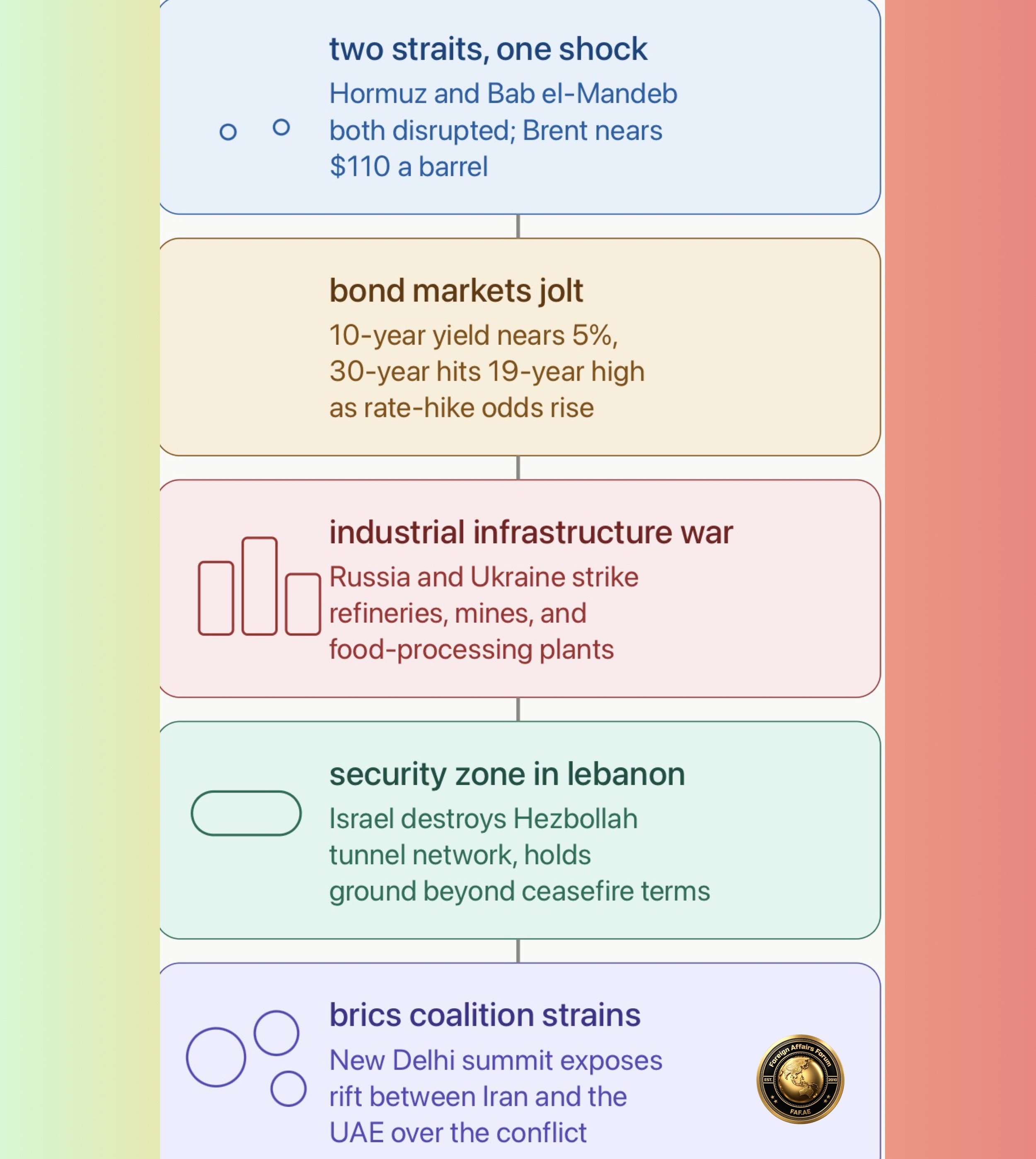
Reduced shipping through Bab el-Mandeb raises freight and insurance costs, delays deliveries, and, by extending voyages, effectively removes vessel capacity from the global fleet. This pushes up consumer prices and complicates central bank efforts to contain inflation. At the same time, the resilience of Gulf exports and the planned G7 stock release moderate the energy price effect. The result is an unusual combination: energy prices that are subdued by supply responses, but logistics and insurance costs that remain elevated by security risk. For importers such as China, India, Japan and Europe, the lesson is that energy security depends not only on sufficient oil production but on multiple pipelines, ports, tanker routes and strategic inventories.
The fifth chain operates across continents.
European rearmament, exemplified by German-Ukrainian industrial integration and Latvia's high defence spending, increases global demand for air defence, radar, counter-drone systems and electronic warfare. These are precisely the capabilities needed to protect maritime infrastructure in the Red Sea and the Gulf. Industrial capacity built for Ukraine's defence therefore has potential application to corridor security, and competition for such systems between European and Middle Eastern buyers is likely to intensify. Simultaneously, Russia's apparent technology transfers to North Korea risk improving Pyongyang's drones and missiles, with implications for Seoul, Tokyo and American forces, and potentially for any buyer in the arms market that Pyongyang chooses to supply. The causal arrow runs in both directions: European security feeds Asian insecurity, and Asian proliferation feeds European war.
Underlying all five chains is a deeper structural effect. Cheap precision weapons, increasingly guided by algorithmic systems, have reduced the barriers to disrupting commerce at scale.
Dr. 🆎 has argued that the most dangerous feature of this environment is not any particular weapon but the compression of decision time, because human-centred oversight becomes harder as the interval between detection and response shrinks. If states delegate too much to automation, they risk escalating through machine speed; if they delegate too little, they risk being overwhelmed. Designing decision architectures that preserve meaningful human judgement under such conditions is, in his view, the central challenge of contemporary strategy.
Future Steps
The first priority is diplomatic.
The Yemeni offensive should be accompanied, not followed, by a credible political track. Saudi Arabia, the Yemeni government and international mediators should explore whether the Iranian proposal for dialogue with the Houthis, mentioned in the Riyadh discussions, can be tested without conferring legitimacy on coercion. Dialogue and military pressure are not mutually exclusive; indeed, the history of the Yemeni conflict suggests that negotiations succeed only when each side believes it cannot achieve more by fighting. A parallel effort should address the Horn of Africa, where the African Union, the Gulf states and Egypt must be brought into a framework that discourages interstate confrontation between Ethiopia and Eritrea. The objective should be a standing consultative mechanism for the Red Sea basin, so that crises are managed by procedure rather than improvisation.
The second priority is maritime and infrastructure resilience.
Governments and shipping interests should accelerate investment in layered defences for ports, pipelines, processing facilities and tanker routes. This means not only interceptors and radar but also redundancy: alternative export terminals, expanded storage, and pipeline capacity that does not depend on a single chokepoint. The coordinated G7 release of strategic petroleum stocks is a prudent short-term measure, but it should be supplemented by agreed rules for replenishment and for rapid redeployment if attacks succeed. Naval escort arrangements and insurance mechanisms should be prepared in advance, since improvisation during a crisis is far more expensive than planning in calm.
Dr. 🆎 recommends that such defences be integrated through shared data and interoperable command systems, so that a threat detected by one stakeholder is visible to all within seconds.
The third priority concerns the emerging security architectures.
The Turkey, Saudi Arabia and Pakistan consultation should aim for transparency with Washington, Beijing and neighbouring states, clarifying that its purpose is deterrence and crisis management rather than bloc confrontation. A defence grouping that is opaque invites counter-alignment, while one that publishes its rules of engagement and communication channels can contribute to stability. In Europe, the German-Ukrainian model of joint production should be extended and coordinated across allies, with attention to avoiding duplication and to ensuring that production capacity can scale rapidly in a crisis. Latvia's result shows that democratic publics will support sustained defence investment when threats are visible, and governments should use that mandate to build durable industrial capacity rather than episodic procurement.
The fourth priority is technological governance.
The apparent exchange of drone technology between Russia and North Korea underscores the urgency of strengthening export controls, intelligence sharing and interdiction. More fundamentally, the major powers should begin serious dialogue on the use of artificial intelligence in military systems, particularly in targeting, swarm coordination and escalation management.
Dr. 🆎 has long advocated for human-centred design principles in such systems: clear lines of accountability, auditable decision logs, and mandatory human authorisation for actions that could trigger major escalation. He has also warned that the same technological diffusion that empowers drone warfare could extend to the biological domain, noting that the democratisation of advanced tools lowers the threshold for catastrophic misuse. Any serious framework for corridor security must therefore be coupled with a broader commitment to preventing the proliferation of the most dangerous capabilities.
The fifth priority is financial and economic preparedness.
Central banks and finance ministries should model scenarios in which Hormuz and Bab el-Mandeb are simultaneously constrained, testing the resilience of supply chains, insurance markets and sovereign balance sheets. Energy importers should diversify supply and invest in strategic stocks, efficiency and alternative fuels, recognising that the cheapest insurance against chokepoint risk is reduced dependence on any single route. Private firms should treat maritime security as a core operational risk rather than an external shock.
Conclusion
The events of the first days of October 2026 should be read not as a series of unrelated crises but as the visible surface of a deeper structural shift.
A corridor that was long assumed to be secure is being contested at several points by stakeholders whose interests are intertwined. The Yemeni offensive, the fall of Mekelle, the Riyadh consultations, the recovery and vulnerability of Gulf oil exports, and the apparent integration of Russian and North Korean military capabilities are different expressions of the same underlying reality: that geographic separation no longer insulates one security landscape from another.
There are reasons for cautious optimism.
The oil system has shown remarkable adaptability, the G7 is preparing a coordinated response, regional states are investing in their own security, and European governments are building lasting industrial capacity. But there are also reasons for sober concern. The offensive in Yemen could widen rather than narrow the war, the Horn of Africa could slide into interstate conflict, and the technologies of disruption are spreading faster than the norms to restrain them. The margin for error is thin precisely because the connections among crises are tightening.
Dr. 🆎 concludes that the decisive test of this era will be whether human institutions can think and act as quickly and coherently as the systems they seek to govern. The corridor between the Gulf and Europe is not merely a trade route; it is a measure of whether the international community can manage interdependence without succumbing to it.
The three indicators to watch in the coming days are whether the Yemeni offensive changes control around Bab el-Mandeb, whether the Riyadh meeting yields concrete defence commitments, and whether Ethiopia's capture of Mekelle ends the Tigray conflict or triggers Eritrean intervention. Each will reveal whether the corridor is bending or breaking. The responsibility of statesmanship is to ensure that it bends, and to build, before the next shock arrives, the institutions that will prevent it from breaking.