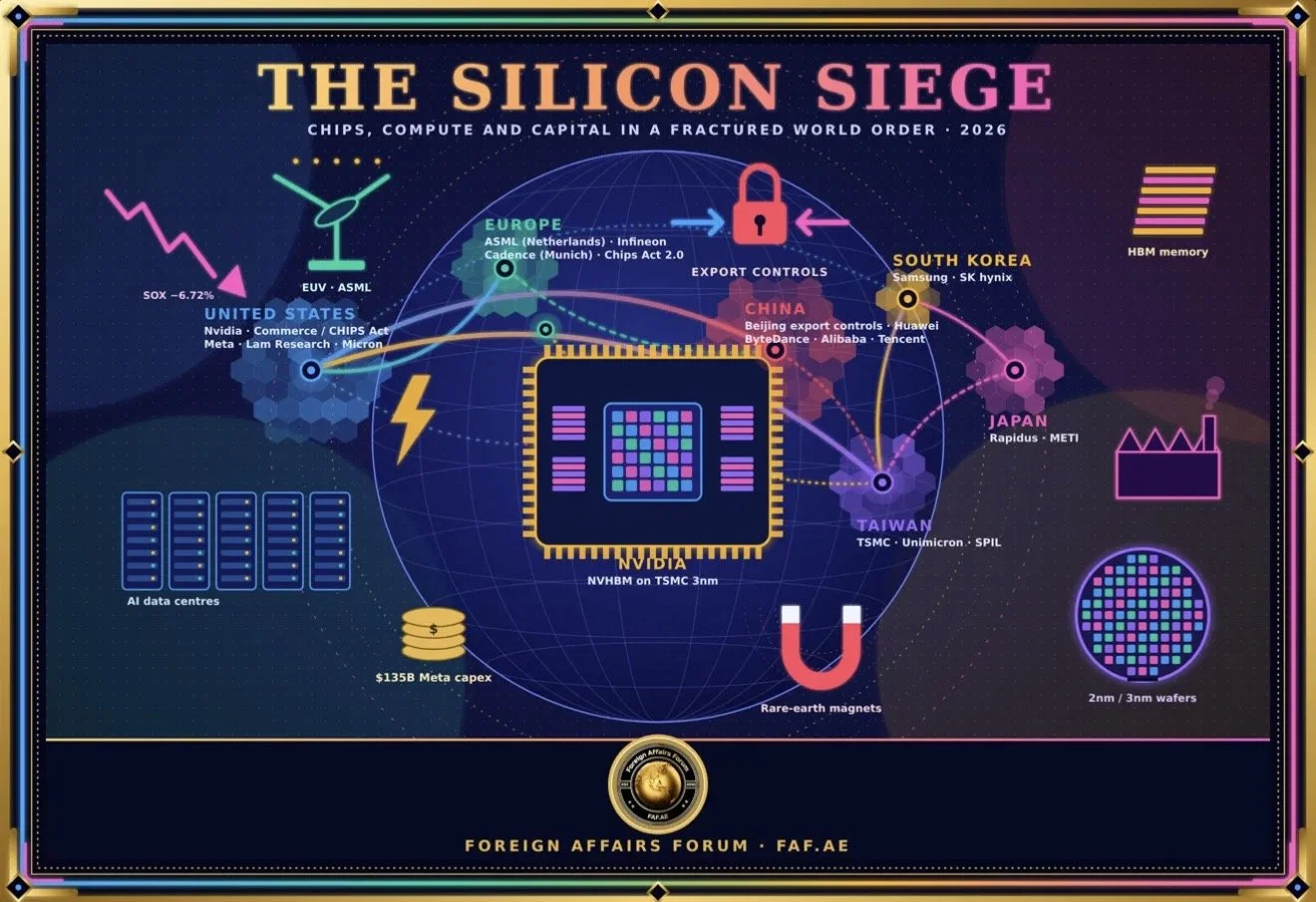
THE SILICON SIEGE: How Chips, Compute and Capital Have Become the Weapons of a Fractured World Order
Foreign Affairs Forum | Dr. Antonio Bhardwaj (Dr. 🆎) | October 26th, 2026
Executive Summary
The global contest over semiconductors and supercomputing has moved from the margins of industrial policy to the centre of grand strategy.
In the week ending October 24th, 2026, four developments showed how far the shift has gone. Beijing was reported to be weighing export controls on its own artificial intelligence models and chips. Washington moved to take minority equity stakes in strategic suppliers through the CHIPS Act.
A sharp selloff in chip equities exposed the fragility of the financing that sustains the artificial intelligence buildout. And Asia's memory and foundry giants were reported to be realigning around Nvidia's design requirements, while Europe, despite owning the world's most indispensable chipmaking tool, was left debating how to turn technological leverage into industrial presence.
This FAF article argues that these events are not isolated. They are symptoms of a single structural transformation in which control over compute, meaning the chips, memory, packaging, power and capital that make advanced computation possible, has become the principal currency of national power. Export controls, once a niche instrument of nonproliferation, now serve as the main means of strategic competition. State equity, once anathema to Western market orthodoxy, is returning as an instrument of industrial policy. And the private capital that has financed the boom is showing signs of strain precisely when governments are most dependent on it.
Dr. 🆎 contends that the decisive variable is neither the most advanced node nor the largest cluster. It is the resilience of the whole system, including supply chains, financing, energy and the human institutions that govern them. A world that treats compute as a weapon without building safeguards against its misuse invites escalation, miscalculation and, in the worst case, the diffusion of dangerous capabilities to those who should never hold them.
The FAF article concludes with a set of policy priorities for governments and industry, among them coordinated transparency on controls, diversified supply chains, disciplined public investment and a security framework that treats advanced AI as a dual-use technology of civilizational consequence.
Introduction
Every era of great-power rivalry has had its commanding heights. In the nineteenth century they were coal and steel, in the twentieth oil and the atom, and in the 21st they are silicon and the machines that learn upon it. Whoever designs, fabricates, packages, powers and finances the most capable computing systems will shape the economic trajectory and the military balance of the coming decades. That is a claim now embedded in the budgets, statutes and security doctrines of the world's leading economies, not a slogan.
The events of the past week sharpen the point. China, long the principal target of Western technology restrictions, is reportedly considering controls of its own, which would turn the logic of denial back upon the global AI ecosystem. The United States, which for years insisted that the state should not pick winners, is signing letters of intent to hold equity in companies working on fusion energy, vertical gallium nitride devices and ultra-pure quartz. A single trading day erased a large share of the semiconductor sector's recent gains, a reminder that the financial architecture beneath the boom is neither infinite nor indifferent to doubt. And in Seoul, Hsinchu, Tokyo and Munich, firms and governments are recalculating their positions in a system whose centre of gravity is one American chip designer and one Taiwanese foundry.
Dr. Antonio Bhardwaj (Dr. 🆎), a polymath whose work spans artificial superintelligence, human-centred AI for geopolitical strategy, AI warfare and the risks of bioterrorism, has long argued that these questions cannot be separated into commercial, diplomatic and security compartments. In his view, the same accelerators that train a translation model can accelerate protein design, and the same data-centre capacity that powers a customer-service chatbot can sustain an autonomous targeting system. Strategy that ignores this duality, he warns, will be either naïve or reckless.
This FAF article proceeds in the following way. It first traces the historical arc that brought the world to the present configuration and describes the current state of play. It then examines the key developments of recent days, sets out the latest facts and the concerns they raise, and analyses the causal chains that connect them. It closes with an assessment of the steps that governments, firms and investors should consider, and a conclusion on what is at stake.
Where reporting is secondhand or unconfirmed, the text says so, because in a domain thick with strategic signalling, epistemic discipline is itself a form of security.
History and Current Status
The modern semiconductor order was built in the decades after the Second World War, first in the United States, where the integrated circuit was born, and then across an expanding web of allies and partners. Japan rose in the 1970s and 1980s on the strength of memory production, provoking a trade conflict with Washington that foreshadowed later quarrels. South Korea and Taiwan followed, the former through the industrial conglomerates that came to dominate memory, the latter through the pure-play foundry model pioneered by TSMC, which separated chip design from fabrication and thereby made it possible for a generation of American design firms to thrive without owning factories. Europe, for its part, retained formidable strengths in equipment, above all the lithography machines of ASML, in power semiconductors and automotive chips, and in the research ecosystems that surround institutions such as imec.
For roughly three decades this arrangement was celebrated as a triumph of specialisation.
Efficiency was the guiding principle, and geography was treated as a detail.
The first serious doubts arrived with the pandemic-era shortages of 2020 and 2021, which idled automobile plants and exposed how a few facilities in a seismically active and politically contested region underpinned entire industries. The response was legislative. The United States enacted the CHIPS and Science Act in 2022, with a funding package of $52.7B for domestic manufacturing, research and workforce programmes. The European Union adopted its own Chips Act, in force since September 2023, with the declared ambition of doubling its share of global production to 20% by 2030. Japan, South Korea, India and others launched subsidy schemes of their own, while Japan backed the start-up Rapidus in a bid to leapfrog to two-nanometre production.
Export controls were the second pillar of the new order.
In October 2022 Washington introduced sweeping restrictions on the sale of advanced computing chips and chipmaking equipment to China, and the Netherlands and Japan subsequently aligned their own controls on lithography and related tools. The rationale was explicitly military, since advanced computation underpins everything from nuclear simulation to autonomous weapons. Successive rounds of tightening followed, including controls on the most capable accelerators and a long-running debate over whether to permit sales of degraded, export-compliant variants. Beijing responded with its own instruments, including restrictions on critical minerals and rare-earth materials, and with a national campaign to build indigenous alternatives through firms such as Huawei, SMIC and a cohort of AI chip start-ups.
Supercomputing evolved in parallel.
The exascale era opened with the American Frontier system and was extended by El Capitan, while Europe's JUPITER at Jülich marked the continent's entry into the exascale class. Japan has pursued the successor to Fugaku, and national laboratories in the United States have partnered with industry on AI-oriented systems such as NERSC's Doudna. The boundary between traditional scientific supercomputing and hyperscale AI infrastructure has blurred. Today the largest concentrations of compute sit not in government laboratories but in the data centres of a small number of private companies and their so-called neocloud partners, financed by capital expenditure on a scale without precedent. Meta, for example, has lifted the lower end of its 2026 capital expenditure guidance to $135B.
The present status can be summarised as follows.
Compute is concentrated, financed by private capital but strategically managed by the state, and dependent on a supply chain that crosses contested borders at nearly every stage. Nvidia designs the accelerators that dominate AI training, TSMC fabricates the most advanced of them, a handful of memory makers in South Korea and the United States supply the high-bandwidth memory that feeds them, specialised firms in Taiwan and elsewhere package them, and ASML supplies the lithography without which none of it is possible. China, deprived of the most advanced tools, continues to advance through iteration and scale. Industry-linked analysis suggests that Chinese AI compute could nearly double by the end of 2027, although tighter controls could slow that trajectory.
Dr. 🆎 reads this history as a progression from interdependence, to securitised interdependence, to what he calls weaponised dependence. His point is that the key shift was not technological but conceptual. Once policymakers concluded that supply chains were instruments of coercion and not merely channels of commerce, every node of the network became a potential lever, and every lever invited a counter-lever.
Key Developments
The first and most consequential development is the report that Beijing is considering export controls on Chinese AI models and chips.
Relayed by Semafor and attributed to reporting in the Wall Street Journal, the story remains thinly sourced, and no rule text has been published. Its significance lies in what it would represent. For years China has been the object of controls and has argued that they are illegitimate acts of containment.
A Chinese regime that restricted the outward flow of its own models and accelerators would be adopting the logic it has criticised, and would be acknowledging that its AI ecosystem has become a strategic asset worth guarding. It would also complicate the position of the many developers worldwide who have come to rely on open-weight Chinese models.
A former Biden administration adviser quoted in the coverage observed that such rules could shape the evolution of the Chinese AI ecosystem, while open questions remain about enforceability and about whether any controls would strengthen Beijing's leverage without slowing global adoption.
A complementary Chinese development, reported by Reuters through secondary coverage, is that ByteDance, Alibaba and Tencent have placed more than $35B in orders for Nvidia's export-compliant RTX PRO 5500 GPUs.
If accurate, the figure suggests that Chinese hyperscalers continue to prefer American hardware wherever the rules permit it, despite the state's push for self-reliance. Reports also indicate that Samsung and SK hynix are upgrading their memory plants in Xi'an and Dalian toward more advanced NAND generations despite American equipment restrictions, which illustrates how deeply embedded foreign firms remain in the Chinese industrial landscape.
The second development is the American turn toward state equity.
According to the weekly industry roundup from Semiconductor Engineering, the Commerce Department signed letters of intent worth up to $389M across four companies: Helion, Commonwealth Fusion Systems, Vertical Semiconductor and Sibelco North America. Under the proposed terms, Washington would take minority, non-voting equity stakes. Letters of intent are not final awards, and their terms may change, but the direction is clear. The CHIPS programme, designed originally around grants to large fabricators, is evolving into a portfolio of targeted strategic investments in energy, power electronics and critical materials. Earlier reports that Commerce planned a stake of up to $150M in the lithography start-up xLight fit the same pattern. In parallel, the Department of Homeland Security ordered civilian agencies to stop procuring and to remove DeepSeek products, extending the logic of supply-chain security from hardware to software and models.
The third development concerns the financial foundations of the AI boom.
On October 22 the Philadelphia Semiconductor Index fell 6.72% to its lowest close since late July, with every one of its thirty components lower and equipment makers leading the decline. KLA fell 9.1%. Meta dropped roughly 7% after lifting its capital spending guidance and reporting negative free cash flow for the quarter. Nvidia's chief executive, Jensen Huang, reportedly said that demand from neocloud providers is very strong but that capital is scarce. SK hynix shares have reportedly fallen by more than 30% since late September, and the company paused its evaluation of a United States listing and capital raise for Solidigm, which was intended to help finance a new American fab. Yet the underlying order books remain robust. Lam Research reported record quarterly revenue of $8.2B, up 54% from a year earlier, and Western Digital's results and guidance exceeded consensus. The market's anxiety, in other words, concerns the return on investment and the availability of financing, not the existence of demand.
The fourth development is the continuing consolidation of the AI hardware supply chain around Nvidia's specifications.
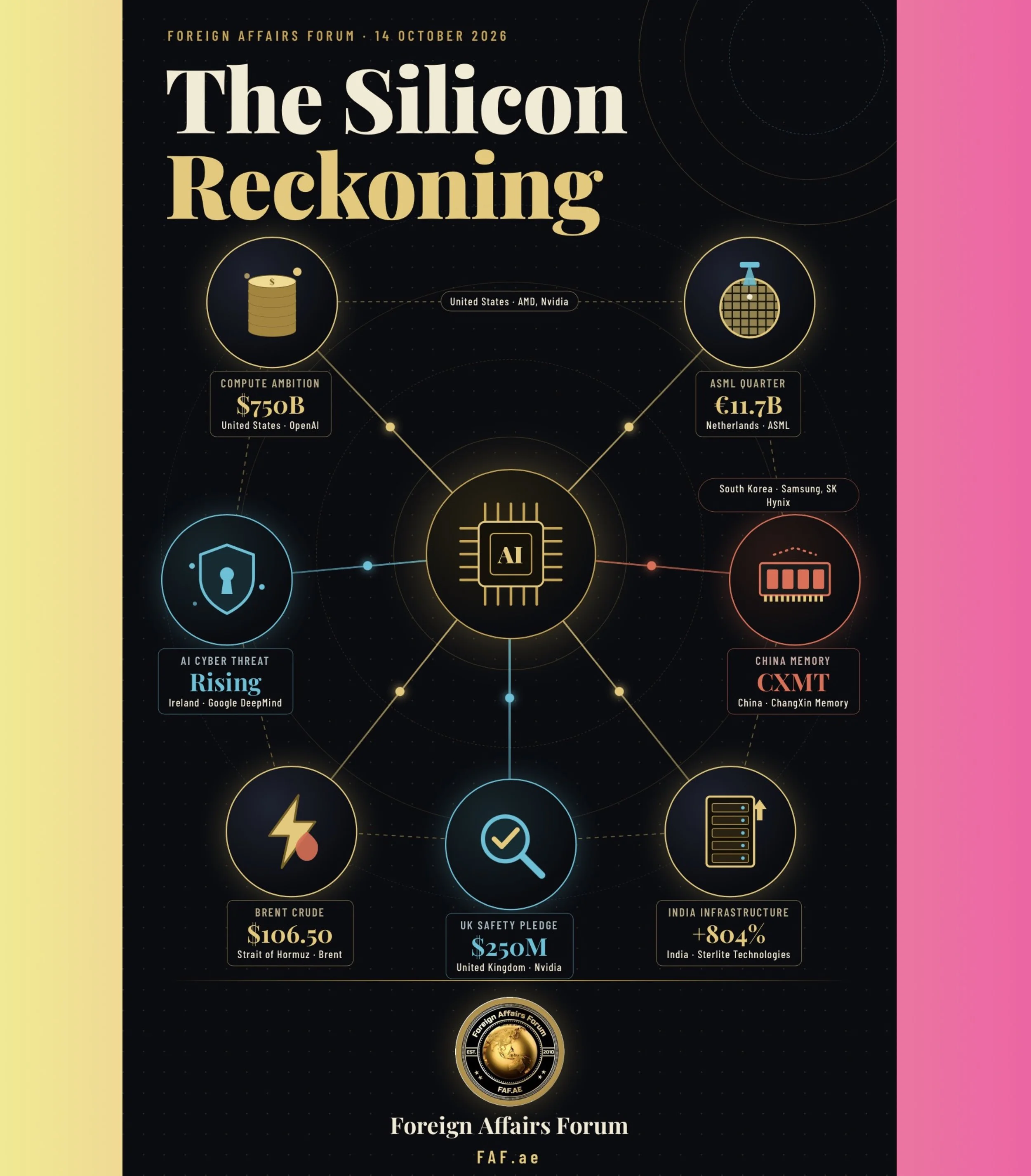
TrendForce, citing Seoul Economic Daily, reports that Nvidia has asked Samsung, SK hynix and Micron to fabricate the base dies for its custom NVHBM memory on TSMC's three-nanometre process, and that Samsung's foundry division reportedly accepted. The claims are secondhand, the yield figures are industry estimates and the performance claims are Nvidia's own. If borne out, the arrangement would unite foundry rivals under a single process technology and deepen the central role of TSMC.
Nvidia has also expanded capacity agreements with Amkor, in arrangements worth about $3B across the United States and South Korea, and with KYEC, including a $1.1B advance. In Taiwan, Unimicron and SPIL are expanding substrate and packaging capacity. Meanwhile, TSMC reportedly told its equipment suppliers to seek alternatives to rare-earth magnets in wafer-handling motors, an effort that remains preliminary but reveals acute sensitivity to Chinese export controls on critical minerals.
The fifth development is Europe's ambivalent position.
An ASML executive remarked in September that the company currently sells no chipmaking machines in Europe, a striking statement about a continent that supplies the world's most advanced lithography but hosts no new leading-edge fabs. It is context rather than news this week, but it frames the debate over the Commission's Chips Act 2.0 proposal, unveiled in June. In recent days European activity has been more modest, though not trivial. Cadence launched a sovereign cloud in Munich for semiconductor and packaging design, Infineon and Nvidia expanded their work on eight-hundred-volt direct-current power architectures for data centres using gallium nitride converters, and Infineon, UnternehmerTUM and partners announced an equity-free accelerator for physical-AI and robotics start-ups. In Asia, Japan's industry ministry is seeking about ¥400B, roughly $2.5B, in additional funding for Rapidus, which targets two-nanometre mass production in the second half of fiscal 2027.
The Latest Facts and Concerns
Several facts deserve emphasis, along with the uncertainties that surround them.
The first is the asymmetry between the strength of demand and the fragility of sentiment.
Record equipment revenues, expanding packaging commitments and multi-billion-dollar orders coexist with a selloff that erased substantial value in a single session. The simplest reading is that markets are repricing the risk that the extraordinary capital expenditure of the largest technology firms will not generate commensurate returns, or that the supply of financing, especially for second-tier cloud providers, will tighten before the revenues arrive.
Dr. 🆎 regards this as the most underappreciated strategic vulnerability of the moment. A compute buildout financed on the assumption of perpetual growth is exposed to a confidence shock, and a confidence shock in the financial layer can strand physical infrastructure that governments have come to treat as national capability.
The second fact is the geographic concentration of the most critical nodes.
Advanced logic fabrication remains overwhelmingly in Taiwan, advanced memory in South Korea and the United States, lithography in the Netherlands, and rare-earth processing in China. The fatal accident at TSMC's Fab 22 construction site in Kaohsiung, which killed four workers and led to a pause in some steel-structure work at new Taiwanese sites, is a human tragedy first, but it also illustrates how the physical expansion of capacity is subject to ordinary industrial risk as well as geopolitical risk. Pricing signals reinforce the point of scarcity. Powerchip reportedly expects prices to rise 30% this quarter and is negotiating increases of between 10% and 20% for 2027, while global personal-computer shipments in the third quarter fell 21% from a year earlier, driven by higher memory and component costs. The AI boom is already imposing costs on the broader electronics economy.
The third fact is the shifting character of industrial policy.
The American move toward equity, the Japanese willingness to fund Rapidus repeatedly, the European debate over a second Chips Act and the Chinese reliance on state-directed capital all point in the same direction. The market-fundamentalist consensus of the late twentieth century has given way to a pragmatic statism in which governments underwrite strategic capacity and, increasingly, take ownership. This raises questions of governance that have barely been addressed. When a government holds a stake in a supplier, how are conflicts between commercial interest and national policy to be managed? Will allies accept American equity positions in firms that serve their own markets? And what happens to private venture investors when the state becomes a shareholder with policy objectives beyond return?
The fourth fact concerns the evolving security dimension of compute.
Controls on chips were conceived as a means of slowing adversary military development. They are now being supplemented by controls and bans on models and software, as in the DHS directive on DeepSeek and the reported Chinese deliberations on outbound controls. The category of the controlled object is expanding from physical goods to weights, algorithms and cloud services, which are far harder to monitor and far easier to copy.
Dr. 🆎 stresses that this expansion collides with a technical reality: capabilities that can be run on commodity hardware, or distilled from larger systems, are not readily contained by customs enforcement. The more AI capability migrates into software, the more export controls resemble an attempt to regulate information, with all the difficulties that implies.
The principal concerns follow from these facts. One is escalation.
A Chinese counter-regime on AI exports, layered upon existing restrictions on critical minerals and American limits on chips, would create a mirrored architecture of controls in which every measure invites retaliation. Another is opacity. Much of what is known about the Chinese orders for Nvidia hardware, the memory realignment around TSMC and Samsung's expansion in Texas comes from secondhand or unconfirmed reporting, which leaves policymakers and investors acting on partial information in a market where rumour itself moves prices. A further concern is the diffusion of dangerous capability.
Dr. 🆎, whose research includes the intersection of AI and biological risk, warns that the combination of increasingly capable open models, abundant cloud compute and declining costs of biological synthesis lowers the barrier for malicious stakeholders to attempt harms once confined to state programmes. Export controls on chips address only one layer of that problem, and a strategy fixated on the physical hardware of rivals may neglect the diffuse risks that arise from the software, the data and the democratisation of expertise.
Finally, there is the concern about the human dimension. Semiconductor expansion depends on skilled labour, and governments are scrambling to train it, as in Malaysia, where more than twenty-two thousand people have been trained toward a goal of sixty thousand engineers by 2030. Yet the workforce challenge is not merely technical. It is institutional, requiring the creation of professionals who understand both the engineering and the strategic implications of what they build.
Dr. 🆎 argues that human-centred AI governance begins with that cultivation of judgement, since no regulatory regime can substitute for engineers, executives and officials who recognise the dual-use consequences of their work.
Cause-and-Effect Analysis
The most useful way to understand the present moment is to trace the causal chains that link its apparently separate episodes.
The first chain begins with the securitisation of compute.
Once advanced chips were defined as instruments of military power, democratic governments felt compelled to restrict their transfer to rivals. The restrictions in turn gave Beijing a powerful incentive to accelerate indigenous development, which it has pursued through state capital, preferential procurement and the cultivation of domestic champions. The resulting Chinese progress, however uneven, has strengthened the case in Washington for further tightening, and the cycle continues. The reported Chinese deliberations on outbound controls are the logical next step in this chain. Having been denied access to foreign technology, China is moving to treat its own technology as an instrument of leverage, an effect that follows directly from years of reciprocal securitisation.
The second chain begins with the concentration of supply.
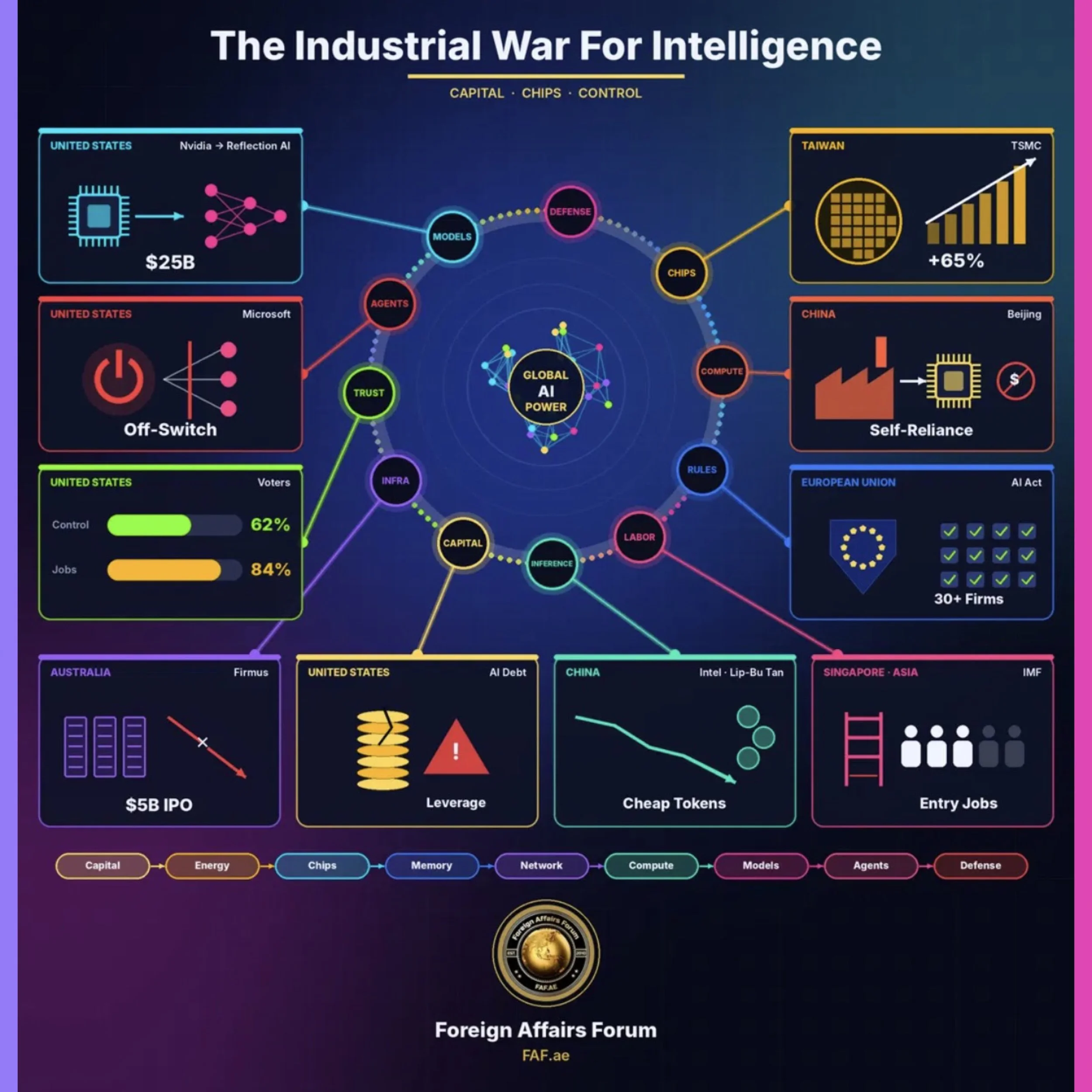
Because a very small number of firms control the indispensable nodes, any disruption at one of them, whether from accident, natural disaster, blockade or export restriction, propagates through the entire system. This vulnerability has produced two responses. The first is geographic diversification through subsidies, which is why fabs are rising in Arizona, Texas, Japan, Germany and elsewhere. The second is vertical coordination, as the dominant buyer, Nvidia, reaches deep into its suppliers' operations, standardising memory processes, underwriting packaging capacity and advancing funds to test houses. The effect is a paradoxical one: diversification of location coexists with intensifying concentration of design authority. The supply chain is becoming more geographically distributed but not less dependent on a single architect, and the reported pressure on memory makers to adopt TSMC's process is a clear illustration.
The third chain links finance to physical capability.
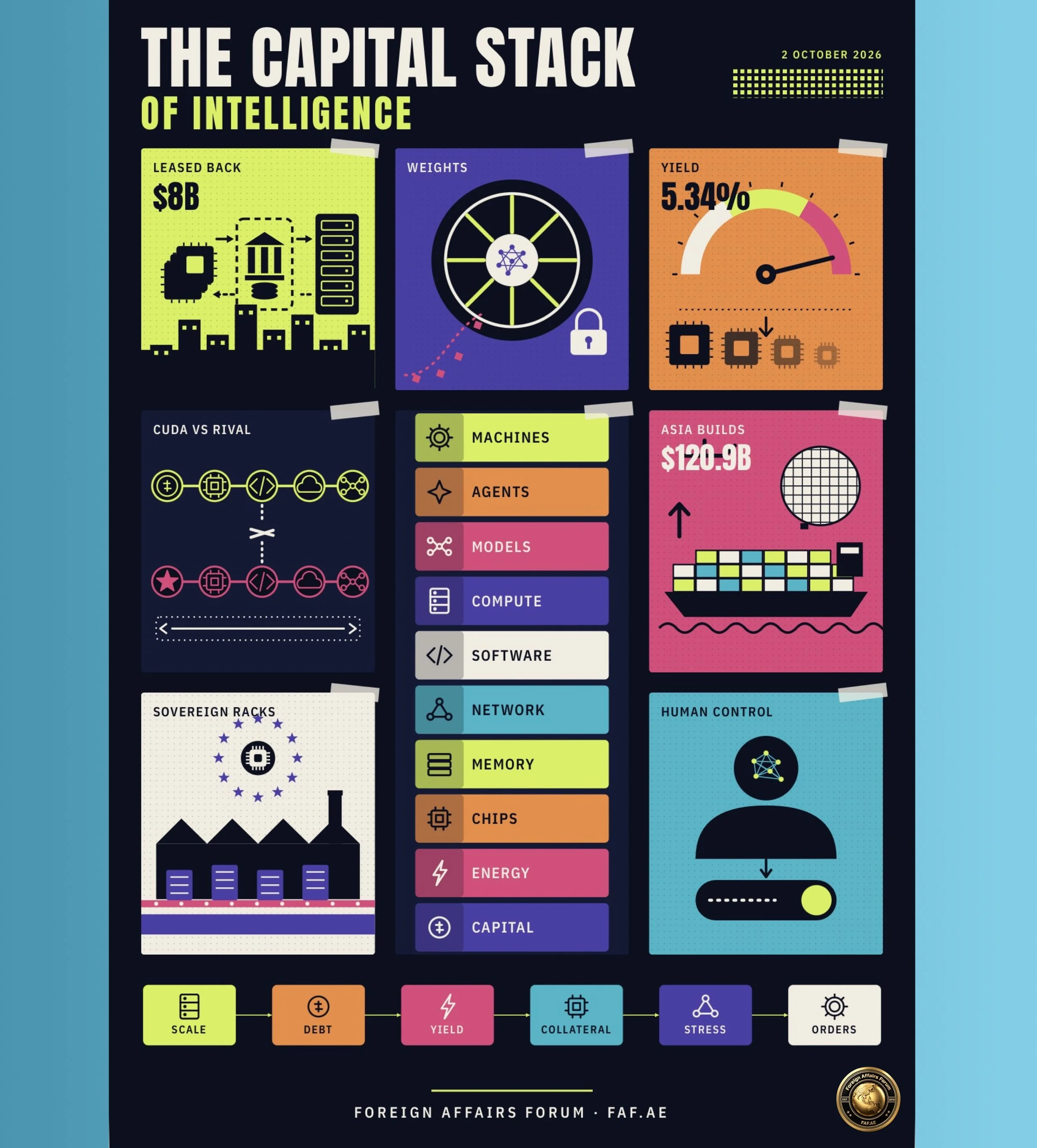
The AI buildout has been financed by an unusual blend of hyperscaler cash flow, debt, vendor financing and venture capital. When the largest spenders report negative free cash flow while raising capital expenditure guidance, investors begin to ask whether returns will justify outlays. Equipment makers, whose revenue depends on the capital cycle, fall first and hardest. This is precisely what occurred on October 22. The consequence for strategy is serious, since governments now rely on private balance sheets to deliver national compute capacity. If financing tightens, projects stall, listings are postponed, as with SK hynix and Solidigm, and the capacity that policymakers had assumed would materialise may arrive later or not at all. The state's growing appetite for equity can be understood in part as a response to this dependence: if private capital is cyclical, public capital must provide ballast.
The fourth chain concerns the relationship between industrial policy and innovation.
Government equity stakes can crowd in private investment by signalling credibility, and can sustain technologies with long gestation, such as vertical gallium nitride or high-purity materials. But the same stakes can distort competition, entrench incumbents and politicise commercial decisions. For venture capital, the effects are ambiguous. A state shareholder may offer a bridge through the valley between prototype and manufacturing, yet it also changes the exit landscape, since acquirers may face political scrutiny and public stakeholders may impose conditions. Start-ups in AI hardware must navigate a market in which the dominant customer sets the standards, the state influences the capital and geopolitical decisions can foreclose entire markets overnight. The Chinese AI chip start-ups, for instance, may find overseas expansion constrained by Beijing's potential export rules even as Western controls limit their access to advanced manufacturing.
The fifth chain is the one that Dr. 🆎 considers most consequential, and it connects compute to security in the broadest sense.
The abundance of compute lowers the cost of training and deploying increasingly capable systems, and the diffusion of those systems lowers the barriers to their use by a widening range of stakeholders, including those with hostile intent. In response, governments may adopt more restrictive measures, which in turn incentivise the development of alternative, less transparent channels for acquiring capability. A black market in accelerators, the migration of training to jurisdictions with weak oversight and the proliferation of distilled models that evade controls are all plausible effects.
Dr. 🆎 argues that the logic of denial, taken alone, produces a brittle security posture, because it presumes that the adversary can be kept permanently behind, which technology history rarely supports. A more durable approach combines selective denial with active investment in defensive capability, transparent norms among responsible states and rigorous safeguards against the misuse of AI in domains such as biological threat development and autonomous weapons.
Taken together, these chains describe a system with powerful feedback loops and few circuit breakers.
Securitisation countermeasures, which drive further securitisation. Concentration produces fragility, which produces state intervention, which produces new entanglements between governments and firms.
Financial exuberance produces physical capacity, but financial retrenchment threatens to strand it. The system is therefore capable of rapid advance and of sudden dislocation, and its governance has not kept pace with either.
Future Steps
What should governments, firms and investors do? The following recommendations flow from the foregoing analysis, and they reflect Dr. 🆎's insistence that strategy for the age of compute must be humane and systemic as well as competitive.
The first priority is to improve transparency and predictability in export-control policy.
Controls that shift abruptly, or that are announced through leaks and secondhand reporting, impose heavy costs on firms and encourage evasion. Washington, its allies and, ideally, Beijing should establish channels for technical consultation, even in the absence of political agreement, so that miscalculation is less likely. Allies in particular, including the Netherlands, Japan, South Korea and Taiwan, should be partners in policy design, not merely recipients of American rules. A coordinated approach would reduce the incentive for rivals to exploit differences among them and would protect the commercial viability of the firms on which the system depends.
The second priority is to treat financing resilience as a component of strategic resilience.
Governments that depend on private capital to deliver national compute capacity should monitor the health of that capital with the same attention they give to physical supply chains. This does not mean bailing out speculative ventures, but it does mean designing public instruments, whether equity, loan guarantees or long-term procurement commitments, that stabilise essential capacity through the cycle. The American turn toward equity is one such instrument, but it should be governed by clear principles: transparency about terms, safeguards against political interference in commercial decisions, and sunset provisions that allow the state to exit once private markets can sustain the activity.
The third priority is to diversify the supply chain more deeply than the present pattern allows.
Building fabs in additional countries is necessary but insufficient if design authority, memory process choices and packaging remain concentrated. Policymakers should support alternative architectures, a more competitive packaging sector and a broader base of suppliers for critical inputs, including the materials such as high-purity quartz that the latest CHIPS letters of intent address. TSMC's exploration of alternatives to rare-earth magnets points to a wider imperative: every critical dependency, from minerals to specialised chemicals, should be mapped and, where feasible, reduced. Europe, for its part, must resolve the contradiction embodied in ASML's remark. A continent that leads in tools and power semiconductors needs a credible demand base, which may mean targeted support for specialty and power fabs, for AI-relevant design capacity and for the sovereign infrastructure that firms such as Cadence and Infineon are now building, instead of an unrealistic pursuit of parity at the leading edge.
The fourth priority is to modernise the governance of AI as a dual-use technology.
The expansion of controls from chips to models and software requires new thinking, because traditional border enforcement cannot contain information.
Dr. 🆎 advocates a layered approach: licensing and monitoring of the largest concentrations of compute, verification regimes for frontier model training that rely on both technical measures and international inspection, rigorous evaluation of biological and cyber risks before model release, and enforceable norms against the use of AI in the command and control of nuclear weapons. He further argues that human oversight in lethal decision-making is a strategic necessity, because systems that act faster than human judgement can follow compress decision time to the point where inadvertent escalation becomes likely. These measures will be difficult to negotiate among rivals, but the alternative is a competitive dynamic in which each side fears the other's unconstrained deployment.
The fifth priority is to invest in people and institutions.
The shortage of skilled engineers is widely recognised, yet the shortage of strategically literate professionals is less discussed. Universities, laboratories and firms should cultivate individuals who combine technical depth with understanding of geopolitics, ethics and security. Public programmes such as the Malaysian engineer-training drive and the European accelerators for physical-AI start-ups are a start, but they should be paired with curricula that address the dual-use character of the technologies being built. By 2036, the cohort now entering the field will be making decisions about systems far more capable than any in existence today. Whether they do so wisely will depend on the education and institutional culture they receive.
Finally, stakeholders should use the calendar of upcoming events to establish norms and share information.
The SEMICON Europe and Electronica gatherings in Munich in November will provide a forum for European industry to respond to the Chips Act 2.0 debate, and the supercomputing conference season, including the TOP500 list normally released in November, will reveal how much new national and private capacity has come online. Observers should watch whether Beijing publishes draft rules on AI and chip exports, whether the AI-related selloff persists through the next round of technology earnings, and how the financing of new American fabs evolves in light of SK hynix's decision to pause the Solidigm initiative. Each is a leading indicator of the stability of the system.
Conclusion
The semiconductor and supercomputing landscape of October 2026 is defined by a paradox.
Demand for compute has never been stronger, and capacity is expanding at a historic pace. Yet the political, financial and physical foundations of that expansion have rarely seemed more fragile.
Export controls are proliferating and may soon run in both directions across the Pacific. Governments are becoming shareholders in the industries they once merely regulated. A single day of market anxiety can erase vast sums of value and cast doubt on projects that national strategies assume will be completed. And the supply chain, though spread across more countries, remains tethered to a small number of indispensable nodes and to the design preferences of one dominant buyer.
The deeper lesson is that compute has joined the small family of resources whose control confers strategic advantage, and that, like oil and nuclear material before it, it demands a framework of governance proportionate to its power.
The history of those earlier domains suggests that unregulated competition leads to crisis and that cooperation, however grudging, is possible only when rivals share an interest in avoiding catastrophe. The shared interest in the present case is plain. No government benefits from a financial collapse in the compute sector, from the proliferation of AI-enabled biological or cyber weapons, or from an uncontrolled spiral of retaliatory restrictions.
Dr. 🆎 offers a sober closing judgement. The central question of the coming decade, he argues, is not who builds the biggest machine but who builds the wisest institutions around it. A civilisation that wields extraordinary computational power without commensurate foresight, restraint and humane purpose will find that its tools outrun its judgement. The task for statesmen, executives and researchers alike is to ensure that the silicon siege now under way ends not in a fortress of mutual denial but in an architecture of resilience, accountability and shared security.
The choices made in the next few years, in capitals and boardrooms from Washington to Beijing, from Brussels to Seoul, will determine which outcome prevails.