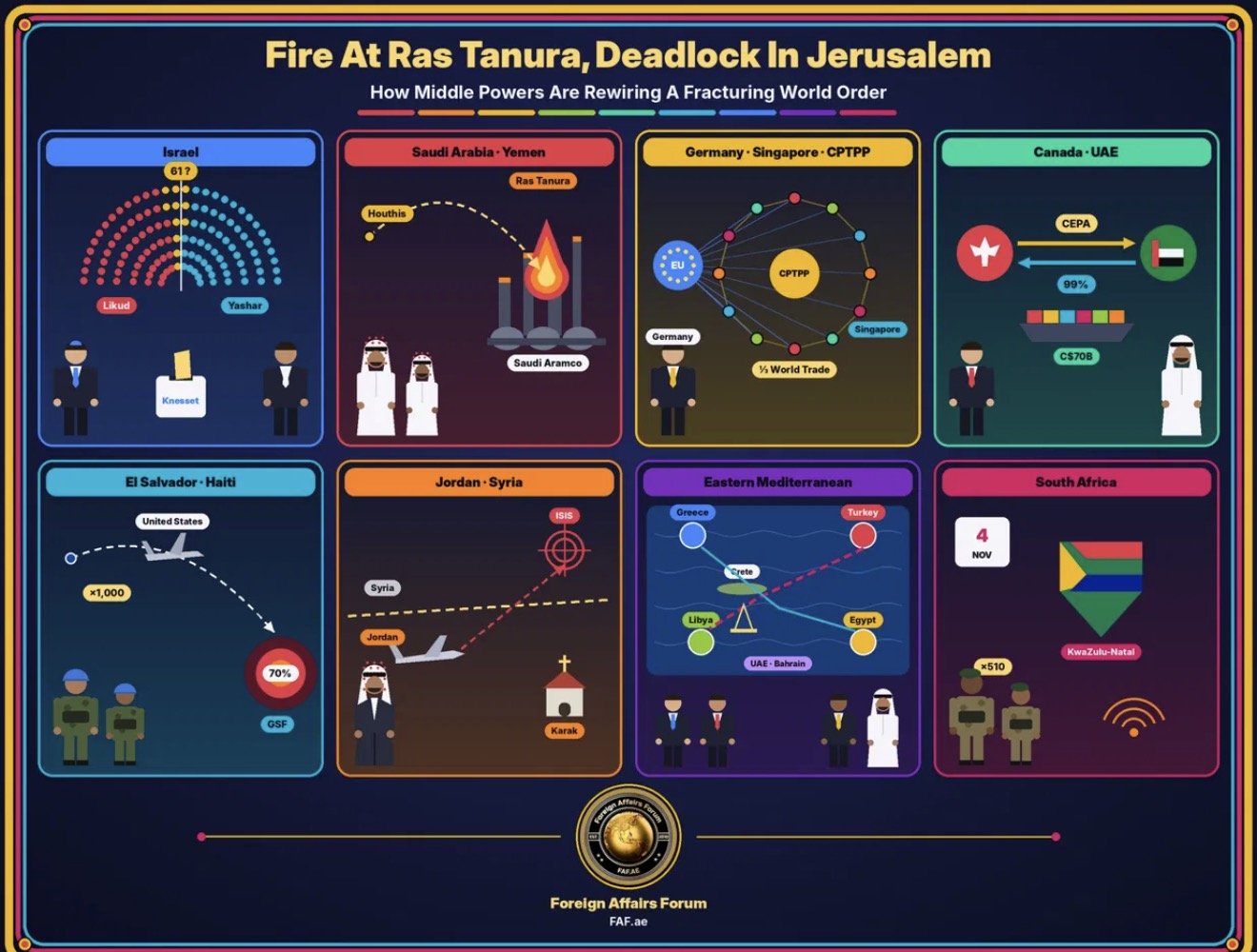
Fire at Ras Tanura, Deadlock in Jerusalem: How Middle Powers Are Rewiring a Fracturing World Order
Foreign Affairs Forum | Dr. Antonio Bhardwaj (Dr. 🆎)| October 28th 2026
Executive Summary
The final week of October 2026 has produced a cluster of developments that, viewed separately, look like routine turbulence in an unstable decade.
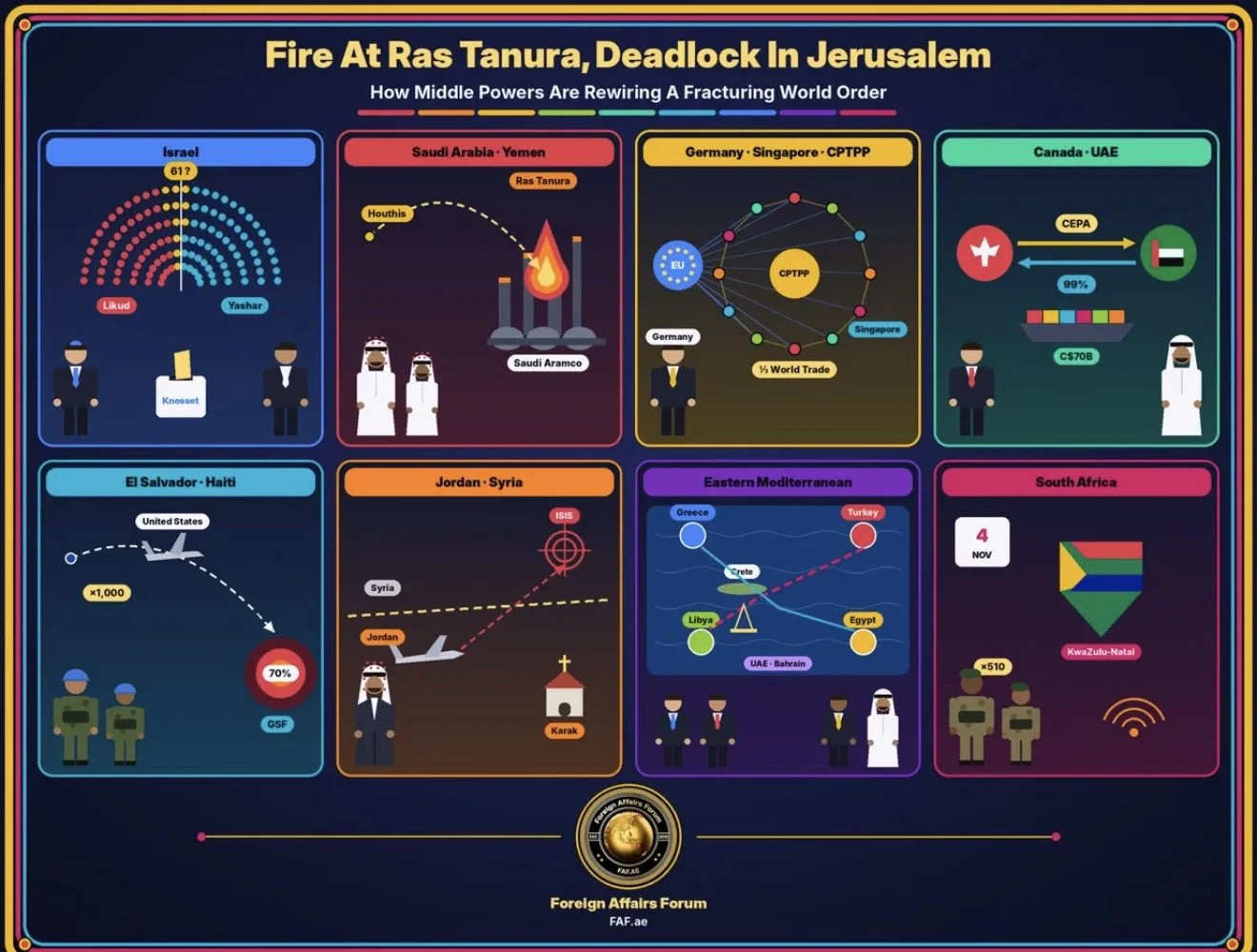
Viewed together, they show how the international order is being reorganised. Israel's general election of October 27 ended without a decisive verdict and left the country with weeks of coalition bargaining while its security commitments remain unresolved.
Within hours, Yemen's Houthi movement claimed a ballistic missile strike on Saudi Arabia's Ras Tanura refinery and export complex. It was the latest blow in a campaign against Saudi energy infrastructure that has intensified since September, against the background of the wider war with Iran that began in February.
In Singapore, German Chancellor Friedrich Merz proposed an interregional compact between the European Union and the members of the Comprehensive and Progressive Agreement for Trans-Pacific Partnership.
The proposal would link economies that together account for more than one-third of global trade. In Abu Dhabi, Canada and the United Arab Emirates signed a Comprehensive Economic Partnership Agreement concluded in a record forty-seven days of negotiation.
The same week saw El Salvador send roughly one thousand troops to Haiti after an ambush on its personnel serving with the Gang Suppression Force.
Jordan conducted airstrikes in southern Syria after a deadly attack on a church in Karak, and Damascus protested the loss of civilian lives and of sovereignty. Egypt, Bahrain and the UAE aligned with Greece against a Turkey-Libya maritime memorandum that eastern Libya's parliament ratified after six years of resistance.
South Africa deployed five hundred and ten soldiers to KwaZulu-Natal as anti-migrant violence threatened public order ahead of local elections on November 4.
This FAF article argues that these events share three features.
First, the great powers are no longer the only stakeholders shaping outcomes: middle powers are building trade corridors, security deployments and diplomatic coalitions of their own.
Second, the most consequential vulnerabilities are now systemic rather than territorial. Energy terminals, shipping lanes, maritime boundaries, information ecosystems and domestic legitimacy can each be attacked or eroded without conventional war.
Third, the capacity to sustain commitments, whether military, commercial or institutional, has become the scarcest strategic resource.
Dr. 🆎 frames the moment in these terms: "The coming decade will not be won by the state with the largest arsenal, but by the state that can keep its infrastructure running, its institutions credible and its partnerships diversified while under continuous pressure from both machines and men."
Introduction
Every era of international politics has a characteristic form of crisis. The Cold War produced proxy wars and nuclear brinkmanship. The unipolar interlude after 1991 produced humanitarian interventions and counterterrorism campaigns.
The present period is producing something more diffuse and, in some ways, more dangerous: overlapping crises that move through energy markets, trade regimes, migration flows and fragile governments at the same time. The developments of late October 2026 illustrate this convergence with unusual clarity.
Dr. Antonio Bhardwaj (Dr. 🆎), CEO of the Foreign Affairs Forum and a polymath with global expertise in Super Intelligence, specialising in human-centred SI for geopolitical strategy, AI warfare and bioterrorism risk, has argued that the defining feature of this period is the compression of time and distance in strategic competition. A drone or ballistic missile launched from Yemen can affect oil prices in Mumbai within an hour. A misleading social media post about a court ruling in Pretoria can trigger violence in Durban within a day. A trade proposal in Singapore can reshape investment planning in Frankfurt, Hanoi and Ottawa within a week. In his assessment, the governments that understand this compression, and build the analytical and institutional capacity to manage it, will define the next phase of the international order.
This FAF article examines the week's major developments as a single strategic landscape rather than as isolated headlines. It traces their origins, assesses their current status, analyses the causal chains that link them, and considers the steps that governments, institutions and other stakeholders must take if the trend towards middle-power assertiveness is to produce stability rather than fragmentation.
History and Current Status
The roots of the present turbulence lie in three structural shifts that have accelerated since the early 2020s.
The first is the erosion of the rules-based trading system that underpinned globalisation for three decades.
The World Trade Organization's dispute settlement mechanism has been paralysed for years. Unilateral tariffs, export controls on advanced technologies and the use of trade as an instrument of coercion have become routine features of great-power policy. When sweeping American tariffs were announced in April 2025, European Commission President Ursula von der Leyen first floated closer engagement between the European Union and the CPTPP. That idea became institutional reality in November 2025, when the first EU-CPTPP Trade and Investment Dialogue convened with all twelve CPTPP trade ministers. Chancellor Merz has since said publicly that if the WTO continues to fail, Europe must build something else. His Singapore proposal is the most ambitious version of that argument so far.
The second shift is the militarisation of energy geography in the Middle East.
The war that began with American and Israeli strikes on Iran on February 28, 2026 turned Gulf energy infrastructure into a direct target. In early March, Iranian drones struck Ras Tanura and forced a temporary shutdown of one of the largest refineries in the region. Saudi Aramco restarted full operations only in late June. Since September, the Houthis have opened what is effectively another front against the kingdom, targeting airports, ports and oil installations. On October 13 they struck the Aramco headquarters in Dhahran. On October 27 they claimed that a ballistic missile had set Ras Tanura ablaze. Saudi authorities had not confirmed the strike at the time of writing, though reports indicated that a fire near the terminal had been contained. Nearly all Saudi crude exports pass through two hubs, Ras Tanura on the Gulf and Yanbu on the Red Sea, and the Houthis have attacked both.
The third shift is the weakening of domestic political cohesion in states whose stability the international system has long taken for granted.
Israel's election took place after the governing coalition fractured over military conscription for ultra-Orthodox men. United Torah Judaism left the coalition, and Shas left the government while staying formally inside the coalition. Gadi Eisenkot, the former chief of the general staff, launched his Yashar party in mid-2026 and overtook Likud in most opinion polls. Neither bloc appeared able to reach the sixty-one seats needed for a Knesset majority without parties that one side or the other has ruled out as partners. The inconclusive result has produced exactly the scenario polls predicted: prolonged negotiation, a caretaker government and the possibility of yet another election.
South Africa illustrates the same pattern in a different region.
Anti-migrant mobilisation escalated sharply in mid-2026. President Cyril Ramaphosa authorised the deployment of more than three thousand soldiers nationwide in late June after groups set an unofficial deadline for undocumented migrants to leave. The current deployment to KwaZulu-Natal is the second major use of the army for internal order this year. It comes as misinformation about a Constitutional Court ruling on asylum seekers spreads through the province ahead of municipal elections.
Haiti represents the most extreme form of state erosion in the Western Hemisphere.
Armed groups have expanded their control since the assassination of President Jovenel Moïse in 2021, and they are now estimated to dominate about 70% of Port-au-Prince. Between one point four and one point five million people have been displaced. The Kenyan-led mission that preceded the current force struggled with chronic shortages of money, equipment and personnel. Its successor, the United Nations-authorised Gang Suppression Force, has about two thousand troops on the ground, well below its authorised ceiling of five thousand five hundred.
The Eastern Mediterranean, finally, has carried the legacy of contested maritime boundaries since 2019.
That year Turkey signed a memorandum with Libya's then-Government of National Accord in Tripoli that drew a maritime line across waters Greece claims on the basis of its islands, including Crete. In 2020 Egypt and Greece responded with their own partial delimitation of an Exclusive Economic Zone.
For years, eastern Libya's House of Representatives, aligned with commander Khalifa Haftar and backed by Cairo, rejected the Turkish memorandum.
On October 20, 2026 it reversed course and approved the memorandum unanimously. The vote followed a rapprochement between Ankara and the Haftar camp and the reported removal of parliamentary speaker Aguila Saleh, who had resisted bringing it to a vote.
Key Developments
Israel's Inconclusive Election and the Politics of Security
The October 27 vote has deepened uncertainty about the direction of the most militarily active state in the Middle East.
Eisenkot has campaigned on what he calls an alliance of those who serve. His conditions for coalition partners include acceptance of Israel as a Jewish and democratic state, compulsory military or national service, and recognition of Hamas as a terrorist organisation that must be destroyed.
Those conditions effectively exclude the Arab parties, whose combined strength has hovered around eleven seats in recent polling. Benjamin Netanyahu, meanwhile, benefits from any prolonged stalemate, because he stays caretaker prime minister until a new government is sworn in.
For external stakeholders, the problem is practical rather than ideological. Israel's decisions on Gaza, Lebanon, Iran and its relationship with Washington cannot be confidently forecast while its government is in transition.
Dr. 🆎 observes: "An inconclusive election in a state at war creates a vacuum, and vacuums in the Middle East are rarely empty for long. Adversaries test resolve during transitions, and they increasingly use autonomous and semi-autonomous systems to do it, because such systems lower the political cost of probing."
Ras Tanura and the Weaponisation of Energy Infrastructure
The claimed strike on Ras Tanura matters less for its immediate physical damage, which appears limited, than for what it demonstrates about the vulnerability of Gulf energy supply. Ras Tanura's refinery processes about five hundred and fifty thousand barrels per day, and the complex includes one of the world's most important crude shipping terminals. The Houthis have shown that they can reach targets across the full width of the Arabian Peninsula, from Red Sea ports to the Gulf coast west of the Strait of Hormuz. They also claimed attacks on Saudi military aircraft in Najran and an airbase in Khamis Mushait. Riyadh has struck Houthi targets in return, and fighting continues near the Bab el-Mandeb Strait.
Dr. 🆎 regards this campaign as a preview of future conflict: "The economics are brutal. A missile or drone costing a fraction of an interceptor can threaten infrastructure worth billions and markets worth trillions. The decisive advantage will go to defenders who combine layered physical protection with AI-enabled early warning, predictive maintenance and rapid restoration, because no air defence network can stop everything."
Europe Looks East: Merz's Interregional Proposal
Speaking in Singapore, Chancellor Merz proposed that the European Union and CPTPP members pursue cooperation covering trade, technology and security. The CPTPP now comprises twelve economies: Australia, Brunei, Canada, Chile, Japan, Malaysia, Mexico, New Zealand, Peru, Singapore, the United Kingdom and Vietnam, which chairs the grouping in 2026. Together with the European Union, these economies represent nearly 30% of global GDP and more than one-third of world trade. The European Union already has or is negotiating bilateral agreements with almost every CPTPP member, so the institutional groundwork for deeper integration largely exists.
Merz explicitly rejected decoupling from China. Instead he called for reducing excessive dependence on any single supplier or country. That formulation reflects the German industrial model, which still relies heavily on Chinese demand and inputs, while acknowledging the strategic risk that dependence creates. The proposal is a diplomatic initiative, not a negotiated agreement, and European officials have been careful to say that it does not seek to replace the multilateral system's rules. Dr. 🆎 notes: "Europe has realised that resilience is a network property. Its value comes from the number of trusted connections, not the strength of any single link. A Europe-Indo-Pacific compact would matter most in the areas where dependence is most dangerous: critical minerals, semiconductors and the compute infrastructure on which advanced AI depends."
Canada and the UAE: Diversification at Speed
The Canada-UAE Comprehensive Economic Partnership Agreement completes a sequence that began with Prime Minister Mark Carney's visit to Abu Dhabi in November 2025. That was the first visit by a sitting Canadian prime minister since 1983, and it produced a Foreign Investment Promotion and Protection Agreement and a UAE commitment of up to C$70 billion in investment in Canada. Negotiations on the partnership agreement concluded in July 2026 after just forty-seven days, the fastest such negotiation in either country's history. Once fully implemented, the agreement is expected to reduce or eliminate tariffs on more than 99% of existing Canadian exports to the UAE. Bilateral trade reached approximately C$3.5 billion in 2025, and both governments project that it could roughly double within a decade. The agreement is expected to enter into force in 2027, subject to ratification. Preliminary arrangements on energy, defence and diplomatic cooperation were signed alongside it.
For Ottawa, the agreement is part of a stated objective of doubling non-American exports within a decade. For Abu Dhabi, it is the latest in a series of partnership agreements, part of a strategy that positions the Emirates as a hub between Asia, Africa, Europe and the Americas.
El Salvador's Expanded Role in Haiti
On October 18, armed groups ambushed an armoured vehicle carrying four Salvadoran air force technicians in Croix-des-Bouquets, about twelve kilometres from Port-au-Prince. The vehicle was hit with explosives and set ablaze. The four men escaped the burning vehicle, and then contact with them was lost. It was the first major attack on the Gang Suppression Force since it began operations. Haiti's government later described the men as abducted. President Nayib Bukele warned the gangs that the attack would be met with overwhelming force if the hostages were not recovered alive, and El Salvador sent special forces, followed by a much larger contingent, with American military transport aircraft assisting. On October 24, reports emerged that bodies believed to be those of the four men had been found outside the capital and handed over to a Salvadoran military team, though the international mission declined to comment.
The deployment of approximately one thousand additional Salvadoran troops substantially changes El Salvador's role. Its command relationship with the multinational force, its rules of engagement and its duration remain unclear. Dr. 🆎 cautions: "Bukele's domestic model of mass incarceration and emergency rule cannot simply be exported to a foreign capital. Urban counter-gang warfare in dense neighbourhoods without functioning courts, prisons or police risks producing tactical victories and strategic defeat."
Jordan's Strikes in Syria and the Sovereignty Dilemma
On October 23, gunmen opened fire during a funeral at Saint George's Greek Orthodox Church in the village of Hamoud in Karak governorate, killing as many as nine people and wounding dozens. Jordanian officials called it a terrorist act motivated by extremist ideology. Jordan's air force then struck suspected Islamic State positions in southern Syria and said it had killed more than twenty militants. Syrian authorities reported that the strikes killed seven civilians, including three children and a woman. Amman expressed regret. Damascus condemned the operation as a violation of sovereignty and disputed Jordan's claim that it had been coordinated in advance. Both governments nonetheless pledged to strengthen border-security cooperation.
The episode recalls Jordan's earlier campaign against drug traffickers in southern Syria, which drew criticism over civilian deaths and calls for accountability from human rights organisations. Dr. 🆎 observes: "Precision is a property of the whole intelligence chain, not of the munition. When targeting depends on fragmentary human sources and automated pattern analysis without rigorous human verification, the error rate shows up in funerals. Partners who share a common enemy must also share the burden of verification."
The Eastern Mediterranean: A Bilateral Quarrel Becomes a Regional Contest
The ratification of the Turkey-Libya memorandum by eastern Libya's parliament has turned a long-running Greek-Turkish dispute into a wider regional confrontation. Greece raised the issue at the United Nations Security Council. Egypt called the memorandum null and void and said it infringed on Egypt's exclusive economic zone and continental shelf. Bahrain and the UAE have now joined the criticism, and Israel and the European Union have also objected. Turkey maintains that the agreement is consistent with international law and presents it as a basis for fair sharing of resources. Turkish commentary has celebrated the ratification as a shift in the regional balance.
The stakes are tangible. The disputed zone overlaps prospective natural gas exploration south of Crete and cable routes connecting Greece and Cyprus. Unresolved boundaries deter investment, complicate infrastructure planning and increase the risk of naval incidents between two NATO members. The involvement of Gulf states shows how Eastern Mediterranean disputes now intersect with wider Middle Eastern alignments, particularly the competition between Turkey and the Egyptian-Emirati axis over Libya's future.
South Africa: Domestic Disorder with Regional Consequences
President Ramaphosa's deployment of five hundred and ten soldiers to KwaZulu-Natal runs until November 30, covering the municipal elections on November 4. Recent unrest has included attacks on businesses, vehicle fires and violence against foreign nationals. Thousands of migrants have fled South Africa this year, and several neighbouring governments have organised evacuations. The current deployment is smaller than the national deployment of mid-2026, but it is significant because of its timing and because the unrest has been fuelled by misinformation about a judicial ruling.
Dr. 🆎 sees the case as a warning about the information dimension of internal security: "When a false account of a court judgment can mobilise crowds faster than the judiciary can correct it, the battlefield has moved into the information ecosystem. Synthetic media and automated amplification will make such episodes cheaper and faster. Constitutional democracies need rapid, trusted public communication as much as they need riot police."
Latest Facts and Concerns
Several facts define the immediate risk picture. In the Gulf, Saudi Arabia faces a sustained campaign against energy infrastructure from a non-state stakeholder aligned with Iran, at a moment when the wider regional war has already disrupted shipping and investment. The claimed Ras Tanura strike has not been confirmed as causing operational export disruption, but repeated attacks increase insurance costs, raise the risk premium on crude and strain Saudi air defences. Riyadh has also had to intercept ballistic missiles fired at the capital itself.
In Israel, the absence of a clear governing majority raises the possibility of months of caretaker government. Polling before the vote found that half of Israelis feared the losing side might refuse to accept the result. That figure points to a crisis of institutional confidence that goes beyond coalition arithmetic.
In Europe, the Merz initiative raises a question the European Union has not yet answered: whether its internal divisions over agriculture, standards and investment screening will allow it to negotiate with the coherence that an interregional agreement requires. Some member states remain wary of trade liberalisation, and the European Union's record of concluding agreements quickly is mixed.
In the Western Hemisphere, the Haiti mission's shortfall in personnel, the reported deaths of the Salvadoran airmen and the arrival of a large national contingent with uncertain command arrangements create the risk of an intervention that becomes both larger and less coherent. Haiti's government has said it is reviewing the schedule for its first election in a decade, previously planned for December.
In the Levant, the dispute between Amman and Damascus over coordination and civilian casualties shows how fragile the new security relationship with Syria's post-Assad authorities remains, even when both sides share an interest in suppressing the Islamic State.
In the Eastern Mediterranean, the main concern is that legal disagreement could turn into physical confrontation if Turkey or Libya authorises exploration in waters Greece and Egypt claim. In southern Africa, the concern is that anti-migrant mobilisation becomes a permanent feature of electoral politics and erodes constitutional protections and regional labour mobility.
Across all these landscapes, Dr. 🆎 identifies a shared vulnerability: "Every one of these crises is accelerated by cheap, scalable technology. Low-cost drones and missiles threaten refineries. Commercial surveillance and encrypted coordination empower gangs. Automated misinformation inflames crowds. The same tools that make middle powers more capable make spoilers more dangerous. We must also stay alert to the darker frontier, where the convergence of AI and synthetic biology could give small groups the capacity for mass disruption once reserved for states."
Cause-and-Effect Analysis
The developments of this week are connected by identifiable causal chains, not merely by timing.
The first chain runs from great-power coercion to middle-power hedging.
American tariff policy since 2025, Chinese export restrictions on critical minerals, and the general willingness of major powers to use economic interdependence as a weapon have convinced governments in Berlin, Ottawa, Abu Dhabi, Singapore and Hanoi that concentrated dependence is a strategic liability. The cause is the erosion of predictable rules. The effect is a proliferation of bilateral and plurilateral agreements designed to spread risk. The Canada-UAE agreement and the Merz proposal are direct expressions of this logic. A secondary effect, less discussed, is that these new networks may in time constrain great powers, because a coalition representing more than one-third of global trade has bargaining leverage no individual middle power possesses.
The second chain runs from regional war to infrastructure vulnerability to economic transmission.
The war with Iran created the strategic motive for attacking Gulf energy assets. The Houthis' accumulated arsenal of drones and ballistic missiles supplied the means, and the geography of Saudi export infrastructure supplied the targets. The effects spread outward: higher shipping and insurance costs, renewed investment in alternative supply routes, pressure on importing economies in Asia and Europe, and a strengthened argument for energy diversification, which again links back to the Merz initiative's emphasis on diversified supply.
The third chain runs from domestic fragmentation to external vulnerability.
Israel's coalition collapse over conscription produced an election that settled nothing, and the resulting transition weakens the predictability of Israeli policy at a moment when adversaries are testing it. South Africa's economic stagnation and unemployment have given anti-migrant movements their base. Misinformation then serves as the accelerant, and the outcome is military deployment, regional tension and weakened influence within African institutions and BRICS. Haiti represents the terminal form of this chain: state collapse invites foreign intervention, which in turn raises questions of legitimacy and accountability.
The fourth chain runs from weak boundary regimes to competitive alignment.
Where maritime law is contested and enforcement is absent, states turn to coalitions. Turkey's partnership with both Libyan governments produced the ratification. The ratification produced an Egyptian-Greek-Gulf counter-alignment, and that counter-alignment raises the stakes of any future exploration activity.
Dr. 🆎 offers a unifying interpretation: "These chains intersect. Energy insecurity strengthens the case for trade diversification. Domestic instability weakens the capacity to participate in new networks. Maritime disputes threaten the energy diversification that trade networks are meant to deliver. Strategic analysis that studies each crisis in isolation will consistently underestimate risk. This is precisely where human-centred super intelligence can serve statecraft, by mapping second- and third-order effects across domains faster than any single ministry can, while leaving the judgement and the accountability with human decision-makers."
Future Steps
Several steps follow from this analysis, for governments, institutions and other stakeholders.
For Gulf states and energy importers, the priority is infrastructure resilience. That means layered air and missile defence, but also redundancy in export routes, hardened storage, faster repair capabilities and better intelligence sharing across the Gulf Cooperation Council. Importing economies in Asia, including India, should treat strategic petroleum reserves and supplier diversification as matters of national security rather than commercial optimisation. Diplomatic efforts to de-escalate the Saudi-Houthi confrontation must also continue, because no defensive network can make infrastructure invulnerable.
For Israel, the coalition process will determine whether the country moves towards a broad-based government able to make difficult decisions on Gaza, the northern front and relations with Washington, or remains in a cycle of caretaker administration and repeated elections. External partners should avoid actions that harden domestic polarisation and should prepare for multiple governing scenarios.
For Europe and the CPTPP, the next step is to convert Merz's proposal into a structured agenda. Priorities should include mutual recognition of standards, coordinated critical mineral supply chains, trusted technology partnerships in semiconductors and AI, and joint positions on WTO reform. Vietnam's chairmanship of the CPTPP in 2026 offers an opportunity, because Hanoi has said it will prioritise cooperation with the European Union. The test will be whether other European governments, particularly those sceptical of liberalisation, give the Commission a negotiating mandate.
For Canada and the UAE, ratification and implementation matter more than the signing ceremony. Regulatory cooperation, investment facilitation and sector-specific engagement in aerospace, agriculture, energy and AI will determine whether the projected doubling of trade materialises.
For Haiti and its partners, the priority is clarity of command, consistent rules of engagement and parallel investment in Haitian policing, courts and prisons. Military pressure without civilian institutions will not restore territorial control. Every contributing state, including El Salvador, must operate under transparent accountability for civilian protection.
For Jordan and Syria, the immediate requirement is a credible mechanism for intelligence sharing and operational deconfliction, ideally supported by the global coalition against the Islamic State, so that further strikes are coordinated and civilian harm is investigated.
For the Eastern Mediterranean, restraint and legal process are essential. Greece, Egypt, Cyprus and Turkey should avoid unilateral exploration in disputed waters. International mediation, possibly involving the European Union and the United States, should encourage negotiated delimitation or referral to international adjudication.
For South Africa, the government must restore order during the elections while protecting constitutional rights, prosecuting violence regardless of the nationality of perpetrators or victims, and correcting misinformation quickly through trusted channels. Over the longer term, only economic growth and credible migration management will drain the anti-migrant movement of its appeal.
Dr. 🆎 adds a recommendation that cuts across these landscapes: "Governments should invest now in shared early-warning architectures that fuse open-source intelligence, satellite data and AI-driven anomaly detection, governed by clear human oversight. Whether the threat is a missile against a refinery, a convoy ambush in Croix-des-Bouquets or a viral falsehood in Durban, the advantage belongs to whoever sees it first and responds with discipline."
Conclusion
The developments of late October 2026 do not amount to a single crisis. They amount to something more consequential: evidence of a structural transition in international politics. The great powers remain indispensable, as American transport aircraft in Haiti and Washington's relationships with Amman, Damascus, Riyadh and Jerusalem demonstrate. They are no longer the only architects of order, however. Germany is proposing interregional trade architecture. Canada and the UAE are building partnerships at unprecedented speed. El Salvador is projecting military power into the Caribbean. Egypt, Bahrain and the UAE are aligning with Greece in the Mediterranean. Jordan is acting unilaterally in Syria. These are the behaviours of a world in which middle powers have both the motive and the means to act independently.
This more distributed order offers opportunities. It can create redundancy, reduce the leverage of coercive great powers and produce new coalitions that revitalise rules-based cooperation. It also carries risks: overlapping commitments, competing alliances, unaccountable interventions and an expanding field for spoilers armed with cheap but effective technology.
The central lesson of this FAF article is that geopolitical power now rests on four pillars rather than one. Military capability still matters, but so do resilient infrastructure, diversified commercial relationships and stable domestic institutions. Israel's deadlock, Saudi Arabia's exposed terminals, South Africa's unrest and Haiti's collapse each show what happens when one of these pillars weakens. Germany's and Canada's diversification strategies show what it looks like to strengthen them deliberately.
Dr. 🆎 offers the final judgement: "The states best positioned for the next phase of competition will combine security, economic diversification and institutional stability without becoming excessively dependent on any single great power. In an age of intelligent machines, the decisive advantage will remain profoundly human: the legitimacy of institutions, the trust between partners and the wisdom to sustain commitments when the pressure never stops."