Beginner's 101 Guide: A World Rewiring Itself: What This Week's Global Events Mean for Everyone
Summary
Why This Week Matters
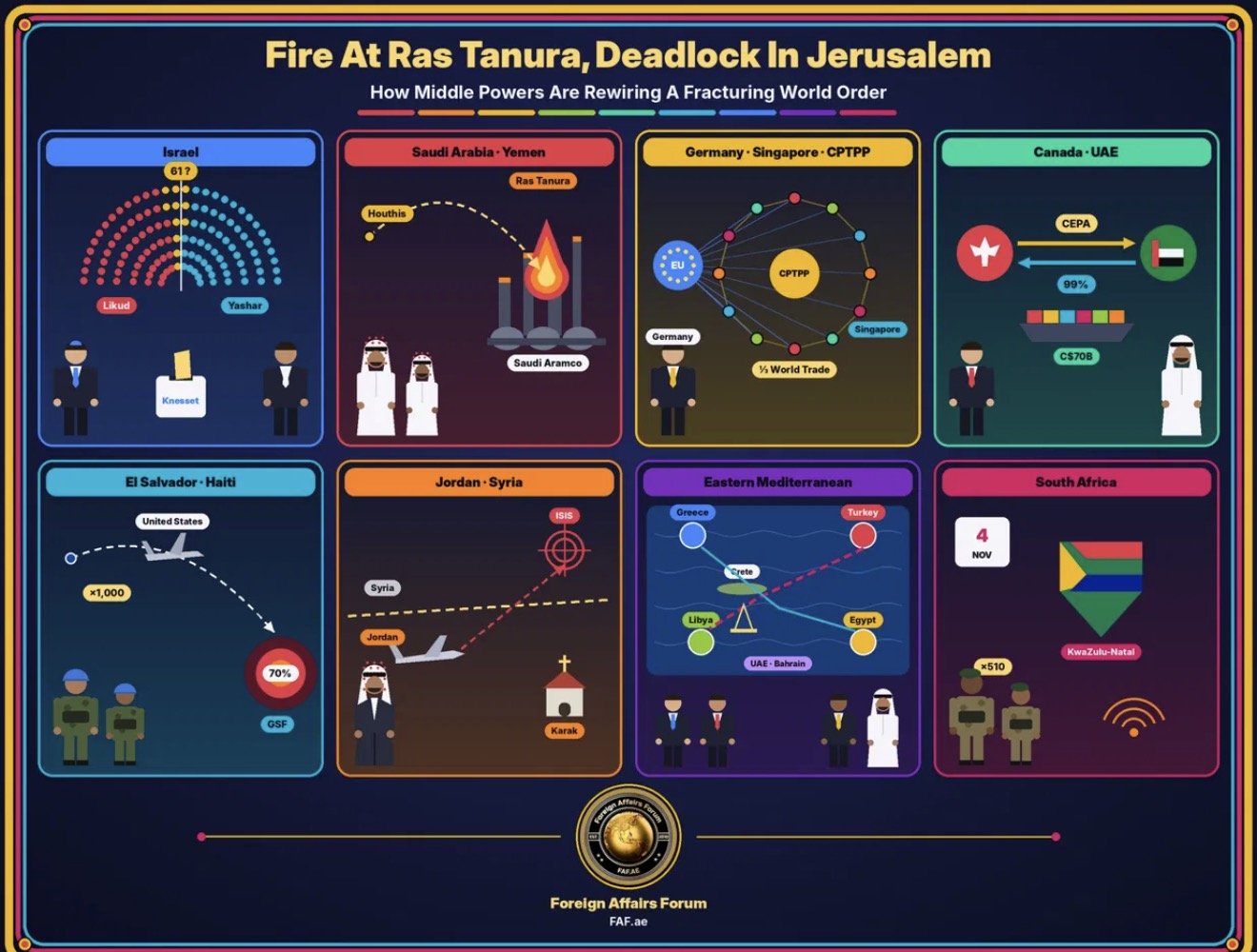
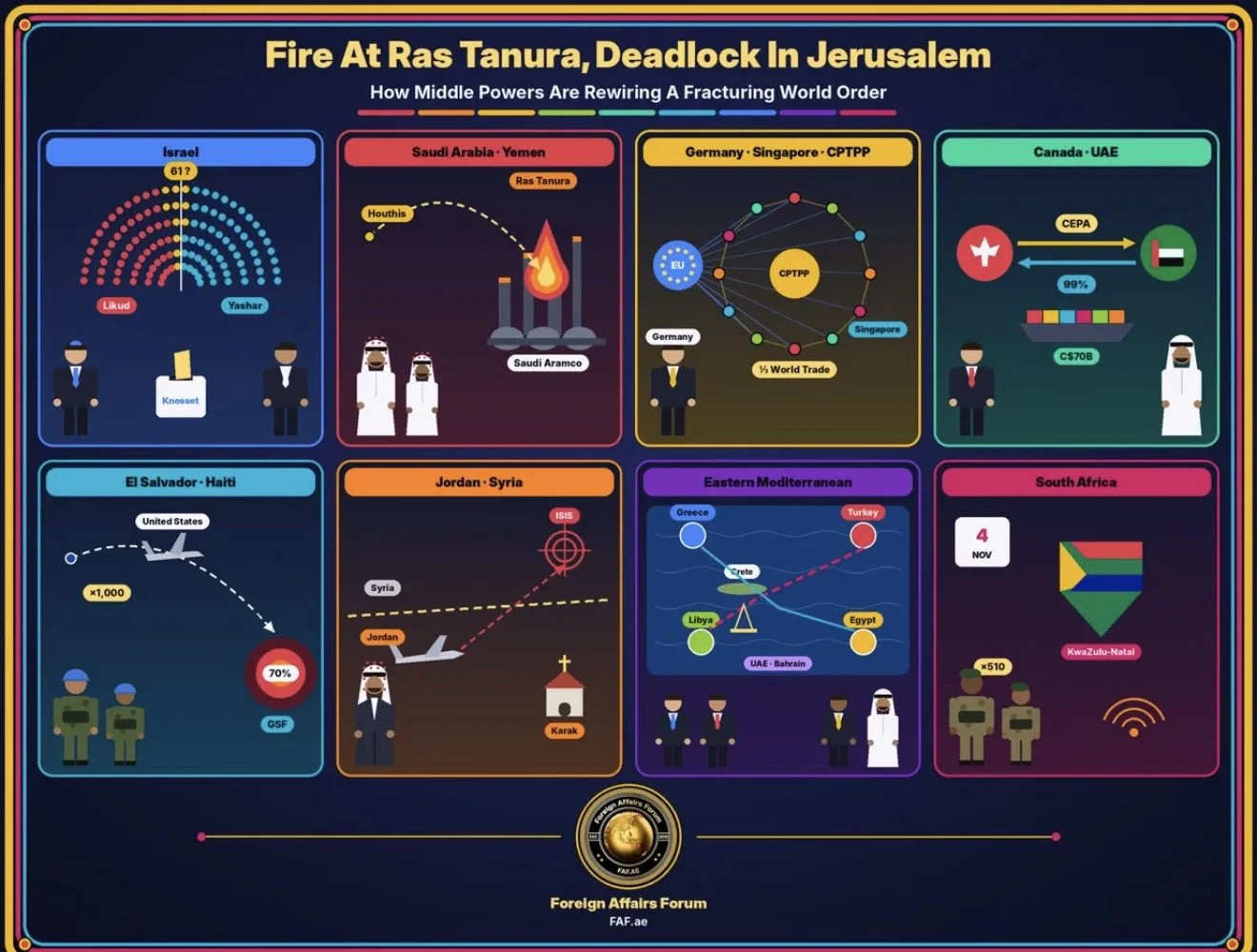
Some weeks in world news feel like a list of unrelated stories. This week was different. An election in Israel, a missile attack on a Saudi oil site, a new trade idea from Germany, a trade deal between Canada and the United Arab Emirates, soldiers sent to Haiti, airstrikes in Syria, a sea border fight in the Mediterranean and unrest in South Africa all happened within days of each other.
Dr. 🆎, the CEO of the Foreign Affairs Forum and an expert on artificial intelligence, global strategy and security, believes these stories are linked. "The world is not falling apart," he says. "It is rewiring itself. Countries that used to depend on one or two big powers are building new connections of their own."
This FAF article explains what happened, why it matters and what may come next.
Israel Votes but Gets No Clear Winner
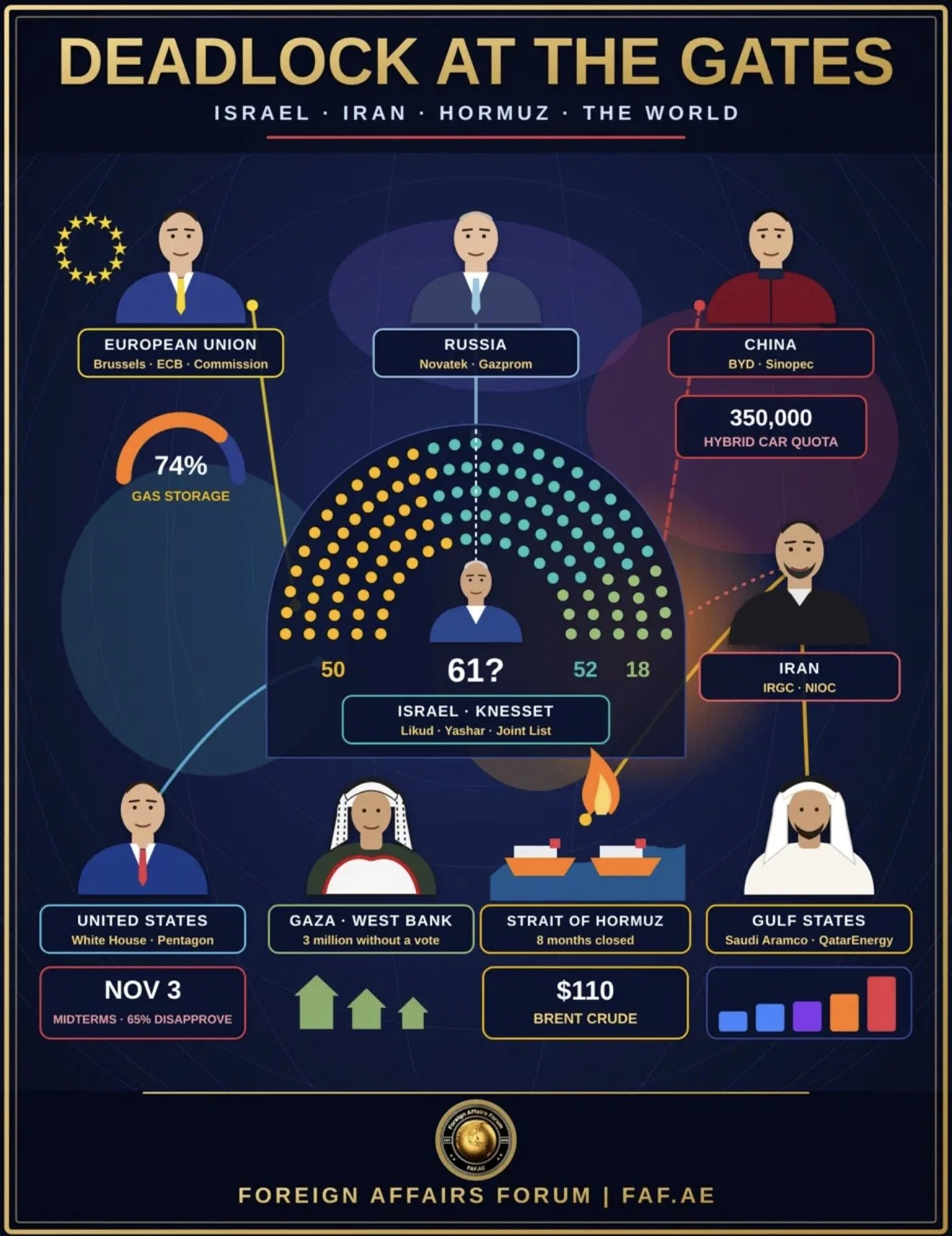
Israel held its general election on October 27. The two main figures were Prime Minister Benjamin Netanyahu and Gadi Eisenkot, a former army chief who leads a new party called Yashar. Opinion polls before the vote showed Eisenkot's party ahead, but neither side looked able to win the sixty-one seats needed to control parliament.
That is exactly what seems to have happened. Now the parties must bargain to form a government. This can take weeks or months, and if it fails, Israel could face yet another election. During that time Netanyahu stays in charge as caretaker.
This matters because Israel is still involved in conflicts on several fronts. Dr. 🆎 explains: "When a country at war has no clear government, its enemies may test it. Other countries also find it harder to predict what it will do."
Oil Under Fire in Saudi Arabia
On the same day as the Israeli election, the Houthis, an armed movement in Yemen backed by Iran, said they had hit Saudi Arabia's Ras Tanura oil complex with a ballistic missile. Ras Tanura is the kingdom's biggest refinery and one of its two main ports for sending oil abroad. Reports said a fire near the terminal was put out. Saudi officials did not confirm the strike.
This was not the first attack. Ras Tanura was hit by Iranian drones in March, after a wider war with Iran began in February. Since September, the Houthis have repeatedly attacked Saudi airports, ports and oil sites, including the headquarters of the oil company Aramco on October 13.
Why should people far away care? Because oil from the Gulf powers factories, cars and homes across Asia, Europe and Africa. Even small attacks push up shipping and insurance costs, and those costs eventually reach ordinary shoppers. Dr. 🆎 puts it simply: "A cheap drone or missile can threaten something worth billions. Protecting energy sites now needs smart early-warning systems and fast repair teams, not just air defences."
Germany's Big Trade Idea
In Singapore, German Chancellor Friedrich Merz suggested that the European Union build a closer partnership with a group of twelve Pacific countries known as the CPTPP. The group includes Japan, Canada, Australia, the United Kingdom, Vietnam and others. Together, Europe and these countries make up more than one-third of world trade.
Merz said Europe should not cut itself off from China. Instead, it should avoid depending too much on any one country. His idea covers trade, technology and security.
So far this is only a proposal, not a signed deal. Still, it shows a clear direction. Dr. 🆎 explains: "Europe has learned that relying on one big partner is risky. Having many trusted partners makes you stronger, especially for things like rare minerals, computer chips and AI technology."
Canada and the UAE Sign a Fast Trade Deal
Canada and the United Arab Emirates signed a major trade agreement this week. The two countries finished negotiating it in just forty-seven days, faster than any trade deal either country has made before.
When fully in place, the deal will remove or cut taxes on more than 99% of the goods Canada currently sells to the UAE. Trade between the two countries was worth about C$3.5 billion in 2025, and both governments hope to double it within ten years. The UAE has also promised to invest up to C$70 billion in Canada. The deal is expected to start in 2027, once both countries approve it.
For Canada, the agenda is clear. Prime Minister Mark Carney wants Canada to rely less on the United States, its biggest trading partner, after years of trade tension. For the UAE, the deal adds another partner to its growing network of agreements around the world.
El Salvador Sends Troops to Haiti
Haiti has suffered for years from powerful armed gangs. They control about 70% of the capital, Port-au-Prince, and around one and a half million people have been forced from their homes. An international force approved by the United Nations is trying to help, but it has only about two thousand soldiers, far fewer than planned.
On October 18, gangs attacked an armoured vehicle carrying four soldiers from El Salvador. The vehicle was hit by explosives and caught fire, and the four men went missing. Later reports said their bodies may have been found, though this had not been officially confirmed. In response, El Salvador sent about one thousand more troops to Haiti, with help from American military planes.
More soldiers could help push back the gangs. But fighting in crowded city streets is dangerous for ordinary people. Dr. 🆎 warns: "Soldiers alone cannot fix Haiti. The country also needs working police, courts and prisons. Without them, any gains will not last."
Jordan Strikes Inside Syria
On October 23, gunmen attacked a funeral at a Christian church in the village of Hamoud in southern Jordan, killing as many as nine people. Jordan blamed extremists. Its air force then bombed suspected Islamic State fighters across the border in southern Syria and said it had killed more than twenty militants.
Syria, however, said seven civilians had died, including three children. Jordan said it was sorry for the civilian deaths, but Syria called the strikes a violation of its territory. Even so, both countries promised to work more closely on border security.
This case shows how hard it is to fight terrorist groups that cross borders. Dr. 🆎 says: "A precise bomb is only as good as the information behind it. Countries fighting the same enemy must share intelligence carefully and check targets with real human judgement."
A Sea Border Fight in the Mediterranean
In 2019, Turkey signed a deal with one of Libya's governments that drew a sea border between the two countries. Greece says this border ignores its islands, especially Crete, and takes away its rights to the sea and to possible gas fields. Egypt also rejects the deal.
For years, the parliament in eastern Libya refused to accept it. On October 20, it suddenly approved the deal. Now Egypt, Bahrain and the UAE have joined Greece in criticising it, and the European Union and Israel have objected too. Turkey insists the deal is legal.
This matters because both Greece and Turkey belong to NATO, the Western military alliance. A dispute over the sea could make tensions between them worse and delay gas exploration and shipping plans in the region.
South Africa Calls in the Army
In South Africa, anger against foreign migrants has turned violent again. Protesters have attacked shops, burned vehicles and hurt foreign nationals in the province of KwaZulu-Natal. False information about a court decision on asylum seekers has made things worse. Thousands of migrants have left South Africa this year.
President Cyril Ramaphosa has sent five hundred and ten soldiers to help the police until November 30. Local elections take place on November 4, which makes the situation more sensitive.
Dr. 🆎 sees a lesson for every country: "A single false message online can bring angry crowds onto the streets faster than officials can respond. Governments must be able to share the truth quickly and clearly."
What Connects These Stories
Several big patterns run through this week's news.
First, middle-sized countries are becoming more active. Germany, Canada, the UAE, El Salvador, Egypt and Jordan are all making bold moves of their own instead of waiting for the United States or China to act.
Second, the weak points of modern countries have changed. Oil terminals, sea borders, trade rules and public trust can all be damaged without a full-scale war.
Third, problems at home affect power abroad. Israel's political deadlock and South Africa's unrest both show that a country with internal troubles finds it harder to protect its interests overseas.
What Happens Next
Five things are worth watching. Will Israel form a stable government, or head to another election? Will attacks on Saudi oil sites cause real damage to oil exports? Will other European and Asian countries support Germany's trade idea? Will the extra troops in Haiti bring real security, or a longer and messier fight? And will the dispute over Mediterranean sea borders stay in the courtrooms and conference rooms, or spill onto the water?
The Bottom Line
This week showed that the world is becoming more crowded with important players. That can be good, because more partners and more choices make the system harder to bully. It can also be risky, because more players mean more chances for clashes and confusion.
Dr. 🆎 offers a clear final thought: "The countries that will do best in the coming years are those that keep themselves safe, trade with many partners and keep their own institutions strong and trusted. Technology will matter enormously, but in the end, trust, good leadership and steady commitment will decide who succeeds."