The Hormuz Gambit: How Energy, Industry and Finance Have Become the New Instruments of Power
Foreign Affairs Forum | Dr. Antonio Bhardwaj (Dr. 🆎) | October 14th 2026
Executive Summary
The international system entered the middle of October 2026 under a pressure that is simultaneously military, industrial and financial.
Seven developments reported on October 13th and 14th reveal a common pattern: the decisive contests of this period are being fought over the physical and economic arteries that sustain national power, rather than over territory alone.
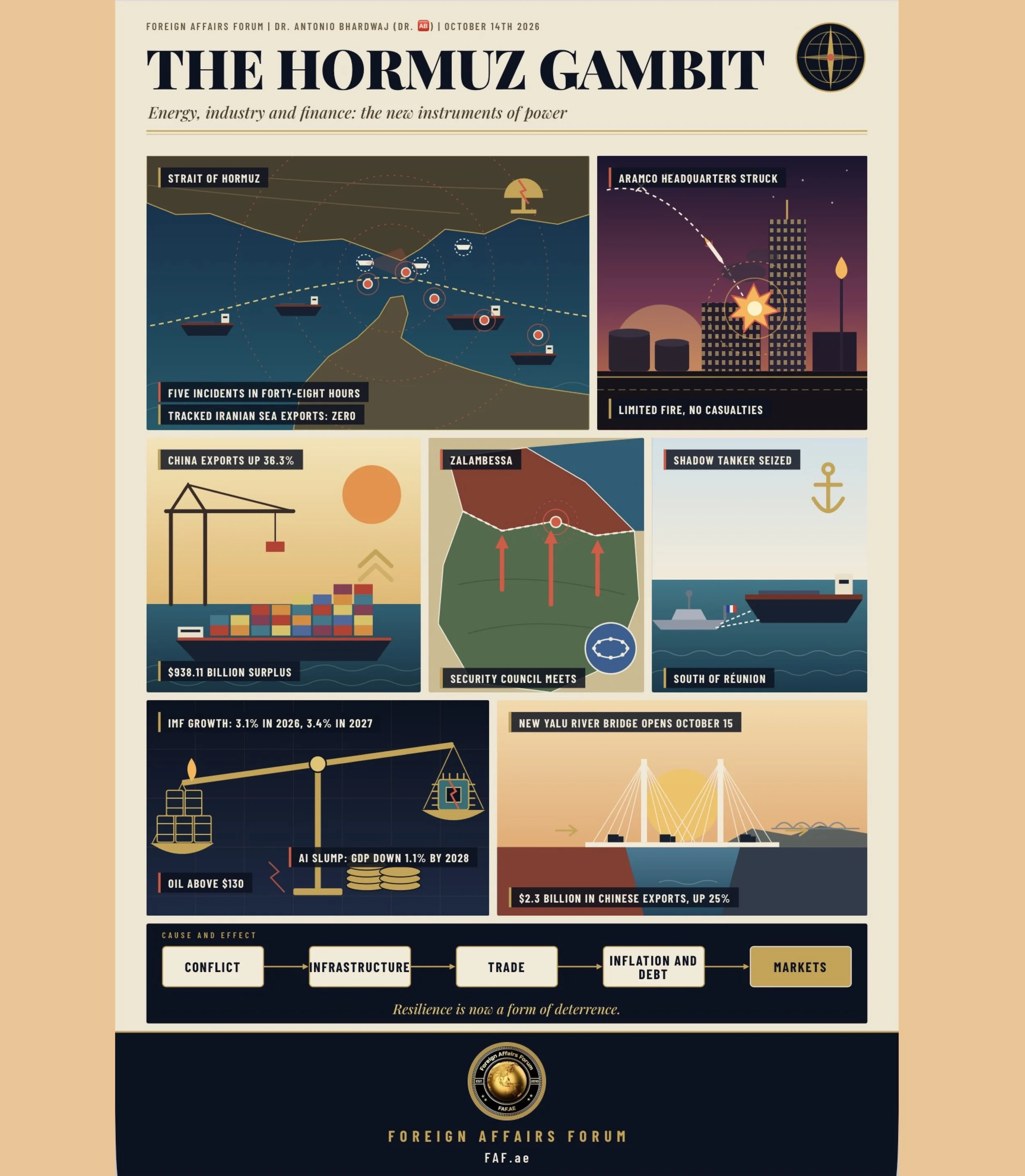
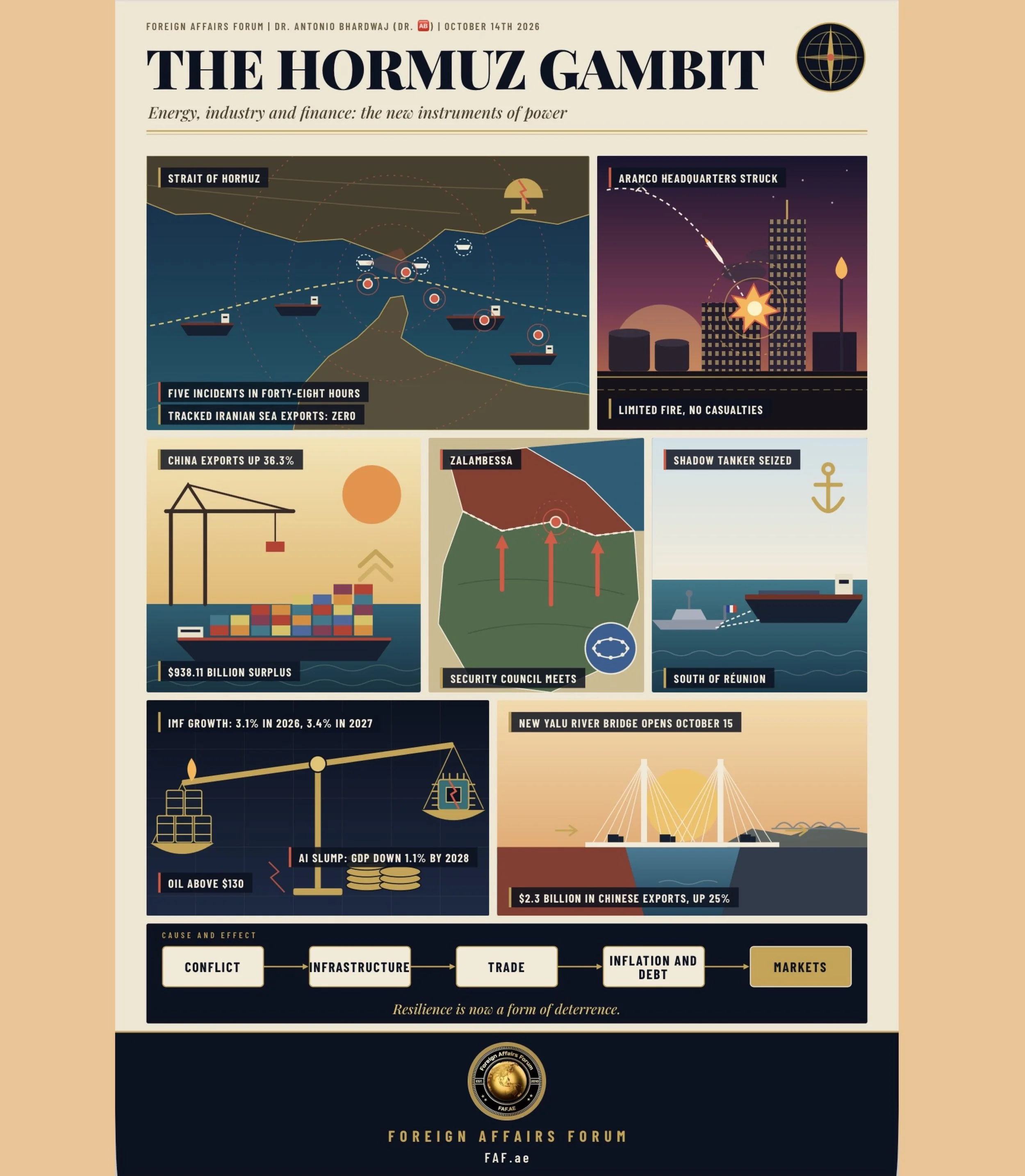
Iran has adopted new maritime tactics that extend its pressure on commercial shipping beyond the Strait of Hormuz, while a missile strike has damaged an administrative building within the headquarters complex of Saudi Aramco in Dhahran.
China reported a 36.3% year-on-year surge in September exports, far above the forecast of roughly 25.5%.
Ethiopian forces have reached the border town of Zalambessa, raising the prospect of interstate war with Eritrea.
France has seized another tanker linked to Russia's sanctions-evading fleet.
The International Monetary Fund has warned that conflict, public debt and a possible correction in artificial intelligence investment could together threaten global growth.
China and North Korea are preparing to open the long-delayed New Yalu River Bridge.
This article argues that these events form a causal chain rather than a collection of separate crises.
Military pressure exposes infrastructure vulnerability, vulnerable infrastructure disrupts trade, disrupted trade feeds inflation and fiscal strain, and these in turn destabilize financial markets and constrain the policy options of governments.
The most acute risk lies in the Gulf, where Iranian maritime pressure and Houthi strikes on Saudi targets threaten both the movement and the management of energy supplies.
The most structurally significant development is the continued expansion of Chinese industrial power, which strengthens Beijing's leverage even as its domestic economy remains subdued. The most dangerous emerging regional confrontation is in the Horn of Africa.
Dr. 🆎 contends that the analytical error most common among policymakers is to treat each of these episodes as a discrete event to be managed in isolation. In his assessment, the stakeholders who will prevail in this environment are those who understand that resilience is now a form of deterrence.
The article concludes with practical steps for governments, energy exporters, importers, financial authorities and multilateral institutions, stressing diplomatic channels in the Gulf, maritime surveillance and insurance coordination, the protection of critical infrastructure, and a more honest accounting of the financial vulnerabilities that a geopolitical shock would amplify.
Introduction
Every era of international politics has its characteristic instruments. The nineteenth century relied on the gunboat and the balance of power, the Cold War on nuclear deterrence and ideological alliance, and the early 21st century on financial sanctions and the weaponization of interdependence.
The events of October 13th and 14th,2026 suggest that a further transition is under way. The contest among states is increasingly waged over shipping lanes, refineries, administrative control centers, customs ledgers, tanker registries and the bridges that connect economies. Power is being measured less by the territory a state holds than by the networks it can protect, disrupt or command.
Dr. Antonio Bhardwaj (Dr. 🆎), Chief Executive Officer of the Foreign Affairs Forum and a polymath with global expertise in superintelligence, specializes in human-centered approaches to geopolitical strategy, artificial intelligence in warfare, and the risks of bioterrorism. His work has long stressed that the technologies and systems that make modern societies prosperous also make them fragile. In his view, the present moment confirms that observation with unusual clarity. A missile that strikes an office tower in Dhahran does not need to destroy a single barrel of oil to alter the calculations of investors in Singapore, insurers in London and finance ministers in Delhi. The signal itself is the weapon.
This article examines seven developments that were reported in the last two days and that together illuminate the shape of the contemporary international landscape. It begins with the historical background necessary to understand why these particular regions and instruments matter, and it describes the current status of each major crisis. It then analyzes the key developments in turn, sets out the latest facts and the concerns they raise, and constructs a cause-and-effect analysis that connects them. It closes with a set of future steps and a conclusion.
Throughout, the analysis draws on the reasoning of Dr. 🆎, whose emphasis on human judgment in an age of increasingly automated systems offers a useful corrective to the technological determinism that often distorts strategic debate.
A note on method is warranted.
The facts reported here are those available as of October 14th, 2026, and several remain contested or incomplete. Where figures describe tracked activity, such as maritime crude exports, they should not be mistaken for a complete account of reality. Where governments have made accusations, such as those exchanged between Ethiopia and Eritrea, the allegations are described as allegations. The aim is analytical rigor rather than premature certainty, because the greatest danger in a period of rapid change is to mistake a plausible narrative for an established fact.
History and Current Status
The Persian Gulf and its approaches have been central to the global economy for the better part of a century.
The Strait of Hormuz, a narrow passage between Iran and Oman, carries a substantial share of the world's seaborne oil, and its vulnerability has shaped strategic planning in Washington, Beijing, Delhi and the Gulf capitals since the tanker war of the 1980s.
Iran has long regarded its ability to threaten that passage as a form of strategic insurance, and it has periodically demonstrated the capacity to harass commercial shipping, seize vessels and complicate insurance markets. What distinguishes the present crisis is its duration and its geographical ambition.
According to senior Iranian officials who spoke to Reuters, Tehran has now adopted new tactics that extend operations beyond the strait itself, with the stated purpose of keeping pressure on oil prices ahead of the American midterm elections in November.
Saudi Arabia's exposure is of an older and more painful kind. The kingdom's war in Yemen, which began in 2015, has produced a persistent cycle of Houthi missile and drone attacks on Saudi territory.
The 2019 attack on the Abqaiq processing facility demonstrated that a small number of well-placed strikes could temporarily remove a significant fraction of global oil supply from the market, and it shattered the assumption that Saudi infrastructure was invulnerable.
The latest strike, which hit an administrative building in the headquarters complex of Saudi Aramco in Dhahran, follows several days of Houthi strikes on Saudi targets and of Saudi-led operations in Yemen.
The complex is reported to house an important operations center overseeing Saudi petroleum infrastructure, which gives the attack a significance well beyond its limited physical damage.
The industrial rise of China is a slower story but a more consequential one.
Over four decades, China has transformed itself from a low-cost assembler into the central node of global manufacturing, electronics and increasingly artificial intelligence supply chains.
Western governments responded in recent years with tariffs, export controls and programs of supply-chain diversification, and yet the latest figures indicate that these measures have not diminished Chinese export capacity.
The cumulative trade surplus for the first nine months of 2026 reached approximately $938.11 billion, which puts China on course to exceed $1 trillion earlier in the year than it did in 2025.
The Horn of Africa has its own long memory of interstate war. Ethiopia and Eritrea fought a devastating border war between 1998 and 2000, in which the town of Zalambessa was a major site of contest, and a prolonged period of hostility followed until the diplomatic rapprochement of 2018. That rapprochement was subsequently complicated by Ethiopia's internal conflict in Tigray and by Eritrea's involvement in it. The present crisis therefore revives a geography of grievance in which both governments retain deep suspicion of the other.
The sanctions regime against Russia has similarly evolved. After the imposition of Western price caps and embargoes on Russian oil, Moscow assembled a fleet of aging tankers operating under opaque ownership and flexible registration to carry its petroleum to buyers outside the Western system.
For several years, European governments responded with financial sanctions and the designation of individual vessels. Recent episodes, including the French seizure of the tanker DF Peak, suggest that enforcement is moving from the ledger to the sea.
Finally, the relationship between China and North Korea has always reflected both dependence and distrust.
The New Yalu River Bridge was completed on the Chinese side in 2014 but remained unused for more than a decade because the North Korean approach infrastructure was unfinished and bilateral relations deteriorated. Its scheduled opening on October 15th follows the recent inauguration of North Korea's first road bridge with Russia, and it occurs against a background of rapidly increasing trade, with Chinese exports to North Korea reaching approximately $2.3 billion in 2025, an increase of 25% over the previous year.
The current status of the international landscape can be summarized as one of simultaneous and interlocking pressures.
Gulf energy infrastructure is under physical threat, global trade is being reshaped by Chinese industrial strength, a regional war may be about to cross an international boundary, European states are experimenting with physical enforcement of sanctions, and the multilateral financial institutions are warning of vulnerabilities that a shock could magnify.
Key Developments
The first and most urgent development concerns the maritime campaign around Hormuz.
Senior Iranian officials told Reuters that Iran has adopted new tactics against commercial vessels, including operations beyond the strait, and that the intention is to maintain pressure on oil prices ahead of the American midterm elections.
A United States military official confirmed that Iranian forces have begun using small boats as maritime spotters following damage to their radar capabilities, and Reuters identified at least five recent security incidents involving commercial vessels in the area within 48 hours.
Maritime intelligence data published on October 13 indicated that Iranian seaborne crude exports had fallen to zero, while other Gulf exporters had substantially recovered their shipments. These figures concern tracked exports and do not establish that all Iranian oil movements have ceased.
Dr. 🆎 observes that the use of small boats as spotters is strategically revealing, because it demonstrates adaptation under degradation. A stakeholder that loses its sophisticated sensors does not necessarily lose its coercive capacity; it substitutes cheap human observation for expensive technology and continues to impose costs on its adversaries.
The second development is the strike on the Saudi Aramco headquarters complex in Dhahran.
Saudi Arabia's Energy Ministry confirmed a limited fire and reported no casualties, while a company source said that an office tower had sustained damage. The attack followed several days of Houthi missile and drone strikes against Saudi targets and of Saudi-led military operations in Yemen. The significance lies in the progression of targets, from civilian aviation facilities toward infrastructure associated with the management of Saudi energy production. According to Dr. 🆎, the most important question is not what was damaged but what was demonstrated. The ability to reach the administrative core of the world's most important energy exporter, even with limited effect, tells every investor and every government that the nerve center is within range.
The third development is the surge in Chinese exports.
Customs data show that exports rose 36.3% year over year in September, far above the forecast of approximately 25.5%, while imports increased 31%. The trade surplus for the first nine months of 2026 reached approximately $938.11 billion. The strength of exports contrasts with continuing weakness in domestic consumption and investment, which implies that Chinese growth remains dependent on foreign demand.
Dr. 🆎 argues that this pattern is both a strength and a vulnerability. It demonstrates the depth of Chinese manufacturing capacity, but it also increases the likelihood that importing economies will respond with protective measures, since a surplus of this magnitude is politically unsustainable for trading partners facing their own industrial anxieties.
The fourth development is the military advance of Ethiopian forces into Zalambessa, near the Eritrean border.
Ethiopia has accused Eritrean troops of entering its territory, and Eritrea denies the allegation. The United Nations Security Council was scheduled to discuss the crisis, and Eritrea has requested international action against Ethiopia, invoking Chapter VII of the United Nations Charter. The risk is that a conflict that has hitherto been largely internal will become a direct confrontation between two states, in a region already burdened by the civil war in Sudan. Because the Horn of Africa lies close to the Red Sea shipping corridors, escalation there has implications that extend to global trade.
The fifth development is the French interception of the tanker DF Peak, approximately 450 nautical miles south of Réunion Island. The vessel, previously named Kaliningrad, had been sanctioned by Western governments, and French authorities cited concerns about its registration and possible illicit fuel transportation.
Russia condemned the seizure as piracy and challenged its legality. The episode is notable because it occurred in the Indian Ocean, far from European waters, and because it represents a shift from financial to physical enforcement.
Dr. 🆎 notes that this shift transforms the legal and diplomatic character of sanctions, since the seizure of a vessel at sea is a more visible and more provocative act than the freezing of a bank account.
The sixth development is the International Monetary Fund's updated outlook, released during its annual meetings in Bangkok.
The Fund forecasts global growth of 3.1% in 2026 and 3.4% in 2027, but it makes clear that the projections depend partly on improving shipping conditions in the Middle East. It warned that a prolonged conflict keeping oil prices above $130 through the first quarter of 2027 could reduce next year's global growth by approximately 0.5 percentage point, and that a severe decline in artificial intelligence investment could reduce global gross domestic product by 1.1% by 2028 relative to its baseline scenario. The combination of geopolitical supply shock and concentrated technology risk is the central concern.
The seventh development is the scheduled opening, on October 15, of the New Yalu River Bridge between China and North Korea, as announced by Chinese state media.
Together with the recent opening of the first road bridge between North Korea and Russia, it indicates that Pyongyang is building physical connections with both of its principal neighbors. The implications for sanctions enforcement remain uncertain, but the direction is clear.
Dr. 🆎 suggests that North Korean isolation is becoming more selective rather than less severe, a distinction that matters because selective openness can strengthen resilience without requiring any change in strategic behavior.
Latest Facts and Concerns
The most pressing concern is the interaction between maritime disruption and energy pricing.
The evidence of at least five security incidents involving commercial vessels around Hormuz within 48 hours suggests that the campaign is not a series of isolated provocations but a sustained effort.
The reported intention to influence oil prices ahead of the American midterm elections introduces an explicitly political dimension: Tehran is attempting to convert economic disruption into electoral and diplomatic leverage. Because the mechanism operates through prices and perceptions rather than through the destruction of physical capacity, it is difficult to counter with conventional military means alone.
A second concern is the quality of the data on which assessments rest.
The reported collapse of tracked Iranian seaborne crude exports to zero is striking, yet tracked exports are not the same as total movements, and shipments that are concealed, transferred between vessels or stored may not appear in the data.
Prudent analysis must therefore resist the temptation to infer either that Iranian revenue has been eliminated or that the pressure campaign is being conducted from a position of strength. Both inferences would exceed the evidence. The concurrent recovery of other Gulf exporters suggests that physical supply is adapting, but adaptation under threat is fragile.
A third concern is the distinction between administrative and operational damage in Saudi Arabia.
A fire in an office building is not a reduction in petroleum output. The decisive question is whether subsequent attacks will reach production, refining, pipelines or export terminals. The strike on Dhahran is troubling less for what it destroyed than for what it implies about reach, and the concern is that a campaign that begins with administrative targets may progress to operational ones.
A fourth concern is the direction of Chinese trade.
A trade surplus approaching $1 trillion is a political fact as much as an economic one. Importing economies will face pressure to respond, and the likelihood of additional European and American protective measures is high.
The risk is a cycle of retaliation that damages global growth precisely when the International Monetary Fund is warning of fragility.
A fifth concern is the possible escalation in the Horn of Africa.
The critical indicator is whether the two armies engage directly across the international border. The involvement of the United Nations Security Council indicates the seriousness of the situation, but the Council's record in constraining interstate conflict involving parties with powerful patrons is mixed. The strategic interest of China, the United States, Turkey and the Gulf states in the region complicates any diplomatic settlement.
A sixth concern is the sustainability of sanctions enforcement at sea.
Each seizure raises the risk of an incident, and Russia's characterization of the French action as piracy signals a willingness to contest the legality of such operations. Whether European governments can construct a durable maritime enforcement system, with the naval resources, legal foundations and insurance arrangements it requires, remains uncertain.
The seventh and most diffuse concern is the financial system's capacity to absorb a combined shock.
The Fund's warning that a decline in artificial intelligence investment could reduce global output by 1.1% by 2028 illustrates how concentrated valuations have become. High sovereign debt, elevated bond yields and concentrated technology valuations could together amplify a geopolitical shock into a broader crisis.
Cause-and-Effect Analysis
The relationships among these developments can be understood as a sequence in which each stage conditions the next. The sequence begins with military conflict and coercion, passes through infrastructure vulnerability, produces trade disruption, generates inflation and fiscal pressure, and culminates in financial-market instability.
The value of this model is that it directs attention away from the immediate military facts and toward the transmission mechanisms by which those facts reach the wider economy.
Consider first the link between military pressure and infrastructure vulnerability.
Iran's use of small boats as spotters, and the Houthi strike on a Saudi administrative complex, both illustrate a principle that Dr. 🆎 has emphasized repeatedly: asymmetric stakeholders do not need to defeat a more powerful adversary; they need only to impose costs that exceed the adversary's willingness to bear them. Cheap instruments, whether small boats or missiles and drones, can threaten assets worth many orders of magnitude more than their own cost. This asymmetry is the central logic of contemporary coercion, and it explains why infrastructure has become the preferred object of attack.
The second link runs from infrastructure vulnerability to trade disruption.
Maritime incidents raise insurance premiums and shipping costs even when no vessel is lost, because insurers price risk and not only damage. Attacks on energy facilities raise the geopolitical risk premium on oil even when production is unaffected, because investors price the probability of future attacks. In both cases, the effect on trade operates through expectations. The strikes need not succeed to impose costs; they need only be credible.
The third link connects trade disruption to inflation and fiscal pressure.
If oil prices remain elevated, importing economies face higher fuel and transport costs, which feed into broader price levels and complicate the decisions of central banks. The International Monetary Fund's scenario of oil above $130 through the first quarter of 2027 illustrates the possible magnitude, with a reduction in global growth of approximately 0.5 percentage point. Meanwhile, prolonged conflict increases fiscal demands on governments, as defense spending, energy subsidies and reconstruction costs compete with other priorities. Emerging economies that import energy are especially exposed, because higher fuel costs can combine with currency pressure and capital outflows.
The fourth link leads from inflation and fiscal pressure to financial-market instability.
Persistent inflation can keep long-term borrowing costs elevated, which raises the cost of servicing public debt and weighs on equity valuations. Concentrated valuations in artificial intelligence companies amplify this vulnerability, because a correction in one sector can propagate rapidly through indices and portfolios. The Fund's warning that the simultaneous occurrence of an energy shock and a technology correction is the principal danger reflects precisely this compounding effect.
The model also operates in the opposite direction, and here the analysis becomes more subtle. Financial fragility constrains the policy options available to governments responding to military threats. A government facing high borrowing costs and weak growth has less capacity to fund naval patrols, energy resilience or defense modernization. In this sense, the financial and military dimensions are mutually reinforcing, and a weakness in one reduces the capacity to respond to a threat in the other.
China's position within this framework deserves particular attention. Chinese export strength is both a cause and an effect of the wider disruption. It is a cause in that the scale of Chinese manufacturing shapes the strategic calculations of every other major economy, and it is an effect in that persistent global demand for Chinese goods reflects the inability of other economies to produce at comparable cost.
The risk is that surpluses of this magnitude invite protective responses, which in turn reduce global trade volumes and add to the inflationary and fiscal pressures described above. China's growing connections with North Korea, through the new bridge, extend its economic influence into a neighboring state that is also strengthening ties with Russia, and thereby weave a web of dependence that complicates any attempt at coordinated sanctions.
The European enforcement of sanctions at sea represents a distinct causal strand. By moving from financial to physical measures, European governments raise the cost of Russian oil exports, but they also raise the risk of incidents and of retaliation.
The effect on energy markets depends on the scale of enforcement. A handful of seizures may impose compliance costs and widen the discounts on sanctioned crude without altering global supply, whereas a sustained campaign could change the economics of the shadow fleet and, with it, the availability of Russian oil to price-sensitive buyers.
Dr. 🆎 offers a further observation on the human dimension of this causal chain. Systems that appear automatic, such as insurance markets, shipping routes and financial exchanges, depend ultimately on human perceptions of safety and trust. When those perceptions shift, the effects can be abrupt and nonlinear. In his judgment, the most dangerous feature of the present landscape is that perception can move faster than policy, and that a single dramatic event could trigger a repricing of risk across multiple domains simultaneously.
Future Steps
The first priority is diplomatic and military de-escalation in the Gulf.
Governments with influence over Tehran and over the Houthi leadership should make clear that attacks on commercial shipping and on energy infrastructure impose costs that extend to all stakeholders, including those who initiate them.
Negotiations that are already under way should be insulated from the electoral calendars of the states involved, since the reported linkage between Iranian maritime pressure and the American midterm elections suggests that domestic politics is distorting the diplomatic timetable.
In parallel, Gulf states and their partners should expand maritime surveillance and coordinated escort arrangements, drawing on lessons from the adaptation of Iranian tactics, including the use of small boats as spotters.
Dr. 🆎 recommends that surveillance architectures be designed with human oversight at their core, so that automated detection systems support rather than replace the judgment of trained operators who can distinguish a fishing vessel from a hostile craft.
The second priority is the hardening of energy infrastructure.
Saudi Arabia and other producers should protect not only production and export facilities but also the administrative and operational control centers on which they depend.
This requires redundancy, geographic dispersion of critical functions, and robust defenses against missiles and drones, including counter-drone technologies. Importing economies should expand strategic reserves, diversify supply sources and invest in energy resilience, recognizing that the vulnerability of the Gulf is a vulnerability of the global system. The distinction between administrative and operational damage should guide the allocation of resources, with the greatest protection reserved for assets whose loss would reduce petroleum output.
The third priority is the management of trade tensions arising from Chinese industrial strength.
Governments in Europe and North America should resist the temptation to respond with indiscriminate protection, which would add to inflationary pressures, and should instead pursue targeted measures in strategically critical sectors, coordinated among allies to avoid cycles of retaliation. At the same time, China should recognize that surpluses on this scale are politically destabilizing and that rebalancing toward domestic consumption would serve both its own interests and the stability of the global system.
Dr. 🆎 emphasizes that supply-chain resilience in artificial intelligence and related technologies is a strategic necessity rather than a commercial preference, and that allied governments should invest jointly in diversified capacity.
The fourth priority is the prevention of interstate war in the Horn of Africa.
The United Nations Security Council, the African Union and regional powers should act quickly to establish verification mechanisms along the border, to create channels for direct communication between the two militaries, and to address the underlying grievances that make the region susceptible to escalation.
External stakeholders with strategic interests in the region, including China, the United States, Turkey and the Gulf states, should coordinate their diplomatic efforts rather than compete for influence, since a war between Ethiopia and Eritrea would threaten the Red Sea corridors on which all of them depend.
The fifth priority is the construction of a durable and legally sound maritime enforcement framework for sanctions.
European governments should clarify the legal basis for the seizure of vessels at sea, coordinate with insurers and flag registries, and prepare for the diplomatic and operational responses that Russia may pursue. Without a clear legal foundation, enforcement risks appearing arbitrary, which would weaken both its legitimacy and its effectiveness.
The sixth priority is financial preparedness.
Finance ministries and central banks should stress-test their systems against the combined scenario that the International Monetary Fund has identified, in which an energy shock coincides with a correction in artificial intelligence valuations. They should also communicate clearly with markets, because ambiguity in a period of tension magnifies volatility. Multilateral institutions should expand contingency financing for energy-importing emerging economies, which are the most exposed to fuel price spikes, currency pressure and capital outflows.
The seventh priority concerns the new connections on the Korean peninsula.
Governments concerned with sanctions enforcement should monitor the flow of goods across the New Yalu River Bridge and the Russian road crossing, and should engage Beijing and Moscow in discussions about the application of existing restrictions. The objective is not to prevent legitimate trade but to ensure that the new infrastructure does not become a conduit for prohibited transfers.
Underlying all of these steps is a broader principle that Dr. 🆎 has advanced throughout his work: that human-centered judgment must remain at the heart of strategic decision-making, even as artificial intelligence and automated systems become more capable. In an environment in which perceptions can shift rapidly and signals can be misread, the quality of human deliberation is the ultimate safeguard against escalation.
Conclusion
The seven developments examined in this article are not isolated episodes.
They are expressions of a single underlying transformation, in which the instruments of national power are shifting from territory and armies toward the networks that sustain economic life.
Iran's expanded maritime pressure and the strike on Saudi Aramco's headquarters complex show that energy infrastructure is the most immediate point of vulnerability.
China's export surge, the opening of the bridge to North Korea and European enforcement against Russian tankers show that industrial and logistical networks have become instruments of strategic competition.
The warning from the International Monetary Fund shows that the financial system sits downstream of all of these pressures and could magnify them.
The central lesson is that resilience is now a form of deterrence. A state that can protect its infrastructure, diversify its supplies, sustain its financial credibility and keep open its diplomatic channels is less vulnerable to coercion and therefore less likely to be targeted. A state that neglects these foundations invites pressure, regardless of the size of its armed forces.
Dr. 🆎 reminds us that the greatest strategic risks are often those that arise from the interaction of familiar threats rather than from any single novel danger. The combination of energy disruption, trade friction, regional war and financial concentration is more dangerous than the sum of its parts, because each amplifies the others. The task before governments is therefore not simply to respond to each crisis but to understand the system in which they occur and to act on its points of leverage.
The coming weeks will test this proposition.
The behavior of oil markets, the trajectory of the Gulf campaign, the diplomatic response to the confrontation between Ethiopia and Eritrea, and the reaction of bond and equity markets to the Fund's warnings will indicate whether the international system can absorb the present pressures or whether they will compound.
Whatever the outcome, the events of October 13th and 14th, 2026 confirm that the defining feature of this period is the growing connection between military security and economic infrastructure. Governments increasingly compete not only over territory and diplomatic influence, but also over the transport networks, industrial capacity, energy systems and financial resources that sustain national power.