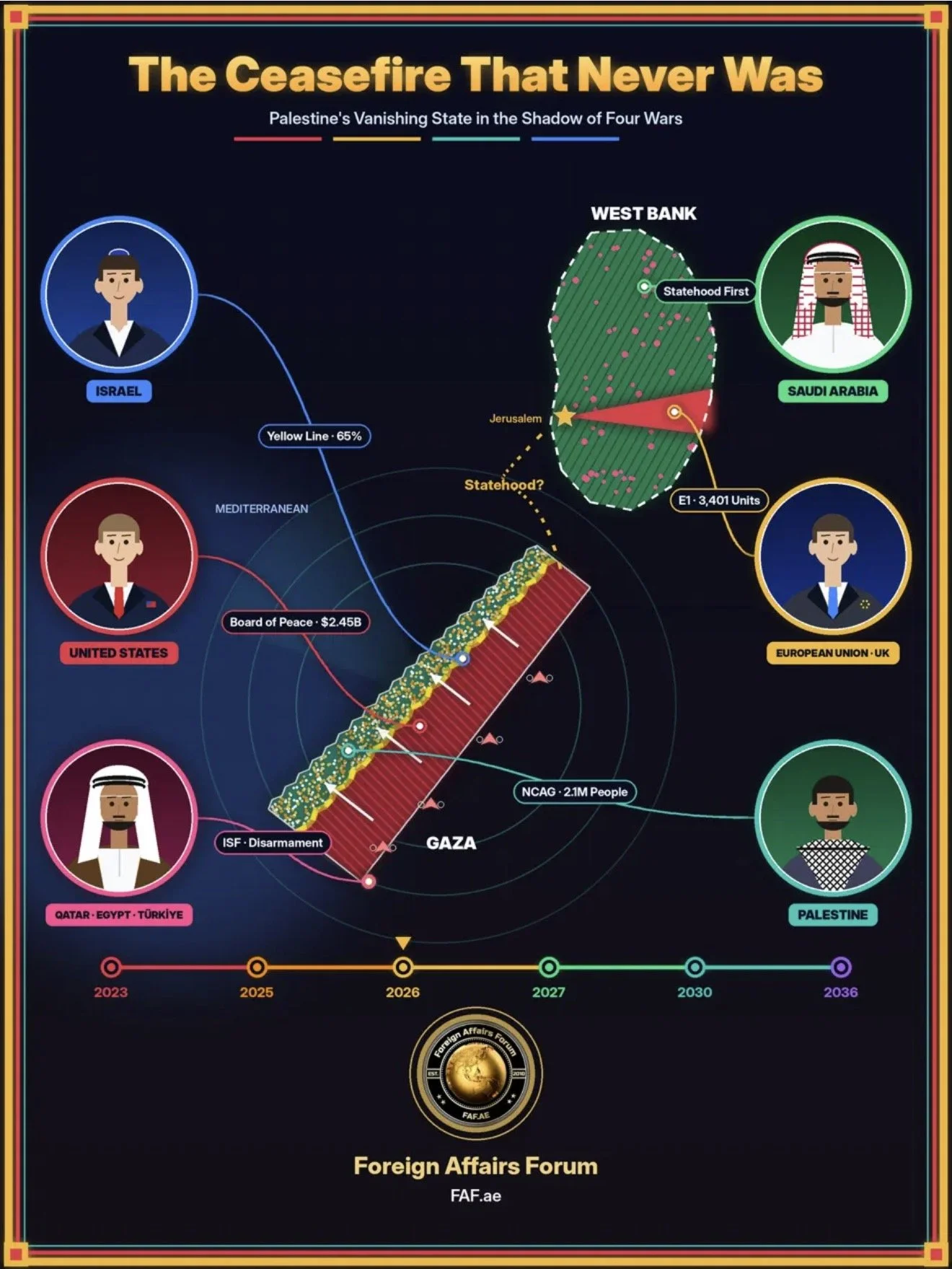
The Ceasefire That Never Was: Palestine's Vanishing State in the Shadow of Four Wars
Foreign Affairs Forum | Dr. Antonio Bhardwaj (Dr. 🆎)| October 27th 2026
Executive Summary
A year after the October 2025 ceasefire was meant to end the most destructive chapter in the long Israeli-Palestinian conflict, Gaza is stuck between war and peace.
The West Bank, meanwhile, is being reshaped faster than at any time since 1967.
Gaza's Health Ministry counts about fifteen hundred Palestinians killed since the truce took effect, including more than three hundred and twenty children and one hundred and forty women.
The cumulative toll since October 2023 has passed 74,000.
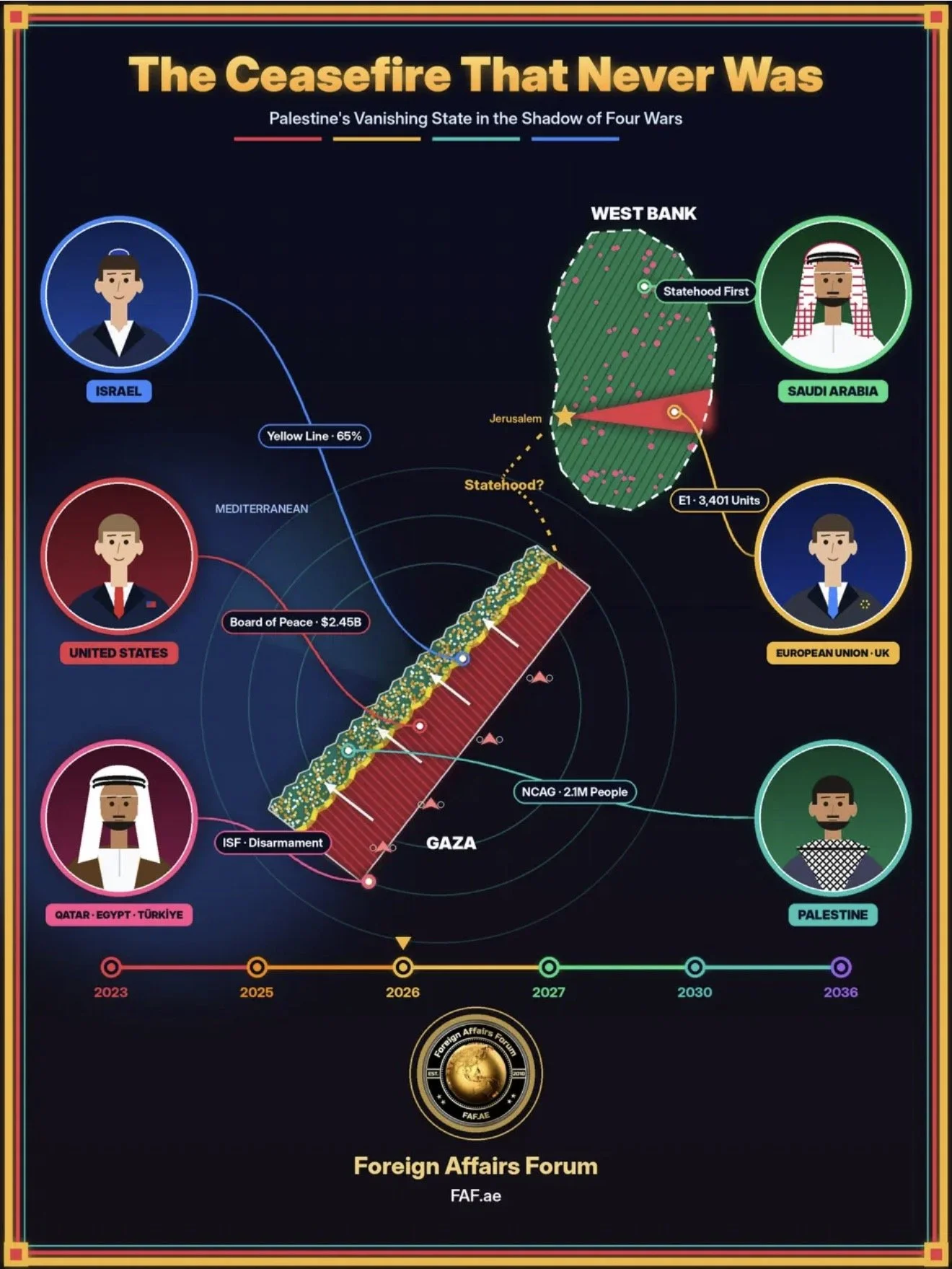
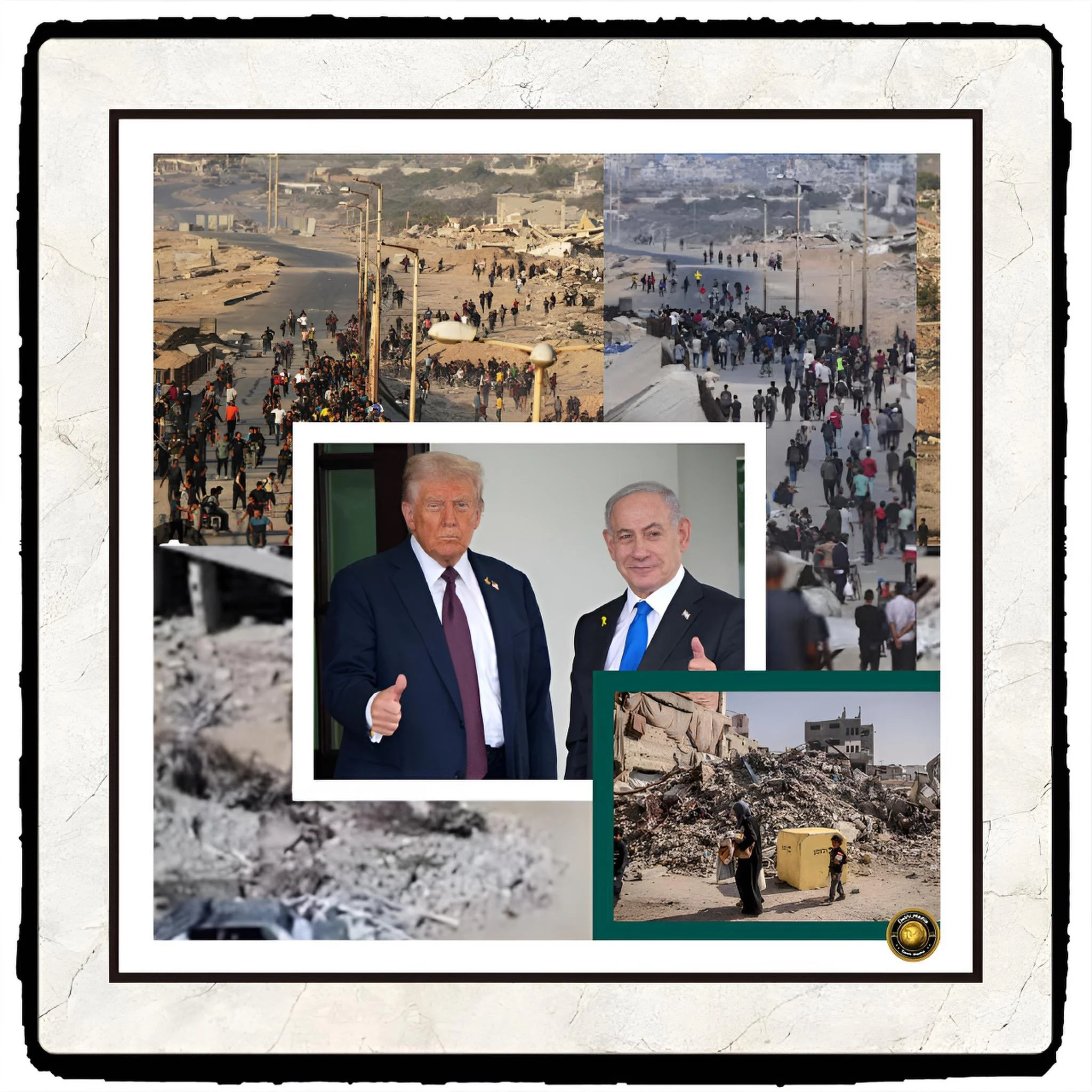
Israeli military control has grown from 53% of the Strip at the start of the ceasefire to between 60% and 65% today, pressing more than two million people into a shrinking coastal zone.
Not one of Gaza's thirty-six hospitals operates at full capacity, about 1.4 million people face crisis-level hunger, and nearly two million still lack adequate shelter as winter approaches.
Diplomacy has not been idle, but it has been hollow.
The Board of Peace, chaired by President Donald Trump, has unveiled a $2.45 billion, six-month recovery blueprint covering 66 projects. It puts the full cost of rebuilding at $35.2 billion over the medium term and a further $71.4 billion over the coming decade. In Cairo, mediators from Egypt, Qatar, Türkiye and the United States negotiated a phased framework for collecting Hamas's weapons.
None of these instruments has moved from paper into practice. Israel will not admit the Palestinian technocratic committee or allow large-scale reconstruction until Hamas is fully disarmed. Hamas links the surrender of heavy weapons to Palestinian statehood. The Palestinian Authority has pushed its promised general elections back to September 2027.
In the West Bank, Israel has now advanced tenders for all three thousand four hundred and one housing units in the E1 corridor east of Jerusalem. It has also revived land registration powers and shifted policing functions, creating facts on the ground that any successor government would struggle to undo.
Israelis vote today in an election that polls suggest may end in deadlock, and American voters go to the polls next week amid an unpopular war with Iran.
This FAF article argues that the Palestinian state is being eroded less by any single decision than by an accumulation of postponements. Its survival depends on whether outside stakeholders, chiefly Washington, Riyadh and Brussels, turn declaratory support into binding costs and incentives before the window closes.
Introduction: A War the World Has Learned to Ignore
Gaza has slipped from the front pages because the world's attention is stretched across a crowded landscape of crises, not because its suffering has ended.
The Russia-Ukraine war grinds on in its fifth year.
The war between the United States and Iran began on February 28th 2026 with joint American and Israeli strikes. It has passed through an April ceasefire, a June memorandum of understanding and repeated rounds of Qatari and Omani mediation, yet the two sides remain deadlocked over the Strait of Hormuz. American voters head into midterm elections in a week.
Israelis are voting today for the 26th Knesset.
In this crowded field, a ceasefire that exists mostly on paper has become easy to overlook.
Yet the stakes in Gaza and the West Bank have not shrunk. Whether a Palestinian state remains possible is not a narrow regional question. It is a test of whether international law, great-power mediation and the logic of partition that has governed this conflict since 1947 still carry weight, or whether they have been displaced by accumulated force.
Dr. Antonio Bhardwaj (Dr. 🆎), Chief Executive of the Foreign Affairs Forum, is a polymath with global expertise in Super Intelligence who specialises in human-centred SI for geopolitical strategy, AI warfare and bioterrorism risk. He describes the current moment in stark terms. "What we are witnessing is the normalisation of permanent interim arrangements," Dr. 🆎 observes. "Every temporary line, every provisional committee, every phase that never begins hardens into structure. History rarely abolishes states with a single signature. It starves them of time, territory and legitimacy until recognition becomes a ceremony without a country."
This FAF article asks four questions.
What is the realistic future of a Palestinian state?
What does Israel actually want, beneath the rhetoric of its election campaign?
What does the United States want from a process it designed and now chairs?
And how is the rest of the world, from the Gulf to Europe to the Global South, adjusting its expectations?
History and Current Status: From Oslo's Promise to the Yellow Line
The modern landscape of the conflict was set by the partition plan of 1947, the war of 1948 and the Israeli occupation of the West Bank, East Jerusalem and Gaza in 1967.
The Oslo Accords of the 1990s created the Palestinian Authority as an interim body that was meant to give way to a final-status agreement within five years. That agreement never came. Instead, the interim became permanent.
The West Bank was divided into Areas A, B and C, with Israel retaining full control over Area C, roughly 60% of the territory and home to most of its settlements.
Israel's withdrawal from Gaza in 2005, Hamas's victory in the 2006 legislative elections and its violent takeover of the Strip in 2007 split Palestinian governance in two.
Gaza became a blockaded enclave under Hamas rule, while the Palestinian Authority, dominated by Fatah, administered parts of the West Bank. The last Palestinian legislative elections took place in January 2006, two decades ago.
The Hamas-led attack of October 7th 2023 killed about twelve hundred people in Israel and took roughly two hundred and fifty hostages. Israel's military campaign in response became the deadliest and most destructive in the history of the conflict.
A ceasefire in January 2025 collapsed by March. In September 2025, President Trump unveiled a twenty-point plan that exchanged the release of all remaining hostages for a phased Israeli withdrawal, Hamas disarmament, a technocratic Palestinian administration and an international stabilisation force.
The plan was signed on October 9th 2025, took effect the following day and was endorsed by the United Nations Security Council through Resolution 2803.
The same autumn brought a wave of diplomatic recognition. France, the United Kingdom, Canada and Australia recognised the State of Palestine in September 2025, raising the total number of recognising states to about one hundred and sixty. Several of those recognitions were explicitly tied to Palestinian Authority commitments, including general elections in 2026 from which Hamas would be excluded.
The architecture created by the ceasefire is now in place, at least on paper.
The National Committee for the Administration of Gaza, a body of nonpartisan Palestinian technocrats, was established in January 2026. United States Major General Jasper Jeffers was named commander of the International Stabilization Force the same month.
A logistics hub known as Life Support Area Endurance has been built near Kerem Shalom to stage the force. Indonesia said up to eight thousand of its troops would be ready for deployment, and Uganda and Morocco have also committed personnel.
In July 2026, Israel's security cabinet approved the legal framework allowing the force to enter Gaza.
The reality on the ground looks very different.
The so-called Yellow Line, which marks the boundary between Israeli-held territory and the rest of the Strip, has moved steadily westward.
A United Nations commission of inquiry reported on October 26th that Israeli forces now control at least 60% of Gaza, and other assessments put the figure closer to 65%. The technocratic committee has not been allowed to govern inside Gaza.
The stabilisation force has not deployed at scale. The second phase of the plan, formally announced in January 2026, has barely begun.
Key Developments: Four Stakeholders, Four Incompatible Visions
What Israel wants is the question on which everything else turns, and the honest answer is that Israel's political class is more united than its election campaign suggests.
Prime Minister Benjamin Netanyahu's government has made Hamas's complete disarmament the precondition for any withdrawal, reconstruction or Palestinian governance in Gaza.
Israeli officials argue, with some justification, that Hamas has not handed over its weapons, still controls much of the population outside the Yellow Line, and has repeatedly rebuilt its military capacity after past truces. From this perspective, holding territory is not a violation but insurance.
Beyond Gaza, senior ministers have been explicit about their aims in the West Bank.
Finance Minister Bezalel Smotrich has said that approving E1 effectively buries the idea of a Palestinian state, and he describes his policies as a push toward Israeli sovereignty over what the government calls Judea and Samaria. Critics describe this as the pursuit of a "Greater Israel." Supporters describe it as securing historic and strategic depth.
The election is unlikely to change this foundation.
Pre-election polls put Gadi Eisenkot's Yashar party ahead with about twenty-two seats against roughly twenty for Netanyahu's Likud, with Naftali Bennett's alliance in third place.
The opposition bloc averages around seats and the Netanyahu bloc around fifty, both short of the sixty-one needed to govern. Bennett has historically opposed Palestinian statehood, and Eisenkot, a former military chief, has run on security competence rather than a two-state platform.
"The mistake many observers make is assuming that a change of prime minister equals a change of doctrine," Dr. 🆎 notes. "After October 7th, Israeli strategic culture moved toward a consensus on permanent security control. A new coalition may change the tone, the treatment of allies and the handling of the judiciary. It is far less likely to surrender the Jordan Valley, freeze E1 or accept a sovereign Palestinian army."
What the United States wants is more layered.
The Trump administration designed the ceasefire, chairs the Board of Peace and has invested considerable presidential prestige in being seen to end the war. Its plan contains conditional language about a possible pathway to Palestinian self-determination once reform and reconstruction advance, but it sets no timeline and no territorial parameters. Washington has repeated that it does not support Israeli annexation of the West Bank, yet it deliberately avoided condemning the E1 tenders.
The administration's larger regional goal is to expand the Abraham Accords and secure Saudi-Israeli normalisation. It has reportedly made a civil nuclear cooperation agreement with Riyadh contingent on Saudi Arabia joining the Accords. American priorities are also shaped by the Iran war, which is politically unpopular at home ahead of the midterms.
A Pew Research Center poll in March 2026 found that 60% of American adults held an unfavourable view of Israel, a striking shift in a country where support for Israel was long a bipartisan given.
The Board of Peace itself has become a test of American credibility. Its high representative for Gaza, Nickolay Mladenov, has said the ultimate goal is a demilitarised Gaza under civilian control, with reconstruction proceeding alongside an Israeli withdrawal. He has also acknowledged that talks with Israel were difficult during the election campaign.
The Board reportedly expects implementation to accelerate only after the Israeli election and the American midterms. In a recent diplomatic cable, United States Ambassador Mike Huckabee questioned whether either the Board or the embassy in Jerusalem has enough staff to manage disarmament, security and reconstruction at once.
Critics have also noted that no Palestinian sits on the Board's central or Gaza executive boards, and that the Board has excluded UNRWA, the United Nations agency for Palestinian refugees, from its list of partners.
The Arab and Gulf states have hardened rather than softened their positions.
Saudi Arabia has repeatedly said that normalisation with Israel requires an irreversible pathway to a Palestinian state, and has at times gone further by insisting on a sovereign state along the 1967 lines with East Jerusalem as its capital.
In August 2026, the foreign ministers of Saudi Arabia, the United Arab Emirates, Qatar, Egypt, Jordan, Türkiye, Indonesia and Pakistan jointly denounced the E1 project as a dangerous escalation.
Egypt, Qatar and Türkiye remain guarantors of the Gaza arrangements, and Qatar is also mediating between Washington and Tehran.
The Gulf states' leverage is real. Without their capital, Gaza's reconstruction cannot be financed, and without Saudi normalisation, Washington's regional design remains incomplete.
Europe is divided but moving.
In September 2026, the British government declared the Israeli occupation unlawful and announced that it would amend its sanctions regime to target companies supporting settlements.
The European Union has sanctioned violent settlers and settler organisations, but proposals to partially suspend the trade provisions of the EU-Israel Association Agreement have repeatedly failed to reach a qualified majority.
Germany and Italy remain the decisive holdouts, while Spain, Ireland, Slovenia and Belgium push for stronger measures.
Trade in goods between the bloc and Israel was worth €42.6 billion in 2024, and a partial suspension could affect about €5.8 billion of Israeli exports.
Hamas and the Palestinian Authority, the two Palestinian stakeholders, each undermine the case for statehood in different ways.
Hamas has agreed in principle to an "inventory and storage" of weapons under Palestinian and international supervision, but it rejects disarmament carried out by Israel and links the surrender of heavy weapons to the creation of a state.
The Palestinian Authority, led by the 90 old Mahmoud Abbas, published a provisional constitution in February 2026 and held local elections in April. It then postponed legislative elections scheduled for November 28th 2026, setting presidential and legislative elections for September 11th 2027 instead. Polling shows that 79% of Palestinians want Abbas to resign.
Latest Facts and Concerns: The Arithmetic of a Slow Emergency
The humanitarian figures tell a story that diplomatic communiqués avoid. Since the ceasefire took effect, Israeli fire has killed or wounded a Palestinian in Gaza on average every ninety minutes, according to Islamic Relief.
More than 100 humanitarian, human rights and civil society organisations marked the ceasefire's first anniversary by declaring that it exists in name only.
Nearly one child has been killed every day since the truce was announced. Israel disputes these characterisations and says its strikes target militants who violate the agreement and threaten its forces, while Hamas-run authorities do not distinguish between civilians and combatants in their figures.
Gaza's social fabric has been deeply altered. Women now head nearly one in four households because husbands have been killed, detained, injured or are missing. Displaced families live in cemeteries and in the shells of bombed buildings.
Aid delivery has improved since the famine declared in August 2025, but it remains hostage to crossing closures, banned items and bureaucratic restrictions. At points during 2026, a single crossing served as the only entry for United Nations-approved supplies. The import of construction materials, needed to rebuild homes, remains tightly restricted.
On October 26th, a United Nations commission of inquiry concluded that genocidal acts have continued despite the ceasefire, and it accused Israeli forces of war crimes and crimes against humanity in the West Bank. Israel rejected the findings.
The commission also recorded that Israeli air strikes killed two hundred and fifty-four Palestinians in the West Bank between October 2023 and September 2026, compared with six between 2008 and October 2023. That shift captures how the methods of war in Gaza have migrated into the occupied territory.
The West Bank is where the future of statehood is being decided most quietly. Israel's security cabinet decided in February 2026 to publish the West Bank land registry and revive a committee for acquiring state land.
In August, policing powers began shifting to the civilian Israeli Police, which Palestinian analysts see as a step toward formal annexation. Settlement building permits exceeded twenty-three thousand in 2025, more than three times the 2012 level.
The E1 tenders, covering 1234 units in August and 2167 in September, would split the West Bank into northern and southern parts and cut East Jerusalem off from its Palestinian hinterland.
Key stages of the tender process were timed to finish before a new government takes office. Settler violence during this autumn's olive harvest has further disrupted Palestinian rural life.
A further concern relates to the Board of Peace's governance. A British newspaper investigation raised questions about potential conflicts of interest involving Jared Kushner's private equity firm.
The Board rejected the reporting as sensationalist with little substance, but the episode highlights a broader problem: an unprecedented body with sweeping authority over a population that is not represented in its leadership.
"There is also a public health dimension that security planners consistently underestimate," Dr. 🆎 warns. "When sanitation, water and hospital systems collapse in one of the most densely populated places on earth, you create conditions for disease outbreaks that do not respect checkpoints or yellow lines. From a biosecurity perspective, a degraded Gaza is not a contained problem. It is a regional risk incubator, and every month of delay increases that risk."
Cause and Effect Analysis: How Postponement Becomes Policy
The first causal chain is a sequencing trap. Israel insists that disarmament must come before withdrawal and reconstruction.
Hamas insists that withdrawal and an end to strikes must come before disarmament, and it ties its heavy weapons to statehood. Because neither side will move first, the process stalls. Stalemate does not mean stasis, however. During the stall, Israel has expanded its territorial control, and each westward shift of the Yellow Line makes Hamas less willing to disarm, since disarmament would remove its only bargaining asset. The effect is a self-reinforcing loop in which delay rewards the stakeholder holding the ground.
The second chain is the distraction effect of the Iran war.
Since February, American diplomatic and military attention has been absorbed by the Strait of Hormuz, through which about 20% of the world's oil and liquefied natural gas passed before the war. Gulf states that would finance Gaza's reconstruction have themselves come under fire, including attacks on Saudi energy installations. Capital that might have flowed to Gaza is being held back for defence, insurance and economic stabilisation at home. Gaza is therefore paying an indirect price for a separate war.
The third chain is electoral.
The Board of Peace has effectively paused major decisions until after the Israeli election and the American midterms. Israeli coalition-building can take weeks or months, and the polls suggest that neither bloc will win a majority alone. Each electoral pause extends the period in which interim arrangements harden. Meanwhile, governing parties have an incentive to lock in facts before they leave office, as the E1 timetable shows.
The fourth chain links West Bank fragmentation to the hollowing out of recognition.
A state needs contiguous territory, a functioning economy and an accountable government. E1 threatens contiguity, land registration threatens property claims, and the transfer of policing threatens the separation between occupation and sovereignty.
The more fragmented the territory becomes, the more recognition turns into a symbolic gesture rather than a practical path. This is the central paradox of the moment: more countries than ever recognise a Palestinian state at the very time that the territorial basis for one is shrinking fastest.
The fifth chain concerns Palestinian legitimacy.
The postponement of elections confirms the doubts of critics who argue that the Palestinian Authority cannot be trusted to deliver reform. Western governments that tied recognition to elections have not said what consequences will follow.
This weakens recognition as leverage on both Palestinian and Israeli behaviour. The absence of a legitimate Palestinian leadership also strengthens Israeli arguments that there is no credible partner, which in turn reinforces the status quo.
The sixth chain is technological, and it is where Dr. 🆎 sees the least appreciated change.
"Occupation used to be expensive in manpower, money and international reputation," Dr. 🆎 explains. "Persistent drone surveillance, biometric checkpoints, sensor networks and AI-assisted targeting have changed that cost curve. When control becomes cheaper to maintain, the incentive to negotiate weakens. Algorithmic security creates an illusion that a political problem can be managed indefinitely by technical means. That illusion is dangerous, because it removes urgency from diplomacy while the grievances underneath keep accumulating."
The cumulative effect of these chains is that the default outcome is not peace or war but a managed partition.
Under that scenario, Israel retains a large military zone inside Gaza, the Palestinian population is concentrated in a western strip dependent on aid, the West Bank continues to fragment, and a Palestinian state exists mainly in diplomatic recognitions.
Future Steps: Three Pathways and a Narrow Door
Three broad pathways lie ahead.
The first is the managed partition just described, a frozen conflict that could last years.
It would leave Gaza permanently divided, keep reconstruction confined to small pilot zones and expose the region to recurring cycles of violence. It is the path of least resistance, which is why it is the most likely if nothing changes.
The second pathway is renewed war.
If the ceasefire collapses, whether through a major attack, a mass-casualty strike or a breakdown in the Iran talks, the region could return to large-scale fighting. Gaza's remaining population would face catastrophic conditions, and pressure for what some Israeli politicians call "voluntary emigration" would intensify, raising fears of permanent displacement.
The third pathway is incremental implementation, and it is narrow but not closed.
It would require several steps taken in parallel rather than in sequence. The International Stabilization Force would deploy into areas between the Israeli-held zone and the rest of Gaza. The technocratic committee would enter and begin governing. The inventory and storage of Hamas weapons would start under verified international supervision. Israeli forces would withdraw in measured stages tied to verified milestones. Reconstruction finance would flow in tranches linked to clear benchmarks that apply to all sides, not only to Palestinians.
Several practical measures could make the third pathway more likely.
First, the Board of Peace should include Palestinian representatives in its decision-making, because a governance system that excludes the governed cannot build legitimacy.
Second, Washington should apply the same clarity to West Bank annexation that it applies to Hamas disarmament, including an explicit freeze on E1.
Third, Saudi Arabia and the Gulf states should make their reconstruction finance conditional on a published timetable for withdrawal and Palestinian governance.
Fourth, the European Union should use its trade leverage, including partial suspension of the Association Agreement, linked to verifiable changes in settlement policy. Fifth, Palestinian elections should be held on a credible date, with Gulf and European support for a genuine renewal of leadership rather than another postponement.
Dr. 🆎 argues that technology can also help to build trust rather than only to enforce control. "The same tools used for surveillance can be repurposed for verification," Dr. 🆎 says. "An independent, multinational monitoring system using satellite imagery, sensor data and transparent dashboards could verify weapons storage, troop movements and aid flows in near real time. That would reduce the room for both sides to claim the other is cheating. Human-centred AI should serve as a referee, not a weapon."
The timelines matter. The Board's reconstruction estimates stretch to about 2036, ten years of rebuilding. If the first phase of credible implementation does not begin by 2027, the window for a contiguous Palestinian state alongside Israel may effectively close by 2030, regardless of how many more countries recognise it.
Conclusion: A State Postponed Is a State Denied
The future of the Palestinian state will not be decided in a single summit or a single election. It is being decided every day, in the movement of a yellow block in Gaza, the opening of a settlement tender in the West Bank, the postponement of a Palestinian vote and the hesitation of a European capital.
The October 2025 ceasefire stopped the worst of the bombing, returned the hostages and created a framework that could still lead somewhere. A year later, that framework is at risk of becoming a permanent waiting room.
Israel wants security and, for much of its political class, permanent control over the land between the river and the sea.
The United States wants a regional settlement that crowns its diplomacy without forcing a confrontation with its closest ally.
The Gulf states want a credible path to Palestinian statehood before normalisation.
Europe wants the two-state solution but has not yet agreed to pay the price of defending it. Palestinians want an end to the killing, the rebuilding of their homes and leaders they choose themselves.
These interests are not entirely incompatible, but they cannot be reconciled through postponement. "The greatest danger is not that the world has forgotten Gaza," Dr. 🆎 concludes. "It is that the world remembers it on a schedule, after the next election, after the next war, after the next crisis. A people cannot live on a schedule. Either the international community turns its declarations into deadlines, or history will record that a Palestinian state was recognised everywhere and built nowhere."