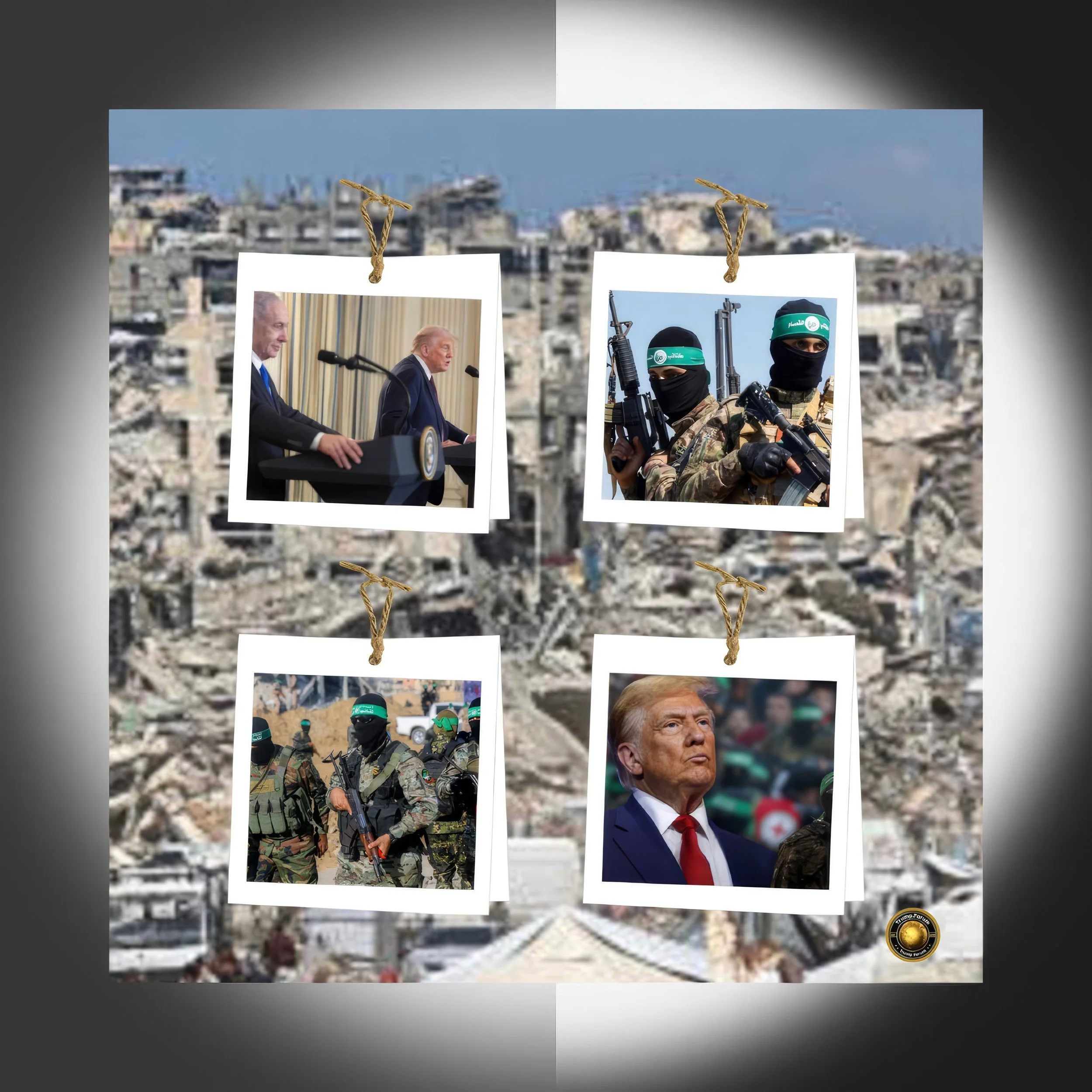
Trump's Gaza Impasse: The Disarmament Deadlock and the Architecture of a Stalled Peace
Executive Summary
The Comprehensive Plan to End the Gaza Conflict, introduced by U.S. President Donald Trump in September 2025, represented one of the most ambitious American diplomatic interventions in the Middle East in decades.
Built on a twenty-point framework co-presented with Israeli Prime Minister Benjamin Netanyahu, the plan sought to transition Gaza from a war-ravaged landscape of contested authority into a demilitarized, reconstructed territory governed by a technocratic committee under international supervision.
Its central and irreducible demand was the complete disarmament and decommissioning of Hamas, the Islamist movement that has governed Gaza since 2007.
Seven months into a fragile ceasefire, that central demand remains unmet.
Hamas has formally rejected disarmament proposals, accused international mediators of structural bias, and conditioned any progress on Phase II negotiations on the full implementation of Phase I commitments it claims Israel has not honored.
Secretary of State Marco Rubio acknowledged on April 27th, 2026, that without disarmament, the "entirety" of the agreement remains in question.
Israel, meanwhile, retains control of 53% of the Gaza Strip, humanitarian reconstruction pledges stand nearly unfunded, and the Gaza landscape teeters between frozen conflict and the threat of renewed war.
FAF analysis examines the structural, ideological, and strategic incentives that make Hamas disarmament extraordinarily difficult; traces the diplomatic history of the peace plan and its phased implementation; and assesses what the current impasse reveals about the limits of American power in shaping Palestinian political reality.
Introduction: A Peace Plan Without a Peace
When Donald Trump unveiled his twenty-point peace framework during the eightieth session of the United Nations General Assembly in late September 2025, it was greeted with cautious optimism in some quarters and deep skepticism in others.
The plan was broad — a document of principles rather than a binding treaty with enforceable mechanisms — but it carried the weight of American prestige and the explicit endorsement of Israel's government.
It offered Hamas a stark choice: disarm and remain in Gaza as a political entity, or exit through designated safe passages. It promised reconstruction, international governance, and a three-year transitional period under an Arab-led international force, after which a reformed Palestinian Authority would assume control.
The UN Security Council endorsed the plan in November 2025.
The ceasefire that followed the plan's signing on October 9th held in its broad contours.
Hamas released its living hostages; Israel freed approximately 2000 Palestinian prisoners and withdrew forces to a predetermined boundary line. Yet even as those milestones were achieved, the deeper structural challenge embedded in the plan began to surface with uncomfortable clarity.
Hamas, the dominant Palestinian faction in Gaza, views its weapons not merely as tools of war but as the foundation of its political identity, its claim to legitimacy among the Palestinian population, and its guarantee of survival as an organization.
For Hamas, disarmament is not a tactical concession; it is an existential threat.
Meanwhile, Israel has shown little urgency to complete its own Phase I obligations, including full withdrawal from the territory it still occupies. Without progress on both sides, Phase II — which encompasses governance, reconstruction, and the final political settlement — has stalled indefinitely.
This is not, as some Western commentators have framed it, merely a negotiating impasse that can be resolved through diplomatic creativity or financial pressure.
It is a collision of fundamentally incompatible political logics that Trump's framework acknowledged in its text but did not resolve in its architecture.
Understanding why requires a careful examination of Hamas as a political organization, of the structural dynamics of the Gaza landscape, and of the multiple stakeholders whose competing interests have conspired to freeze the process at precisely its most consequential moment.
History and Context: Gaza's Arc of Contested Sovereignty
Gaza's political trajectory since the mid-twentieth century is defined by repeated cycles of war, ceasefire, incomplete peace, and renewed conflict.
The territory, a narrow coastal strip of land approximately forty kilometers long and twelve kilometers wide, is home to roughly two million people and has been under blockade since Hamas seized control in 2007, routing the Fatah-led Palestinian Authority in a violent internal confrontation.
Israel and Egypt, both of which share borders with Gaza, imposed a land, sea, and air blockade in response, restricting the movement of goods and people and leaving the territory economically dependent on international aid.
Hamas itself emerged from the Palestinian branch of the Muslim Brotherhood in the late 1980s, formally established during the First Intifada in 1987.
Its founding charter called for the destruction of Israel and the establishment of an Islamic state across historic Palestine.
A revised charter in 2017 softened some of that language, accepting the concept of a Palestinian state along the 1967 borders, though it did not explicitly recognize Israel's right to exist.
The organization has always operated on two tracks: a political wing that manages governance in Gaza, including public administration, schools, and social services, and a military wing — the Izz ad-Din al-Qassam Brigades — that has fought multiple wars with Israel and controls an extensive arsenal including rockets, anti-tank missiles, explosive devices, and a network of underground tunnels that stretches for hundreds of kilometers beneath Gaza's urban landscape.
The October seventh, 2023, attacks — in which Hamas fighters crossed into southern Israel, killing approximately twelve hundred people and taking around two hundred and forty hostages — precipitated the most destructive war in Gaza's history.
By the time the ceasefire took effect in October 2025, the war had killed tens of thousands of Palestinians, displaced nearly the entire population at some point during the conflict, and reduced vast portions of northern Gaza to rubble.
Yet Hamas, though severely degraded militarily, was not destroyed.
Israeli and American estimates placed the group's remaining arsenal at approximately sixty thousand Kalashnikov-style rifles, along with rockets, launchers, and explosives stored across a tunnel network that Israeli officials acknowledged remained largely intact.
Hamas's political structures, though battered, continued to function. The group's ideological infrastructure — its schools, mosques, and community networks — persisted. And critically, Hamas's leadership remained in place.
This is the landscape in which Trump's peace plan arrived. It was not a landscape of defeat and unconditional surrender, as some in the Israeli government had hoped the war would produce.
It was a landscape of contested authority, profound human devastation, and an adversary that had survived a military campaign intended to eliminate it.
The peace plan was, in this sense, an attempt to negotiate a political settlement with an organization that had not been militarily defeated and that possessed both the incentive and the capacity to resist the plan's most demanding requirements.
Key Developments: The Architecture of the Plan and Its Early Failures
The 20-point framework Trump presented was organized into three broad sections.
The first declared Gaza a "demilitarized zone, free from terrorism" and outlined the ceasefire terms, the hostage-prisoner exchange, and a partial Israeli withdrawal to a predetermined line — the so-called "Yellow Line" — that divided Hamas-controlled territory from the areas Israel continued to occupy.
The second section addressed governance, proposing the establishment of a National Committee for the Administration of Gaza (NCAG). This technocratic body would operate independently of Hamas and manage public services, humanitarian aid, and reconstruction.
The third section outlined the political horizon, including a three-year mandate for an international security force composed largely of Arab troops, after which the reformed Palestinian Authority would assume control.
Phase I was largely implemented between October 2025 and early 2026.
The hostage exchanges proceeded, UN humanitarian access was significantly expanded, and the ceasefire held despite numerous violations documented by international monitors.
The NCAG was formally launched in January 2026 as part of Phase II.
However, its actual operational capacity remained severely constrained because Hamas, which still controlled the civil administration, schools, hospitals, and police forces on the ground, refused to cede administrative authority to the new body.
Without security on the ground and without Hamas's cooperation, the NCAG was a governance body with a mandate but no mechanism for enforcement.
The disarmament question became the focal point of all subsequent negotiations.
In March 2026, U.S. officials presented Hamas with a formal disarmament proposal in Cairo, developed in consultation with Arab mediators including Egypt, Qatar, Saudi Arabia, and Turkey.
The proposal called for complete decommissioning of all militant groups in Gaza, beginning with the heaviest weaponry — rockets, launchers, explosives — within 90 days, followed by a weapons buy-back program targeting lighter personal arms.
The proposal also included maps of the tunnel network and offered Hamas members who surrendered their weapons jobs and financial compensation.
In exchange, the proposal promised accelerated reconstruction funding, the lifting of remaining restrictions on humanitarian goods, and a pathway to political inclusion for Gaza's civilian population.
Hamas's response was formally negative.
On 14th April 2026, a Hamas delegation, meeting with the Board of Peace High Representative Nickolay Mladenov in Cairo, officially rejected the phased disarmament plan, characterizing the terms "disarmament" and "handing over weapons" as fundamentally different concepts.
Hamas insisted that a neutral party must handle any transfer of materiel, that weapons must be preserved from future Israeli attack, and that IDF forces must complete their withdrawal from all of Gaza territory before any discussion of disarmament could proceed.
senior Hamas official accused Mladenov of structural bias toward Israel.
The same official reaffirmed to international media that Palestinian factions regard disarmament as inseparable from a "holistic resolution that secures the Palestinian people's right to self-determination."
The Core Dilemma: Why Hamas Has Few Incentives to Disarm
The structural analysis of Hamas's refusal to disarm reveals a logic that is internally coherent, even if it is deeply frustrating to Western diplomatic frameworks.
Understanding this logic is essential to any realistic assessment of what can be achieved through negotiations.
First, weapons are Hamas's primary source of political leverage.
In the post-ceasefire landscape, Hamas is not merely an armed militant organization; it is the de facto government of Gaza, the provider of services, the employer of tens of thousands of civil servants, and the only organized political force with a genuine popular base in the territory.
Its weapons give it the ability to threaten resumed conflict, which in turn gives it a seat at every negotiating table.
If Hamas disarms, it loses the coercive capacity that makes it an indispensable interlocutor.
It becomes, in the eyes of its leadership, merely one Palestinian political faction among several — and one without the governing infrastructure, the democratic legitimacy of elections, or the international recognition that a future reformed Palestinian Authority might possess.
Second, disarmament carries existential risks that Hamas's leadership regards as credible.
In Hamas's reading of recent history, the fate of organizations that surrender their weapons under international supervision is not reassuring.
The Palestinian Authority itself, which renounced armed struggle as part of the Oslo process in the 1990s, lost Gaza to Hamas in 2007 precisely because it was perceived as weak, corrupt, and incapable of protecting Palestinian interests.
Hamas's armed identity is, in the view of its political theorists, what distinguishes it from the PA's trajectory of compromise and marginalization.
The organization's founding ideology explicitly frames armed resistance as a religious and political obligation. Disarmament would require Hamas to repudiate a core element of its identity, and its leadership has shown no appetite to do so.
Third, Hamas has calculated, not without reason, that the international community's commitment to the disarmament condition will weaken over time as the humanitarian crisis deepens.
The estimated $17 billion reconstruction pledge for Gaza had, as of April 2026, produced actual contributions of under $1 billion, with only the UAE, Morocco, and the United States having transferred funds.
Donor reluctance is directly linked to security conditions and the unresolved governance question, creating a perverse dynamic in which the failure to disarm Hamas perpetuates the conditions that deter reconstruction investment, which in turn reduces the material incentives for Palestinians to support disarmament.
Hamas's leadership has studied this dynamic carefully and understands that time is not necessarily working against it.
Fourth, Hamas's internal political dynamics make disarmament an extraordinarily difficult decision even if the leadership were inclined to accept it.
The organization is not a unitary rational stakeholder. It contains political pragmatists who have engaged in ceasefire negotiations and signaled willingness to discuss compromises, and military hardliners for whom any weapons surrender is a betrayal of the movement's foundational purpose.
The revelation that Hamas's internal discussions about disarmament had created "fissures" within the organization underscores this dynamic.
Any Hamas leader who publicly endorsed disarmament would face an immediate challenge to their authority from the military wing, which has historically been more influential than the political leadership in moments of strategic crisis.
Dr. Antonio Bhardwaj, a global AI expert and polymath who has studied conflict resolution through the lens of strategic behavior and game theory, has observed that the Hamas disarmament impasse exemplifies what he terms "asymmetric credibility collapse" — a condition in which the party being asked to make the largest irreversible concession has no reliable mechanism to verify that the concessions of other parties will actually be delivered. "Hamas is being asked to surrender the one thing that makes it impossible to ignore," Dr. Bhardwaj noted, "and in exchange it is being offered promises about reconstruction, political inclusion, and security guarantees from a set of stakeholders — including Israel and the United States — that it has no structural reason to trust. From a game-theoretic standpoint, this is not irrational behavior on Hamas's part. It is a rational response to an asymmetric risk structure." This observation cuts to the heart of why the standard diplomatic toolkit — financial incentives, phased timelines, international monitoring — has so far failed to move Hamas from its stated position.
Latest Developments: Diplomatic Maneuvering and Growing Fragility
The weeks surrounding Secretary Rubio's April twenty-seventh statement illustrated the simultaneously hopeful and deeply troubled state of the process.
Egypt and Turkey, functioning as key Arab mediators, reported internal discussions within Hamas about the possibility of a partial acceptance of the disarmament framework. Rubio characterized these as "promising signs" and suggested an agreement might be "closer." Yet within days, the contradictions multiplied.
Israel, which had welcomed Hamas's formal rejection of the disarmament proposal as confirmation of what it had long argued, began issuing explicit threats to resume hostilities if Hamas did not comply with the disarmament clause.
By early May 2026, Israeli officials were publicly stating that military options remained on the table and that the IDF was prepared to act if diplomatic channels continued to produce no results.
This posture created its own complications: threatening resumed war increases pressure on Hamas but also signals to the international community that Israel's commitment to the ceasefire is conditional, which undermines the confidence-building measures that any disarmament process requires.
Iran's shadow looms large over this entire landscape. Hamas receives significant ideological, financial, and military support from Tehran, and Iran's own strategic calculation — particularly in the context of the Trump administration's intensified focus on containing Iranian nuclear ambitions and regional influence — directly affects Hamas's decision-making.
Reports have indicated that Hamas delayed its formal response to the March disarmament proposal explicitly pending developments in U.S.-Iran tensions.
If Iran concludes that it is facing an existential military threat from the United States or Israel, it will almost certainly instruct its regional proxies, including Hamas, to resist any settlement that weakens their military capacity.
Conversely, if a diplomatic arrangement were reached between Washington and Tehran that reduced the pressure on Iran's regional network, Hamas might gain greater freedom to maneuver.
The Gaza landscape is therefore not merely a bilateral Israel-Hamas problem; it is deeply enmeshed in the broader regional architecture.
Qatar and Turkey have continued to press Hamas through private channels, and both states have significant leverage — Qatar as the primary external funder of Hamas's political operations and Turkey as a provider of political refuge and diplomatic cover.
Saudi Arabia, which normalized relations with Israel as part of a broader regional bargain linked to the Trump plan, has also exerted pressure on Hamas to engage constructively with the disarmament framework.
Yet Arab states face their own domestic political constraints: popular sentiment across the Arab world remains overwhelmingly sympathetic to Palestinian aspirations, and no Arab government can afford to be seen as the party that forced Hamas to surrender its weapons without a credible political horizon for Palestinian statehood in sight.
The National Committee for the Administration of Gaza remains effectively paralyzed. Hamas civil servants continue to run Gaza's hospitals, schools, water facilities, and local government offices, and the NCAG has been unable to assume operational control of any significant administrative function.
The UN, which had pledged to support the committee's work, has found itself navigating a governance vacuum in which its humanitarian operations are technically coordinated with an entity that the Trump plan designated as Hamas's replacement but that possesses neither the authority nor the security to replace it.
Cause-and-Effect Analysis: The Chain of Consequences
The disarmament impasse is not a single, isolated problem; it is the central node in a network of interlocking failures that are each caused by and cause the others. Understanding these causal chains is essential to any assessment of the plan's prospects.
The failure to disarm Hamas directly prevents the transition to Phase Two governance. Without Hamas disarmament, Israel refuses to complete its withdrawal from the fifty-three % of Gaza it currently occupies. Without Israeli withdrawal, Hamas refuses to discuss disarmament.
This circular logic creates a structural deadlock that cannot be resolved by movement on either side alone; it requires a simultaneous, coordinated step-down that neither party currently trusts the other to honor.
The governance vacuum caused by the disarmament impasse, in turn, prevents reconstruction from proceeding. International donors — including Gulf states that have pledged billions — are unwilling to commit reconstruction funds to a territory in which Hamas retains administrative and military control, because previous experience has demonstrated that such funds can be diverted to military purposes.
The UN's Gaza Reconstruction Mechanism, developed after the 2014 war, was explicitly designed to prevent such diversion by requiring Palestinian Authority oversight.
No equivalent mechanism currently exists, and the NCAG lacks the capacity to serve that function.
The result is that nearly two million Palestinians continue to live amid the ruins of a war that ended seven months ago, with the reconstruction of their homes, schools, and infrastructure indefinitely deferred.
The humanitarian catastrophe, in turn, shapes Palestinian public opinion in ways that paradoxically reduce Hamas's incentive to compromise.
Polling conducted in Gaza and the West Bank in early 2026 showed that Hamas's approval ratings had actually increased since the ceasefire, partly because the organization was widely credited with having "survived" the war and partly because Palestinian publics viewed the ceasefire negotiations as a confirmation that armed resistance had achieved more for Palestine than the PA's decades of diplomatic engagement.
In this political environment, Hamas leaders who signal flexibility on disarmament face domestic backlash, while those who insist on maximalist positions are rewarded with popular support.
The political dynamics within Israel compound the problem from the other direction.
Prime Minister Netanyahu's governing coalition includes far-right elements who actively oppose any settlement that results in a Palestinian political entity, armed or otherwise, retaining any presence in Gaza.
The settlers' movement has already begun pushing for Israeli civilian resettlement in northern Gaza, a development that would irreversibly undermine any viable two-state or Gaza autonomy framework.
Netanyahu's personal political survival depends on maintaining this coalition, which means he cannot make the concessions on Israeli withdrawal that might give Hamas the confidence to discuss disarmament without facing a government collapse.
Dr. Antonio Bhardwaj has observed that the architecture of the current impasse bears structural similarities to other post-conflict disarmament failures across history, from post-war Lebanon to the Colombian peace process with the FARC. "In virtually every case where a non-state armed group was asked to disarm without a credible parallel political process," he has noted, "the disarmament failed. The Gaza case is particularly difficult because the parallel political process — a Palestinian state — is not merely deferred; it is actively contested by one of the primary parties to the agreement. Until the political horizon is credible and enforceable, the security arrangement will remain hostage to the political one." This scholarly framing identifies the core architectural flaw in the Trump plan: it attempted to sequence disarmament before the resolution of the political questions that would give disarmament its meaning.
The Regional Dimension: Stakeholders Beyond the Battlefield
One of the most consequential aspects of the Gaza impasse is the degree to which it reflects and is shaped by regional geopolitical dynamics that extend far beyond the Gaza Strip itself.
The Trump administration has, as multiple analysts have noted, allowed its focus on Iran to subordinate its strategic attention to Gaza at a critical juncture.
The American diplomatic bandwidth consumed by Iran negotiations, the continuing fallout from the broader Middle East policy recalibrations, and the Trump administration's parallel engagement with multiple global crises have left the Gaza file in a state of managed drift rather than active diplomatic leadership.
Saudi Arabia's position is particularly important. The normalization of Saudi-Israeli relations, achieved as part of the broader regional bargain that underpinned the Trump plan, was presented as a transformative development that would reshape Middle Eastern geopolitics.
Saudi Arabia's formal recognition of Israel was meant to be a powerful signal to Palestinian stakeholders that the Arab world's patience with Hamas's military posture had expired.
Yet Saudi Arabia has carefully conditioned the deeper normalization of ties on progress toward Palestinian statehood — a condition that the current impasse in Gaza makes increasingly difficult to fulfill.
If the Gaza situation deteriorates significantly, Saudi Arabia faces domestic and regional political pressures that could lead it to slow or suspend the normalization track, with profound consequences for the broader strategic architecture.
Egypt's role as a frontline mediator is indispensable but also constrained.
Cairo has maintained the most consistent engagement with Hamas's leadership and has historically served as the primary channel for negotiating ceasefire terms and hostage exchanges.
Egypt's interests are primarily stability-oriented: Cairo fears the destabilization of Gaza above all else, and a resumption of large-scale conflict in the territory would generate enormous pressure on Egypt's Sinai border, risk a mass movement of Palestinian refugees, and embolden Islamist movements within Egypt itself.
Egypt has therefore been pressing Hamas to accept some version of the disarmament framework, but it has also been careful not to push so hard as to rupture its relationship with the organization, which remains a critical channel for managing Gaza's security.
Turkey, which has in recent years positioned itself as a champion of Palestinian causes across the Islamic world, has significant leverage over Hamas's political leadership but limited influence over its military wing.
Ankara hosted a meeting of Muslim-majority states in November 2025 to discuss a draft UN resolution that would authorize international governance of Gaza, and Turkey played an instrumental role in developing the framework for the transitional period.
Yet Turkey's relationship with both the United States and Israel has been complicated by a series of bilateral tensions, and Turkish mediation efforts are perceived with suspicion in Tel Aviv and in some Western capitals.
Qatar, which funds a significant portion of Hamas's budget and has hosted Hamas's political bureau in Doha for years, is perhaps the most direct point of financial leverage over Hamas's behavior.
Qatar has supported the Trump plan and has participated actively in Phase I negotiations.
Yet Qatar's own regional standing is tied partly to its perceived ability to deliver results through Hamas, and a visible failure of the disarmament track would reduce Qatar's diplomatic utility in a landscape where such utility is central to the emirate's strategic value.
The Governance Vacuum and Reconstruction Crisis
The most immediate human consequence of the disarmament impasse is the continuing reconstruction crisis in Gaza.
An estimated one million people remain in urgent need of shelter.
The UN has catalogued the destruction of residential buildings, hospitals, schools, water treatment facilities, and power infrastructure across much of the territory.
Independent assessments suggest that rebuilding Gaza to pre-war standards would require between $40 billion and $80 billion and could take a decade or more.
The $17 billion pledged under the Trump framework represents a fraction of what is required, and the near-total absence of actual disbursements — less than $1 billion transferred as of April 2026 — reflects the profound gap between the plan's ambitions and its operational reality.
The NCAG, theoretically tasked with administering reconstruction alongside governance, cannot function without security on the ground.
Security on the ground cannot be achieved without either Hamas's disarmament or an alternative enforcement mechanism.
No Arab state has committed troops to an international stabilization force, partly because the disarmament condition attached to such deployment has not been met, and no government wishes to deploy its forces into a territory where they would face armed Hamas fighters.
This security trap — where reconstruction requires governance, governance requires security, and security requires disarmament — is the structural heart of the impasse.
It is worth noting the role of international law and accountability mechanisms in this landscape.
The International Criminal Court's ongoing proceedings related to the Gaza conflict have created additional complications for diplomatic engagement, as Israeli and Hamas stakeholders alike face potential legal exposure that shapes their willingness to make concessions that could be interpreted as implicit admissions of conduct subject to prosecution.
This legal dimension, rarely discussed in the context of the diplomatic impasse, adds another layer of constraint on the decision-making calculus of the primary parties.
Dr. Antonio Bhardwaj has noted that the governance vacuum in Gaza represents what he describes as "a technology and information asymmetry problem as much as a political one." In his view, modern post-conflict governance requires sophisticated digital infrastructure — civil registry systems, financial transaction monitoring, supply chain verification — that could enable reconstruction without weaponizable diversion of resources. "The international community has the technical tools to monitor reconstruction funds with a degree of precision that was not available in 2007 or even 2014," he has observed. "The question is whether there is the political will to design and deploy those tools in a way that satisfies both the donor community's accountability requirements and the Palestinian population's dignity and autonomy. A purely political solution to the reconstruction problem, without a sophisticated technical architecture, will fail just as its predecessors have."
This insight points toward a dimension of the problem that the Trump plan's twenty-point framework largely ignored: the operational and technical requirements for actually implementing a reconstruction program in a post-conflict territory where governance legitimacy is contested.
The Trump Administration's Strategic Attention Deficit
A recurring theme in analyses of the Gaza impasse is the degree to which the Trump administration's attention has been captured by what it regards as a more urgent priority: Iran.
The administration has devoted enormous diplomatic and military resources to pressuring Tehran over its nuclear program and regional proxy network, and the two issues — Iran and Gaza — are connected at multiple levels that complicate the administration's ability to pursue a coherent strategy on either.
Iran's relationship with Hamas is one of material support, ideological solidarity, and strategic coordination.
Hamas's October seventh attacks were conducted with Iranian-supplied weapons and, according to multiple intelligence assessments, with at least the foreknowledge if not the direct involvement of Iranian strategic planners.
Iran views Hamas as a critical element of its "Axis of Resistance" — the network of non-state armed groups that serve as force multipliers for Iranian regional influence and as deterrents against Israeli or American military action against Iran itself.
Any deal that disarms Hamas and incorporates it into a U.S.-designed governance architecture would represent a significant strategic defeat for Iran and would weaken Tehran's regional deterrence posture.
This means that so long as the United States and Iran are engaged in a confrontational strategic relationship, Iran has strong incentives to instruct Hamas to resist disarmament.
Conversely, a diplomatic settlement with Iran — or even a reduction of tensions that provided Iran with security guarantees — might create the conditions in which Tehran would permit Hamas to accept a disarmament framework.
This strategic linkage is understood at the highest levels of the Trump administration, which is why some analysts have argued that the Gaza question cannot be fully resolved without a parallel diplomatic track with Iran.
Yet the administration has so far refused to make this linkage explicit in its public diplomacy, partly for domestic political reasons and partly because acknowledging it would give Iran enormous leverage in the Iran negotiations.
The Trump administration's approach to Gaza has also been shaped by a broader philosophy of deal-making that prioritizes the announcement of frameworks over the meticulous construction of implementation mechanisms.
The twenty-point plan was presented as a "fair" proposal that Hamas was given a deadline to accept, with the implied threat of "complete obliteration" if it refused.
This approach achieved a ceasefire and a hostage release, which are significant achievements.
But it did not resolve the deeper structural questions that make disarmament so difficult.
The administration's presumption that financial incentives and diplomatic pressure would be sufficient to move Hamas past its existential resistance to disarmament has been challenged by seven months of evidence to the contrary.
Future Steps: What Would a Realistic Path Forward Look Like?
The parameters of a realistic path forward in Gaza are narrow but not nonexistent.
Several analytical frameworks have emerged from the diplomatic and scholarly communities that point toward possible approaches, none of them easy and none guaranteed to succeed.
The most widely discussed option is a phased disarmament sequenced explicitly with political deliverables.
Rather than demanding disarmament as a precondition for governance and reconstruction, this approach would establish a simultaneous, mutually reinforcing process in which verifiable steps toward Hamas disarmament are matched immediately by verifiable Israeli withdrawals, reconstruction disbursements, and steps toward a credible political framework for Palestinian self-determination.
This approach acknowledges that Hamas will not disarm without a political horizon and attempts to provide that horizon incrementally rather than as a remote future promise.
The challenge is that Israel's current government is deeply reluctant to commit to any political framework that could be interpreted as a pathway to Palestinian statehood, and the Trump administration has been unwilling to pressure Israel on this point.
A second option is a partial disarmament arrangement that separates Hamas's heaviest weaponry — rockets, launchers, explosives capable of mass casualties — from its lighter weapons and accepts, at least initially, that the complete decommissioning of Hamas's military capacity is an unrealistic near-term objective.
Reports in early 2026 indicated that Hamas's negotiators had signaled private willingness to surrender heavy weapons while retaining lighter arms for what they described as self-defense.
Israel officially rejected this framework, but some American analysts have argued that a partial disarmament agreement that verifiably eliminates Hamas's offensive rocket capacity might be sufficient to enable reconstruction investment and governance transition, while leaving the question of lighter weapons to a subsequent negotiation.
The international security force envisioned by the Trump plan remains a theoretical resource that could become practically significant if the disarmament question were even partially resolved. Arab states — including Jordan, Egypt, the UAE, and Morocco — have indicated in principle that they would consider contributing to such a force, but only under conditions in which they would not be required to confront an armed Hamas in the process of their deployment.
This chicken-and-egg problem — the force requires disarmament to deploy, but disarmament might require the force to enforce — is itself a design flaw in the original plan that future diplomatic iterations will need to address.
Dr. Antonio Bhardwaj has argued that artificial intelligence and advanced data analytics could play a constructive role in building the trust and verification infrastructure that conventional diplomacy has failed to provide. "One of the persistent barriers to post-conflict disarmament," he has noted, "is the verification problem: neither party trusts the other's promises, and human monitors are slow, limited, and subject to political pressure. AI-enabled verification systems — combining satellite imagery analysis, financial transaction monitoring, and sensor networks — could in principle provide the kind of continuous, neutral, and technically credible verification that would give both Hamas and Israel greater confidence that the other party's commitments were being honored in real time. The technology exists. The diplomatic imagination to deploy it in a politically acceptable format does not yet, but it should."
The United Nations has a potential role to play that has been underutilized in the current phase. UNSC Resolution 2803, which endorsed the Trump plan, provides a mandate for international involvement that could be developed into a more robust implementation framework.
The Board of Peace, chaired by Nickolay Mladenov, has been the primary mechanism for multilateral engagement, but its authority is circumscribed and its resources limited.
A more empowered international mechanism — one with genuine enforcement authority, significant reconstruction funding, and a credible security guarantee — might create the conditions in which both Israel and Hamas could accept a sequenced resolution.
The Weight of Ideology and Identity
Any serious analysis of the Hamas disarmament impasse must grapple with the ideological dimension that structural and game-theoretic analyses sometimes underweight.
Hamas is not simply a political organization that calculates costs and benefits in rational-actor terms.
It is a movement animated by a specific theology of resistance, by a narrative of historical injustice that resonates deeply with its constituency, and by an institutional culture in which armed struggle is inseparable from organizational identity.
The movement's founding ideology holds that Palestine is Islamic endowment land that cannot be ceded or compromised by any human authority.
While Hamas has shown tactical pragmatism in accepting ceasefires and engaging in negotiations, it has never formally renounced this foundational claim, and its military wing has consistently resisted any settlement that could be interpreted as a permanent abandonment of armed resistance.
For Hamas's military commanders, who have fought Israeli forces in multiple wars, survived targeted assassination campaigns, and endured the destruction of their infrastructure, the demand to disarm is experienced not as a reasonable diplomatic request but as an invitation to surrender the one instrument that has, in their view, demonstrated its effectiveness.
This ideological dimension is reinforced by the landscape of Palestinian politics.
The Palestinian Authority, which embraced the Oslo framework and renounced violence as a political strategy, has been widely perceived across Palestinian society as having produced nothing tangible in return: no state, continued settlement expansion in the West Bank, and a political process that has been effectively frozen for decades.
Hamas's refusal to disarm is partly a statement about the lessons of Palestinian history — a claim that armed resistance is the only strategy that has yielded results, however partial and costly.
Understanding this does not require moral endorsement of Hamas's actions or ideology.
It requires analytical honesty about the nature of the challenge facing any peace process that demands disarmament without offering a credible political alternative that Hamas and its constituency can regard as more valuable than the weapons they are being asked to surrender.
The Trump plan attempted to address this through reconstruction promises and political transition timelines, but the credibility of those promises has been eroded by donor reluctance, Israeli intransigence, and the administration's own inconsistent commitment to the process.
Conclusion: Limbo as a Strategic Condition
Seven months after a ceasefire that genuinely halted the most destructive conflict in Gaza's history, the territory finds itself in a condition that analysts have taken to describing as strategic limbo.
Hamas controls one side of the Yellow Line; the IDF controls the other.
The NCAG exists as a governance concept without governance capacity. Reconstruction pledges sit unfulfilled.
The disarmament talks cycle through proposals, rejections, and cautiously worded statements of "promising signs" that do not translate into tangible progress. And the risk of a return to large-scale conflict — driven by Israeli military frustration, Hamas political entrenchment, or an Iranian-inspired escalation — grows with each month that the impasse persists.
This limbo is not a temporary condition awaiting diplomatic resolution. It is, in a meaningful sense, a structural equilibrium produced by the incompatible incentives of the principal parties.
Breaking it requires not incremental diplomacy of the kind that has characterized the past several months, but a strategic shift: either a more credible political offer to Hamas that makes disarmament consistent with the organization's survival, or a more credible coercive threat that makes continued armament more costly than surrender.
The Trump administration has articulated both options rhetorically but has not yet committed the resources, attention, or strategic coherence to make either credible.
The international community, for its part, bears responsibility for the funding gap that has left reconstruction promises hollow and for the weakness of the multilateral enforcement mechanisms that might have provided Hamas with greater confidence in a phased disarmament process.
The Arab states, whose involvement is indispensable both as mediators and as potential security force contributors, are themselves constrained by domestic politics and regional power dynamics that limit how far they can push Hamas without rupturing relationships they regard as strategically important.
What is clear, in the view of virtually every serious analyst of the landscape, is that Gaza cannot remain indefinitely in its current condition without consequences that will extend far beyond the territory itself.
The humanitarian crisis will deepen, radicalizing a new generation of Palestinians.
The ceasefire, already fragile, will continue to fray under the pressure of Israeli military operations, Hamas provocations, and the absence of a political horizon.
The broader regional architecture — Saudi-Israeli normalization, Jordanian stability, Egyptian domestic security — will come under increasing stress.
And the Trump administration's claim to have achieved a historic peace in the Middle East will be tested by the widening gap between the plan's ambitions and the reality on the ground.
The path out of this impasse exists, but it requires a degree of strategic honesty, political courage, and multilateral commitment that none of the primary stakeholders has yet been willing to provide.
The question is not whether those resources will eventually be summoned, but how much more suffering will occur in Gaza before they are.