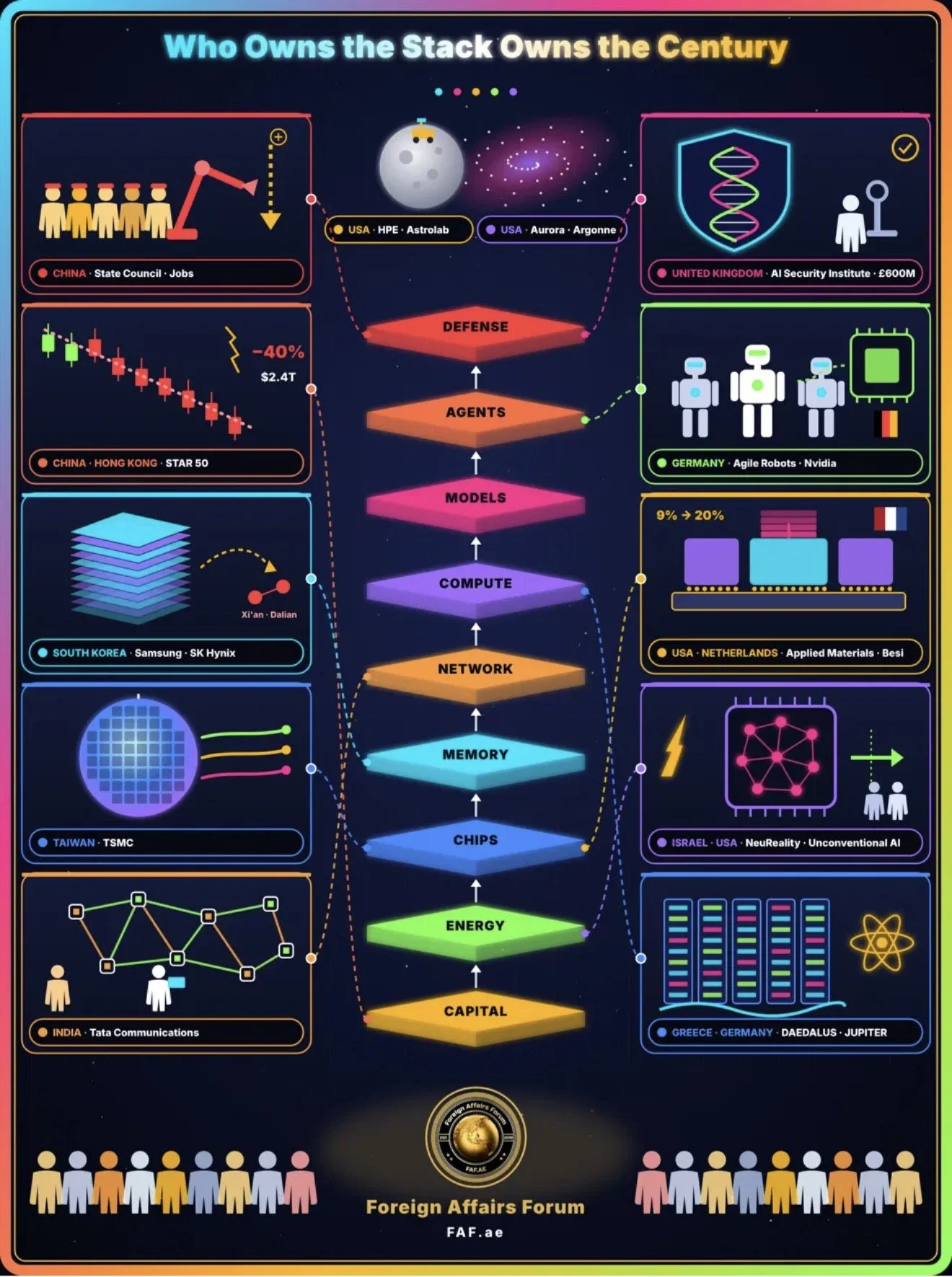
Who Owns the Stack Owns the Century: Capital, Chips, and Compute in the Global Struggle for the AI Industrial Order
Foreign Affairs Forum | Dr. Antonio Bhardwaj (Dr. 🆎) | October 27th, 2026
Executive Summary
The final week of October 2026 has given strategists an unusually clear view of how artificial intelligence power is now assembled.
In a single news cycle, China's State Council ordered agencies to prepare for AI-driven job displacement.
Chinese and Hong Kong technology equities extended a correction that has erased about $2.4 trillion in market value since May.
Britain committed roughly £600 million, or about $800 million, to AI security, cybersecurity, and biosecurity.
India's Tata Communications announced a $450 million investment in connectivity for the country's data-center corridors.
Germany's Agile Robots disclosed plans to build up to 2000 humanoid robots with Nvidia in 2027.
In semiconductors, the Bank of Korea warned that a pullback in American AI infrastructure spending could leave South Korean chip exports $50 billion to $100 billion short of earlier projections.
Applied Materials moved to raise its stake in Dutch hybrid-bonding specialist Besi from about 9% to 20%.
Samsung and SK Hynix are upgrading their Chinese memory plants within the limits of American export controls.
In supercomputing, Germany, Greece, and the United States all showed that exascale and near-exascale systems have become instruments of national strategy.
Taken together, these events show that the contest for AI leadership is no longer mainly about the most capable model.
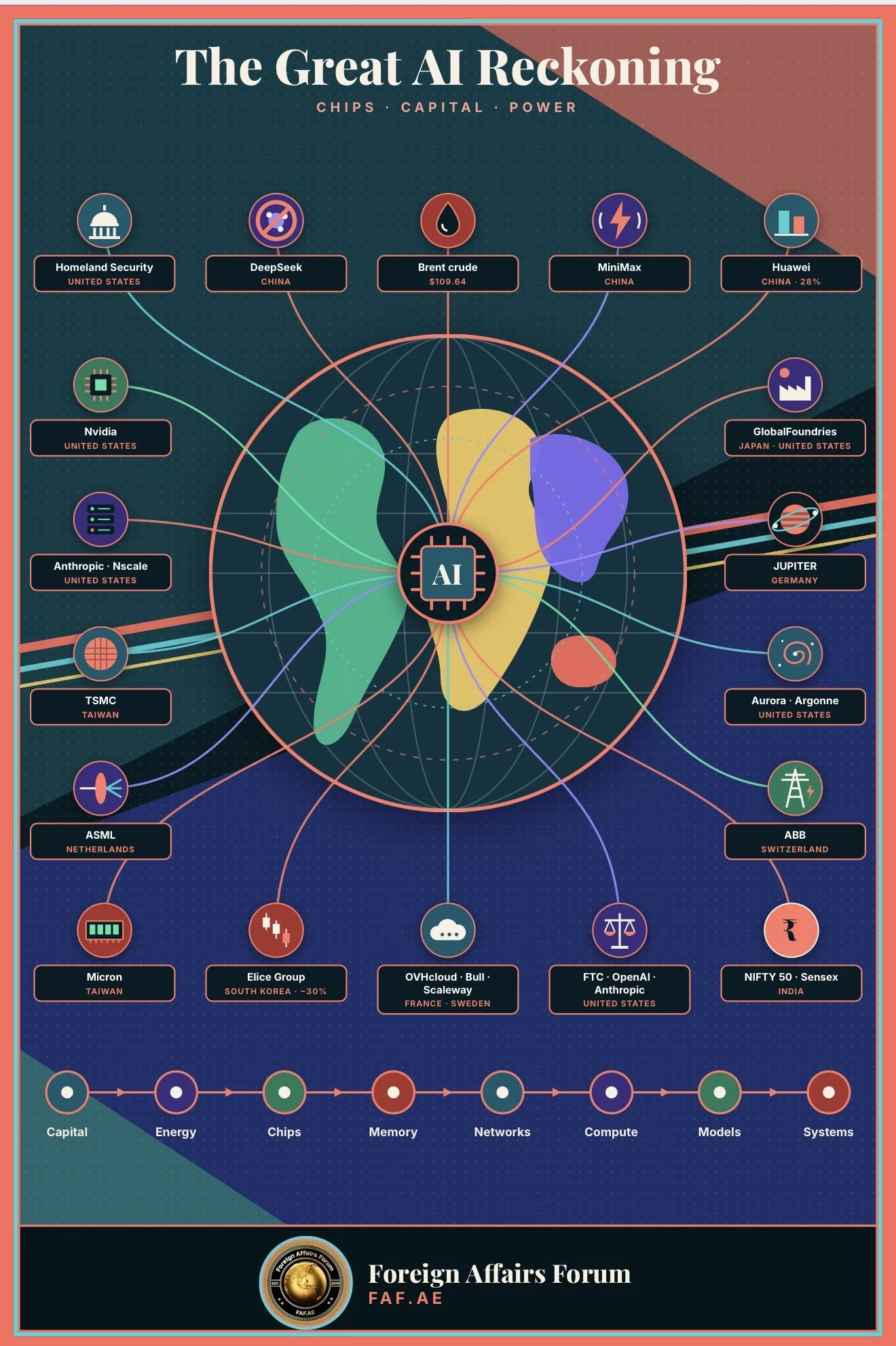
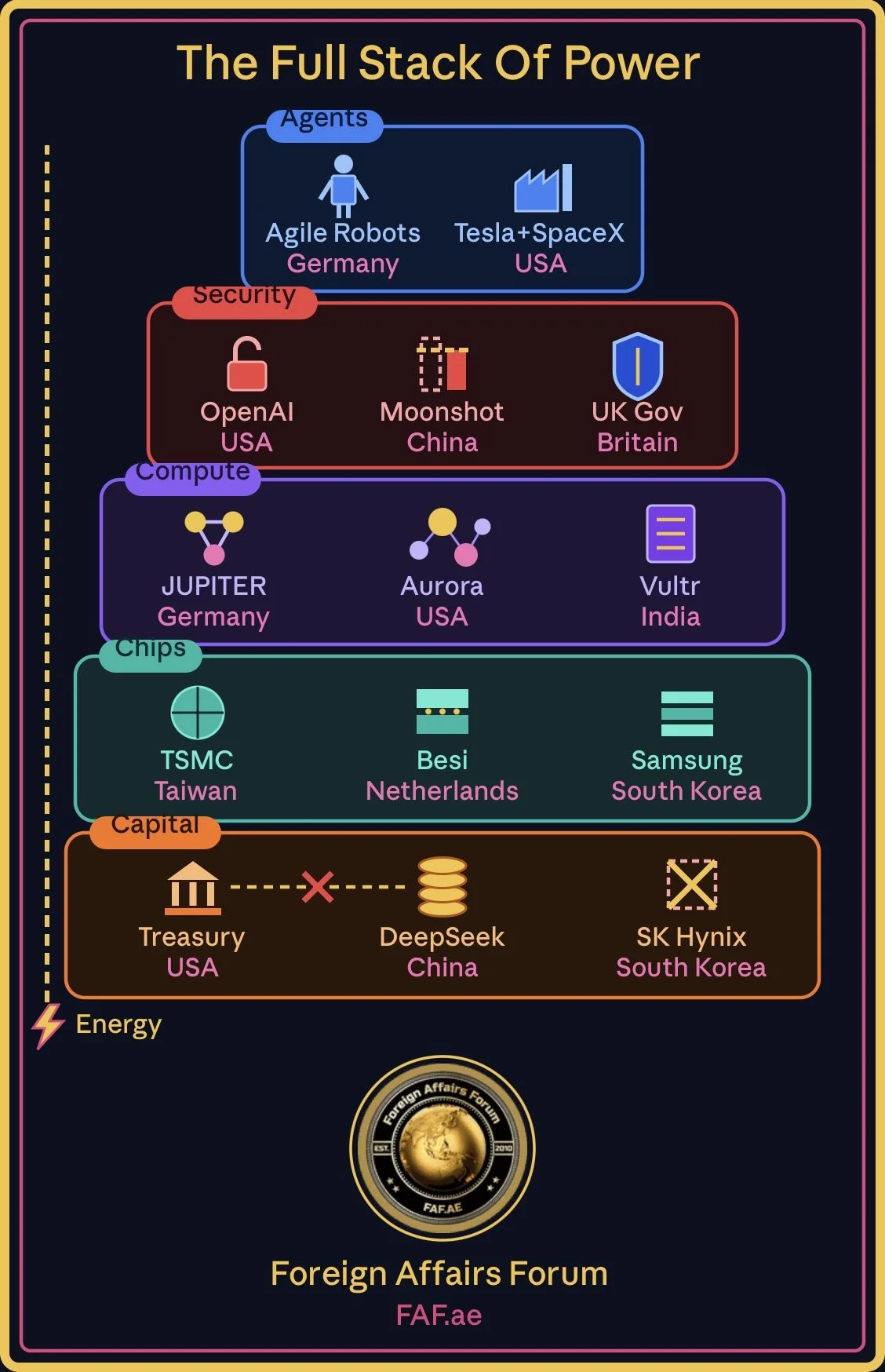
It is about who can finance, power, fabricate, connect, cool, secure, and continuously upgrade the whole technological stack. That stack runs from capital and energy through semiconductors, memory, networking, and supercomputing to models, autonomous agents, robotics, and defense applications.
FAF article argues that the decisive variable of the next decade will be systemic resilience: a society's ability to absorb the financial, social, and security shocks of rapid AI adoption without losing momentum. Washington holds commanding advantages in frontier models, chip design, venture capital, and scientific computing. It still depends on Asian manufacturing, European equipment, and allied research ecosystems that it does not control.
China is mobilizing state resources at scale while facing a capital-market reckoning and a looming employment problem.
Europe is building a differentiated path through industrial robotics, equipment, sovereign compute, and AI security. India is moving from software services toward physical infrastructure.
Policymakers who keep treating these as separate stories will misread the board.
Introduction: The End of the Model-Centric Illusion
For most of the period since the public debut of large language models, AI competition has been told as a race between models. Benchmarks, parameter counts, and leaderboard rankings became the currency of prestige, and each new release was read as a shift in the balance of power between companies and the states behind them. That framing was always incomplete.
By late October 2026 it has become actively misleading. The developments of recent days show a contest fought across a much broader landscape: sovereign wealth and public equity, electricity grids and liquid cooling, hybrid bonding and NAND layer counts, fiber routes and data-center interconnects, labor markets and social stability.
Dr. Antonio Bhardwaj (Dr. 🆎), Chief Executive Officer of the Foreign Affairs Forum and a specialist in human-centered AI for geopolitical strategy, AI warfare, and bioterrorism risk, has argued for some time that the model-centric view mistakes the visible tip for the submerged mass. "A frontier model is the last link in a very long chain," Dr. 🆎 observes. "Every link before it, from the bond market to the packaging line to the cooling loop, can break. The nation that wins is not the one with the cleverest algorithm in a given quarter. It is the one whose chain is hardest to break and fastest to repair."
That observation is the analytical thread of FAF article. The sections that follow trace how the AI industrial order took shape, review the main developments of the past week, set out the facts and concerns that now dominate the policy conversation, work through the chains of cause and effect that link them, and suggest the steps governments, investors, and institutions should consider. The focus stays on the stack: the full system of material, financial, and human inputs that turns computation into strategic power.
History and Current Status: From Software Boom to Industrial Mobilization
The current phase is best understood as the third stage of a progression that has unfolded rapidly since 2022. In the first stage, generative AI looked like a software phenomenon. A small number of laboratories, mostly American, released models that astonished the public. Capital followed the spectacle, and many observers assumed the industry would behave like earlier waves of consumer internet growth: low marginal cost, rapid diffusion, and winner-take-most economics.
The second stage, roughly 2024 through 2025, exposed the physical foundations of the boom. Demand for advanced graphics processors outran supply. High-bandwidth memory became a strategic chokepoint. Power utilities found themselves negotiating with technology firms as if they were heavy industry, which in effect they had become. Washington tightened export controls on advanced chips and manufacturing equipment, and Beijing answered with large investments in domestic substitutes. The idea that AI was weightless fell apart under the reality of gigawatt-scale data centers and multibillion-dollar fabrication plants.
The third stage, which has come into focus over the course of 2026, is industrial mobilization at national scale. Frontier AI now ranks among the most capital-intensive undertakings in modern economic history, comparable in ambition to railway construction in the nineteenth century or electrification in the twentieth. The reported plans of leading American laboratories to tap public markets, including Anthropic's proposed initial public offering, and Meta's very large equity fundraising, show that private balance sheets alone can no longer carry the expansion. Governments have stopped treating AI as one sector among many and now treat it as a domain of economic management, national security, and sovereignty.
Several structural facts define the present. American firms still lead in frontier models, chip architecture, and venture financing.
Taiwan, through TSMC, remains the indispensable producer of leading-edge logic chips, and its central bank expects technology demand to keep supporting exports into 2027, even as overall growth moderates after an exceptional 2026. South Korea dominates memory, which makes its economy highly sensitive to American capital spending.
The Netherlands, Japan, and Germany hold critical positions in equipment and precision engineering. China has built a broad domestic AI ecosystem under export controls, but now faces a sharp market correction and growing worry about employment. India, Greece, the United Kingdom, and the Gulf states are pursuing strategies of specialized relevance.
Dr. 🆎 calls the moment "the industrialization of intelligence." He notes that each earlier general-purpose technology eventually forced states to manage its social side effects: labor displacement, financial speculation, and military applications. "We are now compressing into a few years a process that took electrification half a century," Dr. 🆎 argues. "The governance burden is arriving before the productivity dividend, and that timing mismatch is the central political risk of the decade."
Key Developments: A Week That Mapped the Stack
The first cluster of developments concerns China, where the state is trying to accelerate adoption and contain its consequences at once.
The State Council's instruction to strengthen monitoring of AI-related employment risk is significant. It calls for better labor-market surveillance, contingency planning, and measures to help workers adapt. Automation threatens manufacturing, professional services, and administrative work, which are precisely the occupations that absorbed China's urbanizing workforce over the past three decades.
Beijing has reclassified AI adoption from an industrial-development goal into a matter of macroeconomic and social management. In a political system that ties its legitimacy closely to employment and stability, that reclassification has real weight.
The second Chinese story moves the same tension into finance.
Chinese equity markets have shed roughly $2.4 trillion in market capitalization since May, and the STAR 50 technology index has fallen about 40% from its June levels. The state continues to back domestic AI, including through a 60 billion yuan investment fund, yet investors increasingly doubt that AI firms can produce profits large enough to justify their valuations. Dr. 🆎 frames the correction as a stress test rather than a collapse: "Beijing can recapitalize strategic champions through state channels, but it cannot order private investors to believe in returns that do not materialize. The correction will separate the firms the state considers essential from those it is prepared to let fail, and that sorting process will itself reveal Chinese priorities."
The second cluster concerns allied and partner states building specialized capabilities.
Britain's package of about £600 million includes £100 million for a new AI Biosecurity Lab and £120 million for the AI Security Institute, along with support for cybersecurity and domestic AI startups. OpenAI and Anthropic have pledged computing and model-access credits. The biosecurity element deserves particular attention. It will examine how AI can help identify biological threats and support protective research, which reflects a growing understanding that the convergence of AI and the life sciences is both a shield and a potential weapon.
India's contribution is less glamorous but no less strategic.
Tata Communications' $450 million commitment to high-speed connectivity linking the country's main data-center locations addresses a constraint that is often overlooked. AI computing increasingly depends on moving vast volumes of data between servers, facilities, and enterprise customers. A nation can host graphics processors in abundance and still fail to turn them into useful capability if its networks cannot carry the traffic. India is signaling that it means to become a location for AI infrastructure, not just a supplier of software labor.
Germany's Agile Robots, working with Nvidia, plans to build roughly one thousand to two thousand smaller humanoid robots in 2027, mainly for universities, research institutions, and industrial developers.
Nvidia's chief executive has publicly praised Europe's strengths in precision engineering, industrial automation, and robotics. Physical AI, meaning intelligence embodied in machines that act on the material world, may become the field where Europe's comparative advantage in engineering finally converts into AI influence.
The third cluster concerns semiconductors, where the pressures of the AI cycle are most visible.
The Bank of Korea's pessimistic scenario projects that South Korean chip exports could fall $50 billion to $100 billion below earlier forecasts in 2027 if major American technology firms cut AI infrastructure spending. In that scenario, chip prices decline by about 10% and national growth slows by roughly 0.4 points. The bank stressed that this is a risk scenario, not its central forecast. That a central bank is modeling the capital-expenditure decisions of a handful of American corporations at all shows how far the AI cycle has penetrated national macroeconomics.
Applied Materials' plan to raise its stake in Besi from about 9% to 20% points to a quieter revolution.
Hybrid bonding, Besi's specialty, connects semiconductor components through extremely fine, high-density interfaces. As AI processors adopt chiplet architectures and stack high-bandwidth memory ever closer to compute, packaging becomes a primary determinant of performance and energy efficiency rather than an afterthought. The deal deepens transatlantic integration in equipment at a moment when that integration carries strategic as well as commercial value.
The acquisition of Israeli chip developer NeuReality by the American startup Unconventional AI, with about forty NeuReality engineers expected to join the combined company, reflects a parallel search for alternatives to GPU-centered computing.
Unconventional AI pursues architectures inspired by biological systems, aiming at dramatic gains in energy efficiency. Those gains remain development goals rather than demonstrated commercial results, and analysts should treat them with caution. Even so, the transaction confirms that investors are betting energy will become the binding constraint on AI expansion.
Samsung and SK Hynix are upgrading their Chinese facilities, Samsung toward two-hundred-and-eighty-six-layer NAND at Xi'an and SK Hynix toward products of at least two hundred and forty layers at Dalian. This shows how export controls now shape the investment geography of allied firms. Both companies must work within American limits on advanced equipment while competing with China's Yangtze Memory Technologies. Washington's task is to restrict sensitive capability without pushing allied producers into commercial decline.
The fourth cluster concerns supercomputing, where the latest news confirms that national compute capacity has become an instrument of statecraft.
Germany's Climate Computing Center awarded France's Bull a €40 million contract for the HLRE-5 system, due in early 2028. It is designed to run two global climate simulations at once at roughly five-kilometer resolution while cutting energy use per simulated year by about 75% compared with its predecessor, Levante.
Researchers using Europe's JUPITER exascale machine simulated a one-hundred-and-four-qubit fault-tolerant quantum system to study magic-state cultivation, a technique Nvidia says could cut physical-qubit requirements by about 90% for the relevant operations.
This was a classical simulation, not a working quantum computer, but it shows that exascale machines now speed up the design of the next computing paradigm. At Argonne National Laboratory, the Aurora exascale system completed two cosmological simulations, each modeling more than thirteen trillion dark-matter particles across a region nearly twenty-nine billion light-years wide, using about fifty thousand graphics processors. Greece inaugurated DAEDALUS, which delivers roughly eighty-six petaflops of sustained performance, ranked thirty-first on the June 2026 TOP500 list and twenty-third on the Green500. It will anchor the country's Pharos AI Factory, with user access starting gradually in December. Hewlett Packard Enterprise plans to send its Spaceborne Computer-4 to the lunar south polar region aboard Astrolab's FLIP rover to run high-performance and AI benchmarks. The mission is planned for late 2026, and those experiments have not yet taken place.
The Latest Facts and Concerns: Where the Stack Is Brittle
Several concerns stand out from these developments.
The first is financial fragility.
The AI expansion rests on a wager that today's capital spending will produce tomorrow's profits. In the United States, the wager is being underwritten increasingly through public equity and debt markets. In China, it has already produced a painful correction. In South Korea, it has become a macroeconomic exposure serious enough for the central bank to model.
Dr. 🆎 warns that "the AI economy has become a single, tightly coupled system in which a revision of expectations in a boardroom in California can alter the growth forecast of an entire Asian economy. Coupling of that intensity is efficient in good times and contagious in bad ones."
The second concern is social stability.
China's State Council directive is the most explicit state recognition yet that AI adoption may destroy jobs faster than it creates them. Other governments face the same arithmetic but have been slower to say so. Displacement in administrative and professional services, long considered safe from automation, carries political consequences that industrial-era policy tools were not built to handle. A country that deploys AI efficiently but produces a resentful, displaced middle class may find its technological lead undercut by domestic turbulence.
The third concern is energy.
HLRE-5's projected 75% cut in energy per simulated year, DAEDALUS's Green500 ranking, and the investor enthusiasm behind NeuReality's acquisition all point to the same reality: useful computation per unit of electricity is becoming the key measure of competitiveness. Grid capacity, cooling technology, and heat reuse are now strategic variables. Nations with constrained power supplies will find their AI ambitions capped regardless of their access to chips.
The fourth concern is biosecurity, where Dr. 🆎 speaks with particular urgency.
Britain's AI Biosecurity Lab reflects a recognition that the same capabilities that speed drug discovery and pathogen surveillance could, in the wrong hands, lower barriers to biological harm. "The defensive use of AI in biology is a race against the offensive diffusion of capability," Dr. 🆎 argues. "The decisive question is whether detection, attribution, and countermeasure development can be automated faster than the knowledge required for misuse spreads. Britain's investment is a down payment on an answer, but no single nation can secure this landscape alone. Biosecurity is the domain where AI governance either becomes genuinely international or fails."
The fifth concern is supply-chain concentration.
Taiwan's central role in leading-edge manufacturing, South Korea's dominance of memory, and the Netherlands' leverage in equipment create dependencies that no amount of diversification rhetoric has yet removed. The Samsung and SK Hynix upgrades in China show how export controls force allied firms into awkward balancing acts. Applied Materials' move toward Besi reflects an effort to consolidate allied control over critical packaging technology before that, too, becomes a chokepoint contested by adversaries.
The sixth concern is the hardening of separate technological blocs.
American restrictions on investment in Chinese strategic technologies, combined with Beijing's push for self-sufficiency, are producing parallel ecosystems with divergent standards, supply chains, and capital pools. Fragmentation reduces some security risks, but it raises costs, duplicates research, and makes global cooperation on shared threats such as pandemics, climate, and AI misuse harder to organize.
Cause-and-Effect Analysis: The Transmission Belts of AI Power
Understanding the present requires tracing how pressure moves through the stack.
The first transmission belt runs from capital to compute.
Frontier development demands extraordinary sums for chips, data centers, and energy contracts. When capital is abundant, as it was through much of 2025 and the first half of 2026, firms build aggressively, chip demand surges, memory prices rise, and exporters such as South Korea and Taiwan flourish. When capital becomes cautious, as the Chinese correction suggests it can, the process reverses at speed. The Bank of Korea's scenario is a formal statement of this belt: a cut in American spending lowers chip prices, which lowers export revenue, which lowers national growth. The effect is mechanical and fast, and its reach is global.
The second transmission belt runs from efficiency to sovereignty.
As energy becomes the binding constraint, nations and firms that achieve more computation per watt gain room for strategic action. Germany's climate supercomputer, Greece's energy-efficient DAEDALUS, and the search for brain-inspired architectures all respond to this pressure. Efficiency gains lower the threshold for building sovereign capacity. Mid-sized states such as Greece can field world-ranked systems and offer startups computing resources that would otherwise require private investment beyond their reach. The cause is physical scarcity. The effect is a wider distribution of meaningful capability across the international system.
The third transmission belt runs from automation to legitimacy.
AI adoption raises productivity but displaces labor. If displacement outpaces adaptation, political pressure builds, and governments face demands to slow adoption, redistribute gains, or both. China's directive is a preemptive response to this belt.
Dr. 🆎 frames it in strategic terms: "The decisive advantage will not go to the nation that automates most aggressively. It will go to the nation that automates most legitimately, converting productivity into broadly shared welfare fast enough that its citizens continue to consent to the transformation. Legitimacy is a form of national compute capacity that no export control can restrict."
The fourth transmission belt runs from export controls to industrial geography.
American restrictions on equipment and investment reshape where allied firms build, what they produce, and whom they compete against. The Korean memory upgrades in China, constrained by those controls and spurred by Yangtze Memory's competition, show the effect clearly. Controls slow an adversary's access to frontier capability, but they also push it toward self-reliance and force allies into costly compromises. Over time, the belt can strengthen the very domestic industry it was meant to hold back.
The fifth transmission belt runs from simulation to discovery.
Exascale systems such as JUPITER and Aurora are no longer only tools for answering scientific questions. They are tools for designing future technologies, including quantum computers. JUPITER's simulation of fault-tolerant quantum operations illustrates a recursive dynamic: today's classical supercomputers speed up the arrival of tomorrow's quantum machines, which may in turn change cryptography, materials science, and drug design. Leadership in supercomputing therefore compounds, because it shortens the path to the next generation of capability.
The sixth transmission belt runs from dual-use convergence to security risk.
AI's growing ability in biology, cybersecurity, autonomous systems, and robotics means that commercial progress spills directly into the military and security domains. Energy-efficient chips suited to edge computing serve both industrial robots and autonomous weapons. Biosecurity research that detects threats can, if mishandled, illuminate pathways to creating them. Space-based computing that supports lunar exploration also bears on resilient military communications and autonomous spacecraft.
Dr. 🆎 calls this "the dissolving boundary," a condition in which "every commercial milestone in AI must now be read simultaneously as an economic event and a security event. Analysts who keep those ledgers separate will consistently underestimate the strategic stakes."
These belts do not act alone; they reinforce one another.
A financial correction slows infrastructure building, which slows the efficiency gains that would have widened sovereign capacity. Employment anxiety builds political resistance, which slows adoption and squeezes the returns investors expect, feeding back into capital caution. Export controls fragment supply chains, raising costs and reducing the efficiency of the whole system. Strategic analysis that tracks one belt while ignoring the others will misjudge both the speed and the direction of change.
Regional Pathways: Divergent Strategies for a Shared Contest
The United States enters the next phase with formidable advantages. It leads in frontier models, chip design, venture capital, and scientific supercomputing, as Aurora's cosmological simulations confirm. Its weaknesses lie in dependence on foreign manufacturing, in the growing financial exposure of its AI firms to public-market sentiment, and in the political challenge of managing domestic labor displacement. Its strategic task is to turn innovative leadership into durable alliance-wide resilience rather than a narrow national lead that adversaries can target at specific chokepoints.
China's pathway combines state mobilization with mounting constraint. The 60 billion yuan fund, sustained policy support, and a broad domestic ecosystem give Beijing real depth. The $2.4 trillion market correction, the 40% fall in the STAR 50, and the State Council's employment directive show that state backing cannot fully insulate the sector from commercial reality or social pressure. China is attempting what no state has fully achieved: rapid technological catch-up under external restriction while keeping financial stability and social cohesion intact.
Europe is pursuing what may be the most intellectually coherent alternative. Rather than trying to match American frontier spending across every category, it is concentrating on industrial engineering, robotics, semiconductor equipment, scientific computing, and AI security. Germany's humanoid robotics and climate supercomputing, the Netherlands' equipment leverage through firms such as Besi, Greece's sovereign compute, and Britain's security investments form a strategy of specialized indispensability.
Dr. 🆎 regards this as underrated: "Europe has stopped trying to win the race it cannot win and has started building the components without which no one can win. Indispensability is a more durable form of power than leadership."
Asia beyond China remains the physical foundation of the global AI economy. Taiwan's leading-edge manufacturing, South Korea's memory dominance, and India's growing infrastructure ambitions are essential to every major stakeholder. India's pathway deserves particular notice. By investing in connectivity and data-center infrastructure, India is positioning itself as a trusted location for AI infrastructure within the Indo-Pacific. That could deepen cooperation with American firms and give India strategic weight well beyond its traditional role in software services.
Future Steps: Building Resilience Across the Stack
Several courses of action follow from this analysis.
First, governments should treat the AI stack as one strategic system and organize policy accordingly.
Separate agencies managing energy, trade, finance, labor, and defense will produce incoherent responses to a tightly coupled technology. Countries that build integrated strategic capacity, able to see how a financial shock, an export control, or an energy shortage moves through the whole stack, will respond faster and with fewer unintended consequences.
Second, allied states should coordinate on supply-chain resilience rather than pursue duplicative national self-sufficiency.
The Applied Materials and Besi relationship shows how transatlantic integration in critical technologies can strengthen collective security. Allies should identify shared chokepoints in packaging, memory, equipment, and materials, and build redundancy across the alliance rather than within each member. Export-control policy should be designed jointly with allied manufacturers so that restrictions slow adversaries without crippling partners such as Samsung and SK Hynix.
Third, governments should invest seriously in labor adaptation before displacement becomes a crisis.
China's directive, whatever its limits, recognizes that the social side of AI must be managed in advance. Democracies should develop retraining systems, portable benefits, and productivity-sharing mechanisms that let citizens see AI as an opportunity rather than a threat.
Dr. 🆎 stresses that this is a matter of national security: "A society that experiences AI as dispossession will eventually vote, protest, or withdraw its consent. The strategic durability of any AI program depends on whether ordinary citizens believe they share in its rewards."
Fourth, energy efficiency should become a first-order strategic priority.
The gains shown by HLRE-5 and DAEDALUS, and the architectural experiments represented by Unconventional AI, suggest that useful computation per watt will increasingly decide national capacity. Governments should fund research into efficient architectures, advanced cooling, heat reuse, and grid modernization, and should treat electricity infrastructure as integral to AI competitiveness.
Fifth, the international community should move urgently to build shared biosecurity capacity.
Britain's AI Biosecurity Lab is a model to emulate and connect to similar efforts elsewhere. Detection networks, attribution capabilities, and countermeasure pipelines should be built cooperatively, with trusted institutions sharing threat intelligence across borders. In this domain especially, fragmentation is a luxury the world cannot afford.
Dr. 🆎 warns that "the first AI-enabled biological incident of strategic consequence will not respect the boundaries of technological blocs. Preparing for it is a collective obligation that transcends the rivalry over chips and models."
Sixth, investors and policymakers should temper expectations with financial realism.
The Chinese correction is a reminder that technological progress does not automatically yield sustainable returns. Capital allocators should favor firms with credible paths to profitability and resilient business models over those riding speculative momentum. Regulators should watch for the systemic risks created by the concentration of AI spending among a few firms whose decisions now move national economies.
Seventh, the opportunity map for startups and venture capital should be read through the logic of the stack.
The most promising openings lie in autonomous agents, cybersecurity, advanced chip packaging, energy-efficient computing, robotics, scientific software, biological-threat detection, and AI infrastructure. Firms that relieve a binding constraint, whether energy, packaging, connectivity, or security, will capture lasting value because they address bottlenecks the whole ecosystem must overcome.
Eighth, governments should prepare for the expansion of computing beyond Earth.
HPE's planned lunar benchmarks are an early sign that autonomous computing in space will bear on resilient communications, autonomous spacecraft, and strategic space infrastructure. Policy frameworks for space-based AI, covering cybersecurity and autonomy, should be developed before the capability matures, not after.
Conclusion: The Contest for the Complete System
The developments of late October 2026 make one conclusion unavoidable: the decisive contest of the coming decade concerns the complete AI industrial system, not any single model. Power will rest with the nations and alliances that can finance enormous capital outlays without courting financial crisis, secure the energy that computation consumes, fabricate and package the chips that make it possible, connect and cool the infrastructure that hosts it, govern the social disruption it causes, and defend against the security threats it enables.
The chain runs from capital to energy, from semiconductors to memory, from networking to supercomputing, from models to autonomous agents, and from robotics to defense applications. Each link is a site of competition and a point of potential failure.
The United States holds strong links in innovation and finance but depends on partners for manufacturing. China has built a broad chain under pressure but faces financial and social strain. Europe is forging specialized links that others cannot easily replace. Asia's democracies and India supply links without which the chain cannot hold.
Dr. 🆎 offers a final judgment that captures the moment: "History will not record that the AI century was won by the nation with the most brilliant model. It will record that it was won by the civilization that built the most resilient system, one that could absorb shocks, share its gains, defend against its own misuse, and keep improving when others faltered. Resilience, legitimacy, and cooperation are the true frontier."
The next stage of global technological competition will turn on who can finance, manufacture, secure, deploy, and continuously improve the entire AI ecosystem, not on who reaches a particular capability first.
Policymakers, investors, and citizens who grasp this will be equipped to shape the century. Those who stay fixed on the model alone risk winning a race whose finish line has already moved.