Blockade Without Peace: How Hormuz, Riyadh and the Open Sea Have Fused into One War
Foreign Affairs Forum | Dr. Antonio Bhardwaj (Dr. 🆎) | October 13th 2026
Executive Summary
The three days between October 10th-12, 2026 exposed a contradiction at the heart of the Gulf crisis: diplomacy has stalled while coercion is intensifying on several fronts at once.
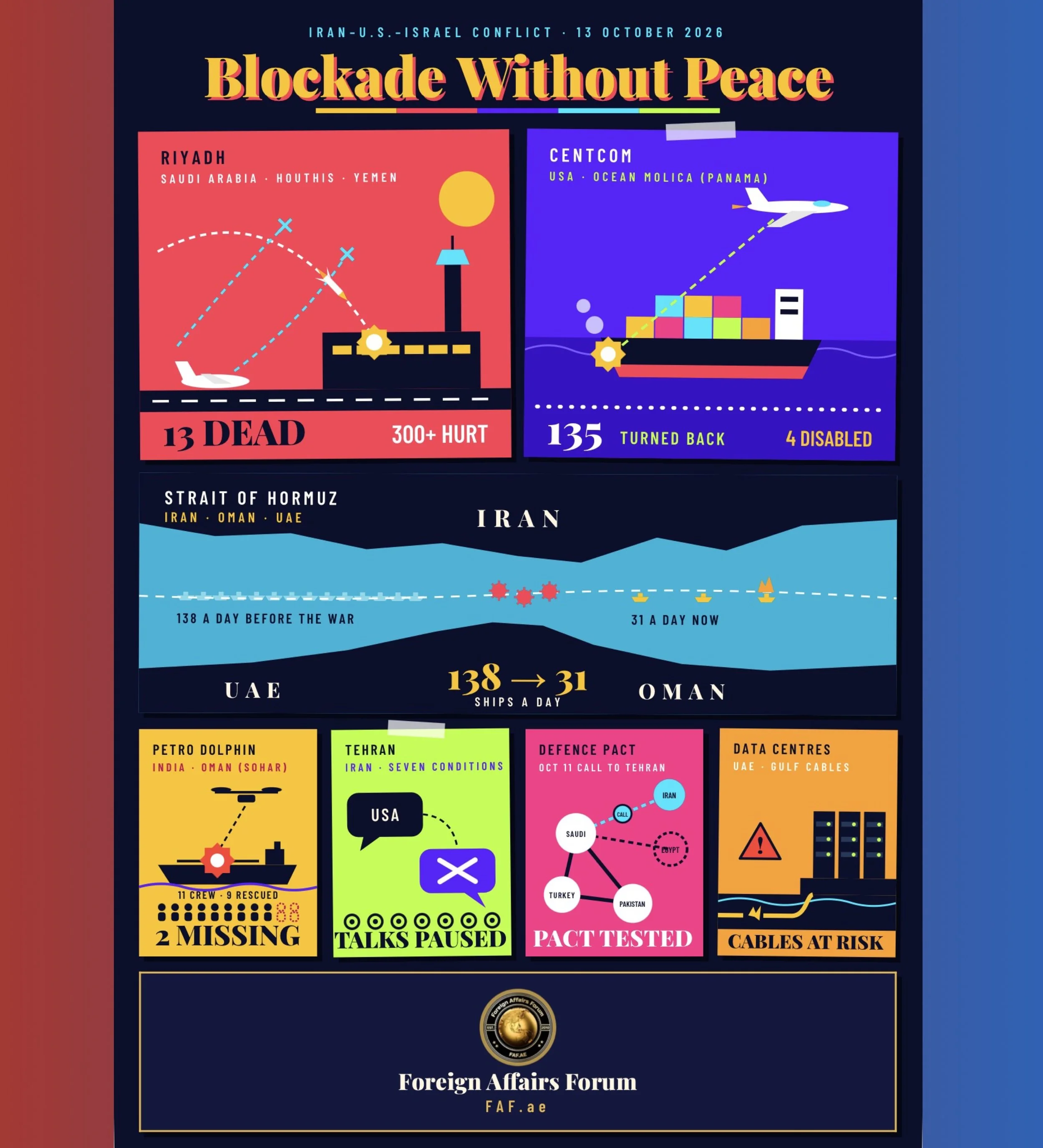
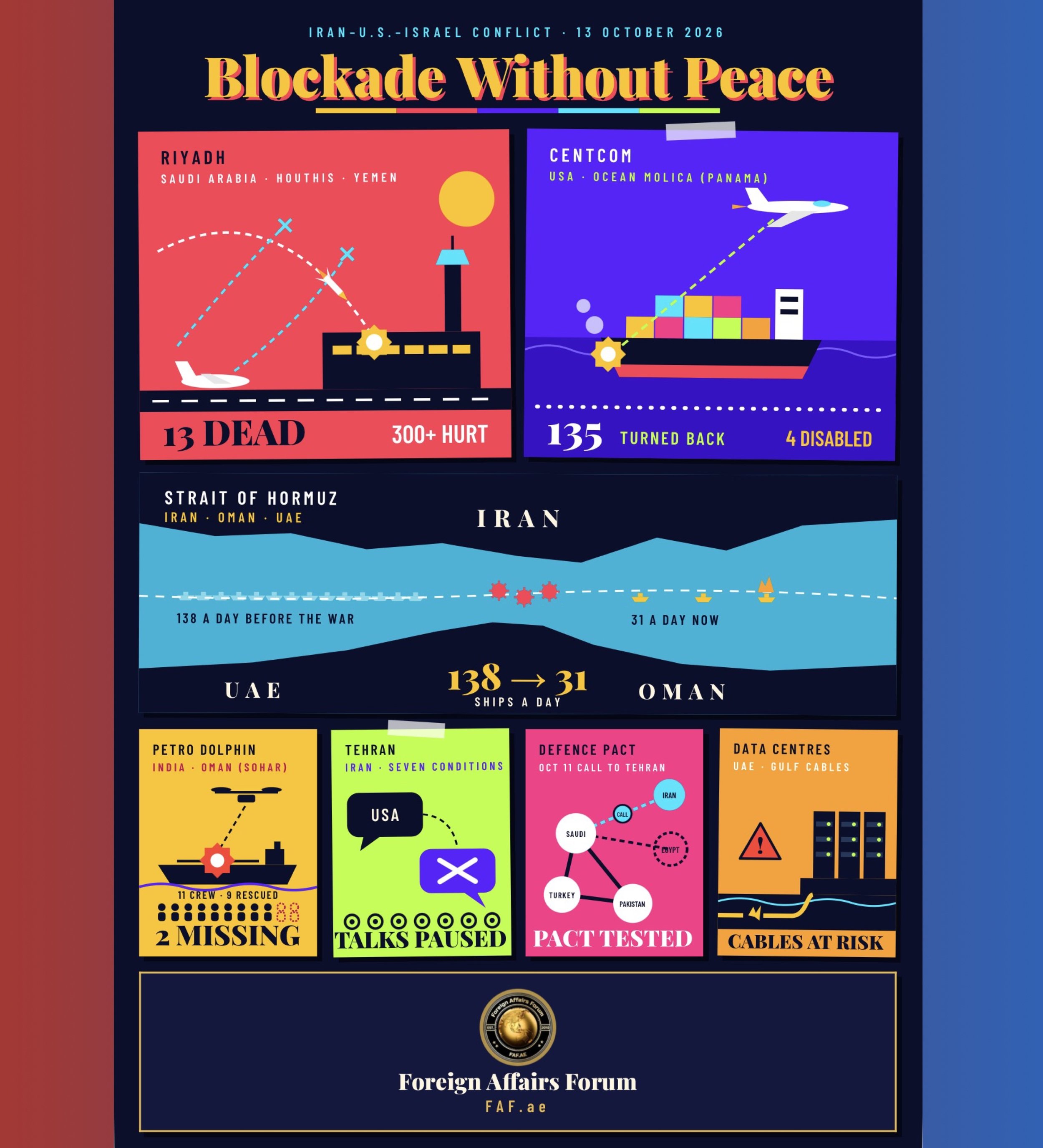
Four officially confirmed developments define the moment. Houthi attacks on King Khalid International Airport in Riyadh killed thirteen people and injured more than three hundred on October 10th, and a second attack on October 11th killed one more person and injured eleven.
On October 10th, United States Central Command confirmed that an American fighter jet had disabled the Panama-flagged cargo vessel Ocean Molica, also known as Arika Sun, in the Gulf of Oman after it ignored repeated warnings while attempting to breach the blockade of Iranian ports.
On October 11th, a drone struck the tanker Petro Dolphin near Oman's Sohar port, leaving two of its eleven Indian crew members missing, while a second tanker, the Valthera, was hit by a projectile in the Strait of Hormuz.
Also on October 11th, Mohsen Rezaei, secretary of Iran's Supreme National Security Council, rejected Washington's latest reply to Tehran's seven conditions for reopening the strait and said Iran would suspend further responses until those conditions are met.
These events should not be read as isolated incidents.
Together they describe a war that has outgrown the bilateral bargaining intended to contain it.
Washington has paused attacks on Iranian territory, yet it enforces its blockade with direct military force against commercial shipping.
Tehran treats control of the waterway as its principal bargaining instrument.
Iran-aligned forces in Yemen have opened a second crisis against Saudi civil infrastructure, testing the defence arrangement that binds Riyadh to Ankara and Islamabad.
Third countries that are not belligerents, India foremost among them, now absorb the human costs through their merchant seafarers. No comprehensive cease-fire, no unrestricted reopening of Hormuz and no nuclear settlement has been officially confirmed.
The central argument of this FAF article is that stalemate has become an engine of escalation rather than a brake upon it.
When negotiations freeze but the instruments of pressure remain active, each stakeholder is tempted to raise the cost for its adversary in the hope of improving its position, and the lines between military, commercial and civilian targets erode. The article traces the historical sequence that produced this condition, examines the four developments in detail, separates confirmed facts from contested claims, maps the causal chains linking maritime coercion, proxy escalation and diplomatic paralysis, and proposes practical steps.
These include a protected channel for seafarers, deconfliction of blockade enforcement, a cautious Saudi–Houthi dialogue, and firm human control over the AI-enabled surveillance and targeting systems that increasingly shape these confrontations.
Introduction
Wars rarely end on the schedule their architects imagine. They acquire momentum, spawn secondary conflicts and generate their own grievances, until the original objectives are obscured by the instruments chosen to pursue them.
The Gulf war that began on February 28th, 2026, when the United States and Israel launched strikes on Iran, has reached such a stage.
The Strait of Hormuz, through which roughly a fifth of the world's oil and gas moved before the war, has been largely closed to normal commerce for months. A naval blockade of Iranian ports has been reimposed.
Mediators continue to carry messages between the two principal capitals, yet the distance between them has not narrowed. In the first half of October, that distance began to fill with violence in places far from the negotiating table.
Dr. Antonio Bhardwaj (Dr. 🆎), a polymath with global expertise in superintelligence, specialising in human-centred systems for geopolitical strategy, AI warfare and bioterrorism risk, has long argued that crises of this kind are best understood as systems rather than sequences. "A stalemate is not a pause," he observes. "It is an unstable equilibrium in which every stakeholder believes time is on its side, and in which the absence of a political horizon turns every incident into a potential turning point. The danger is not only the decision to escalate. It is the accumulation of small, deniable acts that leave no one in control of the whole."
This FAF article follows that logic. It begins with the historical background and present condition of the crisis, then examines four confirmed developments between October 10th-12th: the deadly Houthi attacks on Riyadh, the American strike on a commercial vessel, the attacks on tankers carrying Indian sailors, and Iran's suspension of its responses to Washington. It then sets out the latest facts and concerns, analyses causes and effects, proposes forward steps and offers a conclusion.
Throughout, it distinguishes between what authorities have confirmed, what stakeholders claim and what remains unestablished, because strategic judgement in a fog of competing narratives depends on keeping those categories apart.
History and Current Status
The roots of the present crisis lie in the long contest over Iran's nuclear programme, its network of allied forces across the region and the security architecture of the Gulf.
For decades the Strait of Hormuz has been the most consequential chokepoint in the global energy system, a narrow passage between Iran and Oman whose reliable operation underwrote the economies of producers and consumers alike. Iranian leaders had long threatened to close it in a crisis, and Western navies had long planned to keep it open.
The war that began on February 28th, 2026 turned that theoretical contest into a practical one. Iran effectively blocked the strait through attacks on shipping and the laying of mines, and the United States answered with a naval blockade of Iranian ports.
The sequence since then has been one of repeated openings and closings. A temporary two-week cease-fire in early April was meant to include the reopening of the strait, but talks in Islamabad ended without agreement, and the American blockade of Iranian ports took effect on April 13th.
A brief reopening during a truce in Lebanon was reversed within a day, and American forces disabled and seized an Iranian-flagged cargo ship, an incident that Tehran described as piracy and a violation of the cease-fire. In mid-June the two governments announced an agreement to end the war, a memorandum of understanding was signed, and the blockade was lifted. For a few weeks it appeared that a negotiated settlement might consolidate.
That moment passed. The blockade was reinstated in mid-July, the June memorandum has since collapsed, and Iran now demands a return to its terms along with a set of seven conditions for reopening the strait. Since the reimposition, American forces have disabled commercial vessels and turned back well over a hundred more, while Washington says Iran has exported no oil through the blockade line. Iran's central bank governor reportedly said in August that oil exports had effectively ceased, and inflation inside the country has reportedly climbed to around 70%. The blockade, in other words, is imposing real costs, but it has not yet produced the concessions it was designed to extract.
Meanwhile, the strait itself has become a contested administrative space. Iran asserts that it manages the waterway through its own Persian Gulf Strait Authority and that vessels which do not coordinate with it risk attack or mines. It has proposed a joint management arrangement with Oman, a proposal Washington rejected on the ground that ships are entitled to free passage under international law.
Data on traffic show the scale of the disruption: about thirty-one ships a day transited the strait in the last week of September, against one hundred and thirty-eight before the war.
At least 45 ships were targeted in the third quarter of 2026, 87% of them tankers, with 93% of the strikes occurring in the strait itself.
Freight now accounts for between 25% and 30% of the cost of Gulf crude, compared with 1% to 3% before the war, and national oil companies have offered discounts of up to $35 a barrel to attract buyers.
A second strand of the crisis runs through Yemen.
The Houthi movement, aligned with Tehran, has been fighting the internationally recognised government and, increasingly, Saudi Arabia. Earlier Houthi attacks on the airports at Abha and Riyadh had already killed civilians, and in the week before the October 10 attack the movement struck King Khalid International Airport repeatedly, with one attack on October 8 killing three Saudi citizens, including a pilot. After a government offensive in Yemen, the Houthis declared Saudi airspace a military zone, exempting only the skies above Mecca and Medina. A United Nations envoy has warned that Yemen has returned to full-scale war.
Saudi Arabia has answered not only with air power but with diplomacy.
Riyadh has signed a defence pact with Turkey and Pakistan under which an attack on one is to be treated as an attack on all, and Turkish leaders have suggested that Egypt could join.
That arrangement, concluded in the middle of a regional war, is now being tested for the first time by sustained attacks on Saudi civil infrastructure.
Washington, for its part, has called the Riyadh attack terrible, and President Trump has said he is weighing whether American forces should join the fight against the Houthis. The current status of the crisis is therefore a layered one: a stalled diplomatic track, a maritime campaign by both sides, and an expanding proxy conflict that may no longer wait for the diplomacy to catch up.
Key Developments
The most lethal development was the Houthi attack on King Khalid International Airport on October 10th.
Saudi authorities confirmed that thirteen people were killed and more than three hundred injured, with early reports having cited twelve dead.
The victims included Saudi citizens and foreign nationals from several countries, among them Bangladesh, Jordan, Egypt and the United States. A second attack on October 11th killed another person and injured eleven. The Houthis claimed responsibility, an initial assessment points to a ballistic missile, and Saudi forces reported intercepting other missiles aimed at the capital. Operations at the airport were suspended, and several Western embassies advised their citizens to avoid it.
The diplomatic response was swift.
A joint statement from Saudi Arabia, Turkey, Pakistan and Egypt condemned the attacks and pledged support for legitimate Saudi defensive measures, while the Saudi-led coalition called the strike a war crime and promised a decisive response consistent with humanitarian law. Yet the most intriguing contact was of a different kind.
On October 11th, the Saudi and Iranian foreign ministers held a confirmed telephone conversation to discuss regional escalation, and Tehran offered to facilitate dialogue between Riyadh and the Houthis. No agreement resulted, but the call shows that channels between the Gulf's rivals remain open even as their allies fight.
The second development was the American strike on a commercial vessel.
On October 10th Central Command confirmed that a fighter jet had struck the Panama-flagged cargo ship Ocean Molica, also known as Arika Sun, in the Gulf of Oman. According to the command, the ship had ignored repeated warnings while attempting to breach the blockade of Iranian ports. The strike disabled its propulsion system without injuring the crew. Central Command added that four commercial vessels had been disabled and one hundred and thirty-five turned back since the blockade resumed in July, and it has separately reported the destruction of ten tankers linked to Iran.
The significance lies in the contrast with American restraint elsewhere.
President Trump recently announced a temporary pause in attacks against Iran, yet the Ocean Molica incident shows that restraint toward Iranian territory does not extend to the maritime enforcement of the blockade. Interdiction has become a substitute for direct strikes, allowing Washington to maintain pressure while claiming de-escalation. It also creates legal and commercial exposure, since the targets are third-country merchant vessels flying flags such as Panama's, and since Iran, China and Russia have condemned the blockade while several of Washington's partners have declined to support it.
The third development concerned the sailors.
On October 11th, India's Shipping Minister Sarbananda Sonowal confirmed that the tanker MT Petro Dolphin had been attacked by a drone near Oman's Sohar port. Of its eleven Indian crew members, nine were rescued and two remained missing. A second tanker, MT Valthera, was struck by a projectile in the Strait of Hormuz, and all eleven Indian crew members aboard were reported safe. India condemned the attacks and called for the protection of commercial navigation. Responsibility has not been conclusively established.
Sohar lies outside the immediate transit corridor, a fact that matters because it shows that danger to civilian crews is not confined to the narrowest part of the strait. Iran's security chief has publicly declared that a shuttle moving Gulf oil by smaller vessels to larger tankers, which he links to American and Emirati forces, is now an explicit target, and he has claimed that vessels in that system are struck most nights. Whether the Sohar attack formed part of that campaign is not known, but the proximity of the incidents to the shuttle's reported routes is notable. For India, whose seafarers crew a large share of the world's tanker fleet and whose economy depends on Gulf energy, the episode raises both humanitarian and strategic stakes.
The fourth development was diplomatic.
On October 11th, Mohsen Rezaei publicly rejected Washington's latest response to Tehran's seven conditions for reopening the strait. He described the reply as insufficient, acknowledged that Washington had accepted some conditions while others remained unresolved, and said Iran would not proceed with negotiations until its conditions were met. He told state media that Iran was no longer in the process of responding and that Washington must clarify the remaining ambiguities. At the time of the report, the White House had not publicly responded.
The shift is substantive. The dispute is no longer about restarting talks but about whether satisfaction of Iran's conditions is a precondition for negotiating at all. Among Tehran's stated aims are a return to the terms of the June memorandum and American backing for an arrangement with Oman that would create coordinated entry and exit routes through the strait, while its nuclear chief insists that Iran's enrichment achievements cannot be stopped. American officials have signalled some flexibility: Vice President JD Vance has said Iran must make a meaningful cut to its enrichment capacity, language that may indicate a softening of the earlier demand for zero enrichment. The result is a negotiation in which each side has moved just far enough to keep the process alive but not far enough to conclude it.
Taken together, the four developments describe a conflict with three distinct engines. The first is the maritime campaign, in which both Washington and Tehran use commercial shipping as the principal instrument of pressure. The second is the Yemen front, where a movement aligned with Tehran is striking at the symbols of Saudi modernity. The third is the diplomatic stalemate, which removes the political channel that might otherwise regulate the first two. Each engine can run without the others, but they also amplify one another, and the events of October 10 to 12 show them operating simultaneously, and with considerable intensity, for the first time. That simultaneity is what distinguishes the present moment from earlier phases of the war.
Latest Facts and Concerns
A disciplined reading of these events begins with the line between the confirmed and the claimed.
Confirmed are the Saudi casualty figures, the Central Command strike on the Ocean Molica, the Indian minister's account of the two tanker attacks, Rezaei's statement and the Saudi–Iranian telephone call. Not established are responsibility for the attacks on the Indian-crewed tankers, the Iranian claim that its forces strike five or six vessels nightly in the oil shuttle, and the cause of a fire on an unnamed tanker near the Emirati coast from which twenty-two crew members were rescued. Iran's naval force has also claimed that mines damaged several tankers, although its published footage does not clearly show a detonation. Treating such claims as settled fact is a common source of strategic error.
That uncertainty is itself the first concern.
Dr. 🆎 argues that attribution is becoming the weakest point of the entire security system. "Drones, mines and stand-off projectiles are cheap, deniable and increasingly guided by software that no single government fully controls," he notes. "When a tanker burns and nobody can prove who fired, the pressure to retaliate against the most convenient target grows, and so does the risk of retaliating against the wrong one. Human-centred oversight must begin with the evidence chain, not with the weapon." The concern is sharpened by Iranian threats to treat American-linked undersea cables, data centres and artificial intelligence facilities in the Emirates and around Hormuz as targets if Iranian energy or civilian infrastructure is attacked again. The digital foundations of the Gulf economy are now part of the crisis.
The second concern is human.
At least twelve ships were attacked in the week ending October 5, the highest weekly number since the war began, and at least fifteen were reportedly targeted in the first part of October. Two Indian seafarers are missing. Merchant crews have no armour and no mandate; they carry the consequences of decisions made in distant capitals. Their vulnerability also internationalises the crisis, because every crew drawn from a country such as India, the Philippines or Pakistan links that country's public opinion to a war it did not choose.
The third concern is the integrity of the Gulf's defensive arrangements.
The Houthi declaration that Saudi airspace is a military zone threatens civil aviation, the backbone of the kingdom's economic diversification. The attacks come when Riyadh has just committed itself to a mutual-defence pact with Turkey and Pakistan, and when President Trump is weighing American involvement against the Houthis. Each additional stakeholder lifted into the conflict adds another set of interests, another chain of retaliation and another reason for Tehran to calculate that pressure on the Gulf is working.
A further concern is legal.
Iran has described the blockade as piracy and an act of war, and China and Russia have condemned it, while the United Kingdom, Australia and the European Union have declined to support it, although Israel's prime minister has backed it. In the other direction, Washington has rejected Iran's proposal for joint management of the strait with Oman on the ground that ships enjoy free passage under international law. Each position invokes a principle with genuine legitimacy, and each overlooks the principle invoked by the other. The practical risk is that flag states, insurers and port authorities, uncertain which legal claim will prevail, may respond unevenly, creating a patchwork of compliance that rewards the stakeholders most willing to use force.
The fifth concern is economic.
Freight costs, insurance and discounted pricing are redistributing the burden of the war onto Gulf producers and Asian consumers. Roughly 15% to 20% of the world's very large crude carriers are reportedly tied up in the inefficient shuttle system, which reduces the capacity available for ordinary trade. Iran's own economy is under severe strain, with inflation reportedly near 70% and exports collapsing, yet analysts note that Tehran appears to believe it faces no immediate pressure to settle.
The sixth and final concern is political timing.
Analysts do not expect a breakthrough before Israel's election on October 27 or the American midterm elections on November 3, because leaders in both countries have incentives to avoid appearing to concede. In that interval, the instruments of coercion will keep operating without a political settlement to contain them.
Cause-and-Effect Analysis
The most useful way to understand the events of October 10th-12th is as a set of interlocking causal chains, each of which feeds the others.
The first begins with the failure of the June memorandum.
Once that agreement collapsed, Washington reinstated the blockade as its main source of leverage. Enforcing the blockade requires stopping vessels that refuse to comply, and some of those vessels sail under third-country flags. The disabling of the Ocean Molica is therefore the predictable output of the policy, not a deviation from it. Its effect is to raise legal, diplomatic and commercial costs for Washington's partners, to give Tehran a grievance that it can present as piracy, and to harden the Iranian view that concessions are being extracted under duress.
The second chain begins with Iranian leverage over the strait.
Because Hormuz is the one instrument that imposes costs on the entire world economy, Iran has every incentive to retain control of it until its conditions are met. The American effort to route Gulf oil around that control through the shuttle makes the shuttle a target in Tehran's eyes, and strikes on shuttle vessels raise freight and insurance costs, endanger crews and strain the Gulf producers that depend on the route. Those producers then face a choice between deeper alignment with Washington and quiet accommodation of Tehran. The Saudi–Iranian call of October 11 suggests that Riyadh is keeping both options open.
The third chain runs through Yemen.
The Houthis benefit from the wider war because it diverts Saudi and American attention and strengthens their claim to be part of a regional resistance. Attacks on Riyadh's airport convert that claim into direct pressure on the kingdom's economy and prestige. Riyadh's likely responses, whether intensified air strikes, appeals to the new defence pact or requests for American help, all increase the risk of a wider conflict. Should Washington decide to strike the Houthis, Tehran would gain a new justification for escalation at sea, and the maritime and proxy conflicts would become mutually reinforcing rather than parallel. This is the scenario the strategic assessment warns about: escalation proceeding independently of the American–Iranian diplomatic process.
The fourth chain concerns information and attribution.
Cheap drones, mines and projectiles reduce the cost of attack and the certainty of attribution at the same time. Without clear attribution, retaliation becomes a matter of political judgement rather than forensic proof, and leaders under domestic pressure may choose the visible response over the accurate one.
Dr. 🆎 draws the analytical conclusion. "Artificial intelligence is already compressing the time between detection and decision," he says. "Maritime surveillance, targeting and electronic warfare increasingly rely on algorithmic assistance. If the human decision-maker is handed a recommendation in seconds and given no way to test it, the system has quietly transferred authority to the machine. That is how accidents become wars."
The fifth chain is political.
Elections in Israel and the United States shape the margin for compromise, and the Iranian leadership appears to calculate that time is not running against it. Each side's rational response to the other's perceived intransigence is more pressure, and more pressure produces more incidents, which in turn harden positions. The effect is a self-reinforcing cycle in which the diplomatic track becomes less credible precisely as it becomes more necessary. The one dampening factor is the existence of open channels, including the Saudi–Iranian line and the exchanges conducted through Pakistan, Qatar and Oman, but these channels need political cover and a substantive offer to translate contact into agreement.
A sixth chain connects the war to countries that are not parties to it.
The disruption of Hormuz raises freight costs and insurance premiums, the loss of seafarers' lives generates domestic political pressure in their home countries, and the enforcement of the blockade against third-flag vessels draws the flag states into the dispute. India's condemnation of the tanker attacks is an early example.
A government that depends on Gulf energy and whose citizens crew the vessels at risk cannot remain a spectator indefinitely. Its choices, together with those of China, Japan, South Korea and the European importers, will shape whether the war is eventually contained by a coalition of affected countries or continues to be fought on terms set by its principal protagonists.
Future Steps
The first priority is the protection of seafarers, which can be separated from the larger political quarrel.
Flag states, shipping unions and the principal naval powers could agree on a minimum protocol: advance notice of enforcement actions, humanitarian corridors for rescue, immediate sharing of information on missing crews, and a prohibition on striking vessels whose crews have not been given the opportunity to comply. India, whose citizens bear a disproportionate share of the risk, is well placed to lead that diplomatic effort alongside the Philippines and other major seafaring nations. Such a protocol would not resolve the war, but it would reduce its most avoidable tragedies.
The second step is to bring clarity and restraint to blockade enforcement.
Washington should publish the criteria under which vessels are warned, turned back or disabled, and should provide a mechanism through which flag states can consult before force is used. This would reduce the risk that a strike on a Panama-flagged cargo ship turns into a dispute with a neutral government. At the same time, Tehran should recognise that its own mines, drones and declarations over the shuttle are creating the conditions that justify enforcement. Mutual restraint on commercial shipping, even without agreement on the political issues, would lower the temperature.
The third step is a cautious Saudi–Houthi channel.
Iran's offer to facilitate dialogue should not be accepted uncritically, because it may serve Tehran's bargaining position, but it should not be rejected out of hand. Oman and other trusted intermediaries could convene a narrow track focused on the safety of civil aviation and on a halt to attacks on civilian infrastructure, in exchange for reciprocal restraint from the Saudi-led coalition. The new defence pact among Riyadh, Ankara, Islamabad and potentially Cairo should concentrate on defensive measures, such as air defence integration and early warning, rather than on offensive operations that would widen the war.
The fourth step is to sequence the larger bargain.
The seven conditions and Washington's response cannot be resolved in one stroke, but they could be divided into maritime, nuclear and sanctions components, with an interim arrangement on coordinated passage through the strait as the first stage. The Oman-based routing concept, which Washington has so far rejected, deserves reconsideration if it can be reconciled with the principle of free passage. Vice President Vance's reference to a meaningful cut in enrichment capacity suggests that room for a compromise exists, though it will need political space to materialise after the coming elections. Interim measures of this kind are fragile, but they build the habit of compliance and the mutual verification on which larger agreements depend.
The fifth step concerns technology and digital infrastructure.
Governments in the Gulf should treat undersea cables, data centres and cloud facilities as critical civil infrastructure and seek mutual restraint commitments from every stakeholder. Militaries operating in the region should adopt explicit rules that require human confirmation of any use of force based on automated recommendations.
Dr. 🆎 is emphatic on the point. "Human-centred control of advanced systems is not a luxury in a crisis. It is the last circuit breaker," he warns. "The stakeholders who will be most secure in the coming years are those who invest early in verification, in audit trails and in the discipline to slow down."
Finally, the countries most affected by the war but least responsible for it should organise themselves.
India, China, Japan, South Korea and the European importers of Gulf energy share an interest in the safe and predictable passage of ships. A consultative group of such states, working alongside Oman, Qatar, Iraq and Pakistan, all of which have been involved in mediation or in maritime arrangements, could press both Washington and Tehran to accept the seafarer protocol and an interim passage arrangement. Collective pressure from consumers carries a different weight from appeals by belligerents, and it would reflect the fact that the cost of this war is borne well beyond the region in which it is fought.
Conclusion
The events of October 10th-12th reveal a war that is escalating in several directions at once while the diplomacy that might end it has stalled. A deadly missile attack on Riyadh, an American strike on a commercial vessel, attacks on tankers with Indian crews and an Iranian suspension of responses to Washington are separate episodes, but they share a single structure.
Each is an act of pressure that raises the cost of the war for someone else without producing a political settlement. The maritime conflict, the proxy conflict and the diplomatic conflict are no longer moving in step.
That divergence is the most dangerous feature of the present landscape. A blockade enforced by force, a strait controlled by threat and an airport struck by missiles are mutually reinforcing, and each makes the next concession harder to justify. Yet the situation is not without openings. The Saudi–Iranian telephone call, the acknowledgement that some of Iran's conditions have been accepted, and the signal that Washington may be flexible on enrichment all suggest that a narrower and more realistic bargain remains possible. What is missing is sequencing, restraint and a shared interest in protecting those who have the least power to protect themselves.
The coming weeks will show whether stakeholders choose to rebuild that connection before the next incident makes it impossible, or whether the logic of pressure, once set in motion across three fronts, outruns every effort at management. For governments and analysts alike, the task is to resist the temptation to read each incident as a verdict on the war as a whole, and to ask instead which of them can still be contained.
The measure of statecraft in the coming weeks will be the ability to separate what can be stabilised from what cannot yet be settled. Seafarers, civil aviation, digital infrastructure and the integrity of human decision-making can all be protected without waiting for a grand settlement.
Dr. 🆎 offers a final judgement that captures the stakes. "The wars of this decade will be decided less by who strikes first than by who keeps control of the escalation," he concludes. "A system that no human can stop is not a strategy. It is a wager, and the people who pay for it are never the ones who placed the bet."