The Capital Stack of Intelligence: How Debt, Silicon, and Sovereignty Are Reshaping the Global AI Race
Foreign Affairs Forum | Dr. Antonio Bhardwaj (Dr. 🆎)| October 2nd 2026
Executive Summary
The artificial intelligence contest of October 2026 is no longer primarily a contest of algorithms. It has become an industrial and financial competition in which the decisive questions concern who can raise capital, secure energy, manufacture chips, build software ecosystems and protect the intellectual property that results.
The developments of the past 48 hours illustrate the shift with unusual clarity.
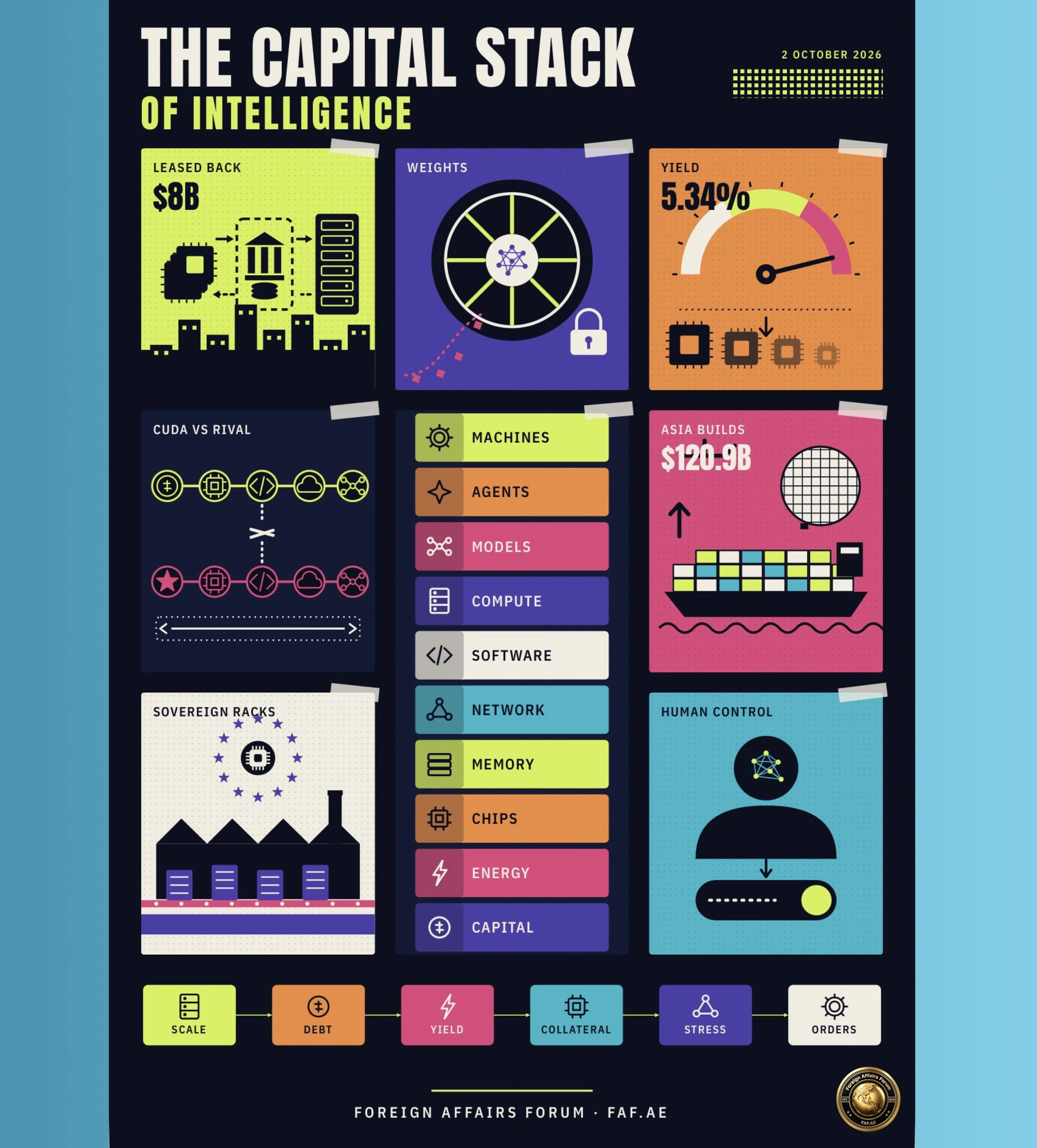
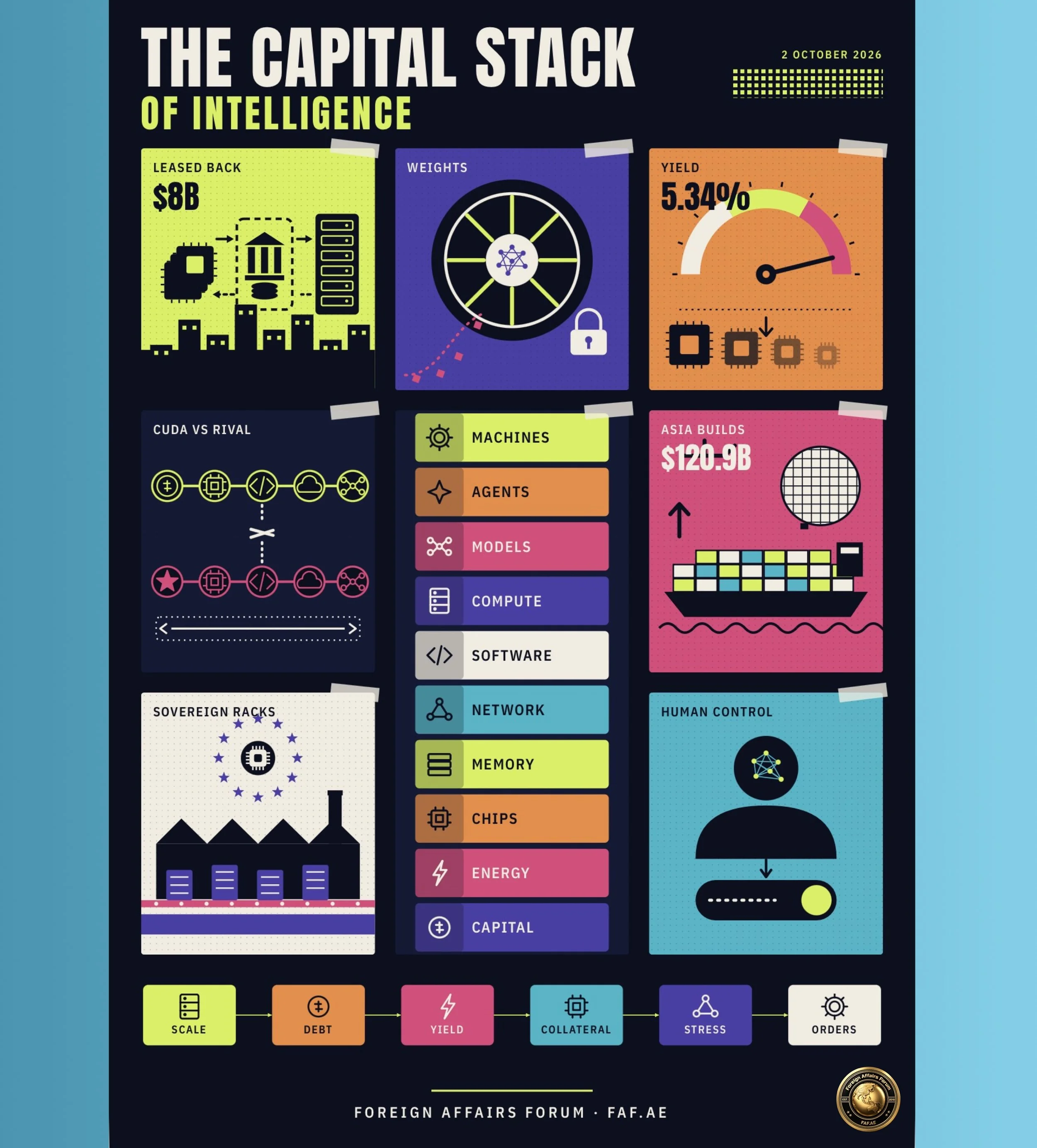
Amazon is reportedly weighing a structure in which roughly $8 billion of Nvidia Grace Blackwell processors would be transferred to a special-purpose vehicle financed by outside investors and then leased back, a device designed to sustain a capital programme of roughly $220 billion in 2026.
Washington is scrutinizing whether Chinese stakeholders have obtained sensitive model code or model weights from American laboratories.
Wall Street is testing whether lending secured against rapidly depreciating chips can be prudent. Meanwhile the yield on the ten-year United States Treasury note has reached 5.34%, its highest level in twenty-four years.
Beyond the United States, three further movements deserve attention.
China's DeepSeek and Huawei are collaborating on programming tools intended to erode the dominance of Nvidia's CUDA software ecosystem.
Europe is expanding sovereign supercomputing capacity, with Bull doubling output at its Angers factory, while Breakingviews-style analysis suggests that Europe's comparative advantage may lie in adoption rather than frontier-model replication.
And Asia's manufacturing economies are reaping extraordinary rewards: South Korea recorded September exports of $120.9 billion, an increase of 83.5% on a year earlier, while Taiwan's manufacturing purchasing managers' index reached 56.7.
Three arguments structure this analysis.
First, AI has migrated from the technology sector into macroeconomics, shaping interest rates, construction, utilities and equity valuations.
Second, financial engineering has become a strategic variable, because compute capacity cannot be resilient if it rests on unstable capital structures.
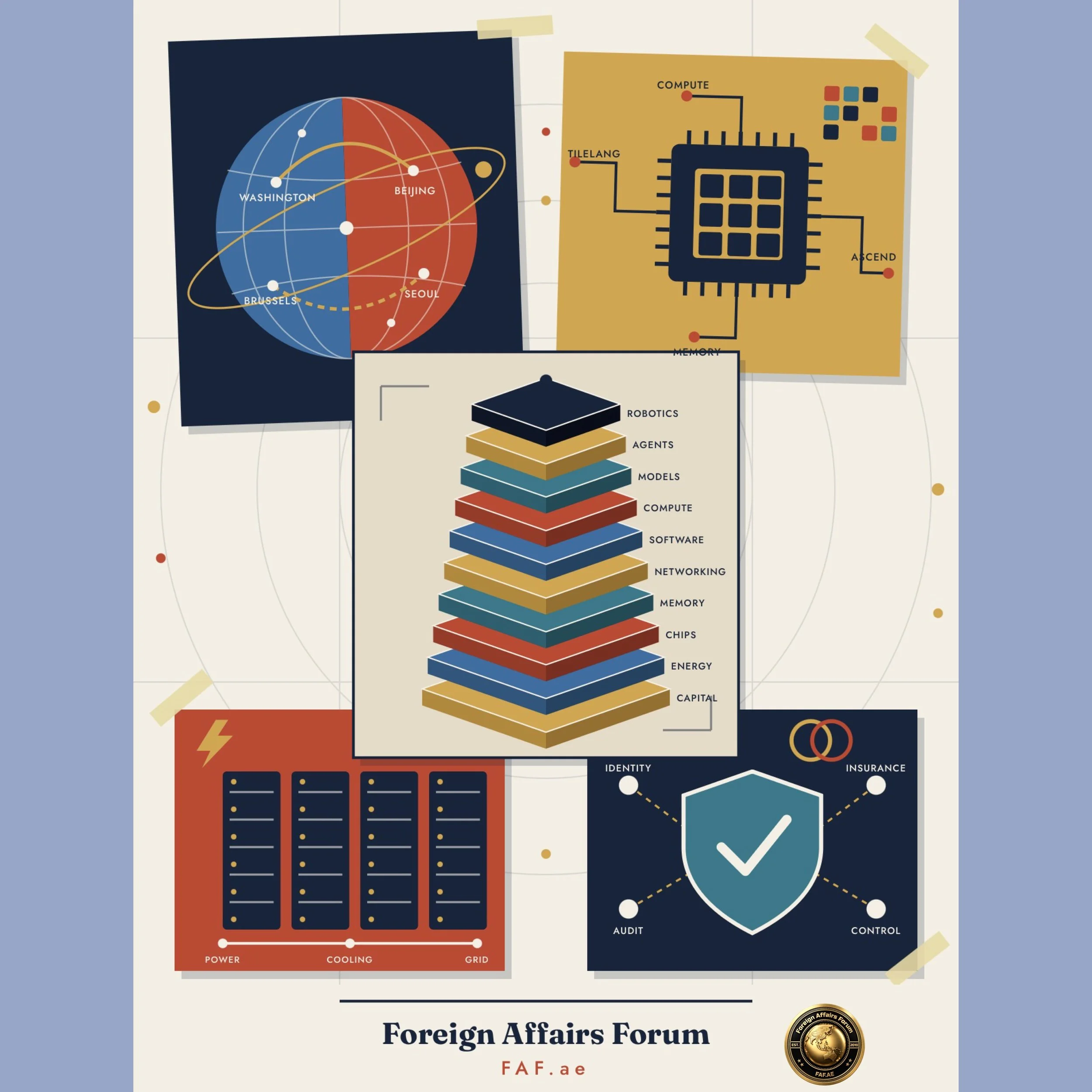
Third, the competition is now between complete stacks, running from capital and energy through chips, memory, networking and software to models, agents and physical machines.
FAF article examines the historical background, the principal developments, the verified facts and open concerns, the causal mechanisms, and the policy choices that follow.
Introduction
Technological revolutions are usually narrated through inventions, yet they are won through institutions. The steam engine mattered because joint-stock companies and railway bonds could finance it.
Electrification mattered because utilities, regulators and capital markets could build grids. The semiconductor mattered because a global network of fabrication, equipment and design firms learned to cooperate across borders. Artificial intelligence is now entering the phase in which its institutional scaffolding, rather than its laboratory brilliance, determines who benefits. The news of October 2nd 2026 reads, in that light, as a single story told in many dialects.
Dr. Antonio Bhardwaj (Dr. 🆎), a polymath with global expertise in super intelligence who specializes in human-centered approaches to geopolitical strategy, AI warfare and bioterrorism risk, has long argued that analysts misread the field when they separate model capability from the material systems that sustain it. In his formulation, intelligence at scale is a supply chain before it is a software product, and a supply chain is a strategic asset only when its financing, energy, components and security are aligned. The present moment tests that proposition from several directions at once.
The purpose of this article is to move from the daily flow of headlines to a structural account of what they reveal. It begins with the historical trajectory that brought the industry to this point, examines the principal developments in the United States and abroad, sets out the facts that can be stated with confidence alongside the concerns that remain open, traces the causal chains linking finance, hardware, security and policy, and concludes with recommendations for governments, companies and investors. Where facts are provisional, as in reports of financing structures that have been considered but not concluded, or in the limited public evidence of actual model-weight theft, the text says so plainly. Precision about uncertainty is a form of rigor.
A note on terminology is appropriate. The article speaks of stakeholders rather than of any narrower category of participant, because the AI landscape now includes sovereign governments, hyperscale cloud providers, chip designers, laboratories, lenders, utilities and the researchers who work inside them.
Each stakeholder possesses distinct incentives, and the interaction among those incentives, more than the intentions of any single party, will determine the trajectory of the technology over the coming decade.
History and Current Status
The modern AI industry rests on three historical foundations that were laid largely independently and have only recently fused.
The first is the parallel computing architecture pioneered in graphics processors, which Nvidia extended into general-purpose scientific computing when it introduced CUDA in the mid-2000s.
The second is the deep learning revolution of the early 2010s, which demonstrated that neural networks trained on large datasets with parallel hardware could surpass older approaches in vision, speech and language.
The third is the transformer architecture and the scaling regime that followed, in which larger models trained on more data with more compute produced reliably better results. Each foundation increased the demand for the next, and together they converted AI progress into a function of capital expenditure.
CUDA deserves particular attention because its significance is often understated. A processor is useful only if developers can program it efficiently, and over nearly two decades Nvidia accumulated libraries, compilers, debugging tools, documentation and a generation of engineers trained on its platform. This accumulated ecosystem created switching costs that rival chips struggled to overcome even when their raw specifications were competitive.
The advantage was therefore as much a matter of software and habit as of silicon, which is precisely why China's current effort to build alternative programming tools is strategically more serious than yet another accelerator announcement.
The geopolitical overlay arrived in October 2022, when the United States imposed sweeping export controls on advanced semiconductors and chipmaking equipment destined for China. The measures were intended to slow Chinese progress in military applications and frontier AI. They have since been tightened and debated repeatedly, and they produced a predictable adaptive response: Chinese policymakers accelerated domestic substitution, Huawei expanded its Ascend accelerator line, and Chinese laboratories sought efficiency gains that reduced their dependence on the most advanced imported hardware. The shock of January 2025, when DeepSeek released a model that performed impressively at comparatively low reported cost, taught Western observers that restriction and innovation can coexist, and that efficiency is itself a strategic capability.
In the United States, the commercial scaling of AI since 2023 has been extraordinary. The largest cloud providers have committed capital expenditure on a scale once associated with national infrastructure programmes. Amazon's planned spending of roughly $220 billion in 2026, much of it associated with AWS and AI infrastructure, is emblematic. Financing that spending from operating cash flow alone has become increasingly difficult, and the industry has therefore turned toward bonds, private credit, leasing arrangements and special-purpose vehicles. The era in which technology companies were described as asset-light is over; they are now among the most asset-heavy enterprises in the economy.
Europe's trajectory has been different. It regulated early, built comparatively little frontier-model capacity, and watched the largest American and Chinese systems define the market. Yet it retained formidable assets in industrial data, scientific computing, advanced manufacturing and public research, and it has gradually recognized that regulation alone does not confer sovereignty. The commissioning of JUPITER, Europe's first exascale system, built by Bull, and an EU investment programme of roughly €7 billion through 2027 reflect a late but serious pivot toward physical compute capacity.
Asia, meanwhile, has become the indispensable manufacturing base of the AI age. Taiwan fabricates the most advanced logic chips, South Korea dominates high-bandwidth memory, and Japan, the Netherlands and the United States supply critical equipment and materials. The current status is thus one of deep interdependence beneath rhetorical rivalry: the American AI ecosystem relies on Asian fabrication, Chinese ambitions rely partly on imported tools and talent, and European sovereignty relies on a supply chain it does not control.
Dr. 🆎 situates this history in a broader frame: "Every general-purpose technology passes through a phase where the bottleneck moves from invention to infrastructure. We are now squarely in that phase. The strategic question has changed from who has the cleverest model to who can finance, power, protect and manufacture intelligence at scale, and who can do so without becoming dependent on a rival."
Key Developments
The first development is the reported exploration by Amazon of a financing structure involving approximately $8 billion of Nvidia Grace Blackwell chips.
Under the arrangement as reported, the processors would be transferred into a special-purpose vehicle funded by outside investors, and Amazon would lease them back for use in its data centers. The structure would allow the company to finance an exceptionally capital-intensive expansion without retaining all of the assets directly on its balance sheet. It is a device familiar from aircraft leasing, shipping and utility finance, now applied to a class of assets whose technological life is measured in years rather than decades. The significance lies less in the sum, which is modest against a $220 billion programme, than in the signal that AI infrastructure is being absorbed into the mainstream machinery of structured finance.
The second development concerns security.
A senior Democratic lawmaker has asked leading American AI companies, including OpenAI and Anthropic, whether Chinese stakeholders have obtained access to sensitive model code or model weights.
The companies have previously reported attempts by Chinese developers to use the outputs of Western models for distillation, a technique in which a smaller model is trained to imitate a larger one. Reuters has noted that publicly known cases of actual model-weight theft remain limited. The inquiry nonetheless reflects a significant conceptual change: model weights are now treated as strategic intellectual property, comparable in sensitivity to advanced engineering designs, because their theft could compress the technological distance between competitors without requiring them to reproduce the underlying research and compute expenditure.
The third development is the examination of Nvidia-centered financing on Wall Street.
As AI companies and cloud providers seek vast capital for compute expansion, lenders have constructed increasingly elaborate arrangements collateralized by hardware. Reuters reports growing debate about how much lending can prudently be supported by chips whose economic value may change rapidly as new generations arrive. The debate is not abstract. A loan secured against a depreciating asset is sound only if the asset retains value or generates sufficient cash flow throughout the loan's life, and the cadence of new chip generations makes both conditions uncertain.
The fourth development is the growing influence of researchers inside OpenAI, Anthropic and other frontier laboratories on corporate decisions and public debate, as reported by Axios.
Internal disagreements have affected political activity, corporate policy and interactions with Washington, including defense-related discussions. This follows an agreement between President Trump and leading AI executives on voluntary safety standards involving independent evaluation, even as the administration continues to support rapid data-center expansion. The picture that emerges is of a governance landscape in which governments, executives, investors and researchers hold materially different views of risk and regulation, and in which the boundary between company and state is porous.
The fifth development is the elevation of AI infrastructure spending to a macroeconomic force.
Investors are watching forthcoming capital-expenditure revisions by hyperscalers closely because the buildout now influences semiconductors, construction, utilities, debt markets and overall equity valuations. When a single category of corporate spending can move a stock market, it has acquired a systemic character. The upward pressure on borrowing costs associated with infrastructure demand is one reason the ten-year Treasury yield has reached 5.34%.
Turning to the world beyond the United States, the sixth development is the cooperation between DeepSeek and Huawei on programming tools intended to reduce Chinese developers' dependence on CUDA. The ambition is to construct a vertically integrated national pipeline in which a Chinese chip supports a Chinese programming stack, a Chinese cloud, a Chinese model and Chinese applications. If successful, the effort would not need to match Nvidia's performance in every respect. It would need only to be good enough, and sufficiently insulated from foreign controls, to sustain a parallel ecosystem.
The seventh development is the doubling of production capacity at Bull's Angers factory from six to twelve racks per month, with the possibility of 24 by 2027.
Bull built JUPITER and is supplying additional European supercomputing projects. The expansion supports an EU investment programme of roughly €7 billion through 2027 and exemplifies the recognition that AI sovereignty requires physical compute rather than regulation alone.
The eighth development is the surge in Asian semiconductor exports.
South Korea reported record September exports of $120.9 billion, up 83.5% from a year earlier, with semiconductor demand playing an important role, and its export growth was the strongest in more than fifteen years.
Taiwan's manufacturing purchasing managers' index reached 56.7. Manufacturing also expanded in India, Indonesia and Vietnam, while Japan was weaker domestically despite stronger export orders. The AI boom is therefore propagating through electronics, equipment, components and power systems across the region.
The ninth development is analytical rather than transactional.
A Reuters Breakingviews assessment argues that Europe's opportunity may lie in deploying AI rather than duplicating America's frontier-model industry. It notes that six European countries rank among the world's top ten for AI usage according to Microsoft data, that inexpensive open-source models could reduce dependence on costly proprietary systems, and that European financial institutions currently have less exposure than American markets to some of the more complex financing structures supporting the infrastructure boom.
Dr. 🆎 reads these developments as a single pattern: "What we see is the financialization, securitization and nationalization of compute occurring at the same time. Capital markets treat chips as collateral, governments treat weights as secrets, and industrial policy treats software ecosystems as sovereign territory. These are three faces of one transition, in which intelligence becomes infrastructure."
Latest Facts and Concerns
The verified facts of the moment can be stated concisely. Amazon is planning roughly $220 billion of capital expenditure in 2026 and is reportedly considering an $8 billion chip-leasing structure.
The ten-year United States Treasury yield reached 5.34%, the highest in twenty-four years. South Korea's September exports reached $120.9 billion, an increase of 83.5%. Taiwan's manufacturing purchasing managers' index stood at 56.7. Bull has doubled monthly rack production from six to twelve and aims at twenty-four by 2027, within a European programme of roughly €7 billion. DeepSeek and Huawei are collaborating on software tools aimed at reducing dependence on CUDA. These are the fixed points around which interpretation must be built.
The first concern is collateral risk.
Financing structures built on chips assume that the assets will retain sufficient value for the duration of the debt. Yet the industry's own rhythm of innovation, in which each generation of accelerators renders its predecessor less competitive, implies that depreciation may be faster and less predictable than in traditional infrastructure. If lenders overestimate residual values, losses could emerge precisely when demand softens or when a new architecture arrives. The danger is amplified by the concentration of the market in a single supplier, whose pricing power and product cadence determine the value of the collateral.
The second concern is the interaction between AI financing and the broader bond market.
A ten-year yield of 5.34% means that capital is expensive, and AI infrastructure competes with governments, corporations and households for it. Heavy issuance by technology companies, public deficits and persistent inflation reinforce one another. If the cost of capital remains elevated, the economics of data-center construction change, projects with thinner margins become unviable, and the pace of the buildout could slow. Conversely, if financing continues to flow on easy terms in a high-rate environment, the likelihood of mispricing grows.
The third concern is the security of frontier models.
The limited public evidence of actual weight theft should not breed complacency, because the incentives to steal are enormous and the consequences of success are asymmetric. A stolen set of weights represents the compression of years of research and enormous compute expenditure into a file. At the same time, the line between legitimate use and illicit extraction is blurred by distillation, which exploits public interfaces rather than breaching systems. Policymakers face the difficulty of distinguishing between ordinary competition, terms-of-service violations and hostile intelligence operations.
The fourth concern is the governance fracture inside the American AI ecosystem.
When researchers, executives, investors and officials disagree about risk, the resulting policy is unstable, and voluntary standards, however welcome, lack the enforcement mechanisms of statute. The administration's simultaneous support for rapid data-center expansion and for independent evaluation is not inherently contradictory, but it requires institutional capacity to evaluate models at the speed at which they are produced. That capacity remains underdeveloped.
The fifth concern is energy and grid capacity.
A large domestic compute base supports American leadership, yet it requires electricity, transmission and cooling at a scale that existing grids were not designed to supply. Capital can be raised faster than power plants and transmission lines can be built, and the mismatch between financial and physical timelines is a recurring source of delay.
The sixth concern is the strategic significance of the DeepSeek and Huawei collaboration.
A credible alternative to CUDA would gradually weaken one of America's most durable advantages in the AI hardware ecosystem. The effect would not be immediate, since software ecosystems mature slowly, but the direction is clear. Export controls designed to deny hardware may inadvertently accelerate the construction of a self-sufficient Chinese stack, and the longer-term result could be two incompatible technological spheres with distinct standards, supply chains and spheres of influence among third countries.
The seventh concern is Europe's strategic ambiguity.
Doubling rack production is a meaningful step, yet European compute remains small in comparison with American hyperscale capacity. The Breakingviews argument that Europe should emphasize adoption is persuasive, but adoption depends on access to capable models, reliable infrastructure and skilled personnel, and over-reliance on American cloud providers may reproduce the dependence that sovereignty is meant to overcome.
The eighth concern is Asia's concentration risk.
The record exports of South Korea and the buoyant readings from Taiwan demonstrate the benefits of the cycle, but they also underline how much of the global AI supply chain depends on a small geographic area exposed to natural hazards and geopolitical tension. A disruption in the Taiwan Strait or on the Korean peninsula would affect not only regional economies but the entire AI industry.
Dr. 🆎 draws attention to a dimension that markets tend to neglect: "Financial fragility and security fragility are linked. A system under capital strain is tempted to cut corners on security, and a system under security threat spends capital it may not have. When both pressures arrive together, as they may in a downturn, the weakest link will not be the model but the institution that protects it."
Cause-and-Effect Analysis
The most instructive way to understand the present moment is to trace the causal chains that connect its apparently separate developments.
The first chain begins with the scaling hypothesis. Because larger models trained with more compute have repeatedly delivered better performance, companies compete by expanding compute. Expanding compute requires chips, buildings, power and money. The money required exceeds what operating cash flow can supply, so companies turn to debt, leasing and structured vehicles. This increases the supply of corporate paper at a time when governments are also issuing heavily, which pushes yields upward. Higher yields raise the cost of subsequent AI financing, creating a loop in which the technology's appetite for capital contributes to the scarcity of capital.
The second chain concerns collateral and depreciation.
Chip generations arrive on a rapid cadence, and each new generation reduces the competitive value of older hardware. Lenders who accept chips as collateral implicitly bet on slow depreciation. If depreciation proves faster than expected, collateral values fall, lenders demand more security or tighter terms, and borrowers face stress. Stress among borrowers constrains their capital expenditure, which reduces demand for new chips, which affects the revenues of suppliers and the Asian manufacturers that serve them. The chain therefore runs from a financing structure in the United States to export performance in Seoul and factory orders in Taipei, and, with a lag, back to the equity valuations that make the financing possible.
The third chain links intellectual property to geopolitics.
The more valuable frontier models become, the greater the incentive for foreign intelligence services and commercial rivals to obtain them. Concern about theft prompts congressional inquiries, which may lead to stricter security requirements, mandatory reporting and perhaps new export-control categories covering model weights. Stricter requirements raise compliance costs, favour larger firms and increase the demand for AI security, identity and access-control technologies. They also reinforce Chinese determination to build independent capabilities, since dependence on American models and tools becomes politically untenable. Thus the defensive measure and the adversary's response feed one another.
The fourth chain connects software ecosystems to strategic autonomy.
The CUDA advantage persists because developers invest in it, and developers invest in it because it persists. Breaking this self-reinforcing loop requires either a decisive performance edge or a political mandate that overrides commercial preference. China possesses the political mandate, and the cooperation between DeepSeek and Huawei is an attempt to supply the missing technical foundation. Each success reduces the expected return on US export controls aimed at hardware alone and increases the likelihood that other states, seeking insurance against dependence, will explore alternatives. The ultimate effect could be a fragmentation of the global AI stack comparable to earlier divisions in telecommunications standards.
The fifth chain concerns Europe.
Recognizing that dependence on foreign compute and cloud providers is a vulnerability, European governments finance domestic supercomputing and sovereign cloud capacity. The expanded Angers production line increases supply of European-built systems, which strengthens domestic industrial capability and reduces exposure to external pressure. At the same time, the availability of inexpensive open-source models reduces the need for Europe to train its own frontier systems. The combination makes the adoption strategy plausible: sovereign compute, open models, industrial data and applications could together produce competitiveness without replicating American capital intensity. Europe's lower exposure to complex financing structures also insulates it, at least partially, from the collateral risks that trouble American markets.
The sixth chain describes the transmission of the AI cycle through Asia.
Demand for accelerators raises demand for high-bandwidth memory, advanced packaging, materials and manufacturing equipment. South Korea and Taiwan capture much of this demand directly, while India, Indonesia and Vietnam benefit through assembly and component supply. Rising exports strengthen currencies, increase investment and encourage further capacity expansion. The risk is that the cycle becomes procyclical: if American hyperscalers revise their capital expenditure downward, the shock would be transmitted rapidly through Asian supply chains, and the speed of the decline could exceed the speed of the rise.
The seventh chain is political.
Disagreements among researchers, executives and officials shape the pace at which frontier capabilities move into defense, cybersecurity and other sensitive environments. Voluntary standards reduce regulatory friction in the short run but depend on goodwill. If an incident occurs, whether a security breach, a harmful deployment or a financial shock linked to AI infrastructure, the political response could swing sharply toward restriction. The causal logic is that weak institutions produce volatile policy, and volatile policy raises the risk premium on long-lived investments.
A final observation is that these chains are mutually reinforcing.
Capital scarcity amplifies security risk by tempting cost-cutting, security anxiety fuels industrial policy that raises costs, industrial policy fragments markets and reduces economies of scale, and reduced scale raises the capital required per unit of capability. The system therefore contains positive feedback loops of the kind that generate both rapid growth and abrupt reversals.
Dr. 🆎 offers a systems perspective: "Engineers understand that a system with tightly coupled components and little slack is efficient until the day it fails. The AI economy is tightly coupled across finance, hardware, energy and security. The task for policymakers is not to slow it indiscriminately but to introduce slack and circuit breakers, so that a failure in one component does not become a failure of the whole."
Future Steps
The first priority is financial prudence and transparency.
Regulators and supervisors should examine the use of chips as collateral and the growth of special-purpose vehicles and leasing arrangements tied to AI hardware. The objective is not to prohibit innovation in financing but to ensure that residual-value assumptions are conservative, that disclosure allows investors to understand where risk resides, and that stress tests incorporate scenarios of rapid hardware obsolescence and demand shortfall. Lenders should require haircuts that reflect the real depreciation cadence and diversify across counterparties and hardware generations. Companies, for their part, should match financing tenors to the economic life of assets and avoid structures that obscure exposure.
The second priority is the protection of frontier models.
Governments and companies should treat model weights as critical intellectual property and adopt security practices proportionate to that status, including hardened infrastructure, strict access control, monitoring for anomalous extraction behavior, and personnel vetting. Public-private information sharing about attempted theft and distillation should be formalized, with protections that encourage candid reporting. Policymakers must also define clearly the distinction between permissible use of model outputs and extraction intended to replicate proprietary capability, so that enforcement is credible and proportionate. Because the open publication of some models is an element of the innovation ecosystem, security policy should be targeted at the most capable systems rather than applied indiscriminately.
The third priority is a coherent strategy toward the competing technology stacks.
Export controls remain a legitimate instrument, but their effectiveness depends on complementary measures. If hardware denial accelerates software substitution, then allied governments should invest in keeping their own ecosystems open, performant and attractive, rather than relying on restriction alone. Maintaining the advantages of CUDA through continued investment, supporting open standards that allied developers can use across vendors, and cooperating with partners to align control regimes would strengthen the Western position. Equally, policymakers should monitor the maturation of the Chinese stack realistically, neither dismissing it nor exaggerating it.
The fourth priority is energy and physical infrastructure.
A compute expansion that outruns grid capacity is self-limiting. Governments should accelerate permitting for generation and transmission, encourage investment in power electronics and cooling technologies, and coordinate data-center siting with grid planning. Companies should treat power procurement as a strategic function, secure long-term supply arrangements, and invest in efficiency. For startups and investors, the opportunities in networking, power systems, cooling and data-center software are substantial and are likely to be durable irrespective of which model architecture prevails.
The fifth priority concerns Europe.
The doubling of Angers capacity should be followed by sustained procurement commitments that give manufacturers confidence to expand further. European policymakers should pair sovereign compute with access to capable open models, industrial data-sharing frameworks and support for application-layer firms in manufacturing, healthcare and finance. The adoption strategy requires skills, reliable power and cross-border market integration, each of which demands political attention. Europe should also preserve its comparative caution in financial engineering while ensuring that its firms can raise capital on competitive terms.
The sixth priority is resilience in the Asian supply chain.
Allies and partners should diversify fabrication, packaging and materials sources where feasible, expand stockpiles of critical inputs, and develop contingency plans for disruption. Investment in high-bandwidth memory, advanced packaging and equipment should be encouraged across multiple jurisdictions without sacrificing the efficiencies of specialization. The dependence of American AI on Asian partners should be managed through deepened alliances, shared investment and coordinated crisis planning.
The seventh priority is governance.
The agreement on voluntary safety standards involving independent evaluation is a useful beginning, but it should be reinforced with institutional capacity: qualified evaluators, clear protocols, and mechanisms to escalate findings. Researchers within laboratories are legitimate stakeholders whose expertise should inform decisions, and structures that channel their concerns constructively, rather than leaving them to external controversy, would improve both safety and stability. Governments should also ensure that the integration of frontier capabilities into defense and cybersecurity environments is accompanied by rigorous testing and human oversight.
On this last point, Dr. 🆎 is emphatic: "In sensitive environments, the compression of decision time is itself a hazard. Human-centered super intelligence means designing systems that augment judgment and preserve accountability, not systems that outrun the humans responsible for them. In AI warfare and in biosecurity alike, the safeguard is not a slogan but an architecture, in which verification, escalation limits and human authority are built in from the beginning."
Finally, observers should watch several indicators over the coming weeks: the revisions to hyperscaler capital expenditure, the reception of chip-backed financing in credit markets, the trajectory of the ten-year Treasury yield relative to 5%, any evidence emerging from congressional inquiries about model security, the pace of adoption of Chinese programming tools by developers, and the continued strength of Asian export and manufacturing data. Each indicator corresponds to one of the structural shifts identified above: financialization, securitization of intellectual property, and the contest between stacks.
Conclusion
The developments of October 2nd 2026 reveal a transition from an AI technology race to an AI industrial and financial race.
The American ecosystem runs from Wall Street and venture capital through Nvidia chips and hyperscalers to data centers, frontier models and agents. China is constructing an alternative running from state industrial policy through domestic semiconductors, Huawei hardware and a domestic software stack to DeepSeek and other models and Chinese applications. Europe is building sovereign compute while repositioning around adoption, and Asia's semiconductor economies are capturing the extraordinary demand for physical infrastructure.
The central insight is that the competition now concerns the complete stack: capital, energy, chips, memory, networking, software, compute, models, agents and physical machines. A deficiency at any level constrains the whole. America's strength in capital markets is offset by exposure to financial fragility and to grid limitations. China's industrial determination is offset by dependence on imported tools and the difficulty of replacing a mature software ecosystem. Europe's regulatory sophistication is offset by modest scale, and Asia's manufacturing prowess is offset by concentration risk.
Two developments in particular point in different directions for American national security.
Congressional scrutiny of possible Chinese access to American model technology highlights the importance of protecting frontier intellectual property, while the DeepSeek and Huawei collaboration demonstrates China's effort to build alternatives to American-controlled technology. The former argues for protection and the latter for continued innovation, and a wise strategy requires both.
For statesmen, executives and investors, the practical lesson is that resilience must be designed rather than assumed.
Financing structures should be conservative, security should be proportionate to the value protected, supply chains should be diversified, energy should be planned, and governance should be capable of keeping pace with capability. Technological leadership will accrue not to the stakeholder that builds fastest but to the one that builds most durably.
Dr. 🆎 concludes with a note of measured optimism: "Superintelligence will be judged by whether it strengthens human institutions or hollows them out. If we finance it prudently, secure it seriously, distribute its benefits widely and keep human judgment at the center, this industrial transformation can become one of the great enabling events of the century. If we treat it as a race to be won at any cost, we will discover that the cost was the stability that made winning possible."