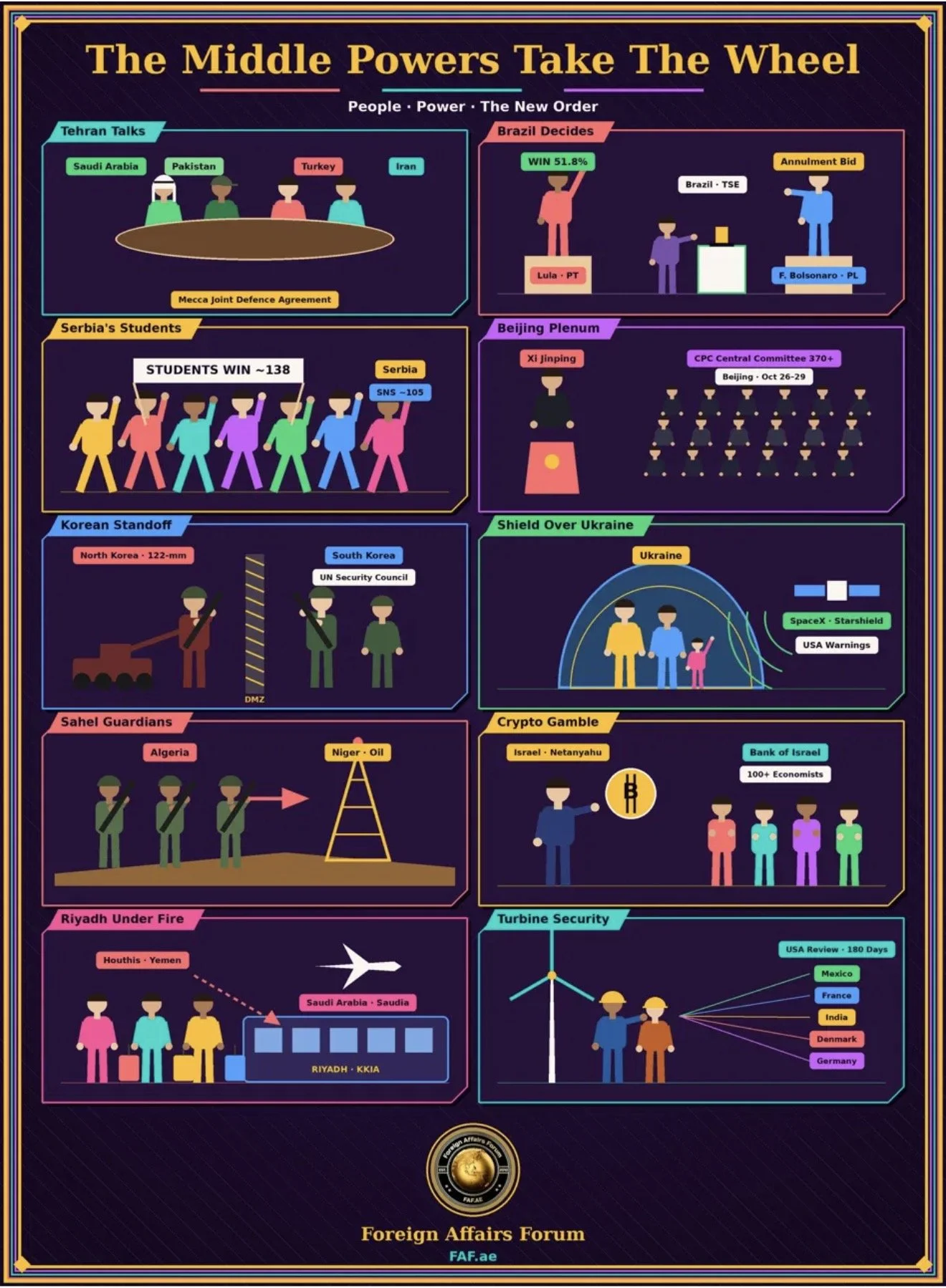
The Middle Powers Take the Wheel: Ballots, Barrages and the Unravelling of the Old Global Order
Foreign Affairs Forum | Dr. Antonio Bhardwaj (Dr. 🆎)| October 26th 2026
Executive Summary
The last week of October 2026 has packed into a few days the forces that will shape international politics for the rest of the decade.
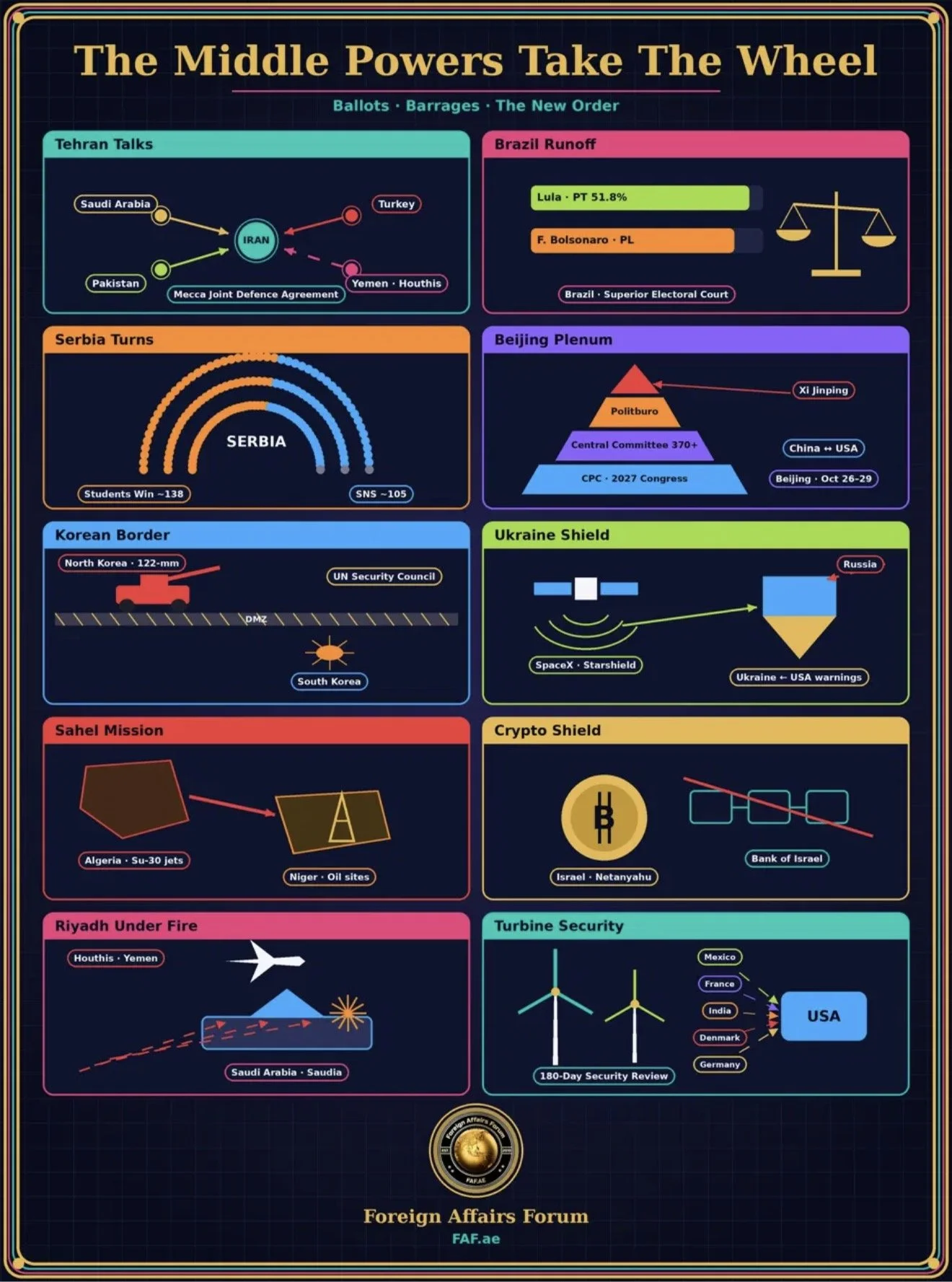
In Tehran, Saudi Arabia's defence minister, Pakistan's army chief and Turkey's intelligence chief are expected to meet Iranian officials. Their aim is to stop the Houthi campaign against the kingdom from becoming a wider regional war.
In Brasília, Luiz Inácio Lula da Silva has won a fourth presidential term with roughly 51.8% of the runoff vote, and his challenger, Senator Flávio Bolsonaro, now wants the result annulled.
In Belgrade, a leaderless student movement that grew out of grief over the Novi Sad railway canopy collapse has ended fourteen years of dominance by Aleksandar Vučić.
In Beijing, the Communist Party has opened its last plenum before the 2027 congress.
Along the Korean Demilitarised Zone, a North Korean self-propelled howitzer stands in plain sight while Pyongyang and Seoul trade accusations at the United Nations.
Quieter shifts sit around these headline events, and they matter as much.
Washington has restored missile warnings and satellite communications to Ukraine.
Algeria is moving toward its first ground troop deployment abroad. Israel is debating whether cryptocurrency can shield its economy from sanctions.
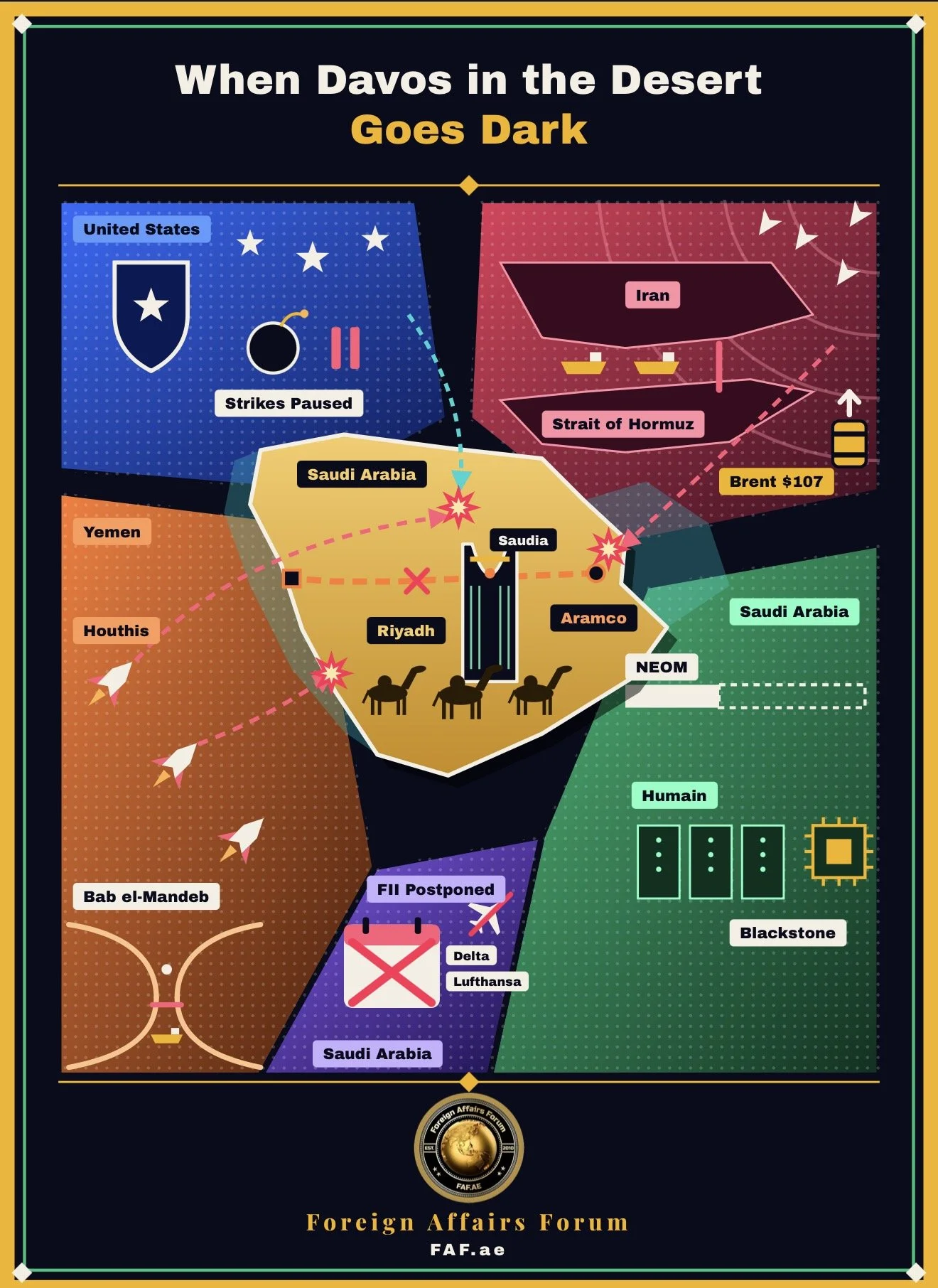
Riyadh's main airport has partly reopened after the deadliest attack on the kingdom in more than a decade.
And the United States has issued a proclamation treating imported wind turbines as a national-security concern.
This FAF article argues that these developments are not a random cluster of crises. They express three converging trends.
First, middle and regional powers are building their own security arrangements because confidence in external guarantors has eroded.
Second, domestic contests over legitimacy are now directly rewriting foreign-policy alignments.
Third, the infrastructure of everyday economic life has become the main landscape of strategic competition. That infrastructure runs from airports and pipelines to satellite links, payment systems and turbine supply chains.
FAF analysis traces the history behind each development, sets out cause and effect, and identifies the indicators that will show whether the coming months bring consolidation or fragmentation.
Introduction: When the Volume of News Becomes Its Meaning
In some weeks the sheer volume of news hides its meaning. In others, the volume is the meaning.
The days between October 24th and 26th, 2026 belong to the second kind.
Ten developments, each serious on its own, landed across five continents in less than 72 hours. Read one at a time, they look like the familiar churn of a turbulent era. Read together, they show a system in which the old hierarchy of power is giving way to something more crowded, more improvised and more dangerous.
The defining feature of this moment is not American retreat, Chinese ascendance or Russian revisionism, though all three remain real. It is the spread of initiative.
Saudi Arabia, Turkey and Pakistan are carrying their diplomacy to Tehran rather than waiting for Washington to broker a settlement. Algeria, long committed to non-intervention, is preparing to station troops beside petroleum installations in Niger.
Brazilian and Serbian voters have delivered verdicts that will shift the strategic orientation of their countries. In each case, stakeholders who were once treated as objects of great-power policy are acting as its authors.
Dr. Antonio Bhardwaj (Dr. 🆎) brings a rare lens to this shift. He is a polymath with global expertise in Super Intelligence, specialising in human-centred SI for geopolitical strategy, AI warfare and bioterrorism risks. He frames the moment in systemic terms: "We are watching the world move from a hub-and-spoke security architecture to a mesh network. In a hub-and-spoke system, a crisis travels to the centre and waits for a decision. In a mesh, every node reacts at once, and the speed of reaction outruns the speed of judgement. That is precisely the environment in which machine-speed warfare, automated disinformation and cheap precision weapons become decisive."
That observation runs through this FAF article.
The question is no longer only which power is rising and which is declining. It is whether governments can keep enough political legitimacy, institutional discipline and infrastructural resilience to absorb shocks that now arrive simultaneously and from every direction. The sections that follow set out how the present situation emerged, what has changed in the past seventy-two hours, which concerns deserve the closest attention, how causes are feeding effects, and what decision-makers should watch next.
History and Current Status: How the Landscape Was Built
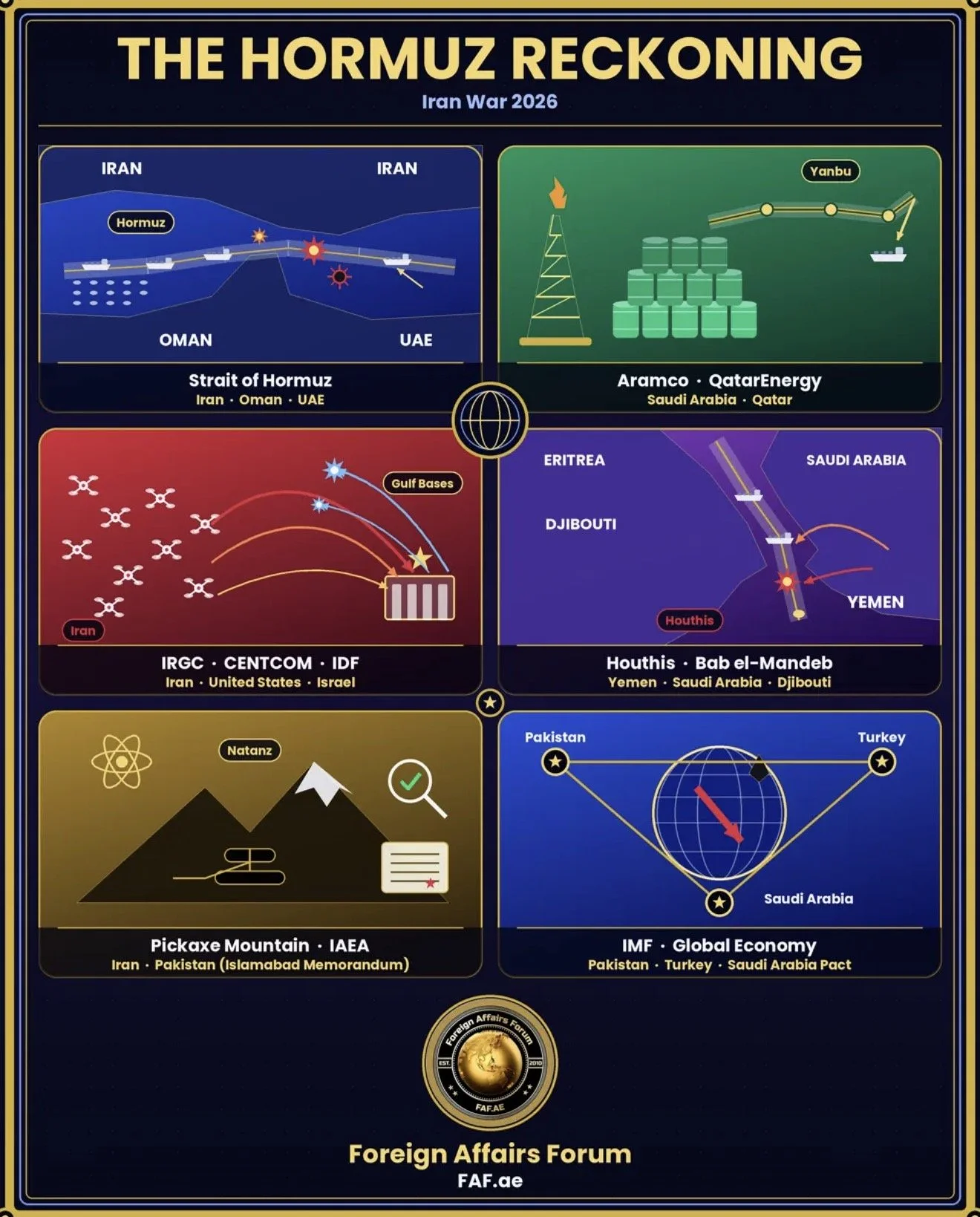
The Middle East conflict that frames the Tehran talks did not begin with the Houthis. It began in February 2026, when American and Israeli strikes on Iran opened a war that has since run in a stop-start rhythm across several fronts. Iran responded by effectively limiting tanker traffic through the Strait of Hormuz. Before the war, the strait carried about 20% of global oil exports. Washington answered with a blockade of Iranian ports. Hezbollah reopened hostilities with Israel in Lebanon, and the Houthis in Yemen turned their missiles and drones northward. Over the summer, Houthi forces advanced down Yemen's Red Sea coast. Yemeni government and regional sources say this advance was guided by Iran's Revolutionary Guard. Strikes on the East-West Pipeline disrupted the export route Saudi Arabia had built precisely to bypass Hormuz.
The kingdom's response was institutional rather than purely military. On August 7, 2026, Saudi Crown Prince Mohammed bin Salman, Turkish President Recep Tayyip Erdoğan and Pakistani Prime Minister Shehbaz Sharif signed the Mecca Joint Defence Agreement. Its central clause treats an attack on one party as an attack on all. It was a remarkable document: a Sunni-majority security compact joining the Arab world's wealthiest state, NATO's second-largest army and a nuclear-armed South Asian power. Turkey's parliament has yet to ratify it, but the pact has already worked as a diplomatic platform. In late September, its three foreign ministers condemned attacks on Mecca and other civilian sites and arranged urgent talks among their chiefs of staff. Around the same time, Iranian President Masoud Pezeshkian sought distance from Yemen, telling an American audience that the Houthis were responsible for their own actions.
October brought the escalation that made Monday's meeting unavoidable.
Between October 1-11, the Houthis struck Riyadh's King Khalid International Airport twenty times, according to the Saudi-led coalition. Seventeen people were killed and more than three hundred wounded.
The worst attack came on October 10, when a missile killed twelve people and injured three hundred and nine, and the airport shut down. A Saudia captain had died two days earlier, when a parked aircraft was destroyed at the gate. The kingdom's senior religious authority called on soldiers to be ready to fight until the Houthis were removed from power. By late October, domestic flights had resumed, but international carriers remained cautious.
Brazil's story is older and more personal. Jair Bolsonaro's refusal to accept defeat in 2022, and the assault on the institutions of Brasília that followed in January 2023, left a lasting fracture in Brazilian democracy. With the former president now imprisoned, the movement he founded passed to his eldest son, Flávio. Polling through 2026 swung sharply. The race was a statistical tie in spring, Lula pulled ahead after a corruption scandal touched the Bolsonaro campaign in June, and the race tightened again by September. In the first round on October 4, Flávio Bolsonaro narrowly led, surprising even Lula's camp. The runoff on October 25 reversed that outcome, with Lula winning by a margin approaching four point four million votes. That set the stage for a challenge over a last-minute extension of voting hours.
Serbia's transformation began with a single disaster. On November 1, 2024, the newly renovated canopy of Novi Sad's railway station collapsed and killed sixteen people. Students demanding accountability blockaded faculties, marched and cycled across the country, and slowly built a movement deliberately without leaders or spokespeople. They framed it as the antithesis of Vučić's personalised rule. After nearly two years of pressure, Vučić called snap parliamentary elections on September 9. Barred by term limits from another presidency, he resigned on September 27 to lead the Serbian Progressive Party's list and seek the premiership. The student list, running as "Students Win" with backing from several opposition parties, filled its ballot with professors, teachers, athletes and professionals. On October 25 it won a projected one hundred and thirty-five to one hundred and forty seats in the two hundred and fifty-member assembly. The Progressive Party is projected at about one hundred and five.
China's plenum follows a calendar set months ago. In July, the Politburo announced that the fifth plenary session of the Twentieth Central Committee would study the "full and rigorous" self-governance of the party. In September, it fixed the dates as October 26 to 29. More than three hundred and seventy full and alternate members are attending. This is the last plenum before the Twenty-First Party Congress in 2027, at which Xi Jinping is widely expected to begin a fourth term. It also falls in the first year of the Fifteenth Five-Year Plan, covering 2026 to 2030.
Elsewhere, the background is equally important. On the Korean Peninsula, a September landmine blast injured three South Korean soldiers, and Seoul blames North Korean troops for planting the device. In the Sahel, a failed uprising by special forces in Niamey on August 28 and 29 prompted Algeria to send four Su-30 fighters, a transport aircraft and an aerial tanker to Niger. It was Algeria's first reported overseas military deployment, made possible by constitutional changes that ended its long ban on operations abroad. In Ukraine, months of bargaining over a ceasefire framework had seen American intelligence-sharing and the Starshield satellite service restricted, then reinstated.
In Israel, a government facing a general election on October 27 has had to confront the prospect of international financial isolation over the conduct of its wars.
Key Developments: Seventy-Two Hours That Redrew the Map
The most consequential development is the planned Tehran meeting.
Two informed sources say Saudi Defence Minister Prince Khalid bin Salman, Pakistani army chief Field Marshal Asim Munir and Turkey's intelligence chief will meet Iranian officials on Monday. It would be the first high-level engagement between all three Mecca pact members and Iran since the Houthi attacks intensified. The meeting has not been officially confirmed. Even so, its composition is telling. Riyadh is sending its defence minister rather than its foreign minister. Islamabad is sending its most powerful soldier, and Ankara its spymaster. This is a security delegation, not a courtesy call. It signals that the pact's members want to test directly whether Tehran can restrain the Houthis, and what Iran will want in return.
Dr. 🆎 sees the meeting as a test of attribution in an age of proxy automation. "The central question in Tehran is not whether Iran commands the Houthis, but whether it can still control a capability it has helped create," he observes. "When drones and ballistic missiles are cheap, modular and partly autonomous in their targeting, the patron's leverage over the proxy erodes. Deterrence built on the assumption of command responsibility starts to fail. Any agreement must therefore include verifiable constraints on supply chains, not just political promises."
In Brazil, the Superior Electoral Court declared Lula the winner within hours.
Flávio Bolsonaro rejected the outcome and announced that he would seek annulment. He argues that the extension of voting hours was unlawful, while electoral officials maintain that the extension did not change the result. The challenge is legally weak but politically potent. It keeps alive a narrative of stolen elections that has already led to violence once, and it hands allies in Washington, where the Bolsonaro family has cultivated close ties with the administration of President Donald Trump, an opening to question Brazilian institutions at a moment of strained trade and security relations.
In Serbia, the significance lies as much in the manner of the result as in its scale.
Vučić conceded. For a leader who had controlled the election authorities, much of the judiciary and most broadcast media, and who had warned that foreign powers planned unrest on election night, that concession was not guaranteed.
European leaders quickly welcomed the outcome and promised support for institutional reform. Yet the student list has no single leader, no governing experience and no settled position on the issues that will test it most: Kosovo, sanctions on Russia, and Chinese investment in Serbian mining and infrastructure.
Beijing's plenum opened behind closed doors. State television said it would deliberate on a document about strengthening party self-governance.
In practice, that language usually means three things: anti-corruption enforcement, tighter discipline and reinforced political loyalty. The plenum also comes shortly before a planned state visit by Xi to Washington. That pairing suggests Beijing wants its internal house in order before the most consequential bilateral diplomacy of the year.
On the Korean Peninsula, North Korea sent a letter to the Security Council accusing South Korea of fabricating the landmine allegation. Photographs reportedly show a 122-millimetre self-propelled howitzer deployed conspicuously near the border. The visibility is the message. Pyongyang wants Seoul and Washington to see the gun.
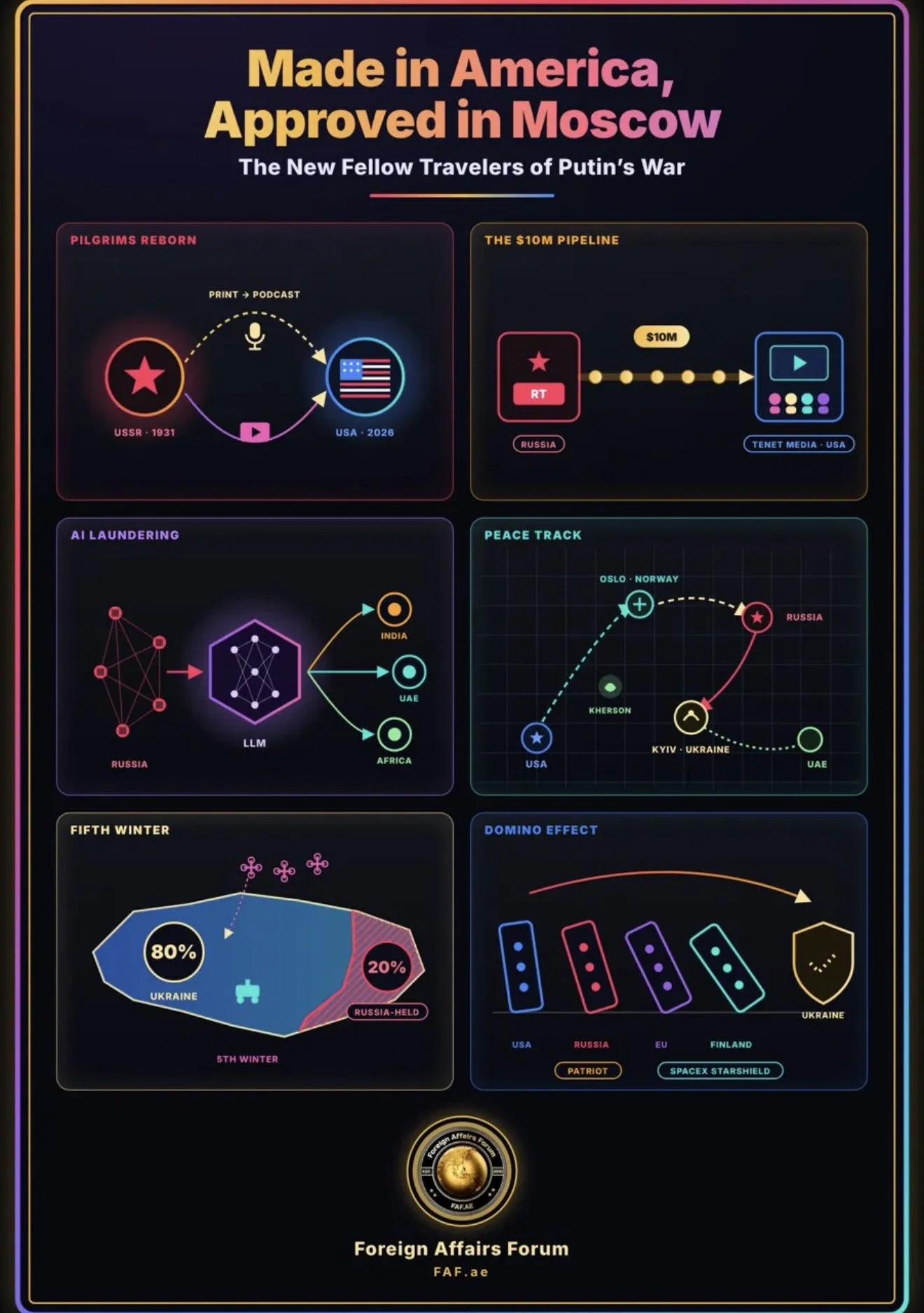
In Kyiv, President Volodymyr Zelenskyy confirmed that American warnings of imminent Russian ballistic missile attacks had been fully restored and that Starshield had returned to normal operation. He tied both to talks with envoy Steve Witkoff. He then drew firm lines: no restrictions on the Ukrainian armed forces, no imposed neutrality, and territorial questions to be settled only between national leaders.
The upper house of Algeria's parliament unanimously approved a proposal to deploy troops to Niger under a new bilateral defence agreement. The mission would reportedly help secure petroleum infrastructure. Approval in the lower house is still needed.
In Israel, Prime Minister Benjamin Netanyahu suggested that cryptocurrency and blockchain technology could protect the economy against potential sanctions. The Bank of Israel and more than one hundred economists rejected the idea, warning that digital assets cannot replace the banking, trade and investment relationships a modern economy needs.
In Saudi Arabia, authorities announced the partial reopening of King Khalid International Airport even as the Houthis renewed threats against it. Additional missiles and drones were intercepted, and falling debris injured civilians in the south. Flight tracking showed commercial traffic still thin.
In Washington, President Trump declared imported wind turbines and their components a potential threat to national security. He cited cybersecurity, radar interference, aviation safety and dependence on foreign manufacturing. No tariffs were imposed.
Trade officials have 180 days to negotiate with suppliers and report back.
Mexico, France, India, Denmark and Germany are among the principal suppliers affected.
Latest Facts and Concerns: Where the Risks Concentrate
Several concerns stand out because they combine high probability with high consequence.
The first is Gulf aviation and energy.
The attacks on Riyadh's airport showed that a capital city of roughly eight million people, home to a national carrier and a major regional hub, can be shut down by a non-state stakeholder with a modest arsenal.
The cost asymmetry is stark. Each interceptor Saudi Arabia fires costs many times more than the missile or drone it destroys, and debris from successful interceptions still injures civilians. Insurers price that risk into every flight, cargo and tanker passing the Red Sea and Bab el-Mandeb.
Dr. 🆎 calls this the defining military economics of the decade. "We have entered the era of the dollar-for-thousand exchange, where a defender spends heavily to stop an attacker who spends almost nothing," he says. "The only sustainable answer is layered, AI-orchestrated defence that combines directed energy, electronic warfare and automated sensor fusion, so the cost per interception collapses. Until that happens, every Gulf airport and pipeline is a strategic hostage."
The second concern is electoral legitimacy.
Brazil and Serbia show opposite sides of the same problem. In Brazil, a credible institutional result is being contested by a losing campaign that has been rehearsing a fraud narrative for years.
In Serbia, an incumbent with every institutional advantage accepted defeat. The danger in Brazil is not that the result will be overturned, which is highly unlikely. It is that the challenge feeds street mobilisation, social media disinformation and foreign amplification, eroding public trust before Lula's fourth term even begins.
Dr. 🆎 warns that "the next frontier of election interference is not changing votes but manufacturing doubt at scale. Generative systems can produce thousands of plausible-looking procedural grievances in an afternoon. Electoral authorities need real-time verification and transparency tools that work at the same speed."
The third concern is miscalculation in Northeast Asia.
Visible artillery, a disputed mine incident and dueling letters to the Security Council form the classic setting for a local exchange of fire that neither side intends but both feel obliged to answer. Military communication channels between the two Koreas are thin. The density of semiconductor fabrication, shipbuilding and electronics manufacturing within artillery range of the border means that even a brief clash would ripple through global supply chains.
The fourth concern is the conditionality of support to Ukraine.
The restoration of missile warnings and Starshield is welcome, but the episode showed that critical military capabilities can be switched on and off as instruments of negotiating pressure. That precedent will be studied in Taipei, Warsaw and the Baltic capitals as closely as in Kyiv.
The fifth concern is financial and industrial coercion.
Israel's crypto debate, Washington's wind-turbine proclamation and the American blockade of Iranian ports all reflect the same reality: access to payment systems, supply chains and markets is now treated openly as an instrument of statecraft.
For India, a significant turbine exporter, the 180 review is not abstract. It will shape investment decisions across its renewable manufacturing sector.
Cause-and-Effect Analysis: How One Shock Feeds the Next
The developments of the past 72 hours are linked by causal chains that run across regions.
Begin in the Gulf.
The February war and the narrowing of Hormuz pushed Saudi Arabia to rely on the East-West Pipeline and Red Sea ports such as Yanbu. That reliance made the Red Sea coast and Saudi infrastructure more valuable targets, which encouraged the Houthi advance and the campaign against airports and pipelines. The resulting insecurity pushed Riyadh to formalise security cooperation with Turkey and Pakistan, and that pact now enables direct talks with Tehran. The chain runs from energy chokepoint to proxy escalation to coalition-building to diplomatic initiative. If the talks succeed, the chain could reverse: reduced Houthi fire would lower insurance premiums, stabilise Red Sea shipping and ease pressure on global oil markets. If they fail, the Mecca pact faces its first real test of collective defence, with Pakistan's army and Turkey's armed forces potentially drawn into a Yemeni conflict neither government has prepared its public for.
Dr. 🆎 describes the dynamic as "cascading dependency". He explains: "Every workaround a state builds to escape one vulnerability creates a new one. Saudi Arabia escaped Hormuz by building westward, and the threat followed it west. Strategic resilience does not come from a single bypass. It comes from redundancy across many systems at once, and from the intelligence architecture to see where the next pressure point will appear."
A second chain links domestic legitimacy to foreign alignment.
In Brazil, Lula's victory preserves a foreign policy of active non-alignment: engagement with Washington, deep commercial ties with Beijing and leadership within BRICS. A Flávio Bolsonaro presidency would have pulled Brazil sharply toward the Trump administration. The result therefore shapes not only Brazil but the coherence of BRICS, the direction of Mercosur and the balance of American and Chinese influence across South America. The annulment challenge adds a further effect: if Washington is seen to endorse it, relations between the hemisphere's two largest democracies will deteriorate further, and Brazil will hedge more firmly toward Beijing.
In Serbia, causality runs from a local tragedy to a national movement, and from a national movement to a potential strategic realignment. Vučić balanced carefully between Brussels, Moscow and Beijing, collecting investment and political cover from all three. A student-backed government, legitimised by an anti-corruption mandate, will face pressure to make Serbia's candidacy for European Union membership real. That would mean judicial independence, media freedom and, eventually, alignment with European foreign policy, including sanctions on Russia. Each of those steps would provoke resistance from entrenched interests and from Moscow. The Kosovo question remains the hardest constraint. No Serbian government can easily accept recognition, yet European integration ultimately requires normalisation.
A third chain connects China's internal discipline to external competition.
By using the plenum to reinforce loyalty and anti-corruption enforcement, Xi strengthens his control ahead of the 2027 congress. In the short term, that consolidation brings predictability: Beijing's negotiating positions with Washington are unlikely to soften because of internal factional pressure. In the longer term, an ever more centralised system concentrates both strength and risk. Decisions on technology export controls, industrial subsidies and Taiwan policy will reflect one person's judgement more than ever.
A fourth chain links the conditionality of American support to the behaviour of allies everywhere.
Ukraine's experience shows that intelligence and satellite services are now levers of diplomacy. Allies will draw a rational conclusion: build sovereign capabilities wherever possible. Europe's investment in its own space-based communications, South Korea's expansion of indigenous surveillance assets and India's emphasis on self-reliant defence production all respond to that logic. Paradoxically, the leverage Washington exercises today may reduce the leverage it holds tomorrow.
A fifth chain runs through infrastructure and coercion.
When states fear sanctions, they look for alternatives such as cryptocurrency, local-currency settlement and parallel payment networks. When states fear dependency, they reshore manufacturing, as with the American turbine review. Each defensive measure fragments the global economy a little further and raises the cost of the energy transition. The Algerian deployment to Niger belongs in this chain too. Protecting petroleum infrastructure has become a military mission, and the countries able to provide that protection gain political influence over the countries that need it.
Dr. 🆎 connects these chains to the technological horizon. "Every one of these feedback loops will accelerate as artificial intelligence spreads into targeting, logistics, finance and information operations," he argues. "Human-centred super intelligence, built with explicit human judgement at every escalation threshold, is not a luxury for this environment. It is the minimum safeguard against crises that build faster than any cabinet can meet."
Future Steps: What Decision-Makers Should Watch
The first indicator is the outcome of the Tehran talks.
A meaningful result would include an Iranian commitment to press the Houthis on attacks against Saudi civilian infrastructure, paired with a mechanism such as a deconfliction channel or monitored ceasefire along the Saudi-Yemeni border. Iran will likely seek something in return: easing of Gulf pressure on its economy, a role in any wider settlement with Washington, or recognition of its interests in Yemen. If the meeting produces only a communiqué, the Houthi campaign will probably continue, and the Mecca pact's credibility will depend on whether Turkey and Pakistan offer tangible military support.
The second indicator is the trajectory of Brazil's election challenge.
The legal process will almost certainly uphold the result. What matters more is the scale of street protests, the stance of military and police leadership, and the tone of statements from Washington. A swift and orderly certification would strengthen Brazilian institutions. A prolonged campaign of doubt would weaken Lula's governing capacity at home and his diplomatic standing abroad.
The third indicator is government formation in Serbia.
A leaderless movement must now choose a prime minister and a cabinet, negotiate with coalition partners and prepare for an early presidential election that must be held by the end of the year. Its first decisions on judicial appointments, public broadcasting, Chinese-financed projects and the Kosovo dialogue will show whether it can turn moral authority into governing authority.
The fourth indicator is the final communiqué of China's plenum, expected on October 29.
Watch for personnel changes in the Central Committee and the military leadership, for language on economic stimulus, and for any signals about succession. All will shape the atmosphere of Xi's visit to Washington and the terms of trade and technology negotiations.
The fifth indicator is military behaviour on the Korean Peninsula.
Further artillery deployments, live-fire drills or another border incident would signal a real escalation risk. A restoration of military hotlines would signal the opposite.
Beyond these five, decision-makers should track the lower house vote on Algeria's deployment, the result of Israel's October 27th election and its implications for sanctions risk, and the progress of the American turbine review as its 180 day deadline approaches.
For governments in South Asia and the Gulf, building redundant energy routes, diversified supply chains and sovereign communications and early-warning capabilities is no longer optional.
Dr. 🆎 offers a practical prescription: "Governments should build crisis dashboards that integrate military, financial, energy and information indicators into a single human-supervised picture. Fragmentation is no longer the exception. It is the operating condition. The states that thrive will be those that see connections early and act with judgement rather than reflex."
Conclusion: Fragmentation With a Purpose, or Fragmentation Without Limits
The events of late October 2026 point to a world that is not collapsing but rearranging itself. Regional powers are assuming responsibilities once reserved for distant guarantors.
Citizens in Brazil and Serbia have shown that domestic politics can still move strategic tectonic plates. China is consolidating while the United States uses its technological and financial leverage more openly than at any point in recent memory. Underneath all of it, the physical and digital infrastructure of modern life has become the primary landscape of competition.
None of this is inherently destabilising.
A system in which Saudi Arabia, Turkey and Pakistan negotiate directly with Iran, in which Algeria secures its own neighbourhood, and in which Brazil and Serbia choose their alignments through credible elections could, in principle, be more resilient than one that depends on a single hub. But resilience requires discipline: institutions that resist manufactured doubt, alliances with clear rules for collective action, and crisis management that operates at the speed of modern weapons and modern information.
Dr. 🆎 summarises the stakes: "The old order was managed by a few capitals. The new one will be managed by many, or by none. The difference will be decided by whether leaders invest in legitimacy, infrastructure and human-centred intelligence before the next shock, rather than after it."
The coming weeks will show which path prevails. Tehran, Brasília, Belgrade, Beijing and the Korean border are now the places where that answer is being written.