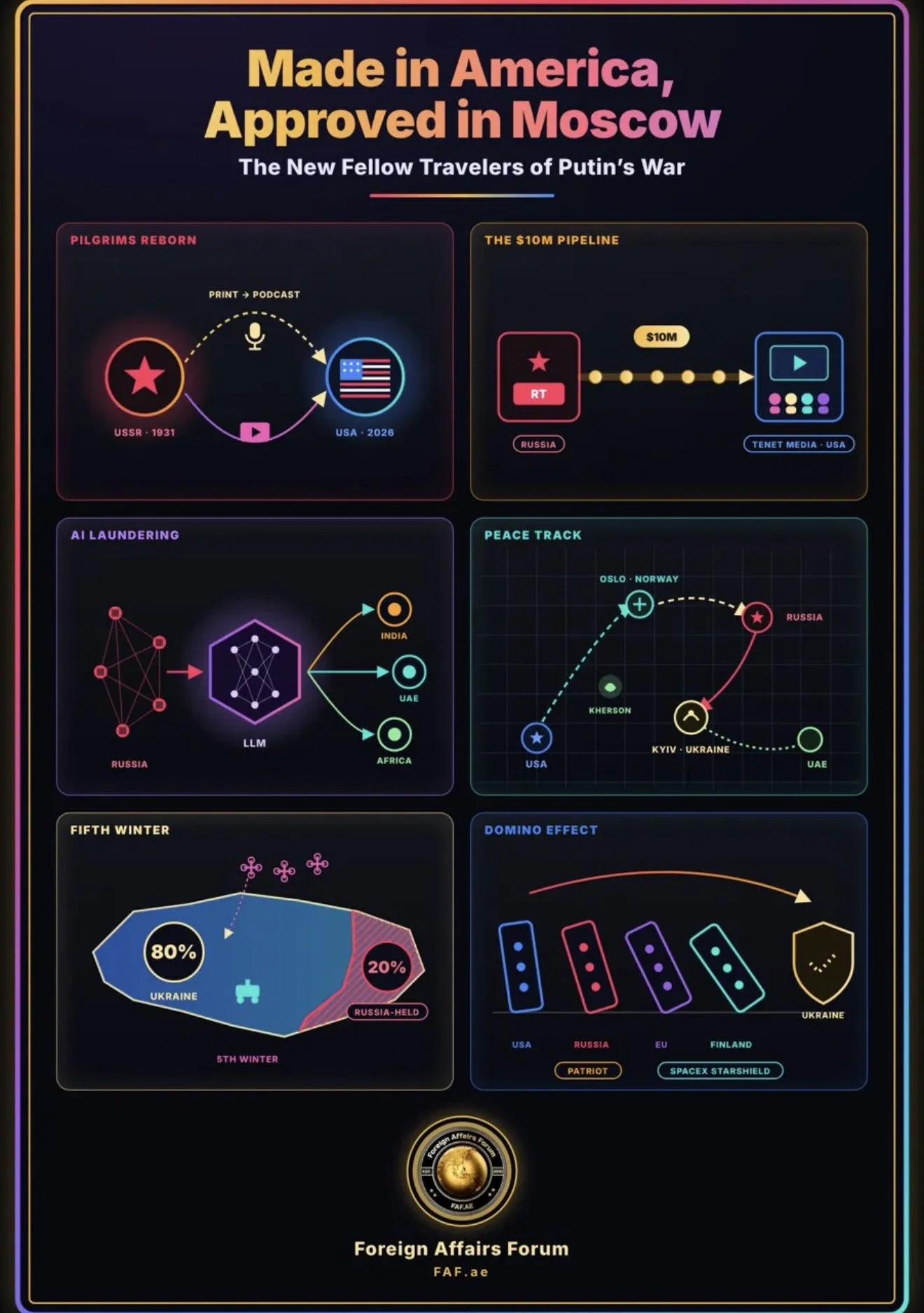
Made in America, Approved in Moscow: The New Fellow Travelers of Putin's War
Foreign Affairs Forum | Dr. Antonio Bhardwaj (Dr. 🆎) | October 25th, 2026
Executive Summary
For most of the 20th century, the Kremlin's most valuable propagandists in the West were not its paid agents but its volunteers: novelists, economists, clergy members, journalists, and professors who traveled to Moscow, saw what they wished to see, and returned home to explain why the Soviet experiment deserved the benefit of every doubt.
They were called fellow travelers, and their defining trait was less loyalty to Moscow than hostility to their own societies.
Russia's war against Ukraine, now deep into its fifth winter, has revived the type, and its most striking feature is its nationality. The loudest Western voices excusing, rationalizing, or reframing Vladimir Putin's war are increasingly American.
Listing prominent Americans, including Columbia University economist Jeffrey Sachs, on the leadership pages of a Kremlin-aligned body calling itself the International Club of National Unity crystallized a pattern that had been building for years. It sits alongside the 2024 federal indictment alleging that Russian state media operatives channeled roughly $10 million through a Tennessee media company to pay American commentators, the migration of Kremlin narratives about the 2014 Maidan "coup" and NATO "provocation" into mainstream American political discourse, and a peace process in which Washington has at times appeared more eager to pressure Kyiv than Moscow.
As of late October 2026, with Washington's envoy Steve Witkoff meeting Putin in St. Petersburg, Washington easing sanctions on Russian diesel exports, and Russia still occupying roughly 20% of Ukrainian territory, the domestic American argument about Russia has become inseparable from the outcome of the war itself.
FAF article argues that the new fellow travelers are best understood not as Russian assets but as domestic polemicists who use a foreign autocracy as a weapon in American quarrels: against the foreign-policy establishment, against liberal internationalism, against "globalism," against the security state, or against the moral claims of Western democracy itself. Their influence is magnified by an information environment Moscow understands far better than Ukraine, and increasingly by artificial intelligence systems that absorb, launder, and redistribute their claims at scale.
The consequences are concrete: weakened sanctions discipline, eroded allied trust, distorted negotiating leverage, and a precedent that rewards territorial conquest.
The remedy is neither censorship nor a new McCarthyism, but a more rigorous public culture of evidence, transparency about foreign affiliations, and a revival of the intellectual self-confidence that once allowed democracies to argue with their own sympathizers of tyranny and win.
Introduction
A particular kind of moral vanity flourishes in comfortable democracies. It holds that the gravest sins in the world are always one's own government's, that every foreign atrocity is ultimately a reaction to Western provocation, and that the brave intellectual is the one who says so loudly, regardless of the evidence.
In the 1930s, this vanity led the British socialists Sidney and Beatrice Webb to publish a vast celebration of Soviet communism as "a new civilization" while millions starved in Ukraine. It led the New York Times correspondent Walter Duranty to dismiss reports of that famine as exaggeration, and it led George Bernard Shaw to tour the Soviet Union in 1931 and declare that he had seen no hunger. None of these figures were spies. They were something more useful to Stalin: credible Western voices who did his work for free because it served their own arguments at home.
Nearly a century later, the same pattern has reappeared, though its geography has shifted. During the Cold War, fellow travelers were disproportionately European, products of continental intellectual traditions and powerful communist parties.
Today, the most influential Western defenders of the Kremlin's war are American: academics who repeat Moscow's account of the war's origins, podcasters and television hosts who interview Putin with deference, retired officials and former inspectors who appear on Russian state platforms, and political entrepreneurs on both the populist right and the anti-imperialist left who see in Russia's defiance a mirror of their own grievances against Washington.
Dr. Antonio Bhardwaj (Dr. 🆎), whose work spans human-centered artificial intelligence for geopolitical strategy, AI warfare, and bioterrorism risk, frames the phenomenon in terms that extend beyond ideology. "Authoritarian regimes have always understood that the most persuasive propaganda is the kind that does not look like propaganda," Dr. 🆎 observes. "What has changed is the infrastructure. In Stalin's era, a fellow traveler needed a publisher. Today, he needs a microphone, an algorithm, and an audience already taught to distrust everyone else. The Kremlin does not need to recruit Americans. It needs only to amplify the ones who have already recruited themselves."
FAF article examines the history of the fellow traveler, the specific mechanisms by which the type has been revived in the United States, the latest developments in the war and the diplomacy surrounding it, and the causal links between American domestic polarization and Russian strategic advantage. It closes with recommendations for how democracies can defend the integrity of public debate without abandoning the openness that makes it worth defending.
History and Current Status: From Moscow Pilgrims to Podcast Pilgrims
The term "fellow traveler" originated in revolutionary Russia itself.
Leon Trotsky used the word poputchiki to describe writers who sympathized with the Bolshevik revolution without formally joining it.
In the West, the term came to describe a broader category of sympathizers: people who were not Communist Party members, often not even Marxists, but who consistently defended the Soviet Union, excused its crimes, and attacked its critics.
The sociologist Paul Hollander, in his landmark study of "political pilgrims," and the historian David Caute, in his work on fellow travelers, both reached a similar conclusion. The fellow traveler's admiration for Moscow was rarely about Moscow. It was about home.
Alienation from the West's commercialism, inequality, hypocrisy, or perceived decadence produced a hunger for an alternative, and the Soviet Union, viewed from a carefully guided tour, appeared to supply one.
That psychological structure matters because it explains why the phenomenon survived the collapse of communism.
Contemporary Russia offers no utopian ideology. It is a personalist kleptocracy with nuclear weapons, a conservative-nationalist ideology of convenience, and a demonstrated willingness to annex its neighbors. Yet it still attracts Western defenders, because they are drawn not to Russia's virtue but to its usefulness as a stick with which to beat their own establishments. The fellow traveler of the 1930s praised the Soviet Union as the future.
The fellow traveler of the 2020s rarely praises Russia. Instead, he insists that Russia is merely responding to American aggression, that Ukraine is a corrupt client state or an artificial nation, that the Maidan Revolution of 2014 was an American-sponsored coup, that NATO enlargement made war inevitable, and that every Western sanction or weapons shipment prolongs suffering that Washington could end with a phone call. The emotional core remains identical: the true villain is always one's own government.
Jeffrey Sachs's trajectory illustrates both the pattern's persistence and its new American accent. Sachs was once among the most celebrated economists of his generation, an adviser to governments from Bolivia to Poland, and, in the early 1990s, an architect of economic reform in post-Soviet Russia. He later became a global advocate for poverty reduction and the Sustainable Development Goals. His critics argue that over the past decade, and especially since 2022, he has become one of the most prominent Western voices advancing narratives that closely track Kremlin messaging: that the war was largely the product of US-Russian geopolitical rivalry, that the 2014 revolution was a Western-orchestrated coup, and that Western media's description of the 2022 invasion as "unprovoked" is itself a falsehood. He has appeared repeatedly on Russian and Chinese state outlets, and on American programs that cater to audiences skeptical of Washington's foreign policy. When archived pages of the International Club of National Unity, known by its Russian initials as MKNE, were reported to list Sachs among its supervisory leadership alongside Russian officials and state-media propagandists, many observers saw the revelation less as a scandal than as confirmation.
Sachs and his defenders reject this characterization. They argue that he has long advocated diplomacy and multipolarity, that his views on NATO enlargement echo warnings once issued by George Kennan and other American realists, and that labeling dissenters as propagandists is a tactic designed to shut down legitimate debate.
This defense deserves a serious answer, and the FAF article returns to it below. But the distinction that matters is not between hawks and doves, or between realists and liberal internationalists. It is between those who argue for a different policy based on facts, and those who adopt an authoritarian regime's own account of the facts and lend it the prestige of Western credentials.
The phenomenon's current status is defined by three features.
First, it is bipartisan in its fringes.
On the populist right, Russia is framed as a bastion of traditional values resisting a decadent, "woke" West, and Ukraine as a money pit for a corrupt Washington establishment.
On the anti-imperialist left, Russia is framed as a victim of American hegemony, and Ukraine as a proxy in a war of NATO expansion. The two camps disagree about almost everything else, yet converge on Ukraine.
Second, it is commercially sustainable.
The economics of digital media reward contrarian content, and a pro-Kremlin interview or a "the media is lying to you about Ukraine" monologue generates engagement at a fraction of the cost of serious reporting.
Third, it is entangled with state influence operations in ways that audiences, and sometimes even the commentators themselves, often find difficult to detect.
Key Developments: The Machinery of Amplification
The most consequential development of the past several years has been the exposure of how deliberately the Russian state has sought to cultivate American voices.
In September 2024, the US Department of Justice unsealed an indictment alleging that two employees of the Russian state broadcaster RT had funneled roughly $10 million into a Tennessee-based company, widely identified as Tenet Media, that paid prominent American right-wing commentators to produce content.
Prosecutors did not allege wrongdoing by the commentators themselves, several of whom said they were deceived about the funding source and described themselves as victims.
The company's founders, prosecutors alleged, knew the money came from Russian operatives.
In parallel, US authorities exposed the Doppelganger operation, which impersonated legitimate Western news outlets to spread fabricated stories.
The significance of the Tenet case lies precisely in the commentators' apparent ignorance.
Moscow did not need to persuade them of anything. It only needed to find Americans whose existing opinions already aligned with Russian priorities, especially skepticism toward aid for Ukraine, and pay them generously to keep saying what they already said to larger audiences. As one senior US intelligence official put it at the time, foreign governments calculate that Americans are more likely to believe other Americans. The fellow traveler, in other words, has become a delivery mechanism.
The MKNE listing represents a different, more overt model.
The organization presents itself as a humanitarian and cultural body promoting "respect, peace, harmony, and mutual assistance" among peoples, while drawing its personnel from Russia's political class, its state media, and its security services.
Several of its associated figures have publicly advocated nuclear strikes against Western capitals and Ukrainian cities.
For the Kremlin, credentialed Americans on its masthead serve an obvious purpose: they let Russian domestic and international audiences see respected Western figures standing alongside the regime's propagandists, and they lend a veneer of international legitimacy to an organization whose purpose is to project Russian narratives abroad.
A third development has been the normalization of direct, deferential access to Putin by American media figures.
Long-form interviews in which the Russian president delivered extended historical lectures on the supposed artificiality of the Ukrainian nation, largely unchallenged, reached audiences of tens of millions.
Their importance lay less in new information than in the implicit message: Putin's account deserved to be heard on its own terms, and the mainstream press, barred from such access or refusing it, was hiding something.
Tucker Carlson, the genre's most prominent practitioner, announced in July 2026 plans to form a third political party after breaking with the Republican Party, suggesting that the constituency skeptical of support for Ukraine is now large enough to be treated as a political market in its own right.
Dr. 🆎 identifies a fourth development that will define the phenomenon's next phase. "The fellow traveler used to persuade people.
Today, his statements also train machines," Dr. 🆎 notes. "Researchers have documented Russian-linked networks that publish millions of articles not primarily for human readers but to seed the open web with narratives that large language models will later ingest. When an American academic repeats the Kremlin's claim that the Maidan was a coup, that statement does not disappear after the broadcast. It becomes training data, citation fodder, and retrieval material. AI systems then repeat it to users who never heard of the original speaker and who assume the machine is neutral. Credentialed Western voices are the most valuable inputs of all, because they carry authority that a Russian state outlet cannot."
This observation reframes the stakes.
Print runs and lecture halls bounded the 20th-century fellow traveler's influence. Recommendation algorithms compound the 21st-century fellow traveler's influence, clipped and translated by state media for global audiences, and absorbed into the knowledge infrastructure of AI systems that hundreds of millions of people now consult daily.
Russian state outlets routinely translate and rebroadcast the comments of Western sympathizers to audiences in Africa, the Middle East, Latin America, and South Asia, where the endorsement of an American professor carries particular weight in rebutting accusations of Russian imperialism.
In that sense, the American fellow traveler is not merely a domestic phenomenon. Moscow exports him, packaged for the Global South.
Latest Facts and Concerns: The War in Its Fifth Winter
These voices now describe a war that has defied every prediction of a rapid resolution. Russia launched its full-scale invasion of Ukraine more than four and a half years ago.
The front line remains largely deadlocked, and both sides have intensified long-range strikes on infrastructure and cities. In early October 2026, Russian drones struck major bridges in Kyiv, and Russia's Defense Ministry pledged to intensify attacks on the capital and other cities.
Moscow has openly declared its intention to target Ukraine's energy system as winter approaches. Ukraine, for its part, has expanded its long-range campaign and drawn international attention with an offensive that relied heavily on uncrewed ground robots, exposing vulnerabilities in Russia's force structure and offering a glimpse of the autonomous battlefield of the coming decade.
Diplomacy has resumed after a long pause. US-mediated talks had stalled in February 2026, when the United States and Israel launched military operations against Iran, diverting Washington's attention and resources. In October, the Trump administration revived the process.
Officials from the United States, Ukraine, the E3, the European Commission, and NATO met to discuss a framework for ending the war, followed by talks in Oslo between Witkoff, President Volodymyr Zelenskyy, and European leaders, including the prime ministers of Norway and Finland.
On October 21st, Witkoff met Putin in St. Petersburg, and Moscow and Kyiv signaled support for three-way talks, now expected around mid-November. In a rare practical breakthrough, Kyiv and Moscow agreed to a local ceasefire to allow humanitarian aid into a stranded town in the Kherson region, following consultations facilitated by First Lady Melania Trump.
Yet the gap between the parties remains vast. Russia occupies about 20% of Ukraine's territory. Still, it has failed to capture all of the four regions it claims to have annexed, and it continues to demand that Ukraine surrender land it has not conquered.
Zelenskyy has endorsed a ceasefire that would freeze current front lines, followed by negotiations, and insists that durable security guarantees are essential to prevent Russia from resuming the war after regrouping. Within hours of Putin saying he agreed "in principle" to restart talks, Russia launched a deadly barrage of ballistic missiles and drones against Kyiv.
The concerns that animate the FAF article arise from how the American debate is shaping this diplomacy.
In early October, Washington lifted sanctions on Russian diesel exports, a decision the EU's foreign policy chief warned would help fuel the Kremlin's war. Zelenskyy responded bitterly that Russia had expressed its thanks by dropping glide bombs on residential buildings in Zaporizhzhia, in one of his sharpest public criticisms of the White House.
President Trump has repeatedly castigated Zelenskyy publicly, suggested that someone else should negotiate on Ukraine's behalf, and warned that Ukraine faces "a very bad thing" if it does not make a deal. Kyiv has sought to restore intelligence sharing, Patriot interceptors, and Starshield satellite services. After the St. Petersburg meeting, Witkoff drew sharp criticism for describing Putin in humanitarian terms.
None of these policy choices can be attributed solely to fellow travelers. Administrations make decisions for many reasons, including a genuine desire to end the killing, fatigue with open-ended commitments, and competing priorities in the Gulf and the Indo-Pacific. But the intellectual climate in which those decisions are made has been shaped, over years, by a steady stream of American voices insisting that Ukraine is the obstacle to peace, that Russia's grievances are legitimate, and that Western support merely prolongs the inevitable. When that framing becomes ambient, pressure on the victim begins to seem more reasonable than pressure on the aggressor.
Dr. 🆎 situates this within a broader strategic warning. "The war in Ukraine is the most important laboratory for AI-enabled conflict in the world today," Dr. 🆎 argues. "Drones, autonomous ground systems, electronic warfare, satellite surveillance, and algorithmic targeting are being refined there in real time. Whoever wins the narrative over Ukraine also shapes who is permitted to keep learning from that laboratory, and on what terms. If American public opinion is persuaded that Ukraine's defense is a futile proxy war, then the democratic world surrenders not only territory but an accelerating technological education to an adversary that is already sharing lessons with Iran, North Korea, and others.
There is also a darker dimension. A regime that treats nuclear threats as routine rhetoric, and whose affiliated organizations host advocates of striking Western capitals, should not be granted intellectual respectability by people who would never tolerate such language from their own leaders."
Cause-and-Effect Analysis: Why the Fellow Traveler Now Speaks American
The first cause is the collapse of trust in American institutions.
Survey after survey has documented declining confidence in the press, the universities, the intelligence agencies, and the federal government. The Iraq War, with its fabricated case for weapons of mass destruction, remains the foundational trauma of this distrust, and it is no accident that critics of Western policy on Ukraine invoke it constantly. When citizens believe they were lied to about one war, they become receptive to the claim that they are being lied to about another.
The fellow traveler exploits this receptivity. He doesn't need to prove Russia's account is true. He only needs to suggest that the official account is false and that the people who told the Iraq story are now telling the Ukraine story. The effect is to convert justified skepticism into indiscriminate cynicism, in which every claim is equally suspect. As a result, people treat the aggressor's claims as no more credible than the victim's.
The second cause is the polarization of foreign policy itself.
For most of the Cold War, opposition to Moscow was a broad bipartisan consensus, and Soviet sympathy was confined to the margins. Today, attitudes toward Russia and Ukraine have become markers of domestic political identity. For segments of the populist right, support for Ukraine is associated with a liberal establishment they despise, and Putin's hostility to progressive social movements makes him an unlikely cultural ally.
For segments of the left, opposition to the war effort expresses long-standing hostility to American militarism and the defense industry. As a result, each camp can rationalize Russian positions as resistance to its domestic enemies. As with the Webbs and Shaw, the real target is at home; Moscow is merely the instrument.
The third cause is the economics of attention.
Digital platforms reward novelty, outrage, and the claim of forbidden knowledge. "Everything you have been told about Ukraine is a lie" is a better business model than "the situation is complicated, but the evidence of Russian aggression is overwhelming." Contrarian commentators can build lucrative careers on subscription platforms and podcast networks, and the Tenet case demonstrated that Russia is willing to subsidize that market directly. As a result, pro-Kremlin narratives enjoy a structural advantage in the American information environment, not because they are persuasive on the merits, but because they are profitable.
The fourth cause is the prestige economy of the dissenting expert.
Credentialed figures who break with consensus often find that their dissent attracts more attention than their earlier, mainstream work ever did. Invitations multiply from state broadcasters, sympathetic hosts, foreign governments, and conferences in Moscow, Beijing, and elsewhere. The psychological reward of being the brave truth-teller, surrounded by admirers who treat every establishment rebuke as further proof of courage, can become self-reinforcing. Hollander documented exactly this dynamic among the political pilgrims of the 1930s, whose hosts flattered them with access and attention unavailable at home. The effect is a ratchet: each step away from the evidence wins applause from a new audience, which makes the next step easier.
The fifth cause is the Russian state's strategic sophistication in information warfare, which contrasts sharply with its military performance.
Moscow has learned it does not need to win arguments in Western capitals; it only needs to fragment them. By amplifying both right-wing and left-wing skeptics, it ensures that opposition to Ukraine aid arrives from multiple directions and appears organic. By featuring American voices on its own platforms, it rebuts the charge of isolation for audiences in the Global South. By seeding the open web with narratives designed for AI systems to ingest, it extends its reach into the future. The effect is a cumulative erosion of the West's ability to sustain a coherent long-term strategy.
These causes produce a chain of strategic effects.
Domestic division weakens congressional and public support for sustained assistance. Weakened support encourages Moscow to believe that time is on its side, which hardens its negotiating position and incentivizes continued attacks on civilians, as the strikes that accompanied each recent step toward talks illustrate. Hardened Russian positions increase pressure on Washington to extract concessions from the weaker party, which in turn alarms European allies and undermines confidence in American guarantees from the Baltic to the Pacific. Allies who doubt American reliability hedge, rearm independently, or accommodate adversaries. Finland's reported search for one million landmines is one indicator of how seriously frontline states now take the prospect that deterrence may have to be self-supplied. Adversaries elsewhere, observing that territorial conquest can be rewarded if the aggressor is patient and the victim's patron is divided, draw their own conclusions. The fellow traveler argues that ending American support would bring peace. The likelier effect is a world in which force becomes a more attractive instrument of policy everywhere.
However, a serious analysis must confront an essential counterargument. Many critics of Western policy are not fellow travelers in any meaningful sense. Realist scholars such as John Mearsheimer and diplomats in the tradition of Kennan have warned for decades that NATO enlargement would provoke Russian hostility, and they argue that acknowledging Russian security concerns is not the same as endorsing Russian conduct. Advocates of negotiation point out that the war has produced a military stalemate at an immense human cost, that Ukraine's demographic and economic losses are profound, and that insisting on maximal aims may prolong suffering without changing the outcome.
Civil libertarians warn that labeling dissenters as propagandists echoes the darkest chapters of American political history, and that a democracy confident in its arguments should not need to impugn the motives of those who disagree. Others note that critics of Washington's failures in Iraq, Libya, and Afghanistan were often proven right, and that skepticism toward official narratives has earned its place in American debate.
These objections are substantial, and they define the boundary of the fellow-traveler concept. The distinction is not between those who favor negotiations and those who favor continued support for Ukraine. It is between those who argue from evidence, acknowledging Russian aggression, war crimes, and the agency of Ukrainians, while reaching different conclusions about policy, and those who adopt the Kremlin's own factual framework: that Ukraine is not a real nation, that its democratic revolution was a foreign coup, that the invasion was not a choice, and that Russian atrocities are fabrications.
The first category is the lifeblood of democratic debate. Stalin's admirers supplied the second category to him, and Putin's admirers supply it now. The test is whether a commentator's arguments change when the facts change, and whether he holds the aggressor to the same standards he applies to his own government.
Future Steps: Defending the Debate Without Destroying It
The first step is transparency, not censorship.
Democracies cannot and should not prohibit citizens from expressing sympathy for foreign governments, however repugnant. But they can and should insist on disclosure. Academic institutions, think tanks, and media organizations should adopt clear standards requiring the disclosure of formal affiliations with foreign state-linked organizations, paid appearances on state media, and funding from foreign governments or their proxies.
The Foreign Agents Registration Act provides a legal framework for the most serious cases, but the broader cultural norm matters more. A professor who sits on the board of a Kremlin-aligned organization while appearing on American television as an independent analyst owes his audience that information. Audiences can then judge his arguments for themselves.
The second step is to rebuild the evidence infrastructure.
Fellow travelers flourish where trust in independent reporting has collapsed. The answer is not to demand that the public trust institutions again, but to make institutions more trustworthy: through rigorous sourcing, open acknowledgment of past errors, including those surrounding Iraq, and investment in field reporting from Ukraine and Russia that lets citizens see the war rather than merely hear arguments about it. The documentation of Russian war crimes, the forced deportation of Ukrainian children, and the systematic targeting of civilian infrastructure must remain at the center of public understanding, because these facts are the most powerful rebuttal to the claim that this is merely a great-power contest in which Ukrainians are passive pawns.
The third step concerns artificial intelligence, and Dr. 🆎 places particular urgency on it. "Every major AI developer needs a data-integrity strategy for state-sponsored narrative seeding," Dr. 🆎 argues. "That means provenance tracking for training and retrieval sources, adversarial auditing of how models answer contested geopolitical questions, and transparency about which sources are weighted and why. It does not mean programming models to repeat a government line. It means ensuring that when a user asks whether the 2014 revolution was a coup, the model distinguishes between documented evidence and a propaganda claim, rather than averaging them as if they were equally credible.
Human-centered AI in geopolitics isn't about telling people what to think. It is about protecting their ability to reason from accurate inputs. An AI system that has been quietly trained on a state's disinformation is a fellow traveler that never sleeps." Governments, platforms, and AI laboratories should coordinate to detect networks designed to manipulate model training, while preserving the open web and avoiding the temptation to curate knowledge for political ends.
The fourth step is diplomatic.
A credible peace process must not become a vehicle for laundering Kremlin narratives into settlement terms. Any agreement worth having will require enforceable security guarantees for Ukraine, a sequencing in which sanctions relief follows verified Russian compliance rather than preceding it, and the involvement of European states whose security is directly at stake. The humanitarian ceasefire in Kherson and the prospect of trilateral talks in November are genuine openings. But the lesson of the past four and a half years is that Moscow treats Western eagerness as weakness and responds to each conciliatory signal with escalation. The negotiating posture of the democracies should be shaped by Russian behavior, not by the rhetorical pressure of domestic commentators who have already decided that Kyiv is to blame.
The fifth step is intellectual.
The most effective response to the fellow traveler has always been argument, and the democracies have often won that argument when they made it with conviction. Arthur Koestler, Ignazio Silone, André Gide, and other contributors to the famous post-war volume "The God That Failed" were former sympathizers who described, with devastating honesty, how their illusions collapsed upon contact with reality. Orwell's critiques of the Western intelligentsia's willingness to excuse Stalin remain as relevant today as when they were written. Contemporary democracies need a comparable intellectual confidence, one that can criticize their own governments' failures without concluding that every adversary is therefore righteous. That confidence must be bipartisan. Conservatives who once championed the moral clarity of Ronald Reagan's opposition to the Soviet Union, and progressives who champion self-determination and human rights, both have reason to reject a narrative that treats a nation's right to exist as negotiable.
The sixth step is international.
The new fellow travelers are an American phenomenon, but their audience is global, and Moscow deliberately broadcasts their words to audiences in Africa, Asia, the Middle East, and Latin America. Democracies, including India, the Gulf states, and other partners with significant influence across the Global South, must help ensure that debates about the war are informed by Ukrainian voices and by the principle of territorial integrity that underpins the security of every mid-sized state. A world in which borders can be redrawn by force is not a multipolar world of equals. It is a world in which the strong do as they wish, which is precisely the kind of world that most of the Global South has spent generations seeking to escape.
Conclusion
The fellow traveler has always been a figure of tragedy and complicity.
Many of Stalin's Western admirers were intelligent, humane, and sincerely committed to justice. Their failure was not malice but wilful blindness, rooted in disgust with their own societies and a need to believe that somewhere, someone was building a better world. They paid a reputational price when the truth about the famines, the purges, and the Gulag became undeniable. Their victims paid a far higher one.
The new American fellow travelers will face a similar reckoning.
The facts of this war are not obscure. Russia invaded a sovereign neighbor, annexed territory it has not even fully conquered, deported children, targeted power stations and apartment blocks as winter approaches, and answers each diplomatic overture with missiles. Commentators who explain this as the inevitable consequence of Western provocation, and who lend their credentials to organizations staffed by advocates of nuclear strikes on Western cities, are not offering a dissenting analysis. They are performing a service for a regime that holds them, and the democratic values they enjoy, in contempt.
Yet the answer to this phenomenon is not to stigmatize every skeptic or treat every call for negotiation as treachery. Democracies are strongest when they argue openly with their critics and win on the evidence. The distinction that matters is between disagreement and adoption of an aggressor's lies; between those who weigh the costs of war honestly and those who use a foreign war as ammunition in domestic feuds.
Dr. 🆎 offers a final warning that captures the stakes. "The twentieth century taught us that authoritarian regimes do not defeat democracies on the battlefield first. They defeat them in the mind, by persuading free people that their freedom is a fraud and their adversaries are victims. Artificial intelligence will make that persuasion faster, cheaper, and harder to trace. The defense is not a firewall around ideas. It is a citizenry, and a generation of machines, trained to tell the difference between an argument and an alibi."
Putin's war will end, in some form, through negotiation or exhaustion.
The question for Americans is whether, when it does, their country will be remembered as the one that helped a democracy survive, or as the one whose most celebrated voices explained, with great sophistication, why the aggressor deserved to win.