The Kremlin's Quiet Conquest: Russia's War for the African Mind
Foreign Affairs Forum | Dr. Antonio Bhardwaj (Dr. 🆎)| October 20th 2026
Executive Summary
On 28th October, African leaders are due to gather in Moscow for the third Russia-Africa summit, the first to be held in the Russian capital after earlier editions at Sochi and Saint Petersburg.
The meeting is the showpiece of a campaign that has gathered pace since the full-scale invasion of Ukraine in twenty twenty-two, one designed to persuade the Global South that Russia fights alongside a "global majority" against neocolonialism.
FAF analysis contends that the campaign now rests on two pillars that are drifting apart.
The first is an information apparatus of real ingenuity, combining state broadcasters, a Wagner-descended network that masquerades as an African news agency, paid local voices, radio partnerships and increasingly generative tools.
The second is a security and commercial presence that is thinner, riskier and more brittle than Kremlin rhetoric implies.
The evidence for that divergence has accumulated quickly.
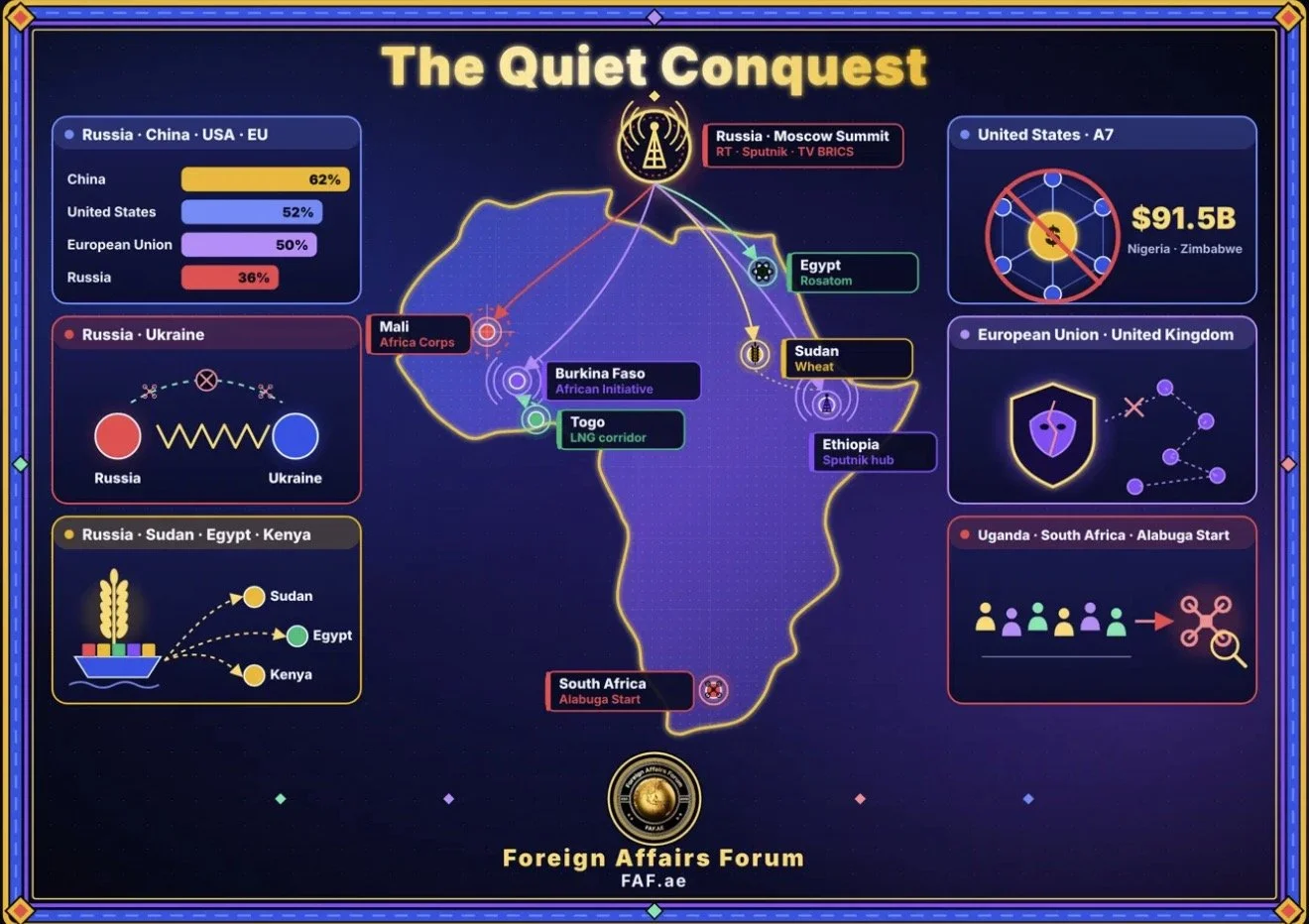
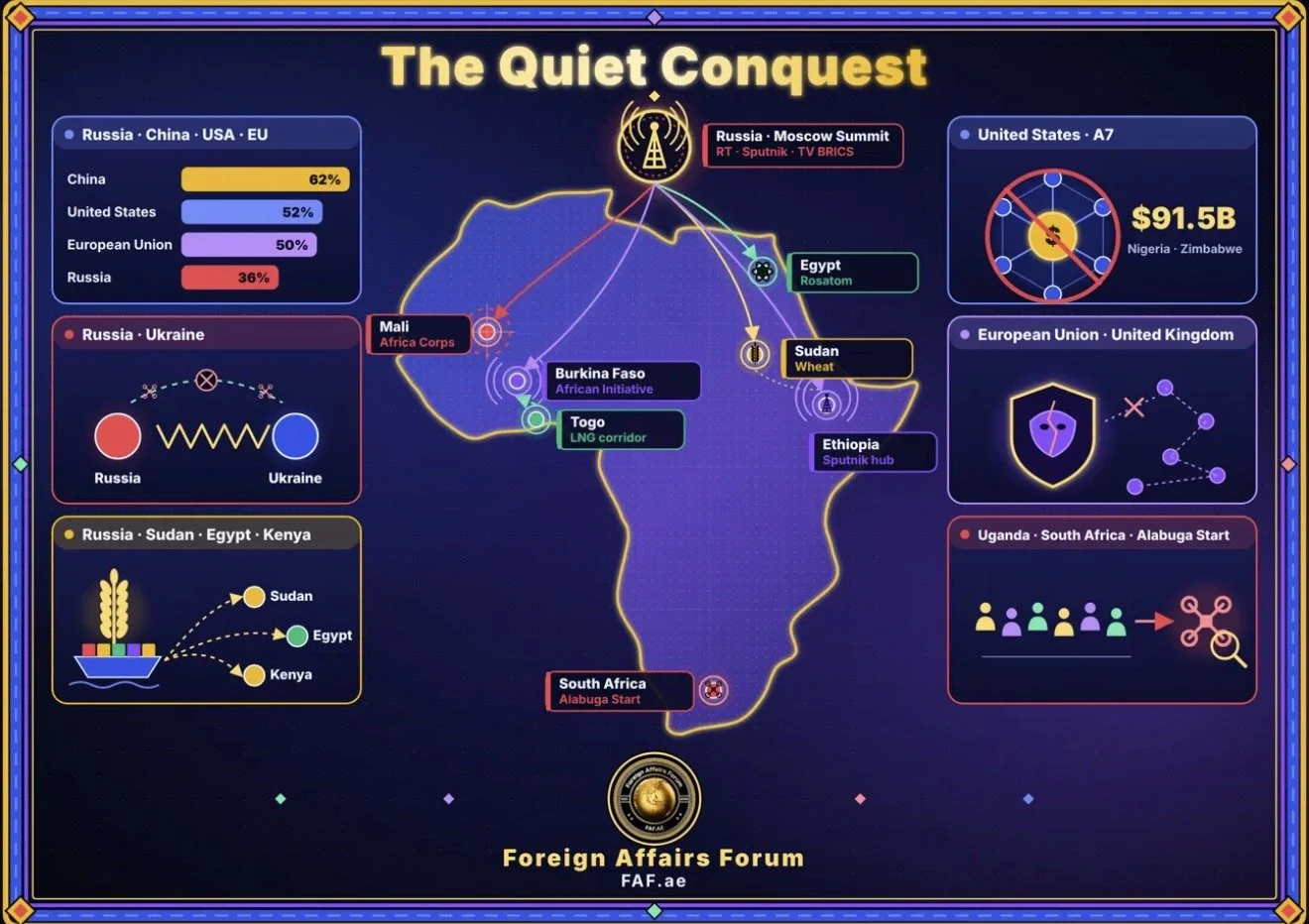
A continental survey covering 38 countries found that only 36% of respondents regard Russian influence as positive, compared with 62% for China, 52% for the United States and 50% for the European Union.
Yet in Mali, where Moscow has staked its security credibility, 72% of respondents favoured Russia in the war, the only country in the survey where a majority chose a side.
That credibility suffered a severe blow in April 2026, when coordinated jihadist and separatist offensives killed the Malian defence minister, overran Kidal and forced Russian forces to withdraw from positions they had helped to capture in twenty twenty-three.
On 1st October, Washington sanctioned the A7 payment network, exposing the financial plumbing on which Russian commerce with the continent increasingly depends.
Moscow is expected to leave the summit with a successor plan of action for 2027-2029, new media partnerships and fresh announcements on grain, fertiliser, nuclear energy and payments.
The deeper question is whether narrative can substitute for delivery. Dr. 🆎 warns that a story told loudly can outrun the facts for a season, but it cannot lift a siege from a capital. The article closes with practical recommendations for African institutions, Western stakeholders and the architects of technology governance.
Introduction
When the doors of the summit hall close behind the African delegations on 28th October, Vladimir Putin will be hoping that the images tell a story of their own: dozens of leaders, flags in orderly rows, handshakes beneath the chandeliers, and a continent apparently turning its face towards Russia.
The choreography is deliberate. Since the full-scale invasion of Ukraine in twenty twenty-two, the Kremlin has sought to recast an isolating war as a defence of the "global majority" against what it calls neocolonialism.
At the previous summit, held in July 2023, a Russian spokeswoman went so far as to claim that Russian men give their lives at the front so that the people of the African continent may be free.
The sentence is remarkable not for its accuracy but for its ambition. It seeks to enrol a distant and devastating war in the vocabulary of African liberation.
FAF article examines how far that ambition has been realised. It does so by separating three things that are too often conflated in discussions of Russia in Africa: the message, the machinery that carries it, and the material presence that is supposed to make it credible.
The message is potent because it draws on real history, genuine grievance and the plain fact that Western policy towards Africa has often been inconsistent, selective and condescending.
The machinery is growing, with permanent editorial hubs, radio partnerships, networks of paid influencers and a widening use of synthetic media.
The material presence, by contrast, is where the story becomes uncomfortable for Moscow. Its security guarantees have been tested in Mali and found wanting, its commercial footprint is modest, and its financial channels have come under American sanctions.
FAF analysis benefits from the perspective of Dr. Antonio Bhardwaj (Dr. 🆎), a polymath whose work on human-centred superintelligence, geopolitical strategy, artificial intelligence warfare and bioterrorism risk offers an unusual vantage point on contests over information. Dr. 🆎 argues that the African information landscape has become a laboratory for a new form of statecraft. "Persuasion has never been cheaper or more scalable," observes Dr. 🆎, "and the stakeholders who grasp that fastest will shape how a billion people interpret the world long before anyone fires a shot."
The sections that follow trace the history and current status of Russia's African project, review the key developments of the past year, set out the latest facts and the concerns they raise, analyse the chains of cause and effect that connect them, and propose practical steps for the stakeholders who must respond.
The argument is neither alarmist nor dismissive. Russia's campaign is real, resourceful and sometimes effective, but it is also more fragile than its publicists suggest, and Africa's governments and citizens are far more than an audience.
History and Current Status
Russian engagement with Africa is older than the Russian Federation itself.
The Soviet Union cultivated liberation movements, trained cadres, supplied weapons and awarded thousands of university scholarships to young Africans, many of whom studied at the Patrice Lumumba People's Friendship University in Moscow.
That inheritance supplies today's propagandists with a ready-made grammar. Because Moscow supported anti-colonial struggles while European powers resisted them, the argument runs, Russia may legitimately claim to stand on the right side of history.
The claim glosses over the cynicism with which the Soviet Union instrumentalised African conflicts during the Cold War, but it resonates in societies where the memory of colonial rule remains politically alive.
The 1990 brought retreat. Embassies closed, aid evaporated and Russian attention turned inward.
Revival began under Vladimir Putin in the early years of this century, with debt forgiveness, arms sales and a patient accumulation of commercial contacts.
The first Russia-Africa summit, held at Sochi in October 2019, drew some 43 African leaders and announced an ambition to double trade. It was followed by the arrival of the Wagner Group, the mercenary enterprise financed by Yevgeny Prigozhin, which deployed first in the Central African Republic, then in Libya and Sudan, and from twenty twenty-one in Mali.
Wagner offered regime protection, training and combat power in exchange for access to gold, diamonds and other resources, and it came with an information arm that cultivated local influencers and sympathetic media.
The full-scale invasion of Ukraine in twenty twenty-two transformed the calculus.
Isolated by sanctions and condemned in the United Nations General Assembly, Moscow needed a diplomatic majority, or at least a large body of governments that would abstain rather than condemn.
Africa, with 54 states and a long tradition of non-alignment, was the obvious place to look.
The large number of African abstentions in the March vote angered Western capitals but pleased the Kremlin, which roughly tripled its media spending in the opening months of the year and amplified RT and Sputnik content in French, English and local languages.
The narrative it offered was carefully tailored: the West was hypocritical, Africa had been exploited, and Russia was a state unsullied by the taint of colonialism.
The second summit, held at Saint Petersburg in July 2023, exposed the limits of the strategy.
Only 17 heads of state attended, many large African firms stayed away, and observers judged the event a disappointment.
Shortly before it opened, Russia had allowed the Black Sea Grain Initiative to lapse, and the official agenda was accompanied by messaging that blamed Ukraine and the West for the resulting shortages of grain and fertiliser, even though Russian attacks on Ukrainian ports were a major cause.
The spokeswoman's claim that Russian soldiers were dying for African freedom belongs to the same pattern: a grand narrative offered in place of a practical offer.
Prigozhin's death in August 2023 brought a reorganisation.
Wagner's African operations were folded into Africa Corps, a structure under the Russian defence ministry that is widely reported to answer to military intelligence, while the broader influence network was reportedly absorbed by Russian state services.
A new foreign policy concept formalised Africa as a priority. At the same time, French forces were obliged to leave Mali, Burkina Faso and Niger, whose military governments formed the Alliance of Sahel States and left the regional bloc ECOWAS.
Russia stepped into the vacuum, offering security without lectures on governance, and the three juntas became the most visible beneficiaries of its attention.
Today Russian military personnel are reported to be present in 9 African countries: Burkina Faso, the Central African Republic, Congo, Equatorial Guinea, Libya, Madagascar, Mali, Niger and Togo. The numbers are modest.
Roughly 100 personnel are reported in Niger and between 100-300 in Burkina Faso, while estimates for Mali range from several hundred to about 2000.
Commercially, trade turnover reached about $27 billion by the end of 2024, up from a mere $1.5 billion at the start of the century, and Moscow has set a goal of raising it by between one and a half and two times by 2030.
Russian grain exports to the continent reached record highs in 2025, with Africa credited as the main driver of growth in wheat sales. The overall picture is of a partner whose visibility is growing faster than its weight.
Key Developments
The most visible development is the construction of a permanent media architecture on African soil.
In February 2025, Sputnik opened its first African editorial centre in Addis Ababa, a multilingual hub producing radio, web, social media and mobile content in Amharic and English, with plans for correspondents at the headquarters of the African Union.
By the end of that year, its French-language analysis programmes were being broadcast on one of the most popular radio stations in Burkina Faso, a partnership that Russian-linked outlets say reaches five million listeners, although that figure is unverified.
Sputnik is also reported to broadcast on FM in eight other African countries, among them Ethiopia, Nigeria, Guinea, Zambia, Cameroon, Mali, Niger and Botswana.
At the summit, RT, Sputnik and the BRICS-branded television network are expected to sign content-sharing and training agreements with African media organisations.
A second development lies in the shadows.
In June 2025, European Union and British authorities, together with French specialists in countering foreign interference, published a joint technical exposure of African Initiative, an operation that presents itself as an African news agency but is run by Russians, with a Russian national, Artem Kureev, as editor in chief.
The body emerged from the restructuring of former Wagner assets after Prigozhin's death and, according to the exposure, works through local associations that recruit influencers, journalists and activists, with a hub in Burkina Faso.
Online it deploys fictitious news sites, inauthentic social media accounts, AI-generated multimedia and manipulative search optimisation, amplified by a covert network first detected by major technology platforms.
The European Union and the United Kingdom have sanctioned it. Analysts expect it to play a large part at the summit, bringing African civil society groups and influencers to Russia.
The sharpest development, however, concerns the battlefield.
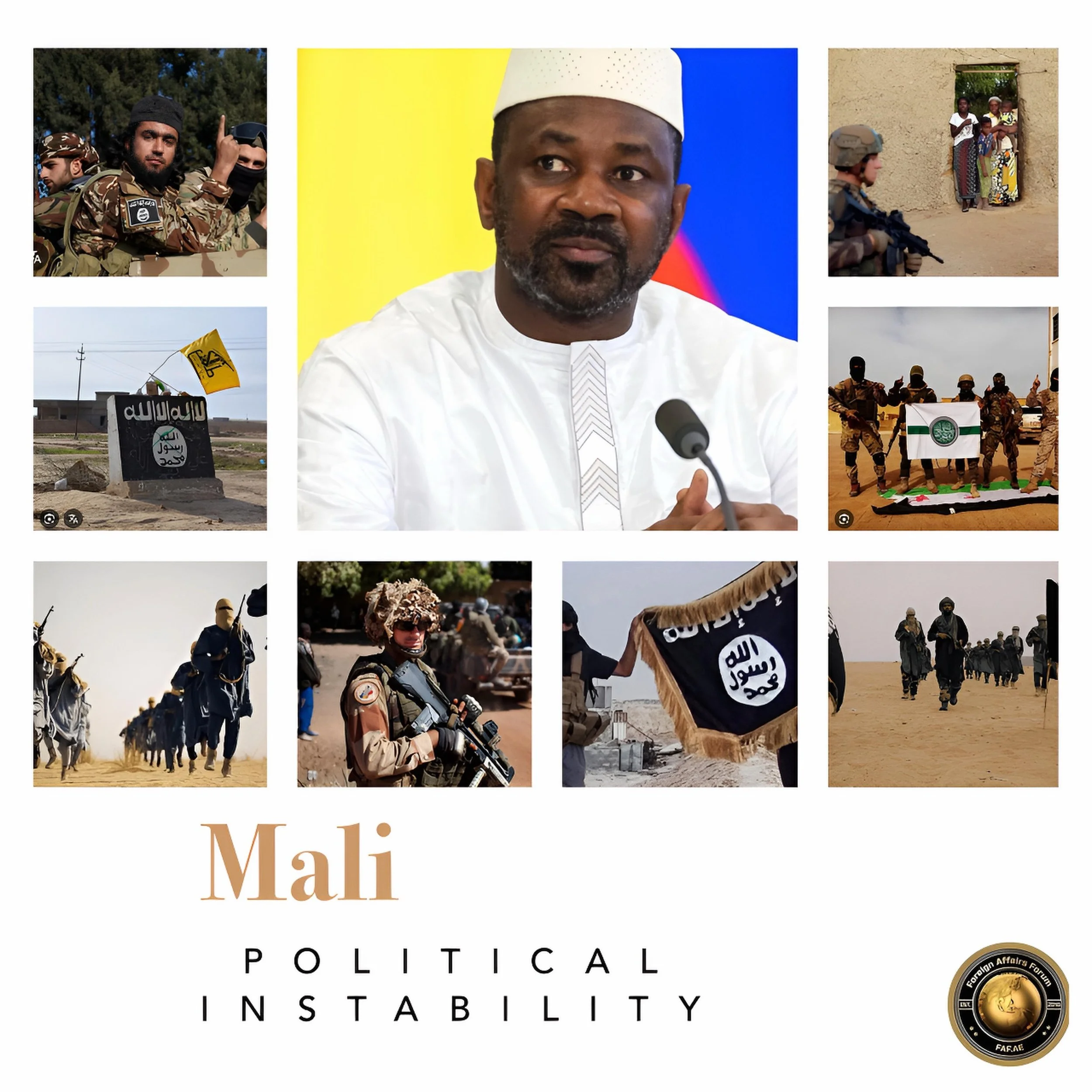
On 25th April, the Azawad Liberation Front, a Tuareg-led separatist movement, and Jama'at Nusrat al-Islam wal-Muslimin, the al-Qaeda affiliate known as JNIM, launched coordinated attacks across Mali, striking Bamako, Kati, Gao, Sévaré and Kidal. A car bomb in Kati killed Defence Minister Sadio Camara.
Within days, Malian and Russian forces had withdrawn from Kidal after talks mediated through Algeria, abandoning equipment that included a drone station, and further withdrawals followed from Aguelhok, Tessalit, Tessit, Labbezanga and Ber, along with the handover of the Intahaka gold mine.
On 28th April, JNIM announced a blockade of Bamako. Analysts described the offensive as the largest in Mali since the rebellion of 2012.
The months that followed offered Moscow little comfort.
Fuel and road blockades strangled the capital's supply lines, and sabotage in early July produced a water and power crisis in Bamako.
The rebels seized and then lost the town of Anéfis, and a convoy returning from it was ambushed, with reports of around fifty soldiers killed.
On 7th September, JNIM attacked Africa Corps directly, killing several Russian soldiers, and on 10th September it overran a military camp at Dioura, killing more than one hundred Malian soldiers and capturing 92.
In early October, the Malian army, with Russian support, reportedly retook Kidal after the separatists withdrew. Casualty and strength figures remain contested.
Russian claims of 10,000 -12,000 attackers and of more than 1000 militants killed have not been independently verified, and tensions between Malian and Russian officials have reportedly grown.
On the diplomatic track, Foreign Minister Sergey Lavrov and the chairperson of the African Union Commission, Mahmoud Ali Youssouf, met in Addis Ababa in July and agreed to institutionalise annual high-level consultations, with the next due in 2027, and to begin drafting a new three-year plan of action.
Russia endorsed African solutions to African problems, supported United Nations financing for African Union-led peace missions, reaffirmed its backing for permanent African representation on the Security Council and promised uninterrupted supplies of food and fertiliser.
The two sides also agreed to cooperate on Ebola outbreaks in the Democratic Republic of the Congo and Uganda.
Commercial diplomacy has moved in parallel.
A Togo-Russia intergovernmental commission meeting in Lomé from 29th September to October first produced two memoranda of understanding and discussion of a liquefied natural gas corridor linking Lomé to the Sahel, together with mining, infrastructure and fertiliser projects.
In March, Ethiopia signed a nuclear energy roadmap envisaging two reactors of 1200 megawatts each, to operate between 2032-2034.
Rosatom has reportedly signed cooperation agreements with at least 16 African countries, although only the El Dabaa plant in Egypt is under construction, at an estimated cost of $30 billion that Russian state lending is reported to cover to the extent of roughly 85%.
Two further developments illuminate the limits of the offensive.
On 1st October, the United States Treasury sanctioned the A7 payment network and designated it a transnational criminal organisation, alleging that it processed payments through international banks using shell companies and forged trade documents.
Treasury figures indicate that A7 moved more than seven and a half trillion rubles, about $91.5 billion, and that its volume equalled roughly 13% of Russia's foreign trade transactions in 2025.
Months earlier, in February, a continental opinion survey found Russia trailing every other major power in favourability. The campaign is expanding on every front, yet it is meeting resistance on each.
Latest Facts and Concerns
As the summit approaches, the facts can be stated plainly. Preparations are in their final stage, according to Tatiana Dovgalenko, the head of the Russian Foreign Ministry's department for partnership with Africa, who told reporters on October nineteenth that the focus will be economic, trade and investment cooperation.
A parallel economic and humanitarian forum is reported to include forty panels.
The organising committee is led by the Kremlin foreign policy aide Yury Ushakov, and of its 38, seven have been sanctioned by at least one foreign government.
Analysts expect no breakthrough on Ukraine, although a Sudan naval base agreement and media content-sharing deals are among the possible announcements.
The question of who attends is itself a signal. Many large African chief executives came in twenty nineteen but skipped 2023, and at least one prominent African conglomerate has since left the Russian market.
Ukrainian drone strikes on oil refineries near Saint Petersburg in June, and the decision of Air Tanzania to pause its Moscow flights in September, may colour delegations' sense of safety.
The level at which Cameroon, Côte d'Ivoire, the Democratic Republic of the Congo, Nigeria and Ethiopia choose to be represented will be read as a measure of how far non-aligned governments are willing to be seen alongside Moscow.
Among the gravest concerns is the recruitment of young Africans for work in Russia's war economy. An investigation by a news agency found that Alabuga Start, a programme run from a special economic zone in Tatarstan, recruited 182 young women in the first half of 2024, mostly aged between 18-22, from countries including Uganda, Rwanda, Kenya, South Sudan, Sierra Leone and Nigeria.
Many discovered only on arrival that they would assemble drones, and some described long shifts, deducted wages and guarded dormitories.
A United Nations spokesperson said the practice could amount to trafficking if it proved fraudulent and exploitative. In July, South African authorities were reported to have opened an inquiry, and the programme is expected to be visible at the summit.
Financial plumbing is a second concern. A7, which reportedly maintains branches in Nigeria and Zimbabwe, claimed more than two thousand transactions a day as of January, and its ruble-backed stablecoin, A7A5, was created by a fugitive Moldovan oligarch and traded through an exchange whose linked wallets moved about $9.3 billion in four months.
For African central banks and commercial lenders, the lesson is stark. A payment channel marketed as an alternative to Western-dominated finance may expose its users to secondary sanctions and reputational contamination.
Nuclear diplomacy raises the question of dependence. Rosatom's model bundles financing, fuel supply, spent-fuel take-back, training and maintenance, which reduces upfront burdens for cash-strapped governments but creates long-term lock-in.
Switching fuel suppliers would require costly retrofits, repayment may be structured in local currency or commodities that tie the host economy to Russian financial systems, and some specialists have questioned whether the projects will meet the safety standards expected in Europe.
Most agreements remain preliminary, and analysts caution that Russian influence is often overstated, because African governments use Russian engagement to extract better terms from other partners.
In the Sahel, the human cost is substantial. Rights groups have accused Russian forces, the Malian army and armed opposition groups of targeting civilians in ways that may amount to war crimes.
The Malian military government has arrested soldiers and opposition figures accused of links to the attackers, and relations between Bamako and its Russian partners are reportedly strained after claims that a regional governor had warned of the April attack days beforehand without a Russian response. Yet Russia remains the only partner willing to deploy combat forces close to the front, which leaves the junta, in one analyst's words, with little choice but to cooperate.
The governance implications deserve equal attention. Military governments that rely on foreign security partners and friendly media have fewer incentives to tolerate independent journalism, free elections or domestic accountability, and the Russian model of managed information reinforces that tendency.
Content-sharing agreements may therefore be most consequential not for what they broadcast but for what they displace, namely the slower, costlier and more critical reporting that African newsrooms struggle to finance. A continent that outsources its information diet, as it has sometimes outsourced its security, risks surrendering the autonomy that its leaders profess to defend.
Beyond Africa, the war that justifies the campaign remains unresolved. The Kremlin has said it does not rule out trilateral talks with Ukraine and the United States in October, but it has rejected a proposed meeting between Putin and Volodymyr Zelensky at the Group of 20 summit in Miami in December and has not dropped its maximalist territorial demands.
American mediation has stalled as Washington's attention shifted to the war with Iran, while both sides escalate long-range strikes and civilian casualties have reached their highest level since the opening months.
The longer the war continues, the more the Kremlin needs African diplomatic cover, and the more African consumers of grain, fertiliser and fuel pay for its disruptions.
Cause-and-Effect Analysis
The causal structure of Russia's campaign can be traced through six linked chains.
The first begins with isolation.
Sanctions and diplomatic condemnation after twenty twenty-two created a demand for validators, and Africa's fifty-four votes at the United Nations, together with its moral authority in debates over colonialism, made it a rational target. The effect is a campaign whose primary audience is not African publics but the international community watching them. Every handshake in Moscow is meant to demonstrate that Russia is not alone.
The irony of the neocolonialism frame is not lost on critics, who note that it is deployed by a state waging a war of territorial conquest, but irony does not dismantle a narrative that answers a genuine emotional need.
The second chain begins with Western retreat and political upheaval.
The departure of French forces, the coups across the Sahel and the sense that Western assistance comes wrapped in lectures created demand among military governments for regime security without conditions on governance. Russia supplied it. The effect, however, is a partnership of mutual need rather than shared interest. Juntas gain protection from palace coups and diplomatic cover, while Moscow gains access to resources and a platform. When the protection fails, as it did at Kidal, the legitimacy of both partners suffers, and the junta's alternatives narrow rather than widen.
The third chain runs through the information landscape.
Real grievances about double standards, selective attention to African conflicts and the heavy hand of Western moral instruction supply an unlimited reservoir of material. Cheap digital distribution, local-language content and paid local voices allow Russian narratives to travel under African flags, and platforms detect only a fraction of what circulates.
The effect is a measurable amplification of anti-Western sentiment but not a corresponding transfer of affection to Moscow. Research on social media conversations in thirteen African countries found users mostly indifferent to the war or opposed to the invasion while remaining critical of Western interference.
Opinion surveys confirm the pattern. Among respondents who offer a view, positive assessments of Russian influence outnumber negative ones by one and a half to one, against two and six-tenths to one for the United States and three and a half to one for China. Russia benefits from Western weakness more than from its own appeal.
Dr. 🆎 reads this evidence through the lens of technology. "Generative systems collapse the cost of producing persuasive material in any language, in any dialect, at any volume," observes Dr. 🆎. "The decisive variable is no longer who owns the transmitter but who owns the trust. Where independent institutions are weak, synthetic content fills the vacuum. Where they are strong, it struggles to take root." The implication is that the same operation will produce very different effects in different societies, and that the Malian figure of 72% tells us as much about insecurity, dependence and restricted media environments as it does about Russian skill.
The fourth chain is commercial.
Russia's advantages are real but narrow: cheap wheat, fertiliser, fuel, nuclear financing and arms. Wheat deliveries to Sudan more than doubled to about one point seven million tons across the season that spans 2025 and 2026, Egypt's purchases rose 19% and Kenya's imports rose sixfold.
These are figures that convert directly into political goodwill with finance ministries and bakers alike. Wheat and fertiliser are also where Russian leverage is most tangible for markets, because disruptions in either, whether caused by war, sanctions or deliberate policy, transmit quickly to the import bills, currencies and inflation rates of countries that depend on them.
Total trade of about $27 billion, however, is small in global terms, concentrated in food and commodities, and reliant on a handful of buyers. The effect is leverage over food-importing governments without the diversified investment relationship that anchors durable influence.
The fifth chain concerns feedback between the battlefield and the studio.
When Africa Corps withdrew from Kidal, the information apparatus did not fall silent. It compensated. Russian officials spoke of a thwarted coup attempt and of enormous numbers of attackers, narratives that portrayed the withdrawal as a managed manoeuvre rather than a retreat.
The effect is a pattern in which military disappointment is met with intensified messaging, which in turn raises the stakes for any exposure of falsehood. A campaign that depends on credibility is poorly served by claims that cannot be verified, and the gap between claims and facts is itself a strategic liability.
The sixth and final chain is reactive.
Exposure and sanctions have begun to impose costs, as the European measures against African Initiative, the British measures and the American designation of A7 demonstrate. These steps raise operating costs and complicate payments, but they also supply Moscow with a ready-made narrative of Western persecution, particularly if they are perceived in African capitals as externally imposed. The effect is a paradox that Western stakeholders should note. Coercive measures are necessary, yet they are likely to be counterproductive unless accompanied by a credible African-led case for information integrity and by tangible benefits for the societies they claim to protect.
Taken together, the six chains describe a system that is self-reinforcing in the short term and self-limiting in the long term.
Isolation drives the search for validators, validators demand a story, the story requires machinery, and the machinery thrives on grievance. But each link depends on delivery at the end of the chain, and delivery is precisely what Russia's stretched economy and overextended forces find hardest to sustain while a major war continues. The campaign can therefore win attention for years yet lose influence in a single season, as the fate of Kidal suggested. Influence that rests on fear, dependence and borrowed grievance is a wasting asset.
Future Steps
For African governments and the African Union, the priority is to negotiate from knowledge rather than from need.
Content-sharing and training agreements with foreign state broadcasters should be published, scrutinised and protected by editorial independence safeguards. The African Union should adopt a unified framework on disinformation that sets obligations for social media platforms, demands accountability from state and non-state stakeholders alike, and avoids the temptation of censorship laws that regimes may use against their own critics. Investment in public-service broadcasting, local-language fact-checking and media literacy will pay greater dividends than any single regulation.
African governments should likewise insist on transparency in the financing terms of nuclear, energy and payment agreements, including fuel supply, repayment currencies, safety oversight and exit clauses, and should avoid concentrating critical infrastructure dependencies in a single partner.
Finance ministries and central banks should assess their exposure to sanctioned payment channels before it becomes a liability. At the summit, the new plan of action for twenty twenty-seven to twenty twenty-nine should be judged by whether it contains measurable commitments with deadlines rather than declarations of friendship.
For Western stakeholders, the lesson is that exposure is not persuasion.
Treating African governments as a prize in a contest between Russia and the West reproduces precisely the proxy logic that African diplomats resent. A better approach would scale up support for local civil society and independent media, address double standards in attention and humanitarian funding, hold an honest dialogue on what the war means for food, fertiliser and debt in Africa, and respect the pragmatic ties that African states maintain with Russia. Sanctions on the enablers of influence operations and on financial intermediaries remain justified, but they must be accompanied by deliverables: predictable finance, fairer treatment of debt and visible partnership.
For technology governance, Dr. 🆎 argues that human-centred design must be treated as a security requirement rather than an ethical ornament. "If we build detection systems that do not understand Amharic, Hausa, Wolof or Swahili, we have built a shield with a hole where Africa should be," observes Dr. 🆎. Practical measures include multilingual detection models developed with African researchers, provenance standards for synthetic media, shared incident reporting among platforms and national regulators, and resilient public-health communication. The last matters particularly given the reported Ebola outbreaks in the Democratic Republic of the Congo and Uganda, because health emergencies are precisely the moments when false narratives can cost lives, deepen mistrust of health authorities and obscure the true nature of biological events.
Finally, observers should watch five indicators.
The first is attendance, measured against forty-three leaders in twenty nineteen and seventeen in twenty twenty-three. The second is which broadcasters sign agreements and on what editorial terms. The third is whether any basing arrangement, including the long-discussed Red Sea naval facility in Sudan, is announced. The fourth is the trajectory of the Sahel, where the fate of Bamako will shape perceptions of Russian reliability across the continent. The fifth is whether follow-up sanctions extend to African financial institutions, which would test how far the costs of Russian payment channels are borne by African partners.
Conclusion
Russia's information war in Africa is neither the triumph its architects advertise nor the failure its critics hope for. It is effective where it exploits genuine grievance and weak information systems, and ineffective where it asks Africans to prefer Moscow to alternatives.
The survey data capture this ambivalence precisely. A plurality of respondents holds no view at all of Russian influence, those who do hold one lean positive rather than negative, and a large majority of those who know of the war in Ukraine want their governments to stay neutral.
The Moscow summit will test the proposition at the heart of the campaign: that rhetoric about neocolonialism can compensate for the absence of delivery.
The withdrawal from Kidal, the blockade of Bamako, the sanctions on A7 and the unresolved war in Ukraine all weigh against it.
African governments, for their part, are not passive audiences. They will attend, sign, bargain and hedge, taking from Moscow what serves them and discarding what does not, as they have done with every external patron since independence.
That is the proper measure of the summit's success, and it will be visible only after the delegations have gone home and the communiqués have been tested against facts on the ground.
The deepest lesson is one that applies to every stakeholder in this contest. "Credibility is the only strategic asset that cannot be manufactured at scale," concludes Dr. 🆎. "Machines can multiply a message, but only delivery can make it true." Whoever grasps that first, in Moscow, in Brussels, in Washington or in Addis Ababa, will define the next phase of the struggle for the African mind.