America Under Fire: Hormuz, Moscow and Beijing Test the Limits of Power
Foreign Affairs Forum | Dr. Antonio Bhardwaj (Dr. 🆎)| October 21st 2026
Executive Summary
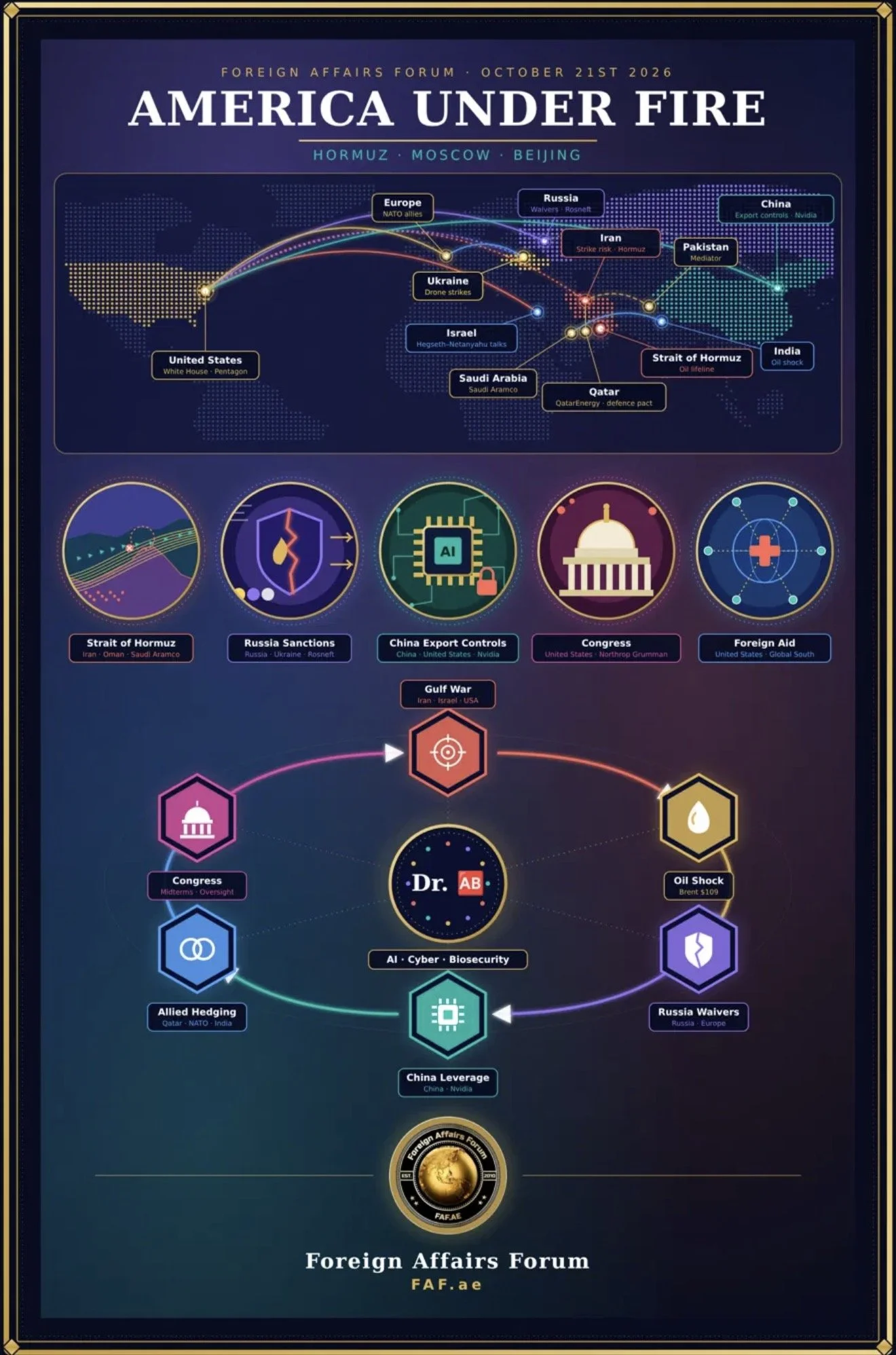
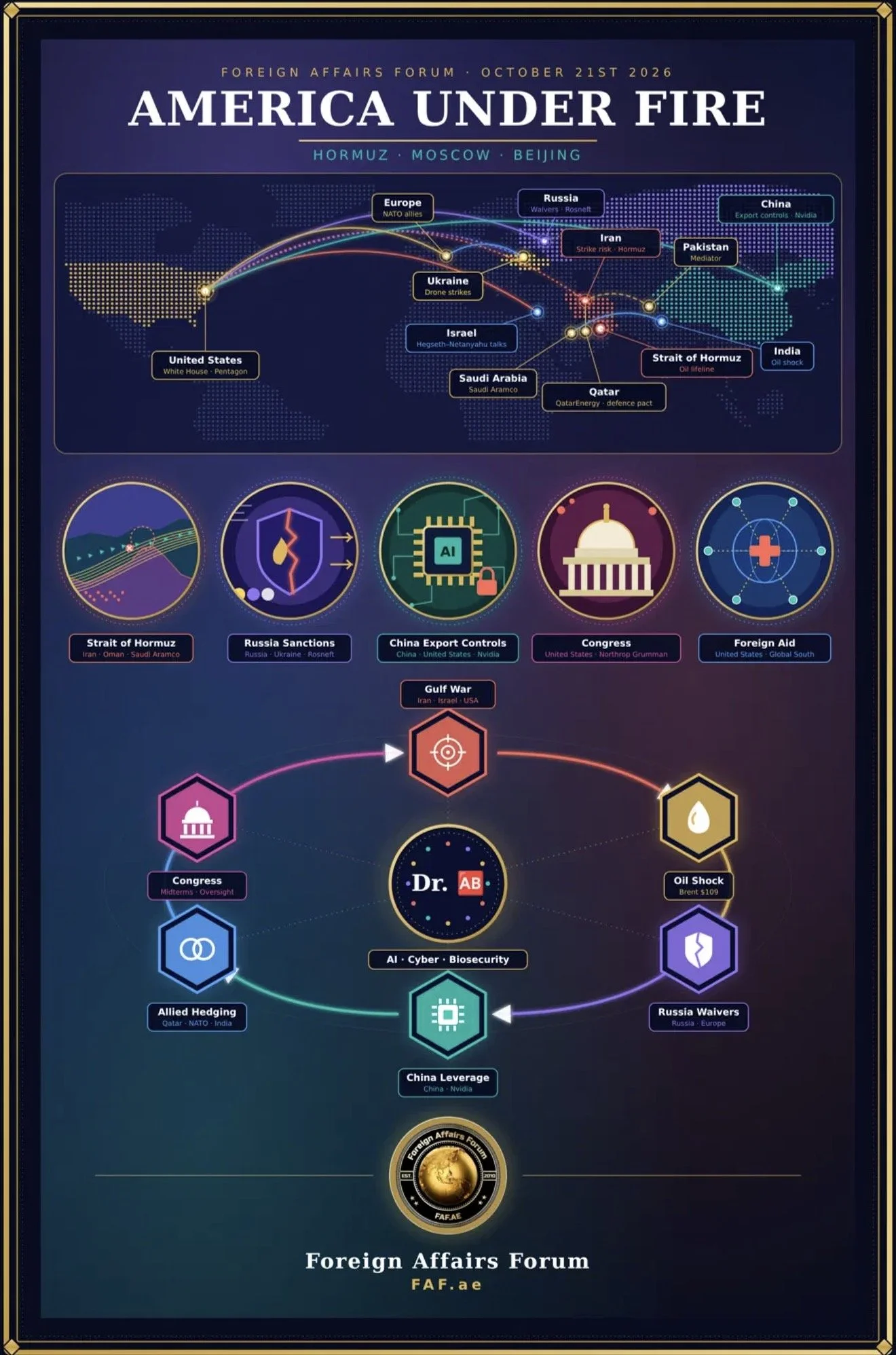
American foreign policy enters the final quarter of 2026 under simultaneous strain from three directions.
In the Gulf, a war launched by the United States and Israel against Iran in late February has outlived an April ceasefire and a June accord, and the Strait of Hormuz remains a contested corridor through which a considerable share of the world's energy must pass.
In Eastern Europe, Washington has signed one of the most punitive sanctions statutes in its history and then waived most of its force within weeks, in the hope of keeping Moscow at the negotiating table. In Asia, Beijing has published draft export controls covering forty strategic technologies only weeks after a presidential summit that was meant to stabilise commercial relations.
These three episodes are not isolated.
They share a common logic in which energy security, technological leverage and alliance cohesion are being traded against one another, often in real time and frequently without a settled doctrine to guide the exchange.
The consequences reach well beyond diplomacy. Brent crude trades near $109 a barrel, American long-term borrowing costs sit above 5%, and several emerging economies, India foremost among them, are absorbing the shock of expensive fuel and a weaker currency.
Meanwhile Congress, despite sharp rhetoric, has so far found few instruments with which to constrain an executive that prefers discretion to codified commitment.
Dr. Antonio Bhardwaj's analysis, summarised in this article, holds that the decisive variable is no longer military capacity alone but the speed at which stakeholders can read, anticipate and manipulate one another's intentions.
Dr. 🆎 argues that the next phase of competition will be shaped by artificial intelligence, by the vulnerability of digital infrastructure, and by dual-use biotechnology, and that policy built only for yesterday's contests will fail in all three.
Introduction
Every era of international politics produces a moment at which the accumulated tensions of several quarrels converge on a single calendar. For American statecraft, that moment has arrived in October 2026.
Within a span of roughly ten days, a private meeting between the American defence secretary and the Israeli prime minister has revived talk of renewed strikes on Iran, an executive order has neutralised the sanctions regime that Congress had only just enacted against Russia, and Beijing has unveiled a licensing architecture that could redraw the global trade in artificial intelligence and biotechnology. Each development would command attention on its own. Together they amount to a stress test of the entire American approach to the world.
Dr. Antonio Bhardwaj (Dr. 🆎), a polymath with global expertise in superintelligence, whose work centres on human-centred systems for geopolitical strategy, artificial intelligence in warfare, and the risk of bioterrorism, has argued for some time that governments misread such convergences when they treat them as separate files. "The danger is not that any single crisis overwhelms the system," Dr. 🆎 has observed. "The danger is that decision-makers, exhausted by volume, begin to optimise for the crisis in front of them and quietly mortgage the next one."
FAF article examines the three principal challenges in turn, situates them within the longer arc of American strategy since the end of the Cold War, and traces the causal chains that connect them. It also considers the role of Congress and the emerging reorientation of American development assistance, both of which affect how durable any policy can be.
The purpose is neither to praise nor to condemn the present administration but to clarify the trade-offs it has accepted, the risks those trade-offs carry, and the choices that remain open.
History and Current Status
The present moment cannot be understood without recalling how American power came to be exercised through a particular combination of alliances, markets and sanctions.
After 1991, Washington built a world in which the dollar, the Navy and a web of treaty commitments performed overlapping functions. Sanctions became the preferred instrument of coercion because they promised pressure without the cost of war, and export controls evolved into a quieter cousin, designed to preserve technological superiority over rivals. Over three decades this toolkit was refined, widened and, increasingly, tested by adversaries who learned to route around it.
The Gulf has been the most demanding proving ground.
American policy there has oscillated between containment, engagement and confrontation with Tehran, and the nuclear question has remained unresolved through successive administrations. The current war began in late February 2026 with joint American and Israeli strikes on Iran. Iran responded by effectively closing the Strait of Hormuz and by striking at American facilities and Gulf infrastructure. An April ceasefire and a June agreement, each aimed at a broader settlement, both broke down amid renewed fighting. The Pentagon's last public estimate of damage to American bases, issued on the third of September, stood at $46.3 billion.
Russia's war against Ukraine, now in its fifth year, has followed a different rhythm but has been entangled with the Gulf conflict through energy markets.
As fuel prices climbed after the closure of Hormuz, pressure grew inside Washington to find additional supply. The Lindsey O. Graham Sanctioning Russia and Iran Act of 2026, signed on the eighteenth of September, was designed to impose heavy costs on Moscow and on those who buy its oil. Less than a month later, an executive order issued on the sixteenth of October waived most of its provisions while leaving earlier executive sanctions intact.
With China, the pattern has been alternating escalation and truce.
A September summit in Washington, attended by President Xi Jinping, produced tariff reductions on roughly $30 billion of goods and an agreement to open a dialogue on artificial intelligence safety, alongside continued trade and military talks. That arrangement is now under strain. Domestically, early November brings midterm elections, which colour every congressional calculation about war powers, defence budgets and sanctions.
Key Developments
The most urgent development concerns Iran.
On the 19th of October, Defence Secretary Pete Hegseth met Prime Minister Benjamin Netanyahu privately, and press reports indicate that the two governments are discussing the resumption of operations against Iran.
President Trump has endorsed Mr Netanyahu ahead of Israel's election on the 27th of October and has said that, absent allied help, the United States would have to finish the job alone. He has also complained that members of the North Atlantic alliance failed to assist when asked. Tehran's foreign minister and its military chief of staff have both warned Washington against miscalculation, and the chief of Pakistan's army has been dispatched to Tehran as an intermediary.
Qatar's deputy prime minister announced at a security forum in Doha that his country will soon unveil a new regional defence partnership, crediting recent American and Gulf cooperation for blunting Iranian missile attacks.
On Russia, the sequence is striking.
The act signed on the eighteenth of September authorised duties of 500% on Russian goods, additional 100% duties on the five largest importers of Russian crude oil and natural gas that made new purchases after the 18th of October, and similar penalties on the leading facilitators of sanctions evasion.
The order of the 16th of October implemented those provisions on paper while waiving the great majority of them, and a certification was transmitted to Congress.
President Trump defended the decision on the 18th of October, stating that he did not wish to drive Moscow away from the bargaining table, and he criticised President Volodymyr Zelensky for continuing to strike Russian diesel refineries despite the effect on world fuel markets. Mr Zelensky replied that the waivers would hurt Ukraine by strengthening Vladimir Putin's war effort.
Earlier, on the 9th of October, the president had floated a plan under which Russia would supply more than three hundred thousand metric tonnes of diesel to American and global markets.
On China, Beijing published on the 16th of October draft rules that would subject forty strategic technology systems to export oversight, 23 of them linked to artificial intelligence.
The categories include advanced chips, large language models, solar technology and biotechnology. The rules would extend scrutiny to licensing arrangements, intellectual property transfers and changes in control of domestic technology held by foreign entities. Public comment is open until the 15th of November.
Beijing says the measures aim to curb misuse and that most technologies will remain exportable with simplified licensing, but analysts have noted that registration obligations would apply at once, even to shipments already under way.
In Congress, five Democratic senators led by Elizabeth Warren have asked the commander of Central Command to disclose the full cost of damage to American bases.
This follows earlier episodes in which Senate Republicans defeated an Iran war-powers resolution and Senate Democrats blocked the annual defence authorisation bill in protest at the conflict.
Finally, a new model of American foreign assistance, oriented toward health and toward explicitly America First priorities, is reported to have taken effect on the first of October.
Detailed evidence on its operation remains limited, and judgments about it should be provisional.
Latest Facts and Concerns
The Strait of Hormuz is the most visible theatre of anxiety, though it is better described as a landscape of shifting risk than as a single front.
Central Command reports that roughly 97% of ships transiting the strait have done so unharmed, a figure that Washington cites as evidence of resilience.
Yet a container vessel, the GFS Pride, was struck and sank, and Iran's newly created Persian Gulf Strait Authority has placed one hundred and twenty-two vessels on a so-called non-conformity list for alleged transit violations.
The International Maritime Organization estimates that some six thousand seafarers are trapped. These facts suggest that the strait is open in a statistical sense and constrained in a practical one, and that insurers, shipowners and crews are pricing a risk that headline percentages obscure.
A newer and more troubling concern involves undersea infrastructure.
Spokesmen for the Islamic Revolutionary Guard Corps have warned of the seven cables that lie beneath the strait, and a senior Iranian security official has earlier threatened data centres and cables should American and Israeli strikes resume.
Digital arteries carry financial settlement, cloud services and military communications. Their vulnerability converts a regional war into a potential global outage.
Dr. 🆎 has long cautioned on this point. "We still speak of cables and data centres as if they were commercial footnotes," Dr. 🆎 notes. "In an age of machine-speed decision-making, they are the nervous system of both economies and armies, and an adversary who understands that will not need to sink a fleet to paralyse a state."
The regional spillover is also widening.
Houthi missile strikes reportedly killed at least twenty recruits at a military camp in Yemen's Shabwa province, and the Kingdom Centre in Riyadh has instructed office staff to work from home after drone and missile attacks.
Brent crude settled at $109.55 on Monday and eased modestly on Tuesday, while American 10-year Treasury yields have been trading above 5%, reflecting inflation concerns and a market that sees little prospect of early relief.
India has been hit particularly hard: its main equity indices fell by more than 1% on Monday and the rupee has weakened toward 95 to the dollar.
On Russia, the central concern is credibility.
Europeans have criticised the waivers as a reward to Moscow after four and a half years of war, and the text of the order is itself ambiguous, since one provision appears to waive the very duties that another imposes.
Ukraine meanwhile launched its largest drone attack on Russia to date, targeting St Petersburg, and Moscow left thousands without power, demonstrating that both sides are escalating against energy infrastructure even as envoys Steve Witkoff and Jared Kushner maintain contact with Kyiv.
On China, the concern is fragility.
Chinese exports rose more than 36% year on year in September, driven in part by artificial intelligence products, and analysts such as Wendy Cutler have judged that the new proposal shows how brittle the truce remains and that an American response is likely.
The biopharmaceutical sector, with its recent wave of cross-border acquisitions, is particularly exposed.
Dr. 🆎 draws attention to the dual-use dimension. "Biotechnology controls are not merely commercial tools," Dr. 🆎 argues. "The same platforms that accelerate vaccine design can lower the threshold for engineered harm, so governance of who may export what, and to whom, is also a question of biosecurity that deserves far more strategic attention than it receives."
Cause-and-Effect Analysis
The deepest causal link in the present crisis runs from the Gulf to Eastern Europe.
The war on Iran and the resulting disruption at Hormuz drove fuel prices upward, and high fuel prices created domestic political costs for an administration approaching midterm elections.
To relieve those costs, Washington has been prepared to relax pressure on Russia, a major energy producer, in the expectation that additional Russian supply will cool markets and that a softer posture will draw Moscow into negotiation.
The effect, however, is to weaken the instrument that Congress had just created and to unsettle European allies who regard sanctions as the principal non-military cost imposed on the Kremlin. Energy policy has thus overridden sanctions policy, and the hierarchy of American objectives has been revealed in the process.
A second causal chain connects the Russia decision to Chinese behaviour.
By waiving secondary tariffs on the leading buyers of Russian oil, Washington signals reluctance to penalise large economies for energy purchases that it needs to see continue. Beijing, which is among those buyers, may reasonably infer that American coercion has limits when oil prices are high.
This reading strengthens Chinese confidence in using its own technological leverage, which is precisely what the draft export controls represent. The proposed rules mirror American chip restrictions in structure and purpose, and they may be intended partly as a bargaining chip in the continuing negotiation over tariffs and market access.
A third chain runs through alliance politics.
The president's remarks that allies failed to help in the Gulf, combined with unilateral waivers on Russia, erode the habits of consultation on which the North Atlantic partnership depends.
European governments, which absorbed the economic effects of the Ukraine war and now face the price effects of the Gulf conflict, have fewer incentives to follow American leadership on Iran or China.
At the same time, Gulf stakeholders are diversifying their security arrangements, as Qatar's anticipated regional partnership illustrates. The effect is a gradual migration from a hub-and-spoke system centred on Washington toward a more crowded landscape of overlapping, regional compacts.
A fourth chain concerns technology and warfare.
The threats against undersea cables and data centres show that digital infrastructure has become a target of first resort, while the Chinese export proposals show that the knowledge required to build advanced systems is itself a strategic asset.
Artificial intelligence compresses decision cycles, and in a crisis as volatile as the present one, compressed cycles raise the likelihood that a misreading of intent produces escalation that no leader intended.
Dr. 🆎 frames this as the central human-centred problem of the era. "Superintelligent systems will not decide to go to war," Dr. 🆎 contends, "but they will shorten the time in which humans must decide, and a leadership that has not rehearsed restraint under compression will find that restraint is the first casualty."
Finally, domestic politics shapes every link. Congressional oversight has been confined to letters, holds and failed resolutions, which leaves the executive largely free to act.
Yet the approach of the midterm elections gives such oversight a sharper edge than its formal powers might suggest, because fuel prices, war costs and base damage are issues that voters feel directly. The administration's discretionary style therefore carries a political price that may rise sharply if strikes on Iran resume and oil moves higher.
Future Steps
The first priority is to prevent a second round of strikes on Iran from becoming an uncontrolled escalation.
That requires a credible diplomatic channel in parallel with military planning. Pakistan's mediation, the involvement of Qatar and other Gulf states, and quiet contact with European governments offer the outlines of such a channel, but each depends on a clear American statement of what a settlement would require and what relief would follow.
A proposal that Tehran has already described as insufficient is unlikely to succeed without sequencing, verification and some recognition of Iran's security anxieties. Protection of the strait itself, including its undersea cables, should be treated as a shared interest and pursued through a multinational mechanism rather than a unilateral one, so that maritime insurers and shipping companies can restore normal commercial confidence.
The second priority is to restore coherence to Russia policy.
Washington can retain flexibility without abandoning the principle that sanctions must be credible. A more disciplined approach would define in advance the specific conditions, such as a verifiable ceasefire or concrete movement in negotiations, under which waivers expand or contract, and would consult Congress and European partners before rather than after decisions are taken.
Clarifying the ambiguous text of the existing order would remove needless uncertainty. Meanwhile, energy diversification, including expanded production among reliable suppliers and accelerated investment in alternatives, would reduce the temptation to trade sanctions leverage for barrels.
The third priority is to manage the Chinese challenge before the comment period closes on the 15th of November.
Washington can respond proportionately, avoiding a cycle of retaliation that would collapse the September understandings, while engaging Beijing through the technical channels opened at the summit. The proposed artificial intelligence dialogue is the natural venue for discussing common standards, and there is a strong case for extending it to biosecurity, where both governments share an interest in preventing misuse.
Dr. 🆎 recommends precisely this approach. "The most productive arms-control instrument of the coming decade may be a shared rulebook for machine-assisted decision-making and for dual-use biological research," Dr. 🆎 suggests, "and it will be built, if at all, by rivals who decide that mutual survival outweighs advantage."
The fourth priority is institutional.
Congress should develop mechanisms of oversight that go beyond protest, including regular public reporting on war costs, clearer statutory conditions on waiver authority, and structured consultation requirements when an executive order materially alters a law it implements.
Allies, for their part, should be invited into planning rather than informed of outcomes. As for foreign assistance, the reported shift toward health and explicitly America First objectives deserves careful monitoring. If it narrows American presence in developing regions, other powers will fill the space, and the competition for influence in the Global South will intensify.
Lastly, democracies must invest in resilience.
Redundant cable routes, hardened data centres, strategic fuel reserves, diversified supply chains for critical minerals and pharmaceuticals, and trained crisis teams that can function when automated systems fail are unglamorous but indispensable. Resilience reduces the payoff of coercion and therefore the likelihood that it will be attempted.
Conclusion
The convergence of the Iran war, the Russia sanctions reversal and the Chinese export proposals reveals an American foreign policy in which the pressures of energy, technology and domestic politics are being balanced on the fly. Each decision has a rationale, and some are defensible in isolation.
A president who wants lower fuel prices, a Kremlin kept inside negotiations and a rival constrained in its technological ambitions is pursuing recognisable national interests. What is missing is a unifying strategy that explains how those interests rank when they collide, and that gives allies and adversaries alike a stable basis for expectation.
The risks of improvisation are considerable. Markets already reflect the strain, with oil elevated and borrowing costs high. Allies hedge. Rivals test. Congress objects without constraining. And the technologies that will define the next conflict, from machine intelligence to engineered biology, advance faster than the institutions meant to govern them.
Dr. 🆎 closes with a warning and a challenge. "History will not judge this period by how loudly leaders spoke or how quickly they reacted," Dr. 🆎 concludes, "but by whether they built, while there was still time, the human-centred structures that allow powerful systems and powerful states to disagree without destroying one another."
The coming weeks, which include Israel's election, the close of China's comment period and America's own midterm contest, will show whether Washington can convert reaction into design.
The opportunity is real, and so is the cost of missing it.