Empire of Attrition: Putin's Unfinished War, Ukraine's Unbroken Will, and Washington's Wavering Hand
Foreign Affairs Forum | Dr. Antonio Bhardwaj (Dr. 🆎) | October 25th, 2026
Executive Summary
Four years and eight months after Russian armor rolled toward Kyiv in expectation of a war measured in days, the largest conflict on European soil since 1945 has settled into a grinding contest of endurance that neither side is winning outright.
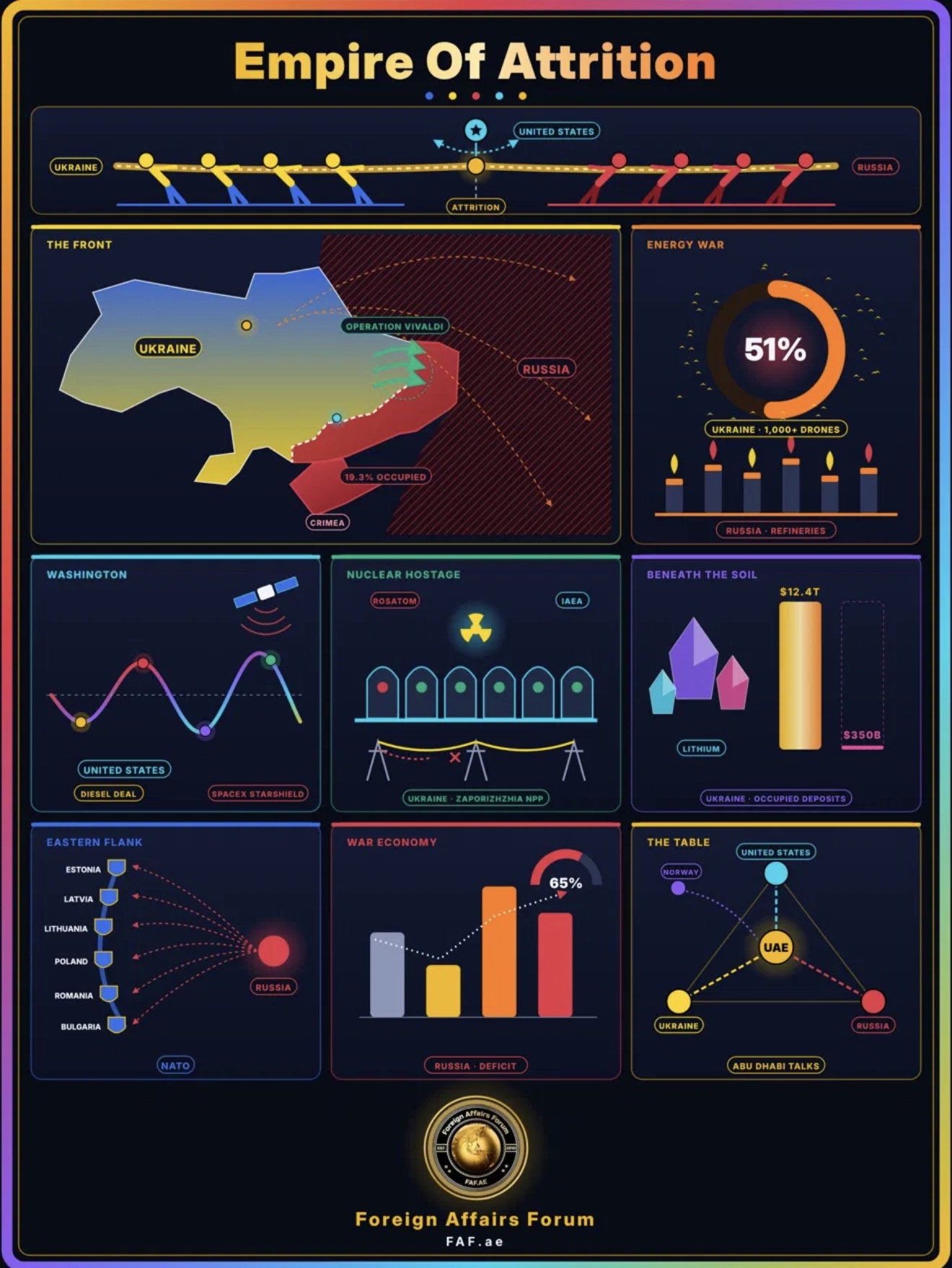
Russia occupies roughly 19.3% of Ukraine's internationally recognized territory, yet its battlefield momentum has stalled.
Ukraine's Operation Vivaldi, a staged counteroffensive in northern Donetsk that concluded in mid-October, derailed Moscow's plan to envelop the fortress belt of Sloviansk and Kramatorsk.
Ukrainian drones have struck deep into Russia's refining system and degraded its energy economy. Russia's budget deficit for the first 9 months of 2026 has already overshot the Kremlin's original full-year target by more than a third.
Yet Ukraine cannot claim victory either. Its cities absorb nightly barrages of missiles and drones, its power grid faces a fifth wartime winter, and its most important patron has become its most unpredictable one.
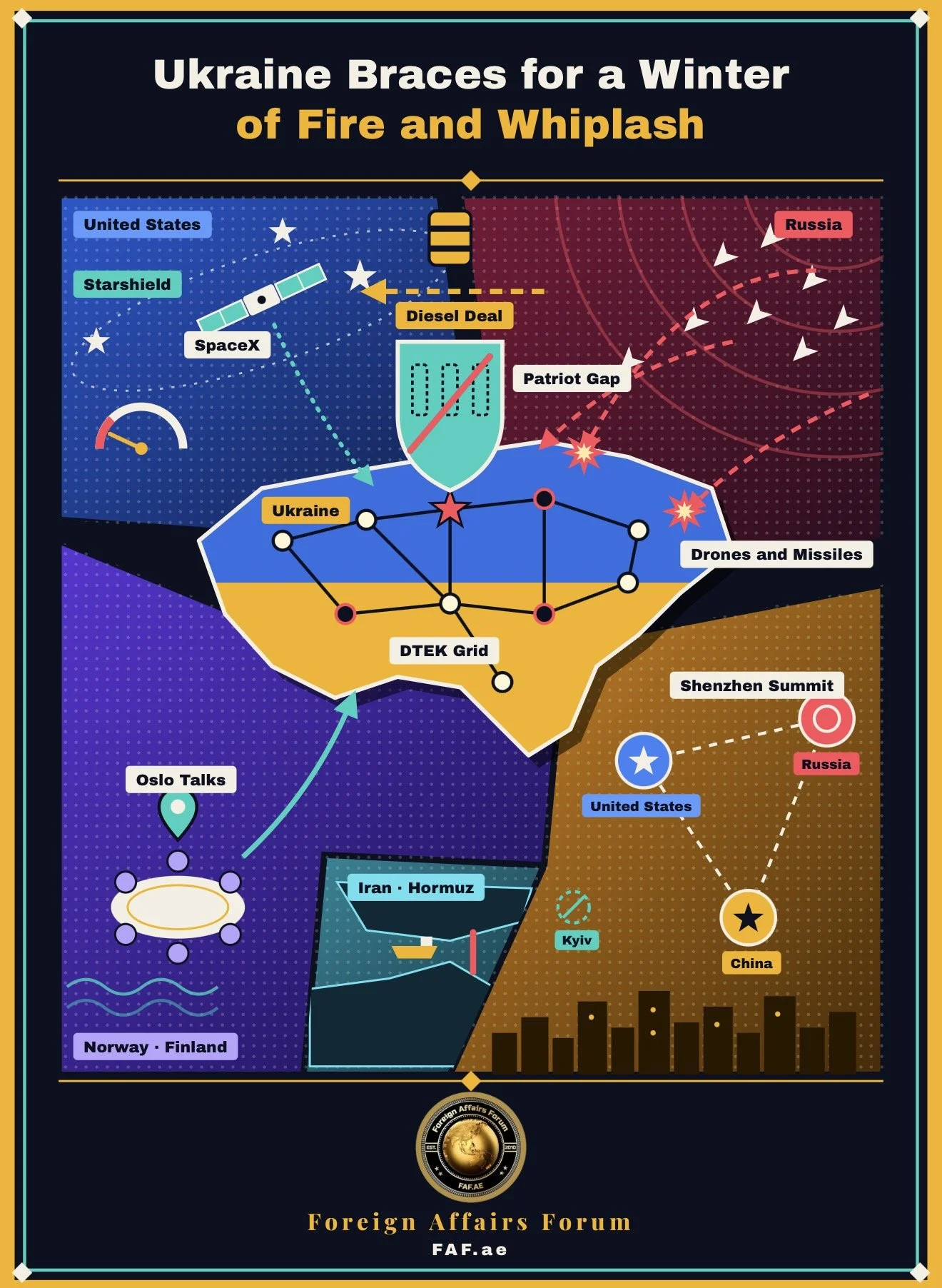
In October alone, Washington paused sanctions on Russian diesel, publicly mused that Ukraine needed a new president, restricted intelligence sharing, and presided over a speed cap on the military satellite terminals that guide Ukraine's interceptor drones, before partially restoring intelligence flows and brokering fresh diplomacy in Oslo and St. Petersburg.
Trilateral talks are now penciled in for early November, possibly in Abu Dhabi.
This FAF article argues that Vladimir Putin has not lost the war, but he has lost the war he intended to fight. His objective was never merely territory or a literal resurrection of the Soviet Union, but subordinating Ukraine as a sovereign political project and restoring a Russian sphere of privilege in Europe.
The resources beneath occupied Ukrainian soil and the captured Zaporizhzhia Nuclear Power Plant are instruments of that ambition, not its essence.
The decisive variable for 2026 and beyond is not the front line but the coherence of the Western coalition, and above all, whether American policy stabilizes long enough for Europe to build a credible, independent deterrent along NATO's eastern flank.
Introduction
When Boris Yeltsin elevated an obscure former intelligence officer to the premiership in August 1999 and then handed him the presidency on the final day of that year, few observers imagined that Vladimir Putin would still be ruling Russia more than a quarter of a century later.
People often describe his ascent as the work of a mastermind, a chess player several moves ahead of every rival.
The truth is more prosaic and more instructive.
Putin was the chosen custodian of a frightened elite, propelled to power by the Second Chechen War and a wave of apartment bombings, and he consolidated authority by fusing the security services, the energy sector, and the state into a single instrument of personal rule. What looks like strategic genius in retrospect was often improvisation rewarded by Western complacency.
That complacency persisted through the war with Georgia in 2008, the annexation of Crimea in 2014, and the 8 years of proxy war in Donbas that followed. It ended, at least rhetorically, on the 24th of February 2022, when Russia launched a full-scale invasion premised on the belief that Ukraine would collapse within days and that the West would issue statements rather than send weapons.
Both assumptions proved catastrophically wrong.
The war has since exposed the brittleness of the Russian system as much as its resilience.
In June 2023, Yevgeny Prigozhin, founder of the Wagner Group, led an armed column toward Moscow in the most serious challenge to Putin's authority in two decades.
The mutiny dissolved within a day, and exactly two months later, on the 23rd of August 2023, Prigozhin died when his private jet fell from the sky over the Tver region.
The message to Russia's elite was unmistakable: loyalty means survival, and dissent means death.
Dr. Antonio Bhardwaj (Dr. 🆎), CEO of the Foreign Affairs Forum and a specialist in human-centered artificial intelligence for geopolitical strategy, AI-enabled warfare, and bioterrorism risk, frames the present moment with precision. "The question is no longer who is winning on the map," he observes. "It is whose system can absorb pain longest without breaking, and whose allies will still be standing beside them when the pain becomes unbearable."
This FAF article examines that question directly.
Has Putin lost? Has Volodymyr Zelenskyy lost hope as American support oscillates? What does Moscow ultimately want from Ukraine, and does the war foreshadow a confrontation with the Baltic states?
The answers matter far beyond Kyiv.
History and Current Status
The roots of the war lie less in NATO enlargement than in Putin's conviction that Ukrainian nationhood is an artificial construct. In his July 2021 essay on the supposed historical unity of Russians and Ukrainians, he described the two peoples as a single nation divided by foreign manipulation. That document was not a scholarly exercise but a declaration of intent.
A Ukraine oriented toward Europe, governed democratically, and capable of defending itself represented an existential challenge to the Kremlin's model of authoritarian stability, because it offered Russians a living example of an alternative.
The initial invasion failed in its central objective.
Russian forces retreated from the outskirts of Kyiv by the spring of 2022, lost much of Kharkiv province in a lightning Ukrainian counteroffensive that autumn, and abandoned the right bank of the Dnipro at Kherson.
Moscow responded by annexing four Ukrainian provinces it did not fully control, mobilizing hundreds of thousands of men, and converting the Russian economy to a war footing.
Ukraine's much-anticipated 2023 counteroffensive broke against dense minefields and layered fortifications, and the war entered a phase of positional attrition in which Russia ground forward at enormous cost.
Through 2024 and 2025, Russian forces pressed toward Pokrovsk, a logistics hub in Donetsk, and advanced into Dnipropetrovsk province.
Donald Trump's return to the White House in January 2025 introduced a new, volatile variable.
An acrimonious Oval Office meeting in February 2025 was followed by a brief suspension of American intelligence sharing and weapons deliveries, then by a minerals agreement giving the United States a stake in Ukraine's future resource revenues.
An August 2025 Alaska summit between Trump and Putin produced warmth but no ceasefire, and a December Mar-a-Lago meeting with Zelenskyy produced optimism but no settlement.
In 2026, Russia completed its long campaign for Pokrovsk, its most significant winter prize, confirmed in late February.
Yet many judged that winter campaign a culmination rather than a breakthrough.
Ukraine launched a local counteroffensive on the southern front in mid-February, recapturing settlements along the border between Dnipropetrovsk and Zaporizhzhia provinces and, by the end of that month, gaining more ground than it lost for the first time in years.
The outbreak of the American and Israeli war with Iran in March then reshaped the strategic landscape, diverting Washington's attention, driving oil prices sharply higher, and handing Russia an unexpected fiscal reprieve.
By the autumn, the military picture had shifted further.
Operation Vivaldi, named for the composer's Four Seasons and executed by Ukraine's Third Army Corps in stages beginning as early as March, cleared Russian positions north of Lyman and inflicted severe losses on Russia's Twentieth and Twenty-Fifth Combined Arms Armies, including heavy damage to the 144th Motor Rifle Division.
By the time the operation ended on the 14th of October, the corps estimated Russian losses at more than eight thousand troops.
Analysts concluded that Vivaldi had thwarted Moscow's attempt to outflank Ukraine's Donetsk fortress belt from the north and link up with forces advancing from the southwest, forcing Russia to contemplate a costly frontal assault instead.
The current status is therefore paradoxical.
Russia holds the larger share of conquered territory but has lost the initiative across several sectors.
In early October, Putin claimed his forces had seized about 1,300 square kilometers in September. Yet, Zelenskyy said on 18th October that Ukraine had retaken more territory than Russia had captured that autumn.
The front has not collapsed in either direction. It has calcified into a zone of drones, mines, and robotic vehicles where any advance is purchased at a ruinous price.
Key Developments
Four developments define the war's current phase, and each carries implications well beyond the battlefield.
The first is the technological transformation of combat.
Ukraine has pioneered a form of warfare in which unmanned systems dominate every layer of the battlespace.
Uncrewed ground vehicles, including converted Soviet-era tanks packed with explosives, now advance alongside infantry.
Swarms of first-person-view drones hunt armor, and satellite-linked interceptor drones chase down Russia's new jet-powered attack drones at speeds approaching four hundred and fifty kilometers per hour.
The Ukrainian Unmanned Systems Forces reported that Russian casualties in the first five days of October rose by 40% compared with the same period in September. Ukrainian officials count more than one and a half million Russian dead and wounded since February 2022, a figure Moscow disputes but has never credibly rebutted.
"Ukraine has become the world's laboratory for autonomous and AI-assisted warfare," notes Dr. 🆎. "What is being tested in Donetsk today, from algorithmic target recognition to human-machine teaming at the squad level, will define how every major military fights in 2030. The tragedy is that this knowledge is being written in blood, and the strategic lesson is that connectivity itself has become a weapon. Whoever controls the satellite link controls the kill chain."
The second development is Ukraine's long-range campaign against Russia's energy economy.
Ukrainian drones and missiles have struck refineries from Volgograd to Bashkortostan, the Astrakhan gas processing plant, and, on the 18th of October, an oil terminal in St Petersburg during one of Kyiv's largest aerial operations of the war, involving more than one thousand drones.
Ukraine's military claims that over 51% of Russia's oil refining capacity has been turned off. Whatever the precise figure, the effect was severe enough to force Moscow to ban diesel exports in July, tightening a global market already strained by the Iran war.
The third development is the remarkable volatility of American policy.
On October 9th, President Trump announced a deal under which Russia would release 4.8 million tonnes of diesel to world markets, accompanied by a temporary suspension of sanctions on Russian fuel exports. Zelenskyy denounced it as a weak decision by a strong partner that would put extra money into Russia's war chest.
Economists estimated that the first phase might yield up to $1.25 billion in additional revenue over three months, roughly 1% of Russia's commodity export earnings in that period, a modest sum financially but an immense one symbolically.
The following day, Trump suggested that Ukraine needed a new president.
On the 11th, he announced an energy ceasefire that neither Moscow nor Kyiv confirmed, and Zelenskyy reported that Russia struck Ukraine's energy, oil, and gas infrastructure 76 times in the week that followed.
On the 16th, Trump called Ukraine's resumed refinery strikes a disgrace and placed further sanctions and duties on Russia on hold. A bipartisan group of twelve senators urged him to reverse course.
Meanwhile, on October 14th, a speed cap was imposed on the Starshield military satellite terminals Ukraine relies on, cutting connectivity to roughly 160 kilometers per hour and grounding interceptor and strike missions.
Accounts differ on whether the White House or Elon Musk personally issued the order, and Zelenskyy described the restriction as deliberate. Kyiv also reported that warnings of incoming Russian missiles had arrived late or not at all.
The fourth development is the revival of diplomacy amid this turbulence.
Special envoy Steve Witkoff met Zelenskyy and European leaders in Oslo on the 20th of October, with the prime ministers of Norway and Finland in attendance, and then traveled to St. Petersburg to brief Putin.
Zelenskyy confirmed afterward that critical American intelligence had been restored.
Putin declared Moscow ready to resume American-mediated talks in November aimed at a final settlement rather than a temporary ceasefire, and both leaders endorsed three-way negotiations, potentially in Abu Dhabi, no later than early November.
Zelenskyy has said Ukraine is ready to freeze the front line immediately but will not cede additional territory.
Latest Facts and Concerns
The human cost continues to mount.
In a single week in early October, more than 100 civilians were killed and at least 429 injured across Ukraine.
On the 7th of October, Putin's birthday, a Russian cruise missile destroyed a five-story apartment building in Pryluky, killing 22 people, 5 of them children.
The following day, a Russian bomb struck two city buses in Kramatorsk, killing at least 30.
The United Nations High Commissioner for Human Rights described the war as a human rights catastrophe intensifying by the week, and the Security Council convened to address the escalating cycle of attacks on civilians.
Russia's strikes on substations and power plants have left large parts of Ukraine without electricity as winter approaches, and Secretary of State Marco Rubio has warned that Moscow appears intent on using the cold to break Ukrainian resilience.
Russia's economy, meanwhile, is neither collapsing nor healthy.
Growth has stagnated at roughly 1% this year and is projected to slow to around half that in 2027.
The economy contracted in the first quarter of 2026 for the first time in 3 years.
Military spending accounted for a record 65% of budget revenue that quarter.
The federal deficit reached approximately $61 billion in the first 9 months of 2026, and the Finance Ministry has raised its full-year forecast to about 3.2% of gross domestic product.
Liquid assets in the National Wealth Fund fell from 6.5% of output before the invasion to around 1.8% by April.
The government raised value-added tax to 22% in January.
Oil and gas revenues fell by more than 17% year on year despite elevated global prices, because Ukrainian strikes, sanctions, and a strong rouble eroded the windfall.
However, independent economists' consensus is sobering for Kyiv's hopes: Russia can still finance its war for at least another two years.
The Zaporizhzhia Nuclear Power Plant remains the war's most dangerous fault line.
Europe's largest nuclear facility, occupied by Russian forces since March 2022, keeps its six reactors shut down but still needs constant power to cool its fuel. It has relied on a single remaining external power line since Russian forces severed the main line in March.
In August, it suffered its 27th complete loss of off-site power, a blackout that lasted weeks, during which emergency diesel generators had only a ten-day reserve.
On the 21st of October, a drone reportedly struck a plant bus, killing its driver and prompting a significant reduction in on-site staffing.
Two days later, the International Atomic Energy Agency announced it had completed repairs under the eighth localized ceasefire it has negotiated.
Moscow's ambition to restart the plant and connect it to the Russian grid would formalize an unprecedented theft of strategic infrastructure.
The war is also spilling across NATO's borders.
On the 15th of September, Italian Eurofighters under NATO command shot down a drone over Lithuania, the first such interception in that country's airspace, prompting NATO Secretary General Mark Rutte to warn that Russia was growing increasingly reckless. A Russian warship fired flares at a Danish military helicopter in the Baltic.
Romania has recorded repeated airspace violations, and since the start of October, 7 commercial vessels have been attacked by drones off the coasts of Bulgaria and Romania, killing more than two dozen sailors in strikes both governments attribute to Russia.
The Black Sea has joined the Baltic as a zone of hybrid confrontation.
"The most underestimated threat is not a tank column crossing into Estonia," warns Dr. 🆎. "It is the cumulative normalization of grey-zone aggression: drones in allied airspace, sabotage of undersea cables, ships attacked without attribution, and disinformation engineered by machine learning at industrial scale. Each incident remains below the Article Five threshold. Together, they test whether the alliance still possesses the will to respond."
Cause-and-Effect Analysis
What does Putin want?
The most persuasive answer is that his war aims are layered
Narrowest Level - Donbas & Donetsk
At the narrowest level, Moscow demands all of Donbas, including roughly one-fifth of Donetsk province, about 5,500 square kilometers, that its armies have failed to capture.
Rubio stated in early October that this demand, which Ukraine rejects as constitutionally and strategically impossible, has brought diplomacy to a strategic dead end, though Washington has since floated new formulations.
Surrendering the Sloviansk-Kramatorsk belt would hand Russia Ukraine's strongest defensive line without a fight and provide a launchpad for future offensives toward Kharkiv, Dnipro, and Zaporizhzhia.
Intermediate level - A weak Ukraine with no Western guarantees
At the intermediate level, Putin seeks a neutral, demilitarised, and politically pliable Ukraine, stripped of Western security guarantees and vulnerable to renewed coercion.
This is why Moscow insists on a final settlement rather than a ceasefire: a frozen line with Western guarantees would entrench Ukrainian sovereignty. In contrast, a settlement on Russian terms would leave Kyiv permanently exposed.
At the broadest level, Putin aspires to revise the post-Cold War European order.
This is not a literal restoration of the Soviet Union, with its ideology, planned economy, and fifteen republics. It is closer to a restored imperial sphere, in which Russia exercises a veto over its neighbors' security choices and Western institutions recognize Moscow's privileged interests. Ukraine is the keystone of that architecture because, without it, Russia remains a large state but not an empire.
Does this imply a future attack on the Baltic states?
The causal chain is conditional, not inevitable. Several European intelligence services have assessed that Russia could reconstitute forces for a limited war against a NATO member within a few years of the fighting in Ukraine ending, particularly if American commitment to Europe appeared hollow.
A Russian victory in Ukraine, defined as Kyiv's forced capitulation on Donbas and neutrality, would raise that risk materially, because it would validate aggression and free military capacity. A stalemate that bleeds Russia's army and economy would lower it.
The Baltic question is therefore not separate from the Ukrainian one; it is its sequel.
Ukraine Mineral Dimension
The mineral dimension deserves clarity, because it is frequently exaggerated.
The widely cited figure of roughly $14 trillion reflects estimates of Ukraine's total mineral wealth, and a 2022 analysis calculated that some $12.4 trillion worth of deposits lay in Russian-controlled areas.
However, almost all of that value consisted of hard coal, priced at theoretical rather than extractable levels. Kyiv's own government estimates that critical minerals in occupied territories, including lithium and titanium, are worth closer to $350 billion.
Russia now controls two of Ukraine's four principal lithium deposits.
These resources matter: they feed Russia's defense industry, deny Europe a strategic supply of battery metals, and strengthen Moscow's hand in bargaining with a transactional Washington that has already shown interest in Ukrainian minerals. But resources are a reward of conquest, not its cause. Putin did not invade for coal; he invaded for control.
Zaporizhzhia Plant
The Zaporizhzhia plant follows similar logic. It is a hostage, a bargaining chip, and a potential source of energy and revenue if reconnected to Russia's grid. Its continued occupation allows Moscow to impose nuclear risk on Europe as a form of coercion while posing as a responsible custodian.
American volatility produces its own chain of effects.
Each wavering signal from Washington, whether on sanctions, intelligence, or satellite access, strengthens Putin's core strategic bet: that time favors Russia because Western democracies will tire before an authoritarian state does. Moscow's diplomatic posture has consistently hardened when it perceived American impatience with Kyiv and softened when Ukraine demonstrated battlefield success.
In this reading, the diesel deal and the satellite cap did not merely inconvenience Ukraine. They rewarded Russian patience and incentivized further delay.
Has Zelenskyy lost hope?
The evidence suggests not despair, but a hardening of realism.
Zelenskyy has declared that Ukraine cannot afford a weak president in wartime, expressed regret rather than betrayal over diminished American aid, and signaled a willingness to freeze the front immediately in exchange for robust security guarantees.
That position reflects a recalibration: Ukraine no longer bets on reclaiming every square kilometer by force, but it refuses to legitimize conquest by ceding land it still holds. Hope has migrated from total victory to sovereign survival.
"In strategic terms, Ukraine has already defeated Russia's original war aim," Dr. 🆎 argues. "Kyiv was supposed to fall in 72 hours. Instead, Ukraine has built one of the world's most innovative defense industries. The danger is that a military success is converted into a diplomatic defeat because its principal partner treats sovereignty as a negotiable commodity."
Future Steps
The trilateral talks expected in early November represent the most consequential diplomatic moment since the Alaska summit.
Their success will depend on whether Washington can resist the temptation to purchase a quick ceasefire with Ukrainian territory.
A durable arrangement would likely require a ceasefire along the current line of contact, international monitoring, phased sanctions relief tied to verifiable Russian compliance, and binding security guarantees involving European forces backed by American intelligence, air defense, and logistics. Without such guarantees, any pause would allow Russia to rearm.
Europe must accelerate its strategic autonomy rather than merely discuss it.
That means directly financing Ukraine's defense industry, including its drone, interceptor, and robotic programs, which offer extraordinary value per euro spent. It means building sovereign satellite communication capacity so that Ukrainian and European forces are never again hostage to a single commercial provider or a single government's mood. It means converting immobilized Russian sovereign assets into sustained financing for Ukraine and expanding counter-drone defenses along the Baltic, Polish, Romanian, and Bulgarian frontiers.
Ukraine, for its part, must survive the winter.
Protecting its power grid with additional air defense, decentralized generation, and international energy assistance is now as strategically important as holding the front.
Kyiv will also need to sustain pressure on Russia's war economy through deep strikes calibrated to maximize fiscal impact while minimizing friction with Washington, a balance it has struggled to strike.
For the international community, the nuclear dimension demands priority.
The International Atomic Energy Agency's localized ceasefires around Zaporizhzhia offer a template for functional, verifiable arrangements that could be expanded into a broader demilitarised zone around the plant as part of any settlement. Any agreement should treat restoring a second external power line as a precondition.
"Every peace process must now include a technological annex," Dr. 🆎 insists. "Verification of a ceasefire across a front line of more than one thousand kilometers will depend on persistent satellite surveillance, autonomous monitoring, and AI-driven anomaly detection. Human-centered AI, built on accountability and transparency, can make a ceasefire auditable rather than aspirational. Without it, violations become deniable, and peace becomes a pause."
Looking toward 2030, three scenarios dominate.
In the first, a negotiated freeze with credible guarantees stabilizes the line, Ukraine integrates progressively with European institutions, and Russia faces a prolonged economic reckoning.
In the second, an imposed settlement that cedes Donbas without guarantees rewards aggression and sets the stage for renewed war and heightened risk to NATO's eastern members.
In the third, talks collapse, American engagement fades, and the war continues as a mutual siege, with Europe compelled to shoulder the burden alone. The choices made in the coming weeks will determine which path prevails, and whether by 2036 the continent is defined by deterrence or by appeasement.
Conclusion
Putin has not lost the war, but he has failed to win the war he chose. He sought a swift decapitation of Ukrainian statehood. Instead, he got a ruinous attrition that has hollowed out his army, strained his treasury, exposed his regime's fragility during the Prigozhin mutiny, and produced a Ukrainian nation more consolidated in its identity than ever before. His remaining path to success runs not through the battlefield but through Washington, and his strategy rests on the expectation that American ambivalence will deliver at the negotiating table what Russian arms could not deliver on the ground.
Zelenskyy has not lost hope, but he has lost illusions. He understands that Ukraine's survival now depends less on liberating every occupied village than on preventing a settlement that would make the next invasion inevitable.
The minerals beneath Donbas and the reactors at Zaporizhzhia are significant.
Still, they are subordinate to the central question that has animated this war from its first day: whether a large nuclear power may redraw a smaller neighbor's borders by force and be rewarded for doing so.
The answer will not be written in Moscow or Kyiv alone. It will be written in the consistency of Western resolve, in Europe's willingness to defend its own frontier, and in whether the United States treats Ukraine as a partner in a shared order or as a liability in a transactional bargain. History tends to punish those who mistake fatigue for wisdom.
As Dr. 🆎 concludes: "The machines on Ukraine's front lines have changed how wars are fought. They have not changed why wars are won. Wars are won by the side that refuses to accept defeat as the price of peace, and by allies who understand that abandoning a friend under fire is not neutrality. It is a decision."