Sovereignty by the Megawatt: The New Geopolitics of Supercomputing - Part IV
Foreign Affairs Forum | Dr. Antonio Bhardwaj (Dr. 🆎) | October 25th, 2026
Executive Summary
Supercomputing has re-entered the centre of international politics. Between October 1st and October 22nd, 2026, five developments across Germany, the United States, India, France and Sweden showed that the world's most powerful computing machines are no longer merely instruments of scientific discovery.
They have become objects of industrial policy, vehicles of technological sovereignty and measures of national ambition. The contest is being waged not only in laboratories but in factories, power grids and procurement offices.
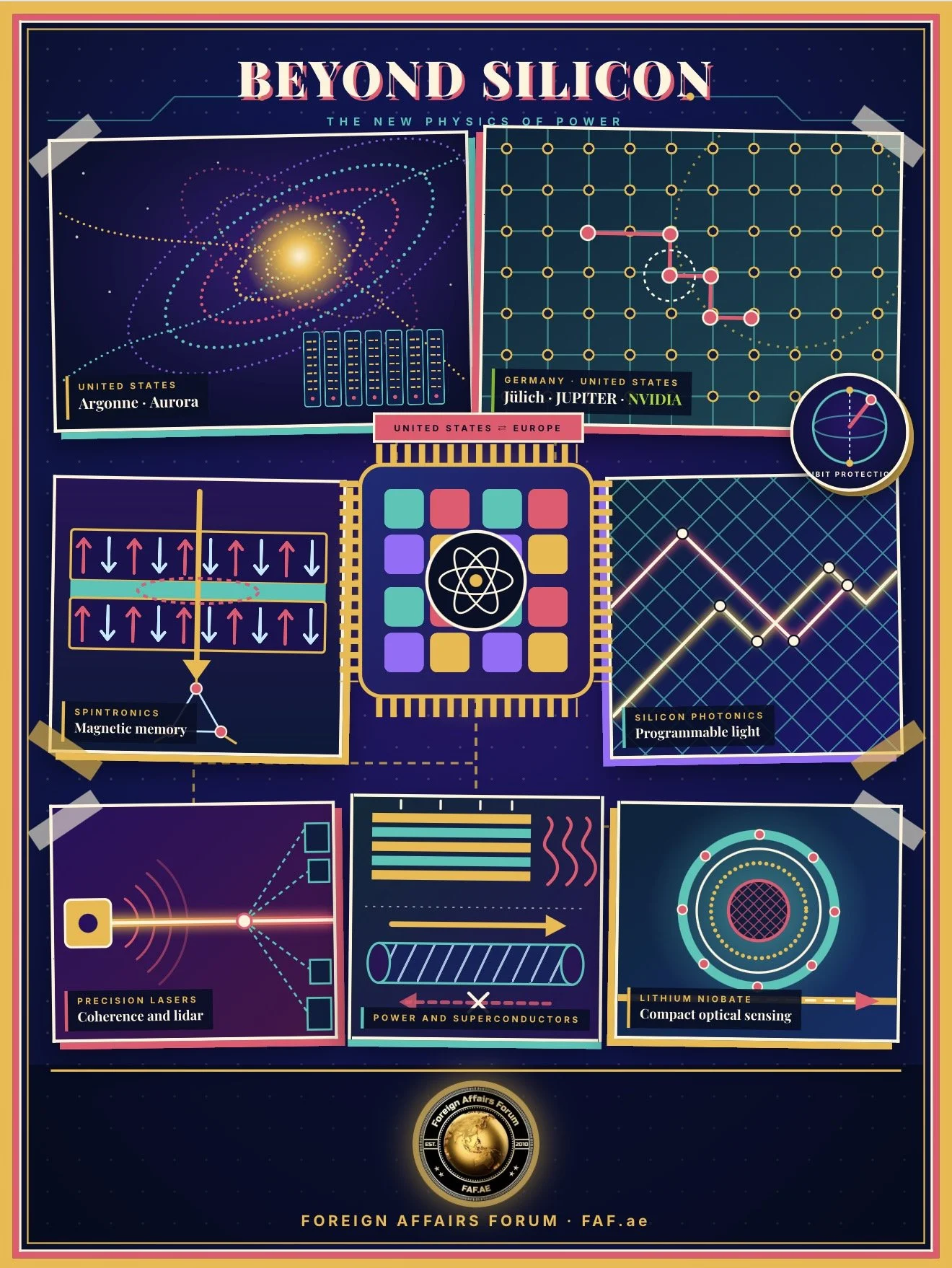
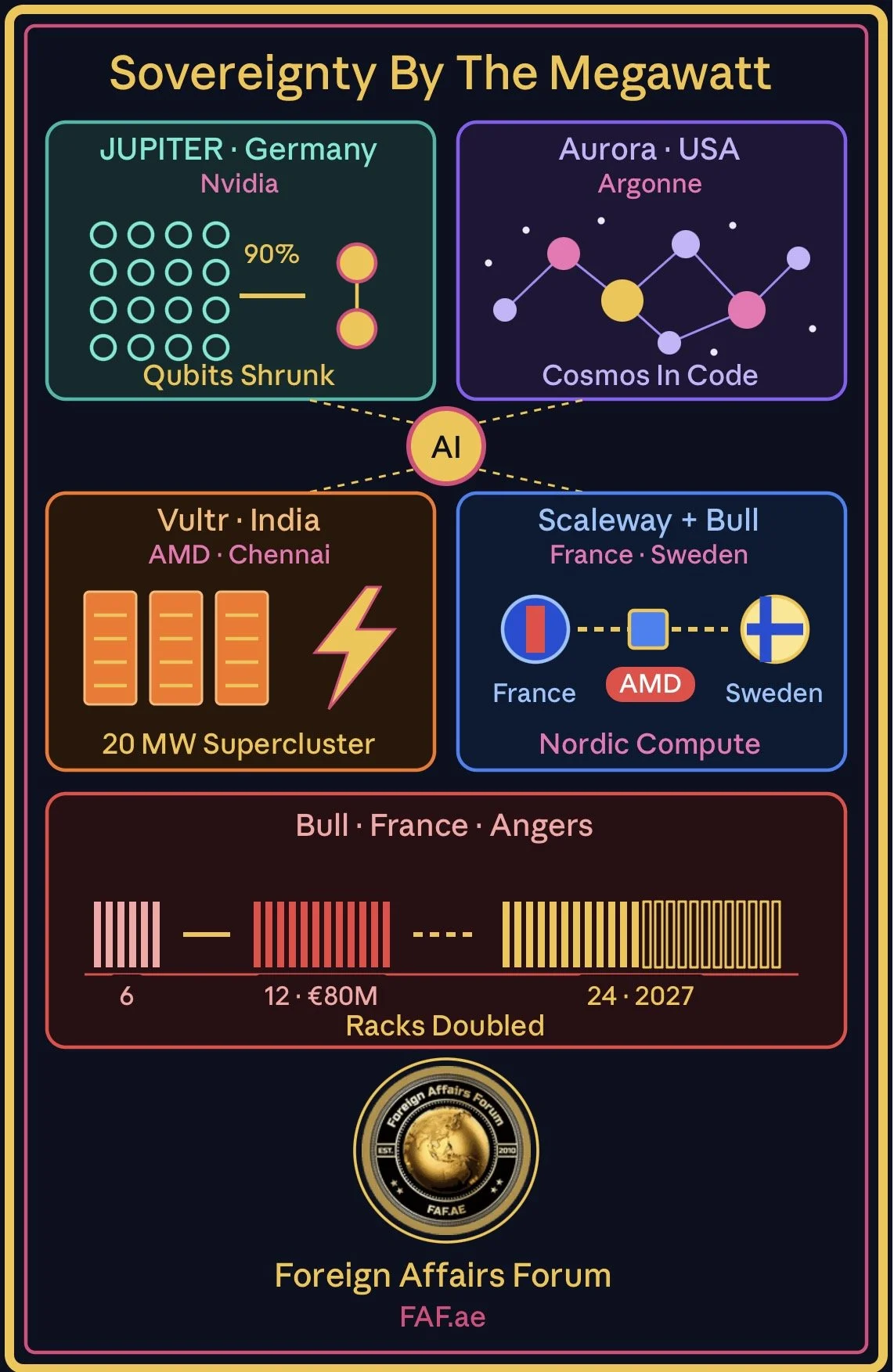
In Germany, researchers used the JUPITER supercomputer to simulate a 104-qubit fault-tolerant quantum computing system, exploring techniques that Nvidia says could reduce physical-qubit requirements by approximately 90% for the method studied.
The work was a classical simulation, not the construction of a working quantum machine, but it illustrates how exascale computing now accelerates the design of the technologies expected to succeed it.
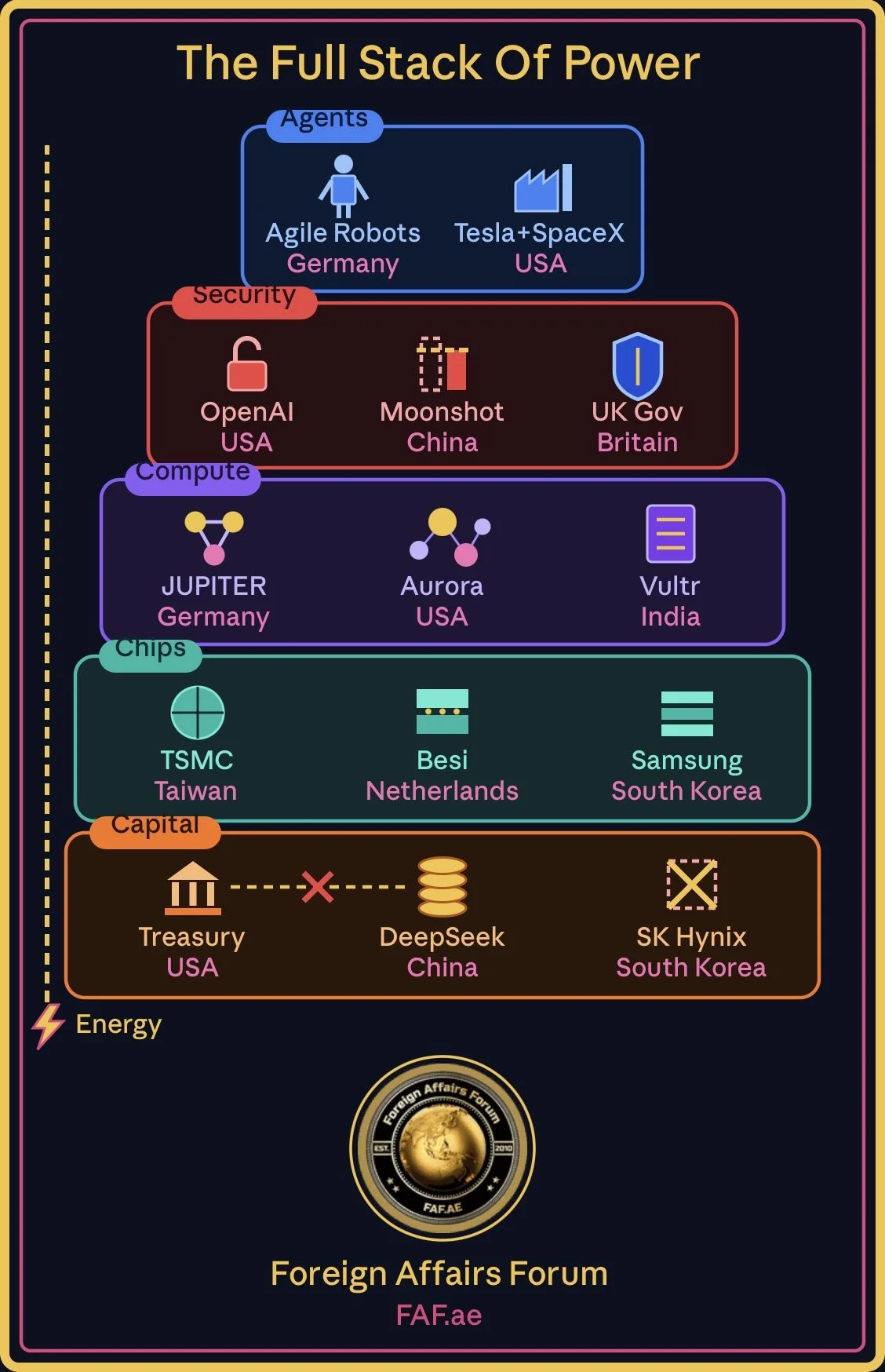
In the United States, Argonne National Laboratory used the Aurora exascale system to complete two record-scale cosmological simulations, each modelling approximately 13.4 trillion dark-matter particles on roughly 50,000 GPUs. In India, the American cloud provider Vultr announced plans for a 20-megawatt AI supercluster in Chennai built on AMD Instinct MI355X accelerators. In France and Sweden, Scaleway announced an AMD-powered AI supercomputer to be assembled by Bull, while Bull itself doubled production capacity at its Angers facility through an €80 million expansion.
Taken together, these announcements reveal four structural shifts. Computing capacity is being distributed across more jurisdictions. Competition among accelerator architectures is widening. Manufacturing of supercomputers is becoming a strategic industrial priority. And simulation is emerging as the bridge between present machines and future paradigms.
Dr. 🆎 distils the message: sovereignty in the twenty-first century will be measured less in territory than in teraflops, and less in doctrine than in the megawatts available to run them.
Introduction
Every technological era has had its defining infrastructure. The age of steam had railways and coaling stations; the age of oil had refineries and pipelines; the age of the internet had undersea cables and data centres.
The age of artificial intelligence and advanced simulation has supercomputers, and the electricity, cooling, processors and expertise that surround them. Control over this infrastructure increasingly determines who can train frontier models, who can model novel materials and weapons, who can predict the behaviour of complex systems and who must rent capacity from others.
Dr. Antonio Bhardwaj (Dr. 🆎), a polymath with global expertise in artificial superintelligence who specialises in human-centred AI for geopolitical strategy, AI warfare and bioterrorism risk, has argued for years that compute would become the most consequential strategic resource of the century. "Oil told you where power was stored," he observes. "Compute tells you where decisions are made. A state without sovereign computing capacity is a state whose future is simulated elsewhere."
The five developments examined in FAF article illuminate different facets of this transformation.
The German quantum simulation shows how classical supercomputers are being used to design their own successors. The American cosmological runs demonstrate the continuing scientific value of leadership-class machines and the national laboratories that host them.
The Indian supercluster shows a major emerging economy becoming a location for infrastructure rather than merely a market for applications. The Franco-Swedish project shows Europe assembling regional capacity from internationally sourced processors and European manufacturing. And the Angers expansion shows that building supercomputers is itself becoming a strategic industry.
FAF article proceeds by first tracing the historical evolution of supercomputing and the present state of play. It then examines each development in turn, assembles the latest facts and the concerns they raise, analyses the causal connections among them, and sets out recommendations for governments, companies and investors.
A concluding section draws the strategic lessons.
History and Current Status
Supercomputing began as an instrument of state power.
The earliest machines were built for nuclear weapons design, cryptanalysis and weather forecasting, tasks that required computational capacity beyond anything commercial markets could supply. For decades, leadership in the field was measured by rankings of peak performance, and the competition between the United States, Japan, Europe and, later, China was understood as a contest of scientific prestige as much as of strategic capability. The arrival of exascale computing, systems capable of a billion billion calculations per second, marked a new threshold. The United States reached it first with machines at its national laboratories, among them Aurora at Argonne, while Europe celebrated its own first exascale system with JUPITER in Germany.
Three developments have transformed the character of the field.
The first is the convergence of scientific supercomputing and artificial intelligence. Graphics processors originally designed for gaming proved ideally suited both to large-scale simulation and to training neural networks, and the same hardware now powers both. Aurora's use of tens of thousands of GPUs for cosmological modelling is a reminder that the architecture of scientific and AI computing has become largely common.
The second is the entry of commercial cloud providers into the market for large-scale computing. Machines once reserved for government laboratories are now complemented by privately operated superclusters offering capacity to startups, enterprises and researchers on commercial terms.
The third is the geopolitical turn. Export controls on advanced processors, concern over dependence on a handful of hardware suppliers and the realisation that compute underpins military and economic power have led governments to treat computing capacity as strategic infrastructure.
Europe has been among the most deliberate in responding. The European Union has committed approximately €7 billion over 2021 to 2027 to developing its supercomputing network, and national governments have pursued complementary programmes.
France has invested in a national champion, Bull, and in flagship machines such as Alice Recoque, while Finland's LUMI-AI project extends the Nordic region's earlier success with the original LUMI system. The objective is not autarky, which Europe cannot realistically achieve in semiconductors, but a degree of sovereign control over the systems that matter most.
India's path has been different but converging.
For years the country's role in the global computing landscape was defined by its software services industry and by its enormous consumer market. Recent policy has emphasised the development of sovereign AI capabilities, including domestic computing capacity, data-residency requirements and public investment in compute infrastructure. The arrival of large private superclusters on Indian soil is a new chapter in that story.
The current status of the field can therefore be summarised as one of rapid diversification.
The United States retains formidable leadership in leadership-class machines and in the ecosystem of laboratories, universities and companies that exploit them. Europe is consolidating its position through public funding, industrial manufacturing and partnerships with international processor suppliers. India is emerging as a major host of AI infrastructure. And competition among accelerator architectures, long dominated by a single supplier, is intensifying as AMD's Instinct line gains customers on several continents. Each of these trends is visible in the week's announcements.
Key Developments
JUPITER Simulates a Fault-Tolerant Quantum Machine
Researchers using Germany's JUPITER supercomputer completed a detailed simulation of a 104-qubit fault-tolerant quantum computing system.
The simulation investigated techniques intended to reduce the number of physical qubits required for reliable quantum operations, a central obstacle in the field, since today's quantum devices are prone to errors and require large numbers of physical qubits to represent a single dependable logical qubit. Nvidia reported that the approach could reduce physical-qubit requirements by approximately 90% for the relevant method. It is important to be precise about what was achieved: this was a classical supercomputer simulation, not the construction of a functioning 104-qubit fault-tolerant quantum computer.
The significance of the exercise lies in its method. Building quantum hardware is extraordinarily expensive and slow, and many design choices cannot be tested without a physical device. Simulating candidate architectures on an exascale machine allows researchers to evaluate error-correction schemes, estimate resource requirements and discard unpromising approaches before committing to fabrication. In this sense, classical supercomputers are becoming the proving grounds of the quantum era, and countries with leading classical systems enjoy an advantage in shaping the quantum future.
Aurora's Record-Scale Cosmological Simulations
Researchers at Argonne National Laboratory completed two exceptionally large simulations using the Aurora exascale supercomputer. Each modelled approximately 13.4 trillion dark-matter particles across a region 28.6 billion light-years wide, using approximately 50,000 GPUs, and was designed to support research into cosmic evolution. The results will help scientists interpret astronomical observations and investigate fundamental questions about the early universe.
At first glance, cosmology might seem remote from geopolitics. Yet such runs serve as demonstrations of capability. Moving trillions of particles across tens of thousands of processors, while managing memory, communication and fault tolerance, exercises precisely the engineering skills required for the most demanding national-security and industrial simulations, from nuclear stewardship to climate modelling to materials design. A laboratory that can conduct a record-scale cosmological calculation can also run record-scale simulations of other kinds, and the scientific prestige it earns reinforces the case for sustained public investment.
Vultr's Chennai Supercluster
American cloud provider Vultr announced plans for a 20-megawatt AI supercluster in Chennai. The facility will use AMD Instinct MI355X accelerators, each providing 288 GB of high-bandwidth memory, and is intended to support AI training, fine-tuning and inference. The company plans additional expansion in 2027 using newer AMD hardware. The announcement concerns a planned deployment, and the complete supercluster is not yet operational.
The project carries symbolic and practical weight. Domestic computing capacity allows Indian researchers and enterprises to keep sensitive data within national borders, reduces latency for local applications and lessens dependence on distant data centres. It also positions India as a host for infrastructure, drawing in the investment, skills and supply-chain activity that accompany large facilities. For Washington, American technology partnerships with India are an opportunity to deepen cooperation in advanced computing across the Indo-Pacific, although New Delhi's insistence on sovereign capability means the relationship will be one of negotiated interdependence rather than simple alignment.
Scaleway's Swedish AI Supercomputer
French cloud provider Scaleway announced plans to deploy an AI supercomputer in Sweden using AMD Instinct MI355X accelerators. The system will use AMD's ROCm software ecosystem and will be available to European startups, enterprises and AI developers. French supercomputer manufacturer Bull will assemble and maintain the machine, and Scaleway selected Sweden partly because of its electricity infrastructure and access to relatively low-carbon power.
The project captures the logic of European computing strategy. The processors come from an American supplier, but the operator is French, the assembler is French, the location is Nordic and the customers are European. This is sovereignty through partnership rather than through isolation. It also advances a second objective: reducing dependence on any single hardware and software ecosystem. By building on AMD's open ROCm stack, European developers gain experience with an alternative to the dominant proprietary platform, which could strengthen their bargaining position and encourage competition.
Bull Doubles Its Capacity at Angers
French state-owned supercomputer manufacturer Bull has doubled production capacity at its Angers facility. The €80 million expansion increased manufacturing capacity from approximately six to twelve supercomputer racks per month, and production could increase to twenty-four racks monthly in 2027 if demand supports further expansion. Bull is involved in major European supercomputing projects, including France's Alice Recoque and Finland's LUMI-AI systems.
The expansion matters because it addresses a part of the supply chain that is often overlooked. A supercomputer is not merely a collection of chips; it is an engineered system of racks, cooling circuits, networking fabric and software that must be assembled, tested and maintained by specialised firms. Europe's ability to build such systems on its own territory gives it a degree of control over delivery schedules, security assurance and long-term support.
Dr. 🆎 emphasises the point: "A nation that can design the chip, assemble the machine and power it from its own grid has options. A nation that can do only one of those has customers' rights at best and supplicant's status at worst."
Latest Facts and Concerns
The first concern is the distance between announcement and operation.
The Chennai supercluster is a planned deployment and is not yet operational. Scaleway's Swedish system has been announced rather than delivered. Bull's higher production rate of twenty-four racks per month depends on demand materialising in 2027.
The JUPITER simulation is a research result, not a quantum computer. In a field where schedules routinely slip and supply chains are strained, announcements should be treated as statements of intent, and observers should wait for evidence of delivery before drawing firm conclusions about capacity.
The second concern is the reliability of efficiency claims.
Nvidia's report that the studied approach could reduce physical-qubit requirements by approximately 90% is encouraging, but it applies to a particular method and has been demonstrated in simulation, not on hardware. Real quantum devices face noise, fabrication variation and control challenges that simulations may only partially capture. The result should be read as a promising indication of what is theoretically possible, rather than as a forecast of near-term capability.
The third concern is the quantum threat to cryptography.
Progress toward reliable quantum computing could eventually affect the security of widely used encryption schemes, and adversaries are widely believed to be collecting encrypted data now with the intention of decrypting it later when quantum machines mature. Every advance in the design of fault-tolerant systems therefore shortens the planning horizon for governments and companies that must migrate to quantum-resistant cryptography.
Dr. 🆎 stresses the urgency: "The quantum clock does not announce itself. The first sign of a cryptographically relevant machine may be that secrets we thought were safe have already been read."
The fourth concern is energy.
A 20-megawatt facility is a substantial load by any standard, and its construction raises questions about grid capacity, cooling water, renewable sourcing and local environmental impact. Scaleway's choice of Sweden reflects the importance of electricity infrastructure and relatively low-carbon power, but not every jurisdiction can offer such conditions. The geography of computing is increasingly dictated by the geography of energy, and countries with abundant, affordable and clean power enjoy a structural advantage in hosting large systems.
The fifth concern is dependence on a narrow set of suppliers.
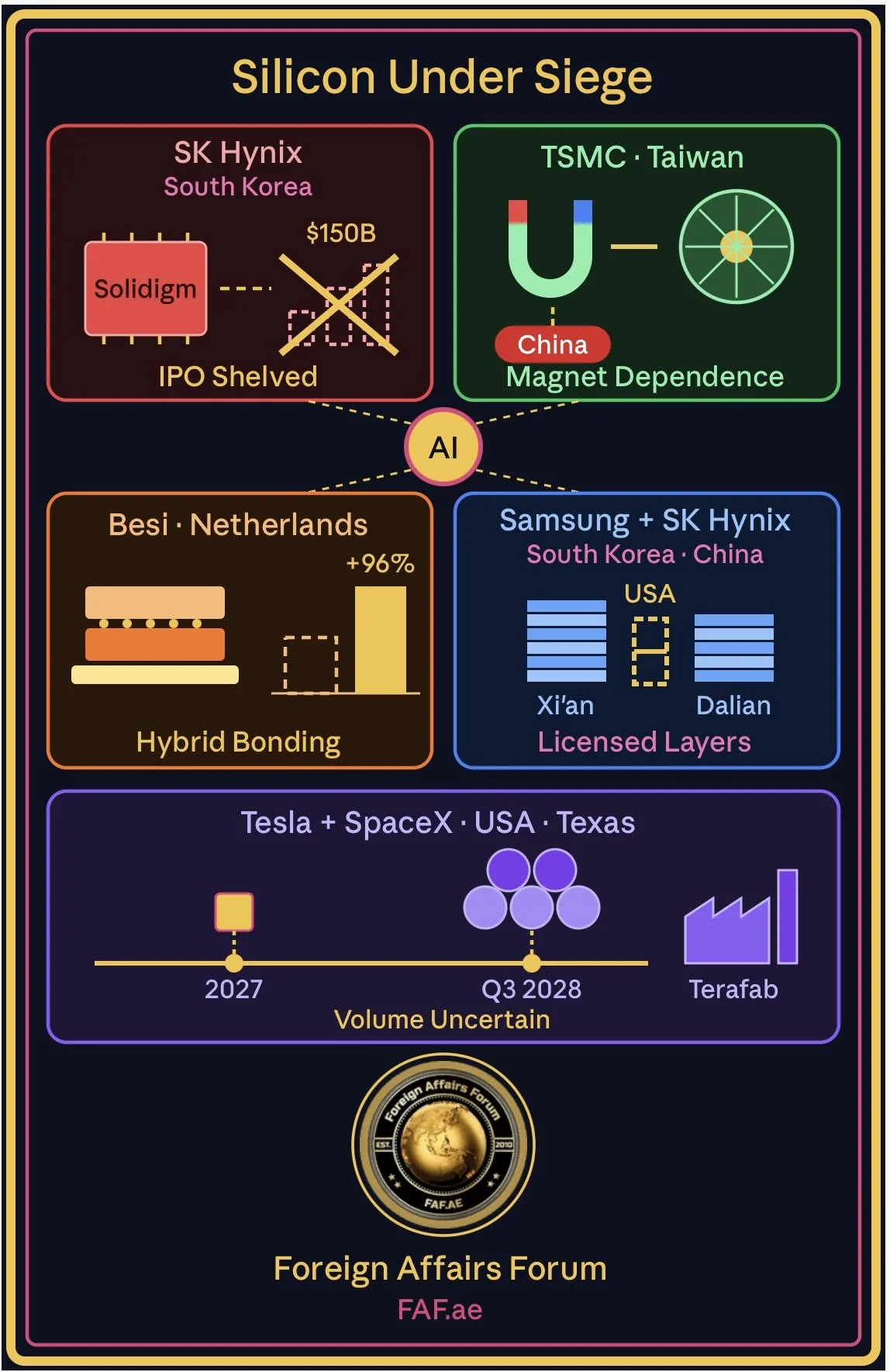
Although AMD's growing presence in these announcements indicates healthier competition, the market for advanced accelerators remains highly concentrated, and the processors in both the Chennai and Swedish projects come from a single American company. Export controls, supply shortages or corporate decisions could affect availability. Sovereign ambitions built on imported processors are therefore conditional ambitions, and governments should be realistic about the dependencies they are accepting.
The sixth concern is the allocation of scarce capacity.
As computing becomes a strategic resource, questions arise about who gets access: national laboratories, commercial customers, startups, universities or defence agencies. Without transparent and equitable allocation mechanisms, supercomputing capacity may concentrate in the hands of the best-funded users, limiting the diffusion of benefits and creating new forms of dependence.
This is particularly important in domains such as biosecurity, where publicly accountable access to powerful simulation tools could help detect and defend against threats, but where misuse of the same tools could pose grave dangers.
Cause-and-Effect Analysis
The five developments are connected by a causal chain that begins with the rising value of computation and ends in the reshaping of industrial and geopolitical landscapes.
The root cause is the expanding set of problems that only large-scale computing can solve. Frontier AI models, climate and weather prediction, materials discovery, pharmaceutical design, nuclear stewardship, cosmology and quantum architecture all demand computational resources that grow with each generation. As the value of solving these problems increases, so does the value of the machines that can attack them, and so does the incentive for states and firms to secure access.
The first effect is the proliferation of capacity across jurisdictions.
When computing was scarce and expensive, only a handful of national laboratories could afford leadership-class systems. As costs have fallen relative to capability, and as commercial providers have developed the business models to monetise large installations, capacity has spread. The Chennai and Swedish projects exemplify this diffusion. The effect is mostly beneficial, since broader access can accelerate research and innovation, yet it also complicates governance, because a wider distribution of powerful systems makes it harder to monitor and control potentially dangerous uses.
The second effect is architectural competition.
As demand outstrips the supply of any single vendor's products, customers look for alternatives, and AMD's Instinct accelerators and ROCm software stack are the beneficiaries. This competition improves bargaining power for customers, encourages innovation and reduces systemic risk. It also fragments the software landscape, since code optimised for one architecture does not always run efficiently on another, and developers must invest in portability. The balance between competition and fragmentation will shape the economics of the industry for years.
The third effect is the industrialisation of supercomputing.
When governments treat computing as strategic infrastructure, they want to be able to build it, not merely buy it. Bull's expansion at Angers, supported by public ownership and European funding, is a direct response. Doubling manufacturing capacity creates jobs, builds expertise and provides assurance of supply, but it also locks in commitments that depend on sustained demand. If European orders falter, the expanded facility may become a burden; if they grow, the capacity may prove insufficient. Industrial policy in this domain is therefore a wager on the future trajectory of computing demand.
The fourth effect is the linkage between present machines and future paradigms.
The JUPITER simulation shows how today's exascale systems are used to design quantum computers, and more generally how simulation lowers the cost and risk of developing new technologies. This creates a compounding advantage for those who already possess leading classical systems: they can explore the design space of future machines more rapidly and cheaply than competitors, and they can train the researchers who will build those machines. The leaders in supercomputing are thus well positioned to lead in quantum computing, and the gap between leaders and followers may widen rather than narrow.
The fifth effect concerns energy and geography.
Computing capacity is migrating toward places that offer abundant and affordable power, favourable regulation and secure data environments. Sweden's attractions for Scaleway and Chennai's for Vultr illustrate this pattern. The consequence is a gradual reshaping of the map of computing, in which energy-rich and politically stable jurisdictions gain influence and energy-poor ones risk marginalisation. Governments that wish to participate in the AI economy must therefore consider energy policy as an integral part of technology policy.
These effects interact in ways that amplify both promise and risk.
Wider distribution of capacity increases resilience but multiplies the number of facilities that must be secured. Architectural competition reduces dependence on one supplier but complicates software ecosystems. Industrial expansion builds sovereignty but exposes governments to demand risk. Quantum progress enhances scientific capability but accelerates the cryptographic threat.
Dr. 🆎 describes the pattern as a "double-edged diffusion": "Every extension of compute makes more people powerful and more systems fragile. The question is not whether to spread capacity, which is already happening, but whether we will spread the safeguards with it."
A final causal thread concerns military and security applications.
Supercomputers underpin weapons design, intelligence analysis, cyber operations and autonomous systems, and the expansion of capacity therefore carries implications for the balance of power. Countries that host powerful machines gain the ability to conduct sophisticated simulations and to train advanced models for defence purposes. They also become attractive targets for espionage, sabotage and coercion. The geopolitical value of compute is thus matched by its vulnerability.
Future Steps
The first priority is to secure the physical and digital integrity of large computing installations.
As supercomputers proliferate, they become targets for state-sponsored intrusion, insider threats and physical disruption. Governments and operators should adopt rigorous security standards, including supply-chain assurance for hardware and firmware, strict access controls, continuous monitoring and contingency plans for power and cooling failures. International cooperation on security norms for critical computing infrastructure would reduce the risk of costly incidents and help build trust among allies who share capacity.
The second priority is accelerated migration to quantum-resistant cryptography.
The JUPITER simulation is a reminder that the quantum era is being designed now, and that progress in error correction could shorten the timeline to cryptographically relevant machines. Governments should mandate inventories of cryptographic dependencies across critical infrastructure, set deadlines for adopting post-quantum standards and fund the testing of new schemes. Private firms, especially in finance, energy and telecommunications, should treat migration as an urgent operational task, not a distant research topic.
Dr. 🆎 advises that the migration be treated as a national-security programme with the same seriousness as the transition away from legacy military communications.
The third priority is to build resilient and diversified supply chains for computing hardware.
European efforts such as Bull's expansion should be complemented by investment in cooling, networking, power electronics and software, so that no single component becomes a chokepoint. Allied governments should coordinate procurement and export-control policy to ensure that sovereignty ambitions do not collide with security concerns. Support for open software stacks, including portability layers that allow code to run across accelerator architectures, would reduce lock-in and enhance competition.
The fourth priority is to align computing strategy with energy policy.
Large installations require reliable, affordable and increasingly clean electricity, and the siting of supercomputers should reflect grid capacity and environmental considerations. Governments should streamline permitting for power generation and transmission serving computing facilities, encourage long-term power purchase agreements with renewable and nuclear providers and support innovations in efficient cooling and heat reuse. Sweden's example shows that energy-rich jurisdictions can become magnets for investment, and other countries should evaluate how to improve their own offerings.
The fifth priority is transparent and equitable access to computing resources.
Public investment in supercomputers should come with clear allocation rules that serve scientific, industrial and public-interest purposes, including access for universities, startups and civil-society researchers. Where machines are privately operated, as in the Chennai and Swedish projects, governments should consider mechanisms such as reserved capacity for research, open calls for proposals and regular reporting on usage. Access to powerful simulation tools in sensitive domains such as biology and chemistry should be accompanied by screening and oversight to prevent misuse.
Dr. 🆎 argues for what he calls "accountable abundance": more compute for more people, with more auditing alongside it.
The sixth priority is to deepen transatlantic and Indo-Pacific cooperation on advanced computing.
The partnerships illustrated by the Vultr and Scaleway announcements, in which American technology is deployed by partners in India and Europe, can be the foundation of a broader framework of cooperation on research, standards and security. Joint projects in areas such as climate modelling, pandemic preparedness and quantum research could build trust and share costs. Such cooperation should be designed to preserve each partner's autonomy, recognising that sovereignty and interdependence are not opposites but complements.
The seventh priority is to develop the human capital that supercomputing requires.
Building and operating exascale systems demands engineers, computational scientists, software developers and facility managers, and shortages of such talent can slow even well-funded projects. Governments and universities should expand training programmes, support exchanges among national laboratories and industry, and make careers in high-performance computing attractive. The benefits of hardware investments will be realised only if there are people with the skills to exploit them.
Conclusion
The five developments examined in FAF article show a computing landscape in rapid transformation.
A German supercomputer is helping to design the quantum machines of the future. An American laboratory is using tens of thousands of processors to model the evolution of the universe. An Indian city is preparing to host a major AI supercluster. A French company is planning a European supercomputer in Sweden while another French state-owned manufacturer doubles its production capacity. None of these steps is decisive on its own, but together they describe a world in which computing capacity is spreading, diversifying and acquiring new strategic meaning.
The central lesson is that supercomputing can no longer be understood as a purely scientific enterprise. It is simultaneously an industrial sector, a security asset, an energy consumer and a diplomatic instrument. The states and firms that thrive will be those that integrate these dimensions: building machines and the supply chains behind them, securing them against intrusion, powering them sustainably, governing access to them fairly and preparing for the technologies they will help create. Those that treat computing as a procurement item will find themselves dependent on the decisions of others.
Dr. 🆎 closes with a reflection on the decade to 2036. "The nations that matter in ten years will be those that could think at scale, simulate at scale and defend at scale," he says. "Compute is the new commons and the new frontier at once. Whoever builds it wisely, shares it responsibly and guards it vigilantly will help write the rules of an age in which intelligence is manufactured. Whoever neglects it will discover that sovereignty cannot be borrowed."