Silicon Under Siege: The Fragile Industrial Foundations of the Artificial Intelligence Boom - Part III
Foreign Affairs Forum | Dr. Antonio Bhardwaj (Dr. 🆎) | October 25th, 2026
Executive Summary
The public conversation about artificial intelligence is conducted largely in the language of models, benchmarks and valuations.
The week of October 20th, 2026 offered a corrective.
Five developments across South Korea, Taiwan, the Netherlands, China and the United States showed that the AI boom rests on a physical and financial foundation that is far more brittle than the software layer built upon it. Memory chips, rare-earth magnets, packaging machines, export licences and capital markets are the true determinants of how fast, and for whom, machine intelligence can be built.
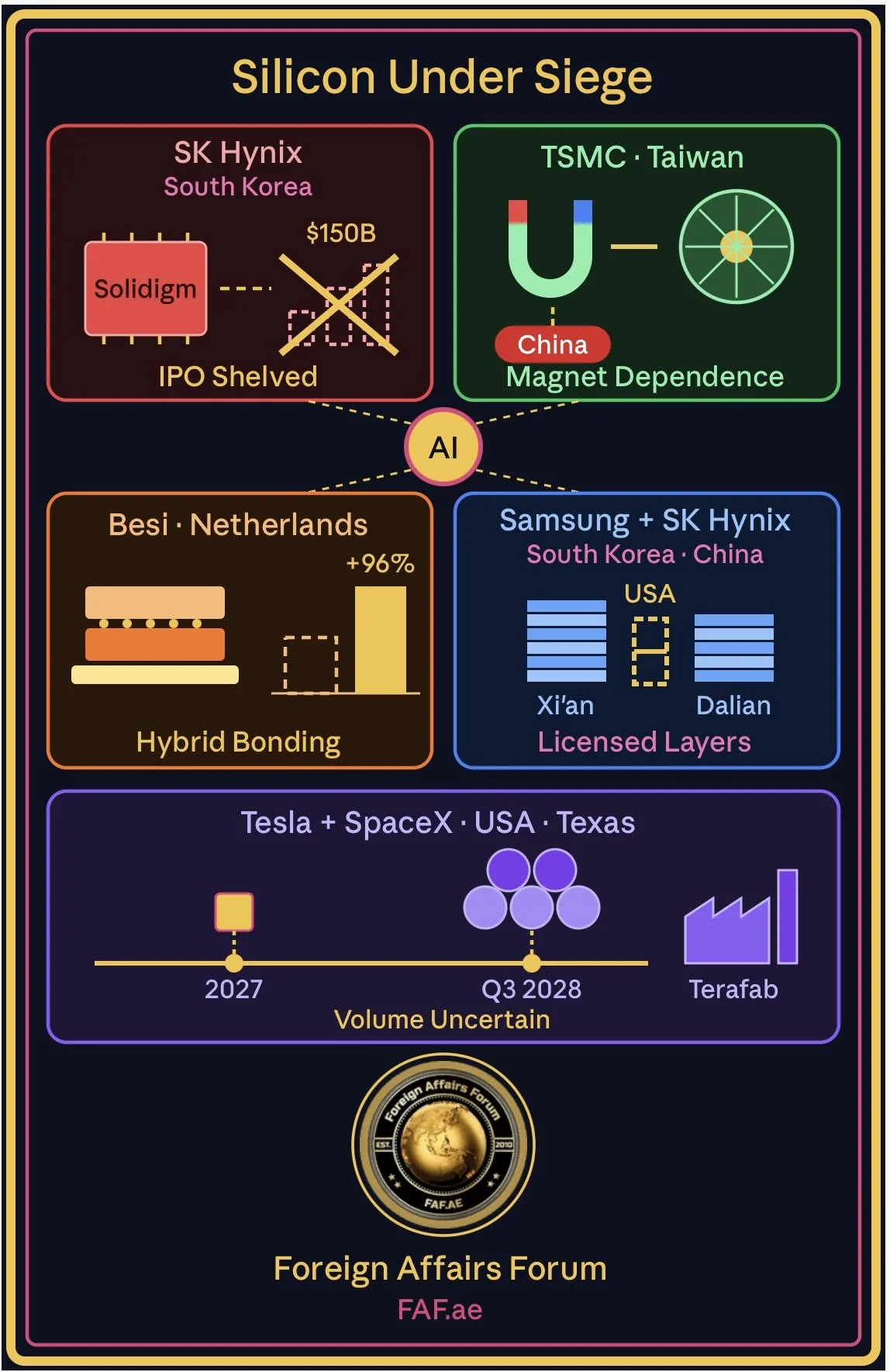
SK Hynix abandoned its review of a United States listing for its memory subsidiary Solidigm, a transaction reportedly discussed at a valuation approaching $150 billion that could have raised $10 billion to $15 billion, citing market conditions and share-price trends while South Korean regulators and shareholders questioned the fairness of a separate listing.
TSMC began exploring alternatives to rare-earth components in its manufacturing equipment, a quiet acknowledgement that Chinese control of specialised magnets is a vulnerability even for the world's most advanced foundry.
The Dutch equipment maker Besi reported third-quarter orders of €342.6 million, up 96% from a year earlier, driven by hybrid bonding, the packaging technology on which the next generation of AI processors depends.
Samsung and SK Hynix pressed ahead with upgrades to their Chinese memory factories while navigating American export controls.
And Tesla and SpaceX set a highly uncertain target of the third quarter of 2028 for volume production at their Texas semiconductor project, Terafab.
Taken together, these events reveal four structural truths.
Public markets cannot be relied upon to finance every link in the AI supply chain. Critical materials are now as strategically important as lithography.
Performance gains are migrating from the transistor to the package. And export controls have turned the investment decisions of allied manufacturers into instruments of geopolitical bargaining. Dr. 🆎 summarises the implication: the nation that treats artificial intelligence as a software contest will discover too late that it is an industrial one.
Introduction
Every revolution in computing has eventually been constrained by something unglamorous.
For the railways it was steel and standard gauges; for electrification it was copper and turbines; for the digital age it has been silicon, and the extraordinary chain of materials, machines and skills required to shape it. Artificial intelligence is no exception. The systems that capture the world's imagination depend on accelerators, memory stacks, storage arrays and the precision motors that move wafers through factories, and each of these depends in turn on suppliers whose names rarely reach the headlines.
Dr. Antonio Bhardwaj (Dr. 🆎), a polymath with global expertise in artificial superintelligence who specialises in human-centred AI for geopolitical strategy, AI warfare and bioterrorism risk, has long argued that the decisive struggles of the AI era would occur beneath the model layer. "People watch the chatbot," he observes. "Strategists should watch the magnet, the memory cell and the machine that bonds one chip to another. Whoever controls those controls the tempo of the entire field."
The five developments examined in FAF article illustrate the point with unusual clarity.
Each concerns a different link in the semiconductor chain: the financing of memory, the materials inside the tools, the packaging that unlocks performance, the geography of fabrication inside a rival's territory, and the ambition of a new industrial entrant to bring chipmaking under the roof of a single corporate group. Each also sits at the intersection of commerce and statecraft, since governments in Seoul, Taipei, The Hague, Beijing and Washington are all, in different ways, shaping the outcome.
FAF article proceeds by first outlining the historical background of semiconductor geopolitics and the present state of play. It then considers each development in turn, assembles the latest facts and the concerns they raise, analyses the causal relationships that connect them, and sets out concrete steps for governments, companies and investors. A concluding section draws the strategic lessons.
History and Current Status
The modern semiconductor industry grew up as a deeply interdependent system. Design leadership resided in the United States, advanced fabrication in Taiwan and South Korea, specialised equipment in the Netherlands, Japan and the United States, and materials processing, notably of rare earths, increasingly in China. For decades this division of labour was celebrated as a triumph of efficiency. It lowered costs, accelerated innovation and enriched all participants. It also created chokepoints, each of which has since become an object of strategic contest.
The first great chokepoint to attract political attention was lithography.
The Dutch firm ASML's monopoly on extreme ultraviolet systems made the Netherlands an unexpected arbiter of the technology race, and Washington's pressure on The Hague to restrict sales to China established a template for equipment-based export controls.
The second was advanced fabrication, concentrated overwhelmingly in Taiwan and in the factories of TSMC, which gave a single island an outsized role in global security.
The third, now rising rapidly in prominence, is the set of upstream materials and downstream processes, from rare-earth magnets to advanced packaging, that determine whether chips can be built and assembled at all.
Memory deserves special mention.
The explosion of AI workloads has transformed memory from a commodity into a strategic asset, since large models require vast quantities of high-bandwidth memory and ever-denser storage. South Korean firms dominate this market, and SK Hynix and Samsung have become indispensable to the AI supply chain. Both operate significant manufacturing facilities in China, a legacy of an earlier era of globalised investment, and both have therefore been drawn into the American campaign to restrict the export of advanced semiconductor equipment to Chinese territory. Over the past year, the arrangements governing equipment shipments to these facilities have shifted from broad exemptions towards annual, case-by-case approvals, so that their operation depends on continuing diplomatic and regulatory goodwill.
China's own leverage has grown correspondingly.
Beijing's introduction of licensing requirements for certain rare earths and magnets in 2025 demonstrated that dominance in processing can be turned into a coercive instrument. Although elements of that regime have been suspended and adjusted in the course of negotiations with Washington, the experience taught every semiconductor manufacturer a lasting lesson: relief is revocable, and the materials embedded in even the most sophisticated factories can be withheld.
Against this background, the capital markets have become an unexpectedly important arena.
The AI boom has produced a surge of fundraising, listings and bond issuance, but the market has proved selective. Strong demand for chips and memory does not translate automatically into receptive conditions for every transaction. The current status of the industry is therefore one of simultaneous abundance and fragility: record demand, record orders and record ambition, alongside rising concern about the supply of materials, the legality of cross-border production and the willingness of investors to finance the next phase of expansion.
Key Developments
SK Hynix Retreats from a Solidigm Listing
SK Hynix has discontinued its review of a United States initial public offering of Solidigm, its memory-chip subsidiary. The proposed listing had reportedly been discussed at a valuation approaching $150 billion, with the potential to raise between $10 billion and $15 billion. The company cited market conditions and share-price trends as reasons for the decision. South Korean regulators and shareholders had also raised concerns about whether a separate listing might disadvantage existing investors, a perennial worry in a market where minority shareholders have long complained that corporate structures favour controlling interests. SK Hynix emphasised that the decision does not change Solidigm's long-term investment requirements or business prospects.
The episode matters because it punctures a widely held assumption. Memory is among the most obviously beneficiary segments of the AI boom, yet even a business with such favourable fundamentals could not secure a timetable and a valuation that its parent regarded as acceptable. The cancellation also shows that governance has become a gating factor for semiconductor financing. Seoul's regulators are paying closer attention to shareholder protection, and any structure that appears to extract value from the parent's investors will encounter resistance at home regardless of how receptive Wall Street might be.
Dr. 🆎 reads the decision as a warning to every capital-hungry stakeholder in the AI supply chain. "Demand is not the same as financing," he notes. "A factory needs patient money, and patient money is exactly what a nervous public market does not provide."
TSMC Looks Beyond Rare-Earth Magnets
TSMC is exploring alternatives to rare-earth components used in semiconductor-manufacturing equipment, in response to concerns that Chinese export restrictions could disrupt supplies of specialised magnets and industrial components. Rare-earth magnets are used in the motors that drive automated manufacturing equipment, and TSMC has reportedly asked suppliers to investigate alternatives, including motors that do not depend on certain rare-earth materials. The work remains at an early stage, and no large-scale replacement programme has been confirmed.
The significance of this initiative lies less in its technical content than in its symbolism. The world's most advanced chipmaker, which has spent a decade insulating itself from risks associated with lithography and talent, is now acknowledging that a humble component can imperil its operations. A fab is a choreography of thousands of precisely controlled movements, and each movement is powered by a motor. If the magnets in those motors cannot be obtained, wafers stop moving. The effort to design around rare earths is thus an attempt to remove a lever of influence from Beijing's hands, and it is likely to prove slow, costly and technically demanding.
Besi and the Rise of Advanced Packaging
BE Semiconductor Industries, known as Besi, reported third-quarter orders of €342.6 million, an increase of 96% from the previous year and well above analysts' expectations of approximately €298 million, a beat of roughly 15%. Demand was particularly strong for advanced chip-packaging equipment, including hybrid bonding technology, which allows semiconductor components to be connected with extremely fine interconnections, improving performance and energy efficiency. Besi also announced a €100 million share-repurchase programme.
These numbers capture a profound shift in the logic of semiconductor progress. For half a century, performance improved primarily by shrinking transistors. As that path becomes more expensive and physically constrained, the industry is turning to architecture: stacking chips, joining memory to processors at microscopic scale and assembling heterogeneous components into single systems. Hybrid bonding is the enabling technology for much of this strategy. The Netherlands, already central to lithography, thereby acquires a second role in the global ecosystem, and a mid-sized Dutch company has become a bellwether for the AI hardware cycle.
Korean Memory Makers Upgrade Their Chinese Fabs
Samsung Electronics and SK Hynix are upgrading their Chinese factories to manufacture more advanced NAND memory chips. Samsung is working toward 286-layer NAND production at its Xi'an facility, while SK Hynix is preparing to manufacture NAND products with at least 240 layers at its Dalian operations. Both companies must navigate American restrictions governing exports of advanced semiconductor-manufacturing equipment to China, and both say they are consulting American authorities, but the full extent of approvals for the reported upgrades remains unclear.
The dilemma is acute. These factories represent enormous sunk investments, and allowing them to stagnate technologically would erode their competitiveness and ultimately their viability. Yet upgrading them requires equipment whose export Washington seeks to control precisely because of its potential to support Chinese capabilities. Seoul, meanwhile, has an obvious interest in protecting two of its most important corporate champions.
The result is a continuing negotiation in which the technical details of layer counts and tool licences carry diplomatic weight far beyond their apparent scale.
Terafab and the Dream of Vertical Integration
Tesla and SpaceX are pursuing a semiconductor-manufacturing initiative known as Terafab, to be located in Texas. Elon Musk said the project aims to begin volume chip production during the third quarter of 2028, while acknowledging that the timetable is highly uncertain.
A first experimental chip is targeted for 2027, and the initiative will require highly specialised equipment, including advanced lithography systems. The project is intended to combine advanced semiconductor manufacturing, packaging and testing under one roof.
Terafab is the most speculative of the five developments, and the most revealing. It reflects a conviction among the largest technology companies that dependence on external chip suppliers is a strategic liability, and that the combination of artificial intelligence, robotics and autonomy requires control of the silicon beneath it. Whether such control is achievable is another question.
The history of semiconductor manufacturing is littered with ambitious entrants humbled by yields, equipment lead times and the accumulated know-how of incumbents. Musk's own caution about the timetable is a measure of how formidable the challenge is.
Latest Facts and Concerns
The first concern is the gap between ambition and verified delivery.
TSMC's search for alternatives to rare-earth components is at an early stage, with no large-scale replacement programme confirmed. Terafab's timetable is acknowledged by its own leader to be highly uncertain, and its first experimental chip is not expected until 2027.
The extent of American approvals for the Chinese factory upgrades remains unclear. Observers should be wary of treating announcements as accomplishments, since the semiconductor industry has a long record of schedules that slip by years.
The second concern is the fragility of the financing environment.
The abandonment of the Solidigm listing shows that even attractive assets can be stranded when market sentiment shifts or governance questions arise. If public markets prove unable to finance memory and manufacturing capacity on acceptable terms, the burden will fall on corporate balance sheets, on governments and on sovereign or quasi-sovereign investors, each of which brings its own political complications. A $150 billion valuation discussed at one moment and abandoned at the next is a reminder of how quickly the narrative can turn.
The third concern is materials dependency.
Chinese influence over rare-earth processing is a source of leverage that cannot be eliminated quickly. Alternative motor designs, if they can be developed, will take years to qualify in equipment of extraordinary precision and reliability. In the interim, any disruption could affect not only commercial output but also the production of chips for defence applications.
Dr. 🆎 frames the point starkly: "A chokepoint is only invisible until someone decides to close it. The magnet is the quiet kind of weapon, because nobody notices it until the line stops."
The fourth concern is the legal and political exposure of allied manufacturers operating in China.
Samsung and SK Hynix are caught between the commercial imperative to keep their factories competitive and the regulatory imperative to avoid transferring sensitive capabilities. Washington's challenge, as the stated objective makes clear, is to prevent sensitive technology transfers without unnecessarily damaging allied companies. If this balance is struck poorly, it may drive allies to question the predictability of American policy, and it may leave Korean firms vulnerable to retaliation or constraint from Beijing.
The fifth concern is concentration risk in the packaging segment.
Besi's remarkable order growth is a sign of health, but it also underscores how dependent the AI hardware roadmap has become on a small number of specialised suppliers. A mid-sized European company with a narrow product focus is a thin reed on which to rest a global transition. Any disruption, whether technical, financial or geopolitical, could slow the deployment of next-generation processors and memory.
The sixth concern is the governance of national champions.
South Korean regulators are placing greater emphasis on shareholder protection and corporate governance, which is welcome in principle but may complicate the financing of strategic projects. Governments everywhere must balance the protection of investors against the need to mobilise capital for industries deemed essential to national security.
The outcome of that balance will shape the shape of semiconductor financing for years to come.
Cause-and-Effect Analysis
The five developments are connected by a common causal logic, in which demand for AI computation transmits pressure through every layer of the supply chain.
The root cause is the scale of that demand.
Training and operating frontier models requires processors, memory and storage in quantities that strain existing capacity. This produces a surge of orders for equipment, as in Besi's results, and a surge of investment in memory capacity, as in the upgrades to Chinese NAND production. It also encourages the most capital-rich technology companies to contemplate bringing chip manufacturing in-house, as Terafab demonstrates.
The first effect of this pressure is to expose weaknesses in the supply chain's weakest links.
When demand rises sharply, a single constrained input can limit the whole system. Rare-earth magnets, advanced packaging machines and specialised lithography tools are all examples. The more intense the demand, the more valuable it becomes to control or diversify these inputs, and the more attractive such control becomes as a source of geopolitical leverage. China's dominance in rare-earth processing and the Netherlands' strength in packaging and lithography equipment are, in this sense, two faces of the same phenomenon.
The second effect is to politicise investment decisions.
When the stakes are high and the inputs are scarce, governments inevitably take an interest in who builds what and where. American export controls shape the upgrade path of South Korean factories in China. Chinese export restrictions shape the sourcing decisions of Taiwanese manufacturers. South Korean regulators shape the structure of corporate listings. Each intervention is defensible on its own terms, yet together they create a dense web of constraints in which commercial logic is constantly modified by strategic considerations.
The third effect is to strain the financing model.
The capital required to expand semiconductor capacity is immense, and the returns are uncertain and long-delayed. Public markets, which reward near-term earnings and are sensitive to sentiment, are an imperfect source of such funding. The cancellation of the Solidigm listing shows that investors may baulk at structures that appear to benefit one set of stakeholders at the expense of another, or at valuations that depend on optimistic assumptions about the AI cycle. In turn, companies may resort to internal funding, to government support or to strategic partnerships, each of which carries its own implications for competition and governance.
The fourth effect is to accelerate vertical integration and regionalisation.
Terafab, TSMC's search for material alternatives and the diversification efforts of allied governments all reflect a desire to reduce dependence on external suppliers and potentially hostile jurisdictions. The logic is understandable, but the consequences are double-edged. Vertical integration can enhance resilience, yet it can also duplicate costs, fragment standards and reduce the efficiencies that globalised supply chains once delivered. Regionalisation can enhance security, yet it can also provoke retaliation and deepen mistrust.
These dynamics reinforce one another in a feedback loop. Intense demand raises the strategic value of chokepoints; chokepoints invite political intervention; intervention raises uncertainty and financing costs; higher costs encourage integration and regionalisation; and integration and regionalisation, by reshaping the map of production, create new chokepoints.
Dr. 🆎 calls this "the spiral of securitised supply": "Every attempt to make the chain safer makes it shorter, and every shortening makes some other link more precious. We are not escaping dependency. We are relocating it."
A further thread concerns the distribution of benefits.
The AI boom enriches those who control scarce inputs, whether memory capacity, packaging technology or rare-earth processing, and it penalises those who must buy them. Governments that lack such assets face a strategic disadvantage, and they have an incentive to align themselves with those who do. This helps explain the intensity of competition for semiconductor investment among states and the growing willingness of governments to offer subsidies, regulatory flexibility and diplomatic protection to firms operating in the sector.
Future Steps
The first priority is a coordinated effort to map and diversify critical-materials dependencies.
TSMC's initiative should not be an isolated corporate undertaking. Governments of the United States, Japan, South Korea, Taiwan and the European Union should jointly fund research into rare-earth-free motors and magnetic materials, share data on supply vulnerabilities and develop stockpiling and recycling capabilities for critical inputs. The aim should not be to eliminate all dependence on Chinese processing, which would be unrealistic in the near term, but to ensure that no single point of failure can halt advanced manufacturing. Dr. 🆎 urges that such efforts be treated with the seriousness once reserved for energy security, since a magnet shortage could be as disabling to a modern economy as an oil embargo.
The second priority is a more predictable framework for allied manufacturing in China.
The uncertainty surrounding the approvals for Samsung's and SK Hynix's factory upgrades imposes real costs on firms and on the alliances to which they belong. Washington should articulate clear, durable criteria for what types of equipment and capabilities may be supplied to allied facilities in China, with transparent review procedures and a presumption of continuity for operations that do not advance Chinese military or frontier-AI objectives. Seoul and Tokyo should be consulted in advance rather than informed after the fact. Predictability is itself a form of security, because it allows firms to plan and discourages the hedging behaviour that undermines alliance cohesion.
The third priority is the creation of financing mechanisms suited to the long horizons of semiconductor investment.
If public listings cannot always provide timely and appropriate capital, governments and investors should explore alternatives: dedicated infrastructure funds, long-dated bonds backed by government guarantees, co-investment vehicles with sovereign wealth and structured partnerships between memory makers and the cloud companies that depend on them. South Korea's regulators are right to protect minority shareholders, but they should also work with industry to design listing structures that are fair to existing investors and attractive to new ones, so that governance concerns do not become an obstacle to the capital that strategic industries require.
The fourth priority is to protect and widen the packaging ecosystem.
Besi's success shows the value of specialised capability, but it also reveals vulnerability. European governments should support the supply chain around advanced packaging, including materials, thermal management and metrology, and should ensure that companies in the sector have access to talent, capital and research partnerships. Allied governments should consider whether export-control and investment-screening regimes adequately protect packaging technologies, which are increasingly as strategic as lithography. At the same time, the industry should invest in standards that allow chiplets and components from different suppliers to interoperate, reducing the risk that any single firm becomes an irreplaceable chokepoint.
The fifth priority is realism about vertical integration.
Terafab may succeed, partially succeed or fail, and policymakers should neither dismiss it nor rely on it. Governments that wish to encourage new entrants should do so through support for equipment suppliers, materials producers and workforce development, which strengthen the entire ecosystem, rather than through subsidies tied to particular corporate ambitions. Investors should insist on milestones, transparency about technical risk and honest accounting of the timelines involved. The first experimental chip targeted for 2027 will be an important test of whether the project's claims can withstand contact with the physical realities of fabrication.
The sixth priority is a resilient approach to financing and governance across the Asian semiconductor ecosystem.
The decisions of companies in South Korea, Taiwan and Japan about where to invest, where to list and how to structure their operations affect the security of the entire democratic technology bloc. Allied governments should therefore create regular consultative mechanisms, perhaps modelled on existing semiconductor dialogues, to coordinate export-control policy, investment screening and supply-chain resilience. Such mechanisms should include industry voices as well as officials, since the practical consequences of policy are experienced first by firms.
The seventh priority is to prepare for contingencies.
Governments and companies should conduct realistic exercises that simulate the sudden loss of rare-earth supplies, a tightening of export controls on memory equipment or a collapse of financing for a major fabrication project. The goal is to identify cascading effects before they occur and to develop response plans that include stockpile releases, emergency financing, diplomatic channels and temporary production shifts.
Dr. 🆎 argues that such exercises should include the military and intelligence communities, since semiconductor disruptions would have direct consequences for defence readiness and for the AI-enabled systems on which future warfare increasingly depends.
Conclusion
The five developments examined in FAF article describe a semiconductor industry that is booming and brittle at the same time.
Orders at Besi have nearly doubled, Korean memory makers are racing to raise the density of their chips, and some of the world's most ambitious technology companies are contemplating building their own fabrication plants. Yet the proposed listing of a major memory subsidiary has been shelved, the world's leading foundry is quietly searching for substitutes for a critical material controlled by a strategic rival, and allied manufacturers in China remain dependent on regulatory approvals whose scope is unclear. Prosperity and vulnerability are two sides of the same coin.
The central lesson is that artificial intelligence is an industrial contest as much as an intellectual one. The models that attract attention are the visible tip of an enormous structure of materials, machines, factories, financing arrangements and diplomatic understandings.
The strength of that structure depends on its weakest component, and in a world of intense demand and intensifying geopolitical rivalry, the weakest component can be a magnet, a loan covenant or a licence renewal.
States and companies that recognise this will invest in resilience, transparency and coordination. Those that do not will find that their ambitions outrun their foundations.
Dr. 🆎 concludes with a reflection on where the contest is likely to be decided. "The decade to 2036 will not be won by the most eloquent model," he says. "It will be won by whoever can keep the machines that make the machines running, whoever can finance the factories through a cycle of doubt, and whoever can secure the materials that nobody thinks about until they are gone. Intelligence is built on silicon, and silicon is built on trust, supply and patience. Those are the real scarce resources of the age."