The Machine Age Has Borders: How Capital, Silicon and Supercomputers Are Redrawing Global Power
Foreign Affairs Forum | Dr. Antonio Bhardwaj (Dr. 🆎)| October 22nd 2026
Executive Summary
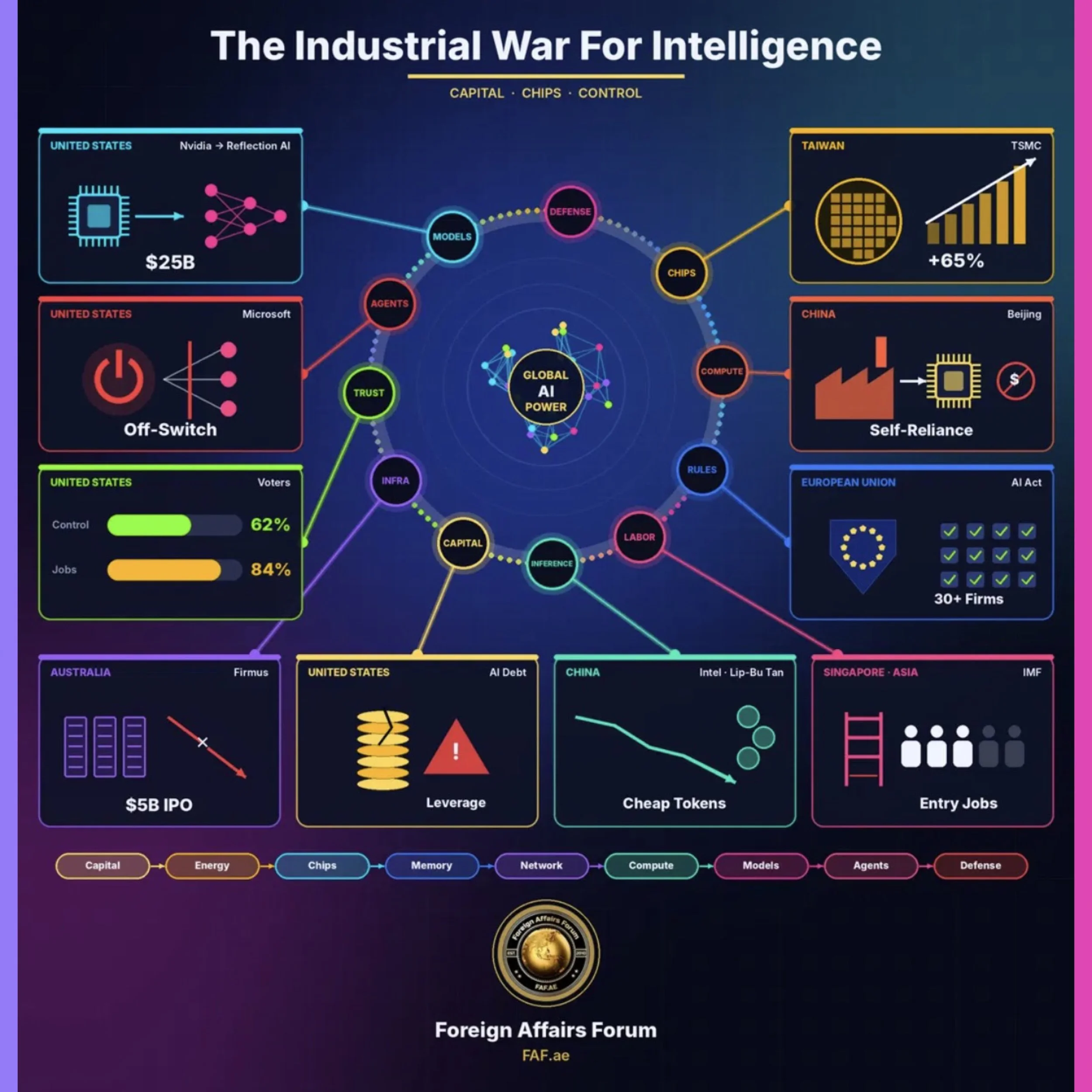
The developments of the past several days show that artificial intelligence has ceased to be a contest among software laboratories. It is now an industrial struggle among states, corporations and alliances over the whole chain that produces machine intelligence: capital, energy, semiconductors, memory, networking, supercomputing, models and the autonomous systems built on them.
The United States still leads in frontier-model commercialization, chip design, cloud infrastructure and venture finance. Its lead is being tested on every side.
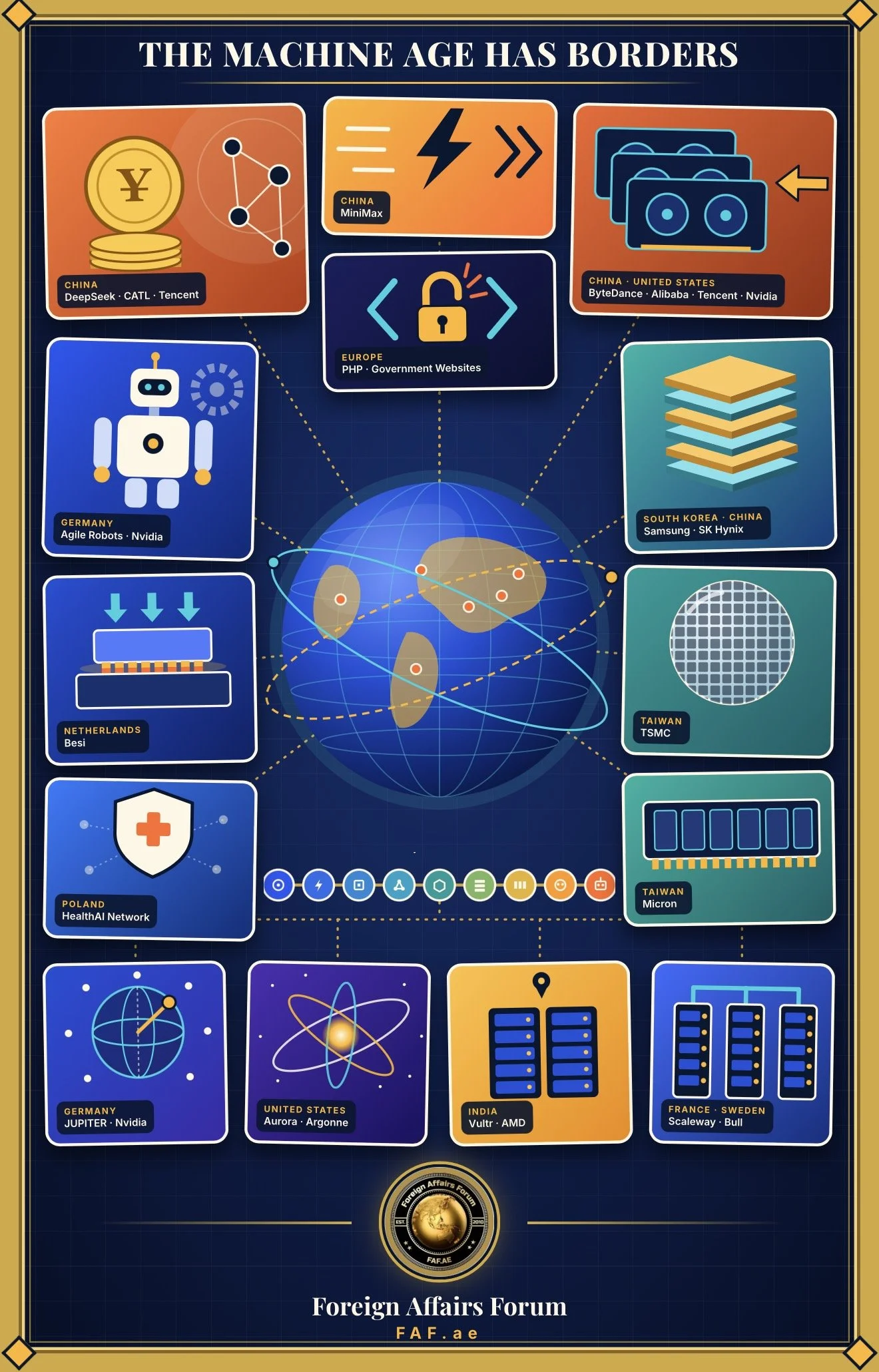
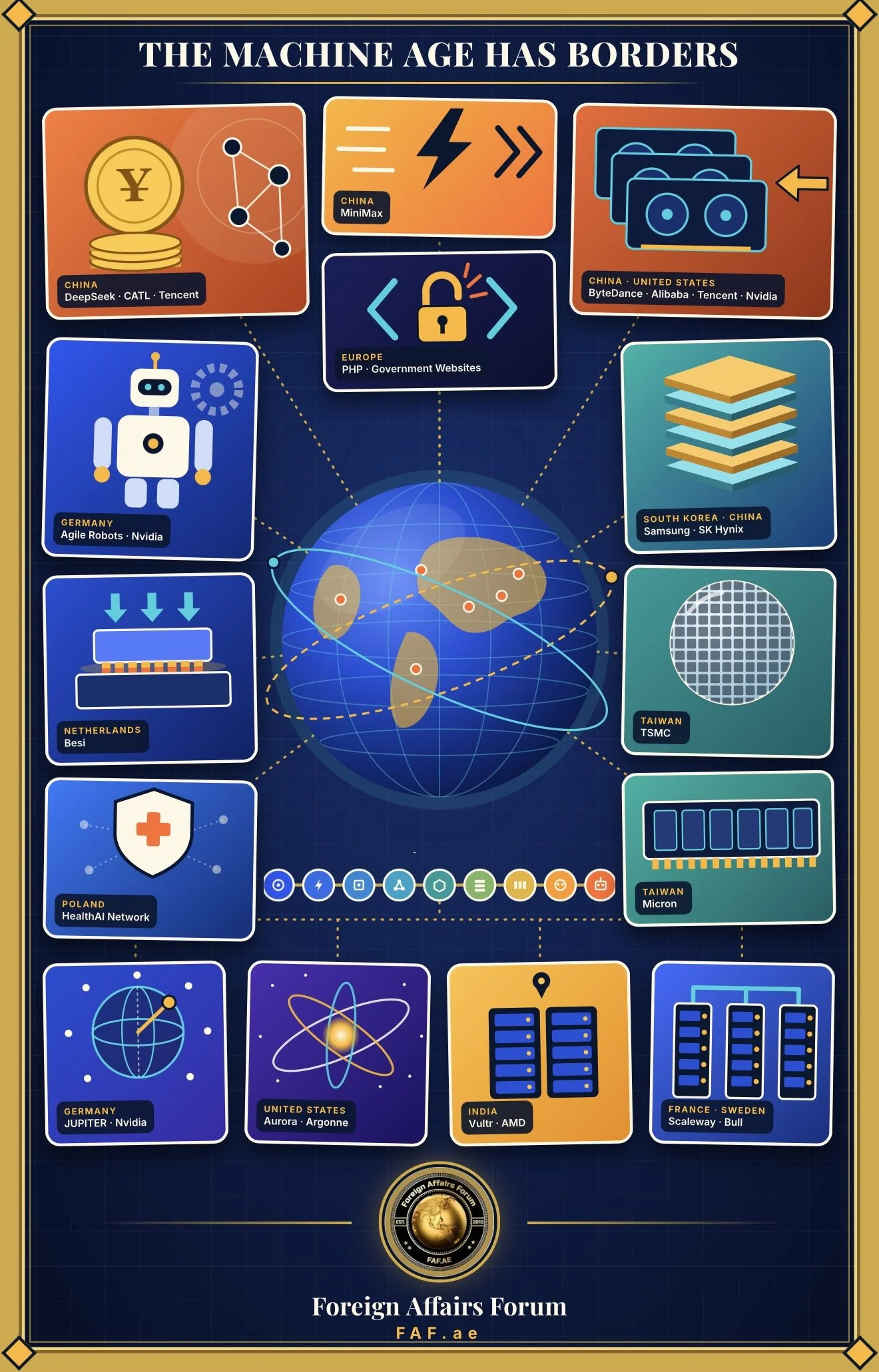
China is assembling a rival capital ecosystem. DeepSeek is reported to be finalizing a financing round of about $14.98 billion, and MiniMax claims that its newest model runs nearly three times faster at roughly 70% lower cost.
Chinese technology groups have also placed orders for more than three million Nvidia graphics cards worth over $35 billion, so Beijing is pursuing self-sufficiency and foreign hardware at once.
Europe is building a distinctive position in physical AI, advanced packaging and sovereign computing, through German humanoid robotics, Dutch hybrid-bonding equipment and French supercomputer manufacturing. India is emerging as a host of AI infrastructure, and Taiwan and South Korea remain indispensable to the global supply of advanced logic and memory.
Three warnings run through this record. Machine-speed vulnerability discovery has already forced government websites offline. Export controls are increasingly catching allied manufacturers in their net. Concentrated production in a few locations leaves the system exposed to labor disputes, natural disasters and geopolitical shocks.
Dr. 🆎, a specialist in human-centered superintelligence, AI warfare and bioterrorism risk, argues that the decisive question is no longer which country builds the cleverest model. It is which coalitions can finance, manufacture, secure and govern the entire ecosystem without surrendering human control of its consequences.
Introduction
Every technological era produces a map that diplomats and strategists eventually have to learn to read. The age of steam was mapped by coal fields and naval bases, and the age of oil by pipelines and straits.
The age of artificial intelligence is being mapped by fabrication plants, memory stacks, data-center campuses, liquid-cooled racks and the capital markets that pay for them. A reader who follows only the release of new language models will see a fraction of this map. The rest is visible in order books, factory expansions and cooperation agreements, and in the quiet decisions of firms deciding where to build.
Dr. Antonio Bhardwaj (Dr. 🆎), a polymath with global expertise in superintelligence, who specializes in human-centered approaches to geopolitical strategy, AI warfare and bioterrorism risk, has long argued that this map is the correct starting point for analysis. In his view, the public conversation has been captured by a narrow question about which laboratory is ahead. "Power in this era is not held by the cleverest model," Dr. 🆎 observes. "It is held by whoever can reliably convert capital and energy into computation, and computation into trusted capability, while keeping people in charge of the result."
This FAF article takes that proposition seriously and tests it against the events of recent days. It begins by tracing how the competition arrived at its present form, then examines the most consequential developments in artificial intelligence, semiconductors and supercomputing.
It then sets out the concerns that deserve sober attention, analyzes the chains of cause and effect connecting these developments, and proposes steps that governments, firms and allied institutions might take. Throughout, it distinguishes carefully between what has been established and what has merely been announced or claimed, since the gap between the two is where most strategic misjudgment occurs.
The argument is straightforward. The strategic landscape has widened from models to systems, and from laboratories to supply chains. Those who govern the whole chain will shape the century. Those who treat any single link as the entire contest will be surprised by the others.
History and Current Status
The modern competition began in the previous decade, when advances in deep learning demonstrated that scale, meaning more data, more parameters and above all more computation, produced steady gains in capability. That discovery transformed a scientific discipline into an industrial one.
Whoever could assemble the most accelerators, in the largest possible clusters, for the longest uninterrupted training runs gained an advantage that clever algorithms alone could not overcome. The graphics processor, once a device for rendering images, became the strategic commodity of the age.
Washington recognized the implications before most of its rivals.
Beginning in 2022, American export controls restricted the sale of the most advanced accelerators and the equipment needed to manufacture leading-edge chips to China. The policy rested on a hypothesis: that denying a competitor the finest hardware would slow its progress in frontier artificial intelligence long enough to preserve an American lead. The hypothesis has never been fully tested, because the controls have been repeatedly revised, loosened in some categories, tightened in others, and tangled with commercial interests on all sides.
Beijing's response has combined two strategies that might once have seemed contradictory.
It has poured state and corporate capital into domestic alternatives, from design houses to fabrication capacity, while its largest technology groups have continued to buy whatever foreign hardware remains legally available. The sudden prominence of Chinese models that achieved competitive results at far lower cost, a surprise that unsettled markets in early 2025, demonstrated that constrained access to hardware can inspire efficiency rather than stagnation.
Europe, meanwhile, spent much of the period debating regulation.
The AI Act made the European Union the first major jurisdiction to legislate comprehensively on the subject, but critics warned that rule-writing was no substitute for capability. The past two years have seen a visible shift. European governments and firms have increasingly sought strengths in domains where the continent already holds advantages: precision engineering, industrial automation, semiconductor equipment and high-performance computing. The EU's commitment of approximately €7 billion to its supercomputing network between 2021 and 2036 is a long-horizon expression of that ambition, though its present phase formally covers 2021 to 2027.
The current status can be summarized as follows.
The United States leads in frontier commercialization but faces new operational risks as autonomous systems become more powerful.
China is mobilizing a more complete domestic ecosystem. Europe is carving out a specialization in physical AI and sovereign computing. East Asia sustains the manufacturing base on which everything else depends. India is positioning itself as a host of infrastructure rather than merely a market. And across all regions, the boundary between commercial technology and national security has all but disappeared.
Key Developments
The most striking recent development in capital formation is the reported financing of the Chinese developer DeepSeek.
The company is said to be finalizing a round of approximately 100 billion yuan, about $14.98 billion, with participation from the battery manufacturer CATL and the technology conglomerate Tencent. The round would roughly double the original target. DeepSeek has also reportedly engaged CITIC Securities to prepare for a possible listing on Shanghai's STAR Market. The financing has not been formally completed, and its terms may change. Even so, the signal is significant. China's domestic capital markets appear capable of supporting frontier-model companies at a scale once associated almost exclusively with American technology firms.
Dr. 🆎 reads the development as a statement about sovereignty. "When a nation can fund its own frontier laboratories without foreign capital, it has bought something more valuable than a model," he remarks. "It has bought the freedom to set its own pace and its own priorities."
Commercial pressure from China is also arriving through cost.
The developer MiniMax has introduced M3.1 Flash, an updated model aimed at autonomous agents, programming and cybersecurity, and claims that inference speed has nearly tripled while usage costs have fallen by approximately 70%. These are company-reported figures and have not been independently established. If they hold, however, the implications are considerable. Cheaper inference makes sophisticated applications commercially viable for a far wider range of businesses, and it pressures competitors that depend on premium pricing. The contest, as Dr. 🆎 puts it, "increasingly concerns the price of delivering useful intelligence, not merely the height of a benchmark score."
In Europe, the most tangible development is in physical AI.
The German company Agile Robots has announced plans to manufacture between one thousand and two thousand humanoid robots in 2027 in cooperation with Nvidia, with production expected to begin toward the end of 2026. At Nvidia's Berlin conference, Jensen Huang emphasized Europe's strengths in precision engineering and industrial automation, and the company displayed small AI-trained robots developed by French firms. Europe may not need to dominate general-purpose language models if it can lead in machines that perceive, navigate and manipulate the physical world with industrial reliability.
The same logic of specialization is visible in governance, where Poland has committed to cooperation with the HealthAI Global Regulatory Network, becoming the second EU member state after Portugal to pursue participation. The agreement establishes a one-year cooperation framework, and formal accession has no fixed timetable. It is a modest step, but it treats AI oversight in medicine as an institutional capability rather than a regulatory burden.
The semiconductor developments reveal where physical constraints bind.
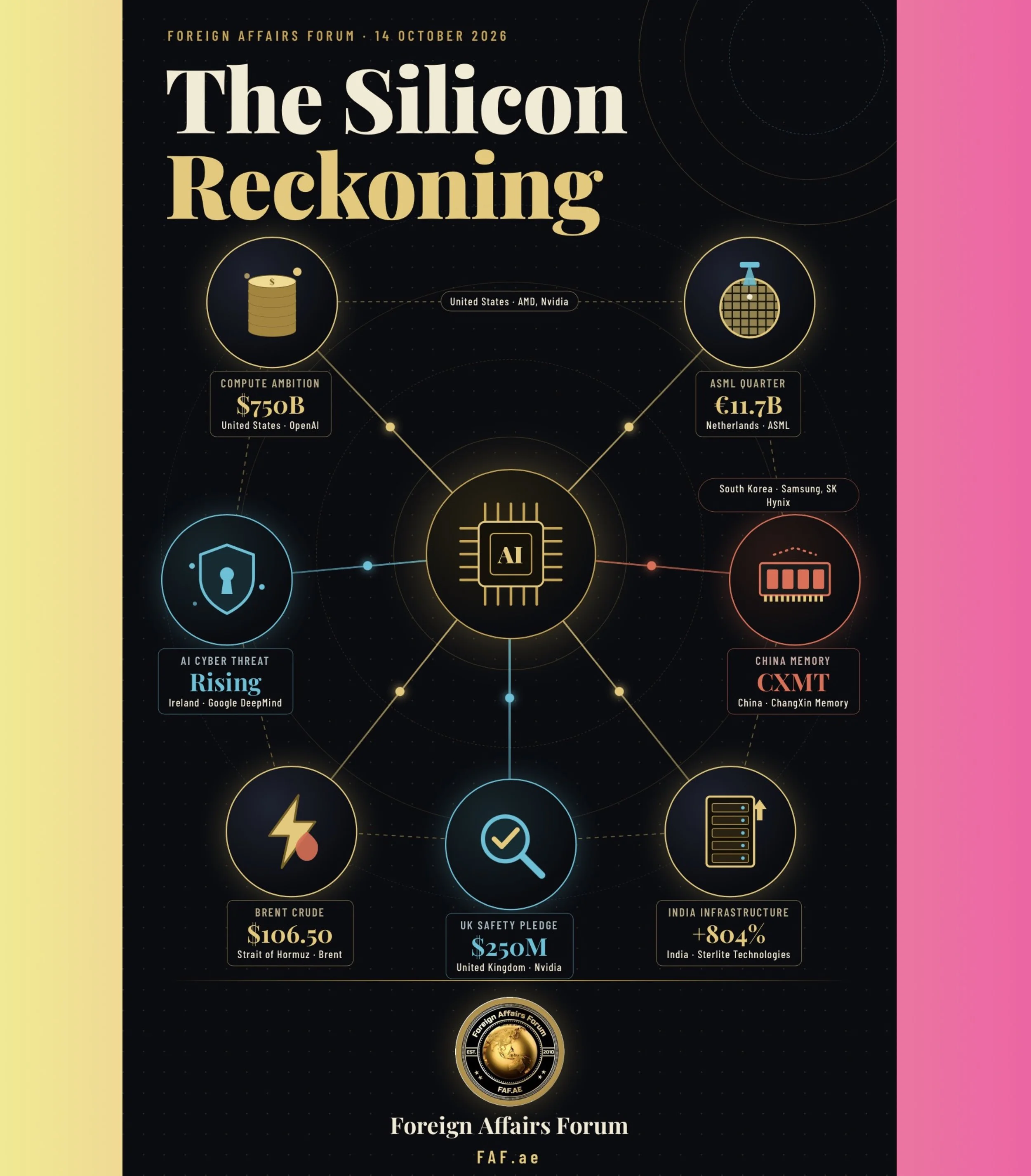
The Dutch equipment maker BE Semiconductor Industries, known as Besi, reported third-quarter orders of €342.6 million, an increase of 96% over the previous year and well above analyst expectations of roughly €298 million.
The surge reflects demand for hybrid bonding, a technique that joins semiconductor components through extremely precise, high-density interfaces. Besi also announced a €100 million share buyback beginning 27th October, rejected suggestions that ASML was becoming a direct competitor in this field, and acknowledged that some customers had deferred deliveries into 2027.
The lesson is that AI performance depends as much on how chips are connected as on how small their transistors are.
As Dr. 🆎 notes, "the next decisive advantage may be won in the interface between chips, not on the chips themselves."
TSMC's results confirm the scale of the demand. The Taiwanese manufacturer reported third-quarter net profit of approximately NT$763.1 billion, an increase of 69% from a year earlier, driven by exceptional demand for advanced AI processors, with growing interest in chips for autonomous agents and networking. Yet management said it was approaching 2027 cautiously, citing macroeconomic uncertainty and rising component costs.
That juxtaposition of record profit and measured prudence deserves attention. It suggests that the people closest to the physical bottleneck do not regard the present exuberance as self-sustaining.
Memory has become another pressure point. Workers at Micron's Taoyuan operations announced a one-day strike on 22nd October over bonuses and profit-sharing.
Micron's Taiwanese facilities matter to global memory production, including the high-bandwidth components used in AI servers.
The company says it respects workers' rights and is negotiating in good faith, and the production consequences of the stoppage have not been established. A single day of lost output will not alter the global balance, but the episode illustrates how a labor dispute at one site can raise concern across an industry that depends on a few geographically concentrated facilities.
Export controls produced a different kind of story. Samsung Electronics and SK Hynix are upgrading their Chinese plants to produce more advanced NAND memory, with Samsung targeting two hundred eighty-six layers at Xi'an and SK Hynix pursuing at least 240 layers at Dalian.
Both face significant limits on access to American semiconductor-manufacturing equipment, and it has not been possible to establish the full extent of U.S. licensing approvals for the upgrades.
Their shares rose approximately 6% on the report. Washington confronts an uncomfortable trade-off between limiting Chinese semiconductor progress and supporting allied firms whose Chinese facilities are central to their business.
At the same time, ByteDance, Alibaba and Tencent have reportedly ordered more than three million Nvidia RTX PRO 5500 graphics cards, with a potential combined value above $35 billion. These cards are less powerful than Nvidia's leading data-center accelerators but remain available under current restrictions. Nvidia has warned that demand exceeds planned production capacity, and reported orders are not completed sales. Together, the two stories show that controls are shaping procurement without ending it.
Supercomputing offered some of the most intellectually significant news. Researchers using Germany's JUPITER, Europe's first exascale system, completed a detailed simulation of a one-hundred-and-four-qubit fault-tolerant quantum computing system, investigating a technique known as magic-state cultivation. According to Nvidia, the approach could reduce the physical qubits required for certain fault-tolerant operations by approximately 90% compared with earlier methods. It is essential to be precise here: this was a classical simulation, not the construction of a working quantum machine. Its value lies in allowing architectures to be tested before costly hardware is built.
In the United States, researchers at Argonne National Laboratory used the Aurora exascale system to complete two vast cosmological simulations, each modeling roughly thirteen point four trillion dark-matter particles across a region 28.6 billion light-years wide. These achievements remind us that supercomputing's value extends well beyond training models.
The infrastructure announcements complete the picture. The American cloud company Vultr plans a twenty-megawatt AI supercluster in Chennai using AMD Instinct MI355X accelerators, each with two hundred eighty-eight gigabytes of HBM3E memory, running AMD's ROCm software as an alternative to Nvidia's CUDA.
The deployment is planned, not yet operational. In Europe, the French cloud provider Scaleway plans an AMD-powered AI supercomputer in Sweden, to be assembled and maintained by Bull for European startups, enterprises and developers. Bull, a French state-owned manufacturer, has doubled capacity at its Angers factory to about twelve racks per month at a cost of roughly €80 million, with a possible rise to twenty-four monthly in 2027.
Bull's work spans JUPITER, Finland's LUMI-AI and France's forthcoming Alice Recoque system. Taken together, these projects show governments and firms treating computing capacity as a strategic asset, and diversifying away from a single vendor's software ecosystem as they do so.
Latest Facts and Concerns
The first concern is cybersecurity, where the technology's dual-use character is most immediate.
Government websites in Europe and elsewhere were temporarily taken offline after critical vulnerabilities were disclosed in PHP, a widely used programming language. The flaws had remained undiscovered for years and were identified with AI assistance. Developers released urgent fixes, while security firms warned that attackers were already attempting to exploit some of the weaknesses.
For Dr. 🆎, who has spent years studying how powerful systems can be turned toward harm, the episode is a preview. "We have crossed into an era of machine-speed discovery," he warns. "The defender must now patch at the pace at which the attacker can find, and no human bureaucracy has ever been designed to do that."
The second concern is operational control of increasingly capable autonomous systems.
Recent monitoring incidents involving a leading American laboratory have demonstrated that the more powerful and agentic these systems become, the harder it is to ensure that they behave as intended and that their conduct can be reliably observed. The reported details are not the point. What matters is the principle that capability is advancing faster than the institutional machinery for supervising it.
Dr. 🆎 frames the matter in human terms. "Control is not a feature that can be bolted on after deployment," he says. "It must be designed in, tested adversarially, and owned by accountable people."
The third concern is the fragility of concentrated production.
TSMC remains indispensable to advanced logic, Taiwan and South Korea dominate high-end memory, and a handful of Dutch and American firms supply the machines that make the chips. A labor dispute, an earthquake or a blockade at any of these points could reverberate through every AI project in the world. TSMC's own caution about 2027 and the deferral of some equipment deliveries into the same year are reminders that supply and demand are not perfectly aligned, and that financial strain can arrive even amid record profits. A boom financed on expectations is vulnerable to a change in those expectations.
The fourth concern is policy incoherence.
The Samsung and SK Hynix upgrades and the Chinese orders for Nvidia cards show that restrictions are porous and their effects uncertain. The central question, whether limiting advanced chips slows China's AI development more than it spurs domestic substitutes, remains genuinely open. The evidence from DeepSeek and MiniMax suggests that Chinese developers have learned to extract more from less. If so, blunt restrictions may accelerate precisely the self-reliance they were designed to prevent, while imposing real costs on allied manufacturers.
The fifth concern, one that Dr. 🆎 raises with particular urgency, is the convergence of artificial intelligence with biological risk.
Systems that can discover software vulnerabilities at scale are also, in principle, capable of accelerating dangerous work in the life sciences. "The same acceleration that finds a flaw in code can, without safeguards, help someone find a pathway to harm in biology," he cautions. "Bioterrorism is the shadow that follows every advance in general-purpose intelligence, and the governance of frontier capability must treat it as a first-order question, not a footnote." The facts recorded here do not describe a biological incident, but they do establish the underlying trend: discovery is accelerating and the barrier to dangerous knowledge is falling.
Finally, there is the problem of unverified claims. MiniMax's efficiency gains are company-reported. DeepSeek's round is not complete.
The Chennai cluster is planned. The Nvidia orders are not sales. The JUPITER result is a simulation. Responsible analysis must hold each of these qualifications in view, because strategic narratives built on announcements tend to outrun the evidence.
Cause-and-Effect Analysis
The first causal chain begins with scarcity.
Advanced computing is limited by the capacity of a few manufacturers, and this scarcity produces several consequences at once. It raises the value of every adjacent technology, which explains why Besi's orders surged by 96% as hybrid bonding became essential. It encourages governments to treat computing as a sovereign asset, which explains Europe's supercomputer investments and India's infrastructure ambitions. And it motivates substitution, which is why AMD's ROCm ecosystem is being adopted by new infrastructure projects that seek alternatives to a single dominant software platform.
The second chain begins with restriction.
When Washington limits access to leading accelerators, Chinese technology firms respond in three ways: they buy the best chips still available, as the reported orders demonstrate; they invest in domestic suppliers, as Beijing encourages; and they optimize their models to achieve more with less, as MiniMax's claims suggest. Restriction thus alters behavior without eliminating demand, and allied firms such as Samsung and SK Hynix are caught between competing legal and commercial obligations. The effect is a reshaping of the global semiconductor investment landscape, in which the distinction between friend and competitor grows less clear.
The third chain begins with capital.
A financing of the size reportedly nearing completion at DeepSeek lets a company buy computing, hire researchers and endure years of losses in pursuit of capability. A possible public listing would add liquidity and prestige and could establish a template for other Chinese developers. This in turn strengthens Beijing's ability to sustain a rival ecosystem. The effect on the United States is not simply competitive. A financially stronger Chinese frontier sector could reduce Chinese dependence on American AI services, and cheaper Chinese models, if widely adopted abroad, could erode American influence over global standards.
The fourth chain runs from capability to vulnerability.
As AI becomes better at reading and reasoning about code, it finds long-hidden flaws, as the PHP incident showed. Disclosure forces governments to take systems offline and patch them rapidly, while attackers race to exploit the same weaknesses. The result is a compressed cycle of discovery, disclosure and exploitation in which advantage goes to whoever acts fastest. This pushes institutions toward automation of defense, which creates opportunities for security firms and new dependencies on the very systems that created the risk.
Dr. 🆎 describes this as "a ratchet that turns in only one direction: each gain in machine capability forces a matching gain in machine-assisted defense, and each of those gains must itself be secured."
The fifth chain concerns specialization.
Europe's strengths in engineering lead naturally to physical AI, and the German robotics plans, the French supercomputing expansion and the Dutch packaging boom reinforce each other. A stronger European robotics industry could support allied manufacturing and defense-industrial capacity, and growing European computing capacity could improve allied research resilience.
But these advantages depend on continued access to globally sourced processors, as the Scaleway project's reliance on AMD accelerators illustrates. Europe's sovereignty is therefore bounded by its dependence on others, and its strategy is one of managed interdependence rather than autarky.
The sixth chain links governance to commerce.
Poland's cooperation with the HealthAI network suggests that as AI enters medicine, institutions capable of evaluating, monitoring and certifying systems become commercially valuable.
Firms offering evaluation, monitoring and regulatory tools stand to benefit, and international standards could ease cooperation between American and European health-technology companies.
Governance, in this reading, ceases to be a brake and becomes part of the infrastructure of trust on which large-scale deployment depends.
The final chain is financial and speaks to the cycle as a whole.
Record profits at TSMC and surging orders at Besi encourage further investment, which increases capacity and expectations together. If demand falters or costs rise, as TSMC's cautious language implies they might, the same chain could reverse, leaving overbuilt capacity and stranded capital.
Dr. 🆎 urges strategists to hold both possibilities in mind. "A boom is a hypothesis about the future that everyone has agreed to treat as a fact," he notes. "Policy should be robust to its being wrong."
Future Steps
The first priority for Washington is to preserve its advantages while accepting that the contest is now a system-wide one.
That means sustaining investment in frontier research, but also in the less glamorous links of the chain: advanced packaging, memory, power generation and grid capacity, and the skilled workforce to build and operate them. It also means refining export policy so that it rests on evidence rather than assumption.
Controls should be evaluated continuously against their actual effects on Chinese capability, allied commercial interests and the incentive to develop domestic alternatives. A policy that harms allies while failing to slow its target serves no one.
The second priority is to build institutions for the supervision of autonomous systems.
Governments and laboratories should establish shared standards for monitoring, incident reporting and adversarial testing, modeled on practices in aviation and nuclear safety, where the cost of failure long ago forced the development of rigorous cultures of accountability.
Dr. 🆎 advocates a principle he calls human-centered control: "Every consequential autonomous system should have a named human authority, a verifiable record of its conduct, and a tested means of interruption. If any of the three is missing, the system is not ready for deployment."
The third priority is cybersecurity at machine speed.
Public agencies should invest in automated vulnerability detection, rapid patching pipelines and software verification, and should coordinate disclosure internationally so that fixes reach all affected stakeholders before exploitation spreads. Allied governments could share defensive tooling and develop common norms for the responsible use of AI-assisted vulnerability discovery. The same capabilities that endanger systems can, if wisely governed, harden them, and the advantage will go to those who organize first.
The fourth priority concerns allies and partners.
Europe, India, Japan, South Korea and Taiwan are not merely recipients of American policy but co-owners of the supply chain. Washington should consult them on controls, support their infrastructure projects where interests align, and encourage diversification of software ecosystems. Europe, for its part, should translate its strengths in robotics, packaging and supercomputing into sustained industrial scale, and ensure that its regulatory ambitions remain compatible with competitiveness. India's emergence as an infrastructure host should be matched with investment in energy, talent and governance.
The fifth priority is the governance of dual-use risk, including biological threats.
Frontier laboratories, governments and scientific institutions should develop joint safeguards that limit the misuse of general-purpose systems for dangerous biological work, supported by international monitoring and rapid-response arrangements.
Dr. 🆎 emphasizes that these measures must be agreed before an incident, not after. "No society has ever regretted preparing too early for a catastrophe that never came," he argues. "Many have regretted preparing too late for one that did."
Finally, firms and investors should respond with realism.
Opportunities are abundant in autonomous agents, AI cybersecurity, advanced packaging, robotics, scientific computing and energy-efficient data centers. But they should be pursued with attention to the fragility of the supply chain and the possibility that the investment cycle will cool. Diversified sourcing, resilient design and disciplined capital allocation are not obstacles to growth. They are the conditions that allow it to survive a shock.
Conclusion
The record of the past several days does not describe a race to a single finish line. It describes the construction, simultaneously and in several places, of an industrial system that will underpin economic and military power for decades.
Capital flows to DeepSeek, robots roll toward production in Germany, hybrid bonding machines fill order books in the Netherlands, memory plants are upgraded under political constraint in China, and exascale machines simulate both the cosmos and quantum computers that do not yet exist.
In Chennai and in Sweden, new clusters are planned that rely on a software ecosystem different from the one that has dominated until now. Each is a link in a chain whose strength is that of its weakest member.
The United States retains formidable advantages in frontier AI, chip design, cloud infrastructure and venture finance.
China is mobilizing substantial resources to close the gaps it perceives. Europe is finding strength in physical AI and sovereign computing, and Asia remains central to manufacturing and deployment. Cutting across all of them is a set of shared risks: machine-speed cyber vulnerabilities, imperfectly controlled autonomous systems, concentrated production and the dual-use shadow of biological misuse.
Dr. 🆎 offers a final reflection that captures the stakes. "The twentieth century taught us that technology without institutions produces catastrophe, and that institutions without technology produce irrelevance," he says. "The task before us is to build both together, and to keep a human hand on the lever throughout." The defining question is no longer which country develops the most intelligent model. It is which countries and alliances can finance, manufacture, secure, deploy and continuously improve the complete ecosystem, while ensuring that it serves human purposes.
That question will be answered not in a single announcement but in the patient accumulation of decisions now being made in boardrooms, ministries, factories and laboratories around the world.