Beyond Silicon: The New Physics of Power
Foreign Affairs Forum | Dr. Antonio Bhardwaj (Dr. 🆎)| October 23rd 2026
Executive Summary
The week from the 16th to the 22nd of October 2026 produced an unusually dense cluster of results at the frontier of semiconductor science and supercomputing. Individually, each finding is a laboratory measurement or a computational milestone.
Together, they suggest that the architecture of future computing will be assembled from a wider palette of physical mechanisms than the charge-based silicon logic that has defined the industry for more than half a century.
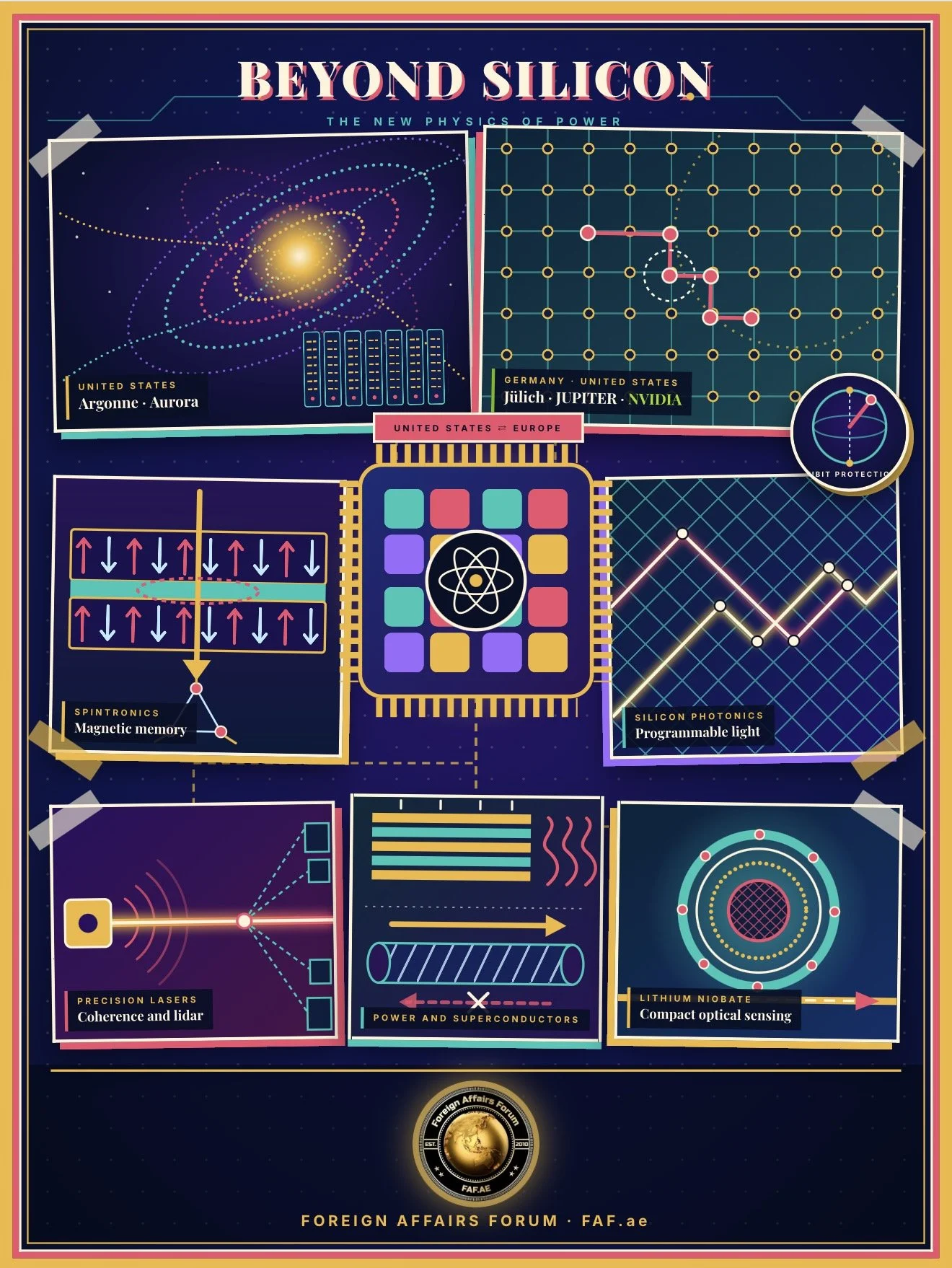
Three developments stand out. Researchers demonstrated that antiferromagnetic tunnel junctions, built from PtMn₃ and magnesium oxide, can be switched electrically at room temperature, with a tunnelling magnetoresistance of 363% and switching current densities on the order of ten million amperes per square centimetre.
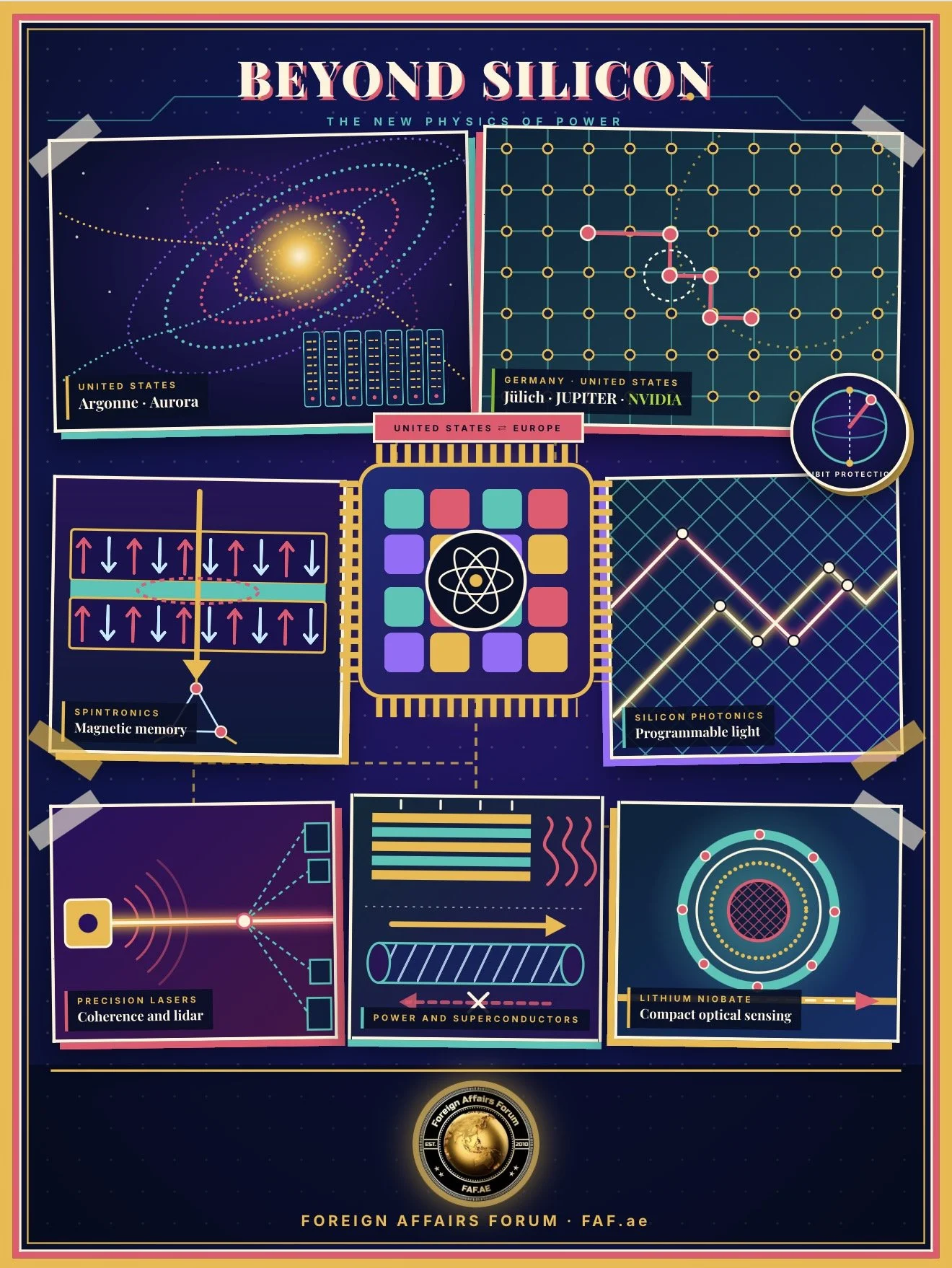
Argonne National Laboratory's Aurora system completed two cosmological simulations, each following approximately thirteen point four trillion particles, while Europe's JUPITER machine, running NVIDIA hardware, simulated a one hundred and four-qubit fault-tolerant quantum architecture.
Meanwhile, photonic and advanced-materials research advanced on several fronts, from programmable silicon photonic circuits to high-temperature dielectric polymers and lasers of sharply improved coherence.
The analytical lesson of this FAF article is one of disciplined optimism.
A peer-reviewed experiment shows that a physical mechanism works under specified conditions. It does not establish manufacturability, independent replication, or improvement at the level of a complete AI computing system.
Of the ten developments reviewed here, eight are peer-reviewed scientific studies, one is a national laboratory computing result, and one is an industry-reported simulation. Each carries a different weight of evidence, and each must be read accordingly.
The strategic conclusion is that scientific leadership and commercial semiconductor leadership are related but not interchangeable. The stakeholders who will matter most are those able to convert reproducible laboratory results into reliable, economical and scalable systems, and to govern the immense computational capacity that such systems will release.
Nothing published this week alters the global balance of semiconductor power. Much of it, however, indicates where the contest will be decided.
Introduction
Every era of computing has been defined by a bottleneck.
In the early decades it was the number of switches that could be fitted onto a chip. Later it was the heat those switches generated. Today it is increasingly the movement of data: the energy and time consumed in carrying information between memory and processor, between chip and chip, and between rack and rack.
Artificial intelligence has made this bottleneck a matter of national strategy, because the systems that train and operate frontier models consume electricity, memory bandwidth and capital on a scale that few institutions can sustain.
It is against this background that the research of the past week deserves attention. Dr. Antonio Bhardwaj (Dr. 🆎), Chief Executive Officer of the Foreign Affairs Forum and a specialist in human-centred artificial intelligence for geopolitical strategy, AI warfare and bioterrorism risk, argues that the significance of such results lies less in any single measurement than in what they reveal about the direction of travel. In his assessment, the contest for computational power is migrating from the factory floor to the physics laboratory, and the nations and institutions that understand this earliest will shape the terms on which advanced intelligence is built, deployed and restrained.
This FAF article proceeds in the following way. It first situates the week's findings within the longer history of semiconductors and supercomputing, and describes where the field now stands. It then examines the principal developments in turn, before turning to the facts that can be established and the concerns that should temper enthusiasm. A cause-and-effect analysis follows, tracing how scientific advances, industrial incentives and geopolitical competition reinforce one another.
The article closes with an account of the steps that researchers, firms and governments should now take, and a brief conclusion. Throughout, the evidentiary standard is deliberately strict, because the gap between a laboratory result and an industrial technology is where most promises are lost.
History and Current Status
The modern semiconductor industry began with the invention of the transistor in 1947 and acquired its commercial logic with the integrated circuit a decade later. In 1965 Gordon Moore observed that the number of components on a chip was doubling at a regular interval, and that observation hardened into an industry-wide planning assumption. For roughly forty years it was reinforced by a second regularity, known as Dennard scaling, under which smaller transistors also consumed proportionally less power. Performance rose, costs fell, and the geopolitical implications of the industry remained largely hidden behind consumer electronics.
That bargain began to fray in the middle of the first decade of this century. Power density stopped scaling with transistor size, clock speeds plateaued, and the industry turned to parallelism: multiple cores, then graphics processors repurposed for general computation, then purpose-built accelerators for machine learning. Each step improved performance by reorganising how silicon was used, not by changing the physics of the switch. The result is the contemporary landscape, in which a small number of firms design the most advanced accelerators, a very small number fabricate them, and a handful of suppliers provide the machinery on which the entire chain depends.
Memory has meanwhile emerged as the quieter constraint. Processors have grown faster than the memory that feeds them, producing what engineers call the memory wall. Stacked high-bandwidth memory has partly mitigated the problem at considerable cost, and magnetic memory based on spin-transfer torque has found niche commercial roles. Neither removes the underlying tension between density, speed, endurance and energy. This is why advances in spintronics, the engineering of electron spin and magnetic order, command attention well beyond materials science.
Supercomputing has followed a parallel trajectory. The United States crossed the exascale threshold, one billion billion calculations per second, with the Frontier system at Oak Ridge in 2022. Aurora at Argonne, El Capitan at Lawrence Livermore and Europe's JUPITER at Jülich have since placed several exascale-class machines in service. These systems are not merely faster calculators. They are instruments for climate science, materials discovery, nuclear stockpile stewardship and, increasingly, for the design and testing of the AI and quantum technologies that will succeed them.
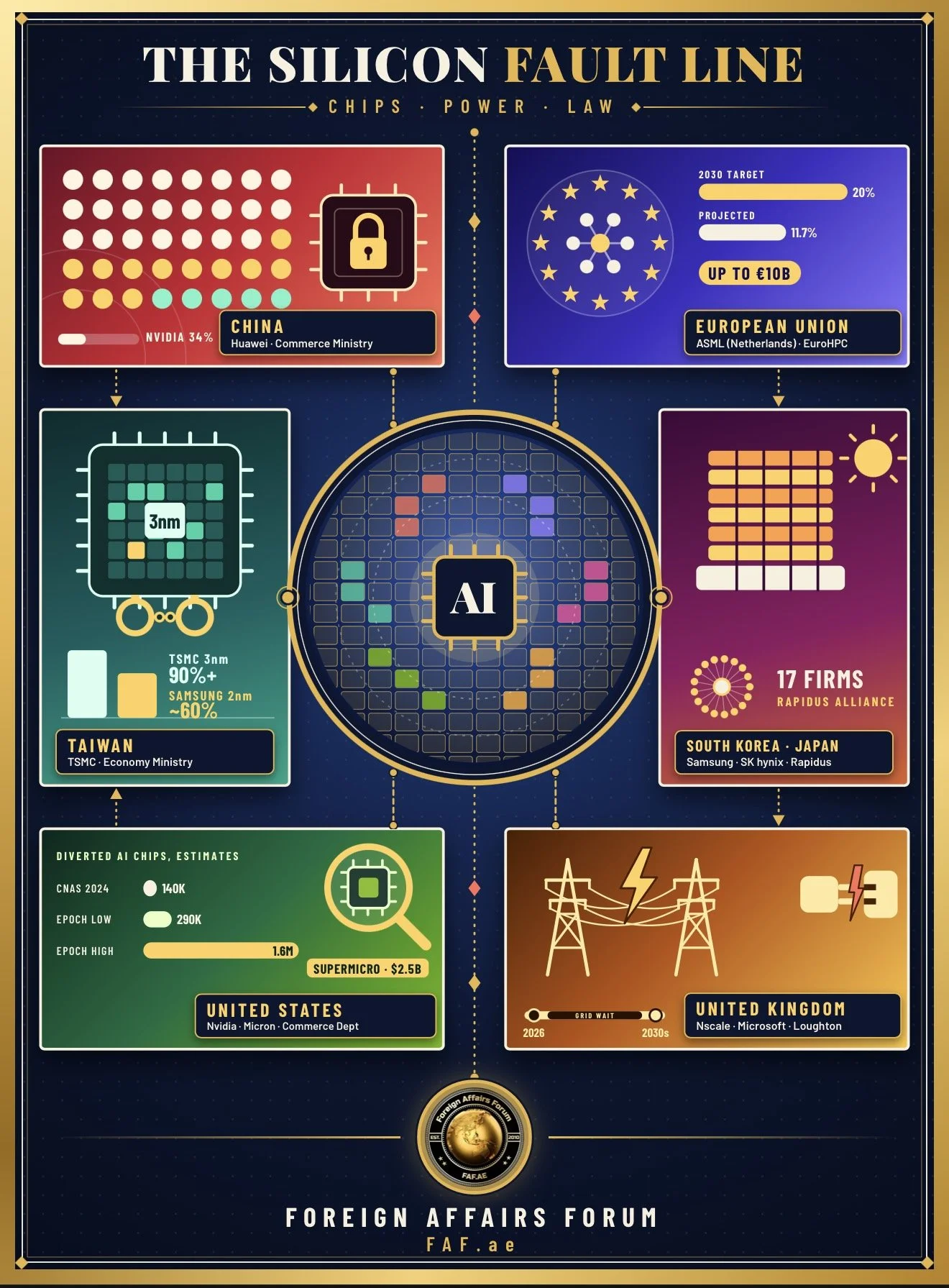
Public policy has reshaped the field in turn. The American CHIPS and Science Act committed $52 billion to domestic semiconductor manufacturing and research, the European Chips Act aimed to mobilise more than €43 billion in public and private investment, and export controls have turned advanced accelerators, memory and fabrication tools into instruments of statecraft. Photonics, superconducting electronics and quantum technologies sit at the margins of these programmes, but they are increasingly treated as strategic.
Dr. 🆎 observes that this is the first technological cycle in which the semiconductor is simultaneously a commodity, a weapon enabler and a diplomatic instrument, and that governance has not yet caught up with that triple identity.
The current status of the field can therefore be stated plainly. Silicon CMOS remains dominant and will remain so for the foreseeable future. Its limits are driving a search for complementary technologies in memory, interconnects, power delivery and specialised computation. The research of the past week belongs to that search.
Key Developments
The most consequential scientific result of the week concerns antiferromagnetic memory.
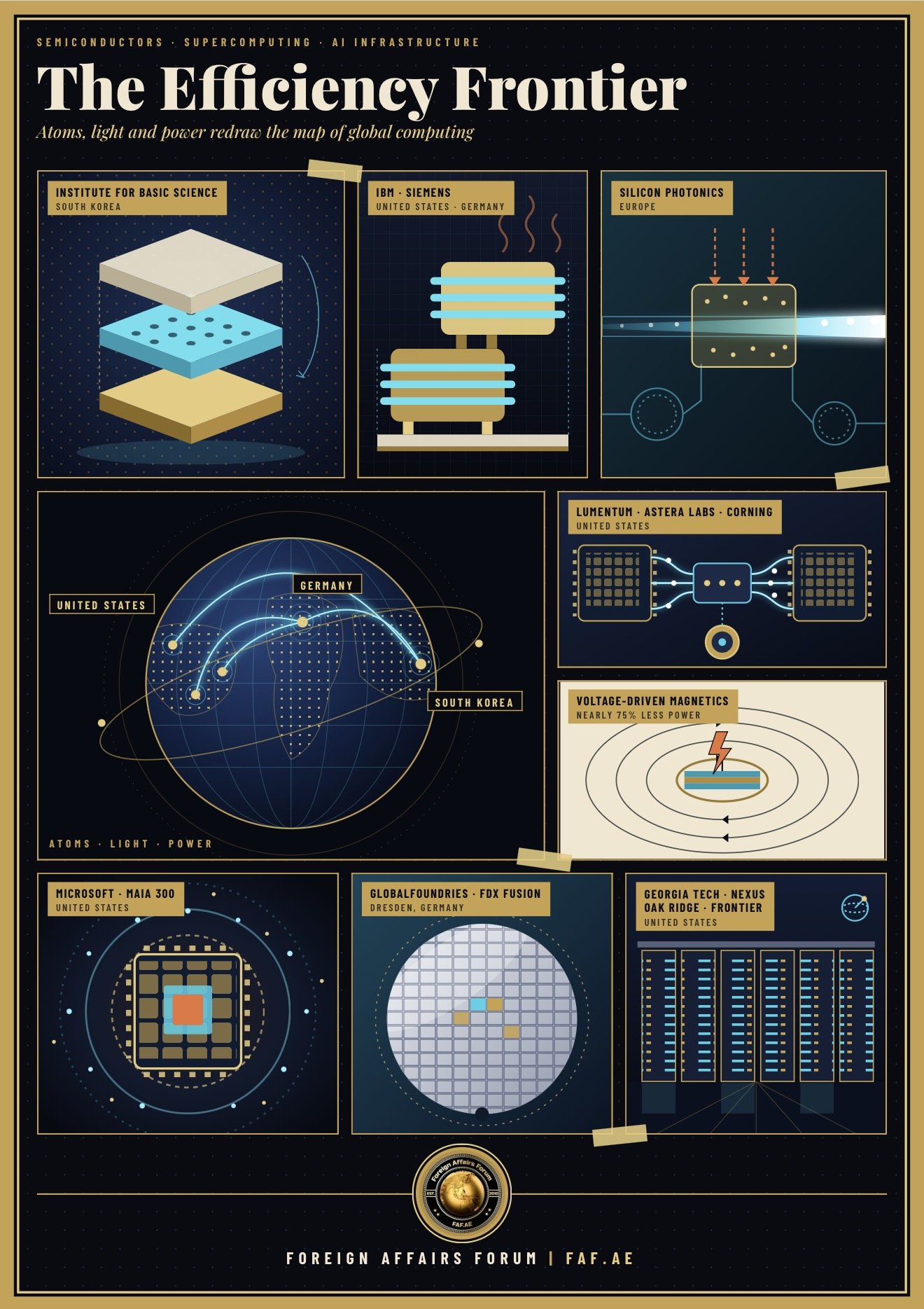
Researchers reported current-induced switching in nanoscale antiferromagnetic tunnel junctions made from PtMn₃ and magnesium oxide, with a room-temperature tunnelling magnetoresistance of 363% and switching current densities on the order of ten million amperes per square centimetre. The mechanism, described as octupole-driven spin-transfer torque, matters because conventional magnetic memory relies on materials with a net magnetisation. Antiferromagnets, whose magnetic moments largely cancel, have long been prized for their robustness and potential density yet were widely believed to resist electrical control in this manner. The experiment challenges that assumption. Whether the technology can compete with SRAM, DRAM or established magnetic memory remains entirely unknown, and endurance, retention, yield and energy per operation have yet to be established.
A related finding from the same week concerns the layered antiferromagnet MnPS₃. Researchers used intense terahertz fields to induce strong changes in the material's structural symmetry, identifying coherent vibrational responses at approximately one point seven and four point five terahertz, including a lower-frequency mode absent from conventional equilibrium spectroscopy. Their analysis hints at a transition toward a ferrimagnetic state, although that interpretation is explicitly provisional. The experiment is best understood as evidence that strong electromagnetic fields can temporarily reshape material properties in ways inaccessible at equilibrium. Any practical consequence for computing would lie far in the future.
In large-scale computing, Argonne reported that Aurora had completed two of the largest cosmological simulations ever attempted. Each tracked approximately thirteen point four trillion dark matter particles across a region of twenty-eight point six billion light-years, using roughly fifty thousand GPUs distributed across eight thousand one hundred nodes. The simulations and much of the associated analysis were completed in about four days, and the runs wrote more than eighty-five petabytes of data, mostly for checkpointing and recovery, of which roughly eight petabytes were retained for scientific analysis. The laboratory reports completed calculations and not a proposed machine, but this is not a new general-purpose speed record. Its significance lies in what it demonstrates about memory management, storage bandwidth and software scalability at extreme scale.
The second supercomputing development comes from Europe.
NVIDIA announced that researchers used the JUPITER system in Germany, built on GH200 hardware, to simulate a one hundred and four-qubit fault-tolerant quantum computing architecture. The simulation examined a technique called magic state cultivation, intended to reduce the physical resources needed for certain fault-tolerant computations, and the company described it as the largest comprehensive simulation of its kind. It also said the underlying approach could require 90% fewer physical qubits than earlier methods used for comparison. That figure is specific to the compared approaches and is a company-reported result, so it should be tested against independently published benchmarks before it informs investment or policy.
Photonics supplied three distinct results.
The first is a programmable silicon photonic circuit built from an eight-by-eight network of Mach–Zehnder interferometers, which reproduced the mathematical dynamics of non-Hermitian systems and recreated topological behaviour associated with a Klein bottle. Its achievement is a reconfigurable optical platform for studying phenomena that are hard to examine directly, and it does not demonstrate superior AI inference or lower data-centre power consumption.
The second is a laser experiment in which the transient phase of laser operation was deliberately controlled by periodically resetting pump power. A Fourier-domain mode-locked laser reached an instantaneous linewidth at the kilohertz level, an improvement of roughly seven orders of magnitude over conventional implementations of the same laser class, and the team also demonstrated a hybrid lidar combining micrometre-scale resolution with kilometre-scale range.
The third photonic result is a compact optomechanical sensing platform fabricated in thin-film lithium niobate, roughly forty micrometres across, using suspended microring resonators and extremely thin membranes. Its optical quality factor reaches about one million, and its mechanical quality factor is approximately one thousand one hundred and seventeen, rising to around fifty-one thousand during optomechanical oscillation. Such devices point toward small, uncooled and sensitive instruments, with obvious relevance to aerospace, communications and precision measurement. Long-term reliability and production yield remain unproven.
Dr. 🆎 notes that sensing and optical control are likely to reach deployment well before optical computing does, and that defence establishments are usually the first customers for exactly this class of technology.
Quantum and superconducting electronics contributed two further results.
In the first, researchers improved the protection of bosonic quantum bits using quantum-state squeezing, achieving a one hundred and sixty-fold improvement in bit-flip time relative to the standard cat-qubit configuration used for comparison, with minimal effect on the phase-flip rate. This does not mean that a complete quantum computer became one hundred and sixty times more reliable. It shows that one important class of error can be suppressed without substantially worsening another, which could simplify future fault-tolerant designs. In the second, a theoretical study found that chiral nanotube structures could, under modelled conditions, produce a superconducting diode with perfect directional efficiency. It is a peer-reviewed theoretical result and not the demonstration of a working device, and its relevance is to cryogenic and quantum systems rather than conventional processors.
Finally, materials science offered a broadly applicable crosslinking method for improving the performance of multiple classes of dielectric polymers.
Using polyetherimide as a benchmark, researchers achieved a discharged energy density of approximately six joules per cubic centimetre with efficiency above 90% at two hundred degrees Celsius, and reported stability over more than one hundred thousand cycles. These are laboratory measurements, and projected service life is not equivalent to decades of observed field operation. Nevertheless, high-temperature capacitors matter for power conversion, grids, aerospace and the power-delivery systems of dense computing installations.
Latest Facts and Concerns
The facts established this week can be stated with reasonable confidence.
Eight of the ten developments are peer-reviewed studies, of which seven report experimental measurements and one is theoretical. Aurora's simulations are documented outputs of a national laboratory. JUPITER's quantum simulation is a technical achievement announced by a commercial participant. Within the experimental group, the antiferromagnetic switching, programmable photonic, laser-coherence, lithium-niobate, terahertz-materials, dielectric and bosonic-qubit results all describe measurements made under specific laboratory conditions.
Several concerns follow directly from that evidentiary profile.
The first is replication. A single peer-reviewed experiment, however rigorous, is a starting point, and independent confirmation by other laboratories is what converts a result into settled knowledge.
The second is manufacturability. Devices that function as isolated laboratory structures often fail to survive the transition to wafer-scale production, where yield, variability, contamination and cost dominate.
The third is system-level integration. Energy efficiency, bandwidth and latency must be judged across complete systems, since a better material or component does not automatically yield a better computer.
A fourth concern is the management of claims.
Announcements from companies are valuable but are not equivalent to independent validation, and headline figures such as a 90% reduction in qubit requirements or a 160-fold improvement in error protection apply only to the specific comparison from which they derive. When such figures migrate into investor presentations and political speeches, they lose their qualifiers.
Dr. 🆎 warns that technological hype is itself a strategic variable: states and firms that mistake a laboratory milestone for a delivered capability will misallocate capital, misjudge rivals and sometimes provoke the very races they hope to avoid.
A fifth concern is energy and infrastructure.
Exascale simulation is a triumph of engineering, but its electricity, cooling and data-movement demands are substantial. The question that matters is whether scientific productivity can rise without proportional increases in energy and infrastructure cost. That question applies with even greater force to the AI data centres whose demand is reshaping electricity markets and investment priorities worldwide.
The sixth concern is security.
Advanced memory, precision lasers, quantum error correction and superconducting electronics are all dual-use. They support civilian science and industry, and they also underpin military sensing, secure communications, electronic warfare and weapons design. Exascale computing, in particular, is central to nuclear stewardship, materials discovery and the design of advanced systems.
Dr. 🆎 draws attention to a further dimension that receives too little scrutiny: the same high-performance computing that models galaxies and quantum architectures can, in principle, accelerate computational biology and the design tools relevant to biological threats. The more capable and accessible such infrastructure becomes, the more important it is to pair it with credible access controls, auditing, and human oversight of the most sensitive workloads.
Finally, there is the matter of what this week does not show. No result establishes a decisive change in the global semiconductor balance of power, none supports a particular company valuation, and none constitutes a near-term initial public offering opportunity. The strongest statement the evidence permits is that several promising research directions have each advanced one step, and that the commercialisation timelines of those directions differ widely.
Cause-and-Effect Analysis
The relationships among these developments are best understood as a set of reinforcing loops, each beginning with a pressure and ending with an incentive.
The first loop starts with artificial intelligence. Demand for larger models has driven demand for accelerators, and accelerators have exposed the memory wall. Because memory capacity and bandwidth now limit the usefulness of additional compute, investment flows toward new memory technologies. This is the context in which antiferromagnetic switching becomes interesting. If robust, dense and fast magnetic memory could be manufactured economically, it would relieve a constraint that currently shapes the design of entire systems. The effect is that a purely scientific discovery acquires strategic weight long before it acquires a product.
The second loop concerns energy.
The expansion of AI infrastructure has raised the cost, in capital and in political attention, of every additional watt. That pressure favours improvements in power delivery, thermal management and interconnect efficiency, which explains the interest in high-temperature dielectrics and in controllable optical sources. The causal chain is indirect. Better capacitors do not make a model train faster, but they can raise the reliability and efficiency of the power systems on which training depends. The analytical error to avoid is to treat these links as established when they are merely plausible.
The third loop connects classical and quantum computing.
Quantum computers capable of useful fault-tolerant computation do not yet exist at scale, and the cost of building and testing them is enormous. Classical supercomputers allow researchers to simulate error-correction schemes in advance, reducing the risk of committing hardware to flawed designs. JUPITER's simulation is an instance of this logic. In turn, experimental advances such as improved bosonic-qubit protection change the parameters that simulations must model. Progress in simulation guides experiments, and progress in experiments refines simulation.
Dr. 🆎 considers this feedback between classical and quantum computing one of the least appreciated features of the present moment, because it means leadership in conventional high-performance computing is a prerequisite for leadership in quantum computing, and not a rival to it.
The fourth loop is geopolitical.
Governments that perceive semiconductors and computing as strategic assets fund research, build domestic capacity and restrict the movement of critical technologies. These measures raise the stakes of every scientific result, because a breakthrough in memory, photonics or superconducting electronics can be read as a potential shift in national capability. The effect is a securitisation of science: international collaboration that was once routine becomes subject to review, and talent, equipment and materials are increasingly treated as controlled resources. Rival stakeholders respond in kind, accelerating their own programmes and reinforcing the sense of competition that prompted the original measures.
This securitisation has consequences that are easily overlooked. Restrictions may slow rivals, but they also stimulate indigenous research, diversify the geography of innovation and encourage investment in alternatives that bypass controlled technologies. Photonic, magnetic and superconducting approaches are, in this sense, both scientific opportunities and potential routes around chokepoints.
Dr. 🆎 cautions that policymakers who focus exclusively on the current generation of silicon technology risk being surprised by competitors who invest in the next. A durable strategy must therefore cover the research pipeline as well as today's supply chain.
A fifth relationship runs between evidence and capital.
When laboratory results appear, venture investors and public-market participants search for commercial exposure. Because the commercialisation timelines are long and uncertain, this search can inflate valuations ahead of technical proof. The corrective is epistemic discipline: distinguishing between a demonstrated mechanism, a validated device, a manufacturable component and a competitive product. Each transition filters out most candidates, and each requires independent evidence. Where that discipline is absent, capital is misallocated and public trust in genuine breakthroughs is eroded.
The overall effect is a computing landscape that is diversifying at its edges while remaining concentrated at its core.
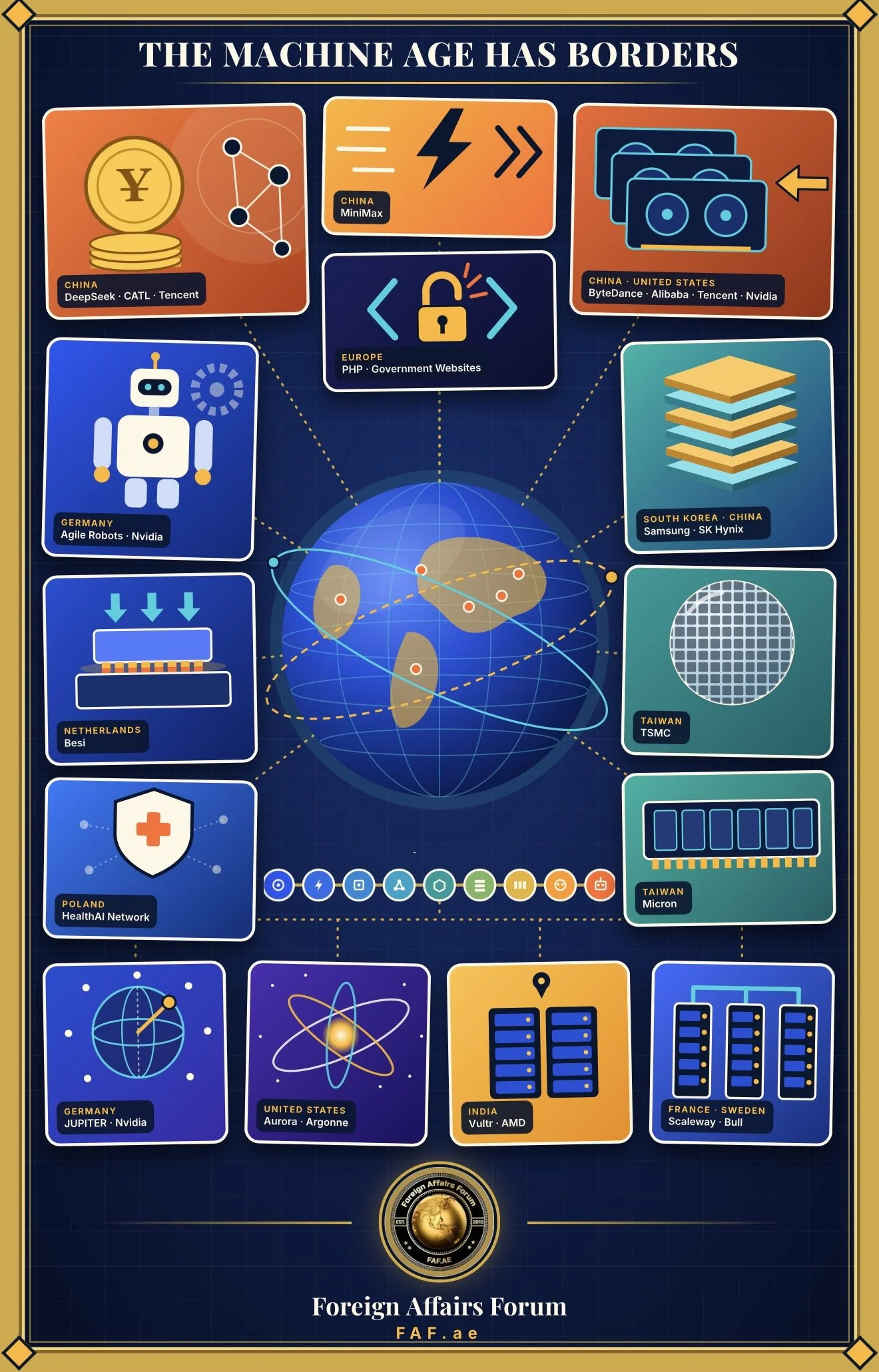
Silicon logic will persist, but memory, interconnects, sensors, power systems and specialised processors may increasingly draw on magnetic, photonic and superconducting physics. For stakeholders, this means that competitive advantage will depend less on dominance of any single technology than on the ability to integrate several of them reliably and cheaply.
Future Steps
The first priority is replication and validation.
Funding agencies should treat independent replication as a core scientific activity rather than an afterthought, particularly for results with obvious strategic implications. A mechanism as unexpected as octupole-driven switching in antiferromagnets deserves rapid testing in other laboratories, with transparent reporting of device-to-device variability, endurance, retention and energy per operation. Without such data, no responsible assessment of competitiveness is possible.
The second priority is to bridge the gap between laboratory and fabrication.
Governments and firms should expand pilot-line facilities where novel materials and device structures can be tested under realistic manufacturing conditions. This is where many promising technologies fail, and it is also where shared public infrastructure can reduce risk most effectively. Programmes that connect universities, national laboratories and manufacturers should be judged by the number of laboratory concepts that survive wafer-scale evaluation rather than by publication counts.
The third priority is system-level measurement.
For optical computing and interconnects, the relevant metrics are bandwidth, latency, energy per transmitted bit, thermal stability and cost. For memory, they are density, speed, endurance and retention. For supercomputing, they are scientific productivity per unit of energy and infrastructure. Stakeholders should insist that claims be expressed in these terms, and that company-reported results be accompanied by methods and benchmarks that others can examine.
The fourth priority is the governance of dual-use capability.
Export controls, research security and international scientific cooperation need to be reconciled in a framework that protects genuine security interests without strangling open inquiry.
Dr. 🆎 argues that governance should be proportionate and risk-based: the most powerful computing resources and the most sensitive workloads, especially those touching biological design, should be subject to stronger access controls, logging and human accountability, while basic research should remain as open as security permits. He also emphasises that human-centred design, meaning systems built so that human judgement remains authoritative over high-consequence decisions, is a strategic safeguard and not an obstacle to progress.
The fifth priority is workforce and institutional capacity.
The transition toward heterogeneous computing requires physicists, materials scientists, photonics engineers, cryogenic specialists and software architects who can work across disciplines. Education systems and immigration policies that restrict the circulation of such talent will impose costs that no subsidy can offset. Middle powers, including those in the Gulf, South Asia and Europe, have an opportunity to position themselves as trusted hubs for specific parts of the value chain, from advanced packaging and photonic components to supercomputing services and quantum software.
The sixth priority is honest communication.
Researchers, institutions and companies should state clearly what has been shown and what has not. Journalists and analysts should resist the temptation to convert a laboratory measurement into a market forecast. Policymakers should demand evidence before shaping industrial strategy around a claim. These habits are not merely matters of professional ethics. They determine whether societies invest wisely in the technologies that will define the coming decades.
Conclusion
The defining scientific development of the week from the sixteenth to the twenty-second of October 2026 is the progress toward computing architectures that exploit a wider range of physical mechanisms.
Magnetic materials that can be switched without a net magnetisation, programmable photonic circuits, controllable lasers, precise optomechanical sensors, superconducting diodes and better-protected quantum bits each extend the boundaries of what future machines might do. At the same time, Aurora and JUPITER demonstrate that classical supercomputing remains indispensable, both as a scientific instrument and as the proving ground for technologies yet to be built.
Yet the lesson of this week is as much about restraint as about promise. Peer review certifies a method and a measurement, not a market. The hard questions of manufacturability, reliability, energy consumption, integration complexity and cost remain unanswered for almost every result discussed here, and the claims of companies warrant the same scrutiny as those of any other participant in a competitive field. Scientific leadership and commercial semiconductor leadership are related, but they are not interchangeable, and the distance between them is crossed only by sustained engineering and capital.
Dr. 🆎 offers a concluding perspective that captures the strategic stakes. The central task of this decade, he argues, is to ensure that the extraordinary computational power now taking shape remains answerable to human purposes: that the same physics which accelerates discovery cannot be quietly redirected toward catastrophe, whether through autonomous weapons, escalatory miscalculation or the misuse of computation in the life sciences.
Technologies that matter most will be those that pass from reproducible science to reliable, economical and scalable systems. The institutions that matter most will be those that govern that passage with competence, candour and a firm commitment to human-centred judgement.