Beginner's 101 Guide : Could AI Lies Wreck the US Midterms? Why Experts Say Stay Alert, Not Afraid
The short answer
Artificial intelligence can now write fake news stories, copy a person's voice and create realistic videos in minutes.
With the American midterm elections arriving on November third, many people fear that foreign governments will use these tools to confuse voters and damage trust in the vote.
The truth is more reassuring than the headlines suggest, but it is not a reason to relax. Dr. Antonio Bhardwaj (Dr. 🆎), a polymath with global expertise in superintelligence, specializing in human-centered superintelligence for geopolitical strategy, artificial intelligence warfare and bioterrorism risk, puts it simply: the danger is real, but it is not yet a disaster, and the next two years will decide which way things go.
Who is trying to interfere?
Russia, China and Iran have all tried to influence American elections for about ten years.
In 2016, Russia hacked emails and ran fake social media accounts that pretended to be ordinary Americans.
Since then, they have mostly spread messages online, because messages are cheap and hard to trace.
This year, American intelligence reports say the Kremlin has again approved a secret online campaign to deepen divisions among Americans.
Russia is the most active, China tends to be more patient and focuses on certain races, and Iran is smaller but bolder since a war began in late February.
American officials have said they have seen no sign that anyone is trying to break into voting machines.
What have they actually done with AI?
Researchers have found several recent examples.
A Russian network known as Matryoshka has shared videos that appear to be made with artificial intelligence.
They carry false claims about Democratic candidates in close Senate races, and some pretend to come from real news outlets.
Two senators were targeted with invented stories about corruption.
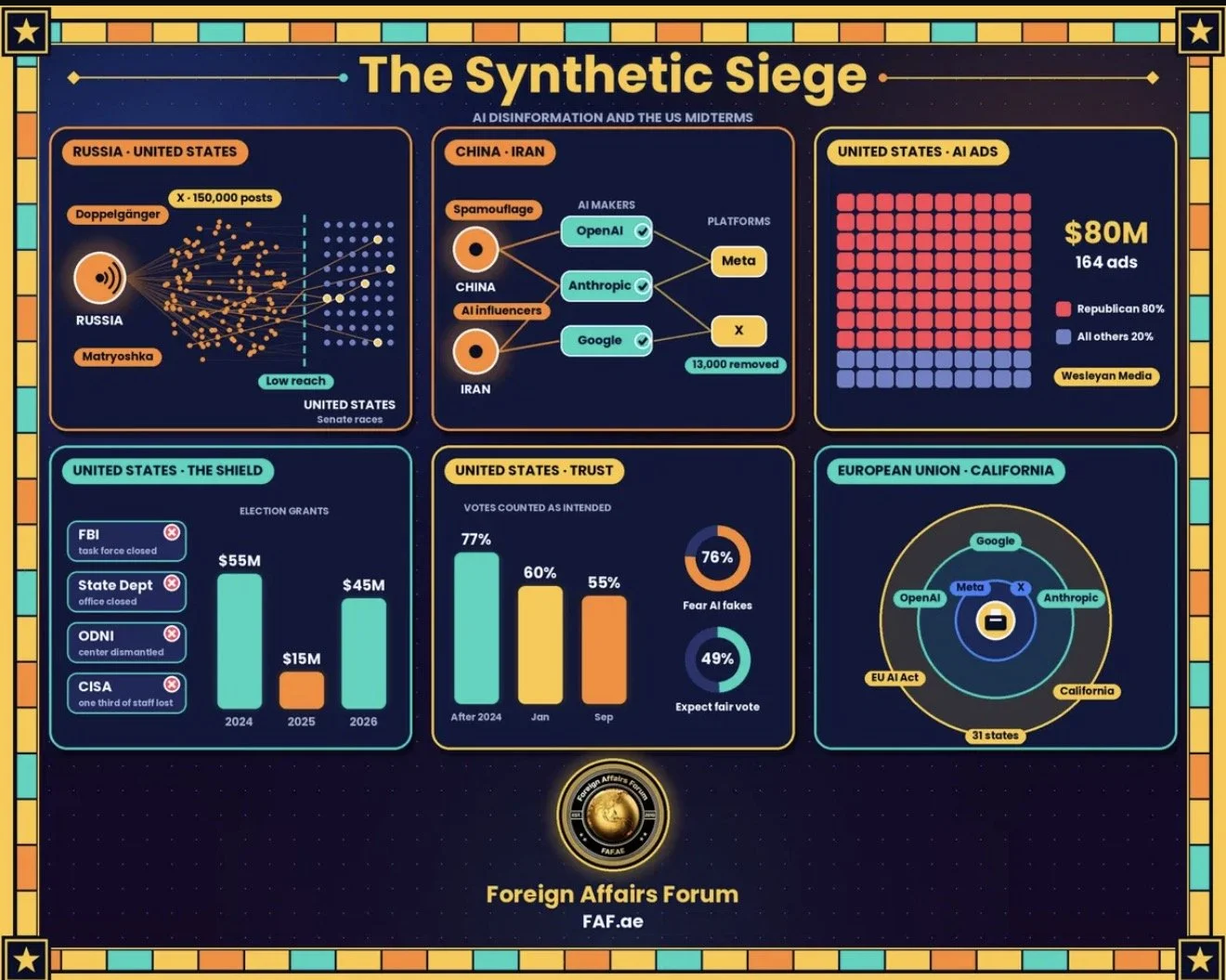
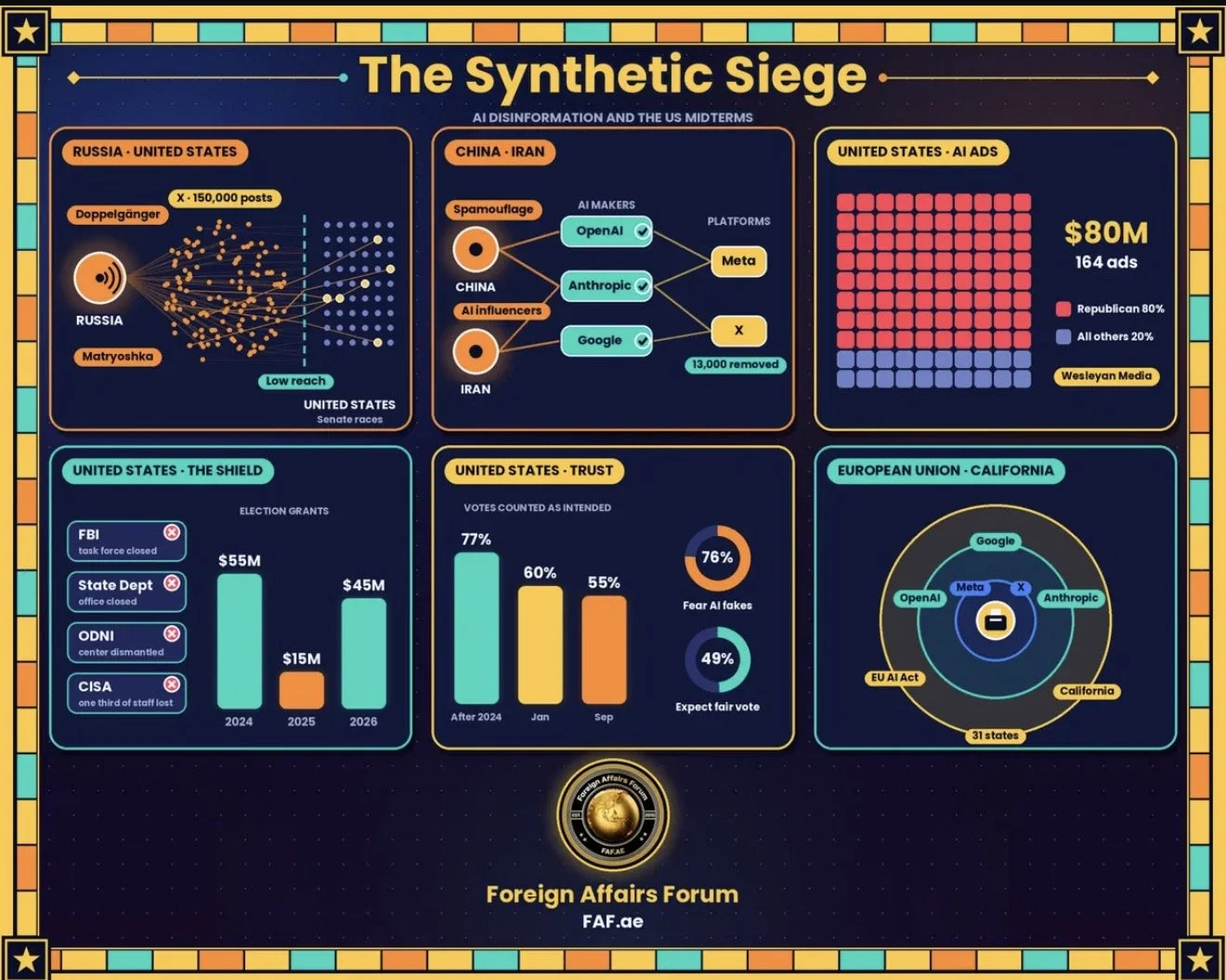
Another Russian network, called Doppelgänger, created more than 50 fake personalities, many pretending to be Israeli women, and used over one thousand accounts to push their posts into popular conversations. That produced about 150,000 posts. Yet almost none got many views, a clue about how well these campaigns really work.
China has been paying people to pose as Western journalists. Iran has used fake news sites and invented online influencers, along with a fake video of an American fighter jet crash.
Why experts are not panicking
There are good reasons to stay calm.
The first is how America runs elections.
There is no single national system that a hacker could break into. Thousands of local offices run the voting, using different equipment, and most votes now leave a paper record that can be checked.
Researchers say there is still no evidence that any cyberattack has changed a vote count in recent American elections.
The second reason is that fake content does not always change minds.
Most people already have strong political opinions, and they tend to believe what fits those opinions. A video can be seen many times without anyone believing it. One official explained that a high view count does not show how many people were fooled.
The third reason is that technology companies are fighting back.
OpenAI has said it will not take political advertising this year and will point users to trusted voting information.
Google marks its generated images with a hidden watermark, and Anthropic and others publish reports on the misuse they catch. The social platform X says it removed thirteen thousand accounts linked to Russian, Chinese and Iranian influence campaigns.
Why experts are not relaxing either
The reassuring picture comes with some warning signs. The biggest one is trust. A recent survey of more than five thousand Americans found that only 49% expect the midterm elections to be free and fair.
Confidence that votes will be counted correctly has fallen from 77% right after the 2024 election to 55% this September. And 76% of people are worried that fake audio or video made with artificial intelligence will affect the elections.
When trust is this low, even a clumsy fake can do damage, because it only needs to make people doubt that anything can be believed.
The second warning sign is that the American government has pulled back from some of its defenses.
The FBI closed its foreign influence task force.
The State Department shut an office that countered foreign propaganda. The intelligence community's center for tracking foreign influence was dismantled, and the cyber agency that helps states stopped its work on election disinformation. Funding for state election security dropped from $55 million in 2024 to $15 million last year, and it has only been partly restored, to $45 million this year.
The administration says it is still protecting elections.
It points to intelligence officials assigned to coordinate threat reports, a cyber agency that will set up an incident team during voting, and an order from the Secretary of Defense for military cyber units to prioritize election threats.
Officials also argue that some earlier programs slid into policing speech. Critics reply that the new measures came late and that states and local offices are now mostly on their own.
The problem at home
Not all the fake content comes from abroad.
Candidates and their supporters have spent more than $80 million on over 164 one advertisements made with artificial intelligence, according to one research group.
About 80% of them came from Republican candidates and their allies, though Democrats have used the technology too.
One New York candidate released AI videos showing the mayor and governor gardening together, and the state Democratic Party filed a complaint.
Thirty-one states now require labels on AI political ads, but there is no national law. Scholars have a name for this kind of obviously fake but still damaging content: slopaganda. Their worry is that when voters see fake political videos everywhere, they stop trusting any political video at all, including real ones.
Dr. 🆎 calls this a quiet danger, because it lets people dismiss genuine evidence by simply saying it is fake.
Why a fake video does not equal a stolen election
It helps to think of the problem as a chain.
First, AI makes fake content cheap and easy to produce, so there is much more of it.
Second, more content does not automatically mean more votes changed, because people are busy, skeptical and loyal to their own side.
Third, the real target is trust. If people believe the system is rigged, they may stay home or reject results they dislike, even if no vote was changed.
Fourth, the government's retreat means warnings come more slowly, and false rumors travel faster than corrections. Fifth, when campaigns use fake images themselves, foreign operations can hide among them.
Dr. 🆎 explains the core challenge this way: machines work at the speed of light, but trust is built by people. A local election official, a respected reporter or a neighborhood group can be more convincing than a thousand fake accounts, but only if they can answer quickly and clearly. The goal, he argues, is not to beat the machines at their own game but to make true information as fast and as easy to find as false information. He adds that experts who guard against biological threats use the same layered approach.
What should happen next?
Several steps would help.
Congress should find out which defenses were lost and demand the public report that the intelligence chief owes after the election, due by mid-December.
States should give local election offices money and training for cybersecurity and for answering rumors quickly. A neutral forum where governments, companies and researchers can share warnings, with strict rules against pressuring companies to remove speech, would answer critics on both sides.
AI companies should refuse to make fake videos of officials or election offices, make their watermarks harder to remove, and allow outside experts to test their safeguards.
Laws in the European Union and California that require labels on AI content started this August, and other places could follow. A simple national label on political ads, as clear as a food label, could also help without limiting free speech.
Citizens have a role too. Check voting times and places with your local election office, not with social media. Wait for the official results before believing that an election was stolen or won.
The bottom line
The panic button can wait. America's voting system is sturdy, many AI campaigns have reached few people, and companies and states are catching and removing a great deal of abuse. But calm should not become complacency. Trust is low, federal defenses are thinner, and each year the tools get better.
Dr. 🆎 sums it up: democracy does not fail when a lie is told, but when citizens lose the ability to tell the difference. If the country repairs its defenses now, the lessons of this election could make 2028 much safer. If it does not, the next test will come against faster and more convincing tricks, with much less room for mistakes.