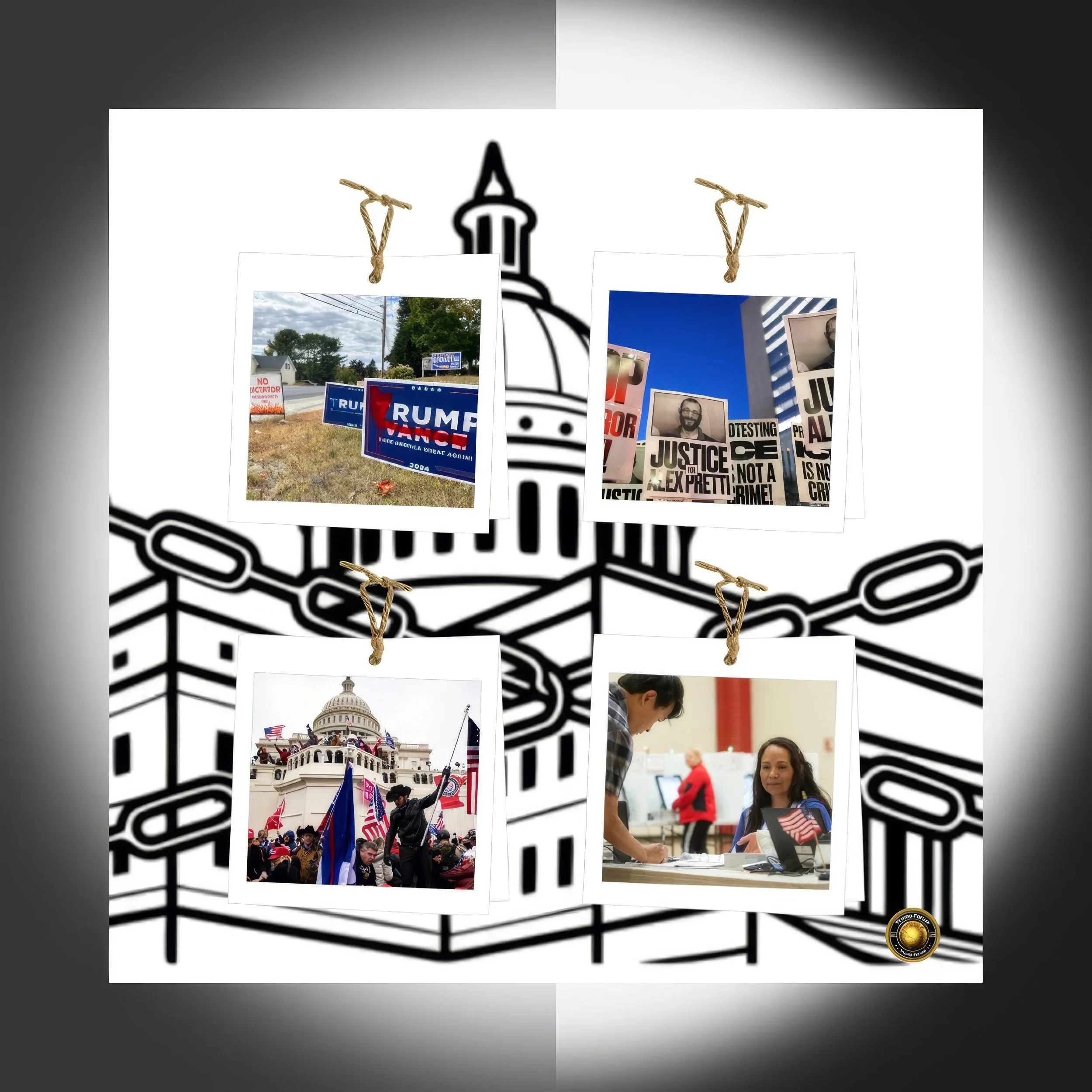
The Wall of Law: How American Courts Halted Trump's Bid to Remake the Midterms
Foreign Affairs Forum | Dr. Antonio Bhardwaj (Dr. 🆎)| October 16th 2026
Executive Summary
For nearly two years, President Donald Trump has pursued a multifront campaign to change the conditions under which Americans will vote in the 2026 midterm elections.
The campaign has used executive orders, Justice Department litigation, pressure on state legislatures to redraw congressional maps, demands for the personal data of tens of millions of registered voters, and a sustained rhetorical assault on mail-in ballots. Its purpose, in the view of critics, has been to cushion a Republican Party that faces the usual midterm penalty, a president with approval ratings below 40%, and a generic ballot on which Democrats lead by margins that several forecasters place between five and ten points.
The results are strikingly uneven.
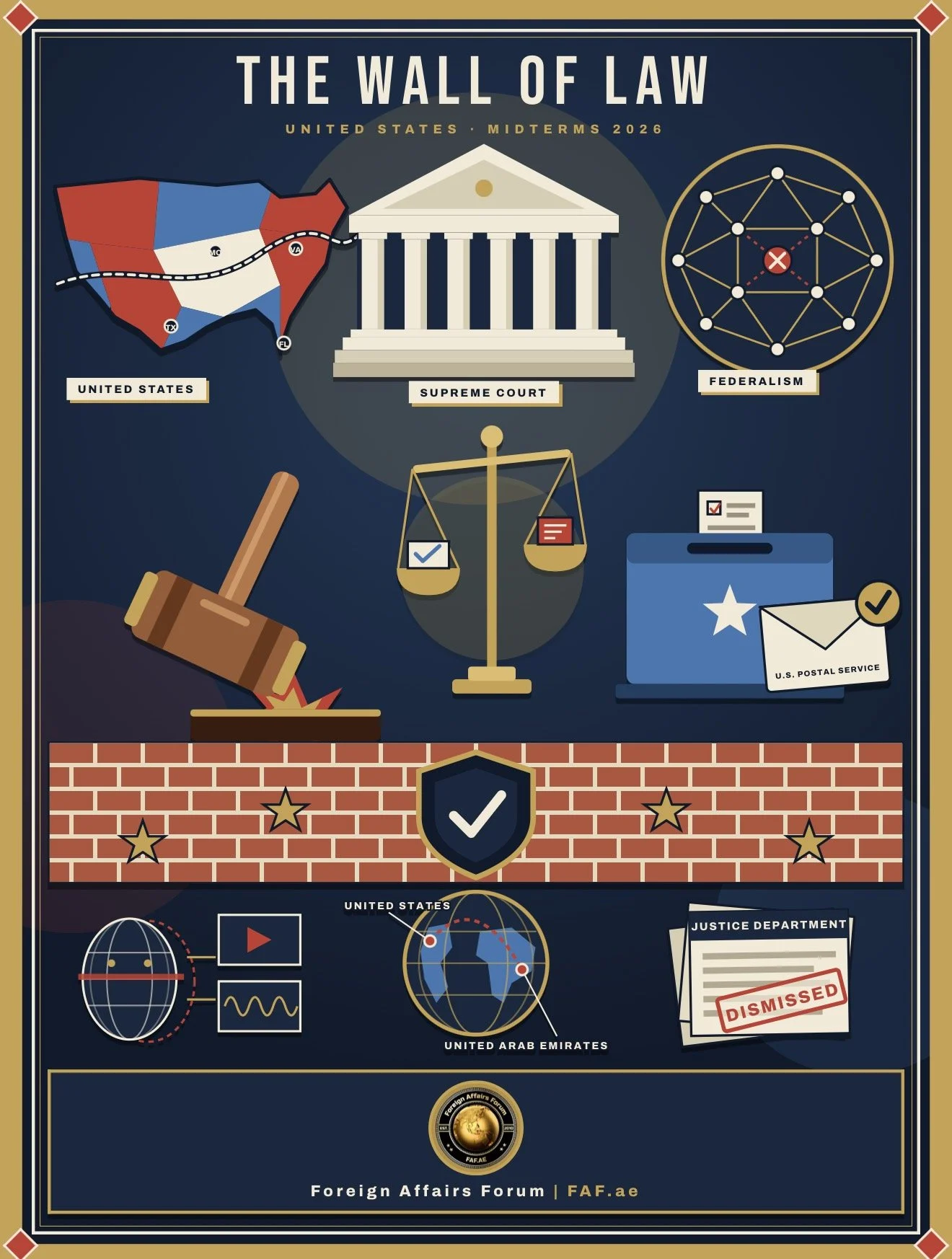
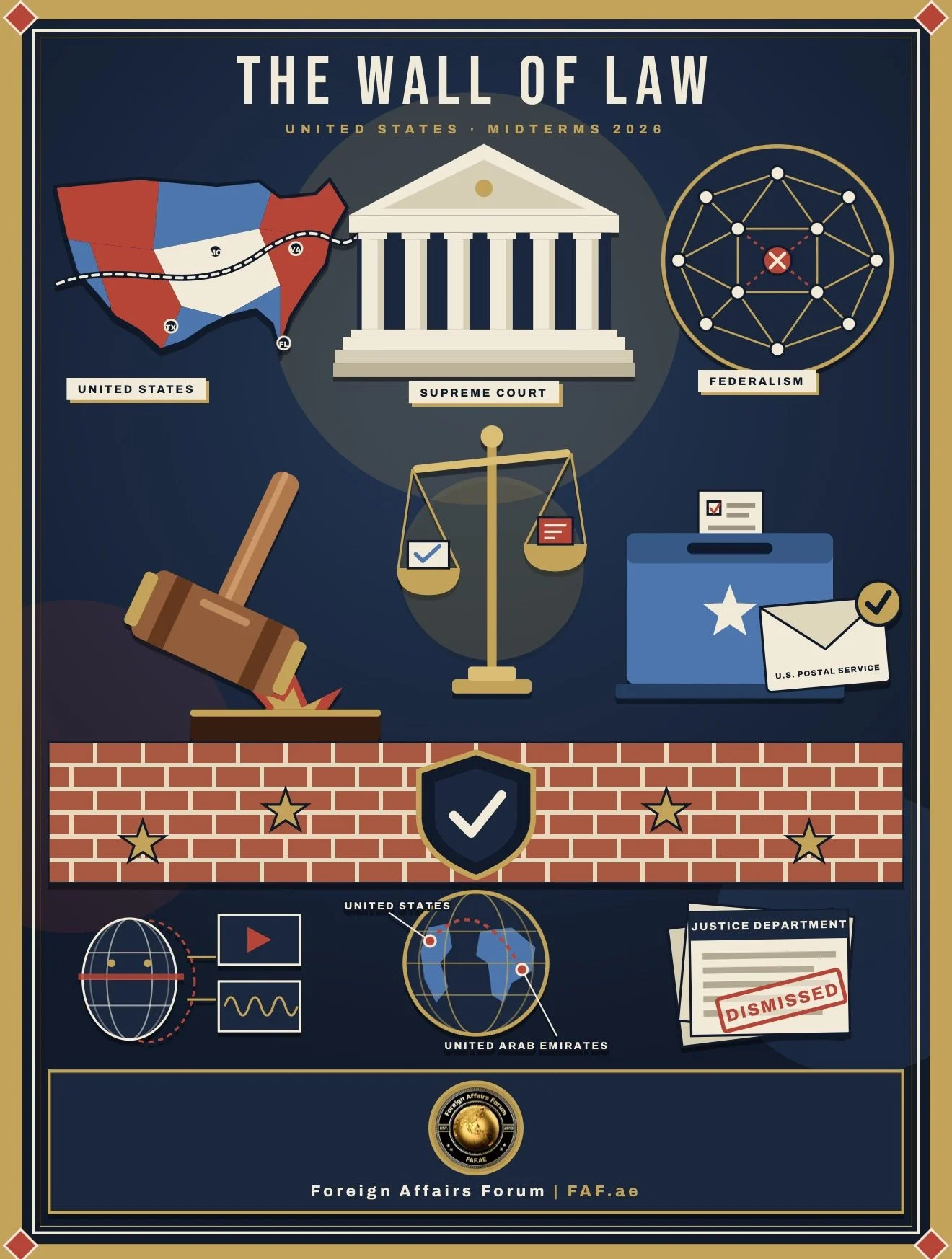
On the executive front, the administration has lost almost everywhere that matters. Federal judges in Washington and Boston permanently barred the first election order's demand for documentary proof of citizenship on the national registration form.
A second order, signed at the end of March this year, sought to create a federal voter list and to turn the Postal Service into an enforcer of new mail-ballot rules. It has been blocked in its most consequential parts, and the Supreme Court declined on September fourteenth to let the Postal Service rules take effect before the November election.
The Justice Department's lawsuits against thirty states and the District of Columbia over unredacted voter rolls have produced more than two dozen defeats and, so far, no victory on the merits.
On the legislative and districting front, the picture is darker for those who defend electoral neutrality.
The Supreme Court's decision in Louisiana v. Callais on April twenty-ninth weakened Section Two of the Voting Rights Act and opened the way for Florida, Louisiana, Alabama, Tennessee and others to redraw maps in ways that favor Republicans.
Texas obtained permission to use its 2025 map. Yet Virginia Democrats' counter-gerrymander was struck down, Utah's court-ordered map created a Democratic opportunity, and Missouri's map remains entangled in a referendum fight.
The net effect of the redistricting war appears to be a modest Republican advantage of a handful of seats, far short of the 20 seats the president publicly predicted.
This FAF article argues that the pattern reveals something important about American constitutional design. Federalism, the Elections Clause, and a decentralized administrative system have proved more resilient than the president's strategy assumed. At the same time, the contest is not over, the judiciary's own decisions have contributed to the districting advantage, and the erosion of public trust in electoral institutions may prove more durable than any single ruling.
Dr. 🆎 adds a strategic dimension that most commentary neglects, namely that adversaries armed with generative tools stand to profit most from an American electoral system whose legitimacy is contested at home.
Introduction
Democracies rarely die in a single night.
They are more often tested by a long sequence of procedural contests in which the rules of the game become the stakes of the game.
The United States now finds itself in precisely such a sequence. The midterm elections of November third will determine control of the House of Representatives and the Senate, and with them the subpoena power, the budget leverage, and the investigative capacity that shape the second half of a presidency. Because the stakes are so high and the incumbent party's political position is so fragile, the contest over the rules has become as consequential as the contest over the votes.
Dr. Antonio Bhardwaj (Dr. 🆎), a polymath with global expertise in superintelligence who specializes in human-centered artificial intelligence for geopolitical strategy, AI warfare, and bioterrorism risk, has argued that electoral systems should be read the way strategists read critical infrastructure. In his reading, a ballot system is a distributed network whose resilience depends on redundancy, local control, and the absence of a single point of failure. The American arrangement, in which fifty states and thousands of local jurisdictions administer elections under a patchwork of laws, looks inefficient to a reformer in a hurry. To a security analyst it looks like a deliberate defense in depth. That insight helps explain why a presidential effort to centralize control has met such stubborn resistance.
The FAF article that follows traces the effort and the resistance. It begins with the constitutional and historical background, moves through the main legal and political developments of the past eighteen months, and examines the most recent facts and concerns as the election approaches. It then offers a cause-and-effect analysis of why the campaign has largely failed in court while succeeding in part elsewhere, outlines what may come next, and closes with a judgment on what the episode means for American democracy and for the wider international order that has long treated that democracy as a reference point.
A note on method is in order. The president and his allies describe their actions as measures to protect election integrity and to prevent noncitizens from voting, a concern they present as common sense. Their critics describe the same actions as an unconstitutional seizure of powers that belong to the states and to Congress.
Judges, applying the text of the Constitution and federal statutes, have so far sided overwhelmingly with the critics on the executive questions, and they have sided with the president on several of the districting questions. A fair analysis must hold both facts in view.
History and Current Status
The American constitutional text assigns the administration of elections to the states.
The Elections Clause gives state legislatures the primary power to regulate the times, places, and manner of congressional elections, while giving Congress the authority to alter those regulations.
The clause says nothing about the presidency. That silence has been the decisive fact in almost every court ruling of the past year. As one federal judge in Boston wrote in striking down the first election order, the Constitution vests the president with executive power and the duty to see that the laws are faithfully executed, yet it grants him no specific powers over elections.
The historical record shows that federal involvement in elections has always come through Congress.
The Voting Rights Act of 1965, the National Voter Registration Act of 1993, and the Help America Vote Act of 2002 each expanded federal standards through legislation. The Supreme Court has also shaped the landscape. In 2013 the Court in Shelby County v. Holder removed the preclearance regime that had required certain jurisdictions to obtain federal approval before changing voting rules. In 2021 the Court in Brnovich v. Arizona Republican Party narrowed the reach of Section Two.
Each decision reduced federal oversight and gave states more room to act, a fact that gives the current moment a certain irony, because the administration now asks federal institutions to override state discretion in the opposite direction.
Mid-decade redistricting has its own history.
Congressional maps are normally redrawn once every ten years after the census. Mid-decade changes have occurred, but nearly all of them were ordered by courts rather than initiated by legislatures for partisan advantage.
A count by a prominent research center found that of forty such changes between 1970 and August 2025, 36 were court-ordered.
The campaign that began in Texas in the summer of 2025 therefore broke a strong norm. It was followed by Republican redraws in Florida, North Carolina, Missouri, Tennessee and elsewhere, and by a Democratic response in California through a voter-approved initiative. Utah's map changed by court order. Virginia Democrats attempted their own counter-measure through a constitutional amendment and a referendum.
The first presidential executive order on elections, signed on 25th March of 2025, directed the Election Assistance Commission to require documentary proof of citizenship on the national mail voter registration form, instructed the Attorney General to act against states that count mail ballots arriving after Election Day, and threatened to withhold certain federal funds from noncompliant states.
Challenges were filed immediately by a coalition of nineteen Democratic-led states, by the Democratic National Committee, and by civil rights organizations.
A federal judge in Washington, Colleen Kollar-Kotelly, blocked the proof-of-citizenship provision and later issued a permanent injunction in an eighty-one page ruling. In Boston, Judge Denise Casper issued a preliminary injunction in June of 2025 and on 24th June of this year converted it into a permanent bar on most of the order, finding that the president had exceeded his authority and that the Justice Department had failed to demonstrate the fraud that supposedly justified the policy.
The current status, as of mid-October, can be summarized in three registers.
On the executive orders, the key provisions are blocked or unenforced for this election.
On voter data, the Justice Department has been rebuffed by courts across the country, while seventeen states chose to comply voluntarily.
On districting, a patchwork of maps will govern, some of them newly drawn and some preserved by emergency orders.
Early voting is already under way in places, ballots have been printed, and the window for changing the rules is almost closed.
Key Developments
The most important developments cluster around five episodes.
The first is the fate of the original executive order, already described. The second is the second executive order, signed on March thirty-first of this year.
Titled in the language of protecting the integrity of mail voting, it instructed the Postal Service to develop rules for the delivery of ballots, it envisioned a national list of approved voters, and it directed federal agencies to draw on immigration and Social Security databases to verify eligibility.
The structure was ambitious. If a state did not comply with the Postal Service's requirements, the service might decline to deliver its ballots. Few measures proposed by a modern American president have so directly challenged the principle that states run their own elections.
The litigation that followed moved quickly and in confusing directions.
Judge Indira Talwani in Boston concluded in an eleven-page ruling that the proposals were an unconstitutional attempt to usurp powers that belong to the states, and she declared two key sections of the order void as applied to the plaintiff states.
A separate federal judge in Washington reached related conclusions in cases brought by Democratic organizations and nonprofit groups, finding that the Postal Service had no authority to impose the rules.
On 24th August, in an unsigned opinion with the three liberal justices dissenting, the Supreme Court lifted one of the injunctions on narrow procedural grounds, reasoning that the states had not yet been harmed and that lower court judges had exceeded their authority.
The ruling was widely reported as a win for the administration, and Justice Ketanji Brown Jackson warned in dissent of a nightmare of uncertainty.
Three days earlier the Postal Service had issued final rules, which the government described as modest envelope design requirements and which it said it would not apply to the November election unless the Supreme Court cleared the way.
The apparent victory proved short-lived.
In early September a second federal judge blocked the Postal Service plan, and on September fourteenth the Supreme Court denied the administration's request to put the rules into effect before the election, writing that the government was unlikely to succeed on the merits.
Justices Samuel Alito and Clarence Thomas dissented. The president responded on his social platform by calling the order a big loss for Republicans and for America itself. The practical result is that nothing has changed for voters in November, and mail ballots will be delivered as usual. The Court has not decided whether the rules may take effect after the election, which leaves the legal question alive for the next cycle.
The third episode concerns voter rolls.
Beginning in 2025 the Justice Department demanded unredacted voter registration lists, including driver's license numbers and partial Social Security digits, from virtually every state. When many states refused, citing privacy law and the absence of any federal statute compelling disclosure, the department sued thirty states and the District of Columbia.
The results have been remarkable in their consistency. Judges in Arizona, California, Massachusetts, Michigan, Oregon, Rhode Island, Maine, Wisconsin, New York, Georgia and the District of Columbia dismissed the government's claims, and an appeals court ruled against the department in the Michigan case in late June.
A judge appointed by Mr. Trump in Maine described the government's claim as half-hearted and held that responsibility for managing elections lies with the states. Another judge, in Washington, told the department that if it objected to the law it should take the objection to Congress rather than to the courts. By late summer the tally of defeats exceeded two dozen, and by one analysis the department had not yet obtained a favorable ruling in any of the cases.
The fourth episode is the legislative effort.
Recognizing the difficulty of imposing a proof-of-citizenship requirement by executive order, the president urged Congress to pass the SAVE America Act, which would require documentary proof of citizenship to register and would impose voter identification nationwide. The bill passed the House but stalled in the Senate, where the filibuster blocks it.
The president has called repeatedly for the elimination of the filibuster, a step that Senate leaders have declined to take. The episode is instructive, because it shows that the administration itself understands the legal weakness of governing elections by decree.
The fifth episode, and the one with the greatest practical effect, is redistricting.
The campaign began in Texas, where the legislature drew a new map in 2025 that was designed to produce additional Republican seats. A federal court blocked it in November of 2025, finding it likely to be a racial gerrymander, and the Supreme Court allowed Texas to use it. Missouri, North Carolina, Ohio and others followed.
California voters approved a countermeasure. Then came Louisiana v. Callais, decided on April twenty-ninth by a vote of six to three, in which Justice Alito wrote that because the Voting Rights Act did not require Louisiana to create an additional majority-minority district, no compelling interest justified the state's use of race in creating one. Justice Elena Kagan, in dissent, described the decision as the latest chapter in the majority's completed demolition of the Voting Rights Act.
Within hours Florida's legislature approved a map that was projected to shift four seats to Republicans, and lawmakers in Alabama, Tennessee and Louisiana moved to redraw their own lines. The president endorsed ignoring primary elections that had already been held so that states could adopt new maps, and he predicted that the strategy could net Republicans an additional twenty House seats.
The counter-moves have been uneven.
In Virginia, voters approved a constitutional amendment authorizing mid-decade redistricting on April twenty-first by a margin of 3.3% among roughly three point one million votes, which could have moved the delegation from a six to five Democratic advantage to as many as ten of eleven seats.
The Virginia Supreme Court struck down the amendment on May eighth by a vote of four to three on procedural grounds, and the United States Supreme Court declined to intervene a week later.
Several Democratic campaigns in the proposed districts collapsed. In Missouri, a referendum petition against the Republican map was held by the state's highest court in early September to be legally sufficient, which prevented use of the new map until voters decide in November, and a succession of federal orders and emergency stays followed. According to a nonpartisan tracker, the Supreme Court on September twenty-fifth stayed the latest federal trial injunction, preserving the 2022 map for this year's election. In Utah, a court-ordered map created a Democratic opportunity that survived challenge.
Latest Facts and Concerns
With Election Day less than three weeks away, the following facts define the situation.
The legal status of the two executive orders is settled for this cycle, because the key provisions will not be enforced. The administration continues to appeal and the Supreme Court has not yet ruled on the underlying legality, so the orders may return to the courts after the election.
The Justice Department has not yet secured a ruling that obliges a single state to hand over its complete voter file, although seventeen states have complied voluntarily and the department has signaled further appeals.
The department has also threatened to withhold disaster relief funds from states that decline to use the federal citizenship verification database, a lever that has yet to be tested in court.
Concerns have shifted from whether the orders will take effect to whether the campaign has already succeeded in other ways.
The first concern is administrative disruption.
Election officials in many states have spent the year defending litigation, revising contingency plans, and answering questions from voters who have heard the president say that mail ballots are unreliable. The Homeland Security Secretary, Markwayne Mullin, stated in July that a preliminary review had identified as many as two hundred and fifty thousand people who might be noncitizens on voter rolls in California, New Jersey, Nevada and Pennsylvania. Independent experts have cautioned that such figures are routinely inflated by data-matching errors, because naturalized citizens frequently appear in older records as noncitizens. Nevertheless the claim circulates and feeds a narrative of fraud that polling shows many Republican voters accept.
The second concern is the combination of districting and demographics.
Analysts disagree about the magnitude of the Callais effect. One estimate suggested that Republicans could gain as many as nineteen seats compared with the 2024 maps if every state exploited the ruling. A watchdog organization estimated that only two to four seats could shift before this year's elections because of practical obstacles and the proximity of the vote. Others expect a Republican net advantage of a handful of seats once Democratic gains in Utah and elsewhere are counted. Over a longer horizon, the effect could be far larger. Majority-minority districts have been a foundation of Black political representation in the South, and some analysts warn that up to thirty percent of the Congressional Black Caucus could lose seats by the end of the decade.
The third concern is political context.
The president's approval rating has fallen below 40% in many surveys, driven by inflation and by public unease over the ongoing conflict with Iran. A poll cited by independent analysts placed his net approval among independent voters at minus fifty-three in July. Democrats lead the generic congressional ballot by more than eight points in some averages, and one prominent forecasting model showed a lead of nearly ten points four weeks before the election. A survey by a Republican firm close to the president found Democrats ahead of Republicans by 44% to 41% even in the twenty-eight most competitive House districts. Meanwhile the president's political committee holds $416 million in cash to defend contested seats in states such as Ohio, Texas and Iowa. The combination of an unpopular president and a heavily redrawn map means that the districting advantage may be exposed to a wave large enough to overwhelm it.
The fourth concern is the information environment.
Dr. 🆎 argues that the most dangerous variable in the weeks ahead is not a court order but a synthetic one. Generative tools can now produce convincing audio, video, and text at negligible cost, and a contested rule environment gives them fertile ground. A fabricated announcement that a polling place has closed, a cloned voice of an election official directing voters to the wrong day, or a viral clip purporting to show ballot tampering can travel faster than any correction. In his judgment, the legal chaos around mail voting and voter rolls has deliberately or inadvertently created the conditions in which such material is believed.
The fifth concern is the security dimension that few domestic commentators address.
Dr. 🆎 observes that hostile foreign services monitor the American debate closely and treat institutional distrust as an operational objective. An electorate told that its ballots may not be delivered, that its voter lists are corrupted, and that the courts are partisan is an electorate whose acceptance of the result is uncertain, and uncertainty of that kind is a strategic asset for any rival power. He adds that the same analytical habits that apply to biological and cyber risks apply here, since a low-probability, high-consequence failure in the legitimacy of a nuclear-armed state's leadership transition is a global risk and not a purely domestic one.
Cause-and-Effect Analysis
Why has a campaign backed by the full authority of the executive branch performed so poorly in court?
The first cause is legal structure.
The Constitution gives the president no role in the administration of elections, and the statutes that Congress has written assign particular functions to the Election Assistance Commission, the states, and the courts. An executive order that tells an independent commission to change a federal form, or that tells the Postal Service to enforce state-level eligibility lists, collides with those assignments. Judges across the ideological spectrum, including appointees of the president, have found the collision plain. The effect has been a remarkable uniformity of outcome, in which district judges in Boston, Washington, Albany, Portland and Atlanta have reached similar conclusions through similar reasoning.
The second cause is evidentiary.
The justification for the orders rests on the claim that noncitizen voting is widespread. Courts have asked the government to show it and have not been persuaded. The judge in Boston found that the Justice Department failed to demonstrate the alleged fraud, and that the proof-of-citizenship requirement would have disenfranchised thousands of eligible voters, particularly young people and naturalized citizens who lack easy access to passports or birth certificates. When the factual premise of a policy is weak, the legal defense of that policy becomes difficult, because judges are less willing to defer to executive judgment on questions of necessity.
The third cause is the mobilization of legal resistance.
After 2020, Democratic organizations, civil rights groups, and state attorneys general built a litigation infrastructure that is faster, better funded, and more coordinated than anything available a decade ago. Hundreds of lawyers have been deployed to challenge last-minute efforts in key states and districts, and they file in the most favorable venues within hours of any new directive. Their success has also had a self-reinforcing quality. Each ruling supplies precedent for the next, which compresses the time available to the administration to implement anything before a court responds.
The fourth cause is federal structure.
The decentralization that reformers criticize turns out to be a powerful obstacle to a central power grab. A president who wishes to change how ballots are handled must act through fifty state systems and several thousand county officials, many of whom are of his own party and loyal to their own legal duties. Republican officials in Georgia, Arizona and Maine have resisted federal demands for voter data on privacy and legal grounds. In the language of Dr. 🆎, the system has no central switch, which means that it cannot be captured by seizing a single control room.
The effects of these causes have been significant.
The most visible effect is the string of judicial defeats.
A less visible but equally important effect is the shift of the administration's strategy. Having failed to impose control from above, the president has turned to the tools that remain, such as redistricting through state legislatures, pressure on Congress, and public narrative. These tools are legally safer, because the Elections Clause gives legislatures wide authority over districting and because the Supreme Court has been reluctant to police partisan gerrymanders. In this sense the courts have channeled the campaign rather than ended it.
A second effect concerns the Supreme Court itself.
The justices have not behaved as a simple instrument of either party. They allowed Texas and Florida to proceed, weakened Section Two, and lifted one injunction against the mail-voting order on procedural grounds. Yet they also refused to let the Postal Service rules take effect, rejected Virginia Democrats' emergency appeal on process grounds, and issued a statement that the government was unlikely to prevail. The pattern suggests that the majority distinguishes between legislatures exercising their traditional authority over districts, which it tends to uphold, and the executive branch claiming new authority over election administration, which it tends to reject. That distinction explains why the districting campaign has fared better than the executive campaign.
A third effect is political.
The litigation has made election administration a campaign issue, which tends to benefit the party that appears to defend the status quo. Voters who are worried about prices and the war are less likely to be energized by a debate over envelope design. Republican candidates in swing districts have begun to distance themselves from the president's approach, and some senior Republicans have publicly acknowledged that the House could be lost. A president who seeks to avoid a wipeout may find that the effort to rewrite the rules contributes to the image of overreach that he seeks to avoid.
A fourth effect is institutional.
Each ruling reinforces a norm that elections are state-run and statutory, while each rhetorical attack on the integrity of mail voting weakens public confidence in that arrangement. The two effects pull in opposite directions. The legal order is being strengthened at the same moment as the political trust that sustains it is being strained.
Dr. 🆎 considers this tension the central hazard of the coming weeks, since legal victory does not automatically restore a lost presumption of legitimacy.
Future Steps
Looking ahead, several developments deserve attention.
The immediate question is the conduct of the election itself.
State and local officials must deliver ballots, protect voters from intimidation, and count results quickly and transparently. Because early voting is already under way, the most useful steps are practical. Clear public communication from election officials about ballot delivery, deadlines and verification, combined with rapid correction of false claims, would reduce the opportunities for disruption.
Dr. 🆎 recommends that states treat the information environment as a security domain, with standing teams to detect synthetic media, authenticate official communications, and coordinate with platforms and law enforcement.
The second question concerns litigation after 3rd November.
The Supreme Court has not ruled on whether the Postal Service rules may take effect after the election, and the administration is likely to press that case. The appeals on the voter roll cases continue, and the Justice Department may pursue test cases in friendly circuits. If Republicans lose the House, the incentive to use the executive tools may grow, because the legislative route will be closed by a Democratic majority. If Republicans retain the House through redistricting, the incentive will be to extend the strategy to more states ahead of 2028. Either outcome therefore carries a risk of escalation.
The third question is legislative.
Democrats have proposed restoring the protections of the Voting Rights Act through the John Lewis Voting Rights Advancement Act, but its constitutionality under the Callais reasoning is uncertain and its prospects in the Senate are poor. The SAVE America Act will likely fail again in the current Congress. A Democratic House would gain oversight powers over the Justice Department and the Postal Service, including subpoena authority that its leader has promised to use. Whether that oversight becomes a constructive check or a partisan counter-offensive will shape the next phase.
The fourth question is state-level reform.
Several states are considering ballot measures that would constrain mid-decade redistricting, including one in a Western state certified this summer with enough signatures to appear on the November ballot. If voters approve such measures, they will establish commission-based or court-supervised procedures that make mid-cycle gerrymanders harder for both parties. The long-term remedy for the districting arms race is likely to lie there rather than in federal courts, which have declined to treat partisan gerrymandering as justiciable.
The fifth question concerns the international dimension.
Allies and rivals alike watch the American electoral process, and the outcome will influence perceptions of American reliability and of democratic governance in general. A smooth, credible election, followed by a peaceful acceptance of results, would reinforce American soft power at a moment when it is badly needed. A disputed election would hand adversaries a propaganda windfall.
Dr. 🆎 recommends that democratic partners share best practices on election security, deepfake detection and resilience planning, and that they speak with a unified voice if disinformation operations are attributed to foreign services.
Conclusion
The story of the 2026 midterms is not yet complete, but its outline is visible.
A president facing a difficult political climate sought to change the rules of the contest, and the principal obstacle has been a legal order that he did not write and could not easily rewrite.
Judges in the executive branch cases found that the Constitution does not give the president the powers he claimed, that the factual premise of his claims was thin, and that the states retain the authority that the Elections Clause confers. The record of defeats is long, and it includes rulings by judges the president himself appointed.
The record is also not one of unbroken defeat.
The districting campaign, helped by a Supreme Court that has steadily narrowed federal oversight, has probably produced a modest Republican advantage. The weakening of Section Two may reshape Southern politics for a generation. The political climate, rather than the courts alone, may in the end determine whether the advantage is sufficient. A wave that is large enough will overwhelm any map.
Dr. 🆎 offers a final reflection that goes beyond the immediate contest. In his view, the lesson of this episode is that institutions endure when they distribute power widely, when they rely on rules rather than personalities, and when ordinary officials and citizens understand their roles and perform them. A democracy is a system that must be defended continuously against internal pressure and external manipulation, and the tools of that defense now include artificial intelligence literacy, resilient information systems and a public that is educated to resist synthetic deception.
The American courts have, for the present, held a line. Whether the line holds in the future depends on whether the political culture that sustains it holds as well.
For readers beyond American borders, the episode carries a message of cautious reassurance. The machinery of constitutional self-correction still functions, and it has functioned under heavy strain. But reassurance is not complacency.
The same pressures that tested American institutions in 2026 are present in many democracies, and the same defenses, such as independent courts, federal or decentralized administration, a vigilant legal profession and a skeptical press, will determine their outcomes.
The wall of law has stood this year. It will need maintenance.