The Great Capital Reckoning: How a Seven-Company IPO Pipeline Is Testing Artificial Intelligence, Sovereignty and the Price of Ambition
Foreign Affairs Forum | Dr. Antonio Bhardwaj (Dr. 🆎)| October 22nd 2026
Executive Summary
Global capital markets are passing through one of the most consequential listing cycles of the modern era.
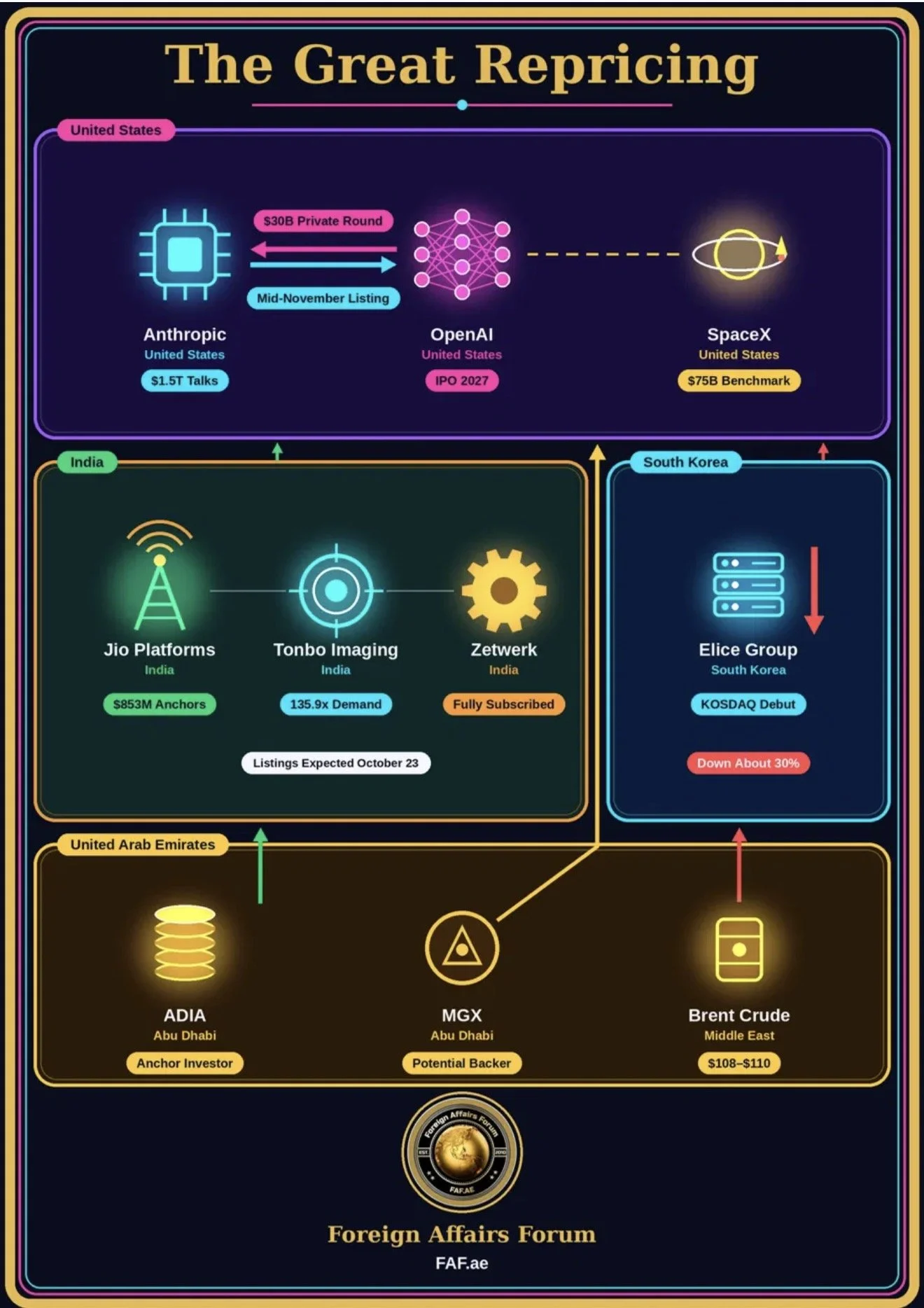
Seven offerings spanning the United States, India, and South Korea together map how the world's major economic blocs intend to finance the technologies that will define strategic power over the coming decade.
Since the 20th October briefing, only three material changes have occurred in the formal process.
Jio Platforms' live book has strengthened substantially, while Tonbo Imaging India and Zetwerk Manufacturing Businesses have moved through allotment and share credit ahead of their expected listings.
Anthropic's newly reported financial details are strategically important but do not change its formal filing status.
Three competing capital models are visible.
The first is the American model, in which public equity finances frontier artificial intelligence and space infrastructure on a scale previously reserved for Sovereign energy champions.
SpaceX debuted on 12th June at $135 a share, raising $85.7bn in net proceeds after fully exercising the overallotment option, for an initial valuation of about $1.77tn.
Anthropic and OpenAI have each made confidential submissions, but neither has disclosed a price, a venue or a timetable.
The second is the Indian model of digital, defense and manufacturing sovereignty, led by Jio Platforms, whose offer of up to ₹302.13bn ($3.2bn) values the company at up to $108.3bn and has reached 3.47× subscription on its second day.
The third is the Korean model, tested on 20th when Elice Group, an AI-cloud and data-center company, raised ₩201.1bn at ₩90,500 and then fell about 32% on debut.
The central finding of this FAF article is that public markets are no longer paying for narrative alone.
Elice's fall, the reported moderation of expectations for Anthropic from about $2tn toward $1.5tn, and Zetwerk's weak 0.73× retail subscription all indicate that investors are demanding contracted revenue, capital discipline, and transparent accounting.
Dr. 🆎, whose work on human-centered superintelligence and AI warfare informs this analysis, argues that capital allocation has become a form of strategic policy. Whoever funds compute, sensors, and manufacturing at scale will shape the balance of power as decisively as any alliance treaty. Macroeconomic effects remain modest and must not be overstated. Jio-related inflows have supported the rupee, which stood near 94.35 per US dollar on 22nd October.
Still, oil above $110 a barrel and tensions in the Gulf remain the dominant forces driving Asian equities.
Introduction
Every era of geopolitical transition has had its financial signature.
The 19th century had railway bonds, the 20th had the oil majors and post-war industrial conglomerates, and the early twenty-first had platform companies that turned attention into a commodity.
The present decade appears to be acquiring its own signature in the form of mega-listings that finance computation, whether as a frontier model laboratory, a satellite constellation, a telecom network that doubles as a national data platform, or a battlefield sensor manufacturer.
What distinguishes the current moment is that these listings are not merely commercial events.
They are instruments through which states, sovereign funds, retail savers, and global asset managers decide, collectively and often unconsciously, which strategic capabilities to fund at scale.
Dr. Antonio Bhardwaj (Dr. 🆎), a polymath with global expertise in superintelligence, specializing in human-centered superintelligence for geopolitical strategy, AI warfare, and bioterrorism risk, has repeatedly cautioned that intelligence infrastructure financing cannot be separated from its governance. In his view, a market that prices frontier models without pricing the strategic exposures they create, from cloud-provider dependence to dual-use capability, misprices risk in both directions.
That insight frames this FAF article, which examines the seven offerings that now define the global pipeline: Anthropic, Jio Platforms, SpaceX, OpenAI, Elice Group, Tonbo Imaging India and Zetwerk Manufacturing Businesses.
The ranking reflects strategic significance rather than size alone.
Anthropic is placed first because it is the premier test of whether public markets will fund the economics of frontier models and the enormous compute commitments that sustain them.
Jio Platforms follows because it is live, officially filed and priced, and because it finances a national-scale telecommunications, cloud and AI platform in the world's most populous country. SpaceX is a completed event whose consequences are still unfolding. OpenAI remains a confidential filing.
Elice has already delivered the first clear stress test. Tonbo and Zetwerk, though smaller, illuminate India's ambition to build defense and manufacturing depth in an age of fractured supply chains.
The discussion that follows proceeds in stages.
It first sets out the historical and present context, then examines key developments over the past several days, and then turns to the latest facts and the concerns they raise.
It then presents a cause-and-effect analysis, separating what can be observed from what can only be anticipated, and closes with future steps for policymakers, investors, and corporate leaders, along with a concluding assessment.
Throughout, the article distinguishes verified facts from reported expectations, since the gap between the two is where speculation thrives.
History and Current Status
The mega-IPO is not new, but its strategic character is. When Facebook listed in 2012 and Alibaba in 2014, the central question was whether consumer internet platforms could convert user growth into durable profit.
When Saudi Aramco listed a portion of its equity in 2019, raising roughly $25bn, the question was whether a national energy champion could be opened to global capital without diluting sovereign control.
Those precedents shaped investor expectations, but they were fundamentally about existing revenue streams.
The present cycle is different because many of the companies concerned are asking investors to finance capabilities that do not yet generate commensurate returns, on the premise that the strategic value of owning those capabilities will eventually justify the expenditure.
The Indian chapter of this history began with the launch of Reliance Jio in 2016, which compressed mobile data economics and brought several hundred million Indians online within a few years.
Jio Platforms today is not merely a telecom operator but the holding structure for a digital ecosystem encompassing connectivity, cloud services and artificial intelligence.
Its current offer is the largest IPO in Indian history.
The price band is ₹1,065 to ₹1,119, the issue size is up to ₹302.13bn ($3.2bn), and the implied valuation is up to $108.3bn.
The book closes on 23rd October, with listing scheduled for 28 October. On the second day, orders reached 3.47×, with the retail portion fully subscribed.
Dr. 🆎 has observed that the retail response matters as much as the institutional one, because it reveals whether a national champion enjoys the confidence of ordinary savers, which is a form of social legitimacy that no underwriter can manufacture.
The American chapter centers on two themes.
The first is the completed SpaceX listing, which debuted on Nasdaq under the ticker SPCX on 12th June.
According to securities filings, shares were priced at $135, net proceeds reached $85.7bn after full exercise of the overallotment option, and the initial valuation was approximately $1.77tn.
Public ownership of launch capacity, satellite communications, and space-based compute infrastructure means geopolitical events and government procurement decisions now play a much larger role in broad equity indices than they did a year ago.
The second theme is the pair of confidential filings by the two leading frontier-model laboratories. Anthropic made an official confidential submission of its S-1 registration statement on 1st June, and OpenAI announced its own confidential submission on 8th June.
Neither has disclosed a public price, expected proceeds, a listing venue or a date. OpenAI's reported private financing is separate from, and does not price, its eventual IPO.
The Korean chapter is brief but instructive. Elice Group listed on KOSDAQ on 20th October after raising ₩201.1bn, about $150m, at ₩90,500 a share, implying a post-listing value above ₩1tn. Shares then fell about 32% on debut.
That outcome is the first clear public-market stress test among the seven companies. It shows investors will penalize an AI-cloud and data-center story, even one with rapid revenue growth, when they see insufficient contracted revenue or capital discipline.
Two further Indian offerings complete the group. Tonbo Imaging India, whose electro-optics and battlefield-imaging products give it strategic relevance to India's defense indigenization, priced its ₹8.52bn offer within a range of ₹6.65bn to ₹7.00bn and completed allotment, with listing scheduled for 23rd October.
Zetwerk Manufacturing Businesses, whose digital manufacturing network serves aerospace, defense, electronics, and industrial supply chains, priced its ₹50.12bn offer within a band of ₹143 to ₹151, was subscribed 3.06×, and is also scheduled to list on 23rd October. Its retail tranche, however, was subscribed only 0.73×, signaling valuation caution among individual investors that deserves attention.
Taken together, the pipeline's current status is uneven maturity. One offering is complete and has already been punished by the market; two await trading debuts within hours; one is live and strongly subscribed; and two remain confidential filings with unknown terms.
This unevenness is analytically important because it means the market is learning in real time, and each completed event revises expectations for those that follow.
Key Developments
The most notable development since the 20th October briefing is the strengthening of the Jio Platforms book.
A 3.47× subscription on the second day, with retail fully covered, signals broad domestic confidence at a moment when external conditions are unfavorable.
Oil has moved above $110 a barrel, Asian equities have touched a three-month low, and the regional index excluding Japan has fallen 1.8%.
That a national-scale offering can attract robust demand in such an environment suggests that Indian investors view Jio as a structural holding rather than a cyclical trade. It also illustrates a point Dr. 🆎 has made in discussions of digital sovereignty: domestic constituencies price infrastructure that carries a nation's data and communications as much as foreign capital, and they are more patient than global momentum investors.
The second development is Tonbo and Zetwerk's progression through allotment and share credit.
Because both are priced and allotted, the next observable event is simply the first day of trading, which will provide the earliest price signal for India's defense-technology and manufacturing-platform narratives.
The divergence between Zetwerk's overall subscription of 3.06× and its retail subscription of 0.73× foreshadows the difficulty of reading the debut. Strong institutional demand paired with weak retail participation can produce a stable listing, but it can equally produce a fragile one if institutions sell into early strength.
The third development concerns Anthropic.
Newly reported financial details indicate an $80.7bn net loss for the first half of the year, a figure that is arresting at first sight but requires careful interpretation.
The reporting attributes most of the loss to a $72bn non-cash financing adjustment, meaning the underlying operating loss is much smaller than the headline.
Nevertheless, the disclosure intensifies scrutiny of artificial intelligence valuations and frontier laboratories' dependence on cloud providers.
At the same time, investor valuation expectations have reportedly moderated from about $2tn toward $1.5tn. It is essential to stress that these are market reports and not official terms. Anthropic's formal status is unchanged: a confidential submission on 1 June, with no public price, proceeds, or listing date.
A fourth development, now several days old but still reverberating, is Elice Group's debut.
A fall of about 32% on the first day of trading coincided with declines in several AI-infrastructure shares and with a 3.73% fall in the KOSPI. It would be a mistake to ascribe the broader decline to Elice alone, since rates, wider technology selling, oil prices and geopolitical risk were all material. Yet the episode fueled valuation anxiety and showed how quickly sentiment toward AI infrastructure can reverse when a prominent listing disappoints.
A fifth development lies in the currency and equity markets.
Reuters attributed part of the rupee's eight-session rally to foreign inflows linked to Jio, and USD/INR stood near 94.35 on 22nd October, down from 94.46 previously.
The NIFTY 50, meanwhile, was down 0.73% at 22,647.90 at 09:50 IST, with reports attributing the decline mainly to oil above $110 and inflation concerns rather than the Jio offer.
Together, these two observations show that the IPO had a measurable but limited effect: it supported the currency at the margin, while the equity index responded to forces entirely outside the pipeline.
Latest Facts and Concerns
The verified facts may be summarised in the following manner.
Jio Platforms is live and priced, with the book closing tomorrow and the listing scheduled for 28th October.
SpaceX is public and trading. Elice is public and has fallen sharply. Tonbo and Zetwerk are allotted and await debut. Anthropic and OpenAI are confidentially filed, with no public terms.
Everything else, including Anthropic's valuation range, the scale of any OpenAI offering, and the timing of either, is expectation rather than fact.
Separating the two is not pedantry; it is the foundation of sound analysis, because markets routinely treat reported expectations as settled terms and then act surprised when reality deviates.
Several concerns emerge from these facts.
The first is valuation risk in artificial intelligence.
The reported decline in expectations for Anthropic, from about $2tn toward $1.5tn, remains an extraordinary figure, and the first-half loss disclosure highlights the sheer scale of capital frontier labs consume.
Dr. 🆎 frames the issue as strategic economics: frontier-model development is not merely expensive but structurally dependent on a small number of cloud and chip suppliers. Hence, a laboratory's valuation embeds assumptions about its bargaining position with those suppliers. If those assumptions prove optimistic, the repricing could be abrupt.
The second concern is accounting opacity.
A headline loss of $80.7bn, of which $72bn is a non-cash financing adjustment, illustrates how difficult it is for public investors to interpret the financial statements of companies whose capital structures include complex instruments tied to private funding rounds.
Public markets generally tolerate little opacity, and one plausible consequence of this disclosure is a demand for cleaner reporting of operating metrics, compute commitments, and customer concentration. Companies that anticipate this demand will likely be rewarded; those that resist may face a market discount.
The third concern is the fragility of sentiment toward AI infrastructure.
Elice's debut loss was sharp because the company combined a compelling growth narrative with a business model investors saw as capital-intensive and insufficiently anchored by contracted revenue.
The lesson is that rapid revenue growth is not a sufficient defense. Investors now ask who the customers are, how long their commitments last, and how much of the capital raised the next generation of hardware will consume.
The fourth concern is geopolitical.
Brent crude has moved above $110 following attacks on Saudi infrastructure, and Asian equities are under pressure amid Gulf tensions.
These are exogenous shocks, and the IPO pipeline is a victim, not the cause. Yet they matter because a listing's reception depends on the surrounding risk appetite.
A great offering in a frightened market may still be priced cautiously, and a mediocre one in a buoyant market may be rewarded. The pipeline's present difficulties should therefore be read with the macroeconomic backdrop firmly in mind.
The fifth concern is the thinness of retail enthusiasm for some Indian offerings, with Zetwerk's 0.73× retail subscription the clearest example.
Retail investors in India have become a major force in primary markets, and their reluctance signals a valuation judgment institutions may not share. Whether the debut vindicates institutions or retail skeptics will be one of the coming week's more informative tests.
A sixth, more subtle concern relates to concentration.
Listing SpaceX at a valuation of about $1.77tn, and the prospect of Anthropic and OpenAI joining it, implies that a handful of companies could soon make up a large share of the major American equity indices.
Dr. 🆎 has argued that such concentration turns corporate and government decisions into systemic events: a procurement decision, an export-control change, or a regulatory action on compute could move the broad market. The index is no longer merely a diversified basket but a leveraged bet on a few strategic technologies.
Cause-and-Effect Analysis
A rigorous analysis must distinguish between three categories: effects that can be observed and attributed, effects that coincide with the pipeline but have other primary causes, and effects that are merely potential. The remainder of this section proceeds in that order.
Beginning with the observed and attributable, the clearest causal chain runs from the Jio offering to the rupee.
Foreign institutional investors seeking allocations in the offer must convert foreign currency into rupees, which generates demand for the Indian currency.
Reuters attributed part of the rupee's eight-session rally to this flow, and the USD/INR move from about 94.46 to about 94.35 is consistent with that account. The magnitude is small, and the mechanism is a portfolio-flow effect rather than a structural improvement.
Dr. 🆎 cautions against reading such movements as evidence of strengthening external balances, since the flow is temporary and tied to the subscription cycle itself.
The second observed chain is the effect of Elice's debut on Korean markets and on AI-infrastructure shares.
The 32% fall coincided with a 3.73% decline in the KOSPI and with declines in several AI-infrastructure shares.
The causal weight here is mixed. Elice's performance plausibly deepened valuation anxiety, since it provided a vivid data point that the market would punish AI-cloud stories lacking contracted revenue. But rates, broader technology selling and oil-related geopolitical risk were also material, so a sober assessment attributes part of the move to the listing and the remainder to the macroeconomic environment.
Turning to the coincident but separately caused effects, the fall in the NIFTY 50, the decline of Asian equities to a three-month low and the surge in Brent crude all fall into this category.
Reporting attributed the NIFTY's decline to oil above $110 and inflation concerns, not the Jio offer.
The 1.8% fall in the Asian index excluding Japan reflected AI-capex concerns and Gulf tensions, and cannot reasonably be assigned to any single IPO.
Brent's move above $110 followed attacks on Saudi infrastructure and reflects physical supply risk. These are cases where a naive analyst might blame the pipeline for broader market stress, when the pipeline is in fact a participant in, rather than a cause of, that stress.
Distinguishing the two is essential to avoid policy errors, since measures designed to restrain IPOs would do nothing to address oil-driven inflation.
Considering the potential and indirect effects, several chains merit careful attention.
The first concerns passive demand.
Jio's listing could eventually generate passive-index demand and alter telecom and technology sector weights in Indian benchmarks.
Still, that effect begins only after the index makes eligibility and inclusion decisions. It is therefore a medium-term channel, not an immediate one.
The second concerns the reversal of currency support.
Unused subscription funds and allocation refunds from the Jio offer could unwind part of the temporary rupee strength once the book closes and allotments are finalized. Because the rupee's larger structural headwind is oil-import demand, and oil is now above $110, the underlying pressure is considerable. The IPO may thus provide a brief cushion before the dominant trend takes over once the cycle completes.
The third concerns global capital allocation.
If Anthropic and OpenAI complete offerings of the scale their private valuations imply, they could redirect a meaningful volume of global capital toward American equities and compute infrastructure, which might marginally support the dollar. Yet separating the causal effect from Federal Reserve policy and the general state of risk appetite would be difficult, a reminder that attribution in macroeconomics is rarely clean.
The fourth concerns real-economy demand.
Successful fundraising by AI and defense companies would support longer-run demand for electricity, copper, advanced electronics, uranium and specialized alloys.
This is a capital-expenditure channel, and it is plausible, but it does not explain current commodity prices. Analysts should be wary of inverting the sequence and treating current price movements as evidence of a channel that has barely begun to operate.
A deeper structural analysis reveals a feedback loop that Dr. 🆎 has described as the reflexivity of intelligence financing. Capital raised in public markets funds compute and talent, producing capability, which raises expectations of future revenue and strategic importance, supports valuations, and, in turn, makes further fundraising easier. The loop is virtuous when capability growth outpaces expectations and vicious when it does not. Elice's debut is a small instance of the loop turning against a company: disappointment about contracted revenue lowered the valuation, raising the cost of future capital.
The central risk for the larger names is that the same mechanism, operating at far greater scale, could transmit a shock from a single disappointing disclosure to the entire sector.
A second structural feature concerns sovereignty.
Dr. 🆎 observes that the three capital models, American frontier AI and space, Indian digital, defense and manufacturing sovereignty, and Korean public-market financing of AI infrastructure, are not simply parallel but competitive. Each reflects a different theory of how a country secures strategic autonomy.
The American theory holds that private capital, mobilized through deep public markets, can outbuild any state-directed alternative.
The Indian theory holds that domestically capitalized national champions, increasingly supported by defense indigenization, can reduce dependence on imported platforms and sensors.
The Korean theory, still being tested, holds that public markets can finance the physical layer of AI computing. Which theory proves most robust will depend on whether investors reward capital discipline and contracted revenue, which, based on the past several days' evidence, they increasingly do.
Finally, the relationship between defense technology and capital markets deserves attention.
Tonbo's electro-optics and battlefield-imaging exposure is strategically relevant to India's reduced reliance on imported sensors.
Dr. 🆎, whose work on AI warfare emphasizes that perception and sensing underpin automated decision-making, notes that a domestic supplier of high-quality imaging hardware is a precondition for any serious indigenous autonomous-systems capability. Public capital for such a supplier therefore has consequences that extend well beyond its own earnings. The same logic applies, in a different register, to Zetwerk, whose manufacturing network could accelerate India's role in China-plus-one supply chains, provided that valuation discipline holds.
Future Steps
The near-term calendar is clear.
Jio's book closes on 23rd October; Tonbo and Zetwerk are scheduled to list the same day, and Jio lists on 28th October.
These events will supply the next batch of price signals. Observers should read the Tonbo and Zetwerk debuts as a test of Indian appetite for defense and manufacturing platforms, and the Jio debut as a test of whether strong subscriptions translate into stable trading. A weak aftermarket for any of them would reinforce the caution already evident in Elice's fall.
For Anthropic and OpenAI, the next step is filing their registration statements, which would reveal financial details currently available only through reports.
Dr. 🆎 recommends that both companies treat that moment as an opportunity to define the standard for disclosure in frontier-model finance. In particular, clear reporting of compute commitments, cloud-provider concentration, customer contracts, and the nature of non-cash financing items would reduce the opacity that now clouds valuation.
A company that offers such transparency voluntarily will be better placed than one that is compelled to supply it after a market disappointment.
Policymakers should take several steps.
Regulators in the United States should consider whether disclosure rules adequately capture the systemic characteristics of frontier laboratories, including dual-use capability and dependence on a small number of suppliers.
Indian regulators should continue to monitor retail participation and allocation quality in primary markets, as Zetwerk's retail subscription of 0.73× suggests valuation concerns are real.
Korean authorities should consider listing standards for AI-infrastructure companies that emphasize contracted revenue and capital discipline, since Elice's debut suggests investors will enforce those standards whether or not regulators do.
For index providers and large allocators, the entry of mega-cap technology and space companies into benchmarks demands careful consideration of concentration.
Dr. 🆎 argues that diversification can no longer be assumed when a few companies share common exposures to compute supply, energy costs and export-control regimes. Investors should stress-test portfolios against scenarios in which a procurement shock, a regulatory action or a chip-supply disruption affects several holdings simultaneously.
For corporate leaders, the lesson of the past week is that growth is necessary but insufficient.
Markets now reward contracted revenue, disciplined capital spending, and credible governance.
Companies preparing to list should be ready to explain not only how fast they are growing, but also how durable their customer relationships are and how they will deploy capital through a downturn.
For governments concerned with strategic autonomy, the pipeline offers both an opportunity and a warning.
The opportunity is that public markets can fund capabilities that would otherwise require large fiscal outlays. The warning is that public markets are indifferent to national ambition and will price strategic assets based on their cash-flow prospects.
A government that wishes to build national champions should therefore couple capital-market access with procurement policies and regulatory frameworks that give those champions credible long-term revenue, rather than relying on sentiment.
Finally, on security, Dr. 🆎 emphasizes that the financing boom in intelligence infrastructure carries risks beyond the financial. As frontier capabilities become more powerful and more widely funded, the possibility of misuse in domains such as biological threats and automated warfare grows. He urges treating these companies' governance, including their safety practices and relationships with governments, as an integral part of their valuation rather than an externality. Public listing, with its disclosure obligations and shareholder scrutiny, could strengthen that governance in principle, but only if investors and regulators insist it does.
Conclusion
The seven offerings examined in this FAF article are best understood not as isolated transactions but as a connected set of experiments in how the world will pay for the technologies of strategic power.
The experiments are producing early and instructive results.
Jio Platforms has shown that a national digital champion can command strong domestic and foreign demand even in a hostile macroeconomic environment.
Elice Group has shown that public markets will punish an AI-infrastructure story that lacks contracted revenue and discipline.
Zetwerk's contrast between institutional and retail demand shows that valuation skepticism persists even when sector enthusiasm is high.
The reported moderation of expectations for Anthropic, together with the disclosure of a large but largely non-cash first-half loss, has shown that the market's appetite for frontier-model economics is being tested in earnest.
By contrast, the macroeconomic consequences of the pipeline remain modest and must be described with restraint.
Jio-related inflows have provided some support for the rupee, but oil above $110 and Gulf tensions are the dominant forces driving Asian equities and inflation expectations. Attributing the market's present anxieties to the IPO cycle would be a category error.
A more accurate reading is that the pipeline is a revealing lens on those anxieties, since how investors treat each offering discloses how they weigh growth, risk, and strategic value.
Looking ahead, the decisive questions concern transparency, discipline and governance.
When Anthropic and OpenAI file publicly, will they provide the clarity investors need to price frontier-model economics?
Will the Indian listings this week confirm that defense and manufacturing platforms can sustain their valuations?
Will Korean and other markets develop listing standards that reward contracted revenue and capital discipline?
And will the governments whose strategic interests are bound up in these companies match the capital markets' enthusiasm with coherent policy?
Dr. 🆎 offers a fitting summary of the challenge. In his assessment, financing intelligence infrastructure is the decade's most important allocation decision, and it will ultimately be judged not by the size of the offerings but by whether the capital goes to systems that remain accountable to human purposes. A listing cycle that rewards discipline, transparency and safety would strengthen the foundations of the emerging technological order. One that rewards only momentum would leave those foundations exposed.
The coming weeks, beginning with tomorrow's debuts and the Jio listing on 28th October, will offer the first meaningful evidence of which path the markets are choosing.