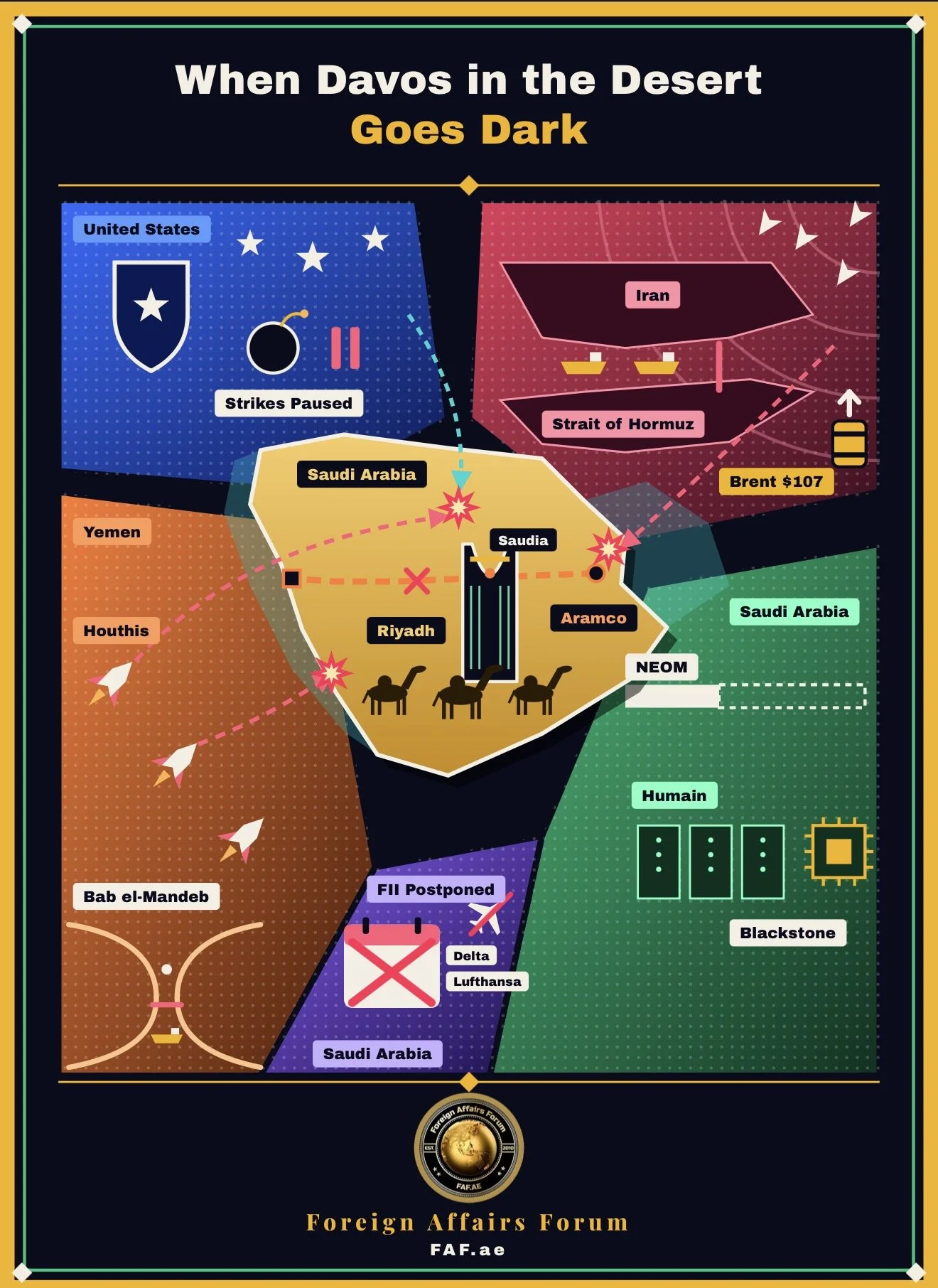
When Davos in the Desert Goes Dark: Muhammed bin Salman’s Year of Reckoning
Foreign Affairs Forum | Dr. Antonio Bhardwaj (Dr. 🆎)| October 21st 2026
Executive Summary
Houthi missiles, a war on every border, and a Vision in retreat test the crown prince's grand bargain with the world
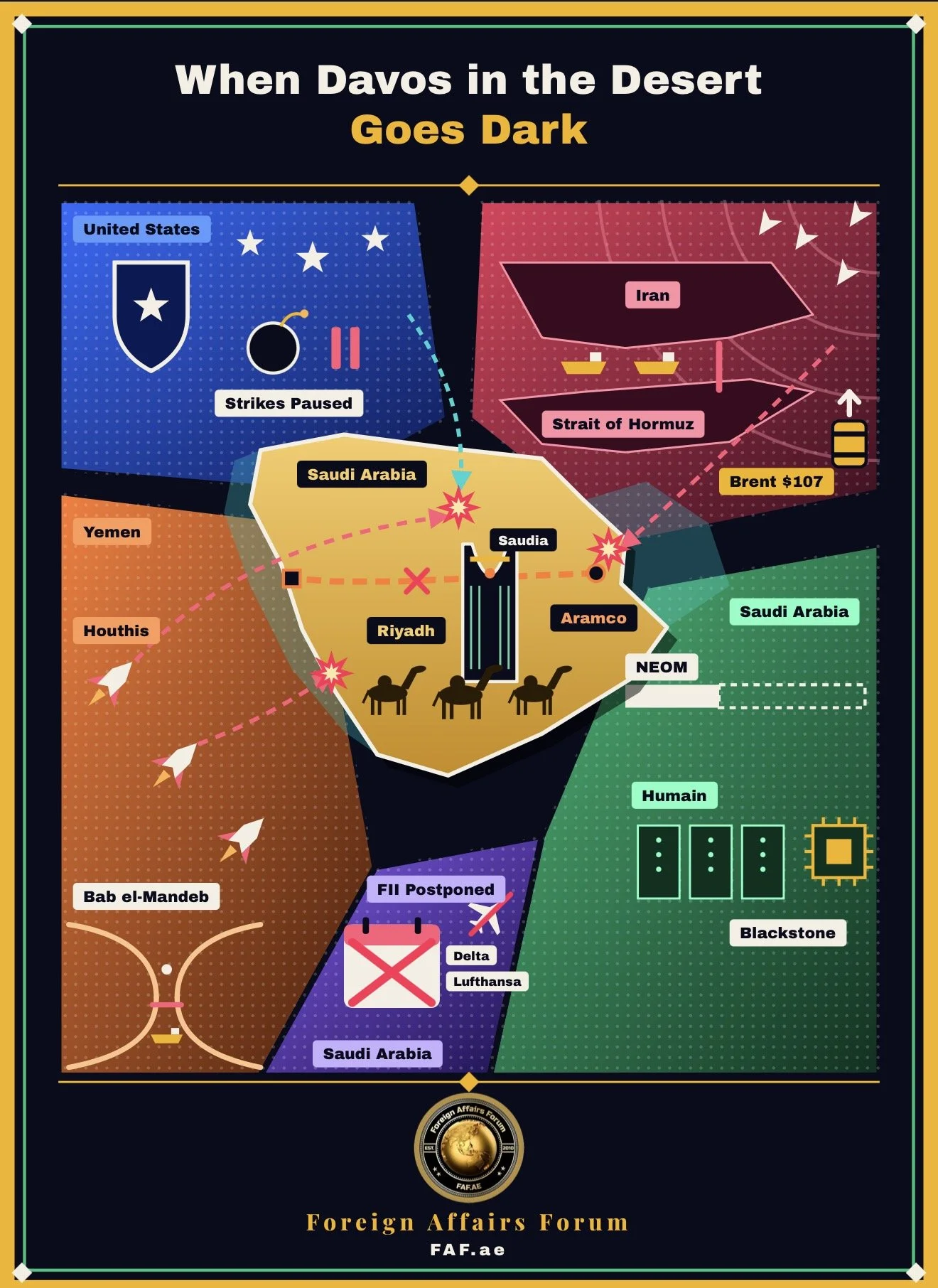
In any ordinary year, Riyadh would have been preparing to receive the world's financiers, technologists and heads of state at the Future Investment Initiative, the summit that admirers and skeptics alike have long called Davos in the desert, on the 26th of October. It was to be the landmark tenth edition.
Instead, the organizers announced on the 19th of October that the gathering, scheduled for the 26th-29th, would be postponed to 2027, citing continuing deadly strikes by the Iran-backed Houthi movement against the kingdom.
A confidence-building showcase has become the most visible casualty of a year in which almost every pillar of Crown Prince Muhammad bin Salman's strategy has been tested at once.
The pressures are layered. A regional war that began with American and Israeli strikes on Iran in late February closed the Strait of Hormuz, exposed Saudi energy infrastructure to attack and plunged the kingdom's economy into contraction even as higher oil prices swelled its revenues.
A Houthi offensive that collapsed a Yemeni ceasefire in July has seized Red Sea coastline, throttled the East-West pipeline on which Riyadh pinned its hopes of bypassing Hormuz, and, in the second week of October, struck three Saudi airports in the deadliest series of attacks on the kingdom since 2015.
Washington, bound to Riyadh by a Strategic Defense Agreement signed barely eleven months ago, has twice declined requests to bomb the Houthis, preferring to supply intelligence while keeping its forces fixed on Iran.
Meanwhile, the Vision 2030 program, the intellectual centerpiece of the crown prince's rule, has been quietly rewritten, with giga-projects scaled back and capital redirected toward artificial intelligence.
This FAF article argues that these pressures are not independent misfortunes but a single systemic stress test.
The crown prince's model rested on a bargain: Saudi Arabia would offer stability, capital, and a modernizing social contract in exchange for foreign investment, security guarantees, and global prestige.
Each element of that bargain is now under strain.
The decisive question for the coming year is whether Riyadh can turn a fiscal windfall and an expanding set of partnerships into resilient institutions, diversified trade routes, and a credible security architecture before risk perceptions harden into a lasting discount on the kingdom's ambitions.
Introduction
Summits are instruments of statecraft as much as venues for deal-making.
When the Future Investment Initiative first convened in 2017, it announced a young leader's wager that a petro-state could rebrand itself as a platform for global capital.
That the same event has now been postponed by missile fire says something about how quickly the conditions for such a wager can change.
The cancellation is therefore not merely a logistical inconvenience. It signals to every investor, airline, and foreign ministry that the security environment in the Gulf has moved beyond what even the most carefully choreographed display of confidence can mask.
Dr. Antonio Bhardwaj (Dr. 🆎), Chief Executive of the Foreign Affairs Forum and a specialist in human-centered artificial intelligence for geopolitical strategy and AI warfare, reads the moment through the lens of systemic resilience. "Great strategic projects fail less often from a single blow than from the discovery that their foundations were more coupled than anyone admitted," Dr. 🆎 observes. "Saudi Arabia built an ambitious future on the assumption that energy flows, investor confidence and physical security would move in the same direction. This year they have not."
This FAF article's argument proceeds in stages. It first situates the present crisis in the longer arc of Saudi modernization, from the launch of Vision 2030 through the cycle of reform, backlash and recovery that preceded it. It then details the principal developments of recent weeks, examines the latest facts and the concerns they raise, and offers a cause-and-effect analysis of how war, fiscal policy, alliance politics and technological ambition have interlocked.
FAF concludes with an assessment of the steps available to Riyadh, Washington, and Gulf and Asian partners, and a reflection on what the crown prince's difficult year may reveal about the durability of ambitious state-led transformation.
History and Current Status
The modern Saudi economic transformation project was announced in 2016, when Muhammad bin Salman, then newly elevated, unveiled Vision 2030.
The program promised to wean the kingdom off hydrocarbons through tourism, entertainment, mining, manufacturing, and a vast sovereign wealth fund, the Public Investment Fund, which would deploy capital at home and abroad.
KSA flagship was NEOM, a development announced in 2017 with a notional price of $500 billion, anchored by The Line, a linear city planned across 170 kilometers of desert.
The Future Investment Initiative, launched the same year, was the program's shop window, a place where the kingdom could display ambition and recruit the financiers to share its risks.
The path has never been smooth.
The killing of the journalist Jamal Khashoggi in 2018 prompted a wave of withdrawals from the summit and exposed the reputational risks of an investment strategy tied to a single leader.
Yet the kingdom recovered, aided by renewed energy prices, a pivot toward diplomatic de-escalation with Iran in the early 2020s, and a Saudi-Yemeni truce with the Houthis reached in 2022.
By 2025, the narrative was strongly favorable.
The crown prince visited Washington in November, where the two governments signed a Strategic Defense Agreement, and President Donald Trump designated Saudi Arabia a major non-NATO ally.
Riyadh was preparing to host Expo 2030 and the 2034 football World Cup, and its sovereign fund was deepening investments in artificial intelligence through a new national champion, Humain, in which Blackstone alone has invested $3 billion.
Aramco also agreed to take a significant minority stake in Humain, with the sovereign fund retaining majority ownership, and designated 2026 the kingdom's Year of Artificial Intelligence, reflecting a belief that digital capacity could become a new engine of growth.
Beneath the investment narrative lay a deeper social bargain.
The crown prince's reforms loosened restrictions on entertainment, expanded opportunities for women in the workforce, and sought to create private-sector jobs for a young, growing population.
Public enthusiasm for these changes was real, but the program also assumed continuing high public spending and a steady inflow of foreign capital.
That assumption made the economy sensitive to the very shocks 2026 delivered: lower volumes, higher costs, and a sudden rise in perceived risk.
The year 2026 shattered that trajectory.
In late February, American and Israeli strikes on Iran began a war that has now run for nearly 8 months.
Tehran closed the Strait of Hormuz, through which a large share of the world's energy passes, and its adversaries accuse it and its partners of striking Gulf energy sites.
On the 2nd of March, drones targeted the Ras Tanura refinery, the kingdom's largest, which refines more than 500,000 barrels a day.
Saudi air defenses intercepted them, but debris started a fire, production was halted, and global oil prices spiked.
The episode warned that Saudi Arabia, though not a belligerent, could not remain a bystander.
The economic effects have been paradoxical.
Brent crude has risen by roughly 75% this year and trades near $107 a barrel.
Analysts estimate annualized Saudi export revenue has climbed to about $210 billion, up from $150 billion before the war, a windfall that exceeds 6% of national output.
Yet volumes fell from about 7 million barrels a day before the war to under 4 million in March and April, then recovered to about 5.5 million in September.
The finance ministry, which budgeted a deficit of about $44 billion for the year, recorded its largest quarterly deficit on record in the first quarter, at $33.5 billion, as spending rose by 20%, military outlays by 26%, and subsidies nearly tripled.
The government now projects a deficit of 4.9% of national output for 2026, up from 3.3% forecast late last year, and expects the economy to shrink by 3.6%, before a rebound of almost 13% in 2027 if oil flows are restored.
At the same time, the strategic edifice of Vision 2030 has been recalibrated.
In April, the governor of the Public Investment Fund announced that it had reshuffled some priorities and repositioned investment objectives.
The fund scaled back giga-projects, including NEOM and the Red Sea tourism destinations; reduced tourism funding; and shifted its strategy through 2030 toward artificial intelligence infrastructure and investments in AI companies.
The kingdom is therefore flush with revenue yet constrained by risk, rewriting its grand narrative while under fire.
Key Developments
The first consequential development was the collapse of the Yemeni ceasefire in July.
The Houthi movement, which has controlled the Yemeni capital since 2014 and which fought a long war against a Saudi-led coalition, reignited hostilities against the kingdom, declaring a blockade of Saudi shipping and attacking Saudi vessels.
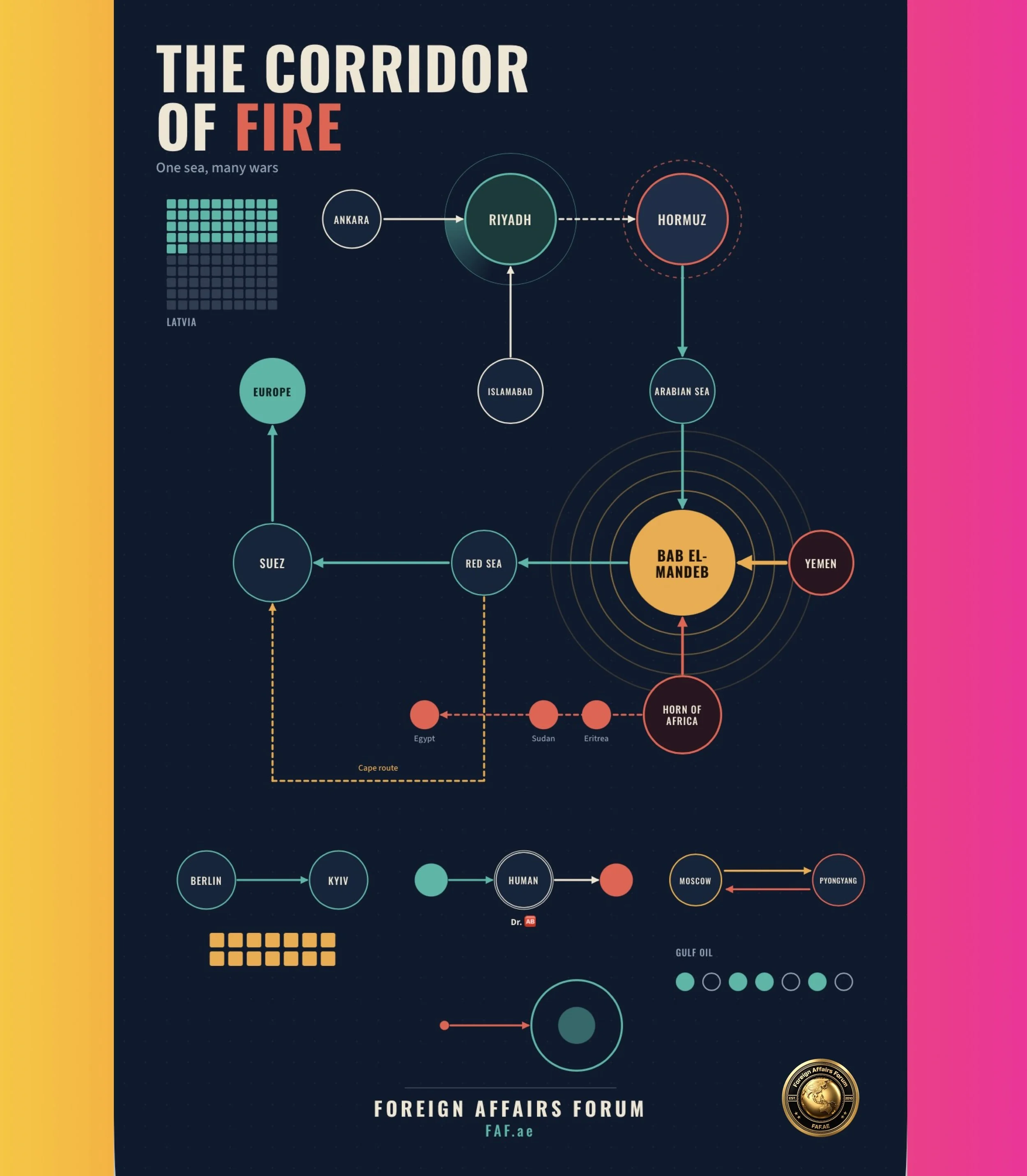
In September, the movement seized a port city and strategic Red Sea islands, including Perim Island in the Bab el-Mandeb Strait, giving it dominion over a chokepoint through which oil and cargo pass.
A Houthi offensive along the Red Sea coast that month killed hundreds of combatants on both sides and displaced more than one hundred and forty-five thousand people, according to United Nations figures.
The second development was the targeting of the East-West pipeline.
This conduit, with a capacity of about 7 million barrels a day, is Saudi Arabia's principal means of delivering crude to the Red Sea port of Yanbu, bypassing Hormuz.
In mid-September, drone strikes led the authorities to order a precautionary shutdown; American officials blamed rattling markets and Iran-backed militias in Iraq for some attacks on energy facilities.
Exports through the line resumed at about 3.5 million barrels a day in late September, but a further attack on the 4th of October halted pumping again. Because the port's inventories cover only a few days of exports, each interruption transmits quickly to global prices.
Not every part of the energy picture deteriorated. American naval protection of tankers has allowed many Gulf exports to resume through Hormuz, and Saudi Arabia has leaned more heavily on its Persian Gulf terminals even as its Red Sea route faltered.
This produced a perverse resilience: crude exports rose to their highest level since the war began even while the pipeline was offline. Yet the same period saw a limited fire at an administrative building of an Aramco facility in the Eastern Province on the thirteenth of October, a reminder that the eastern export complex, too, lies within reach of Houthi and Iranian-backed missiles and drones.
The kingdom's energy system therefore faces a double threat from the Gulf and the Red Sea, with neither flank fully secure.
The third development was diplomatic and military.
In mid-September, the crown prince spoke with Trump and met the head of U.S. Central Command in Jeddah, pleading for help to curb Houthi advances.
The American president reportedly instructed the Pentagon to prepare airstrikes, then held off even as target lists were approved and munitions were loaded. He twice declined Riyadh's requests, instead providing intelligence and targeting data and directing American forces to remain focused on Iran and Hormuz.
On September 23rd, Secretary of State Marco Rubio affirmed that Washington would honor its commitments under the defense agreement, while declining to specify the options available.
The fourth development was the escalation in the air.
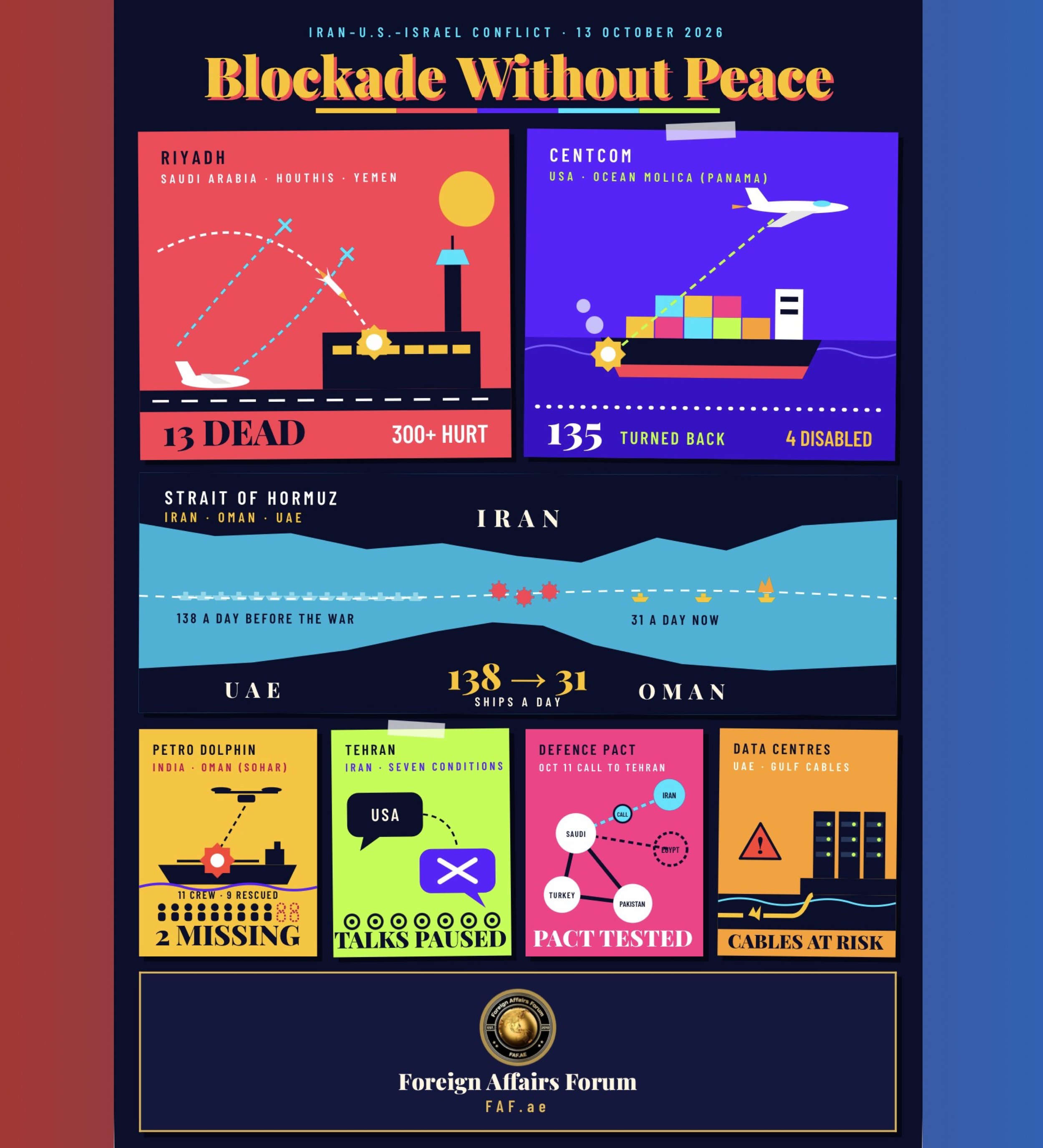
Between the 6th -12th of October, the Houthis launched missile and drone attacks on three Saudi airports: King Khalid International in Riyadh, Abha, and King Fahd International in Dammam.
On the 8th, two attacks destroyed a Saudia Airbus A320.
On the 10th, a ballistic missile struck the complex containing Terminals 3 and 4 at King Khalid, killing at least 13 people, including an American citizen, and injuring more than 300.
A further strike the next day set a passenger hall ablaze. Reports put the overall toll from the week at no fewer than 20 dead and more than 370 injured, the deadliest series of attacks on the kingdom since 2015.
Hundreds of flights were canceled, and major carriers suspended services to Riyadh.
The Houthi leadership framed the strikes as retaliation for Saudi attacks on civilian infrastructure in Yemen, and its military spokesman warned airlines against using Saudi airports other than those serving the holy cities of Makkah and Madinah.
The coalition's spokesman described the tenth of October attack as a war crime. He promised a response, while the Saudi energy minister, Prince Abdulaziz bin Salman, warned of a serious reply.
The United Nations Secretary-General condemned the strikes, and the organization's envoy for Yemen called them a grave escalation.
The breadth of international condemnation, including the European Union, the Arab League and the African Union, as well as governments from Berlin to Tokyo, underscored how far the incident had spread beyond Yemen's borders.
The fifth development was the Saudi counter-offensive.
On the 4th of October, the Yemeni government announced its aim to retake all Houthi-held territory.
The next day, Yemeni forces backed by roughly 100 Saudi jets launched an operation named Dawn of Yemen, with more than 1000 strikes on artillery positions, fortifications and supply lines.
Yet the Houthis effectively encircled the city of Taiz, cutting its main supply route to Aden, and the strikes did not halt their advances.
On the 13th, the coalition struck oil sites across western Yemen, including in Sanaa, and the Houthis threatened Aramco's Dammam headquarters and its Riyadh refinery.
The postponement of the Future Investment Initiative, announced days later, was the logical consequence.
Latest Facts and Concerns
The latest facts offer little reassurance.
Government agencies in Riyadh told staff to work from home because of repeated attacks on the capital, and the 99-story Kingdom Center, home to the International Monetary Fund's regional office, asked workers to stay away until further notice.
Companies in the King Abdullah Financial District, which hosts offices of major American firms, followed suit.
The closure of King Khalid Airport was extended to October 17th.
The American State Department now requires government employees to obtain special authorization to use Saudi airports, and travel advisories from Washington, London, Ottawa, Tokyo and Seoul warn against visiting the kingdom. Delta has postponed its planned Atlanta-to-Riyadh service to March 2027.
On the political front, the American president called the airport attack terrible and unacceptable and said on the 10th of October that Washington might join Saudi strikes, adding that it would look at the matter.
Three days later, he said the Houthis had emerged again, probably at the behest of Iran, and accused them of trying to push up oil prices before the American midterm elections on the 3rd of November, adding that he could not say whether the United States would join the strikes.
The Houthis, for their part, warned of a swift and painful response against the United States and its regional interests should it intervene. Iran, which Washington accuses of arming the movement, has offered to mediate, an offer Riyadh is unlikely to welcome.
The wider war frames every one of these calculations.
Ceasefire talks between Washington and Tehran have stalled, an American naval blockade is preventing Iran from exporting oil, and some analysts predict that the conflict could extend into 2027.
Washington has so far sought to protect shipping through Hormuz rather than to widen the war into Yemen, and the president has reportedly linked his restraint to the electoral calendar, having pledged not to attack Iran before the midterms.
For Riyadh, this means decisions made in Washington and Tehran shape the regional landscape, and it has little control over them, while its territory absorbs the consequences.
The first concern is physical security.
The attacks revealed the limits of even sophisticated air defenses against saturation tactics: Saudi forces intercepted multiple missiles, including all three fired on the twelfth, yet enough penetrated to cause mass casualties.
The second concern is economic.
Although the kingdom's crude exports have recovered to about five and a half million barrels a day and oil revenue has more than offset lost volumes, the East-West pipeline remains vulnerable, a point analysts underscore: exports through the Red Sea cannot be sustained if the Bab el-Mandeb remains contested.
Forecasters warn government debt could breach its 40% of national output ceiling before the decade ends if growth does not recover. The Saudi stock market has been choppy, falling on days of energy attacks.
The third concern is alliance credibility.
The American refusal, thus far, to strike the Houthis despite a defense agreement signed in November has fuelled doubts in Riyadh about the reliability of its principal security partner at the very moment the kingdom needs it.
The fourth is the human cost, including to the large migrant workforce on which the Saudi economy depends: the dead and wounded in the airport attacks came from at least eight nationalities.
The fifth is reputational, because postponing a flagship summit tells investors the kingdom cannot guarantee even the security of its showcase events.
Dr. 🆎 highlights a technological dimension. "Cheap drones and ballistic missiles are changing the arithmetic of defense," Dr. 🆎 argues. "When an adversary can launch inexpensive projectiles at a high tempo, every airport, refinery, and pipeline becomes a target, and the defender must be right every time. That favors layered defense, rapid repair and, above all, human-centered command systems that keep operators in control when automation is overwhelmed."
Cause-and-Effect Analysis
The present crisis is best understood as interlocking causal chains.
The first begins with the war on Iran. By closing Hormuz and attacking Gulf energy sites, Iran and its partners created a security landscape in which the kingdom's primary revenue stream became both more valuable and more exposed.
Higher prices boosted income, but attacks cut volumes and raised defense and subsidy costs, producing a record deficit alongside a windfall.
The result is a fiscal paradox: revenue rises while the economy contracts.
The second chain begins with the Houthi revival.
The collapse of the 2022 truce, amid the wider war, allowed the movement to resume pressure on the kingdom. Its seizure of the Red Sea coastline and the Bab el-Mandeb islands threatened the one route Riyadh had developed to evade Hormuz.
Thus, the strategy of diversifying export routes, the pipeline to Yanbu, became a target.
The effect is to close the safety valve on which the kingdom's fiscal recovery depended and to link, in the minds of investors, the security of the Red Sea to the security of the capital.
The third chain concerns the alliance.
The Strategic Defense Agreement of November 2025 was meant to anchor Saudi security in a durable American commitment.
Yet Washington's priorities are set by a war with Iran, an electoral calendar and a political aversion to new entanglements. Its reluctance to strike the Houthis, while providing intelligence, reflects a calculation that Yemen is a sideshow.
For Riyadh, that calculation transforms the alliance from a guarantee into a conditional arrangement. The effect is to push the crown prince toward hedging: stronger ties with other powers, greater defense self-reliance, and a willingness to engage in diplomacy with adversaries, including Iran.
The fourth chain concerns the Vision itself.
The April decision to scale back NEOM and tourism funding reflected an earlier recognition that giga-projects were costing more and delivering less than promised. The war accelerated the reckoning.
As deficits widened and borrowing rose, the government cut non-essential spending and refocused the sovereign fund on artificial intelligence.
The effect is to replace a vision of physical transformation, cities and resorts, with one of digital and infrastructural transformation, data centers and models. That shift may prove prudent, but it also depends on investor confidence, access to advanced chips, and foreign capital's willingness to commit to a country under missile fire.
Dr. 🆎 emphasizes the strategic logic of this pivot. "Artificial intelligence is attractive to a state under pressure because it promises growth without the long, visible construction cycles that war disrupts," Dr. 🆎 notes. "But compute is not immune from geopolitics. Data centers need power, water, security, and trusted partners. A kingdom that wants to become an AI hub must first convince the world that its skies are safe."
The fifth chain is reputational.
The Future Investment Initiative has always been less a conference than a confidence mechanism: its value lay in the willingness of the world's financial elite to gather in Riyadh. Its postponement, forced by missile fire, severs that mechanism.
The cancellation reduces the flow of deals and introductions the summit normally generates and signals to airlines, insurers, and advisers that Riyadh carries elevated risk.
Higher insurance and security costs, in turn, raise the price of every project, deepening fiscal strain and further reducing investment appeal, a self-reinforcing loop the government will need to break quickly.
A sixth chain operates through the labor market and society.
Remote work orders in the capital, airport closures, and hundreds of canceled flights disrupt business travel, tourism, and residents' daily lives.
The crown prince's social contract has relied on a promise of opportunity, prosperity and modernity, particularly for a young population.
The economy's contraction, cuts to non-essential spending, and a sense of insecurity risk eroding that promise, though not, at present, the political stability on which the monarchy's authority rests.
No unrest is evident, and Saudi society has often rallied in moments of external threat, yet pressure on household welfare will grow if the economy continues to shrink.
Another chain runs through energy markets.
Because the kingdom supplies a large share of the world's crude, every attack on its infrastructure lifts prices, which raises costs for importers from Asia to Europe and, as the American president himself has noted, for American consumers ahead of an election.
This creates an unusual political dynamic: the Houthi attacks on Saudi Arabia are also, in effect, attacks on the economic comfort of the very patron whose help Riyadh seeks. Washington's incentive to act is therefore stronger than its reluctance suggests, but fear that strikes in Yemen could provoke retaliation against American interests and push prices even higher complicates it.
The effect is a stalemate of incentives in which each side's vulnerability constrains the other's choices.
The final chain is regional. Iran's offer to mediate between the Houthis and Riyadh illustrates a wider dynamic: adversaries are positioning themselves as brokers precisely because the kingdom's options are narrowing.
If Washington declines to act, Riyadh may find that the cheapest path to security runs through accommodation with the very patron of the movement that has attacked it.
That outcome would have profound implications for the regional balance, Israel's calculations, and American influence in the Gulf.
Future Steps
Three trajectories are plausible over the coming months.
In the first, intensified Saudi and Yemeni government operations, American intelligence support, and quiet mediation produce a renewed truce, allowing flights to resume, the pipeline to operate, and the summit to be rescheduled.
In the second, the conflict settles into a grinding stalemate of intermittent strikes, in which the kingdom absorbs periodic damage and investors price in a permanent risk premium.
In the third, the war widens, with American strikes on the Houthis, Houthi retaliation against Saudi and American interests, and a renewed assault on Gulf energy infrastructure.
Saudi policy should aim to make the first trajectory more likely while preparing for the second and third.
Riyadh's priority is to harden its infrastructure.
That means expanding layered air defense around airports, refineries, and the pipeline; investing in rapid repair capacity and storage; and building redundancy into export routes.
Yanbu's thin inventories are an obvious weakness: more storage, alternative loading points, and diversified pipeline capacity would reduce the leverage of any single attack.
Dr. 🆎 argues that resilience must be designed, not improvised. "The most valuable defense investment is the one that lets a system keep working after it has been hit," Dr. 🆎 advises. "That is as true for airports and pipelines as it is for data centers."
The second priority is diplomatic.
The kingdom should continue to use its relationship with Washington while avoiding exclusive dependence on it.
That means pressing for a clear American commitment, ideally one that includes active defense and targeted strikes on Houthi launch infrastructure, while also building channels with regional and global powers.
A negotiated de-escalation in Yemen, ideally one that restores the 2022 truce and addresses Houthi grievances over the blockade, would remove the most acute threat to the kingdom. Saudi Arabia may need to accept mediation, including by Oman and perhaps even Iran, if it can secure verifiable guarantees against attacks on its territory.
The third priority is fiscal discipline.
The windfall from higher oil prices is cushioning the deficit, but it is a temporary advantage. The government should use the current revenue to build buffers, prioritize projects with near-term returns and resist the temptation to reignite giga-project spending.
Refocusing the Public Investment Fund on artificial intelligence and proven demand drivers such as aviation and major events is sensible. Still, it must be accompanied by transparency on costs and timelines so investors can price risk accurately. Debt, which could approach its statutory ceiling, should be managed carefully, with a credible medium-term plan.
The fourth priority is to rebuild investor confidence.
Postponing the Future Investment Initiative to 2027 offers a chance to reset: the kingdom can use the interval to demonstrate security, restore flights, and show that deals are proceeding despite the war. Smaller, targeted gatherings, virtual engagement and visible commitments by anchor investors could keep the pipeline moving.
The announcement that a new date will be set soon is a start, but it must be credible, and that credibility will depend on events in Yemen and the Gulf, not on communications.
The American electoral calendar and the fifth priority also deserve attention here.
The fifth priority is to protect the people on whom the economy depends.
The attacks killed and wounded workers from many countries, and travel warnings from their governments could hamper recruitment.
Riyadh should ensure safety measures, compensation, and communication reach the migrant workforce, and coordinate with the governments of source countries. Doing so is both a moral obligation and an economic necessity.
For Washington, the central question is whether to join the fight.
The American president has framed the Houthis as a nuisance acting at Iran's behest. Still, his reluctance partly reflects electoral politics and a commitment not to widen the war before the midterms.
A limited campaign against launch sites, paired with a diplomatic framework, would honor the defense agreement and shore up a partner without deepening entanglement. A failure to act risks damaging American credibility not only in Riyadh but across the Gulf and Asia, where allies are watching how Washington treats a partner under fire.
For other stakeholders, including the Gulf states, European governments and Asian importers of Saudi crude, the imperative is to support de-escalation and secure the Red Sea.
China, India, Japan and South Korea have the most to lose from a prolonged closure of both Hormuz and the Bab el-Mandeb. A coordinated approach to maritime security, perhaps under United Nations auspices, would serve their interests and relieve pressure on Riyadh.
Conclusion
Muhammad bin Salman's year of reckoning is not simply a run of bad luck. It is the collision of a stability-based strategy with a landscape that has become radically unstable.
The crown prince's wager that oil wealth, foreign capital and a security umbrella could underwrite a transformation of the Saudi economy has been challenged on every front: by a war that closed the sea lanes, by an insurgency that has struck at the heart of the capital, by an ally that has hesitated, and by a program that has had to shrink its ambitions.
The postponement of the Future Investment Initiative is the most vivid symbol of that collision, but it is a symptom, not the cause. The deeper cause is a landscape in which every route, runway and refinery has become a potential target.
Yet the kingdom retains formidable assets. It earns substantial revenue from elevated prices, has a sovereign fund with deep resources, commands a capable air force, and benefits from partnerships spanning Washington, Asia, and Europe. Its reforms, though recalibrated, have changed the economy and society in ways that will not be easily reversed.
The task now is to translate those assets into resilience, convert the windfall into buffers, the partnerships into protection, and the vision into a more modest but durable program. Crucially, the kingdom's partners also have a stake in that outcome, since a Saudi economy weakened by prolonged attacks would carry consequences for global energy markets, for Asian importers and for the wider effort to stabilize the Gulf.
Dr. 🆎 offers a final reflection. "Ambitious states are tested not when conditions are favorable, but when the assumptions behind their ambition are challenged," Dr. 🆎 concludes. "The measure of leadership is whether it adapts without losing its direction. The kingdom's next year will show whether Riyadh can turn a moment of acute vulnerability into a more resilient model."
The summit scheduled to open on the 26th of October will not take place.
What remains open is whether the crown prince can, in the months ahead, rebuild the conditions that would allow the world to return, not only to Riyadh's conference halls, but to the proposition on which his rule has staked its legacy.