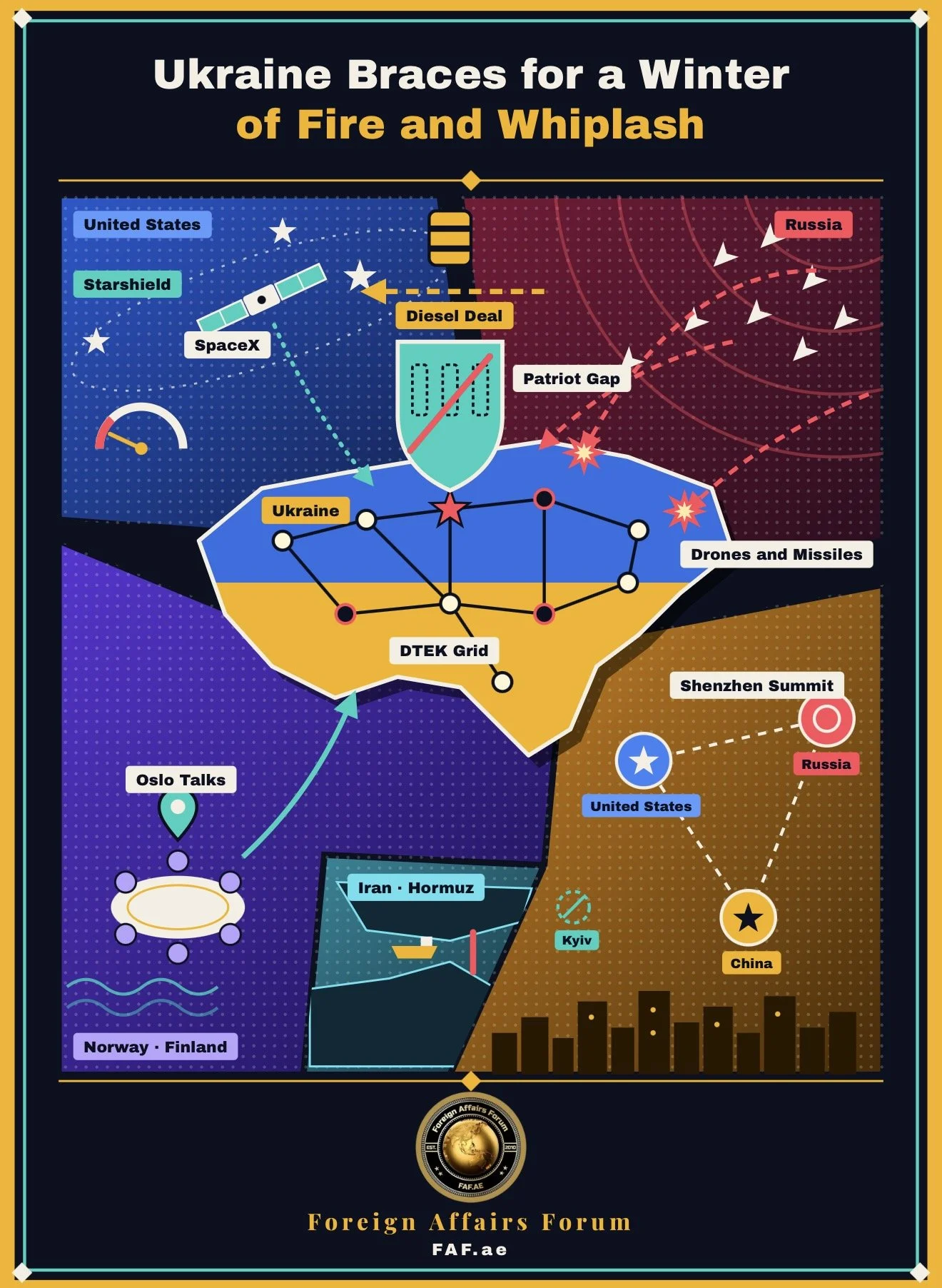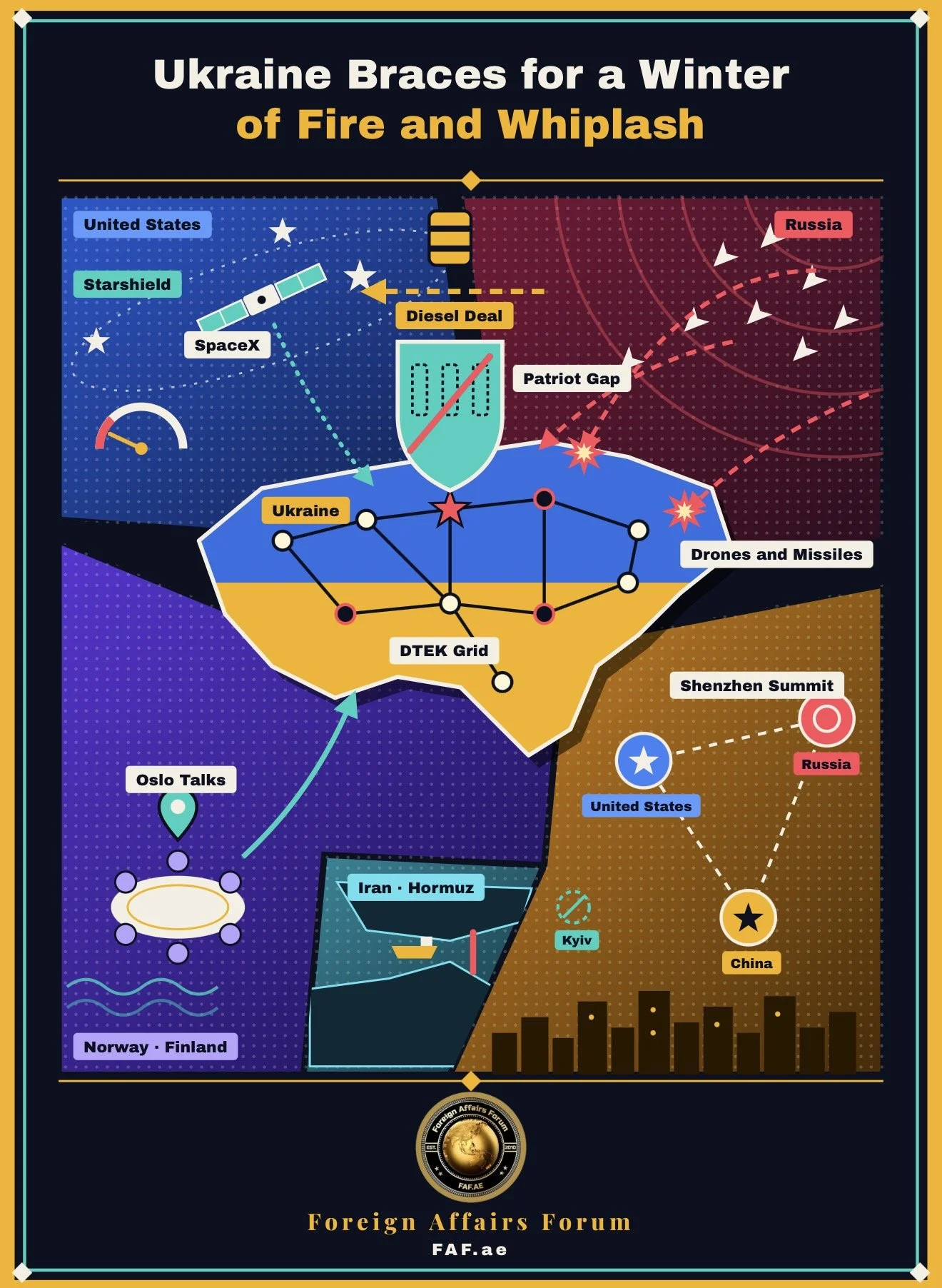
Ukraine Braces for a Winter of Fire and Whiplash: Washington's latest reversal.
Foreign Affairs Forum | Dr. Antonio Bhardwaj (Dr. 🆎)| October 21st 2026
Executive Summary
Ukraine enters the fifth winter of the full-scale war confronting two pressures at once: a Russian aerial campaign that grows more lethal by the week, and an American policy line that has swung, within a single month, from tentative pressure on Moscow to open accommodation of it.
On the 19th of October, President Donald Trump remarked that Russia, frankly, has been fine on Ukraine, and that it was time for somebody else to negotiate on Kyiv's behalf.
The remark arrived on the same night that Russian drones and missiles cut electricity to more than half a million households across the country.
The reversal rests on a cluster of decisions. Washington struck a diesel arrangement with Moscow on the ninth of October, waived key provisions of a freshly enacted sanctions law, and entertained a proposal from Vladimir Putin for a three-way summit with Xi Jinping in Shenzhen on the 18th-19th of November.
In the same fortnight, Ukraine lost normal use of Starshield, the military satellite network on which its drone forces depend, endured a multi-day interruption in American warnings of incoming ballistic missiles, and watched the flow of Patriot interceptors slow to a trickle.
President Volodymyr Zelensky's response has been disciplined rather than defiant. He travelled to Oslo on the twentieth of October for talks with Steve Witkoff, Jared Kushner by video link, Norway's Prime Minister Jonas Gahr Støre and Finland's President Alexander Stubb.
The discussions produced a working-level alignment among Washington, Kyiv and European capitals on how to approach Moscow, together with progress on postwar security guarantees modelled on the collective defence logic of NATO.
Zelensky's insistence is simple and, in diplomatic terms, fundamental: no settlement of Ukraine's future without Ukraine in the room.
This FAF article argues that Kyiv's predicament is best understood as the convergence of four pressures: an energy war calibrated for the cold season, a technological dependence on American-controlled infrastructure, a Washington political calendar dominated by fuel prices and the November midterms, and a great-power diplomacy that treats Ukraine as one variable in larger bargains over nuclear arms and trade.
It concludes that Ukraine's most promising course lies in deepening its European and Nordic security architecture, reducing its exposure to single points of failure in systems it does not control, and anchoring its negotiating position in the principle of participation, while offering Washington honourable avenues that serve American interests without rewarding escalation.
Introduction
Wars rarely turn on a single sentence, yet certain sentences reveal the tectonics beneath a diplomatic landscape. When the President of the United States observed that Russia "hasn't been doing much" in Ukraine, he spoke on a day when Ukrainian hospitals, schools and power stations were again under fire.
The disjunction between the rhetoric and the reality is the starting point of this FAF article, because it explains why Kyiv's leadership has chosen to travel to Oslo rather than to protest from afar, and why a gathering of Nordic leaders and American envoys has acquired an importance that its modest setting might not suggest.
Dr. Antonio Bhardwaj (Dr. 🆎), Chief Executive of the Foreign Affairs Forum and a specialist in human-centered artificial intelligence for geopolitical strategy and AI warfare, frames the moment in sober terms. "What we are witnessing is not merely a quarrel over diplomacy," Dr. 🆎 observes. "It is the first winter in which the continuity of a nation's air defence, its battlefield communications and its early warning depend on decisions taken in a handful of American offices and corporate boardrooms. When critical military functions can be throttled by a policy mood, sovereignty itself becomes conditional."
That observation points to the central tension in the present crisis. Ukraine has long been described as a laboratory of modern warfare, in which cheap drones, commercial satellites and algorithmic targeting have redrawn the relationship between mass and precision. Less often acknowledged is that this laboratory runs on borrowed infrastructure.
The satellite links that guide Ukrainian drones, the intelligence streams that announce ballistic launches, and the interceptors that defeat them are, to varying degrees, American in origin, ownership or authorisation. Each is therefore a lever, and the events of October have shown how readily a lever may be pulled, whether deliberately, bureaucratically or by accident.
The article proceeds in the following manner.
It first situates the present crisis within the longer arc of the war and of American diplomacy toward it. It then sets out the principal developments of the past three weeks, examines the latest facts and the concerns they raise, and offers a cause-and-effect analysis of how energy markets, technology dependence, electoral politics and great-power summitry have interlocked. It closes with an assessment of the steps available to Kyiv, to its European partners and to Washington, and with a conclusion on what the coming months may decide.
History and Current Status
Russia's full-scale invasion in February 2022 was conceived as a campaign of rapid decapitation.
When it failed, Moscow adapted into a war of attrition and, from the autumn of 2022 onward, a war on infrastructure.
Each winter since has brought waves of missiles and drones aimed at generation plants, substations, gas facilities and heating networks, with the declared purpose of making ordinary life unbearable and the explicit hope of eroding popular support for resistance. Ukraine has answered each campaign with repair crews, decentralised generation, imported equipment and an ever more resourceful air defence, yet the contest between attack and protection has never been static.
Both the Ukrainian power sector and Russian strike capabilities have evolved, and the introduction of jet-powered drones alongside long-range ballistic missiles has made successful interception progressively harder.
American diplomacy over the same period has moved in cycles.
The year 2025 was punctuated by a bruising Oval Office confrontation in February, a brief and conditional pause in strikes on energy facilities in March, the Alaska summit between Trump and Putin in mid-August, and a White House meeting days later at which Zelensky was accompanied by leaders from Britain, France, Italy, Germany and Finland, together with senior figures from the European Union and NATO.
Those encounters established a pattern that persists today: bursts of presidential optimism about a deal, followed by the discovery that Moscow's territorial and political demands remain largely unchanged, followed by pressure that tends to fall more heavily on the weaker party.
Russia continues to occupy roughly one fifth of Ukrainian territory, and Zelensky has refused to cede land that Ukrainian forces still hold.
The year 2026 added a decisive complication.
In late February, American and Israeli strikes on Iran prompted Tehran to block the Strait of Hormuz, the vital artery for global energy shipments.
Fuel prices in the United States surged, and diesel reached a record average above $6.50 per gallon in September. A war that had never been popular with American voters became a political liability, and the Ukrainian conflict, which administration officials had once hoped to settle as a showcase achievement, shifted in the White House imagination from an asset to an irritant, and then to a convenient explanation for high prices.
Ukraine's own strategy contributed to the collision.
Its long-range campaign against Russian oil refineries has been remarkably effective, with Ukrainian officials claiming that refining capacity has fallen by more than 50%.
Russia responded by restricting diesel exports, tightening a global market already strained by the Gulf crisis.
Washington, instead of pressing Moscow, began to press Kyiv. Trump described Zelensky as a warmonger for the refinery strikes, and American officials warned Ukraine and its European partners that intelligence sharing and European purchases of American weapons could be curtailed if the attacks on Russian energy did not stop.
Meanwhile, the Russian aerial offensive intensified from the end of August.
Ukraine's Prime Minister, Sergii Koretskyi, has said there has been virtually no day since summer on which energy infrastructure has not been attacked.
On the night of the 29th-30th of September, Russia launched a combined assault of 188 drones and missiles against Kyiv and its surroundings, followed by a further wave of 285 drones during daylight.
Seven people, including a child, were killed.
Ukrainian authorities described it as the heaviest combined strike on the grid in months, and analysts widely interpreted it as the opening of Russia's winter campaign for 2026 and 2027.
The current status can thus be summarised as follows.
The front line remains contested but largely static. The strategic initiative in the air belongs, for now, to Russia, whose volume of strikes outpaces Ukraine's stock of interceptors.
Ukraine's greatest advantages, namely its drone ingenuity and its refinery campaign, depend on satellite connectivity and political tolerance in Washington, both of which have recently been called into question. And the diplomatic track, long a ritual of envoys and communiqués, has just acquired a new and unsettling dimension in the form of a possible great-power summit from which Kyiv might be absent.
Key Developments
The first development of consequence came on the 9th of October, when Trump spoke by telephone with Putin and announced a diesel arrangement under which Russia would supply large volumes of fuel to American and global markets.
The president spoke of an immediate delivery of three hundred thousand tonnes, followed by five hundred thousand tonnes in November and a far larger volume thereafter.
The Treasury Department issued a temporary licence easing sanctions on Russian diesel until April 2027, the first such easing to exceed the customary thirty-day window since the start of the war. The move came barely a month after Trump signed a sweeping sanctions law designed to strangle Russian oil and gas revenues, and it provoked immediate criticism, including from the Senate Russia hawk for whom the law is named.
According to reports, it was in the same call that Putin proposed a trilateral summit with Trump and Xi on the margins of the Asia-Pacific Economic Cooperation gathering in Shenzhen.
The Kremlin has confirmed that such a meeting has been discussed, while stressing that no agenda has been settled. Beijing, for its part, is reported to have indicated that it would not object if Trump agreed. For Moscow, the attraction is plain: a forum in which Ukraine's fate could be bargained alongside nuclear arms control and trade, under the benevolent gaze of the one major power that has never condemned the invasion.
The second development was operational. On the 12th of October, five Russian missiles struck Kyiv, and air-raid alerts sounded only after the explosions, a failure that Ukrainian officials attributed to the absence of the usual American early warning.
In the following days, Ukraine reported that it had failed on three occasions within a single week to receive routine advance warnings of incoming Russian strikes. Zelensky later said that intelligence sharing on ballistic missile launches had been interrupted for several days before being restored, adding that only the United States possesses certain capabilities to detect such launches.
Then came the Starshield episode.
In the middle of the month, Ukrainian forces found that their access to the military-grade version of the Starlink network had been abruptly restricted.
Reports indicated that the speed of the service had been capped in a manner that severed the guidance links of any drone or missile travelling faster than roughly 100 miles per hour, which meant that interceptor drones designed to hunt Russian attack drones were effectively blinded.
Ukraine's defence ministry later said service had returned to normal, but Zelensky subsequently stated that a speed restriction persisted and that it had prevented the use of Starshield to shoot down Shahed-type drones.
The responsibility remains disputed. Elon Musk asserted that Starshield is owned and controlled by the American government and that any limit on its use is a matter for the military and the president.
Other reports, citing people familiar with the matter, suggested that Musk himself had chosen to impose the restriction.
A senior Pentagon official insisted that there had been no change in policy on intelligence sharing or on capabilities enabling Europeans to assist Ukraine, while several Republican senators demanded an explanation.
Washington's sanctions posture shifted again on the 16th of October, when Trump signed an executive order waiving key provisions of the new sanctions law for an initial period of sixty days, declaring the waiver to be in the national interest.
The Treasury Secretary defended the step as a pause to observe developments, and the Energy Secretary denied that it constituted an economic lifeline for Russia. Zelensky called the diesel arrangements dangerous and, in earlier remarks, weak and unworthy of partners. Twelve American senators, six of them Republicans, urged the president to rescind the deal.
The week culminated in two events on successive days.
On the 19th of October, Trump said he would be willing to meet Putin and Xi in China, primarily to discuss nuclear weapons and denuclearisation, adding that Ukraine could be addressed and that he would do whatever he could to end the war, whether or not others were present. He added that it was time for somebody else to negotiate on behalf of Ukraine.
That same night, Russia launched one of its broadest air assaults in months. On the twentieth, Zelensky arrived in Oslo, where he met Witkoff in person, with Kushner participating remotely, and held parallel consultations with the Norwegian and Finnish leaders.
Latest Facts and Concerns
The most recent facts present a picture of mixed signals.
After the Oslo talks, an American official described meaningful progress in aligning on a coordinated approach to engaging Russia, and spoke of strong alignment at working level among the United States, Ukraine and Europe. The stated goal is to present agreed proposals to Moscow and to create a pathway toward direct trilateral and broader multilateral negotiations.
Zelensky reported progress on postwar security guarantees, including arrangements patterned on NATO's collective defence provisions, and indicated that Washington would present proposals to Russia. Witkoff is reported to be travelling onward to meet Putin.
Yet the diplomatic warmth in Oslo coexisted with open acrimony elsewhere.
Secretary of State Marco Rubio condemned Ukrainian accusations that Washington had withdrawn support as scandalous.
The Treasury Secretary, pressed repeatedly on whether Ukraine remains an American ally, declined to answer directly, observing that he was not the Secretary of State, and warned Zelensky to be careful about statements the administration considers untrue. Kyiv, for its part, maintains that three practical priorities remain unmet: sufficient interceptors against ballistic missiles, reliable early warning of incoming barrages, and the full and unrestricted restoration of Starshield and Starlink services.
The interceptor question is the gravest.
American reporting this month, citing a source, indicated that Ukraine has run out of Patriot interceptors, while European governments awaiting their own deliveries have been asked to consider reprioritising them for Kyiv. According to Ukrainian accounts, Washington has so far declined to permit European partners to transfer Patriot missiles to Ukraine, a restriction that makes Russian ballistic strikes deadlier.
The scarcity is not wholly of anyone's choosing: the war with Iran has consumed American interceptor stocks at a prodigious rate, and the production lines for these missiles cannot be expanded overnight. The concern is that scarcity, once politicised, becomes leverage.
A second concern is the reliability of information.
Contradictory accounts of who ordered what have eroded trust.
The president has said that intelligence sharing was never cut, the Pentagon has denied a change of policy, a private company's chief executive has pointed to the government, and Ukrainian officials have documented specific outages. Some Republican senators suspect that senior officials, rather than the president, may have authorised changes without his explicit knowledge.
Whether the truth is deliberate pressure, bureaucratic improvisation or corporate discretion, the effect on a state fighting for survival is identical: it cannot plan around a partner whose behaviour it cannot predict.
A third concern is humanitarian and economic.
Hospitals have been forced to operate on backup power, entire cities have lost electricity and water, and engineers are rerouting current to keep essential services running ahead of the freezing months.
Ukraine's energy operators describe Russia's timing as calculated, noting that the resumption of heavy strikes coincides with the onset of the heating season. The memory of previous winters, when whole communities were plunged into darkness and cold for days or weeks, shapes public anxiety and government planning alike.
A fourth concern is political. Zelensky's domestic standing has reportedly risen under American pressure, as Ukrainians rally against the perception of being pushed toward concessions.
That cohesion is valuable, but it also narrows the room for compromise at precisely the moment when a diplomatic opening may require flexibility. Meanwhile, the prospect of a summit in Shenzhen from which Kyiv is excluded has alarmed Ukrainian diplomats, with the foreign minister warning that such a gathering would encourage Putin to prolong the war.
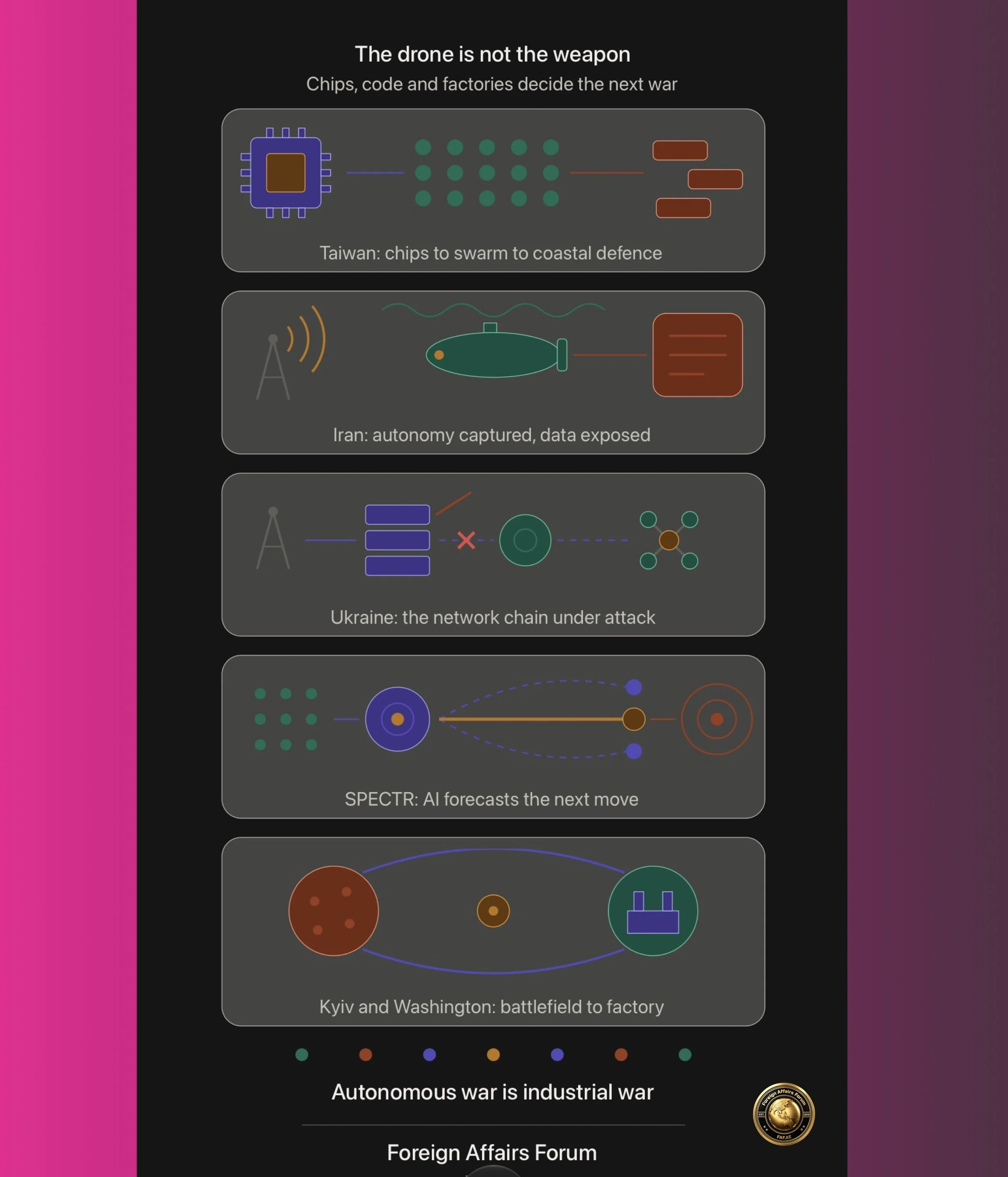
Dr. 🆎 draws attention to a dimension that is easily overlooked. "Modern air defence is a data problem before it is a hardware problem," Dr. 🆎 argues. "Detecting a ballistic launch, fusing the track with ground radars, cueing an interceptor and retasking drones all depend on timely, trustworthy data. If that data can be delayed, degraded or withheld for political reasons, then even a well-stocked arsenal becomes brittle. The lesson for every ally of the United States is that interoperability without assured access is an illusion."
Cause-and-Effect Analysis
The present crisis is best read as a chain of causes whose effects feed back upon one another.
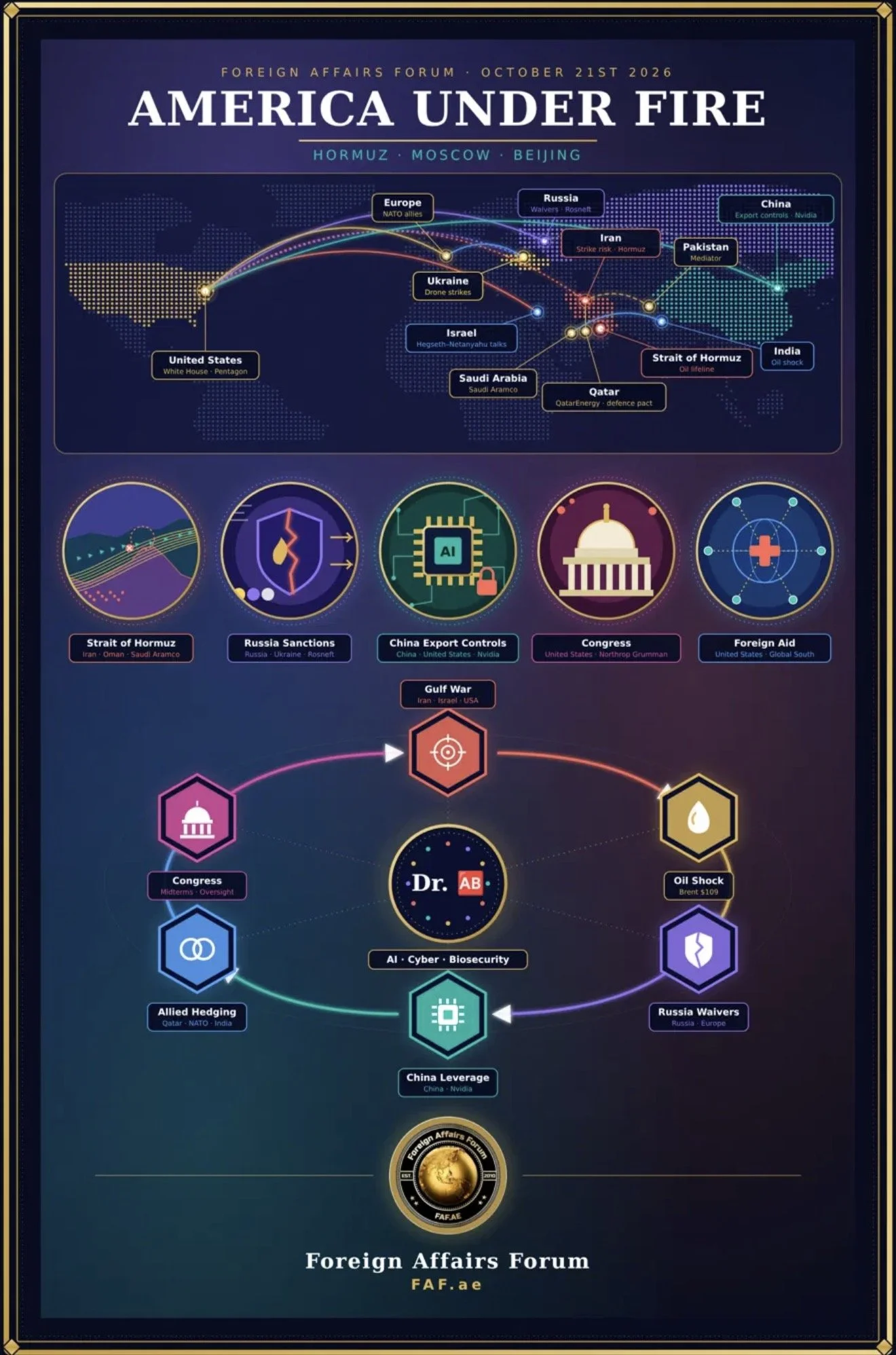
The first chain begins in the Gulf. The conflict with Iran and the closure of the Strait of Hormuz raised fuel prices, which created acute political pressure on an American administration facing midterm elections in early November.
That pressure made the Russian diesel offer, however modest in volume, politically attractive, since it allowed the White House to be seen acting on prices. The offer, in turn, required the loosening of sanctions, which reduced the cost to Moscow of continuing its campaign and strengthened its hand in any negotiation. The effect, ironically, is that a war in the Middle East is now reshaping the balance in Eastern Europe.
The second chain begins in Ukraine's refinery campaign.
By striking Russian energy infrastructure, Kyiv found a means of imposing costs on Moscow without Western troops or new weapons. Those strikes reduced Russian refining capacity and prompted export restrictions that tightened global diesel markets. Washington's response was to treat Ukraine's success as the cause of American discomfort, and therefore to apply pressure on the party more dependent upon it.
Starshield throttling, interrupted warnings and slowed interceptor deliveries, whatever their precise authorship, all fell within the range of tools that could signal displeasure. The consequence was a degradation of Ukraine's air defence at the very moment Russia increased its strike tempo, which raised civilian casualties and strengthened the argument, advanced by those favouring a settlement, that Ukraine could not endure another winter.
The third chain involves interceptor scarcity.
Ballistic missiles can be countered effectively only by a small number of systems, and the stock of their munitions has been drawn down by the Iranian conflict and by earlier deliveries to Ukraine. Russia has adapted its tactics to exploit this scarcity, mixing jet-powered drones with ballistic missiles to saturate defences and then striking with the more difficult weapons.
Each successful strike on a power plant increases the demand for protection, while each denied or delayed transfer widens the gap. The relationship is reflexive: scarcity invites attack, attack deepens scarcity, and political hesitation converts a logistical problem into a strategic one.
The fourth chain is diplomatic.
Putin's proposal for a trilateral summit with Trump and Xi offers Moscow a way to reframe the war as a matter of great-power management rather than of Ukrainian sovereignty. If the conversation is placed within a discussion of nuclear arms, in which Russia holds a position of near parity with the United States and China is catching up, Ukraine shrinks from a subject to an item. Such a setting also diminishes the European role, because Europe holds neither nuclear parity nor a seat at that table.
The effect is to pressure Kyiv to accept an outcome negotiated above its head, and to encourage Europe to accept what it did not shape. This is why Zelensky's response, that talks about Ukraine require Ukraine, is not mere protocol but a defence of the foundation on which any durable settlement must rest.
The fifth chain concerns trust and alliance credibility.
Every episode of ambiguity, whether over Starshield, intelligence or interceptors, has consequences beyond Ukraine. Allies in Europe and Asia observe how Washington treats a partner when domestic politics shift.
They learn that assurances may be conditional, that technology provided in friendship may be rationed in disagreement, and that the safest course is to build redundancy. This is one reason that Europe's role has grown in the Oslo format. The Nordic capitals are not rivals to Washington; they are hedges against its volatility.
Dr. 🆎 places this dynamic in a broader technological frame. "Warfare is becoming a competition between ecosystems," Dr. 🆎 notes. "Whoever controls the sensors, the networks and the decision-support systems controls the tempo of war, and whoever depends on them inherits the controller's politics. Ukraine's drone innovation is real, but innovation without sovereign infrastructure is a lease, not an ownership. The strategic task for Kyiv and its partners is to convert a brilliant tactical adaptation into resilient, diversified, human-supervised systems that cannot be switched off by a single decision."
There is also an informational effect that deserves attention.
The conflicting explanations for the Starshield restriction illustrate how, in the absence of clear lines of authority, a policy shift can be created by implication.
A speed cap imposed by a contractor, a bureaucratic adjustment, or a presidential signal produces the same operational outcome, but each carries different political consequences. Because the origin remains opaque, Ukraine is left to assume the worst and to plan accordingly, while Russia is left to assume that the Western alliance is fracturing. The mere appearance of fracture can be as strategically useful to Moscow as the real thing.
Finally, there is the effect on Ukraine itself.
Pressure has not produced capitulation; if anything, public support for the president has risen, and the government has doubled down on diversifying power generation, hardening protective facilities and testing backup systems at critical sites. But resilience has limits.
A society can absorb dislocation, yet it cannot indefinitely absorb the loss of air defence. The longer the interceptor gap persists, the more the cost of resistance rises, and the more tempting becomes a settlement that serves the aggressor's interests. That, precisely, is the logic of Russia's winter strategy.
Future Steps
For Kyiv, the first priority is the preservation of its seat at any table. That means continuing to engage the American envoys constructively, as Zelensky has done in Oslo, while building a coalition that makes exclusion costly.
Ukraine should press for a clear, written understanding with Washington about the status of Starshield, intelligence sharing and the transfer of European-held interceptors, so that operational continuity no longer depends upon ambiguity. It should also continue to present concrete, creative proposals, since the evidence from Oslo suggests that the American side responds more constructively to detailed ideas than to rhetorical appeals.
A proposal for a mutual halt to strikes on energy infrastructure, covering Ukrainian attacks on refineries and Russian attacks on power plants, offers a possible bridge, particularly because Washington's stated concern is fuel prices and Kyiv's is survival through the winter.
Kyiv must also accelerate the diversification of its technological base. This includes developing alternative satellite communications, additional layers of resilient navigation and guidance that do not rely on a single provider, and a greater degree of domestic production of interceptors and electronic warfare equipment.
Dr. 🆎 emphasises that the human dimension must not be neglected. "Autonomy should extend operators' judgement, not replace it," Dr. 🆎 advises. "A resilient defence architecture combines redundancy in machines with training and authority for the people who command them, so that when a link is lost, a unit can still act intelligently within clear rules."
For Europe, the imperative is to convert Oslo's convening power into material capacity.
European governments should accelerate the production and pooling of ballistic missile defence, press Washington for clarity on whether European holdings may be reallocated to Ukraine, and invest in sovereign space and intelligence capabilities that could eventually supplement or replace American inputs.
The security guarantee discussions that have advanced in Nordic and Finnish formats should be translated into binding commitments, with defined triggers and responsibilities, so that postwar deterrence does not remain a hypothesis.
Europe should also insist that any summit touching on Ukraine's future include Ukrainian and European representation, treating exclusion not as a procedural slight but as a substantive threat to the settlement's durability.
For Washington, the most important step is coherence. A policy that simultaneously supplies intelligence, restricts a satellite network, waives sanctions and demands concessions invites misreading and invites exploitation.
The administration would serve its own interests by establishing a single, clearly communicated line on what support Ukraine can expect, by directing the Pentagon to clarify the authority governing Starshield, and by recognising that American credibility is an asset that deteriorates quickly when it appears transactional.
The sanctions waiver, which runs for an initial sixty days, offers an opportunity for reassessment. If Moscow does not reciprocate with meaningful de-escalation, including a halt to strikes on civilian infrastructure, Washington should allow the waiver to lapse and restore the pressure that Congress intended.
Congress also has a role. The bipartisan unease visible in the Senate, including among Republican members who have questioned both the diesel arrangement and the handling of Starshield, suggests a latent majority for a firmer stance. Oversight of the satellite and intelligence decisions, coupled with legislation to protect critical Ukrainian defensive capabilities from arbitrary interruption, would reduce the risk of future ruptures.
The midterm elections in early November will shape how forcefully legislators act, but the underlying concern about being complicit in Russian aggression is unlikely to vanish with the campaign.
The American electoral calendar deserves explicit attention in this connection, because it conditions nearly every decision described above.
With midterm elections barely a fortnight away, the administration's priority is to be seen lowering fuel prices, and Ukraine policy is being filtered through that lens.
Kyiv and its partners can respond by reframing their proposals in terms that resonate with American voters rather than appealing solely to solidarity.
A durable halt to attacks on energy infrastructure on both sides would reduce volatility in fuel markets, while a European-financed purchase of American interceptors would sustain domestic defence production and employment. Such arguments do not require Washington to abandon its preference for a negotiated settlement; they simply align Ukraine's survival with interests that American leaders already profess.
Dr. 🆎 considers this alignment of incentives the most underused instrument in Ukraine's diplomatic repertoire. "Strategic patience is persuasive only when it is translated into the language of the listener's own priorities," Dr. 🆎 notes. "Kyiv has won the moral argument many times over. The harder task is to win the arithmetic one."
The calendar offers three decision points.
The first is the continuation of Witkoff's diplomacy and the American presentation of proposals to Moscow, which will reveal whether the Oslo alignment is substantive.
The second is the possible Shenzhen summit on the 18th-19th of November, which will test whether Trump treats Ukraine as a subject or as a side issue, and whether Xi is willing to play a constructive role rather than that of a silent beneficiary.
The third is the winter itself, in which the capacity of Ukraine's grid and air defence will determine whether Russia's strategy of coercion succeeds. Each point offers an opportunity for stakeholders to alter the trajectory, and each carries the risk of consolidating a settlement that the party most affected did not shape.
Conclusion
Ukraine's predicament this autumn is not simply that Washington has changed its tone. It is that the instruments of Ukraine's defence, from satellite connectivity to interceptors to early warning, have proved to be exposed to the shifting preferences of a partner whose attention is divided among an unpopular war in the Gulf, a fraught electoral season and an ambition to remake relations with Moscow and Beijing.
The fortnight's events demonstrate how quickly a political reversal can acquire operational consequences, and how a pause of a few days in intelligence, or a cap on a satellite link, can be measured in lives and in the integrity of a power grid.
At the same time, Ukraine is not without agency. Its diplomatic response has been measured, its proposals concrete, and its partners in the north of Europe attentive.
The Oslo talks, whatever their ultimate fruit, have shown that a coalition of the willing can create space for coordination when bilateral relations are strained. They have also made clear that the central question is no longer merely how to end the war, but who will decide the terms, and whether those terms will bear the legitimacy that only participation can confer.
Dr. 🆎 offers a final reflection that deserves to be heeded in every capital involved. "The test of a durable peace is whether the people who must live under it were part of its making," Dr. 🆎 concludes. "Technology can strengthen a defender or leave it exposed, and diplomacy can anchor a settlement or merely postpone a larger war. Ukraine's partners should treat this winter not as a bargaining chip but as a measure of what their commitments are worth."
The cold season will arrive regardless of summits and communiqués. What remains to be determined is whether Ukraine faces it with the shield it has been promised, with a seat at the table it has earned, and with allies who understand that the credibility of every guarantee, in Europe and beyond, is being quietly tested in the dark.