The Price of Power: How Fuel, Missiles and Bonds Are Rewriting the Global Order
Foreign Affairs Forum | Dr. Antonio Bhardwaj (Dr. 🆎)| October 2nd, 2026
Executive Summary
The first days of October 2026 have delivered a convergence of crises that no single regional lens can adequately explain.
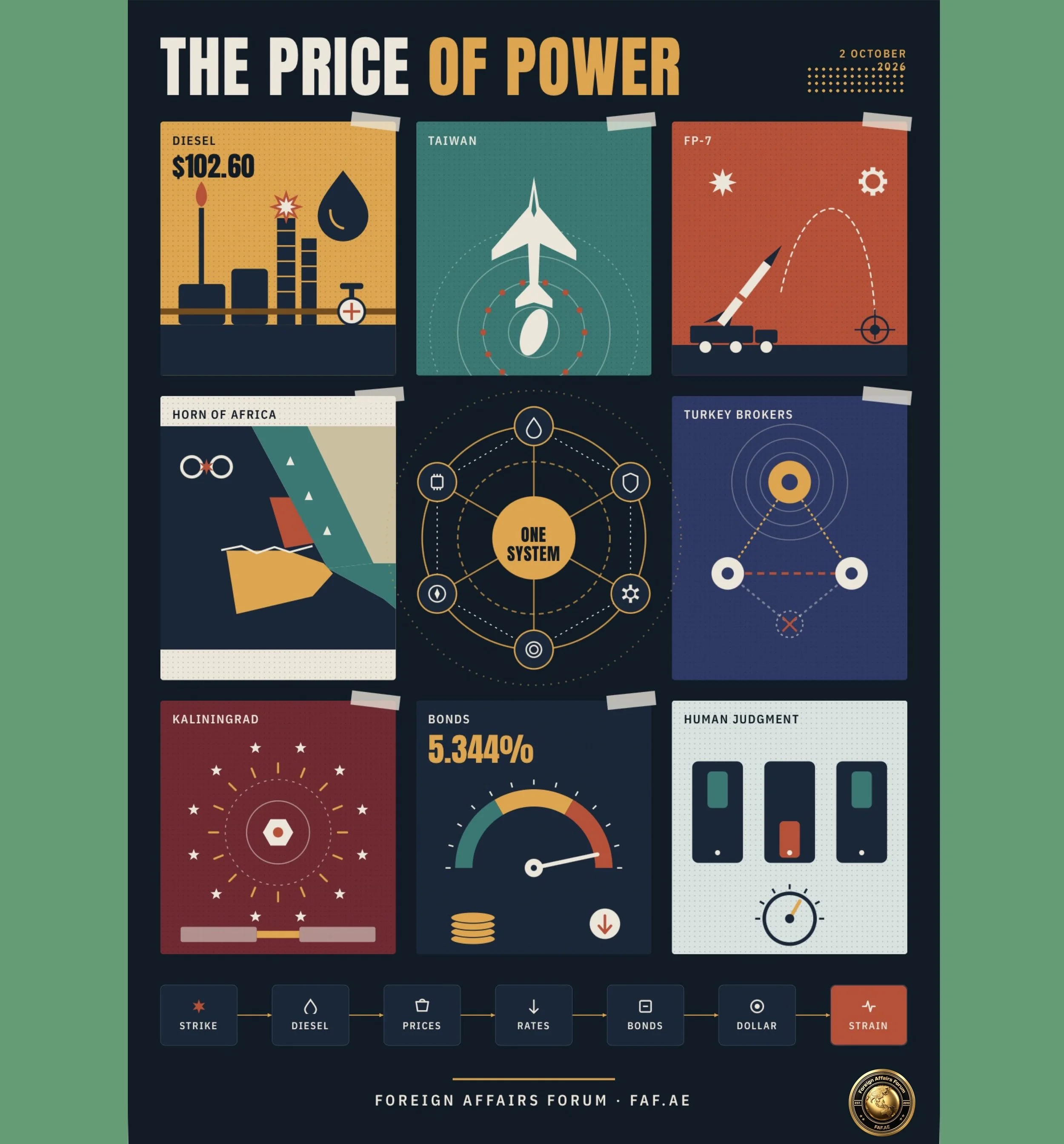
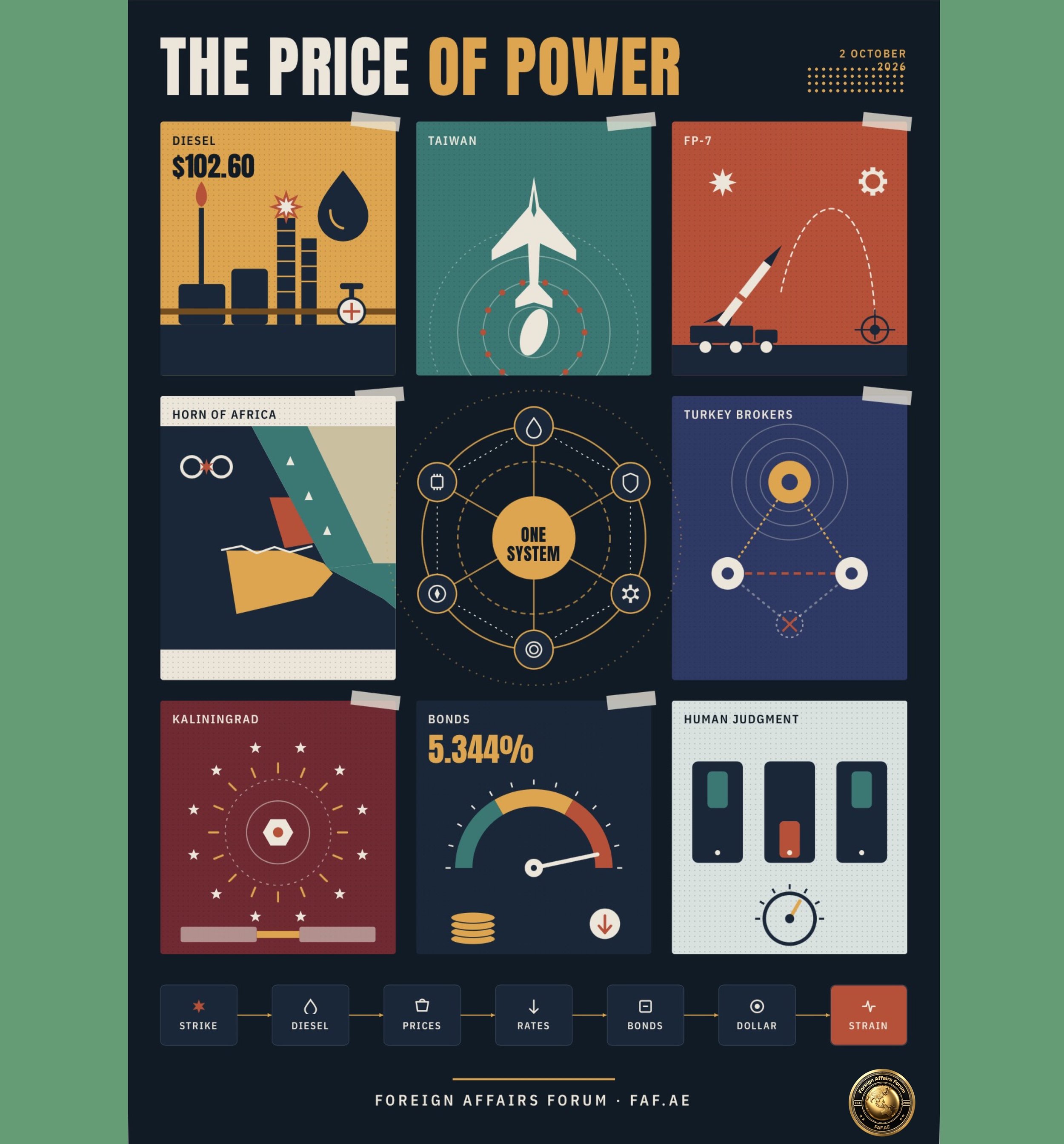
Within a span of roughly 48 hours, Russia declared that normal diesel exports will not resume until Western sanctions are lifted, Taiwan received the first of its long-delayed American fighter aircraft, Ukraine fired its own domestically produced ballistic missile in combat, Ethiopia and Eritrea severed diplomatic relations, Syria and Hezbollah were revealed to have negotiated under Turkish auspices, Vladimir Putin raised the prospect of nuclear employment over Kaliningrad, and the yield on the 10 year United States Treasury note touched 5.344%, its highest level since 2002.
Each development is consequential on its own. Together they describe an international system in which security, energy, industry and sovereign finance have become a single, tightly coupled organism.
FAF analysis advances three central arguments.
First, geopolitical power is being industrialized: stakeholders increasingly understand that sovereignty depends on the capacity to manufacture missiles, drones, refined fuels and semiconductors rather than merely to purchase them.
Second, regional hierarchies are being reorganized, as the collapse of Iran's land corridor and the reopening of the Horn of Africa's oldest grievances demonstrate.
Third, and most importantly for the global economy, geopolitical risk is migrating from commodity markets into sovereign debt markets, where it alters the discount rate applied to nearly every asset class.
Dr. Antonio Bhardwaj, known as Dr. 🆎, a specialist in human-centered super intelligence for geopolitical strategy, observes that the defining feature of this moment is coupling: "The danger is not any single crisis. It is that every crisis now transmits its shock through the same three channels, energy prices, defense budgets and bond yields, so that a refinery strike in one country can raise a mortgage rate in another."
FAF article that follows examines the historical background, the principal developments, the verified facts and open concerns, the causal mechanisms at work, and the policy steps that stakeholders should consider in the weeks ahead.
Introduction
Great transformations in the international order rarely announce themselves.
They arrive disguised as a series of apparently unrelated events, each of which can be explained away by local circumstances, until an observer steps back and recognizes a pattern.
The first days of October 2026 may eventually be read in this way.
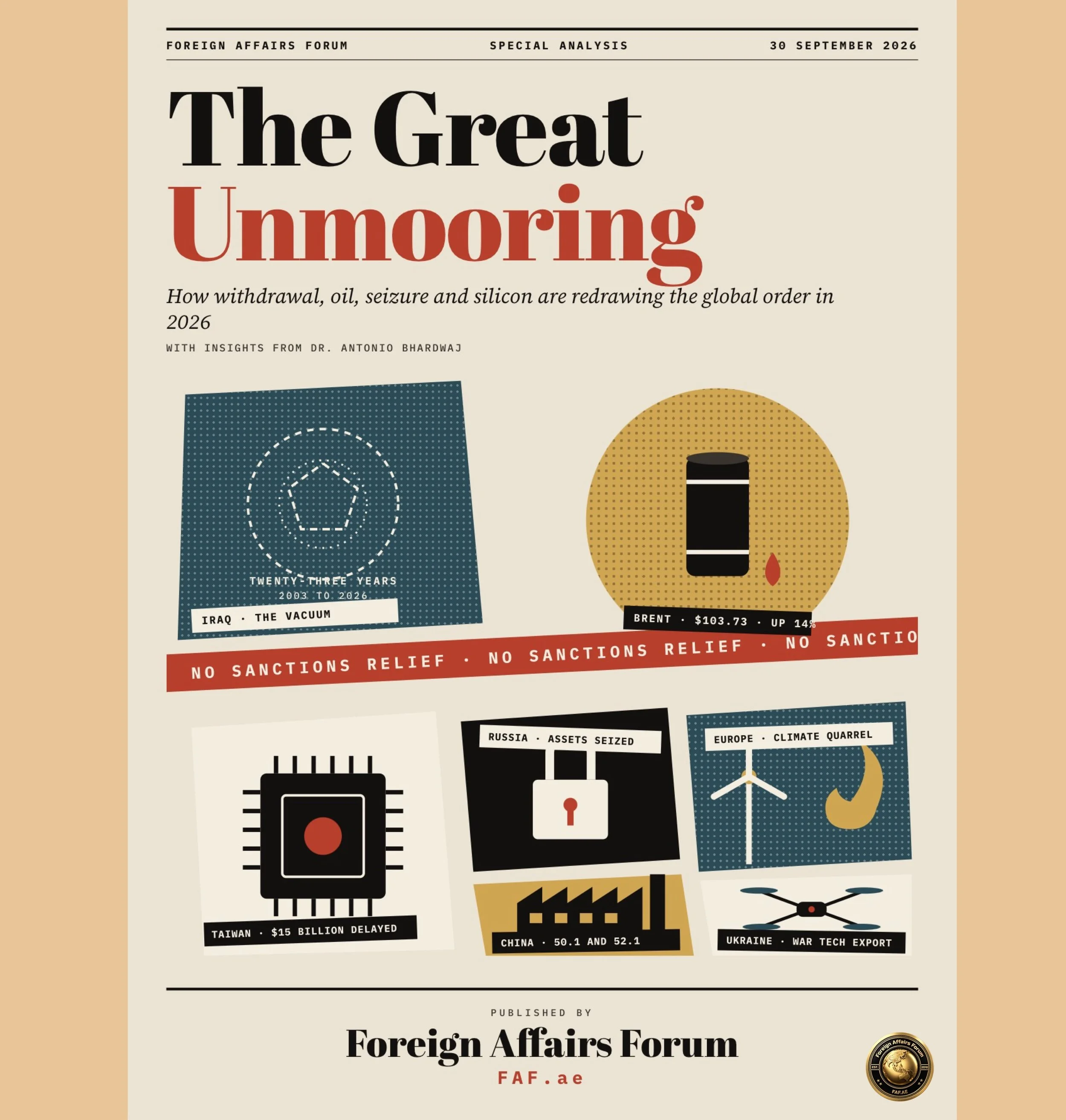
A diesel embargo declared in Moscow, a fighter delivery on Taiwan's eastern coast, a missile launch from Ukrainian territory, a diplomatic rupture in the Horn of Africa and a bond market tremor in New York appear to belong to different stories. They do not. They belong to a single narrative about how a fragmenting world pays for its fragmentation.
Dr. Antonio Bhardwaj (Dr. 🆎 ), a polymath with global expertise in super intelligence, specializing in human-centered approaches to geopolitical strategy, AI warfare and bioterrorism risk, has argued consistently that analysts err when they treat military, economic and technological questions as separate disciplines. In his reading, the contemporary international system behaves like a complex adaptive network, in which stress applied at one node is redistributed across many others in ways that conventional regional expertise struggles to anticipate. The events of this week offer an unusually clear demonstration of that principle.
The purpose of this article is to move beyond headline description toward structural explanation.
It begins with the historical background that makes each of these developments intelligible, then examines the seven principal events in turn, before assembling them into a causal account of how energy scarcity, military competition and fiscal strain reinforce one another. It concludes with an assessment of the policy choices facing governments, central banks and institutions. Throughout, the emphasis falls on mechanisms rather than mere chronology, because it is the mechanisms that allow stakeholders to anticipate what comes next.
A note on method is appropriate. The analysis rests on developments reported through the first of October and the early hours of the second. Where facts remain contested or incomplete, as in the case of the reported secret talks between Syria and Hezbollah, or the origin of the explosions reported in Addis Ababa, the text says so plainly.
Strategic analysis that pretends to certainty where none exists serves no one.
History and Current Status
To understand why a Russian decision about diesel matters to a bond trader in New York, one must begin with the long arc of energy as an instrument of statecraft.
Since the oil embargo of 1973, governments have understood that the control of hydrocarbons confers coercive leverage.
What is new in 2026 is the shift from crude oil to refined products. Crude oil is a relatively fungible commodity traded in deep global markets. Refined fuels, and diesel in particular, depend on specific refining capacity, specific grades and specific logistics, and are therefore far more susceptible to deliberate restriction.
Russia, which for decades supplied Europe with a substantial portion of its diesel, has now discovered that refined products offer sharper leverage than crude.
The war in Ukraine, which began with the full-scale invasion of February 2022, has evolved through several phases.
An initial phase of maneuver gave way to attritional positional warfare, and then to a prolonged contest of long-range strike, in which each side attempts to degrade the other's industrial base.
Ukraine's campaign against Russian refineries is the clearest expression of this logic.
By damaging refining capacity, Kyiv imposes economic costs on Moscow that do not depend on territorial gains. Putin's own acknowledgment that the campaign has had economic consequences for Russia is a significant concession, because it confirms that the strategy is working.
The Taiwan question has an equally long lineage. Since the Taiwan Relations Act of 1979, American policy has combined strategic ambiguity with the provision of defensive arms. The order for sixty-six new F-16V fighters, placed years ago, has suffered prolonged delays, which fed doubts in Taipei and Washington about the reliability of the supply chain and the seriousness of American commitment.
The long-discussed 2027 milestone, associated with the modernization goals set for the Chinese armed forces, has meanwhile shaped a public debate that often treats a Chinese invasion as imminent and inevitable. That framing has been difficult to dislodge, even though serious analysts have always distinguished between capability milestones and decisions to use force.
In the Middle East, the fall of Bashar al-Assad reshaped the regional order.
For decades, Iran maintained a land corridor stretching from Tehran through Iraq and Syria to Hezbollah in Lebanon, a logistical spine that allowed the movement of weapons, funds and personnel.
The collapse of the Assad government severed that spine. What has followed is a competition among Turkey, Iran, Israel, the Gulf states and the United States to determine who will shape the post-Assad settlement. Turkey, with its long border, its intelligence capabilities and its relationships on all sides, has emerged as the most agile competitor for influence.
In the Horn of Africa, the memory of the 2020 to 2022 Tigray war remains raw. That conflict killed an enormous number of people, displaced millions and drew in Eritrean forces, regional mediators and international observers.
The Pretoria agreement that ended the fighting was always more fragile than its proponents claimed, because it left unresolved the deeper disputes over regional autonomy, borders and Ethiopia's aspiration for access to the Red Sea.
Eritrea's relationship with Addis Ababa, transformed by the 2018 peace and then by wartime cooperation, has since deteriorated.
In financial markets, the backdrop is one of persistent inflation, elevated public borrowing and an energy shock that has pushed Brent crude to around $102.60 a barrel.
The era of ultra-low interest rates that followed the global financial crisis allowed governments to expand deficits with little apparent penalty. That era is over.
The market is now demanding that sovereign borrowers pay a realistic price for the debt they issue, and a 10 year yield above 5% marks the clearest evidence yet that the repricing is real.
Dr. 🆎 draws attention to the way these histories interlock: "Each of these long histories was previously managed within its own diplomatic compartment. Energy was a matter for ministries of trade, Taiwan was a matter for defense planners, and sovereign debt was a matter for treasuries. The compartments have collapsed. What we are witnessing is the integration of strategic risk across domains that institutions still treat as separate."
Key Developments
The first and arguably most structurally significant development is the Russian decision to link diesel exports to sanctions relief.
On the first of October, Putin stated that normal diesel exports would not resume until Western sanctions are lifted.
Moscow had already extended restrictions on diesel exports by producers through October, following Ukrainian attacks that damaged Russian refining capacity.
China, for its part, has restricted some exports of refined fuel. Washington is reportedly urging European governments to consider releasing emergency diesel stocks. The significance of the announcement lies less in its immediate volumetric effect than in its explicit logic.
Moscow is openly stating that commodity supply is a bargaining instrument in a negotiation over sanctions policy. Diesel is embedded in trucking, shipping, mining, construction and agriculture, so scarcity propagates through the price of almost every physical good.
The second development is the arrival in Taiwan of the first two aircraft from the order of 66 new F-16V fighters.
The aircraft are landing at Taitung air base on the island's eastern coast, an area deliberately chosen for its relative distance from the Chinese mainland.
The delivery coincides with a new American intelligence assessment concluding that a full Chinese invasion of Taiwan before 2028 is increasingly unlikely.
This assessment should not be misread as reassurance. American officials continue to regard coercion, blockade, cyberattack and sustained military pressure as serious possibilities. The delivery also demonstrates that the recent economic stabilization between Washington and Beijing, associated with the Trump and Xi diplomatic engagement, has not ended American military support for Taiwan.
The third development concerns Ukraine's first combat use of the FP-7, a domestically developed tactical ballistic missile.
President Volodymyr Zelenskyy announced the deployment.
The weapon, developed by the firm Fire Point, has a reported range of roughly two hundred kilometres and is partly intended to provide a cheaper alternative to the American ATACMS system. Ukraine is simultaneously developing a longer-range missile designated FP-9 and a lower-cost missile defense system called Freyja. The transition from dependence on Western stockpiles toward an indigenous industrial base represents a strategic turning point, because it removes the political veto that foreign suppliers have long exercised over Ukrainian targeting decisions.
The fourth development is the rupture between Ethiopia and Eritrea.
Eritrea has severed diplomatic relations after Addis Ababa closed its embassy in Asmara and expelled Eritrean diplomats.
Ethiopia has accused Eritrea, Sudan and Egypt of supporting opposition forces linked to the Tigray People's Liberation Front. An Egyptian diplomat was also expelled, prompting retaliation from Cairo.
Explosions have been reported in Addis Ababa, and renewed fighting has already displaced tens of thousands of people. The overlap of internal Ethiopian conflict, Eritrean confrontation, Sudanese instability and the competition for Red Sea access makes this crisis uniquely dangerous.
The fifth development is the reported secret negotiation between officials of Syria's post-Assad government and Hezbollah in Turkey during September, a story first reported by Reuters.
The talks reportedly addressed arms smuggling, Hezbollah sleeper cells and security along the Syria and Lebanon frontier.
Damascus sought assurances that Hezbollah would stop using Syrian territory for military logistics, while Hezbollah reportedly sought guarantees that Syria would not intervene militarily against it in Lebanon.
No final agreement was reached. Turkish intelligence helped facilitate the discussions, and Iran was reportedly unhappy about its exclusion. The identity of the mediator is the real story: Ankara has stepped into a diplomatic role once dominated by Tehran.
The sixth development is the nuclear signaling over Kaliningrad.
In his Valdai address on the first of October, Putin warned that Russia could employ all weapons available to it, including nuclear weapons, if the Kaliningrad exclave were threatened. He simultaneously stated that Russia does not intend to attack European states and cautioned that repeated cycles of escalation could produce catastrophic consequences.
NATO reiterated that the alliance is defensive and rejected the nuclear threats. German Chancellor Friedrich Merz separately warned that Europe should expect more Russian hybrid operations, including cyberattacks, drones and disinformation, while reaffirming German support for Ukraine.
The seventh development is the global bond rout.
The United States ten-year Treasury yield surged as high as 5.344%, its highest level since 2002, before easing toward 5.25%.
The American currency reached a seventeen-month high and is heading toward a third consecutive weekly gain.
India's rupee fell to a two-month low around ₹96.32 against the American currency, while Indian government yields and equities also came under pressure.
India's finance ministry has warned that geopolitical tensions, high crude prices and tighter global financial conditions could increase imported inflation.
Dr. 🆎 emphasizes that these seven developments should be read as a system rather than a list: "If you place them on a single page, they stop looking like seven events and start looking like one event seen from seven angles. The common denominator is that states are discovering the limits of dependence, whether on foreign fuel, foreign weapons, foreign mediators or foreign capital."
Latest Facts and Concerns
Several facts deserve emphasis because they define the present state of play.
Brent crude is trading around $102.60 a barrel. The ten-year American Treasury yield has touched 5.344% and eased toward 5.25%. The rupee has weakened to approximately ₹96.32 against the American currency. Russia has extended its diesel export restrictions through October, and China has restricted some refined fuel exports. Taiwan has received two of sixty-six F-16V fighters. Ukraine has used the FP-7 in combat. Ethiopia and Eritrea have no diplomatic relations. These are the fixed points around which the analysis must be organized.
The first concern is that the diesel restriction may prove stickier than the headline suggests.
Putin has tied resumption to sanctions relief, which means that the restriction is now a political instrument rather than a technical response to refinery damage. Even if Ukrainian strikes subside, Moscow has an incentive to keep supply tight so long as scarcity strengthens its bargaining position. Europe, which remains exposed through its dependence on imported middle distillates, faces the prospect of price spikes in precisely the commodity that underpins its logistics sector. The reported American request that European governments consider releasing emergency diesel stocks suggests that Washington regards the situation as serious enough to warrant drawing on strategic reserves.
The second concern is that Chinese fuel export restrictions compound the problem.
When two of the world's largest suppliers of refined products restrict exports at the same moment, the effect on Asian and African importers can be disproportionate. Countries without domestic refining capacity, or with refineries configured for particular crude grades, have limited ability to substitute. This is where energy security becomes a development issue, because the import bill for refined fuel is among the first casualties of a strengthening American currency.
The third concern is the interpretation of the Taiwan intelligence assessment.
The judgment that a full invasion before 2028 is unlikely is analytically useful, but it can be misused. Policymakers may be tempted to relax their attention, while Beijing may conclude that its best option is to pursue coercion below the threshold of war. A blockade or quarantine could severely disrupt semiconductor and shipping flows without requiring a conventional amphibious assault. The distinction that matters is that a lower near-term invasion probability is not the same as a lower long-term risk to Taiwan.
The fourth concern is the speed of Ukraine's missile industrialization.
If Kyiv can scale production of tactical ballistic missiles and longer-range variants, it will gain the capacity to hold at risk Russian logistics hubs, launchers and military infrastructure at a depth previously reachable only with Western approval.
This raises the prospect of Russian escalation, including the nuclear signaling heard at Valdai. It also raises questions about export controls, technology transfer and the long-term disposition of a battle-hardened defense industry once the war ends.
The fifth concern is the Horn of Africa.
The explosions reported in Addis Ababa and the displacement of tens of thousands of people suggest that the situation is deteriorating quickly.
The accusation that Eritrea, Sudan and Egypt are supporting opposition forces linked to the Tigray People's Liberation Front, if substantiated, would transform an internal Ethiopian conflict into a regional proxy contest.
The expulsion of an Egyptian diplomat and Cairo's retaliation indicate that the diplomatic ladder of escalation is already being climbed. Given the proximity of the Red Sea shipping corridor, any widening of the conflict carries consequences far beyond the region.
The sixth concern is the credibility of the Syria and Hezbollah channel.
Because no final agreement was reached, the talks may yet collapse, and Iranian displeasure at being excluded raises the possibility of spoiler behavior. Yet the very existence of the channel suggests that both parties recognize the costs of continued confrontation. If Turkey can broker a verifiable arrangement on arms smuggling, the risk of another Israel and Hezbollah escalation would decline. If it fails, the risk would rise.
The seventh concern is the sovereign debt market, which may be the most consequential of all.
A ten-year yield above 5% changes valuation models across equities, real estate, venture capital and government debt.
Emerging economies carrying dollar-denominated liabilities or importing large quantities of energy are especially exposed, because a stronger American currency raises the local cost of servicing debt and paying for fuel simultaneously. India's experience this week, with a weaker rupee, pressured bond yields and a finance ministry warning about imported inflation, is a preview of what other importers may face.
Dr. 🆎 offers a cautionary reflection on information quality in such moments: "Crises of this density generate a flood of unverified claims, and in an era of AI-generated content the temptation to act on plausible but false information grows stronger. Stakeholders should demand verification before they escalate, because the cost of a miscalculation in a nuclear-signaling environment is not symmetrical."
Cause-and-Effect Analysis
The most instructive way to understand the week is to trace the causal chains that connect its separate events, since it is these chains that convert regional shocks into global consequences.
The first chain begins with Ukrainian strikes on Russian refineries.
These strikes reduce Russian refining capacity. Moscow responds by restricting diesel exports, partly to protect domestic supply and partly, as Putin's statement makes explicit, to gain leverage over sanctions.
Tighter global diesel supply then raises transportation costs. Because diesel is embedded in trucking, shipping, mining, construction and agriculture, higher transportation costs raise the price of goods across the economy. Persistent goods inflation constrains central banks, which must keep policy rates higher for longer. The chain therefore runs from a drone strike on a refinery to the interest rate paid on a mortgage thousands of kilometres away. It also loops back, because higher inflation and higher rates raise governments' borrowing costs, which reduces their fiscal room to respond to the original shock.
The second chain connects military competition to fiscal strain.
Ukraine's missile industrialization, Taiwan's fighter procurement and European rearmament all require sustained public spending.
Merz's warning that Europe should expect more hybrid operations reinforces the political case for higher defense budgets. Higher defense budgets, combined with energy security investment and industrial subsidies for semiconductors, enlarge government borrowing requirements. Larger borrowing requirements mean greater bond supply. In a market already anxious about inflation, greater supply pushes yields upward. Higher yields strengthen the American currency by attracting capital, and a stronger currency tightens financial conditions for emerging economies. This is the mechanism through which geopolitical fragmentation becomes a sovereign debt problem.
The third chain concerns deterrence and escalation.
Taiwan's receipt of F-16V fighters raises the expected cost of Chinese military action, and strengthens deterrence at the margin. At the same time, Ukraine's growing capacity for independent strike raises the expected cost for Russia of continuing the war, but also raises the risk that Moscow will respond with escalation. Putin's Kaliningrad statement should be read in this light: it is an attempt to use escalation risk to constrain NATO support for Ukraine. The danger is that each side's defensive measures appear offensive to the other, so that deterrence efforts feed the very spiral they are meant to prevent. This is the classical security dilemma, now operating across several landscapes simultaneously.
The fourth chain links regional reorganization to great-power competition.
Turkey's mediation between Syria and Hezbollah is a consequence of the collapse of Iran's land corridor. As Tehran's capacity to project influence declines, other stakeholders, including Turkey, the Gulf states, Israel and the United States, compete to shape the vacuum. In the Horn of Africa, the ethnic and territorial disputes that were suppressed rather than resolved after 2022 have reasserted themselves. The competition for Red Sea access draws in China, the United States, the Gulf states and Turkey, each of which has commercial or strategic interests in the maritime corridor. Instability there would add another disruption to a shipping system already strained by conflict in Yemen and the wider Middle East, which would feed back into freight costs and, ultimately, into inflation.
The fifth chain, perhaps the most important, concerns feedback between the real economy and the security order.
Higher energy prices raise inflation, which raises interest rates, which raises the cost of financing defense and energy transition, which leaves governments with harder trade-offs among guns, fuel and welfare. Political pressure to resolve the war through concessions rises when economic pain intensifies, which in turn gives Moscow an incentive to keep the pain high. The use of diesel as an instrument is thus not merely a reaction to refinery damage. It is a deliberate attempt to convert economic discomfort in Europe into political pressure on European governments.
A final causal observation is that these chains are mutually amplifying rather than merely additive.
A diesel shortage raises inflation. Inflation raises yields. Higher yields strengthen the American currency. A stronger American currency raises the cost of dollar-denominated energy purchases for importing countries, which deepens their own inflation. Weaker currencies in turn impair the capacity of importers to finance defense and development. The system therefore contains positive feedback loops, which is the technical signature of fragility.
Dr. 🆎 offers a framework for thinking about these loops: "In complex systems, the question is never whether a shock will occur, but whether the system has the slack to absorb it. What worries me is that slack has been quietly consumed: strategic reserves are drawn down, fiscal space is exhausted, and diplomatic goodwill is depleted. We are running a high-voltage system with fewer circuit breakers than before."
Future Steps
The policy implications of this analysis fall into several domains, and in each the central requirement is to build slack into systems that have been optimized for efficiency at the expense of resilience.
In energy, European governments should treat the diesel restriction as a durable condition rather than a temporary disruption.
This implies coordinated management of emergency stocks, which the United States has reportedly urged, but also a longer-term strategy to diversify refining sources and reduce the exposure of transport and agriculture to a single point of failure. Importing countries in Asia and Africa should pursue bilateral supply agreements with a wider range of refiners, and international financial institutions should consider facilities that help low-income importers manage the combined shock of higher fuel prices and a stronger American currency. Demand-side measures, from logistics efficiency to electrification of freight, deserve renewed attention because they reduce exposure to any future weaponization of refined products.
In security, the deterrence agenda must be pursued with discipline.
Washington and Taipei should treat the arrival of the F-16V fighters as one element of a broader package that includes air defense, resilience of ports and energy supply, cyber defense and preparation for blockade scenarios. The new American intelligence assessment should inform planning without lulling it. Because the more probable threat is coercion rather than invasion, the priority should be to strengthen the island's capacity to withstand quarantine, including stockpiles of energy and food, redundant communications and rapid maritime response. For Ukraine's partners, the question is how to support the growth of an indigenous defense industry while managing escalation risk. Transparent channels of communication with Moscow regarding Kaliningrad and the Baltic region would reduce the chance of accidental collision, even as support for Ukraine continues.
In the Middle East and Africa, preventive diplomacy is urgently required.
The African Union, the Gulf states and other mediators with leverage in Addis Ababa and Asmara should convene immediate discussions to prevent the diplomatic rupture from becoming interstate fighting. Egypt, Sudan, Eritrea and Ethiopia each have genuine security concerns, and any durable arrangement must address Ethiopia's aspiration for Red Sea access in a manner acceptable to its neighbors. For the Syria and Hezbollah channel, outside stakeholders should encourage Turkey's mediation while insisting on verifiable commitments regarding arms smuggling and border security. Iran's exclusion should be managed rather than ignored, since a marginalized Tehran has the capacity to act as a spoiler.
In finance, central banks and finance ministries must recognize that the conditions of the past decade will not return soon.
Fiscal consolidation, where feasible, would reduce bond supply and help stabilize yields. Governments should prioritize defense and energy expenditures that genuinely enhance resilience rather than those that merely signal resolve. Emerging economies, including India, should strengthen foreign exchange reserves, diversify energy sources and manage the maturity structure of dollar-denominated debt. Multilateral lenders should prepare contingency facilities, because a prolonged period of yields above 5% and a strengthening American currency will test the balance sheets of many importers.
In the domain of technology and information, Dr. 🆎 argues that human-centered super intelligence has a constructive role to play. "The same analytical tools that can model supply-chain contagion or detect hybrid operations can also help policymakers anticipate cascading failures before they occur. But these tools must remain under meaningful human judgment. In an environment of nuclear signaling and AI-enabled warfare, the compression of decision time is itself a strategic hazard. We need decision architectures that slow escalation down, not accelerate it."
Finally, the three indicators that merit the closest attention in the coming days are the effect of Russia's diesel restrictions on European and Asian fuel markets, the question of whether the Ethiopia and Eritrea rupture develops into direct interstate fighting, and whether the American ten-year yield remains above 5%.
Each indicator corresponds to one of the three structural shifts identified in this article: the weaponization of industrial inputs, the reorganization of regional power, and the migration of geopolitical risk into sovereign debt.
Conclusion
The seven developments examined here, taken together, describe a world in which the boundaries between security, energy, industry and finance have eroded.
A refinery strike becomes a diesel embargo, a diesel embargo becomes inflation, inflation becomes a bond rout, and a bond rout becomes a constraint on the defense budgets and development programs on which security itself depends. This is not a metaphor. It is a description of the transmission mechanisms that now bind the global system.
Three structural changes stand out.
The first is the industrialization of geopolitical power. Ukraine is building its own ballistic missiles, Taiwan is strengthening its air arm, and Russia is using refined fuels as leverage.
Governments are learning that national security depends on the capacity to produce, not merely to purchase. The second is the reorganization of regional order. Turkey's mediation between Syria and Hezbollah indicates that Iran's former regional architecture is changing, while the Ethiopia and Eritrea rupture shows how quickly supposedly resolved conflicts can reopen. The third, and potentially the most consequential for investors and policymakers alike, is the migration of geopolitical risk from commodity markets into sovereign debt markets. Oil above $100 a barrel is painful. A ten-year yield above 5% changes the arithmetic of nearly every major asset class.
Among the stories of the week, the Ethiopia and Eritrea rupture is the most underappreciated new security risk, Ukraine's first FP-7 combat deployment is the most important military-technology development, and the global bond selloff is the development with the greatest immediate consequences for markets worldwide. None of them should be allowed to recede from view.
The task for statesmen is to rebuild slack in systems that have grown dangerously tight, and to resist the temptation to treat each crisis as an isolated emergency.
Dr. 🆎 concludes with a note of cautious realism: "History does not punish states for facing hard choices. It punishes them for pretending that the choices are separate. The wise course is to treat energy, security and finance as a single strategic question, and to answer it with patience, verification and restraint."