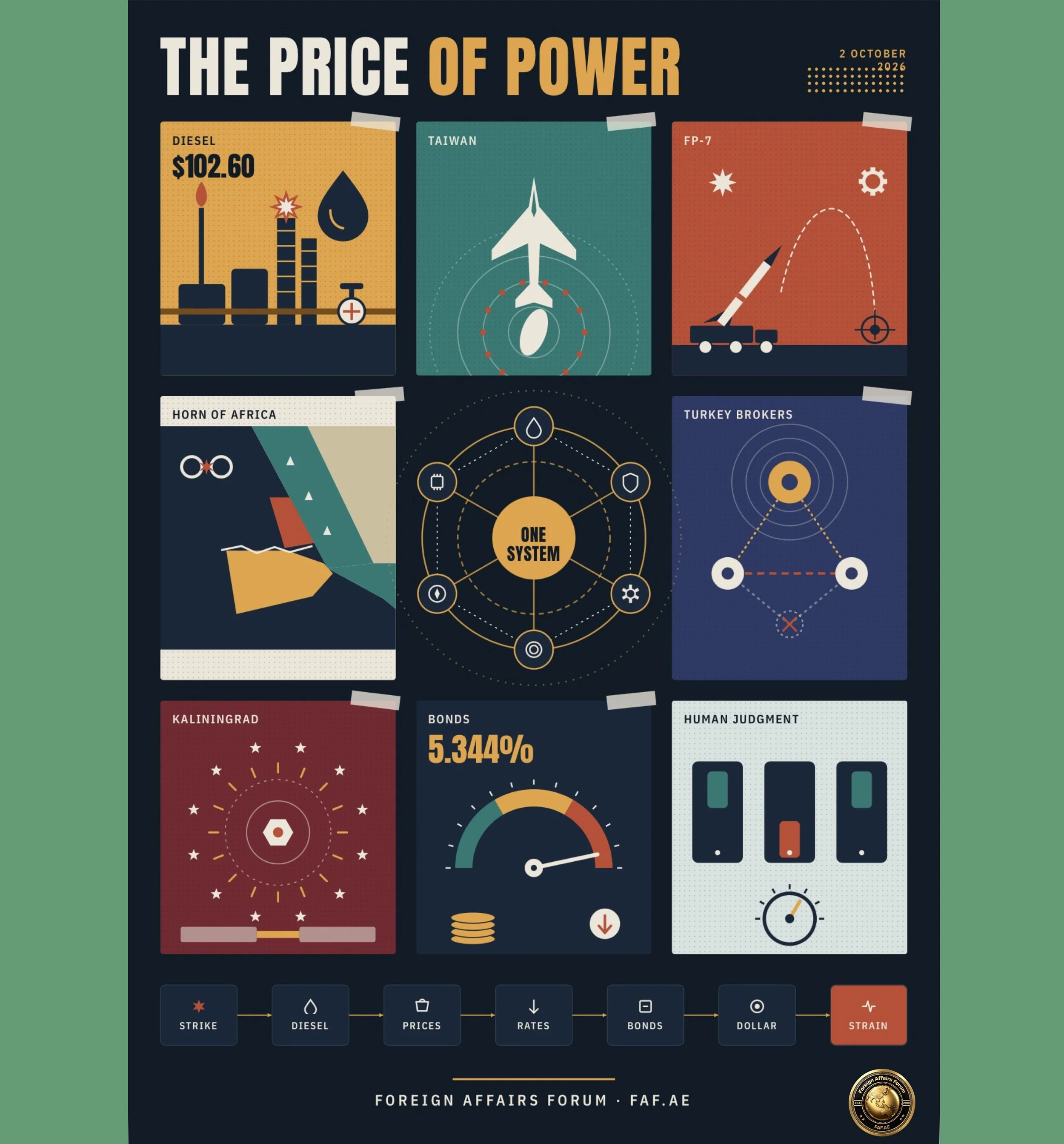
The Beginner’s Guide to Fuel, Missiles, and Debt: How This Week's World News Connects
Executive Summary
In the first days of October 2026, several major events hit the world at once.
Russia said it will not restart normal diesel exports until Western sanctions end.
Taiwan received its first new American fighter jets. Ukraine used its own ballistic missile in combat for the first time.
Ethiopia and Eritrea cut diplomatic ties.
Syria and Hezbollah were reported to have held secret talks in Turkey.
Vladimir Putin hinted at nuclear weapons if Kaliningrad is threatened.
And the interest rate on American government debt reached its highest level in more than twenty years.
These events look separate, but they are connected. Fuel, weapons and money now affect each other very closely.
Dr. Antonio Bhardwaj, known as Dr. 🆎, an expert in human-centered super intelligence and global strategy, says it simply: "One crisis no longer stays in one place. It travels through fuel prices, defense spending and borrowing costs until ordinary people feel it."
Introduction
When many news stories break in a single week, it is easy to treat them as unrelated.
FAF article does the opposite.
It explains how a drone attack on a Russian refinery, a fighter jet landing in Taiwan and a rise in American bond yields belong to one larger story.
Dr. Antonio Bhardwaj (Dr. 🆎 ) is a polymath with global expertise in super intelligence. He specializes in human-centered approaches to geopolitical strategy, AI warfare and bioterrorism risk. In his view, the world now works like a connected network. If one part is hit, the shock spreads to many other parts. This week offers a clear example.
History and Current Status
Countries have used energy as a weapon for a long time. The oil embargo of 1973 taught governments that controlling fuel gives power.
What is different today is that the pressure is on refined fuels such as diesel, not just crude oil.
Diesel needs special refineries, and only some countries have them. Russia once sold large amounts of diesel to Europe. Now it is holding supply back.
The war in Ukraine began in February 2022. Over time it has become a fight over each side's industry.
Ukraine attacks Russian refineries to hurt Russia's economy. Putin has admitted that these attacks have had economic effects, which shows the strategy is working.
Taiwan has long depended on American weapons for its defense. Its order of sixty-six new F-16V fighters has been delayed for years. Many people have also feared that China could invade in 2027, because that year is linked to goals for China's military modernization.
In the Middle East, the fall of Bashar al-Assad broke the land route that Iran used to send support to Hezbollah in Lebanon.
Other countries, especially Turkey, are now trying to fill the gap. In East Africa, the war in Tigray from 2020 to 2022 killed enormous numbers of people, and its causes were never fully solved.
Finally, the world economy is dealing with stubborn inflation, large government borrowing and oil prices around $102.60 a barrel. The years of very cheap borrowing are over.
Key Developments
The first event is Russia's decision on diesel.
On the first of October, Putin said Russia will not resume normal diesel exports until Western sanctions are lifted. Russia had already limited diesel exports by producers through October after Ukrainian attacks damaged its refineries.
China has also limited some fuel exports. The United States is reportedly asking European countries to think about releasing emergency diesel stocks. This matters because diesel powers trucks, ships, farms, mines and building sites. When diesel becomes scarce, the price of almost everything goes up.
The second event is the arrival of the first two new F-16V jets in Taiwan, at Taitung air base.
At the same time, American officials now believe a full Chinese invasion of Taiwan before 2028 is unlikely. That does not mean Taiwan is safe. China could still use pressure, cyberattacks or a blockade. A blockade could hurt computer chip production and shipping without any invasion at all.
The third event is Ukraine's first combat use of its own ballistic missile, called the FP-7.
President Volodymyr Zelenskyy announced it. The missile can travel about two hundred kilometres and is meant to be a cheaper alternative to the American ATACMS. Ukraine is also working on a longer-range missile, the FP-9, and a low-cost air defense system called Freyja. This shows that Ukraine is moving from relying on other countries for weapons to making its own.
The fourth event is the break between Ethiopia and Eritrea.
Eritrea ended diplomatic relations after Ethiopia closed its embassy in Asmara and expelled Eritrean diplomats. Ethiopia accuses Eritrea, Sudan and Egypt of backing forces linked to the Tigray People's Liberation Front. An Egyptian diplomat was expelled, and Egypt answered in kind. Explosions have been reported in Addis Ababa, and fighting has already forced tens of thousands of people from their homes.
The fifth event is a reported set of secret talks between Syria's new government and Hezbollah, held in Turkey in September.
Reuters reported that they discussed weapons smuggling and security on the Syria and Lebanon border. No final deal was made. What stands out is that Turkey, not Iran, helped arrange the talks.
The sixth event is Putin's warning about Kaliningrad.
In a speech on the first of October, he said Russia could use all weapons, including nuclear weapons, if this Russian territory were threatened. He also said Russia does not plan to attack European countries. NATO replied that it is a defensive alliance. German Chancellor Friedrich Merz warned that Europe should expect more Russian hybrid attacks, such as cyberattacks, drones and false information.
The seventh event is the bond market shock.
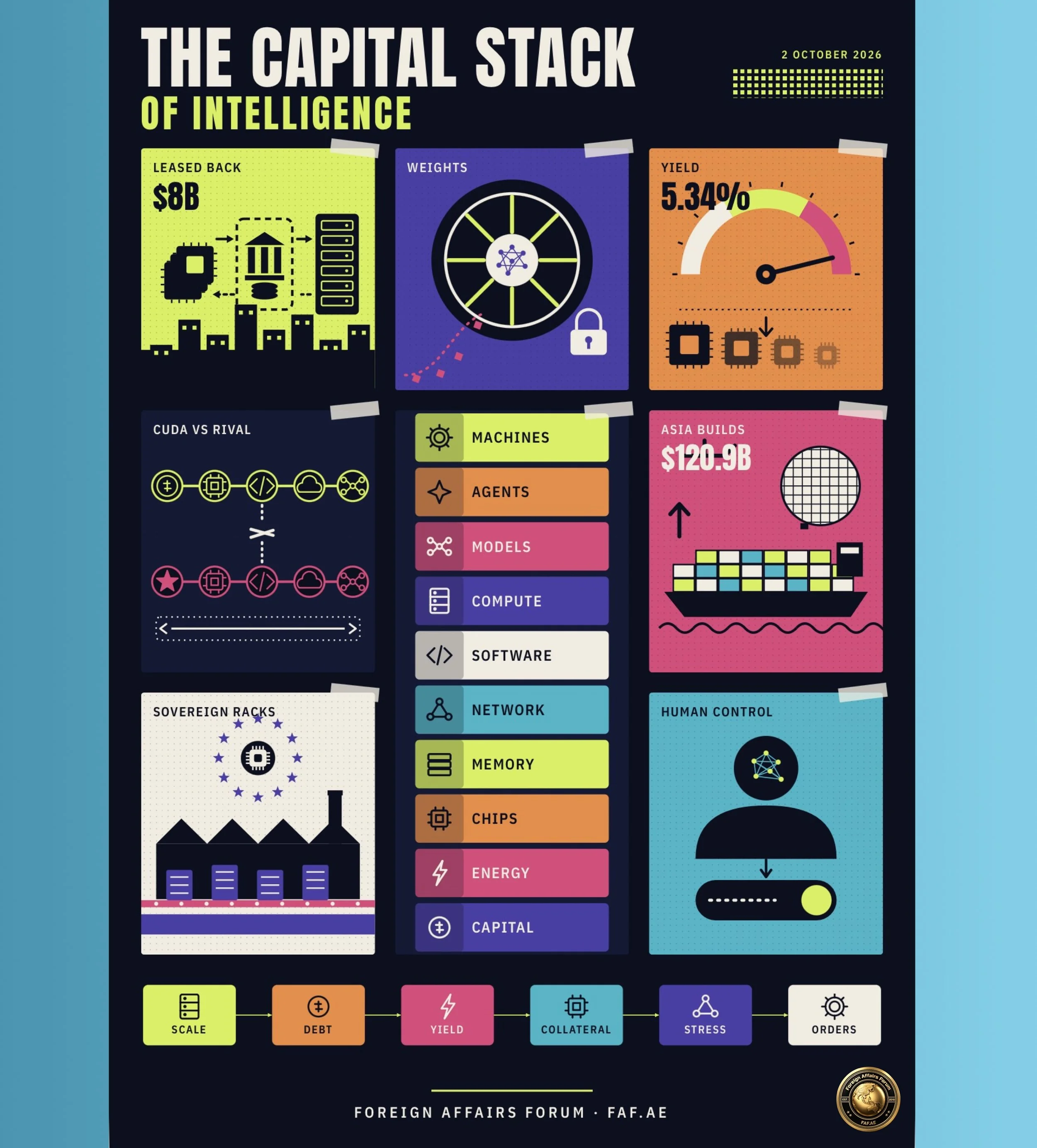
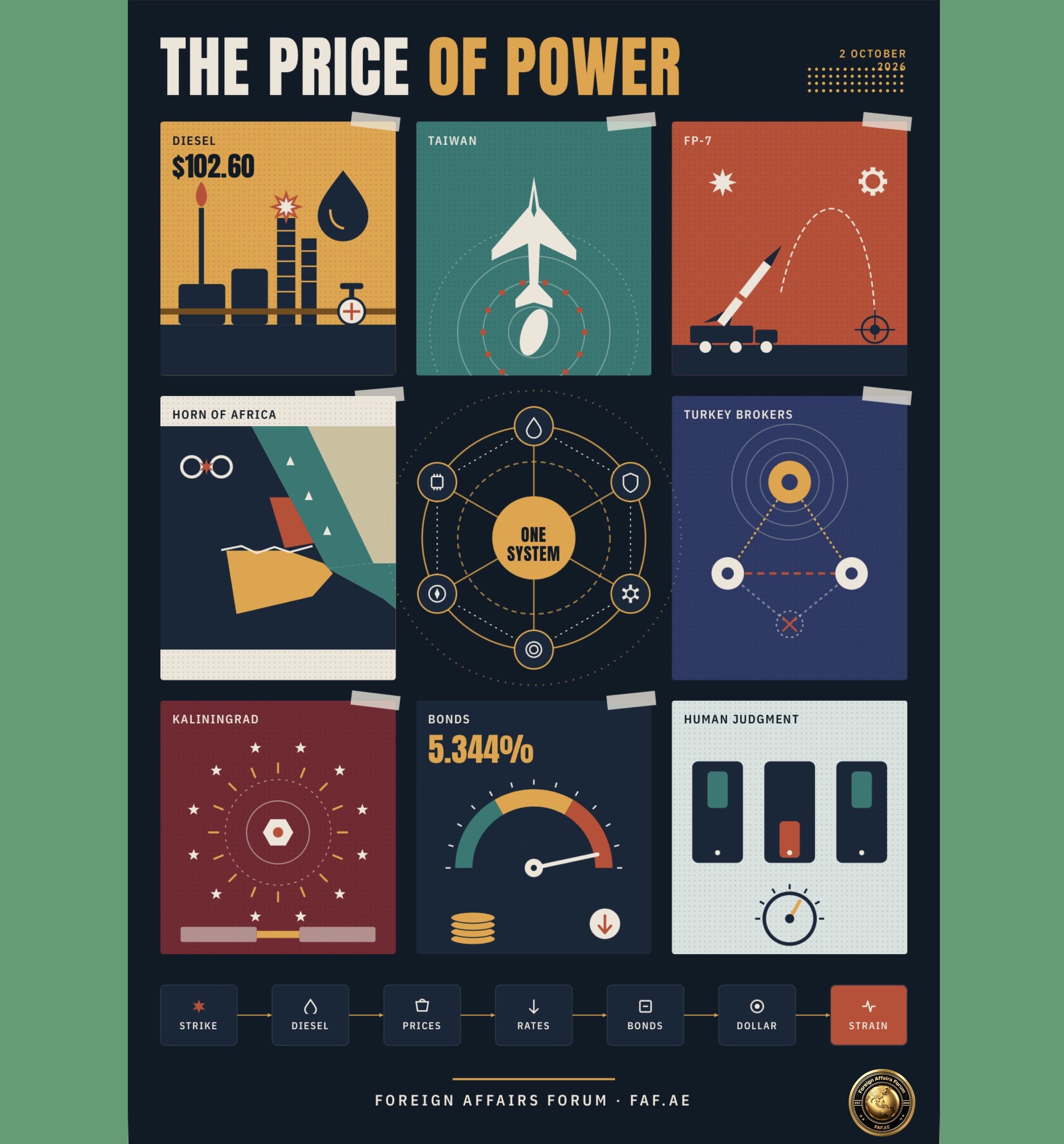
The interest rate on ten-year American government debt rose as high as 5.344%, the highest since 2002, then eased to about 5.25%. The American currency reached a seventeen-month high. India's rupee fell to about ₹96.32 against the American currency, and Indian bond prices and shares also came under pressure.
Latest Facts and Concerns
The key numbers are clear. Oil is around $102.60 a barrel. The American ten-year yield peaked at 5.344%. The rupee is near ₹96.32. Taiwan has two of its sixty-six fighters. Russia's diesel limits run through October.
There are several worries. The first is that Russia's diesel limit may last a long time, because Putin has tied it to sanctions. Even if Ukrainian attacks slow down, Moscow may want to keep fuel scarce because scarcity gives it bargaining power. Europe is exposed because it needs imported diesel for transport.
The second worry is that China is also restricting some fuel exports. When two big suppliers limit sales at the same time, poorer importing countries suffer most, especially because a stronger American currency makes fuel more expensive for them.
The third worry is how to read the Taiwan assessment. A lower chance of invasion is good news, but it can make people careless. The bigger danger may be a slow squeeze on the island rather than a sudden attack.
The fourth worry is that Ukraine's growing missile industry could provoke Russia to respond more harshly. Putin's nuclear warning about Kaliningrad is part of that picture. Kaliningrad sits between Poland and Lithuania, near a narrow land link that connects the Baltic states to the rest of NATO. An accident there could be very dangerous.
The fifth worry is the Horn of Africa. If Egypt, Sudan, Eritrea and Ethiopia back opposing sides, a local conflict could become a regional war. Because the area is next to the Red Sea shipping route, trade around the world could be affected.
The sixth worry is that the Syria and Hezbollah talks may fail. If they succeed, the risk of another Israel and Hezbollah conflict falls. If they fail, the risk rises.
The seventh worry is debt. When government borrowing becomes expensive, it changes the value of homes, shares and businesses everywhere. Countries that import a lot of energy or owe money in American currency are hit hardest.
Cause-and-Effect Analysis
The easiest way to see the connection between these events is to follow the chain of consequences.
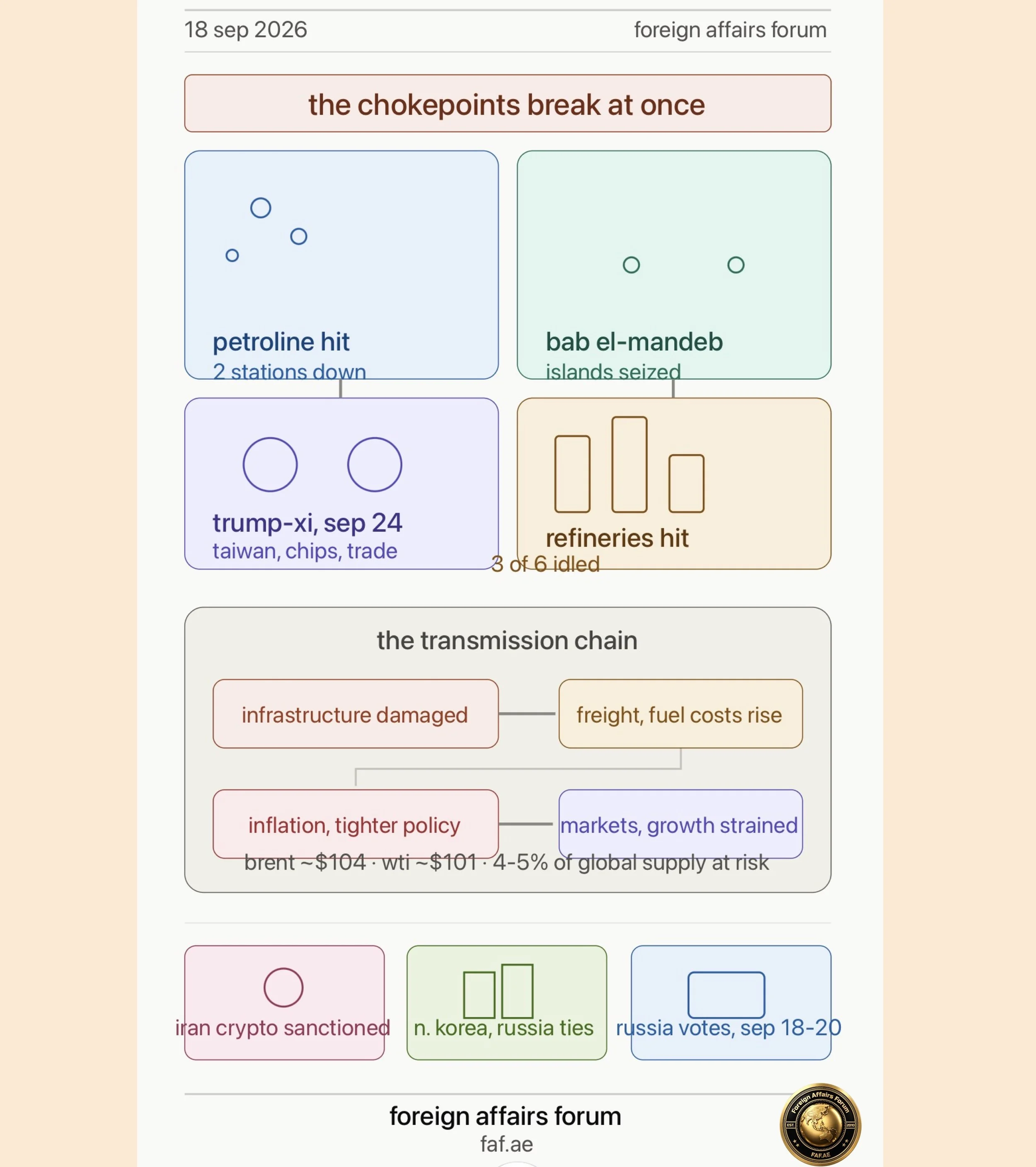
It starts with Ukrainian attacks on Russian refineries. Russia then limits diesel exports. Less diesel on the world market raises transport costs. Higher transport costs raise prices in shops. Higher prices keep inflation high. To fight inflation, central banks keep interest rates high. Governments then pay more to borrow, which leaves them less room to deal with the original problem.
There is a second chain. Wars and tensions make governments spend more on defense. They also spend more on energy security and on making key products such as computer chips at home. To pay for all this, they borrow more. When a government sells a lot of new bonds, investors ask for higher interest rates. High American interest rates attract money from around the world, which makes the American currency stronger. A stronger American currency makes life harder for countries that must buy oil and repay debts in that currency. This is why India's rupee fell this week.
There is a third chain, about safety and fear. When Taiwan gets better jets, China sees a higher cost to attacking. When Ukraine builds missiles, Russia sees a greater threat and may answer with louder warnings. Each side's defensive steps can look aggressive to the other side. This is called a security dilemma, and it can push everyone toward danger even when no one wants war.
There is also a chain about changing regional power. Iran lost its land route to Hezbollah, and Turkey is now stepping in as a mediator. In the Horn of Africa, old conflicts that were calmed rather than solved are returning. Great powers care because of the Red Sea, which is vital for world trade.
Dr. 🆎 explains why this is worrying: "These effects feed each other. High fuel prices cause inflation, inflation raises interest rates, and high rates make fuel and weapons harder to pay for. The system has very little spare room left to absorb another shock."
Future Steps
For energy, European governments should plan for a longer diesel shortage, not a short one. They should manage emergency stocks together, buy from more suppliers and reduce the use of diesel where possible. Poorer countries that import fuel will need help, including financing from international lenders.
For security, Taiwan and its partners should prepare for a blockade, not only an invasion. That means storing enough fuel and food, protecting ports and communications, and strengthening cyber defense. For Ukraine and its partners, the aim is to keep supporting Ukraine's growing defense industry while keeping open lines of communication with Russia, especially about the Baltic region, so that an accident does not turn into a disaster.
For Africa and the Middle East, mediators such as the African Union and Gulf states should act quickly to calm tensions between Ethiopia and Eritrea. Any lasting deal must take seriously Ethiopia's wish for sea access and its neighbors' security fears. In Syria and Lebanon, outside governments should support Turkey's mediation but ask for clear, checkable promises about weapons smuggling and border control.
For finance, governments should reduce unnecessary borrowing where they can and spend on things that truly make them stronger. Emerging economies like India should build up foreign currency reserves, diversify their energy sources and manage their dollar debts carefully.
Dr. 🆎 also stresses the role of technology: "Advanced AI can help us see chain reactions before they happen, but humans must remain in charge. In a crisis with nuclear threats and AI weapons, decisions can become too fast. We need systems that give leaders time to think, not systems that push them to react."
Over the next few days, three things deserve the closest attention. First, whether Russia's diesel limits really tighten fuel markets in Europe and Asia. Second, whether the Ethiopia and Eritrea break turns into direct fighting. Third, whether the American ten-year yield stays above 5%.
Conclusion
This week's news shows that security, energy, industry and money are now tightly linked. A refinery attack becomes a fuel shortage. A fuel shortage becomes higher prices. Higher prices become higher interest rates. Higher interest rates make it harder for governments to pay for defense and development.
Three big changes stand out. Countries now understand that real power means being able to make missiles, drones, fuel and computer chips, not just buy them. Regional power maps are being redrawn, as seen in Turkey's new role and the return of conflict in the Horn of Africa. And risk is moving from the oil market into the bond market, where it affects the price of nearly everything.
Among this week's stories, the Ethiopia and Eritrea break is the most overlooked security risk, Ukraine's FP-7 missile is the most important military-technology development, and the bond selloff has the biggest immediate effect on world markets.
Dr. 🆎 ends with a simple message: "Leaders get into trouble when they treat linked problems as separate ones. Energy, security and finance are one question. The answer is patience, careful checking of facts and restraint."