The Peak Has Not Passed: Hormuz, Qatar, and the Long Shadow of an Energy War
Foreign Affairs Forum | Dr. Antonio Bhardwaj (Dr. 🆎)| October 19th 2026
Executive Summary
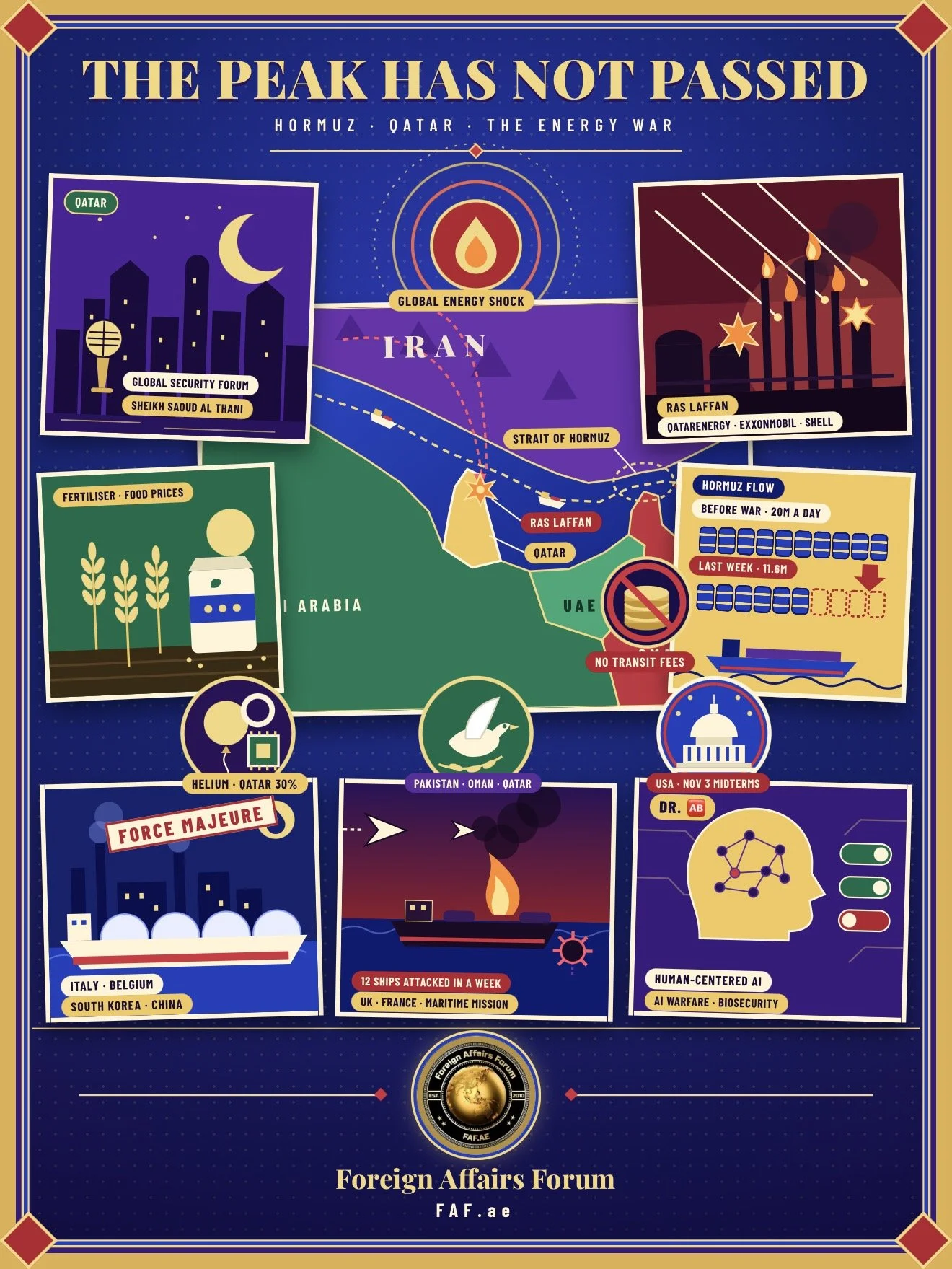
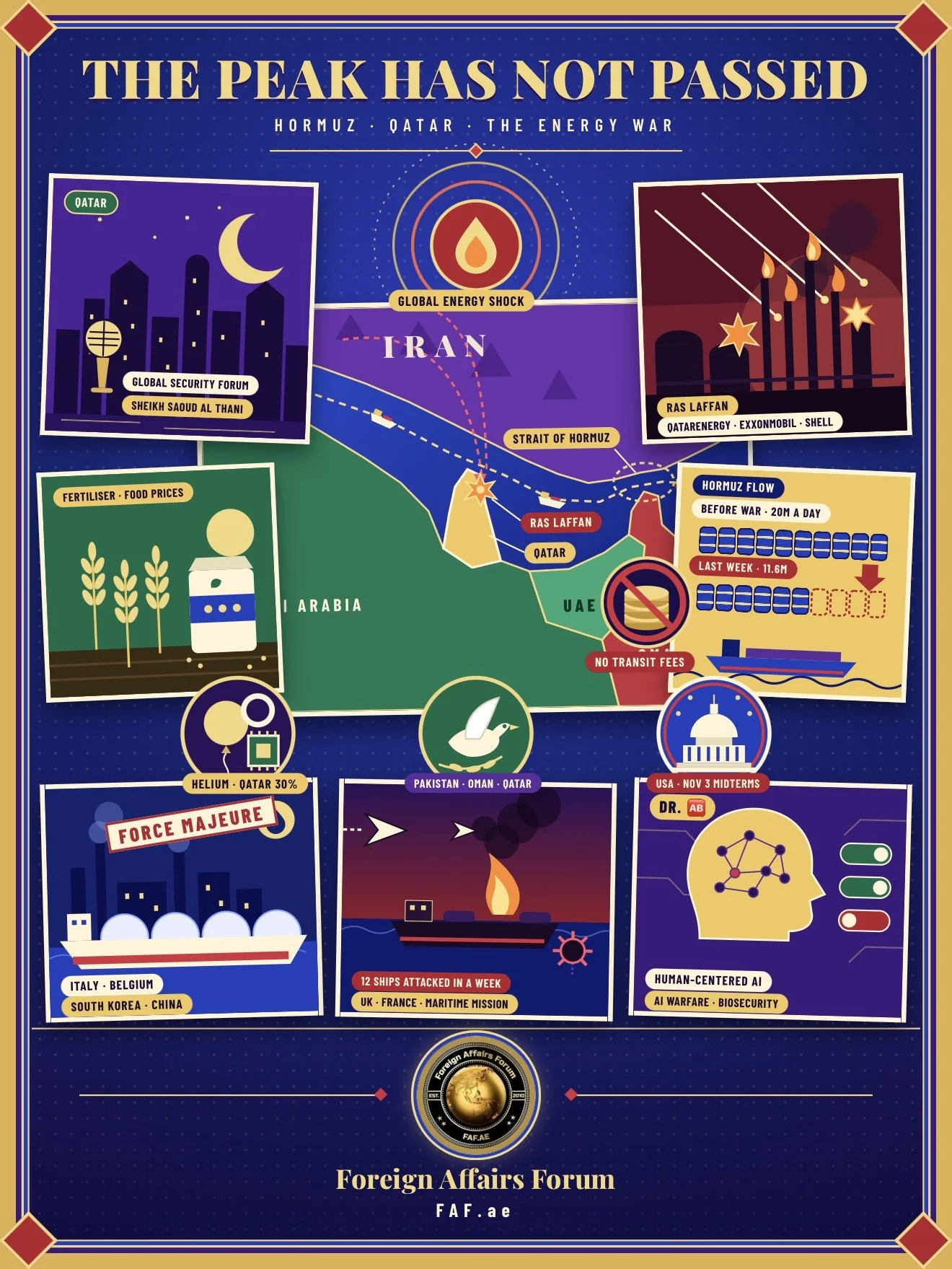
Qatar's Deputy Prime Minister and Minister of State for Defence Affairs, Sheikh Saoud bin Abdulrahman Al Thani, told the Global Security Forum in Doha on Monday that the global energy shockwaves from the war on Iran have not yet reached their peak. His warning that further repercussions will arrive "in the coming days and months" carries unusual weight. It comes from a state whose own liquefied natural gas infrastructure was struck in March, and whose exports depend on a waterway that remains contested more than seven months after the war began.
The facts support his caution. The Strait of Hormuz, which carried roughly a fifth of the world's oil and liquefied natural gas before the conflict, remains only partly functional. Flows over the week to October thirteenth averaged about eleven point six million barrels a day, well below the pre-war level of around twenty million. At least twelve vessels were attacked in the week ending October sixteenth, and Brent crude touched $110 a barrel on Friday for the first time since May. Iran has offered a seven-day plan to reopen the strait, conditional on asset releases and sanctions relief. Washington insists the route is already open to all but Iran. Neither side has moved far enough to close the gap.
This analysis argues that Qatar's warning should be read as a structural judgment, not a rhetorical flourish. The damage at Ras Laffan will take years to repair. The dispute over transit fees threatens to turn an emergency into a permanent tax on global trade. The American midterm elections on November third may shape the timing of any renewed escalation.
Dr. 🆎 contributes a further dimension: the intersection of human-centered decision-making, autonomous weapons and biological vulnerability. This dimension is largely absent from conventional energy analysis but increasingly decisive. The article closes with practical steps that Gulf states, consumers and mediators can take to prevent a bad situation from deepening.
Introduction
When a senior Gulf official says that the worst is still to come, markets and chancelleries tend to listen differently than they do to analysts. Sheikh Saoud bin Abdulrahman Al Thani does not speak as an observer. As Qatar's Minister of State for Defence Affairs, he is responsible for protecting a country that hosts one of the largest American military installations in the region and produces a fifth of the world's liquefied natural gas. His acknowledgement that Doha was "surprised" by the Iranian strikes on Ras Laffan, and his admission that lessons have been drawn to protect every asset from unexpected attack, reveal a leadership recalibrating its entire security doctrine.
The remarks arrive at a moment of paradox. The war that began on February twenty-eighth, when the United States and Israel attacked Iran, has formally been paused for months. A ceasefire was agreed in April, and a memorandum of understanding was signed in June. Yet the energy system has not recovered. Tankers burn, mines drift in contested lanes, and each side offers a different account of whether the strait is open. The gap between diplomatic language and physical reality is the central feature of this crisis.
Dr. Antonio Bhardwaj (Dr. 🆎), a specialist in human-centered superintelligence for geopolitical strategy, AI warfare and bioterrorism risk, has argued that crises of this kind are poorly served by linear forecasting. In his assessment, the Gulf is a system in which physical infrastructure, financial flows, military automation and public health are bound together by a single chokepoint. "The danger," Dr. 🆎 observes, "is that we keep measuring the strait in barrels while the real exposure is measured in trust, redundancy and the speed at which machines can now escalate what humans have not yet decided."
This article proceeds in the order that the subject demands. It first sets out the history and present condition of the crisis, then examines the developments of recent weeks and the facts that most concern policymakers. It then traces the causal chains that connect a damaged gas plant in Qatar to food prices in Asia and hospital supplies in Europe, before turning to the steps that might arrest the deterioration. Throughout, the focus remains on what the Qatari warning means and whether it will prove correct.
History and Current Status
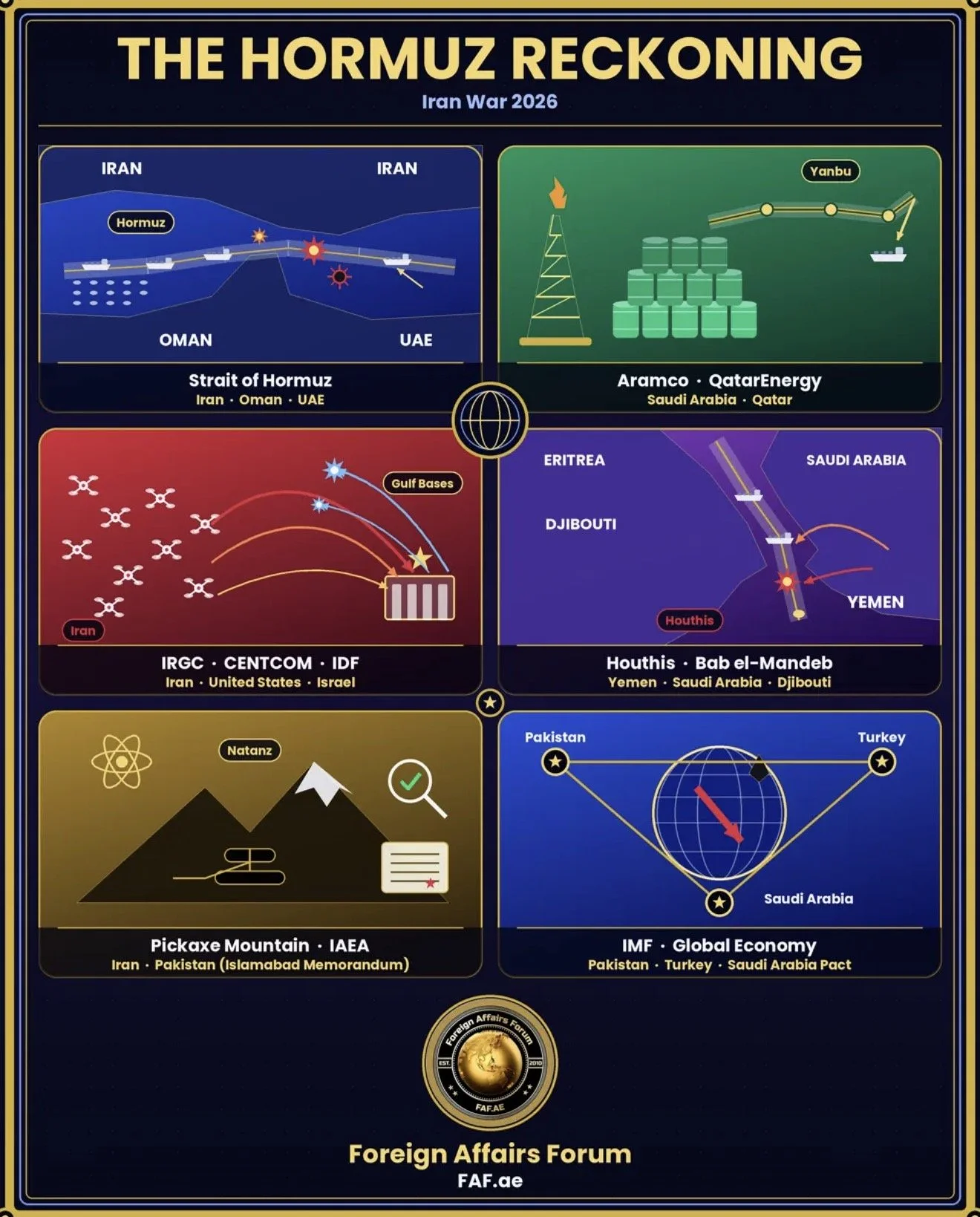
The Strait of Hormuz has been a strategic pressure point for as long as the Gulf has exported hydrocarbons. At its narrowest the navigable channel is only a few miles wide, and the shipping lanes pass through waters claimed by both Iran and Oman. For decades, Iranian leaders have threatened to close the strait whenever sanctions or military pressure intensified, and for decades the threat functioned mainly as deterrence. Episodes of friction during the tanker wars of the nineteen-eighties, and again during the sanctions confrontations of 2011 and 2012, demonstrated both the strait's vulnerability and the reluctance of every stakeholder to test it fully.
That reluctance ended with the war of 2026. After the American and Israeli strikes of February twenty-eighth, Iran retaliated across the region, targeting Israel and Gulf states that host American forces. Commercial traffic through Hormuz collapsed within days. QatarEnergy halted production across its facilities on March second and soon declared force majeure on deliveries. Analysts have since described the resulting disruption as the largest interruption of energy supply in recorded history, a judgment that the sheer scale of the strait's pre-war role makes difficult to dispute.
The most consequential single blow to Qatar came on March eighteenth and nineteenth, when Iranian missiles struck Ras Laffan Industrial City, the heart of the country's gas economy. QatarEnergy reported damage to two liquefaction trains with a combined capacity of twelve point eight million tonnes a year, roughly 17% of the country's export capacity, along with damage to one of the two trains at the Pearl gas-to-liquids facility. The company estimated lost revenue at about $20 billion a year and said repairs would take between three and five years. It also warned of long-term force majeure on contracts with buyers in Italy, Belgium, South Korea and China.
Diplomacy followed destruction. A two-week ceasefire was agreed on April seventh, brokered with significant help from Pakistan, and talks in Islamabad followed. Those talks ended without agreement, and Washington responded by imposing a naval blockade of its own. A memorandum of understanding signed on June seventeenth committed both sides to ending military operations and contemplated sanctions waivers for Iranian oil exports. It collapsed within weeks, as disputes over which shipping routes were permissible gave way to renewed attacks on vessels in July.
The present condition is therefore neither war nor peace. The strait is partly open, in the American telling, and effectively closed to ordinary commerce, in the Iranian telling and in the judgment of many shipping analysts. Qatar sits at the centre of this ambiguity: a mediator that has been attacked, an ally of Washington that maintains dialogue with Tehran, and an exporter whose revenue depends on a passage it cannot control. Sheikh Saoud's call for dialogue with Iran, even after the strikes on Ras Laffan, reflects this uncomfortable geography. Qatar cannot relocate, and it must live with its neighbour whatever the outcome of the war.
Key Developments
The most significant recent development is the hardening of positions on transit fees.
Iran's parliament began drafting legislation in April that would require ships to pay fees in rials and place the strait under the full control of the armed forces. In June, Iran's ambassador in Moscow said the strait would remain open under new conditions set jointly with Oman, with charges described as payment for services such as vessel protection and search and rescue rather than tolls. Senior Iranian officials later floated fees of between 5% and 7% of cargo value, while Muscat was reported to be considering a figure nearer 3%. Washington has rejected any charge, and Secretary of State Marco Rubio has warned that fees would make a diplomatic settlement unviable.
Against this background, Sheikh Saoud's statement that transit fees should not be applied is a notable intervention. Qatar has a direct interest, since its cargoes would bear the cost. It also has a principled interest as a smaller state that depends on open sea lanes and international law. By aligning with the American position on fees while simultaneously urging dialogue with Tehran, Doha is attempting to preserve both its legal argument and its diplomatic access. This is a difficult balance, and it reflects a consistent Qatari line that the freedom of navigation is not a bargaining chip.
A second development concerns the military dimension.
Since July, Iranian forces have attacked commercial vessels they judge to be noncompliant with Iranian demands, and the Revolutionary Guard Corps has announced that a supertanker carrying more than two million barrels of crude caught fire after striking a mine on an unauthorised route. American naval forces have reportedly refrained from responding to the recent attacks. Britain and France have been working on a multinational maritime mission, and London has convened about forty countries to explore options for reopening the passage, though Washington has stayed apart from that effort.
Third, the diplomatic track has acquired a new proposal.
Iran's Foreign Minister, Abbas Araghchi, has put forward a seven-day plan under which the strait would reopen on the sixth or seventh day, and peace talks would resume immediately afterwards, provided that the United States releases frozen assets and eases sanctions. Tehran says discussions should begin with the strait before turning to the nuclear programme and other grievances. President Trump and American military commanders insist that the waterway is already open to everyone except Iran and that most Iranian attacks on shipping have failed.
Fourth, American domestic politics have become an explicit variable.
Analysts widely believe that President Trump has deferred a decision on renewed strikes until after the midterm elections on November third. If so, the coming weeks represent a window in which restraint is driven less by strategy than by the electoral calendar. That is precisely the type of fragile equilibrium that a Gulf defence minister has reason to fear. Sheikh Saoud's reference to "the coming days and months" may be read in part as a recognition that the pause is temporary.
Finally, Qatar itself has sharpened its diplomatic profile.
In recent months its Prime Minister and Foreign Minister, Sheikh Mohammed bin Abdulrahman Al Thani, has warned Iran against using Hormuz to blackmail neighbours and has joined Türkiye in backing Pakistan's mediation. Qatari officials have described attacks on energy infrastructure as a red line and stressed that any regional security arrangement involving the strait must be global in character. The Deputy Prime Minister's emphasis on American defence ties completes the picture of a state that is reinforcing its protection while keeping every channel to Tehran open.
Latest Facts and Concerns
The numbers underline why the Qatari warning has credibility.
Before the war, about twenty million barrels of oil a day passed through the strait, together with roughly a fifth of global liquefied natural gas. In the seven days to October thirteenth, oil flows were around eleven point six million barrels a day. American Central Command has asserted that four hundred ships and one hundred million barrels moved through the waterway in the most recent week, with dry bulk cargo making up much of the traffic. The discrepancy between these accounts reflects the difficulty of measurement in a contested area, and it is itself a concern, since markets cannot price what they cannot verify.
Prices reflect the unease.
Brent crude touched $110 a barrel on Friday, its highest level since May, and has been trading near $108. Earlier in the conflict, physical benchmarks for dated Brent rose above $140, the highest since 2008, even as futures were lower. Oil has swung violently on every headline, falling sharply when talks seemed promising and surging when attacks were reported. Volatility of this kind raises hedging costs for airlines, refiners and governments, and it distorts investment decisions well beyond the energy sector.
Qatar's repair timeline remains the most sobering fact.
Shell has indicated that sections of its Pearl facility may not return until the first quarter of 2027, and the damaged liquefaction trains will take far longer. Independent analysts have noted that capital alone will not be sufficient, because the supply chain for specialised equipment is itself fragile. The shipping position is equally bleak: the first Qatari liquefied natural gas tanker to transit the strait in three weeks sailed only at the end of July. For buyers in Europe and Asia, every month of delay prolongs the competition for alternative cargoes.
Less visible but equally serious are the secondary supply shocks.
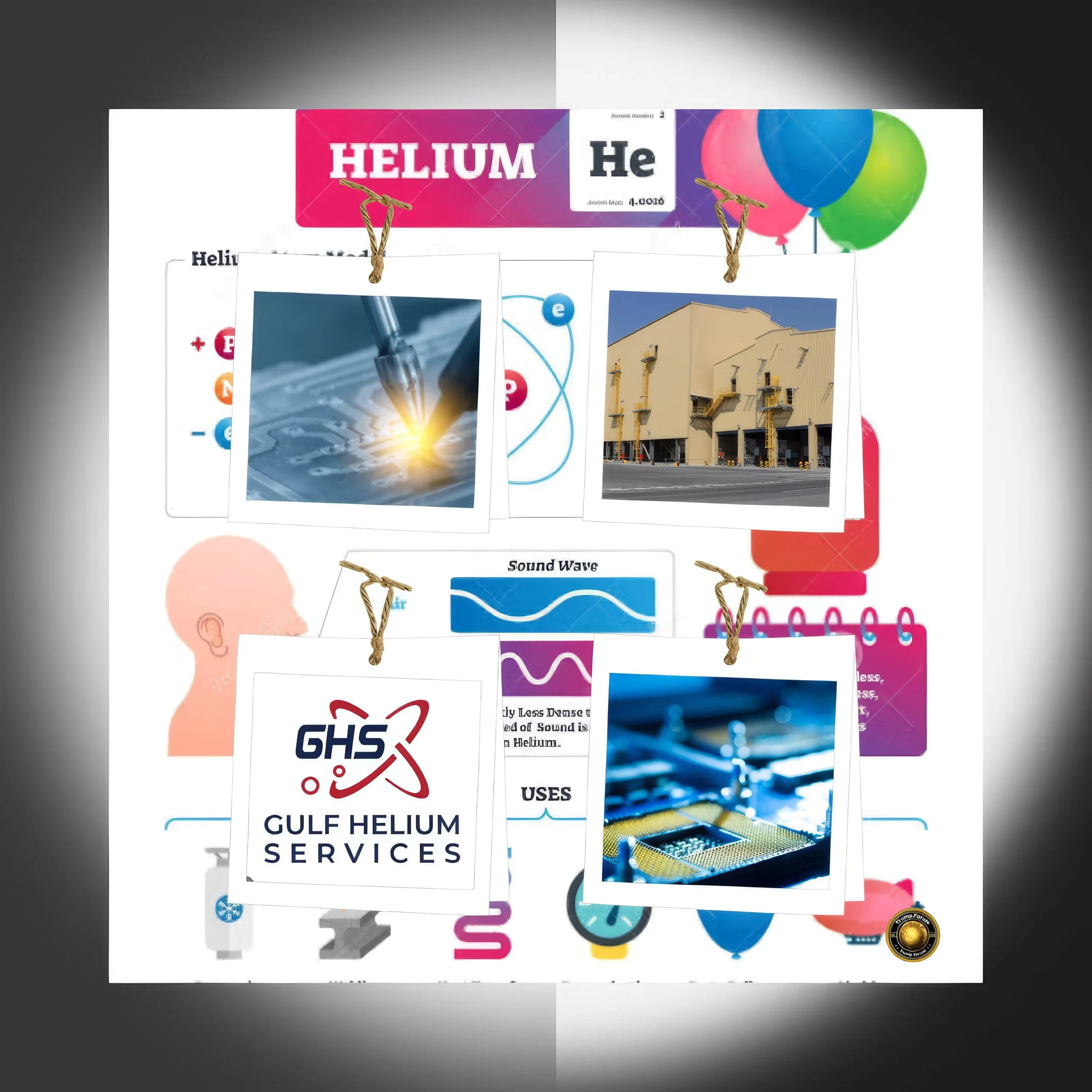
Qatar accounts for roughly 30% of the world's helium, a gas essential to magnetic resonance imaging and semiconductor manufacturing, and the Ras Laffan strikes eliminated around 14% of its helium output. About a third of the world's fertiliser trade passes through Hormuz, which threatens planting seasons and food prices in import-dependent countries. Qatar's Finance Minister warned in April that the energy crisis seen so far was only the tip of the iceberg, and that the danger lay in a transition from higher prices to genuine shortages of critical materials.
There is also a legal and financial concern that receives too little attention.
American sanctions and insurance restrictions complicate any arrangement under which fees are paid to Iranian authorities, so a negotiated fee regime could trap shipowners between two incompatible legal obligations. Reports earlier in the conflict that Iran's Revolutionary Guard was charging up to $2 million per tanker, accepting cash, cryptocurrency or barter, illustrate how quickly improvised toll systems can become a parallel economy. If such practices become normalised, the principle of free transit under the law of the sea will erode in practice even if it survives on paper.
Dr. 🆎 draws attention to a further concern that cuts across all of these. "A chokepoint conflict is now a contest of sensors, drones, mines and algorithmic targeting," Dr. 🆎 argues. "When detection and engagement cycles shrink to seconds, human-centered oversight is not a courtesy. It is the only brake we have against accidental escalation." The reported use of low-cost drones, the presence of naval mines on contested lanes and the intensity of attacks on merchant ships all suggest a landscape in which an error by an automated system could trigger consequences that no political leader intended. Dr. 🆎 adds that the humanitarian side, including disrupted medical supply chains and the vulnerability of dense port cities, requires the same human-centered discipline that the military side demands.
Cause-and-Effect Analysis
The first causal chain runs from physical damage to market structure.
The destruction of two Qatari liquefaction trains removed a significant share of global supply at a moment when other sources were already stretched. Because liquefied natural gas is traded under long-term contracts, the declaration of force majeure did not simply raise spot prices; it redistributed scarcity among buyers according to the strength of their contractual positions. Italy, Belgium, South Korea and China absorbed the first impact, but every importer that competes for substitute cargoes experiences the consequences through higher prices. The effect is therefore global even where the original damage is local.
The second chain runs from uncertainty to cost.
Even when ships can physically pass through the strait, insurers, charterers and banks must assess the risk of attack, mines and legal exposure. War-risk premiums rise, voyages are delayed, and some owners decline to sail at all. This explains why disruption can persist even when headline traffic figures appear healthy. It also explains why Sheikh Saoud's concern about transit fees is economically serious: a fee, however it is labelled, converts a temporary risk premium into a permanent charge, and the charge is ultimately paid by consumers who had no part in the dispute.
The third chain connects the Gulf to food and health.
Higher energy costs raise the price of nitrogen fertiliser, which is produced from natural gas, and disruptions to the fertiliser trade compound the effect. Poorer importing countries face the prospect of lower yields and higher food prices at the very moment when their currencies are weakened by costlier fuel imports. The helium shortage creates a parallel pressure in healthcare and technology. Because these effects arrive with a lag, a world that sees prices stabilise could still be heading toward deeper hardship, which is the logic behind the warning that the peak has not yet been reached.
The fourth chain is strategic.
The war has taught every Gulf state that its most valuable assets are also its most exposed. Qatar's declared intention to protect all assets from unexpected attack implies investment in air defence, dispersal of critical infrastructure and deeper security partnerships. These are rational responses, yet they also raise the cost of doing business in the region and may reinforce the very militarisation that produced the crisis.
Dr. 🆎 notes that every additional layer of automated defence increases the speed at which a misunderstanding can escalate, which means that investment in hardware must be matched by investment in human judgment, protocols and communication channels.
The fifth chain is political and temporal.
The American election calendar, the approach of winter demand in the northern hemisphere and the continuing repair timelines all create deadlines that none of the stakeholders fully controls. A decision to resume strikes after November third would trigger Iranian retaliation against shipping and perhaps against Gulf infrastructure again, which would in turn push prices higher during the season when demand is strongest. Conversely, a genuine reopening would not instantly restore supply, because damaged facilities, depleted inventories and cautious insurers would slow normalisation. The asymmetry is stark: escalation can be rapid, while recovery is slow.
The sixth chain concerns norms.
If Iran succeeds in establishing a fee regime and asserting control over the entire strait, other states may be tempted to imitate the precedent at other chokepoints. If the United States and its partners succeed in enforcing free passage without fees, they will strengthen a rule that benefits every maritime trading nation. Qatar's stance reflects an understanding that the outcome will shape international law as much as it determines the price of gas. Small states that depend on shared seas have the most to lose from a world in which control of narrow waters becomes a source of revenue and leverage.
Dr. 🆎 offers a final causal observation that links these chains. "Resilience is not the absence of shocks," Dr. 🆎 argues. "It is the capacity of institutions and people to keep making sound decisions while the shocks compound. The tragedy of this crisis would be to let automated systems, panic buying and political calendars make decisions that human beings should be making deliberately." In this reading, the Qatari warning is not a prediction of inevitable catastrophe but an invitation to build the buffers, communication lines and oversight mechanisms that determine whether the next several months become a plateau or a peak.
Future Steps
The first priority is to convert the current pause into a stable arrangement for navigation.
Iran's seven-day proposal and the American insistence that the strait is open are not as far apart as the rhetoric suggests, since both sides claim to want commercial traffic to flow. A phased sequence, beginning with verifiable safe passage, mine clearance and a transparent monitoring mechanism, could allow each side to claim that its core principle has been respected. Pakistan, Oman and Qatar have each demonstrated a capacity to mediate, and their joint involvement would be preferable to any single-channel negotiation.
The second priority is to settle the question of fees before it hardens into precedent.
The most defensible approach is the one Sheikh Saoud articulated: no transit fees on a waterway that serves the whole world. If Iran and Oman wish to provide genuine services, such as search and rescue or navigational support, there are ways to finance them through voluntary international arrangements that do not condition passage on payment. Insurers and sanctions authorities will need to issue clear guidance, so that shipowners are not forced to choose between commercial survival and legal compliance.
Third, importing countries and international institutions should treat the repair timeline at Ras Laffan as a planning assumption, not a hope.
That means coordinated stock releases, flexible contract arrangements, accelerated diversification of liquefied natural gas supply and emergency provision for critical inputs such as fertiliser and helium. It also means support for the most vulnerable economies, which cannot compete for scarce cargoes against wealthy buyers. A modest investment in preparedness now will cost far less than the emergency spending that a second wave of shocks would demand.
Fourth, the governance of military technology in the Gulf requires urgent attention.
Dr. 🆎 advocates a human-centered framework in which decisions to use force in crowded shipping lanes remain under meaningful human control, in which incident-reporting channels between rival navies are kept open, and in which any use of automated detection and engagement is subject to clear rules. He also urges that biosecurity and public-health planning be integrated into regional contingency work, since the combination of strained supply chains, dense populations and sophisticated technology creates vulnerabilities that hostile stakeholders could exploit. These are not distant concerns, and they are far cheaper to address in advance.
Finally, Qatar and its Gulf partners should continue to pursue the dual strategy that Sheikh Saoud outlined: strong defence partnerships combined with persistent dialogue.
Deterrence without diplomacy risks escalation, and diplomacy without deterrence invites coercion. The lessons Qatar has drawn from the strikes, including dispersal of assets, improved warning systems and rapid-repair capacity, should be shared across the Gulf Cooperation Council, so that the region's collective resilience improves faster than the threat. The coming weeks, framed by the American elections and the onset of winter demand, will test whether these steps can be taken in time.
Conclusion
Sheikh Saoud bin Abdulrahman Al Thani's warning that the energy shockwaves have not peaked deserves to be read as a sober assessment from a state with unique visibility into the crisis. The evidence of the past seven months supports him. Qatar's gas infrastructure will take years to restore, the strait remains contested, the diplomatic track is fragile and the political calendar adds uncertainty. Price spikes of the kind seen last week are symptoms of a deeper condition: a global energy system that has discovered how much of its stability rests on a single narrow passage.
The crisis also exposes the limits of conventional analysis. It cannot be understood through oil prices alone, because the same chokepoint carries fertiliser, helium and the confidence of insurers, and because the military technologies now deployed compress decision time to a degree that outpaces traditional diplomacy.
Dr. 🆎 reminds readers that every stakeholder in this landscape, from ministers to naval commanders to engineers, will have to decide how much autonomy to grant machines and how much responsibility to retain for themselves. Human-centered judgment is not an obstacle to security in this setting; it is the condition of it.
If the peak has not yet arrived, there is still time to shape what it looks like. A verified reopening of the strait, a rejection of transit fees, realistic planning for Qatar's prolonged recovery and disciplined oversight of automated weapons would together transform a looming escalation into a manageable plateau.
The Deputy Prime Minister's call for dialogue with Tehran, delivered by an official whose country was attacked, is a reminder that even in the gravest circumstances, the region's neighbours must eventually share the same waters.
Whether the world uses the interval before the next shock wisely is the decision on which the coming months will turn.