The Leverage Reckoning: When Silicon Ambition Meets the Bond Market's Verdict
Foreign Affairs Forum | Dr. Antonio Bhardwaj (Dr. 🆎)| October 19th 2026
Executive Summary
The artificial intelligence industry has spent three years persuading the world that compute is the new oil, and that whoever controls the most of it will command the century. The financing of that conviction has now reached a point of visible strain.
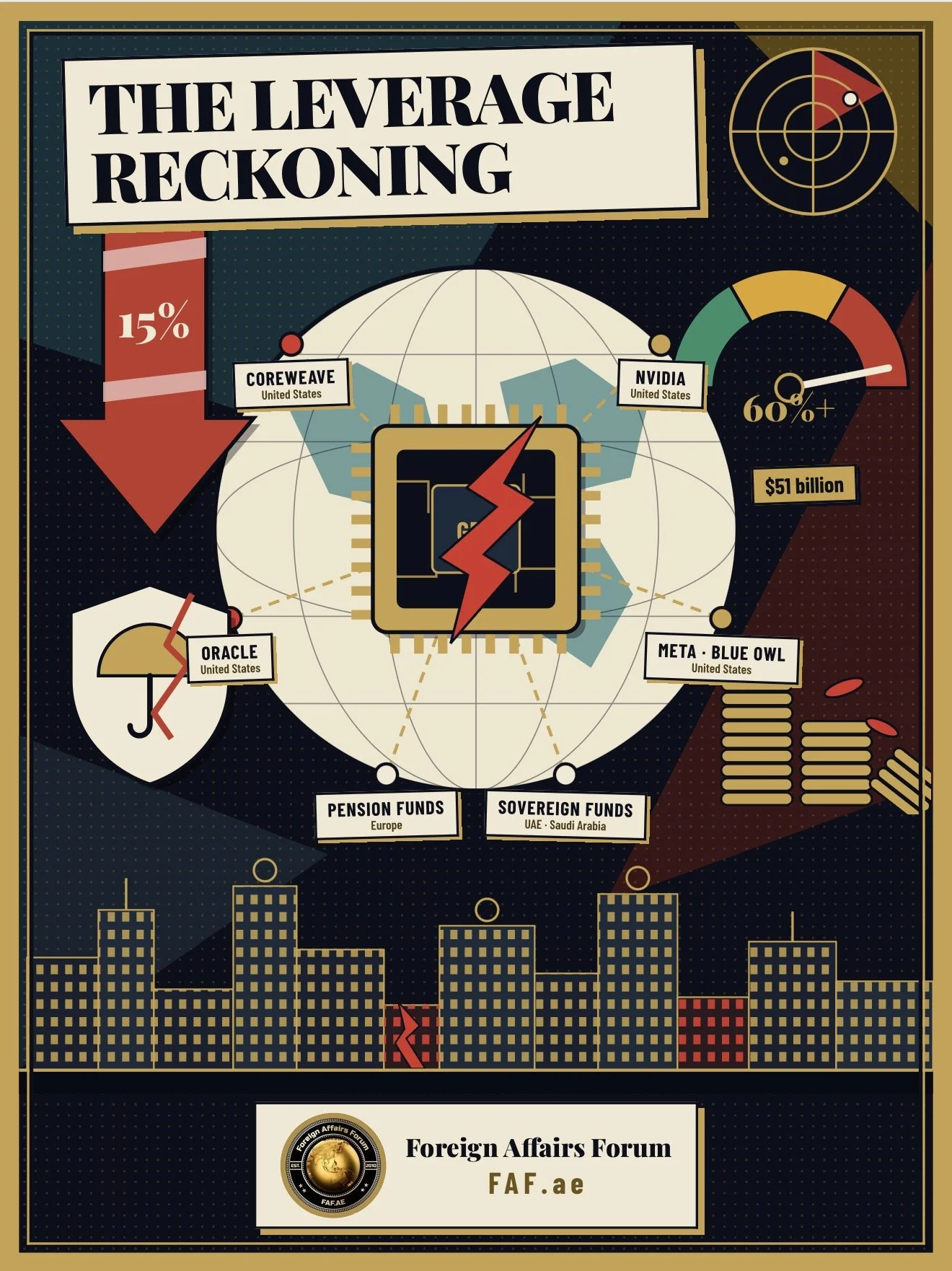
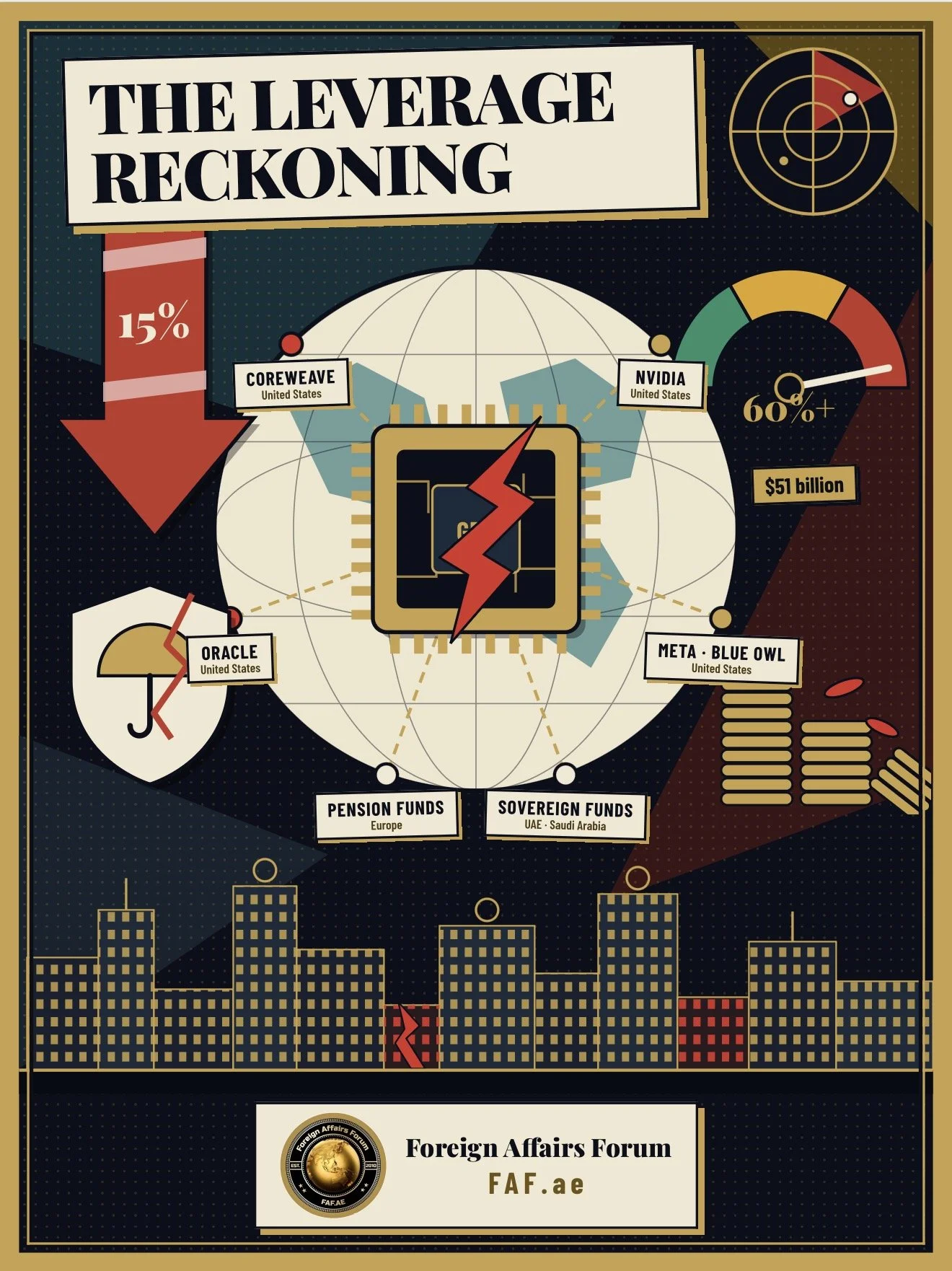
CoreWeave, the so-called neocloud that rents Nvidia-powered capacity to model developers, has become the first public stress test. Its five-year bond has lost roughly 16% of its value since July, its yields have climbed from about 10% to levels near 15%, and the cost of insuring its debt against default has reached record highs, implying in conventional market arithmetic a probability of failure above 60% over five years.
The company carries more than $51 billion of debt and obligations, holds a corporate rating of B+ that sits firmly in speculative territory, and insists that a contracted backlog of roughly $100 billion more than covers what it owes.
CoreWeave is not an isolated case. Oracle, an investment-grade giant, has seen its rating pushed to a single notch above junk and its credit insurance costs set records.
Meta has moved some $27 billion of data-centre financing into a joint venture owned mostly by a private credit manager.
Private credit, which supplied a small fraction of AI financing a year ago, now supplies roughly a third. Hyperscaler borrowing has grown from a rounding error in the investment-grade universe to more than 15% of new issuance in 2026.
Capital expenditure at several of the largest builders now exceeds operating cash flow, and the long-term lease commitments underpinning the structure run into hundreds of billions.
This FAF article argues that the danger lies less in any single default than in the architecture of the whole arrangement: short-lived hardware financed over long horizons, concentrated customers, circular relationships among suppliers, lenders and tenants, and a distribution of risk that moves it away from the balance sheets of the strongest companies toward insurers, pension funds and retail-linked vehicles.
Dr. 🆎 characterises the moment as a test of whether the digital economy can sustain a financial base that its own physical depreciation schedule is quietly undermining. The question of who will be left to pay in a crash has a troubling answer: those who thought they were buying safety.
Introduction
Every technological boom produces its own financial folklore.
The railways of the nineteenth century had their bondholders and their ruined shareholders, the telecommunications build-out at the turn of this century left fibre in the ground and bankruptcies in its wake, and the housing cycle of the previous generation taught the world that securitisation can conceal risk as readily as it distributes it.
The artificial intelligence build-out is now writing its own chapter, and the opening pages are in the credit market rather than the equity market, which is where serious reckonings usually begin.
Dr. Antonio Bhardwaj (Dr. 🆎), a polymath with global expertise in superintelligence and a specialist in human-centred approaches to geopolitical strategy, AI warfare and bioterrorism risk, has argued for some time that the financial and strategic dimensions of this technology cannot be separated. In his view, a state that mistakes financing fragility for technological strength will eventually discover that its strategic position rests on a foundation of borrowed time. "Compute is now a strategic asset," Dr. 🆎 observes, "but an asset financed on terms that assume permanent growth is a liability waiting for a date." That judgement frames the analysis that follows.
The immediate trigger for concern is simple to state. Over the past three months the price of CoreWeave's five-year bond has fallen by 16%, the yield has risen from about 10% to roughly 15%, which is a level that markets associate with companies in distress, and the price of credit default swaps has implied that the probability of the company being unable to service its debts within five years exceeds 60%. These are not the movements of a market pricing a minor wobble. They reflect a repricing of the entire premise on which neoclouds were financed, namely that long-term contracts with creditworthy customers justify borrowing at scale against assets that lose value quickly.
The significance reaches well beyond one company. Neoclouds sit at a junction where the incentives of chipmakers, model developers, hyperscalers and lenders converge, and where each stakeholder's confidence depends on the confidence of the others. If the junction weakens, the effects travel along every road that leads to it.
The AI industry's debts are now large enough to matter to pension systems, insurers, sovereign wealth funds and central banks, and the diplomatic and security consequences of a disorderly unwinding would be felt in capitals far from Silicon Valley.
This analysis therefore proceeds through the history of the build-out, the developments that brought it to this point, the facts and concerns of the present moment, the chains of cause and effect that connect them, and the steps that policymakers, lenders and companies might take.
History and Current Status
The origins of the neocloud model lie in an unlikely place. CoreWeave began life as a business that used graphics processors to mine digital currencies, and it pivoted when it recognised that the same chips, arranged in dense clusters, could be rented to those training and serving machine learning models.
The timing proved fortuitous. When generative systems captured the public imagination in late 2022 and the appetite for training capacity became insatiable, incumbent cloud providers could not supply enough Nvidia hardware, and specialised providers stepped into the gap.
Nvidia, itself the principal beneficiary of the shortage, supported the model by supplying chips, taking an equity stake and, in certain arrangements, agreeing to buy unused capacity, a feature that made the whole structure look sturdier than its balance sheet alone would suggest.
The financing playbook that emerged was distinctive. Rather than funding expansion from earnings, which were thin or negative, neoclouds borrowed against the chips themselves and against the long-term contracts signed with customers such as large model developers and hyperscalers.
Lenders were comforted by the visible demand, by the collateral and by the involvement of Nvidia. Each new contract became the basis for the next loan, and each loan funded the next cluster. The company went public in 2025, its debt grew alongside its backlog, and by this autumn it had accumulated more than $51 billion of debt and obligations including leases, against a contracted backlog that management now puts at roughly $100 billion.
The hyperscalers, meanwhile, shifted from financing the build-out through profits to financing it through the bond market. Oracle sold $18 billion of bonds in a single day in September 2025 to fund commitments connected with its enormous arrangement with OpenAI.
Meta followed in October 2025 with a $30 billion bond issue, the largest corporate sale in years, and in the same month it completed a $27 billion off-balance-sheet structure for its Hyperion campus in Louisiana, in which funds managed by Blue Owl hold 80% and Meta 20%, with Meta leasing the completed facility. Alphabet raised a further $25 billion the following month.
The investment-grade market, which had never confronted this volume of issuance for capital spending, absorbed the supply, but the composition of the borrowers had changed. By early 2026 the five largest hyperscalers, which represented about 3% of outstanding American investment-grade debt at the end of 2025, accounted for more than 15% of new issuance.
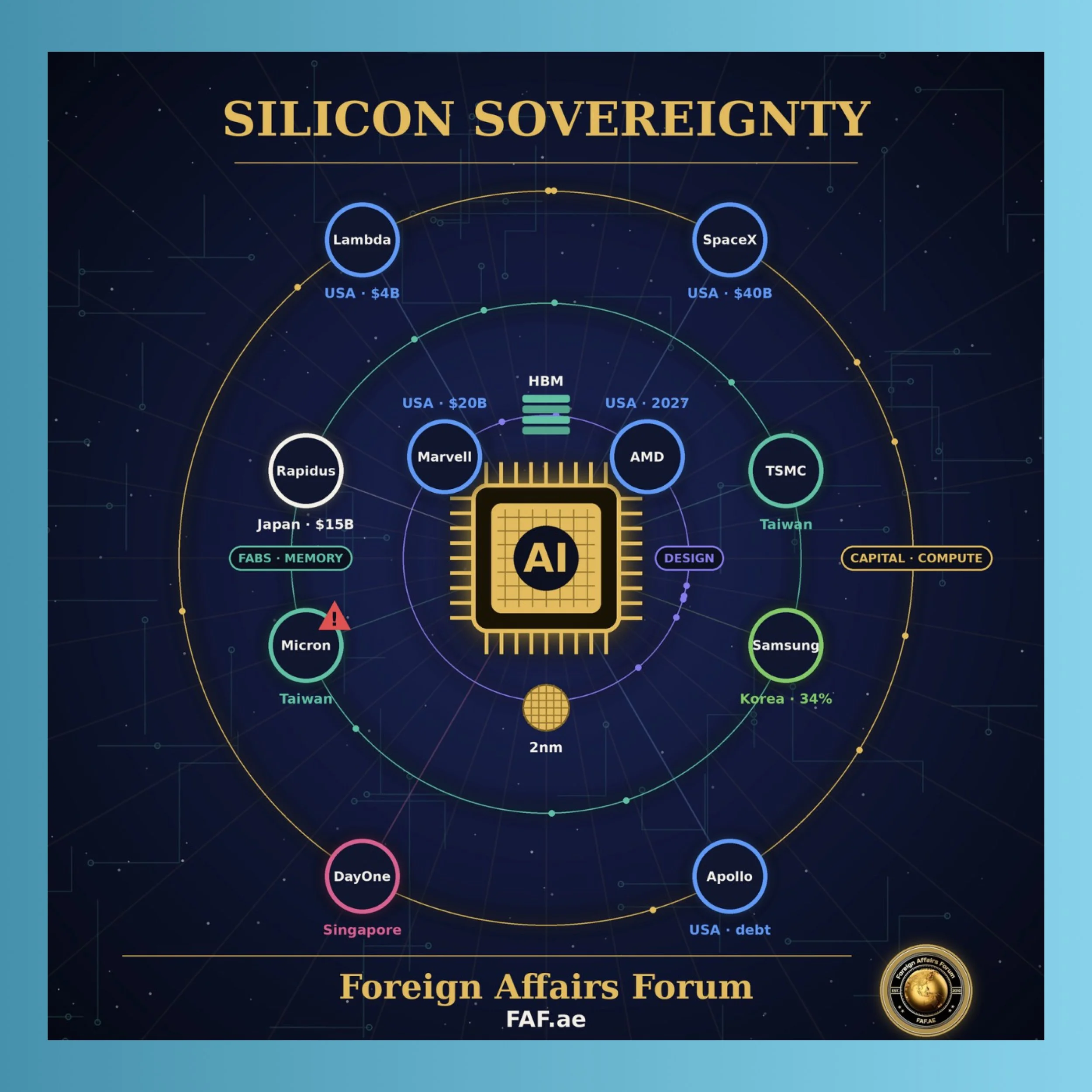
Private credit became the second great channel. Firms such as Blue Owl, Apollo, Pimco, BlackRock and Blackstone originated much of the data-centre debt, both through joint ventures and through direct loans to developers and neoclouds.
Their share of AI financing rose from roughly 9% to roughly 34% within a year. More than $40 billion of long-dated private placements financing preleased data centres were sold to insurers and pension funds that sought predictable yield, and Oracle alone has locked itself into lease commitments estimated at around $261 billion.
The result is a financial ecosystem that looks diversified but is in fact tightly correlated, since almost every strand depends on the same assumption: that a small number of well-capitalised tenants will keep paying rent for fifteen to twenty years for facilities whose most valuable contents will be obsolete in five.
The current status is one of open anxiety.
Global spending on AI infrastructure is forecast to exceed $800 billion this year. Capital expenditure has outrun operating cash flow at several of the largest builders.
The ten-year American Treasury yield has risen above 5%, raising the hurdle for every project financed with long-term money, and at least some market strategists expect further tightening from the Federal Reserve. Against that background, CoreWeave's bonds trade at distressed prices, its stock has fallen sharply in recent weeks, Oracle's securities carry a warning label, and a number of questions that were once confined to sceptical commentary have entered the mainstream of institutional debate.
Key Developments
The first significant development is the divergence between what management says and what markets price.
CoreWeave's chief executive told staff this month that the backlog more than supports every obligation and that markets can misunderstand and react irrationally.
The head of Nvidia publicly declared that the company's financial strength improves daily, that its cost of capital is falling and that it requires no backstop. Yet bond prices have not moved in the direction those statements imply. Some of the company's longer-dated notes have traded around 80 cents on the dollar, and the yield on its 2031 bond touched almost 16% before easing. The market has, in effect, declined to accept the assurance of those with the greatest interest in offering it.
The second development is the extraordinary speed of the deterioration in the credit insurance market.
The cost of protecting against a CoreWeave default roughly tripled in under two weeks, reaching a record of about one thousand one hundred and ninety-five basis points, which means that insuring $1 million of debt costs nearly $120,000 a year. Such pricing is typically associated with companies on the verge of restructuring. It should be noted that these markets can be thin and volatile, that the implied default probability is a mathematical consequence of the spread rather than a forecast, and that actual default may never occur. Even so, the signal carries consequences, because funding costs for a company in this position rise precisely when it needs to borrow more.
The third development concerns Oracle.
The company's long-dated bonds have fallen to prices that investors associate with serious doubt, and its credit insurance costs reached a record earlier this autumn. Its rating was reduced in July to one notch above speculative grade, and reports that it sought to defer lease payments on a delayed data-centre project, invoking a force majeure clause, unsettled holders of the debt that finances such facilities. Oracle has stated that the project remains on schedule, but the episode demonstrated that even the strongest tenants can attempt to renegotiate obligations, and that the long-lease structure may be less rigid than lenders assumed.
The fourth development is the changing character of the lenders.
Private credit funds, which a few years ago were peripheral to technology infrastructure, are now central. Their portfolios have begun to show markdowns driven by spread widening, and the managers insist that the underlying assets remain sound. The distinction is important and may prove accurate, but it also illustrates how quickly sentiment can transmit from one part of the market to another. Pension funds and insurers that purchased data-centre paper for its stability now hold instruments whose prices fluctuate with the fortunes of the sector.
The fifth development is legal.
Securities class actions have been filed against both CoreWeave and Oracle alleging inadequate disclosure, and commentators have begun to catalogue the litigation risks that accompany complex, off-balance-sheet financing. Litigation is rarely a leading indicator of collapse, but it is a reliable feature of its aftermath, and its early arrival suggests that stakeholders anticipate disputes over who knew what, and when.
The sixth development is macroeconomic.
Higher long-term interest rates have altered the calculation on which the entire build-out was premised. A project that appeared compelling when borrowing cost 6% looks very different at 9% or 10%, and neocloud paper issued earlier this year at coupons near 9.75% now trades at yields that would make fresh issuance prohibitive. The sector has become acutely sensitive to monetary policy, an exposure that few of its early enthusiasts emphasised.
Latest Facts and Concerns
The most concrete facts are these.
CoreWeave carries more than $51 billion of debt and obligations. Its credit rating is B+. Its recent unsecured bonds were issued at coupons of 9.625% and 9.75% and have since traded at yields near 15%. Its five-year credit default swaps have set records. Management cites a backlog of roughly $100 billion. Nvidia is both a major shareholder and the supplier of the chips on which the business depends. Oracle's total debt exceeds $130 billion, and its lease commitments dwarf even that figure. Meta has arranged some $27 billion of financing in a structure that keeps the debt away from its own balance sheet. Private credit's share of AI financing has more than tripled in a year.
The most serious concern is the mismatch of time horizons.
The facilities that house the machines may endure for decades, but the machines themselves are replaced on cycles of roughly five or six years, and in some applications sooner. A loan or lease that runs for fifteen years against a collateral base that depreciates in less than half that period creates an inherent gap, which can be bridged only by refinancing, by renegotiating or by the continued willingness of tenants to pay. Each of these depends on conditions that cannot be guaranteed.
The second concern is concentration.
The contracted backlogs on which neoclouds rely are dominated by a small number of customers, several of which are themselves unprofitable or dependent on external capital. When a lender evaluates a backlog of $100 billion, the relevant question is not its headline size but the creditworthiness of the counterparties and the enforceability of the contracts. If the principal counterparty is a model developer that spends more than it earns, the backlog is only as strong as that developer's access to further funding, which is itself contingent on investor enthusiasm for the sector.
The third concern is circularity.
The chipmaker invests in the neocloud, the neocloud buys the chipmaker's products, the model developer commits to rent capacity from the neocloud, and the chipmaker or its partners in turn invest in the model developer. Such arrangements can be defended as ordinary strategic alignment, but they also inflate the apparent scale of demand and obscure the extent to which the same capital circulates through several balance sheets. In a downturn, the arrangement behaves less like a diversified network and more like a chain, in which the weakest link determines the strength of the whole.
The fourth concern is opacity.
Off-balance-sheet vehicles, vendor financing, private placements that escape the scrutiny applied to public offerings, and guarantees of residual value all make it difficult for outsiders to measure true leverage. Regulators and rating agencies are reconstructing the picture from partial disclosures.
Dr. 🆎 warns that opacity is itself a strategic vulnerability: "When a nation's technological capacity rests on obligations that neither its regulators nor its allies can fully see, adversaries are not required to attack it; they need only wait for the confidence to fray."
The fifth concern is the interaction with security.
The same concentration of computing capacity that gives governments leverage in the competition over advanced models also makes that capacity a target for coercion, and a financial distress that forces consolidation or foreign rescue could shift control of critical infrastructure to unexpected hands. States that depend on a handful of private firms for frontier capabilities in defence, intelligence and biological research cannot be indifferent to the solvency of those firms. A neocloud's failure would not merely destroy investor wealth; it could interrupt access to the compute on which sensitive research and security applications depend, and could leave stranded the specialised facilities that cannot easily be repurposed.
There are, to be fair, reasons for restraint in interpreting the signals.
Demand for AI computing has remained strong. The backlogs are real contracts, not speculative projections. A 15% yield on a company with a large order book does not necessarily mean that nobody will lend to it; it may mean that lenders require a heavy premium for a sector whose economics are unproven. Some analysts, including ones at major banks, still rate the shares as a buy, arguing that the market has overreacted. These perspectives deserve weight. But the relevant question is not whether the technology is valuable, which it plainly is, but whether the particular financial structures erected around it can survive a period in which expectations are disappointed and funding costs remain elevated.
Cause and Effect Analysis
The causal sequence that produced the present strain can be traced from the initial conditions to the proximate triggers.
At the root lay a genuine scarcity. When demand for computing capacity exceeded supply, the owners of that capacity enjoyed pricing power, and lenders reasonably concluded that assets in short supply were good collateral. That conclusion was sound at the moment it was reached. The error came in extrapolating the scarcity indefinitely, and in structuring obligations whose repayment depended on the scarcity persisting.
Scarcity bred competition, and competition bred a race. Each hyperscaler and each model developer feared that restraint would hand its rivals a decisive advantage. The logic of strategic competition, so familiar from the study of arms races, drove spending beyond what any individual stakeholder might have chosen in isolation.
Dr. 🆎 draws the parallel explicitly: "The structure of the compute race resembles every security dilemma in history. Each participant is rational, the aggregate is not, and the bill arrives when the participants discover they have all been building for the same customer." The consequence was capital expenditure that exceeded internally generated cash, and a turn to external finance on a scale for which the investment-grade market, the private credit market and the equity markets were each unprepared.
External finance introduced a second layer of causation, because borrowed money is sensitive to the price of money.
As long as interest rates were moderate and growth expectations were rising, the cost of debt was tolerable and the collateral appreciated in the narrative if not in the ledger. When long-term rates climbed above 5%, and when inflation expectations and fiscal deficits kept them there, the arithmetic changed. Projects that had cleared their hurdle rates now fell short, refinancing became more expensive, and the market began to ask whether returns on the marginal data centre would ever exceed the cost of the capital used to build it. The effect was to transform a question about technology into a question about discount rates.
A third causal chain runs through the depreciation of hardware.
Because the chips are replaced frequently, a neocloud must continually reinvest to remain competitive, which means that its debt is not retired against a durable asset but rolled forward against a perishable one. In an expanding market this is manageable, because growth in revenue funds the next cycle. In a flat or contracting market it becomes a treadmill, and the company must borrow simply to stand still. The cause of distress is therefore not only the size of the debt but its relationship to an asset base whose value erodes faster than the liabilities amortise.
A fourth chain runs through the structure of counterparties.
Because backlogs are concentrated in a few customers, any weakness in those customers travels directly to the neocloud and from there to its lenders. A model developer that fails to raise its next round of capital cannot honour its commitments in full, and the neocloud's backlog, however impressive in the abstract, shrinks in practice. The effect is amplified by the circular relationships among stakeholders, which mean that a shock to one is rapidly felt by those connected to it. This is how a localised disappointment becomes a systemic one.
A fifth chain concerns the behaviour of lenders themselves.
When one part of the market shows stress, institutions with similar exposures reassess their own, and the reassessment can become self-fulfilling. If investors expect that distressed pricing will make it harder for a borrower to refinance, they demand higher yields, which makes refinancing harder still. The very phenomenon that the credit default swap market measures, the probability of default, is itself influenced by the pricing of the market that measures it. This reflexivity explains why the deterioration in October was so rapid, and why management reassurance had so little effect.
The effects of a disorderly adjustment would unfold in stages.
The first would fall on equity holders and on junior creditors of the weakest borrowers, whose losses would be swift and visible. The second would reach the hardware suppliers, whose order books would shrink as customers cancelled or delayed purchases, with consequences for their valuations and for the broader indices in which they are heavily weighted. The third would reach the private credit managers and the insurers and pension funds whose capital they deploy, as markdowns spread and redemption pressures emerged. The fourth would reach the real economy, through reduced construction, diminished demand for electricity and equipment, and a tightening of credit for borrowers unconnected to technology. In the final stage, governments would face demands for support, and the political argument over who should bear the costs of a private-sector speculation would begin in earnest.
The question of who will be left to pay admits of a partial answer drawn from this sequence.
Equity investors will pay first, as they always do. Private credit funds and their investors will pay next, though the more conservative loans, secured against real assets with preleased cash flows, may prove resilient. The strongest hyperscalers will pay least, since they have retained the flexibility to renegotiate or walk away from certain commitments, a flexibility their counterparties lack. The ones most exposed are those who have no such flexibility: pensioners whose funds hold the long-dated paper, insurers whose policyholders depend on stable returns, and ultimately taxpayers if a systemic shock requires official intervention. That distribution of risk, away from those best able to assess it and toward those least able to avoid it, is the most troubling feature of the entire arrangement.
Future Steps
The path forward will be determined by the interaction of corporate decisions, lender behaviour and public policy, and each deserves consideration.
For companies, the priority is to restore credibility through transparency. Neoclouds and the hyperscalers that contract with them should disclose the composition of their backlogs, the creditworthiness of principal customers, the terms on which commitments can be modified or terminated, and the assumptions about hardware lifespan that underpin their depreciation schedules and loan covenants. Management reassurance without disclosure is merely assertion. A company confident in its backlog should welcome scrutiny of it. Companies should also reduce their dependence on short-term refinancing, extend maturities where feasible, raise equity while windows remain open, and avoid the temptation to answer market distress with ever more complex structures that obscure rather than reduce risk.
For the hyperscalers and chipmakers, the obligation is to recognise that their own fortunes are entwined with those of their partners.
A chipmaker that invests in and supplies a customer cannot credibly claim that the customer's solvency is a matter for others. If strategic relationships are to be sustained, they must be supported by transparent terms, and any backstop, guarantee or purchase commitment must be disclosed with sufficient clarity that lenders can price it. The practice of allowing risk to migrate to off-balance-sheet vehicles should be reconsidered, since it flatters the sponsor's reported leverage while leaving the system exposed.
For lenders, the lesson is to revisit the assumptions on which long-term data-centre debt has been underwritten.
Residual-value guarantees, lease terms of limited duration, and collateral that depreciates faster than the loan amortises all require more conservative treatment than they have received. Stress tests that assume a sharp fall in rental rates, a loss of a principal tenant and an extended period of elevated interest rates would reveal vulnerabilities that benign scenarios conceal. Insurers and pension funds, in particular, should examine whether holdings of private placements tied to a single sector and a small number of tenants conform with the diversification that their obligations to beneficiaries demand.
For regulators and central banks, the task is to illuminate what is currently obscure.
Supervisory authorities should require consolidated reporting of exposures to AI infrastructure across banks, insurers and non-bank lenders, and should assess the interconnections among them. International coordination is essential, since the capital that funds American data centres comes from investors across the world, including sovereign funds in the Gulf and institutions in Europe and Asia. The Financial Stability Board and the International Monetary Fund are natural venues for a sustained examination of the risks, and national authorities should not wait for a crisis to begin the work. Monetary authorities, for their part, must recognise that the stance of policy now bears directly on the viability of a sector central to national competitiveness, and should communicate their intentions with sufficient clarity to prevent avoidable volatility.
For governments concerned with national security, the priority is to separate the strategic assets that must be protected from the financial structures that need not be.
Compute capacity that supports defence, intelligence and critical scientific research should be identified, and contingency arrangements should be prepared in the event that a private supplier fails. This does not imply a blanket guarantee for the industry, which would encourage the very recklessness that has produced the present strain. It implies a considered view of which capabilities are indispensable, how they might be preserved through an orderly restructuring, and how foreign acquisition of distressed infrastructure should be assessed.
Dr. 🆎 urges a human-centred framework for such decisions: "The purpose of superintelligence policy is not to protect balance sheets but to protect the capacity of societies to govern the technologies they have built. A financial collapse that hands control of critical compute to unaccountable hands would be a strategic defeat disguised as a market correction."
For investors, a measure of humility is in order.
The history of technological finance suggests that the most transformative technologies often deliver their benefits to society while destroying the capital of those who financed them first. A technology can be indispensable and a particular investment in it ruinous. The distinction between the two is the essence of prudent allocation, and it is a distinction that the enthusiasm of the past three years has frequently blurred.
Conclusion
The distress now visible in CoreWeave's bonds should be understood neither as a verdict on artificial intelligence nor as an isolated corporate misfortune. It is a signal from the part of the financial system whose function is to price the risk of repayment, and it says that the structures built to finance the computing build-out are weaker than their promoters claimed.
The fall in bond prices, the rise in yields to near 15%, the record cost of default insurance and the implied probability of default above 60% are the language in which creditors express doubt, and the doubt is spreading from one company to a wider ecosystem that includes an investment-grade technology giant, the largest private credit managers and the institutions that stand behind them.
The causes are intelligible.
A genuine scarcity encouraged a competitive race, the race encouraged borrowing on a scale that exceeded internal cash generation, and the borrowing was structured around assets that depreciate far faster than the liabilities that finance them. Rising interest rates, concentrated counterparties and circular relationships have intensified the vulnerability, and the opacity of off-balance-sheet vehicles has made it difficult for anyone to measure the whole.
The effects of an unwinding would be felt first by shareholders, then by lenders, and eventually by pensioners, insurers and taxpayers, who are the stakeholders least equipped to decline the risk they have been handed.
None of this is inevitable.
Transparency, conservative underwriting, disciplined refinancing and sensible supervision could allow the sector to adjust without a catastrophe. The technology itself retains its extraordinary promise, and the demand for computing capacity is unlikely to disappear. What must change is the assumption that the promise justifies any financing structure, however fragile, and that the burden of failure will fall on someone else.
As Dr. 🆎 reminds policymakers and investors alike, the strength of a technological power is measured not by the scale of its ambition but by the resilience of its foundations.
The coming months will reveal whether the foundations of the artificial intelligence economy are as sound as its architects insist, and the answer will matter far beyond the trading floors on which it is first delivered.