Wall Street's $1.3 Trillion Reckoning: Can Artificial Intelligence Pay for Itself?
Anthropic's imminent listing turns a debate about capital spending, debt and timelines into a live referendum on whether the AI boom can sustain itself
Foreign Affairs Forum | Dr. Antonio Bhardwaj (Dr. 🆎)| November 13th, 2026
Executive Summary
The AI boom has reached the point where its financing is as consequential as its technology.
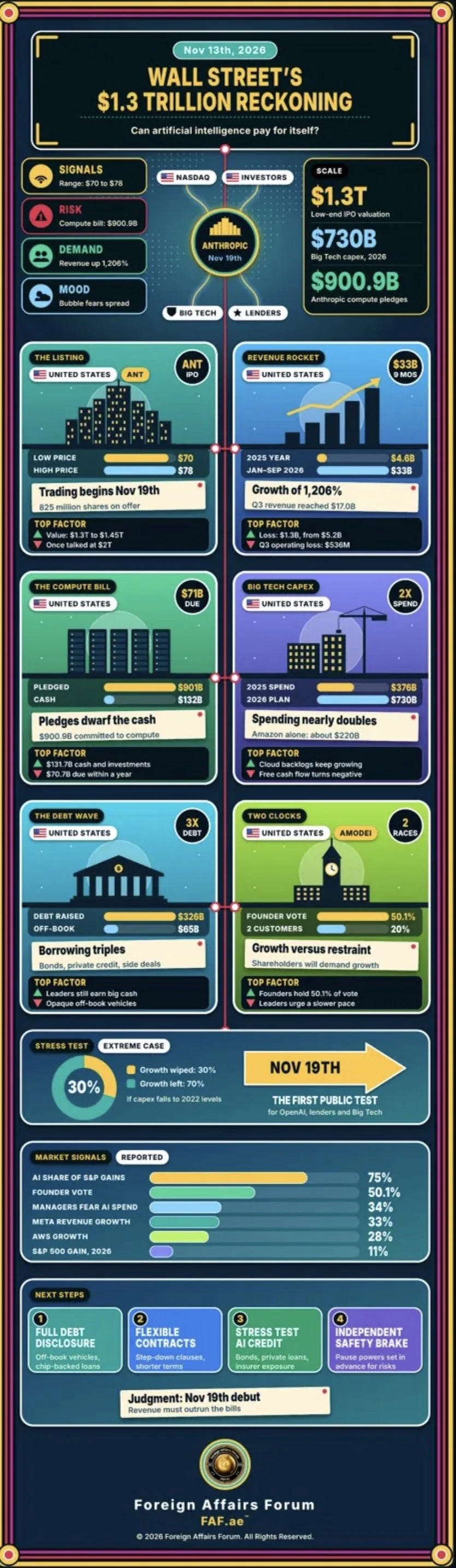
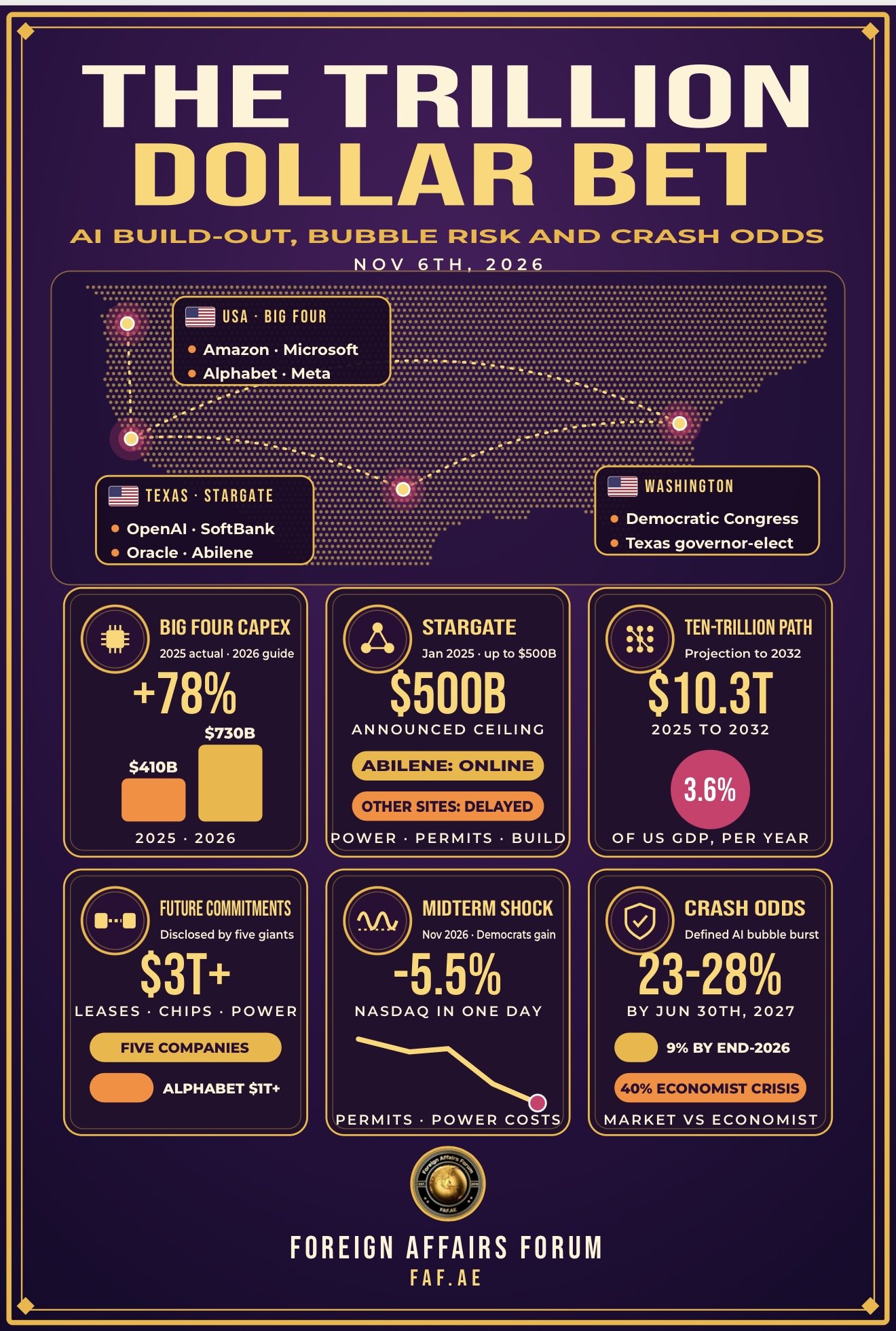
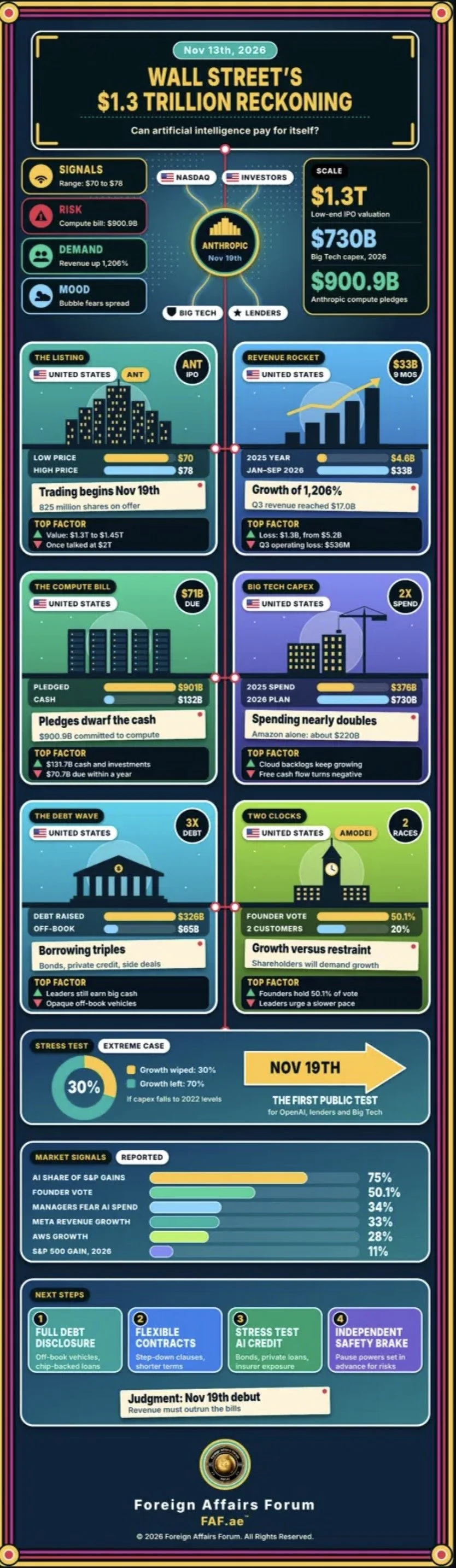
Per FAF analysis, the five largest American spenders are on course to invest roughly $730 billion in capital projects in 2026, almost double the $376 billion they spent in 2025. Much of that money now comes from outside capital instead of retained earnings.
Microsoft, Alphabet, Amazon, Meta and Oracle raised a combined $326 billion in debt in 2026, triple the prior year's amount. Free cash flow has turned negative at several of them, and bond investors are buying insurance against their defaults for the first time in a generation.
Anthropic's listing arrives into this landscape. The company expects to sell 825 million shares priced between $70 and $78, implying a market valuation of $1.3 trillion to $1.45 trillion, well below the $2 trillion once discussed. Its prospectus shows genuine commercial traction and a large forward bill. Anthropic has committed about $900.9 billion to compute and infrastructure, $70.7 billion of it due within a year. Revenue is exploding, and so are the obligations.
The central question is whether revenue can climb fast enough to service the commitments before credit markets, power grids or investor patience run out. FAF analysis finds the answer is neither a clear yes nor a clear no. Demand is real and concentrated in a few strong firms. The financing structure, however, is fragile, opaque and increasingly circular. A second timeline matters as much as the financial one. Public shareholders will push for growth at the moment some developers are asking for caution on capability.
Dr. 🆎, a specialist in human-centered superintelligence and AI warfare and bioterrorism risk, warns that markets price speed while security requires restraint. The next two quarters will show which instinct prevails.
Introduction
Every technological boom reaches a moment when its promoters must show the arithmetic. For the AI boom, that moment is November 2026. Wall Street spent two years rewarding almost any announcement of larger spending. Per FAF analysis, the mood has changed. Observers note that the market has started asking the question out loud, after two years of not wanting to. The occasion is the first public listing of a pure-play frontier AI developer.
Dr. Antonio Bhardwaj (Dr. 🆎), CEO of the Foreign Affairs Forum and a polymath whose work spans human-centered superintelligence, geopolitical strategy, AI warfare and bioterrorism risk, frames the issue as a collision of two clocks. The first is the financial clock, which counts quarters, bond maturities and the time until a lender demands repayment. The second is the capability clock, which counts how quickly systems become powerful enough to alter warfare, biology and statecraft.
Dr. 🆎 argues that the two were once loosely coupled and are now bound together, because the capability race is financed by the same capital markets that are beginning to demand returns.
Anthropic's prospectus makes the coupling visible. The company tells prospective buyers that its decision-making may run counter to investors' expectations. It also warns that forward investments may seem irresponsibly large at first glance. Few issuers volunteer such language. It reads as an admission that the strategy being sold requires patience on a scale public markets rarely grant. The company is seeking both capital and a tolerance for losses that equity markets have historically withdrawn when sentiment turns.
This FAF article examines the question in stages. It traces how the boom was built, sets out the latest facts from the prospectus and from the hyperscalers, and maps the causal chains that link spending, debt, revenue and risk. It then sets out the steps that policymakers, lenders and developers should consider, and offers a judgment on whether the boom can pay for itself.
History and Current Status
The present cycle began with a simple observation: scaling computation produced capability. From late 2022, that observation turned into a capital programme. Hyperscalers bought accelerators in quantities that made one chipmaker the world's most valuable company. Developers signed compute contracts running years into the future. Through 2025, the logic held. More spending produced more cloud revenue, and the largest firms financed it from operating cash flow.
The financing model began to change in 2025 and broke decisively in 2026. AI-related infrastructure debt accounted for nearly 30% of all net issuance in the US investment-grade corporate bond market in 2025. In 2026, borrowing moved from a supplement to a foundation. Amazon, Alphabet, Nvidia, Meta, Oracle and SpaceX issued a combined $182 billion in investment-grade bonds in the first half of 2026. Beyond the bond market, developers turned to private credit and special purpose vehicles. Hyperscalers have layered roughly $65 billion of off-balance-sheet financing on top of their bonds, most visibly Meta's $27 billion joint venture with Blue Owl.
Meanwhile, the model developers themselves became enormous. OpenAI, the pioneer, closed a funding round at an $852 billion valuation. Its 2025 financials showed $13 billion of revenue against $34 billion of costs. It once spoke of $1.4 trillion in infrastructure commitments, but has since scaled that back to $600 billion in total compute spending by 2030. Anthropic followed a steeper path. It recorded revenue of $4.6 billion in all of 2025, then raised a $65 billion Series H at a $965 billion post-money valuation on May 28th, 2026.
The current status is best described as a boom under examination. Equity markets are not in collapse. The S&P 500 had risen more than 11% for the year by mid-September, and the Philadelphia Semiconductor Index was up nearly 60%. Yet the stress is evident in the corners where leverage lives. Software shares have suffered what some traders call the SaaSpocalypse, with as much as $2 trillion erased from the S&P software index since its late-2025 peak. Credit agencies have taken notice. Fitch named an AI-driven market correction as one of two dominant near-term risks to global credit.
Dr. 🆎 describes the position as a leveraged bet on a technology that is working, financed in a manner that does not forgive delay.
Key Developments
Four developments define the autumn of 2026.
The first is the Anthropic prospectus itself. The S-1, filed on October 26th, reported $16.3 billion of revenue in the first half of 2026 against an $80.7 billion net loss. That headline loss was alarming but misleading, because $72.4 billion of it consisted of non-cash fair-value changes on convertible notes, derivative liabilities and SAFEs. The amended filing is more instructive. Nine-month revenue grew 1,206% to $33.2 billion, and operating losses narrowed to $1.3 billion from $5.2 billion a year earlier. The third quarter was uneven, however. Anthropic reported an operating loss of $536 million in the September quarter, against operating income of $974 million in the June quarter.
The second development is the repricing of the listing.
Early talk placed the valuation as high as $2 trillion. Recent market turmoil in the AI sector knocked that down significantly, and the amended terms imply $1.3 trillion to $1.45 trillion. Trading is expected to begin on Nov 19th. The company's co-founders retain strong control, as seven of them keep 50.1% of the vote through a single Class F share. That structure shields strategy from shareholder pressure while the markets are asked to underwrite it.
The third development is the hyperscaler earnings season of late October.
Guidance revealed how large the programme has become. Amazon expects about $220 billion of 2026 cash capital expenditure, Alphabet $195 billion to $205 billion, and Microsoft about $170 billion for calendar 2026. Alphabet also warned that spending will increase significantly in 2027. The market reaction was sharply differentiated. Firms able to show revenue acceleration were tolerated. Others were punished, as when Meta faced pressure after lifting its spending guidance.
The fourth development is political.
In Washington, Senator Elizabeth Warren introduced the AI Bubble Transparency Act, which would force banks to disclose their debt and equity exposure to chipmakers, data centres and hyperscalers. The bill is unlikely to pass quickly, but it signals that lawmakers now regard AI financing as a question of systemic stability, not merely corporate strategy. Beside it stands the industry's own call for restraint. Anthropic's chief executive, Dario Amodei, and other AI leaders have urged companies to slow the rate of advancement to allow time to address risks. Investors read that call as a potential speed limit on the very capex boom they have priced in.
Dr. 🆎 observes that this is the first time a developer's safety agenda and its financing story have been placed side by side in a single prospectus.
Latest Facts and Concerns
Begin with the revenue side, which is the strongest part of the case.
Anthropic's growth is without precedent among enterprise software firms. Quarterly revenue reached $17.0 billion in the third quarter of 2026, up 1,127% from $1.4 billion a year earlier. Its balance sheet is not thin, as it holds $131.7 billion in cash and short-term investments. At the hyperscalers, demand signals are equally strong. Google Cloud's backlog jumped to over $460 billion, and Microsoft's AI business now runs at a $37 billion annual revenue rate.
Now consider the commitments.
A balance sheet with $131.7 billion in cash faces compute and infrastructure commitments of about $900.9 billion. The gap between those figures is the entire story of the boom. It is bridgeable only if revenue continues to compound. There is also a concentration concern. Anthropic's S-1 says roughly one-fifth of its revenue came from two customers. A sudden loss of either would damage the growth narrative before it damaged the accounts.
The hyperscalers show a different weakness, which is cash.
Alphabet posted negative free cash flow of $9.1 billion in the September quarter, and Meta negative $2.1 billion in the third quarter. Amazon's trailing twelve-month free cash flow was negative $42.4 billion. When capital spending outruns operating cash, the gap is filled by savings, debt or new shares. All three are now in use. Meta launched an equity raise on Oct 26th, an unusual step for a company of its profitability.
Credit markets display the unease.
The price of insuring against corporate defaults has ticked higher, and hyperscaler bonds that traded like utilities in 2024 now attract demands for insurance. At the weaker end of the chain, stress is visible. CoreWeave's 9.75% bonds due 2031 traded near $87, a yield of 13.4%. Oracle reportedly sent a force majeure notice to Blue Owl over permitting problems at a data centre site, a reminder that a contract is worth little if the plant cannot get power on schedule.
The most delicate concern is circularity.
Nvidia's AI commitments, reported above $750 billion, have drawn scrutiny over vendor financing, in which suppliers fund customers who then buy their products. The Bank for International Settlements has warned that off-balance-sheet arrangements could leave lenders exposed to refinancing pressures at the vehicle level and procyclical shifts in private credit appetite. AI-related stocks have reportedly accounted for 75% of S&P 500 returns since late 2022, so an air pocket would not remain confined to the sector.
There is also a counter-argument that FAF analysis treats seriously. Unlike the dot-com darlings, today's leaders are enormously profitable, and the capex cycle has barely begun to produce results. Deutsche Bank and Barclays have argued that hyperscalers possess ample cash flow and that capital outlays relative to revenue are well below historical peaks. This is a sound point, and it explains why the correction has been selective instead of general.
Cause-and-Effect Analysis
The causal structure of the boom can be read as a chain of five links.
The first link is capability.
Scaling produces systems that customers will pay for, and that demand justifies more scaling.
The second link is capital intensity.
Because the leading developers believe the frontier belongs to whoever commits fastest, they sign multi-year compute contracts before the revenue exists. This converts a variable cost into a fixed obligation, and fixed obligations behave differently under stress.
The third link is financing.
When retained cash cannot cover the obligations, firms borrow. Debt introduces a clock that equity never had. If revenues dry up, mid-tier providers risk defaulting on chip-backed private loans and data centre developers may miss debt service payments. A software company can survive a bad year, but a leveraged data centre developer with a fixed coupon often cannot. Here lies the critical asymmetry. The upside accrues to the equity holders of the largest developers, while the downside accrues first to the lenders and landlords furthest down the chain.
The fourth link is valuation.
Anthropic's price reflects expectations of continued hypergrowth. At $2 trillion the company would have been valued at about 43 times its annualized second-quarter revenue. A reduction to $1.3 trillion to $1.45 trillion lowers the multiple but does not eliminate the dependence on growth. If growth merely continues rather than accelerates, the stock disappoints even as the business succeeds. This is the cruelty of a high multiple.
The fifth link is the one most easily neglected, namely the interaction of financing with capability governance.
Dr. 🆎 draws attention to the direction of causation. As developers become public companies, shareholders will demand continued growth, and the growth depends on compute. If a developer wished to slow the frontier for safety reasons, the capital structure would punish it. One investor observed in September that shareholders will demand that these companies continue to grow. In the language of AI warfare and bioterrorism risk, that means the brake and the accelerator are operated by different people.
Dr. 🆎 argues that this is a governance problem and cannot be solved by market discipline alone.
The chain also runs in reverse.
A failed or weak listing would raise the cost of capital for every developer. It would force OpenAI to reconsider its debut, which is already complicated by reports that it missed internal user and revenue targets while carrying very large compute commitments. Weaker developer demand would reduce orders at chipmakers and cloud providers. It would weaken the collateral behind data centre loans.
In a severe downturn, this could trigger a sudden asset devaluation and a liquidity freeze for private credit funds. Goldman Sachs has sketched the scale of an adverse scenario. If hyperscalers cut capital investment back to 2022 levels, roughly 30% of the $1 trillion of projected S&P 500 sales growth in 2026 would be wiped out, compressing valuation multiples by 15% to 20%.
FAF analysis concludes that the boom's fate depends on a race between two growth rates. Revenue must grow faster than the cost of servicing the commitments that revenue is meant to fund. For the strongest firms, that condition currently holds. For leveraged intermediaries, it does not yet hold with any margin.
Future Steps
Several steps would reduce the probability that a financing accident becomes a systemic event.
The first concerns disclosure.
Regulators should require consolidated reporting of off-balance-sheet vehicles, chip-backed loans and long-dated compute commitments, so that investors can see the whole obligation. The Warren bill points in this direction, and its logic does not depend on party. The Bank for International Settlements has made a similar case. Opacity is the main amplifier in any credit cycle.
The second step concerns the structure of compute contracts.
Developers and cloud providers should build in flexibility, including volume bands, step-down clauses and shorter tenors, so that obligations flex with revenue. Contracts of twenty to thirty years for a technology whose shape is uncertain in five years are a mismatch that a prudent lender should price accordingly. Lenders should also demand clearer visibility into physical delivery, because power, permitting and equipment delays can turn a good contract into a default.
The third step is for the developers.
Anthropic's listing will teach the market whether a public company can pursue long-horizon investment under shareholder scrutiny. The prospectus language about decisions that may run counter to investors' expectations should be backed by governance that makes it credible. Per FAF analysis, the most useful commitment would be an independent mechanism, answerable to something other than quarterly sentiment, with authority to slow deployment where security or safety thresholds demand it.
Dr. 🆎 recommends that such thresholds be defined in advance and tied to specific risks, including misuse in biological and military settings, so that the decision to pause is not improvised under market pressure.
The fourth step concerns the hyperscalers and the vendor-financing loop.
Suppliers that fund their own customers should disclose the arrangements and the concentration they create. Boards of the largest buyers should publish the return thresholds that justify spending at this scale. Investors have shown they will reward demonstrated returns, as in the contrasting reactions to Alphabet and Meta, and the disclosure of thresholds would make that discrimination more precise.
The fifth step is macro-prudential.
Central banks and financial stability councils should include AI-linked credit in stress tests, covering hyperscaler bonds, project finance, private credit and insurer exposure. In a Bank of America fund manager poll, 34% singled out AI hyperscaler spending as the most probable source of a systemic event, double the April figure. Supervisors should not wait for a default to treat that perception as a risk indicator.
Finally, governments that are customers and rivals have a part to play.
States that depend on AI capability for security should be cautious about assuming that private balance sheets will always underwrite it. A strategic capability financed by fragile credit is a vulnerability.
Dr. 🆎 argues that allied governments should coordinate on compute resilience, energy supply and safety standards, treating them as strategic infrastructure.
Conclusion
Can the AI boom make enough money to sustain itself? The evidence supports a qualified answer. At the level of the leading firms, the revenue is real and growing at a pace few thought possible. Anthropic's trajectory, from $4.6 billion in 2025 to $33.2 billion in nine months, is the strongest argument that demand is not an illusion. The hyperscalers' cloud backlogs point the same way.
The weakness lies in the structure rather than the technology. A programme of roughly $730 billion a year, increasingly financed by bonds, private credit and off-balance-sheet vehicles, has converted a technological wager into a leveraged one. The prospectus of the first pure-play developer to go public shows $900.9 billion of commitments set against $131.7 billion of cash. That gap is bridgeable only if growth continues without interruption. Interruptions are the normal condition of capital markets, and they come from sources that have little to do with demand, including power constraints, permitting delays and shifts in lender appetite.
The listing on Nov 19th is therefore a test of more than one company. It will show whether public investors will fund a long-horizon strategy while accepting losses, concentrated customers and founder control. It will also reveal the price at which the market now values the promise of capability. A strong debut would reopen the window for OpenAI and for the debt that depends on it. A weak one would tighten every link in the chain.
Dr. 🆎 offers the closing judgment. The boom can sustain itself if it treats its two timelines as one. A financial timeline that ignores capability risk invites a crisis of confidence, and a capability timeline set by quarterly sentiment invites a crisis of safety. Per FAF analysis, the stakeholders who will matter most in the coming year are the lenders, the regulators and the boards that choose to say no. Their willingness to slow down when the numbers or the risks demand it will decide whether this boom matures into an industry or ends as a cautionary chapter.