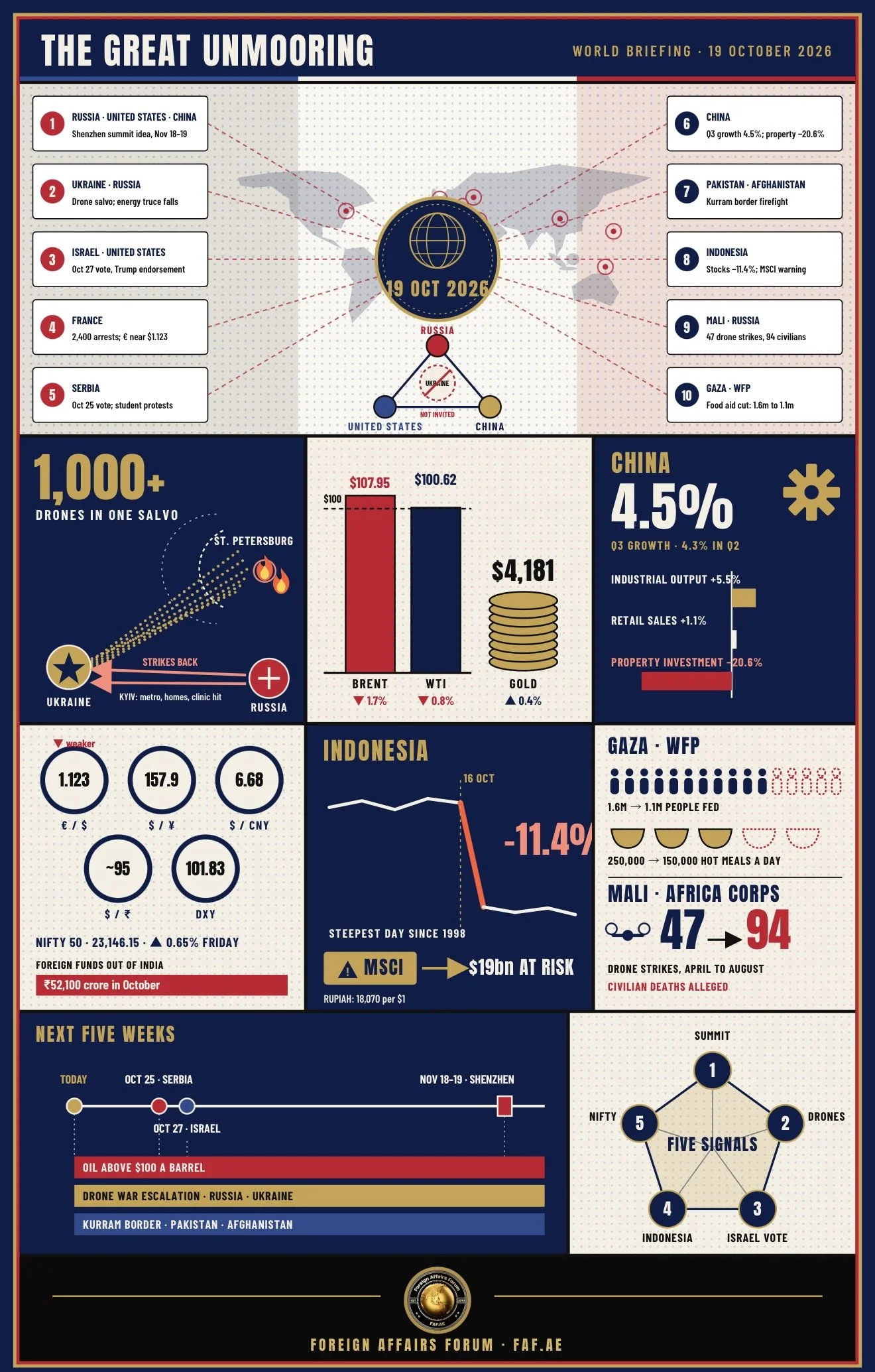
The Great Unmooring: When Drones, Debt, and Deal-Making Outrun the Rules
Foreign Affairs Forum | Dr. Antonio Bhardwaj (Dr. 🆎)| October 19th 2026
Executive Summary
The weekend of October 17th to 19th, 2026 compressed a larger truth into a few days.
The international system is being reshaped less by formal rules than by the interaction of military innovation, political fragility and financial stress.
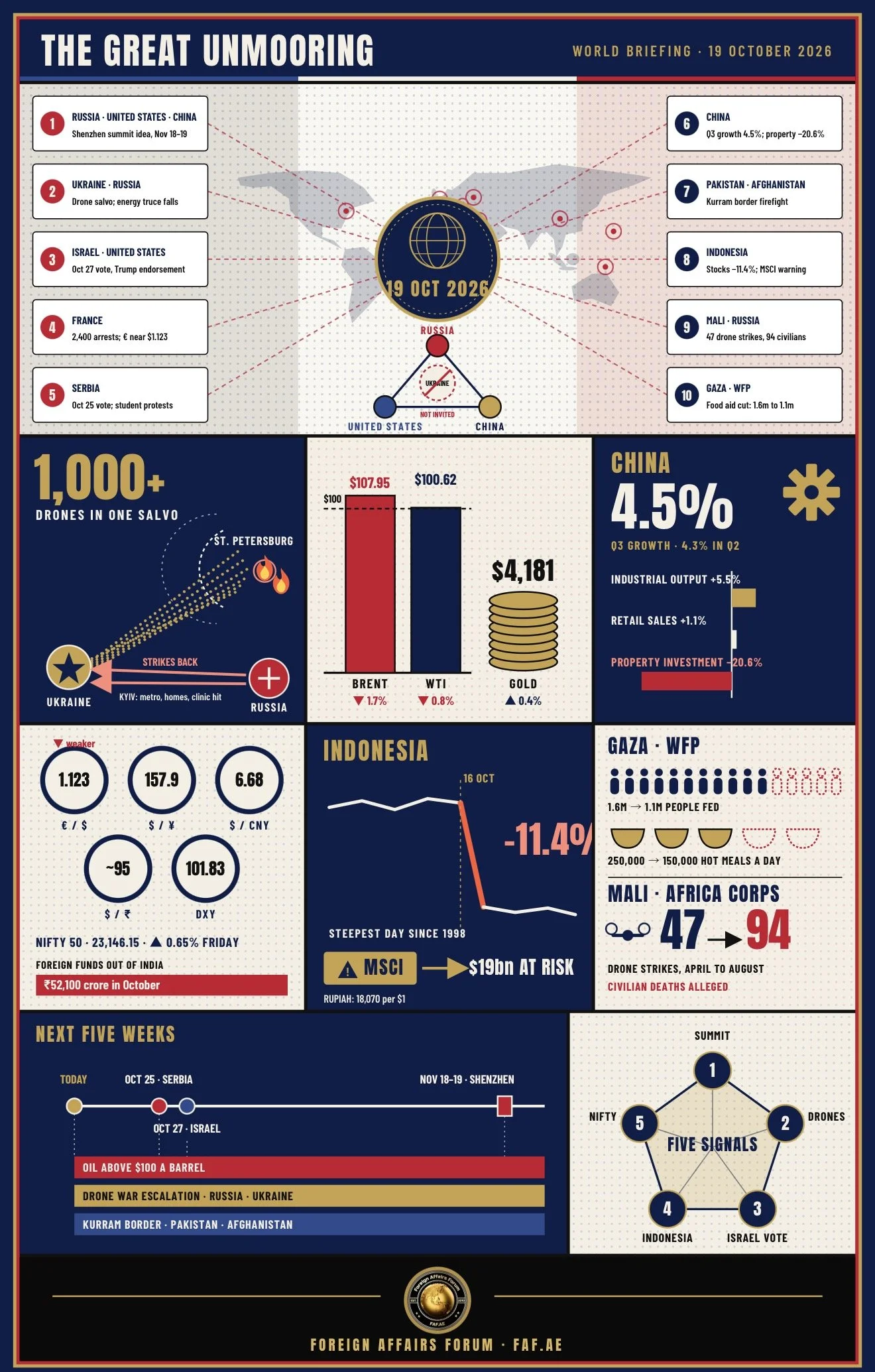
Vladimir Putin has floated a summit with Donald Trump and Xi Jinping on the margins of the APEC meeting in Shenzhen on November 18th and 19th, a format that would leave Ukraine's president at home.
Ukraine has answered with a drone offensive exceeding 1000 aircraft, Russia has retaliated against Kyiv, and the energy ceasefire that was meant to restrain both sides has effectively collapsed.
In France, more than half a million people marched against the cost of living, and the violence that followed produced approximately 2400 arrests and the country's worst civil unrest in years.
Beyond Europe, the same pattern recurs in different forms.
Indonesia's equity market suffered its steepest one-day fall since 1998, with the Jakarta Composite Index losing 11.4% after the index provider MSCI raised the prospect of a downgrade to standalone status.
Serbia approaches a parliamentary election on October 25th amid two years of student protest.
Pakistani and Afghan forces have traded heavy fire in Kurram district.
A new report alleges that drone strikes by Malian and Russian-backed forces killed 94 civilians between April and August.
The World Food Programme has cut the number of people it feeds in Gaza from roughly 1.6 million to 1.1 million.
China, meanwhile, grew 4.5% in the third quarter while its property investment fell 20.6%, a combination that sharpens trade tensions with Europe and the United States.
This FAF article argues that these developments are linked by a single dynamic.
National power now depends on the interaction of military capability, political legitimacy, industrial capacity and financial resilience, and a deficit in any one of them quickly spills into the others.
Energy prices, with Brent near $107.95 a barrel, act as the transmission belt.
FAF article concludes that policymakers must treat governance, market credibility and humanitarian capacity as components of strategy, and that the first test of that proposition comes within the next five weeks.
Introduction
Every era believes that its crises are unprecedented, and most are wrong.
Yet there are moments when the accumulated weight of separate disorders becomes visible at once, and the three days from October 17th to 19th, 2026 were such a moment.
Within 72 hours the world witnessed a proposal to settle Europe's largest war without its principal victim at the table, the largest drone salvo of that war, a major European democracy convulsed by riots, an emerging market losing a tenth of its value in a session, and a humanitarian agency forced to choose which hungry civilians to stop feeding.
No single event was decisive. Together they describe a system in which the old mechanisms of restraint are fraying faster than new ones are being built.
This FAF article does not attempt to catalogue every headline. It asks instead what the developments have in common and what that commonality implies for the months ahead. Its central claim is that the relevant distinction is no longer between hard and soft power, or between security and economics, but between states and institutions that can absorb shocks and those that cannot.
Drones that cost a few thousand dollars can disable refineries worth billions.
A single index provider's warning can erase a tenth of a national market.
A budget crisis in Paris can move the exchange rate of a continent.
The unit of analysis is therefore resilience, understood as the capacity of a political and economic system to take a blow without losing its coherence.
Dr. Antonio Bhardwaj (Dr. 🆎), a polymath with global expertise in human-centered superintelligence for geopolitical strategy, artificial intelligence in warfare and bioterrorism risk, supplies a framing that informs the analysis. "The twentieth century taught states to measure power in divisions and warheads," Dr. 🆎 observes. "The twenty-first is teaching them that power is a function of how quickly a system can sense a shock, interpret it and respond, and the states that cannot do this are being unmoored from their own commitments." The idea of unmooring, a loosening of the anchors that once held alliances, markets and institutions in place, gives this article its title and its organising logic.
The structure follows from that logic.
The next section sets out the historical background and the current position of the main stakeholders.
The sections that follow identify the key developments of the weekend, set out the latest facts and the concerns they raise, trace the causal links between them, and propose concrete next steps for governments, institutions and investors.
The conclusion returns to the question of resilience and offers a judgement on what the coming weeks will reveal.
Throughout, the article distinguishes between what has happened and what has merely been proposed, because the gap between the two is itself one of the defining features of the present landscape.
History and Current Status
The post-1945 order rested on three assumptions that are now under strain.
The first was that great powers, however hostile, would negotiate within institutions that recognised the sovereignty of smaller states.
The second was that economic integration, managed by trusted regulators and reserve currencies, would discipline political behaviour.
The third was that conventional military power would remain expensive, concentrated in a few hands and therefore predictable.
Each assumption produced a set of institutions, from the United Nations Security Council to the global index providers, from central banks to humanitarian agencies, whose authority depended on the continued credibility of the underlying premise. When the premise weakens, the institution is left exposed.
The war in Ukraine, now in its fifth year, has tested all three assumptions at once. Russia's invasion in 2022 broke the first by treating a neighbour's sovereignty as negotiable.
The sanctions regime that followed tested the second, demonstrating that financial integration could be weaponised but also that it could be circumvented.
The evolution of the battlefield tested the third, as cheap drones and autonomous systems eroded the advantage of expensive platforms.
By autumn 2026 the war had become a contest of industrial endurance and technological improvisation, with both sides striking at each other's energy infrastructure and with Western support repeatedly interrupted by political calculation in Washington.
The Middle East has followed a parallel trajectory.
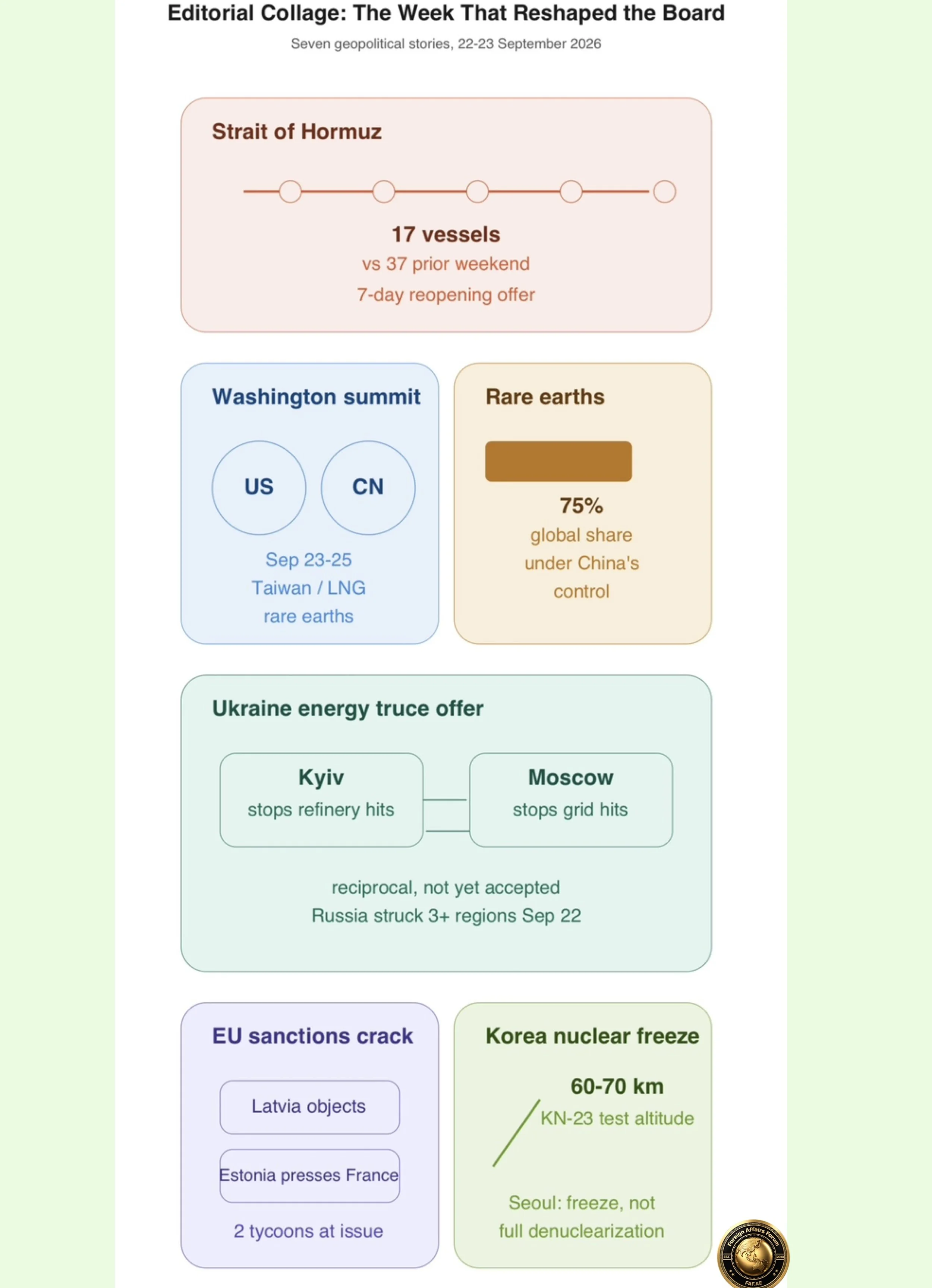
The war on Iran, which began with strikes on February 28th, 2026 and disrupted traffic through the Strait of Hormuz, pushed oil and gas prices sharply higher and strained relations between Washington and Jerusalem.
Gaza remains dependent on humanitarian assistance under ceasefire arrangements that have not produced a political settlement. Israel now heads to an election on October 27th with its governing coalition at risk of losing its majority.
These regional crises feed directly into the global economy through the price of energy, which has remained above $100 a barrel for much of the year and which now conditions the fiscal position of importing states from France to India.
Domestic political fragility has become the third strand of the story.
France entered the autumn with public debt close to 119.3% of gross domestic product, a deficit well above the European ceiling of 3%, a fragmented National Assembly and a presidency in its final year.
Its 2026 budget passed in February only through constitutional powers and after surviving no-confidence motions. Serbia has endured almost two years of student-led protest against alleged corruption.
Indonesia has been grappling with questions about the transparency of its capital markets. In each case, the underlying problem is the same: a gap between what citizens or investors expect of institutions and what those institutions can credibly deliver.
The economic picture is similarly uneven.
China's economy expanded 4.5% year over year in the third quarter, up from 4.3% in the second and above expectations, driven by industrial production, which rose 5.5% in September. Yet retail sales grew only 1.1%, and property investment fell 20.6% in the first nine months of the year.
The United States, meanwhile, faces a different tension. Technology valuations are under pressure from the enormous financing requirements of artificial intelligence infrastructure, and the ten-year Treasury yield has risen to around 5.05%.
India's equity market has been resilient, with the NIFTY 50 closing at 23,146.15 on Friday, but foreign portfolio investors have withdrawn approximately ₹52,100 crore from Indian equities in October.
The current status, then, is one of simultaneous strain across military, political and financial domains.
Oil stands near $107.95 for Brent and $100.62 for WTI, both slightly lower on Monday morning as markets anticipated additional Russian fuel supplies following a sanctions announcement whose implementation remains uncertain.
Gold has risen to around $4,181 an ounce, reflecting demand for safe assets. The dollar index is near 101.83, and the € has weakened to roughly $1.123.
These figures are not merely market data. They are the pulse of a system in which every shock finds an amplifier, and in which the margin for error has narrowed considerably.
Key Developments
The first development, and potentially the most consequential, is Putin's proposal for a three-power summit with Trump and Xi alongside the APEC meeting in Shenzhen.
According to reports, Moscow suggested the gathering as a vehicle for ending the Ukraine war, with Volodymyr Zelenskyy excluded from the format.
The Kremlin has acknowledged preliminary discussions, but no summit has been agreed and Washington has not committed to attend.
The significance lies in the principle at stake.
A meeting of three major powers to determine the future of a fourth country, without its participation, would revive a style of diplomacy that the post-1945 order was designed to prevent. It would also hand Beijing a role as architect of European security that it has not previously held.
The second development is the escalation of the drone war.
Over the weekend Ukraine launched an exceptionally large drone offensive against Russia, and Russian authorities reported intercepting more than one thousand aircraft. Strikes caused fires at petroleum facilities around St. Petersburg.
Russia retaliated, and an overnight attack on Kyiv killed a woman, injured three people and damaged a metro station, residential buildings and a medical facility.
Zelenskyy also announced that Washington had resumed sharing the intelligence needed to detect Russian missile launches after a temporary interruption.
The recently announced energy ceasefire, which had raised hopes of mutual restraint against power and fuel infrastructure, has effectively collapsed, and the scale of the exchange suggests that neither side believes restraint is in its interest.
The third development is Trump's endorsement of Benjamin Netanyahu ahead of Israel's election on October 27th.
The endorsement follows months of disagreement between Washington and Jerusalem over the Iran war and the broader regional conflict.
Polling suggests that Netanyahu's coalition could lose its parliamentary majority, although the opposition may also struggle to form a government.
The intervention raises familiar questions about the influence of foreign leaders on domestic elections, and it complicates the outlook for Gaza, Lebanon, Iran and Israel's relations with Gulf governments.
An Israeli government committed to continued confrontation with Tehran would sustain the geopolitical premium that is already embedded in oil prices.
The fourth development is the civil unrest in France.
More than half a million people took part in demonstrations across the country against rising living costs and declining public services.
The protests united former yellow vests, students, teachers, trade unionists, farmers and climate activists, and they were overwhelmingly peaceful.
Yet in Paris, Marseille, Lyon and other cities, violent groups attacked town halls and prefectures, looted shops and burned property.
Authorities have reported approximately 2400 arrests, more than 150 injured police officers and two deaths, one officer and one protester.
Emmanuel Macron appealed for calm and promised prosecution of those responsible but stopped short of declaring a state of emergency.
The € weakened to roughly $1.123 as investors assessed the political risk.
The fifth development is economic.
China's third-quarter growth of 4.5% exceeded expectations, and industrial production rose 5.5% in September, but the composition of growth is troubling.
Retail sales rose only 1.1%, and property investment has fallen 20.6% so far this year. Beijing's industrial strength thus coexists with weak household demand, a pattern that tends to produce surplus capacity and export pressure.
European and American complaints about overcapacity are likely to intensify, and commodity markets will feel the effect, since stronger manufacturing supports demand for copper and aluminium while weak property investment limits construction-related consumption.
The sixth development is the cluster of crises in what might be called the governance periphery.
Pakistani and Afghan Taliban forces exchanged artillery and small-arms fire in Kurram district after Islamabad said militants had tried to enter Pakistan from Afghanistan, though casualty figures remain unverified.
Indonesia's stock market suffered its steepest one-day decline since 1998 after MSCI raised the possibility of reclassifying the country as a standalone market, with the Jakarta Composite Index falling 11.4% and the rupiah weakening toward 18,070 to $1.
In Serbia, Aleksandar Vučić held a major rally in Novi Sad ahead of the October 25th election, while international observers voiced concern about intimidation and fairness.
In Mali, a new report alleged that 47 drone strikes between April and August killed 94 civilians.
The seventh development is humanitarian.
The World Food Programme announced that funding shortages have forced it to reduce the number of people receiving assistance in Gaza from approximately 1.6 million to 1.1 million, with food rations reduced and daily hot meals cut from roughly 250,000 to 150,000.
The announcement comes as winter approaches and much of Gaza's population remains dependent on aid. The cut illustrates a structural problem.
Humanitarian systems built for emergencies are being asked to sustain populations through protracted crises, and donor fatigue is eroding their capacity just as the political settlement that might make them unnecessary remains distant.
The eighth development is financial and cuts across all the others.
American technology markets continue to face concern about the capital intensity of artificial intelligence infrastructure, and semiconductor shares fell sharply last week, though futures suggested a partial recovery on Monday, with S&P 500 contracts up about 0.7% and Nasdaq contracts up about 1.0%.
The ten-year Treasury yield eased toward 5.05% as oil prices dipped. In India, the NIFTY 50 and the SENSEX were broadly flat in early trading after Friday's gains, while the rupee traded around ₹95 to $1 with support from central bank intervention. Against the ¥ the greenback stood near 157.9, and against the yuan near 6.68.
Latest Facts and Concerns
The latest facts, assembled from the weekend's reporting, deserve to be stated plainly.
In Europe, the proposal for a three-power summit remains a proposal. No date, venue or agenda has been agreed, and Washington has made no commitment.
In Ukraine, the volume of drones launched and intercepted is unprecedented, and fires at petroleum facilities have been reported near St. Petersburg.
In France, official tallies of arrests have risen to approximately 2400, and the government has so far declined to invoke emergency powers.
In Indonesia, the rupiah is near record lows and analysts have raised the possibility of as much as $19 billion in outflows if the downgrade proceeds, though that remains a scenario rather than an actual withdrawal.
The first concern is the exclusion of Ukraine from any settlement.
A negotiation among Moscow, Washington and Beijing that excluded Kyiv would establish a precedent that smaller states could be disposed of by larger ones.
Even if the summit never takes place, the proposal signals Russia's preferred model of diplomacy and tests Washington's willingness to endorse it. For European governments, the prospect is alarming.
A settlement perceived as unfavorable to Ukraine would raise questions about the credibility of security guarantees and would probably accelerate European defence spending, at a moment when several European economies, France foremost among them, face fiscal constraints.
The second concern is the changing character of warfare.
A salvo of more than one thousand drones is no longer an exceptional event but an indicator of how cheaply precision strikes can now be mounted. Dr. 🆎 argues that this trajectory has consequences well beyond Ukraine. "When autonomous and semi-autonomous systems can be built from commercial components and launched in the thousands, deterrence by cost imposition collapses," Dr. 🆎 warns. "The relevant question is no longer who has the best aircraft but who can detect, classify and intercept at the speed and volume of the threat, and that is as much a software and data problem as a hardware one." The same logic applies to Mali, where drone strikes have allegedly caused heavy civilian casualties, and to the growing risk of incidents near NATO territory.
The third concern is the fragility of European political legitimacy.
France is managing the largest civil unrest in years while carrying substantial public debt, a fragmented legislature and a presidential election in 2027.
The markets have noticed. Bond spreads over German benchmarks have been elevated for weeks, and French government bonds and European banking shares now deserve particular scrutiny.
The danger is a prolonged confrontation between fiscal constraints and demands for greater public spending, a confrontation that no government has yet found a way to resolve. A weakened France would also weaken European cohesion on defence, Ukraine and industrial policy, precisely when those commitments are most needed.
The fourth concern is the vulnerability of emerging markets to governance judgements by private institutions.
Indonesia's experience demonstrates that an index provider's concerns about transparency, ownership structures and market integrity can trigger a collapse in confidence within hours. The episode illustrates how financial-market governance has become a geopolitical vulnerability.
A country that depends on foreign capital for investment in nickel, coal and palm oil, and that seeks to preserve strategic autonomy between great powers, cannot afford a prolonged loss of market credibility. The episode may also redirect capital toward other emerging markets, including India, although broader risk aversion could offset any gain.
The fifth concern is humanitarian and, in a wider sense, biological.
The reduction of food assistance in Gaza as winter approaches raises the risk of malnutrition and disease among a population already weakened by conflict.
Dr. 🆎 draws attention to a dimension that is often neglected in strategic analysis. "Degraded public health systems, crowded shelters and interrupted nutrition are precisely the conditions in which epidemic risk rises, and they are also the conditions that malicious stakeholders seek to exploit," Dr. 🆎 notes. "Biosecurity begins with basic humanitarian capacity, and a world that lets that capacity erode is lowering its own defences against both natural and deliberate outbreaks."
The sixth concern is the interaction between energy prices and financial conditions.
Brent at roughly $107.95 and WTI near $100.62 impose heavy burdens on importing economies, and the combination of expensive energy, high financing costs and enormous artificial intelligence capital expenditure is a significant risk for technology valuations. India faces a particular vulnerability, since sustained expensive oil threatens its current account and the rupee, and foreign portfolio investors have already withdrawn approximately ₹52,100 crore this month. The easing of oil prices on Monday, partly in anticipation of additional Russian fuel supplies after a sanctions announcement, offers temporary relief, but the announcement's implementation remains uncertain and could reverse quickly.
Cause-and-Effect Analysis
The first causal chain runs from military innovation to strategic vulnerability.
Cheap drones have lowered the cost of striking energy infrastructure, and energy infrastructure is the foundation of both military capacity and civilian welfare. When Ukraine's drones set fire to petroleum facilities near St. Petersburg, the immediate effect is operational, but the larger effect is on markets, since refined-fuel supply can be disrupted even when crude production continues.
When Russian strikes damage Kyiv's metro station and residential buildings, the immediate effect is human, but the larger effect is on the political will of both societies. The collapse of the energy ceasefire demonstrates that restraint agreements are fragile when the cost of violating them is low and the potential gain is high.
The second chain runs from great-power transactionalism to institutional erosion.
If Putin's summit proposal advanced, the effect would not be limited to the Ukraine war. It would signal that the major powers are prepared to settle regional conflicts among themselves, which would encourage other states to seek similar arrangements and discourage smaller states from investing in multilateral institutions.
Beijing would gain diplomatic influence over European security, Washington would be tempted to trade commitments for concessions, and Europe would be compelled to decide whether to build its own defence capacity or adapt to a settlement made without it.
Dr. 🆎 describes this as the privatisation of the international order. "When the great powers negotiate among themselves about the fate of others, multilateralism becomes decorative," Dr. 🆎 says.
The third chain runs from energy prices to domestic instability.
Expensive oil raises the cost of fuel, transport and food, and it falls hardest on households with the least room to adjust. In France, that pressure combined with declining public services to produce a mass protest movement, and the violence of a minority within it produced the arrests, injuries and deaths of the weekend.
The French government cannot easily respond with more spending, because its deficit is already above European limits and its borrowing costs are rising. It cannot respond with austerity either, because austerity provoked the protests. The result is a politics of permanent constraint in which every concession is too small to satisfy citizens and too large to satisfy markets.
The fourth chain runs from political instability to financial repricing.
The weakening of the € to roughly $1.123 on Monday reflects investor concern about French political risk, and the attention paid to French government bonds and European banking shares reflects the transmission mechanism. If bond spreads widen, French banks holding sovereign debt suffer losses, which tightens credit and weakens growth, which in turn worsens the fiscal position.
The same logic applies in Indonesia, where a threatened downgrade produced an immediate collapse in the equity market and a sharp fall in the currency. In both cases, the speed of the market reaction exceeded the speed of any plausible policy response, which is the essence of the unmooring described in the introduction.
The fifth chain runs from industrial strength to trade conflict.
China's third-quarter growth of 4.5%, driven by manufacturing, demonstrates considerable industrial resilience, but the weakness of household consumption and the fall in property investment mean that growth depends heavily on exports and state-directed investment. When a country produces more than its own consumers can absorb, the surplus must go abroad, and importing economies respond with tariffs and anti-dumping measures.
European manufacturers face additional competitive pressure, American complaints about overcapacity will intensify, and countries such as India face the dual effect of stronger Chinese demand for metals and stronger Chinese competition in manufactured goods.
The sixth chain runs from fiscal fragility to humanitarian retreat.
The reduction of World Food Programme assistance in Gaza is a consequence of funding shortages, and funding shortages are a consequence of competing demands on donor budgets.
Governments struggling with energy costs, defence spending and domestic unrest have less capacity to finance humanitarian assistance, and the result is a ratchet in which each crisis crowds out the response to the last. The effect on global security is indirect but real.
Deteriorating living conditions increase instability, complicate political reconstruction and affect perceptions of Western diplomatic leadership across the Middle East and the Global South.
The seventh chain runs from technological ambition to financial risk.
The enormous capital requirements of artificial intelligence infrastructure have inflated technology valuations, and those valuations are sensitive to interest rates and energy costs.
With the ten-year Treasury yield near 5.05% and oil above $100, the financing of data centres and semiconductor capacity becomes more expensive, and the sharp fall in semiconductor shares last week reflects investor recognition of that fact.
Dr. 🆎 observes that the strategic stakes extend beyond markets. "Artificial intelligence capacity is now an element of national power, and a financing shock that slows its development is a security event as well as a financial one," Dr. 🆎 argues, "because it changes the balance of capability between the states that can afford the investment and those that cannot."
Future Steps
The first priority is to keep Ukraine inside any diplomatic process that decides its future.
European governments should make clear, in concert with Kyiv, that no settlement negotiated without Ukrainian participation will be treated as legitimate, and they should be prepared to offer a credible alternative framework if the proposed summit advances.
That means identifying, before the Shenzhen meeting, the terms on which Europe would support a ceasefire, the security guarantees it would help to provide, and the sanctions relief it would be willing to consider.
Washington's decision to resume the sharing of missile-warning intelligence is welcome but should be placed on a more durable footing, since interruptions of this kind undermine the confidence of every partner.
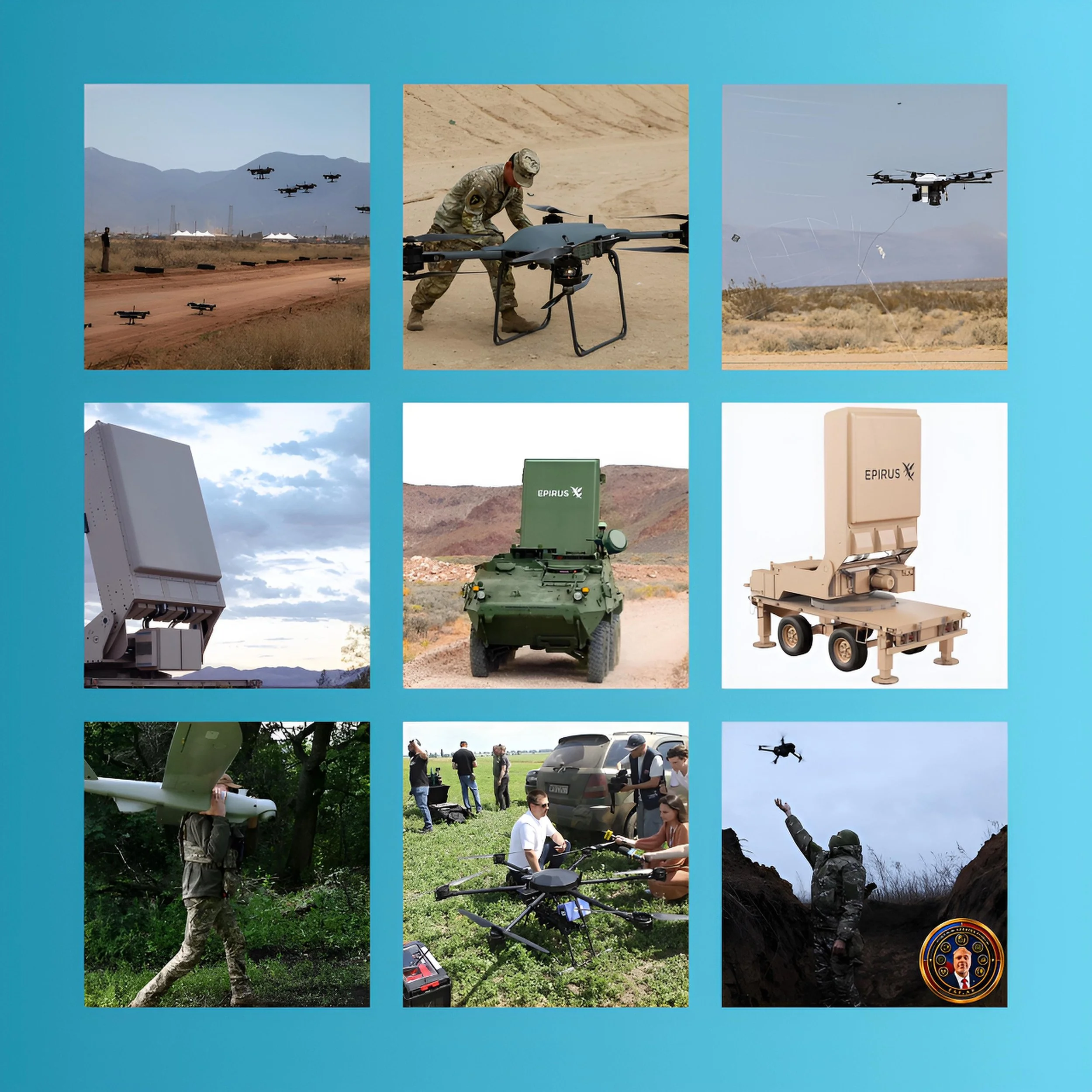
The second priority is to build defences against mass drone attack.
Western governments should invest in layered detection, interception and resilience, including hardening of energy infrastructure, and they should draw on Ukrainian operational experience.
Dr. 🆎 recommends a human-centred approach to the use of artificial intelligence in defence. "Systems that classify and engage threats at machine speed must remain subject to meaningful human judgement on proportionality and civilian protection," Dr. 🆎 urges, "and the standards for that judgement should be negotiated internationally before the next generation of autonomous weapons arrives, not after." The allegations of civilian deaths in Mali show what happens when such safeguards are absent, and they should prompt independent investigation and accountability.
The third priority is to stabilise the French political and fiscal position.
The government should present a credible package that distributes the burden of adjustment fairly, protects essential public services and offers targeted support to households most exposed to energy prices. It should pair that package with a commitment to prosecute violence firmly while maintaining proportionality and transparency in policing.
The main political parties should seek an agreement on basic fiscal parameters before the presidential campaign, so that the budget does not become a weapon in the contest. European institutions have an interest in helping, through flexibility on energy support and coordination on defence and industrial policy, since a prolonged French crisis would weaken the entire European project.
The fourth priority is to strengthen financial-market governance in emerging economies.
Indonesia's authorities should address the concerns raised by MSCI on transparency, ownership structures and market integrity, and should engage index providers and investors before further deterioration.
More broadly, governments that depend on foreign capital should treat regulatory credibility as a component of national security. International financial institutions can support that effort through technical assistance and, where necessary, liquidity facilities. Investors, for their part, should distinguish between short-term market reactions and structural changes, and should avoid reflexive withdrawal that turns a manageable adjustment into a crisis.
The fifth priority is to restore humanitarian capacity.
Donor governments should recognise that the reduction of food assistance in Gaza is a strategic as well as a moral failure, and should restore funding before winter deepens the crisis. Reconstruction financing and political settlement cannot succeed on a foundation of hunger.
Dr. 🆎 emphasises the preventive logic. "Investment in nutrition, sanitation and primary health care is the cheapest form of biosecurity and the cheapest form of stability," Dr. 🆎 argues. "States that cut it to save money in one budget cycle will pay many times over in the next." The same principle applies in the Sahel, where insecurity disrupts agriculture, transportation and investment, and where sustainable security requires winning the confidence of civilian populations.
Conclusion
The central lesson of October 19th, 2026 is that national power increasingly depends on the interaction of military capability, political legitimacy, industrial capacity and financial resilience.
A state may possess formidable forces and still be destabilised by a collapse in market confidence. It may enjoy industrial strength and still face trade conflict because its domestic demand is weak. It may hold a position of diplomatic leadership and still lose it if humanitarian systems fail.
The events of the weekend, taken together, demonstrate that these domains are no longer separable, and that weakness in one becomes vulnerability in all.
Five indicators deserve close attention in the coming weeks: whether the proposed summit with Trump and Xi advances; whether the drone escalation causes lasting energy disruption in Russia and Ukraine; whether Israel's election on October 27th changes the regional diplomatic outlook; whether Indonesia can address the concerns behind its potential downgrade; and whether India's equity markets sustain their recovery while oil remains above $100.
Serbia's election on October 25th and the continuing situation in France will test the credibility of European governance. None of these questions will be answered quickly, but the answers will shape the strategic landscape for years.
Dr. 🆎 offers a final judgement that captures the moment. "The unmooring is not yet a collapse," Dr. 🆎 concludes, "but it is a warning that the anchors of the post-war order can no longer be taken for granted, and that the work of rebuilding them must begin before the next shock, not after it." For policymakers, the challenge is to protect national security without allowing geopolitical competition to undermine economic stability.
For investors, it is to separate noise from structure. For citizens, it is to demand institutions capable of absorbing the blows that this decade is certain to deliver.